Archive for the ‘Uncategorized’ Category
I don’t know if its Facebook or WordPress’ fault but the picture that comes up when I post the blog link isn’t the one that appears on my Facebook Timeline. Can anyone help me stop this?

On 13th February we attended a lovely evening at the Lighthouse in Poole entitled ‘Yet another evening with Rick Wakeman’ Just the man himself and a piano, this proved to be a wonderful evening showcasing his fantastic keyboard skills as he played a series of pieces depicting various times in his life.

Musician, composer, TV personality, raconteur and comedian, Rick told stories about the recording of ‘Morning Has Broken’ with Cat Stevens, his time with Yes, describing singed Jon Anderson as ‘I have never known someone who cares so deeply about the planet whilst living on a totally different one’ and what happened when his mother took all the inhabitants of an old people’s home to see one of his extravagant rock concerts.

Over a month later on the 15th March we visited the BIC to see the lovely and very talented Paloma Faith in concert. Her music was wonderful (although I found the sound mix to be a bit strong on the treble for my ears) but what really grabbed my attention was the support act ….

…. I had never heard of California band Vintage Trouble before (although I have seen singer Ty Taylor performing with Paloma on the Jools Holland Show). The musicians played excellent blues and rock style but Ty Taylor stole the show, if you shut your eyes you could believe you were listening to James Brown or Otis Redding. His energetic act took him all over the stage and indeed all over the auditorium. He returned to perform an Aretha Franklin song with Paloma during the main set.

Stupidly I didn’t take my camera so these shots were taken on my phone. This was particularly annoying as we had great seats just behind the mixing deck free from other people’s heads. Here Ty Taylor, Rick Barrio Dill, Nalle Colt and Richard Danielson line up to be photographed by and with the fans.

In the second half Paloma Faith did a great set on her white art deco stage, complete with a ten piece band (most of whom are hiding in this shot).

And here dances with her backing singers.

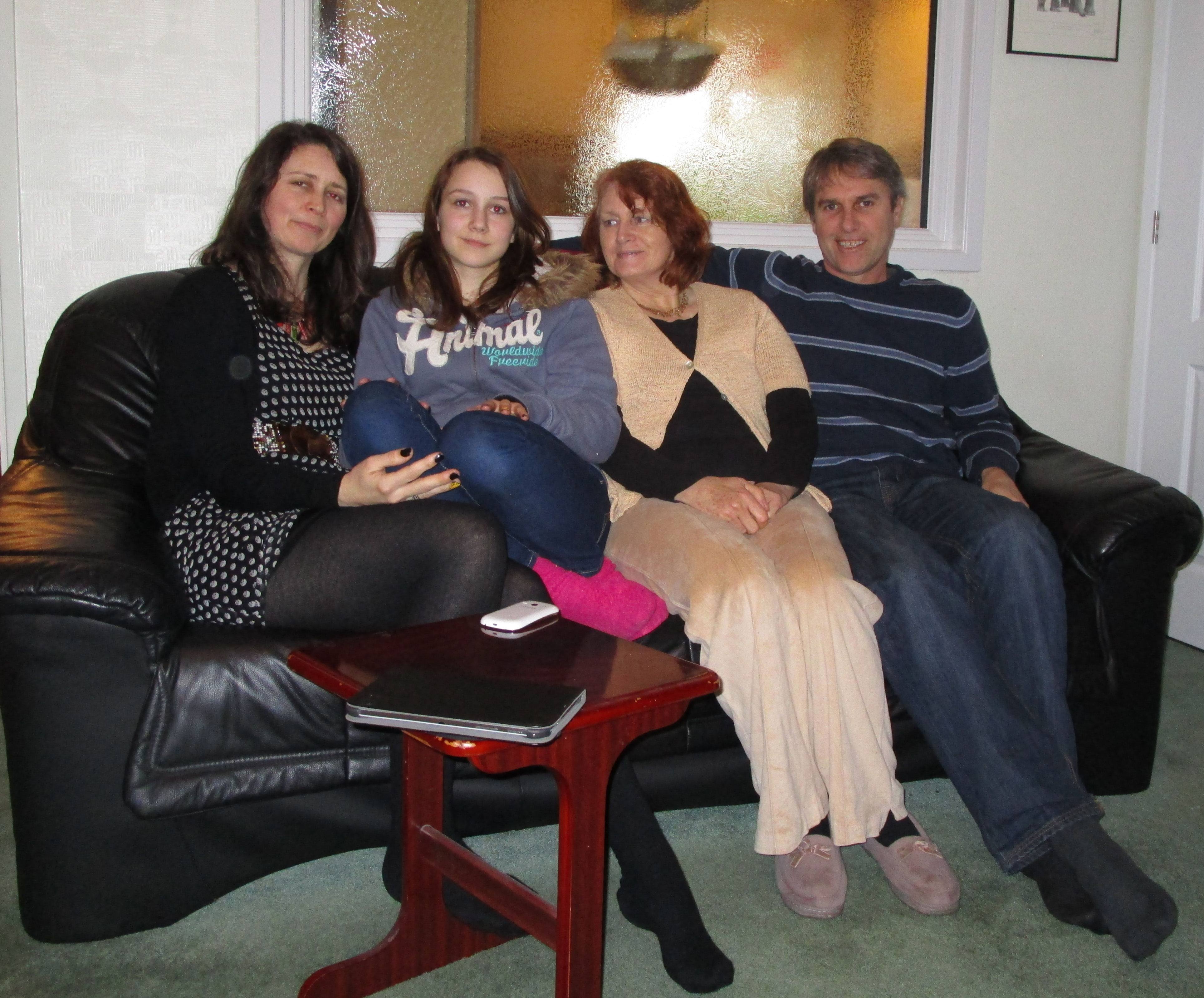
Some family news. Our granddaughter Amber is still working in Essex and living with her aunt and uncle Anita and John. She came back to Dorset for a week and paid us a visit or two. As those of you who have visited us might notice, we have had all the doors and some internal windows in the house replaced recently which gives it a much brighter look.

John and Anita also paid us a visit on the way back from visiting friends in Weymouth and Kara popped in too. Coincidently it was Mother’s Day so that was a nice treat for Margaret.
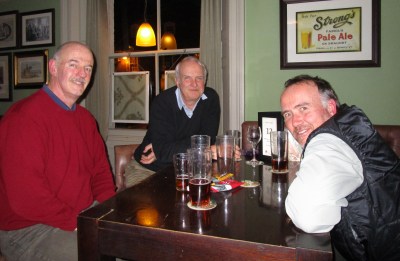
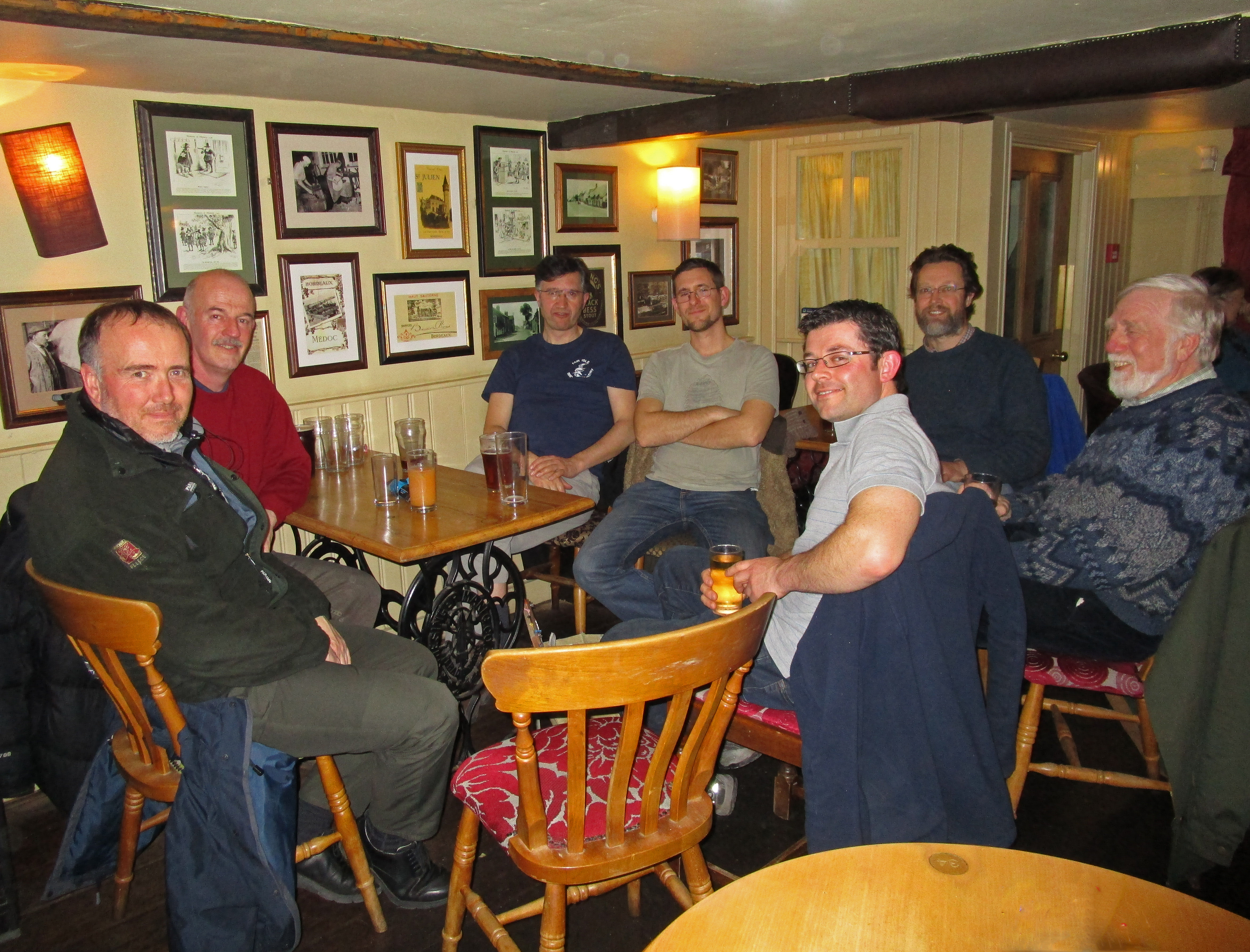
In the last fortnight I have had a reunion with an old friend and had to say goodby to some new ones. Alan Martin, treasurer and one of the leading ringers in Stour Ringing Group up to 1996, was back in Dorset on business so three of us joined him for a drink in Wareham on 13th. L-R Bob Gifford, Alan Martin and Ian Alexander

We were all back in a pub in Wareham (well nearby Stoborough to be precise) on the 17th to say farewell to two members of the ringing group. Simon Breeze, a warden at Durlston is leaving for a new job in Somerset and Mick Cook has decided to retire from ringing due to other commitments. L-R Ian, Bob, Shaun Robson, Simon Breeze, Mike Gould, Sean Walls and Mick Cook. We wish them both well but manning the ringing site at Durlston without their input and their expertise is going to be a challenge .
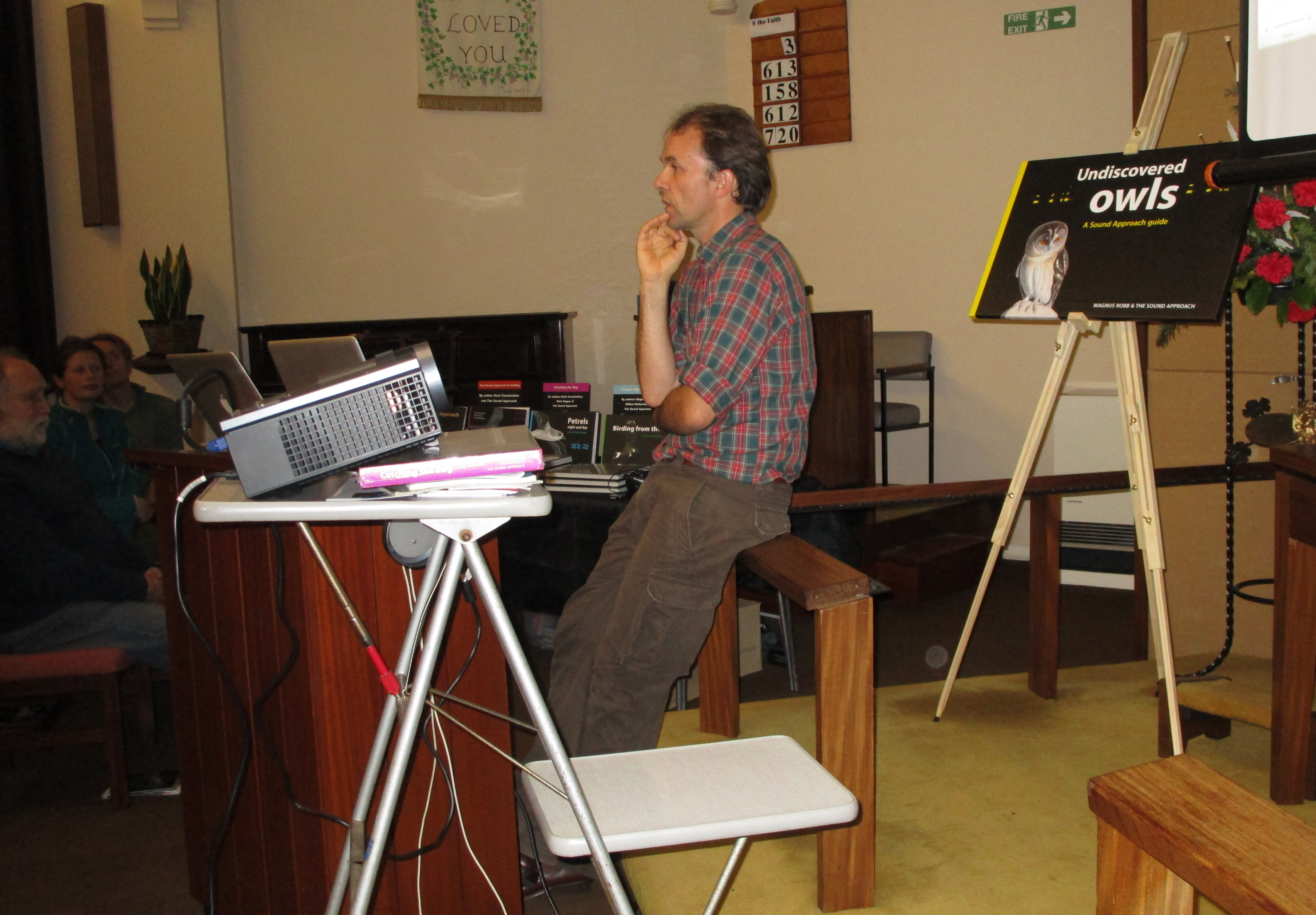
On 18th it was back to Wareham again, this time for the AGM of the Dorset Bird Club which we held in the Methodist church. The Club had looked like it was in danger of folding but thanks to a very generous offer from the Birds of Poole Harbour charity, Marcus Lawson has been employed for two years to take the Club forwards. After the AGM we had a fascinating talk from Magnus Robb on the new Sound Approach book ‘Undiscovered Owls’. We heard some of the wonderful sound recordings (the one of a Ural Owl was so atmospheric), were informed about Magnus’ discovery of the Omani Owl and learned about how the Little Owls over much of Europe, North Africa and Asia are not Little Owls at all , but a separate species they are naming the ‘Cucumeow’. It was one of the most entertaining and informative talks I have ever been to.

Magnus answering questions after his talk on Undiscovered Owls. It looks like this book is going to be of an even higher standard than the four the Sound Approach has produced already. See http://soundapproach.co.uk/product/undiscovered-owls/ for details including a pre-publication discount offer.
On the morning of the 20th there was the long-awaited partial eclipse of the Sun. It was going to be about an 88% coverage of the Sun by the Moon but that would have been spectacular enough. However there was thick cloud in our area and all we noticed was a drop in light levels and temperature. Fortunately I have seen several partial eclipses and a total eclipse, although the latter only briefly. In August 1999 I took a flight from Hurn airport specifically to see the total eclipse. We flew SW of Cornwall to the area of totality. Views through the aircraft windows were good but not excellent, because in spite being in a window seat as soon as I had seen it I had to duck down to let the other two passengers in my row have a view and because almost immediately the pilot had to turn the plane around to let the other side have a chance. As a result views of totality were restricted to a few seconds. One of the most memorable things was watching the shadow of the Moon race across the clouds towards us leaving a dark purple stain in its wake.

Although far better shots can be seen on the internet I have uploaded a scan of this photo which was taken from the cockpit of the 1999 charter flight and was delivered as print to all the passengers. It has been on my sideboard for the last 16 years and has faded some what. This along with it being taken though an aircraft’s window explains the poor quality.
And finally I delayed posting this entry until after our Ringing Group’s AGM on the 22nd. I thought it would be nice to have a photo of all of us together, well 13 out of the 16 of us actually. The evening went well and we made lots of plans for the future, sorted out a few issues and awarded the ‘Stoate Award’ for the worst paperwork entry of the year, but after the meeting had broken up I realised I had forgotten to take any photos. We have managed to go three years since the last AGM (does that make it a TGM?) so it might be 2018 before I have a chance to do that again.
The Phoenix organisation, to which Margaret and I are members, advertised a charter flight from Bournemouth to Tromsø in arctic Norway that joined a three night trip on board one of Hurtigruten’s cruise ships. Although I had been to arctic regions four times before and seen most of its wildlife it had always been in summer with its 24 hour daylight and so had never seen the aurora borealis or northern lights as it is generally known now. The Gulf Stream keeps the waters off northern Norway ice-free throughout the winter and indeed makes this area about 20c warmer than it should be for this latitude.
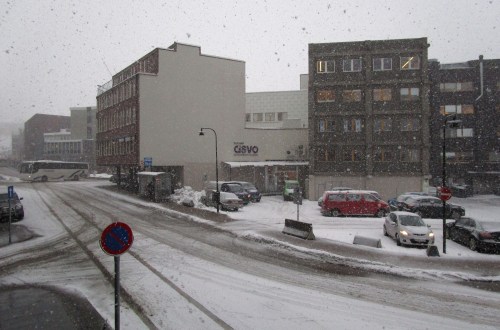
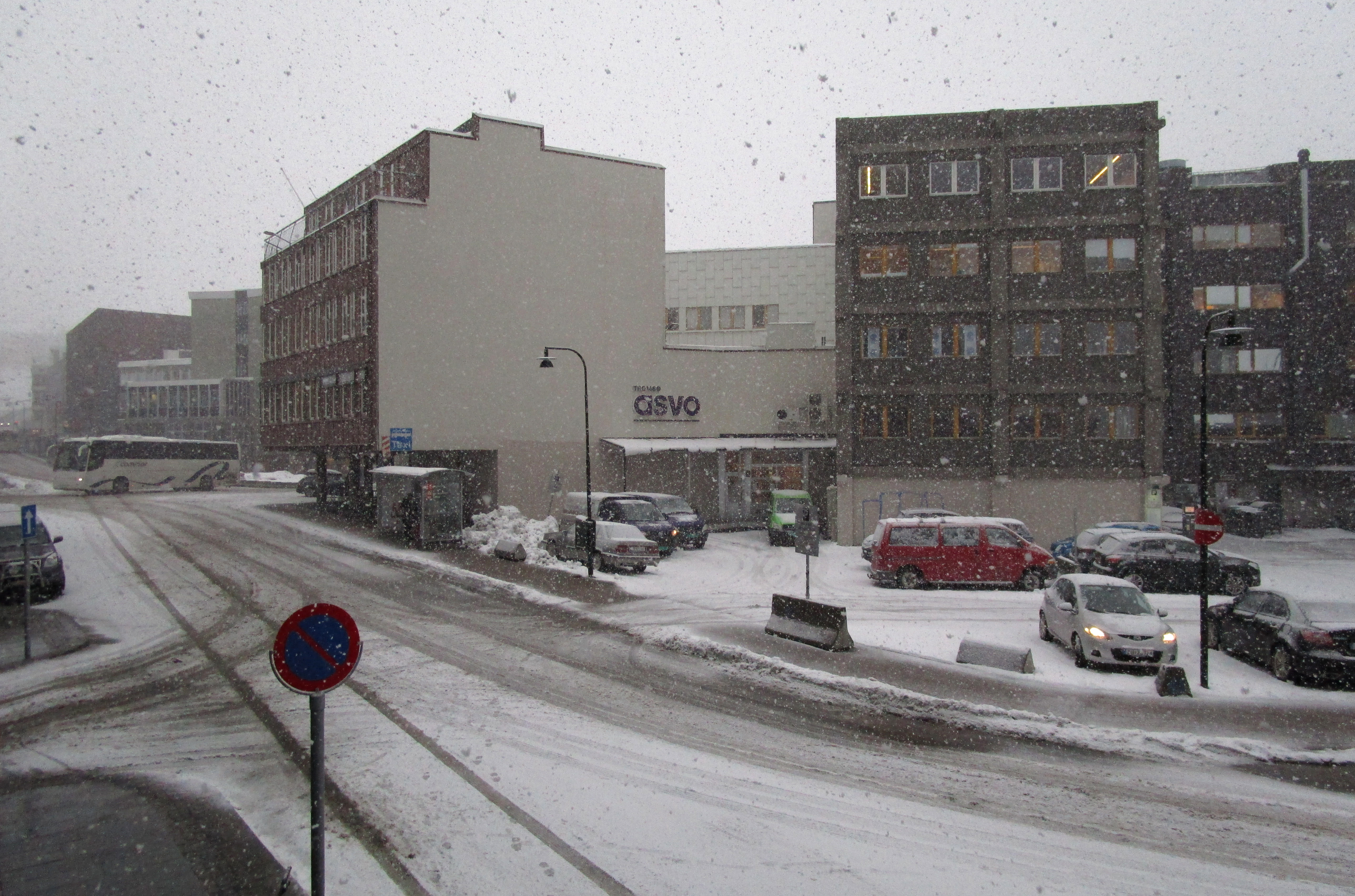
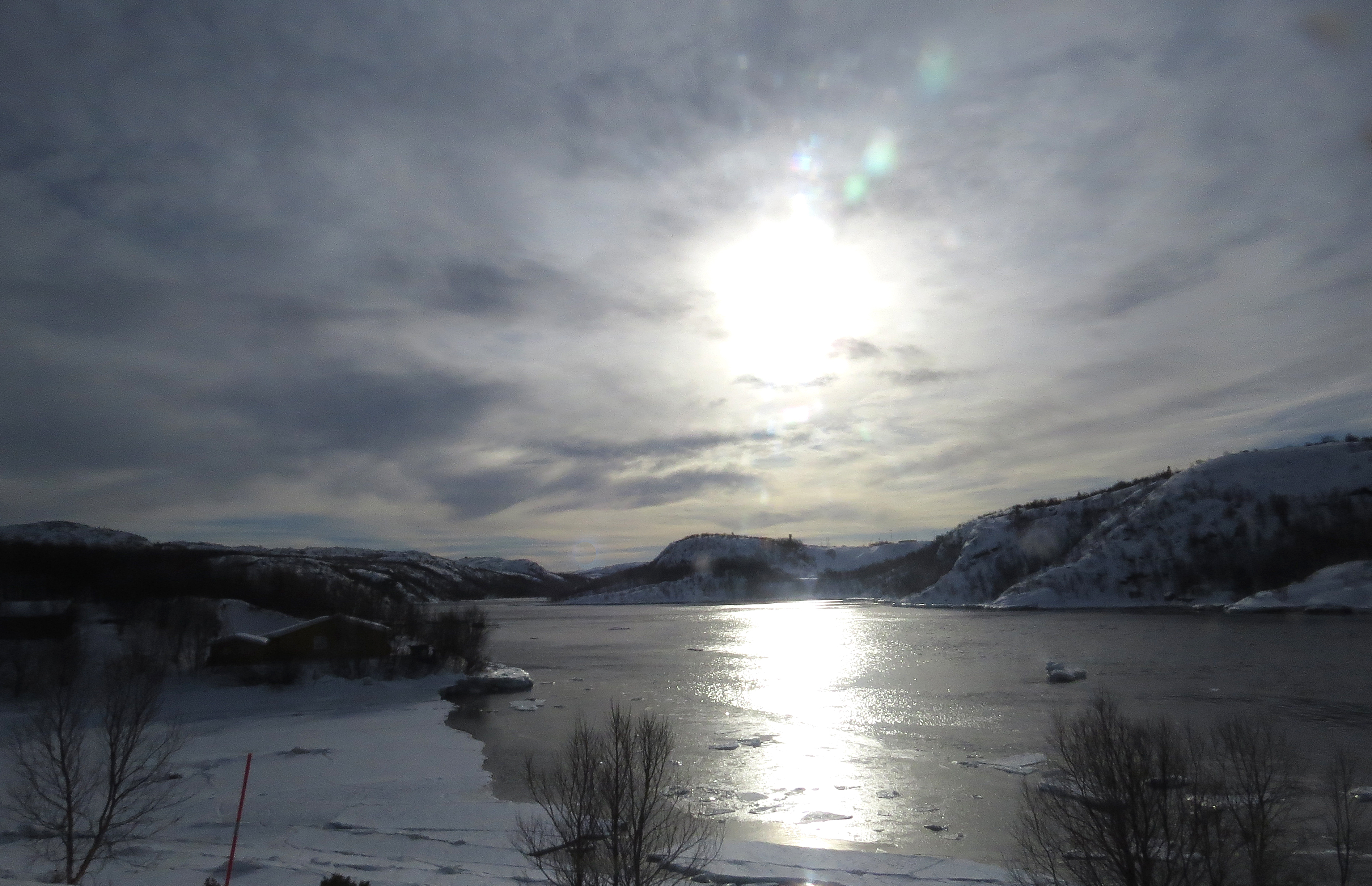
We arrived at Tromsø to very mild conditions. It was raining and 6c. Not what you would expect at nearly 70N in March. The heavy snow seen in this photo was taken on our return five days later.

The following day most of the group opted to try dog sledding at a centre some 30 minutes out-of-town.
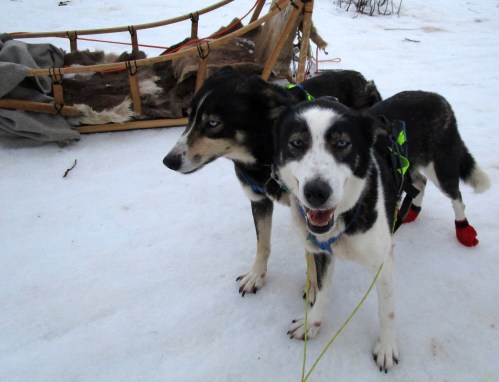
Quite contrary to my belief, these huskies were mild-tempered and docile.

And the puppies were quite adorable (and obviously were excused sled pulling activities).
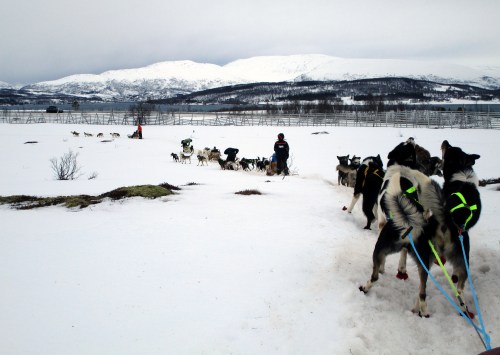
I have never seen dogs so eager to perform as these. They would strain at the leads whenever the brake was on and leap forwards the moment it was released. A few of the sleds got caught up in small trees or overturned so there was a bit of delay. We were out for an hour and it was pretty exhilarating.
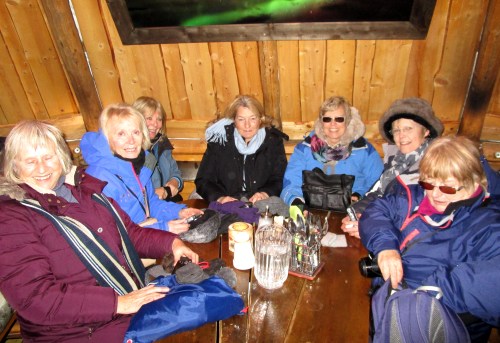
Most of the rest of the Phoenix group. Only Davril and Margaret stayed behind. Yes, I did go on holiday with nine women.

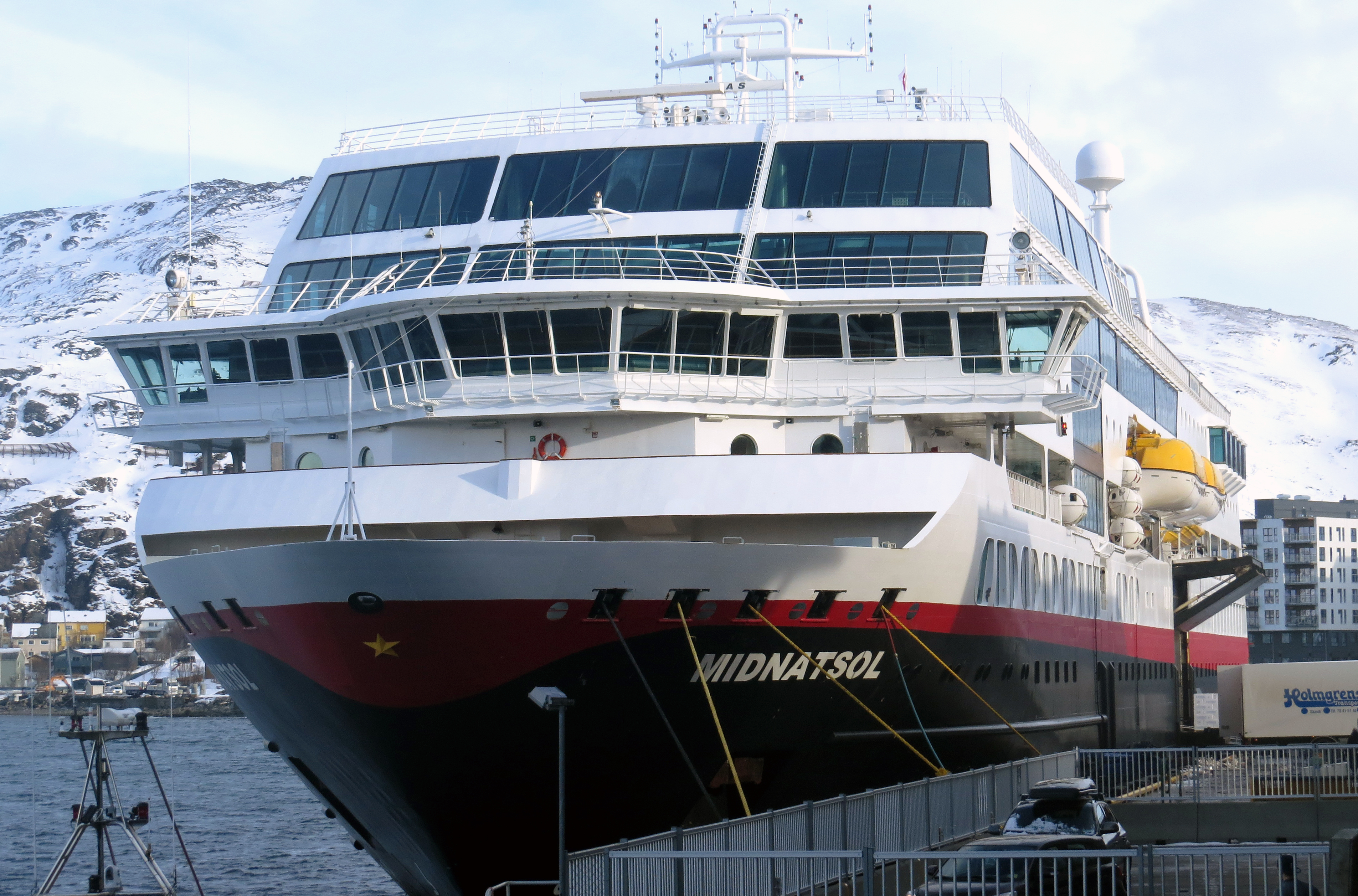
In the afternoon we boarded the MS Midnatsol which sailed at 1800.
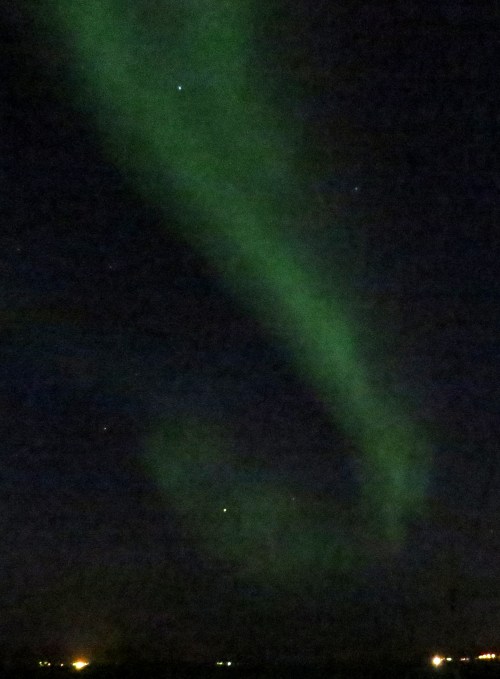
Of course the main reason for coming on this trip was to see the aurora. It runs on an 11 year cycle with this year being at or just after the peak. Even so, the display wasn’t as good as some published photos would have you believe, however those photographers can chose the best nights and best locations for their stunning panoramas.
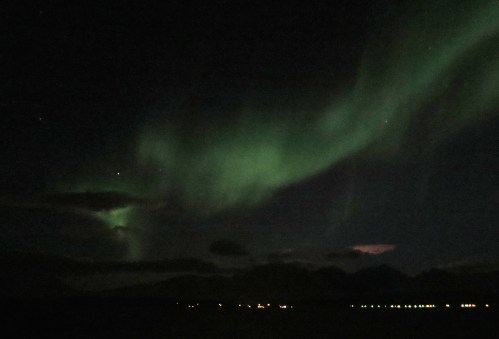
The problem I encountered was that my bridge camera wouldn’t give an exposure longer than one second. As a result I had to set it on 6400 ISO hence the grainy images. Also of course the photos were taken from a moving ship, further blurring the image.
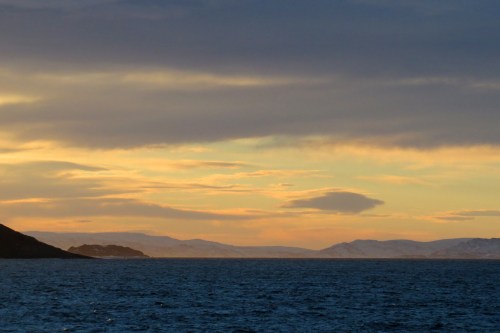
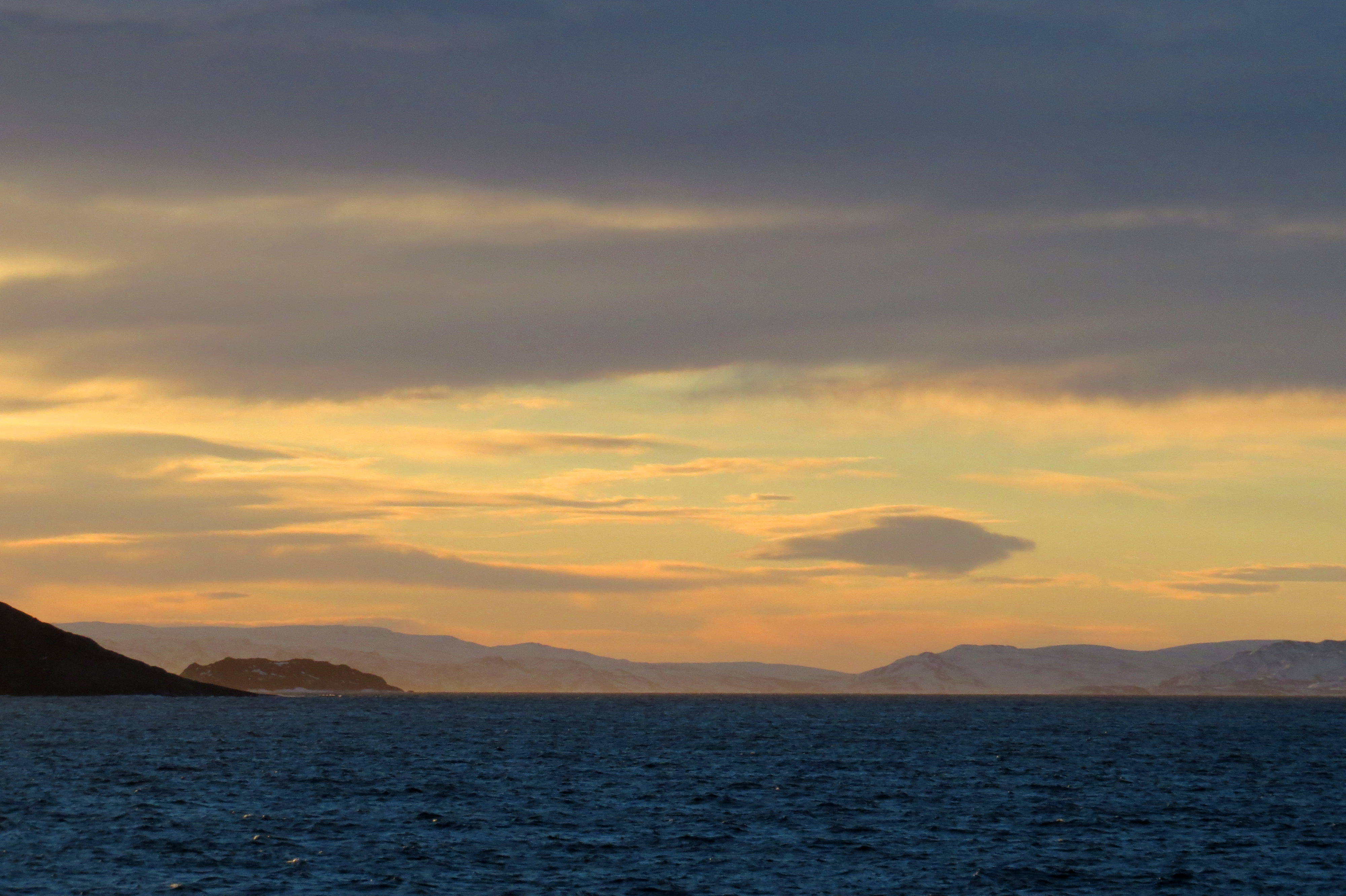
Dawn the next day saw us steaming north through the many fjords.
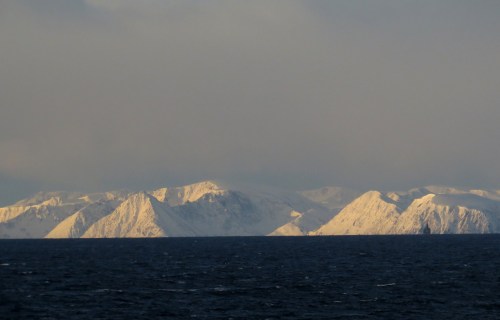
Conditions were a bit colder here and snow came down to the foreshore. Very few birds were seen except the ubiquitous Herring Gull and Kittiwake.

Late morning we called into the pretty village of Honningsvåg on the northernmost island of Magerøya.
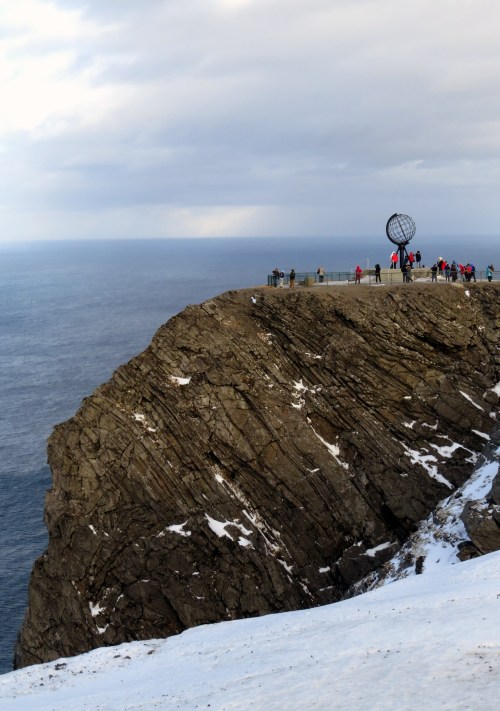
We transferred to the North Cape, generally considered at 71 10′ 21”N to be the most northerly point of Europe, although the next peninsula is 1.5km further north and of course Svalbard is nearly 1000km further still.

It was windy when we arrived but it soon got much worse. Even standing up to get your picture taken at the globe was a trial.

Things deteriorated rapidly when a hail shower driven by force 8 winds struck and caused everyone to run for the visitor centre.

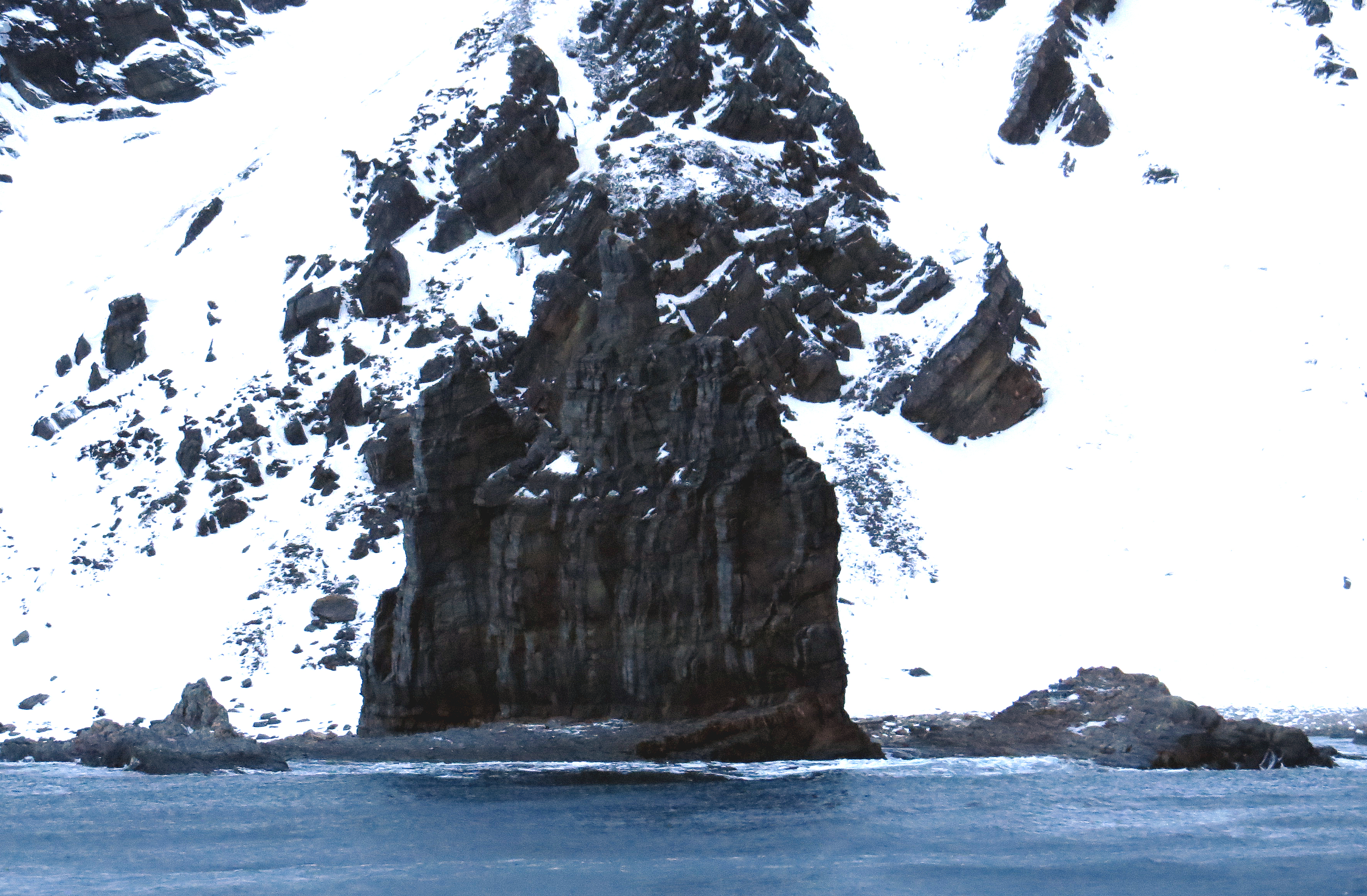
Later we cruised eastwards towards Mehamn. Here we passed a rock formation that bore a strange resemblance to a Finnish church.

It was relatively sheltered with calmer seas in the fjords.

We arrived in Varangfjord at dawn the next day. We were now as far east as Istanbul or Durban in the southern Indian Ocean.
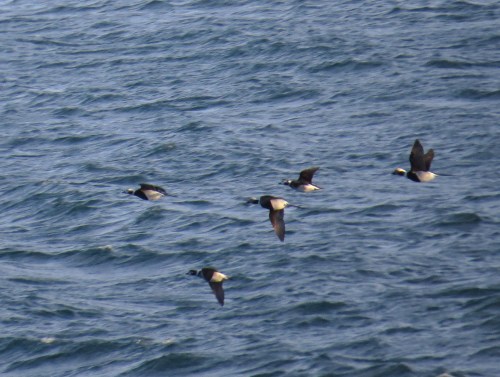
Varangerfjord is famous for its wintering seaducks. Hardy species from arctic Siberia don’t need to travel to the Atlantic coast for winter which they consider to be just for wusses. They prefer the harsher conditions of the eastward facing Vrangerfjord. The best views were in Vadsø harbour where I photographed these Long-tailed Ducks ….
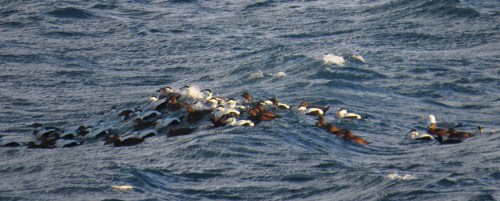
…. this raft of Common Eider ….

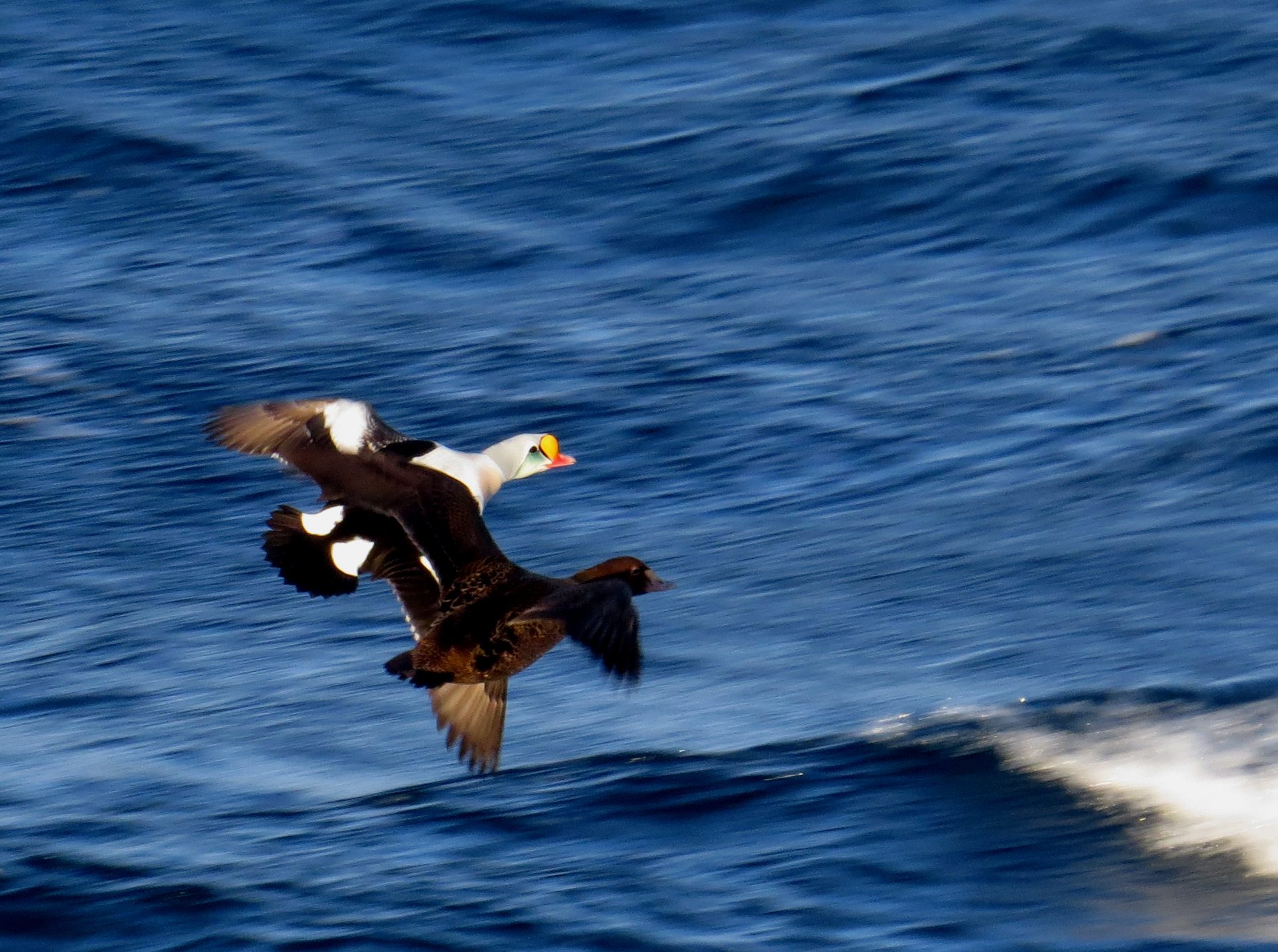
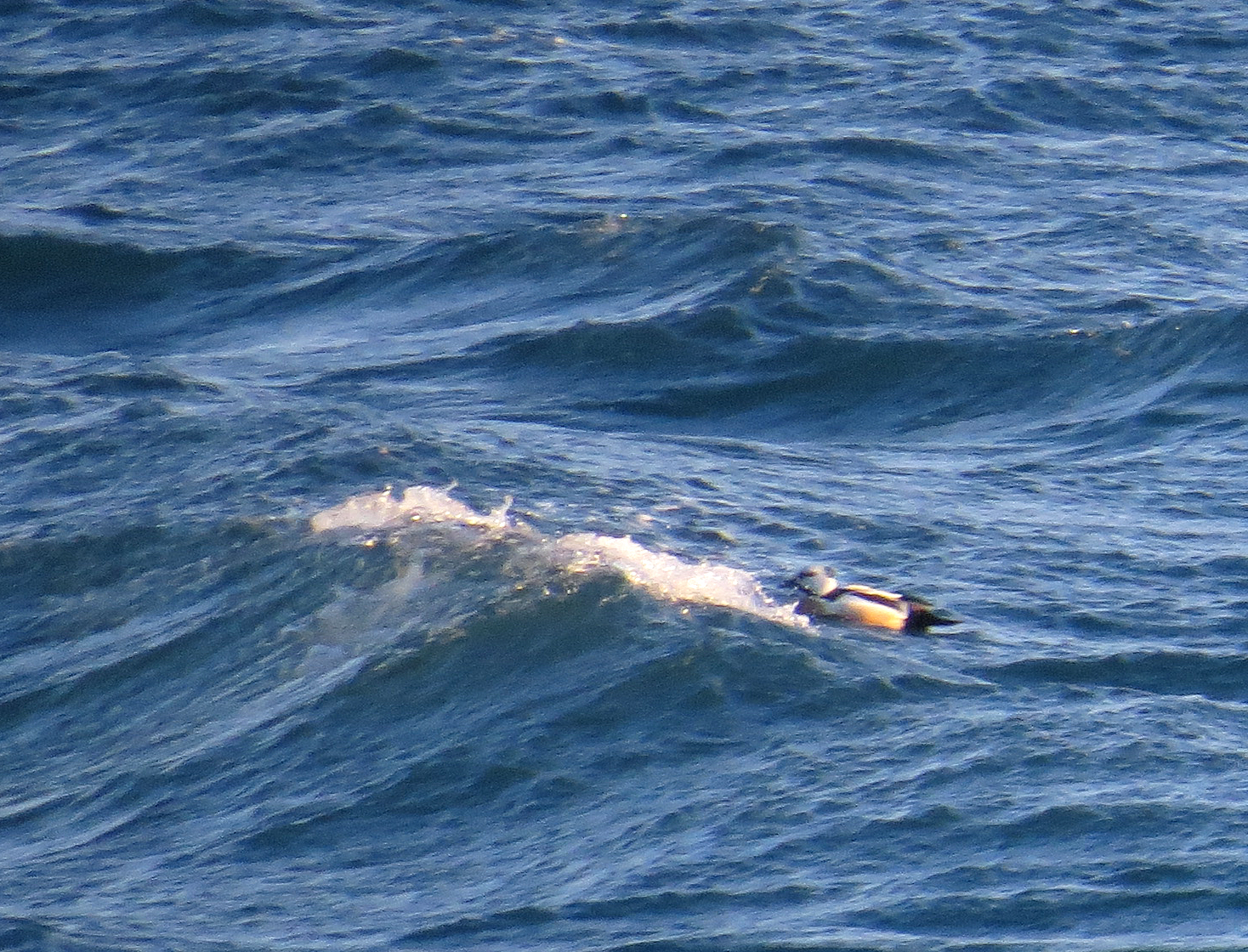
…. and the wonderful King Eider, here on the sea ….
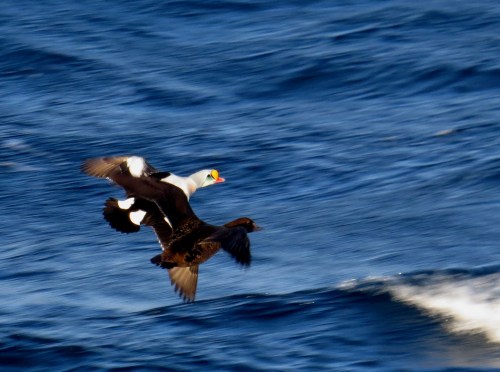
…. and here in flight ….

Best of all was the much scarcer Steller’s Eider named after Georg Wilhelm Steller, the naturalist on board Bering’s 1725 expedition across Russian searching for an eastern route to the New World. Indeed Steller became the first westerner to reach Alaska from the east.
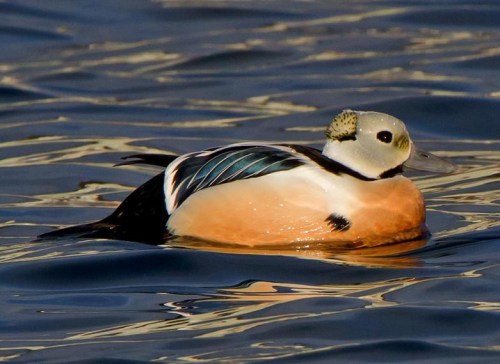
The Steller’s Eiders stayed at the back of the flock, just a bit too distant for photography, so I have copied this stunning image of a drake by M Ravasini from the Internet Bird Collection.
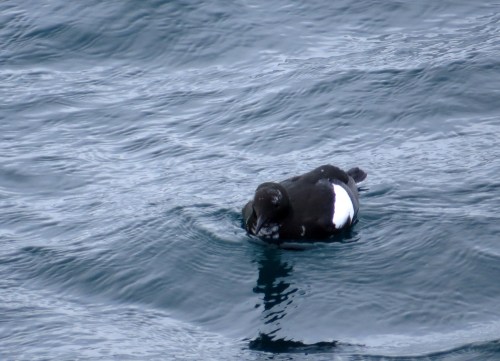
We saw few birds as we crossed Varangerfjord on our way to Kirkenes on the southern shore. The best that Kirkenes harbour could offer was this Black Guillemot moulting from its mainly white winter to it mainly black summer plumage.
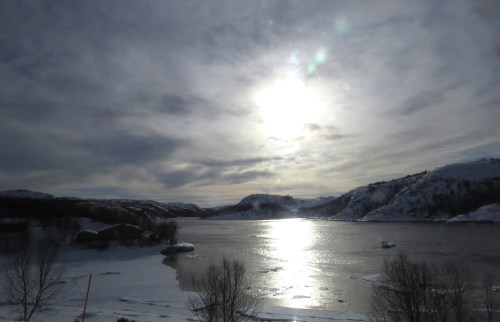
For an excursion we took a bus trip to the Russian border, mainly so we could get out of the town and see if there were any birds around. Here we are crossing the Pasvik river, proposed in the mid 19th century as the border between Russia and Norway, but Russia wanted some territory on the west bank so it could access an ancient Russian Orthodox Church. Norway managed to trade a few square km on the west bank for over a hundred on the east bank.

I have Russian visa for my trip in May but didn’t push my luck and try to cross. I’d have certainly missed the boat back to Tromsø.

We glimpsed a few birds in the Pasvik valley, a Fieldfare, a few Redpolls and a Great Tit and briefly saw flocks of Waxwings in Kirkenes, but from a birding perspective it was rather frustrating, but I was glad to visit this famous birding area as time did not permit this on my trip to Varanger in June 1987.
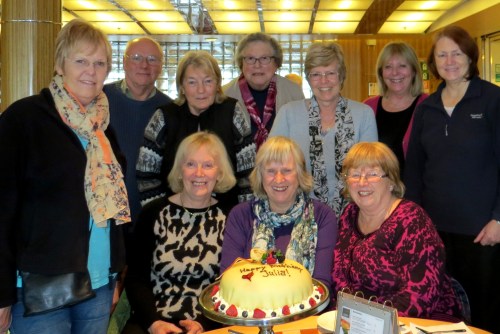
Today was Julie’s birthday and the others had arranged a cake. Bottom row L-R Sue, Julie, Linda. Top row L-R Di, me, Rosemary, Davril, Helen, Von and Margaret.

We crossed back to the north shore of Varangerfjord and sailed around the eastern side to the town of Vardø, situated on an island connected by a tunnel to the mainland. The wind increased markedly and so did the bird activity as we passed the seabird breeding cliffs of Hornøya. Identification of the many (thousands) of auks in poor light and in flight was tricky, but I thought the majority were Brunnich’s Guillemots with smaller numbers of Razorbills and even fewer Common Guillemots. King and Common Eiders abounded and I saw at least 15 Glaucous Gulls, some Gannets and a White-billed Diver. Pride of place however goes to this large pod of White-beaked Dolphins, a species I have never seen before in spite of going on dedicated boat trips to look for it.

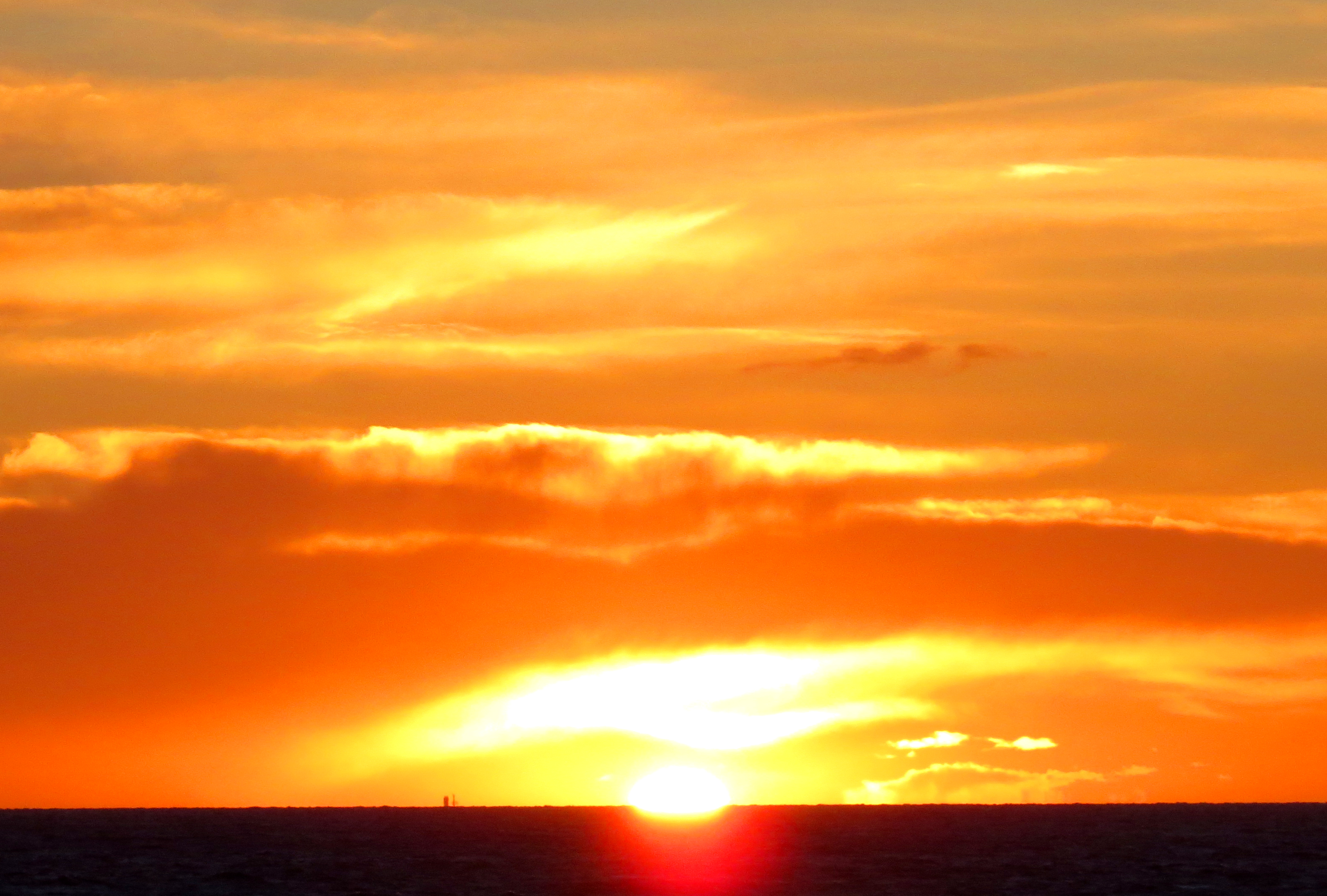
The overnight passage was quite horrendous, the wind increased to force 10 and we were sailing straight into it. That said, the boat remained remarkably stable but we had a pretty bad night’s sleep as something came loose in the roof space above us and crashed and banged with every lurch of the ship. In the late evening we went up to the top deck to see the aurora, sheltering behind the funnel from the wind and ambient light.Very dramatic, with back-lit spray billowing around and above us whilst the green fingers of the northern lights danced in the background. The following morning things had calmed considerably as this photo shows.
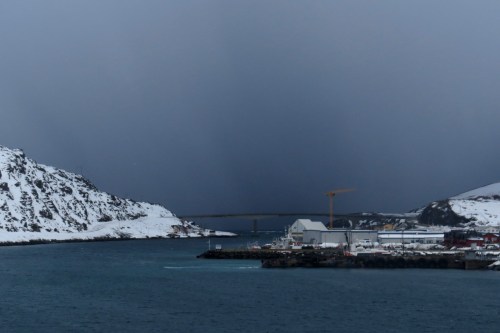
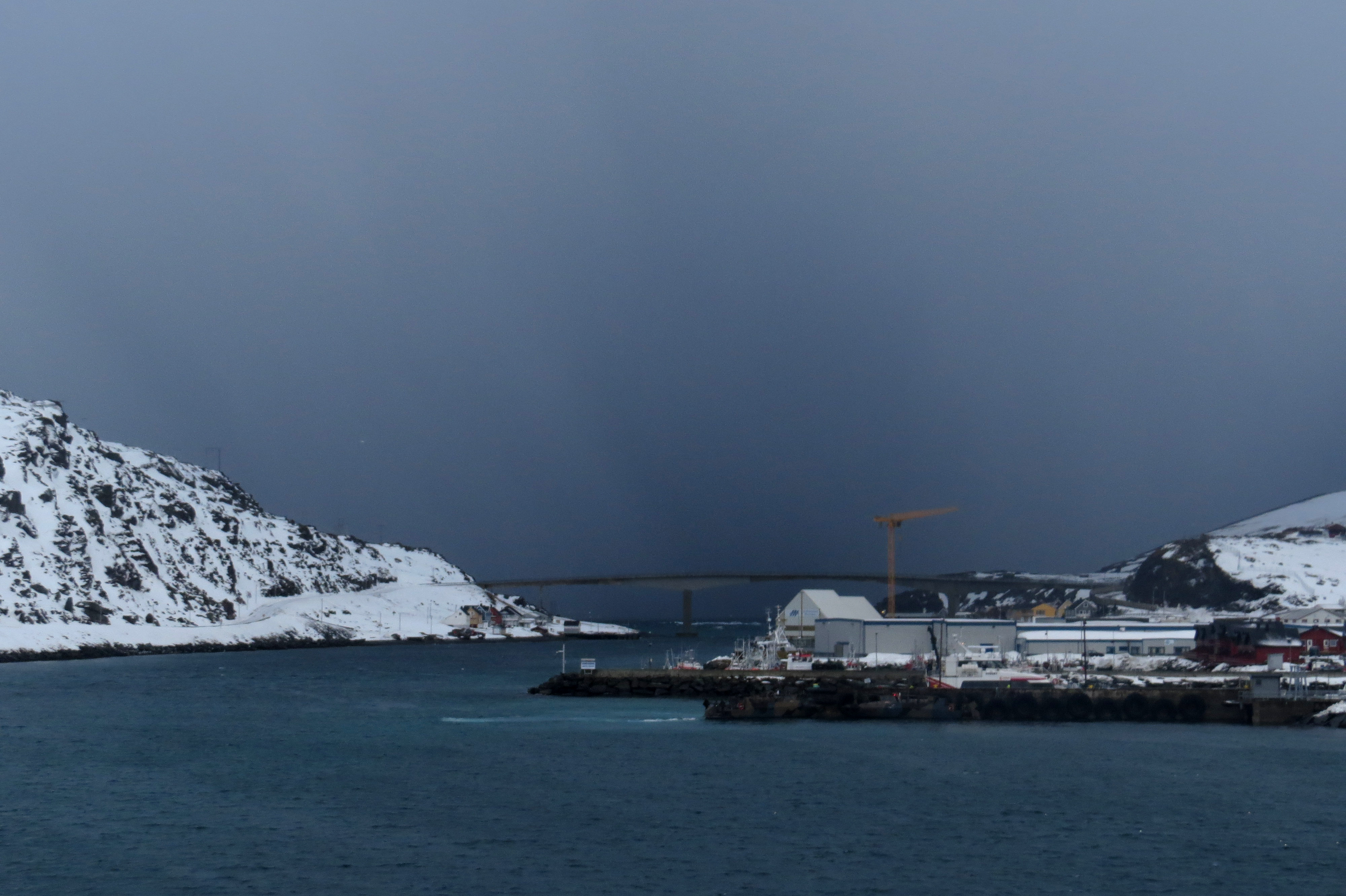
Our first stop that day was at Havøysund where this black cloud ….

…. dumped a whole load of snow on us.

We had a couple of hours to look around Hammerfest, which at over 70N is claimed to be the northernmost town in the world (but again they seem to have forgotten about Longyearbyen, the capital of Svarlbard).
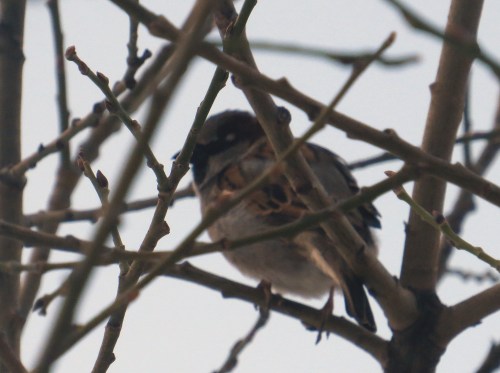
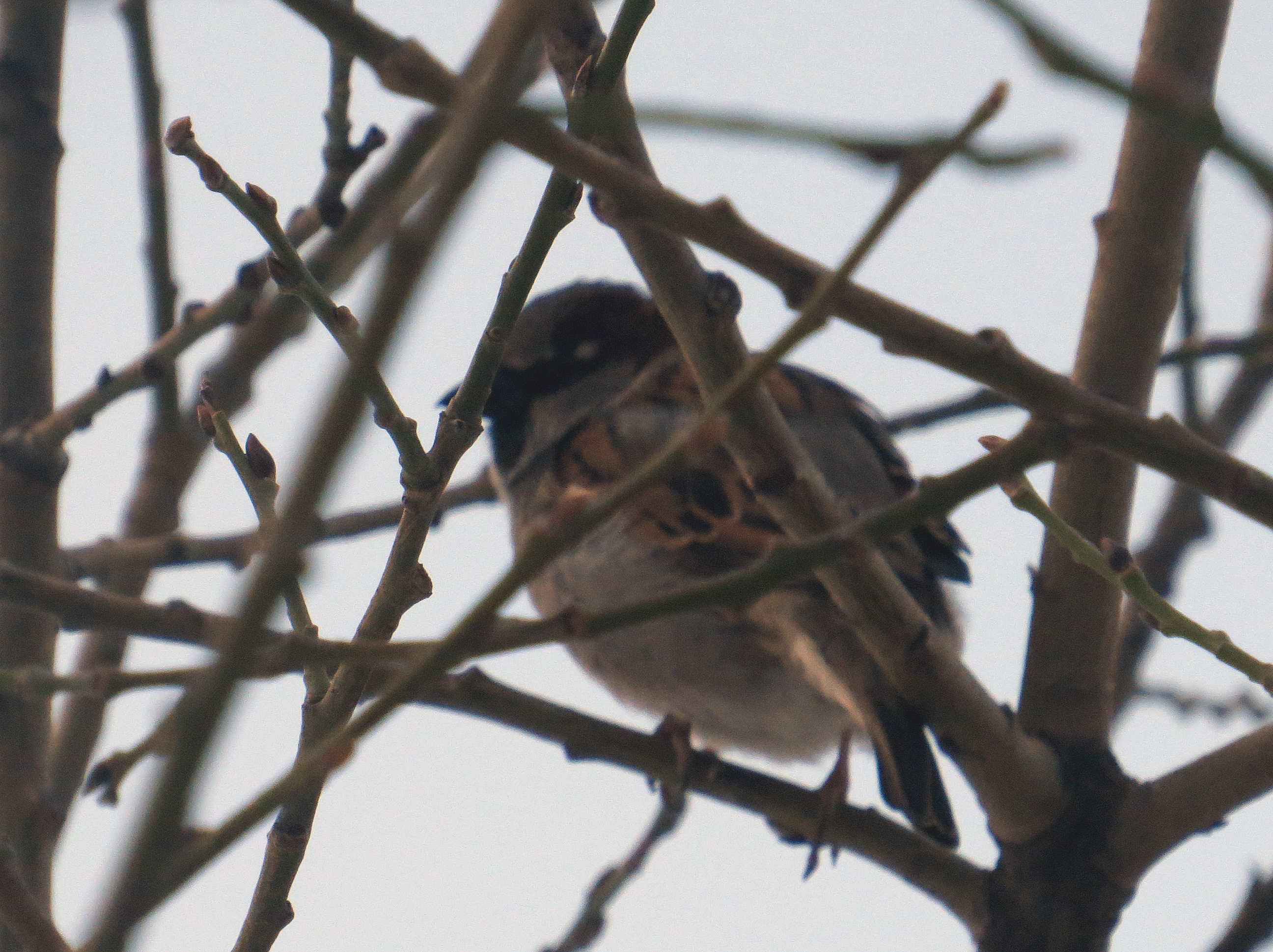
Perhaps Hammerfest’s claim to fame is being home to the most northerly House Sparrows in the world (unless of course you know otherwise)

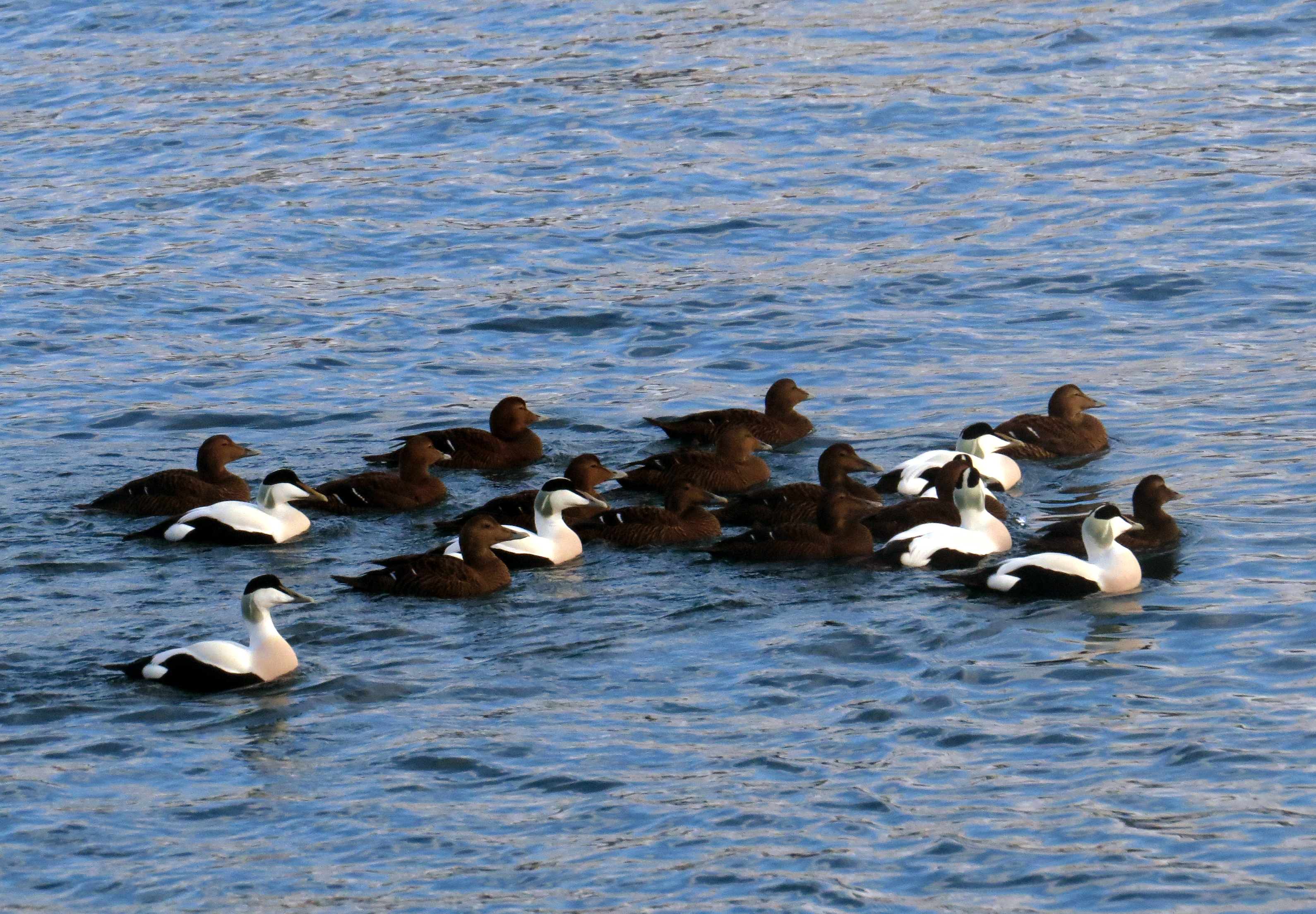
A flock of Common Eider in the harbour gave better views than was possible from the ship.

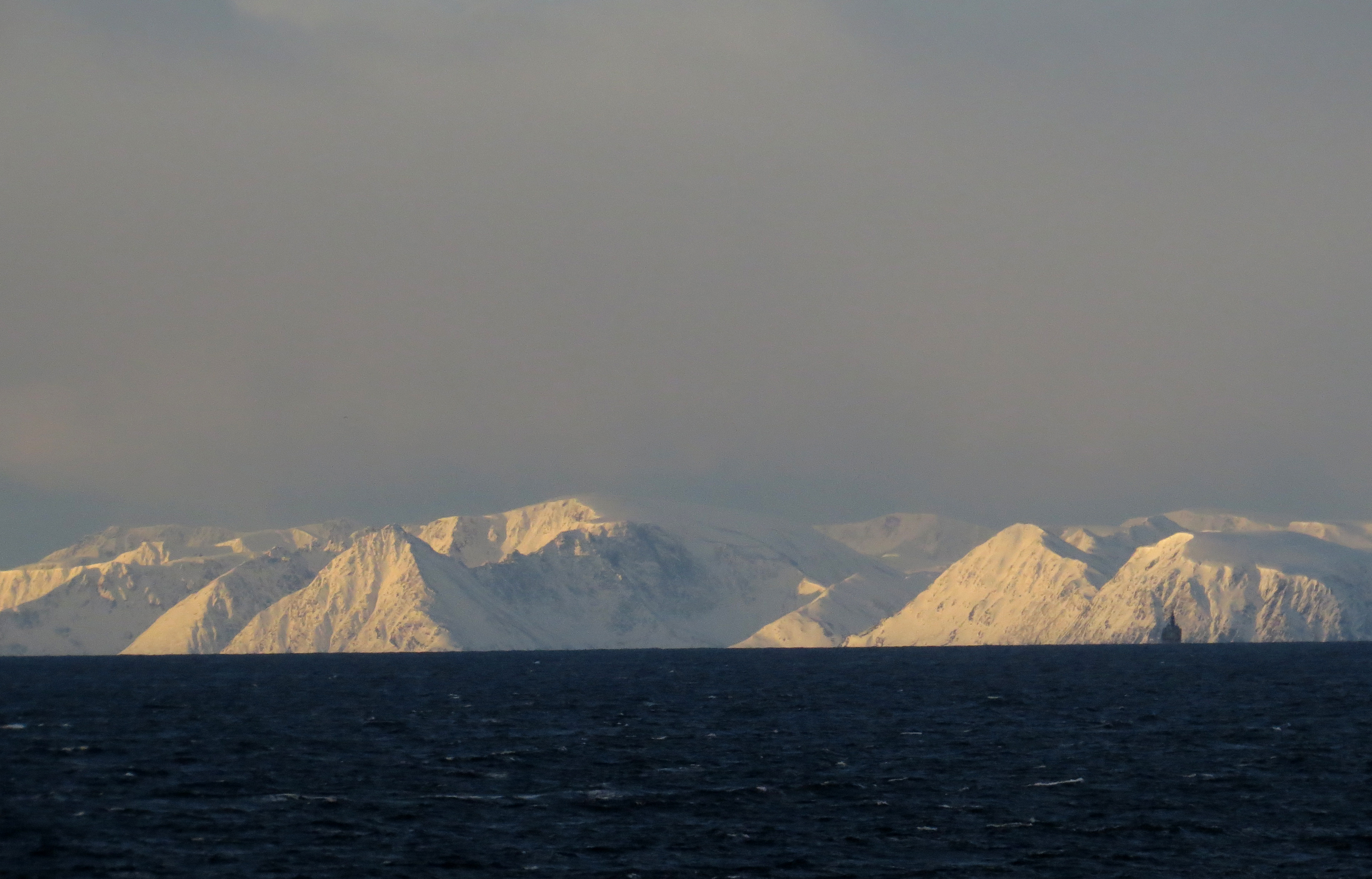
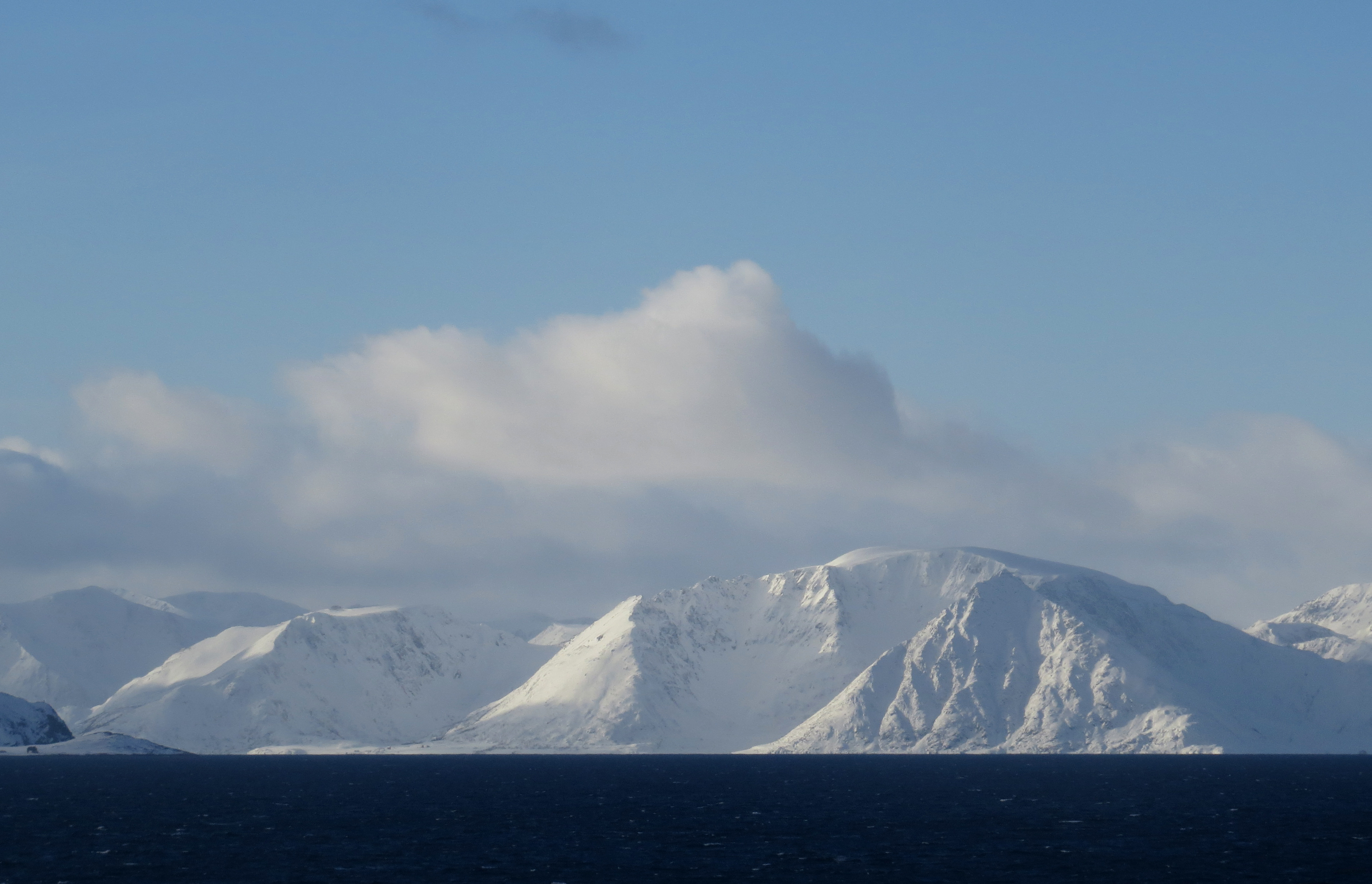
So the rest of the day was taken up with the journey back to Tromsø, again there was wonderful scenery at every turn.

Our final stop in daylight was the little town of Øksfjord just before it got dark.
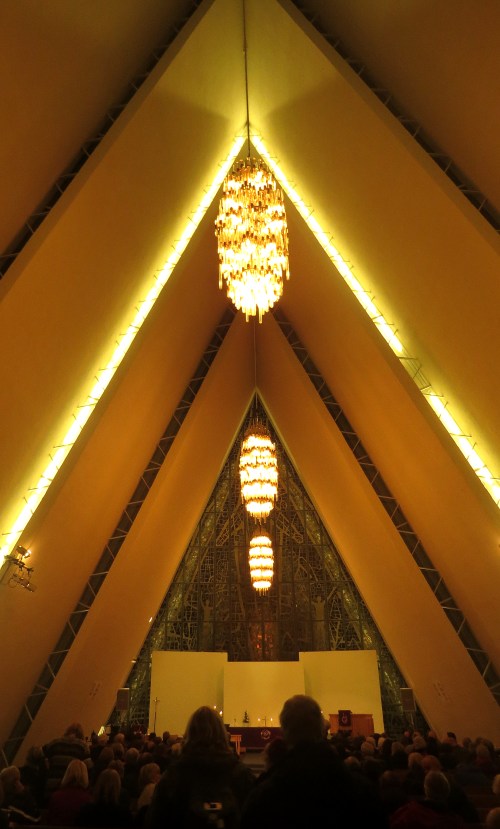
We arrived at Tromsø at 2345 but instead of going straight to our hotel we transferred to Tromsø’s Arctic Cathedral for a wonderful musical recital in a church with the most perfect acoustics I have ever heard. A beautiful end to a beautiful trip.
This is the fifth and final report on my north-east Brazil trip.
From Boa Nova we continued south to the Serra das Lontras range and the Serra Bonita reserve. From here we headed south-east reaching the coast at Porto Segura before heading north towards Salvador for our flight home.
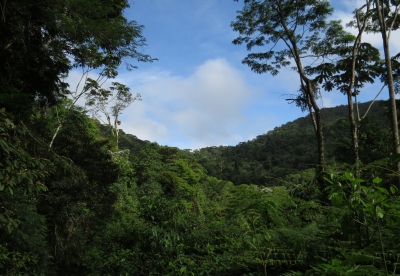
We spent three nights at the private reserve of Serra Bonita near the town of Camacan which produced some excellent birding.

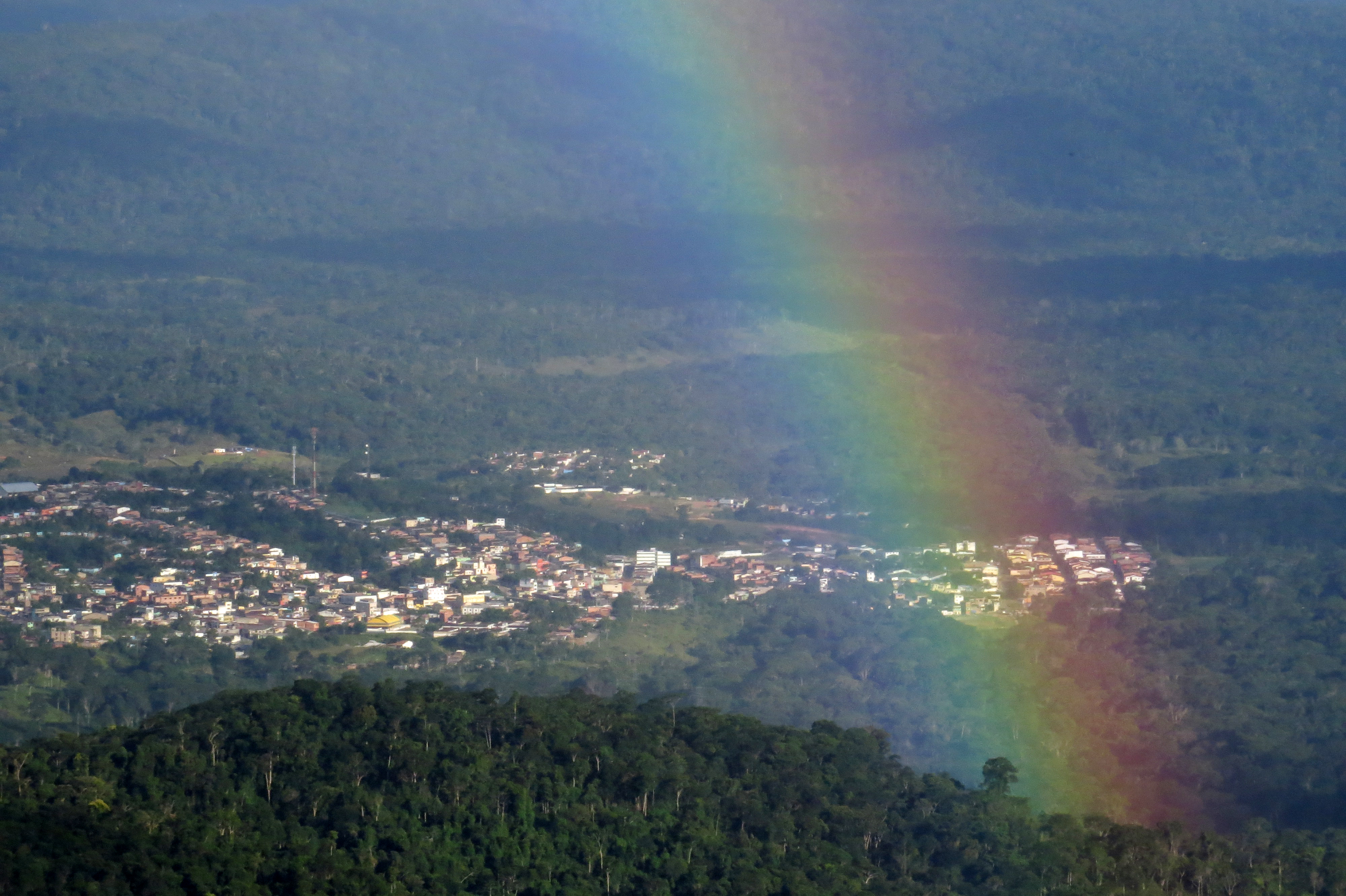
There was a beautiful panoramic view over the town from the restaurant, especially first thing in the morning.

Here are a few birds from the Serra Bonita forests – Rufous-throated Jacamar ….

…. Crescent-chested Puffbird ….
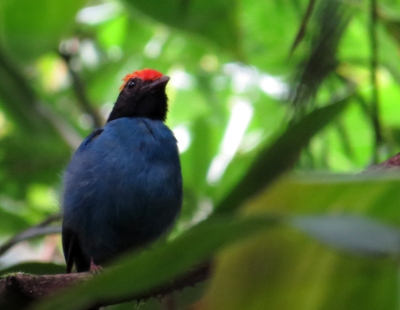
…. Blue Manakin ….
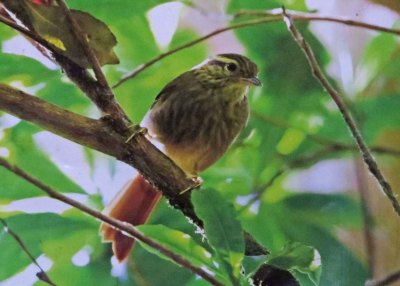
…. but the star bird was this undescribed species of Heliobretus treehunter. A full description is in the pipeline and it will probably be given the vernacular name of Serra das Lontras Treehunter. This is a copy of a print by Ciro Albano https://www.flickr.com/photos/ciroalbanofotos/ and is used with permission.

A middle of the day shower produced a stunning rainbow over the town
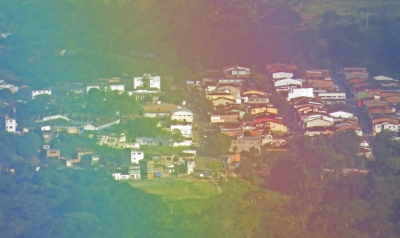
… giving some most unusual effect when I engaged the maximum zoom setting.

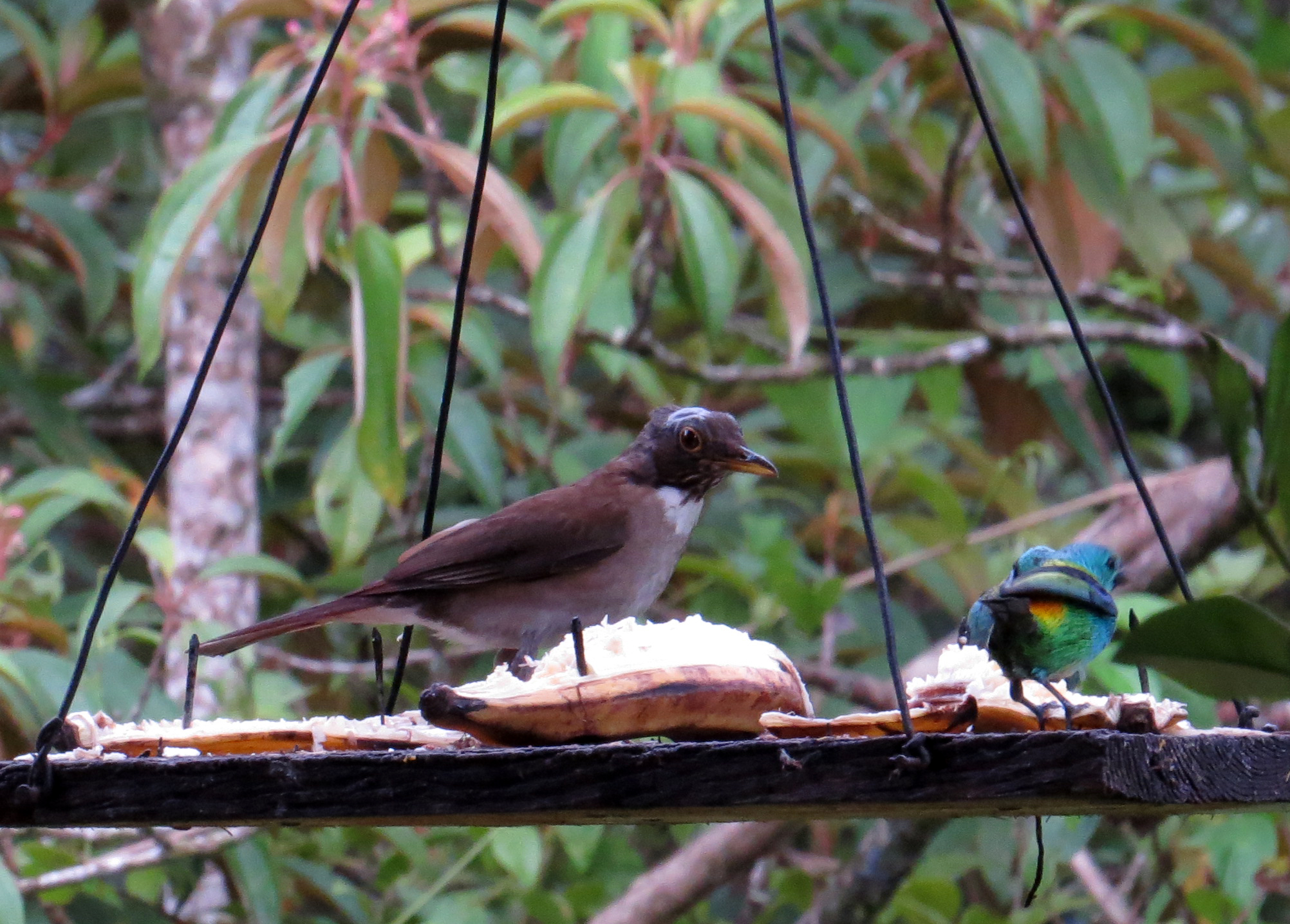
Feeders around the HQ gave some great photo opportunities – here a White-necked Thrush with two Green-headed Tanagers.

A Green-headed Tanager with a Green Honeycreeper.
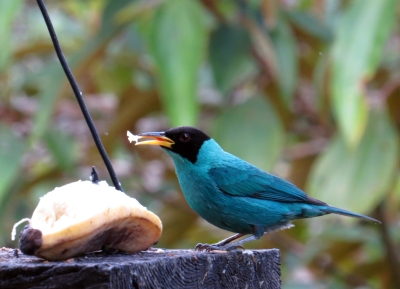
Female Green Honeycreeprs are just that, but the male is more of a blue colour.
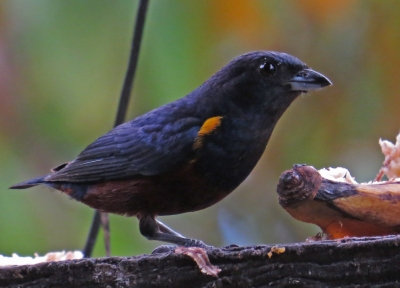
Chestnut-bellied Euphonias were out numbered by their orange-bellied cousins but I have kept a photo of that species for later.
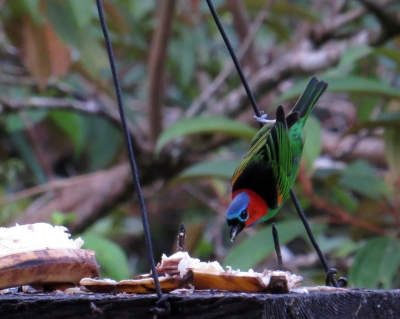
and finally the incredible Red-necked Tanager.

The hummingbird feeders were filled just before dusk to give the birds some calories before their overnight fast. Here Sombre Hummingbirds and a Black Jacobin vie for position.

A male Violet-capped Woodnymph catches the light just right.
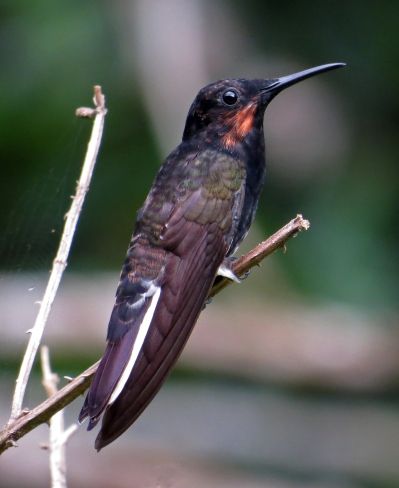
Only the immature Black Inca shows this brown moustachial stripe.
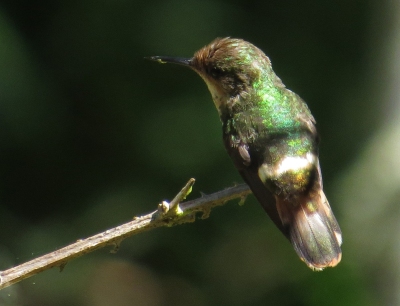
A tiny female Frilled Coquette. The smallest hummer in the world is the Bee Hummingbird of Cuba but the coquettes are not far behind.
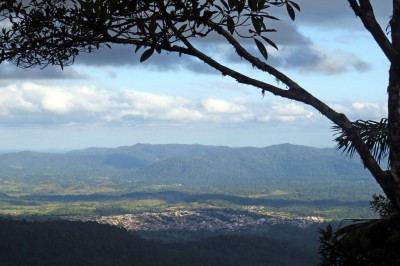
Our final success at Serra Bonita was distant views of the rare Mantled Hawk from the highest peak.
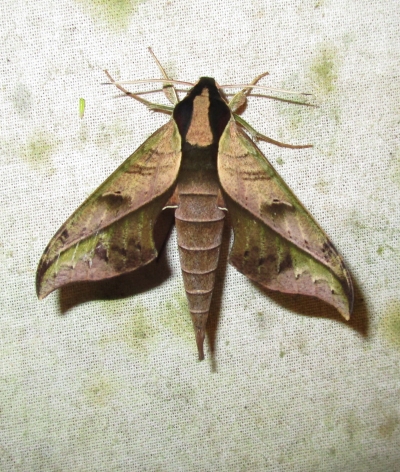
The owner of Serra Bonita is a moth expert and runs a mercury vapor light regularly. Of the 24,000 species known from Brazil, he has identified 12,000 just on this reserve. This contrasts with just 2,500 ever recorded in the UK where there are thousands of moth enthusiasts trapping on a regular basis. I’ve no idea of the name but presume this is some species of Hawk-moth.
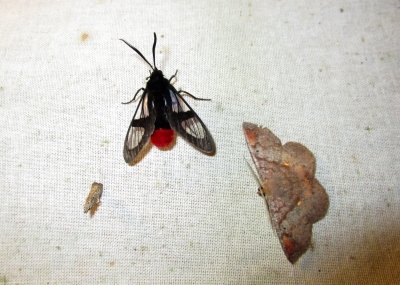
An unidentified micro-moth, a clearwing and what I presume is a one of the Geometridae.
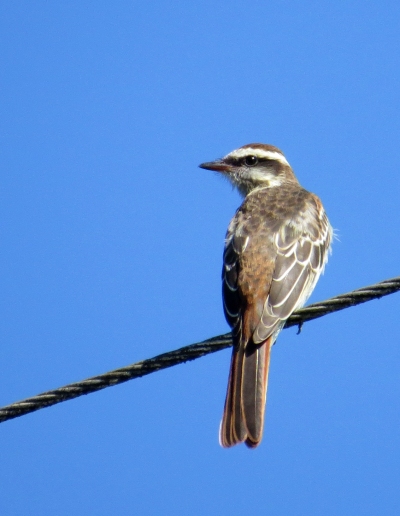
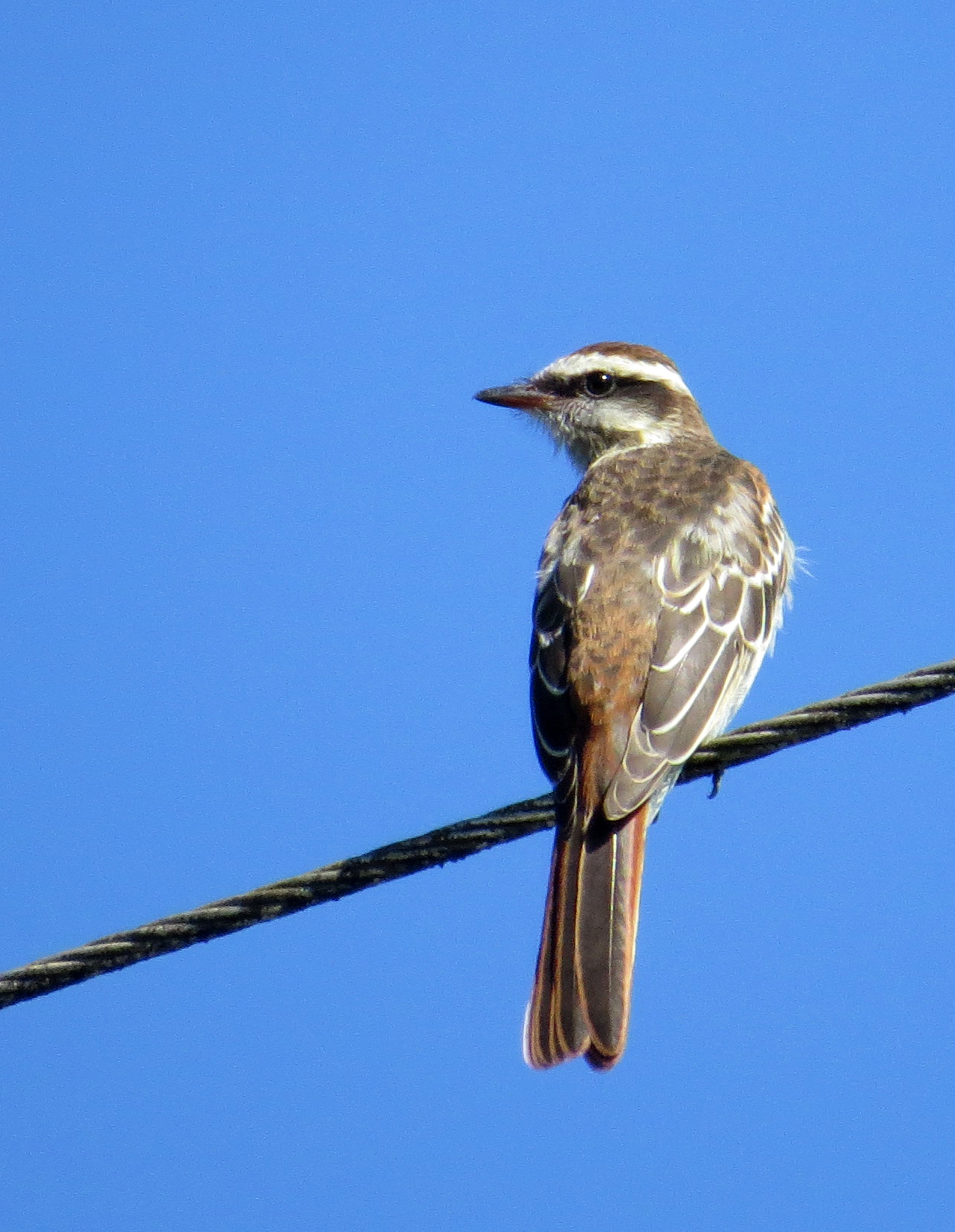
From Serra Bonita we continued to the most southerly point of the trip at Porto Segura. On route we saw many interesting species varying from the widespread Variegated Flycatcher ….
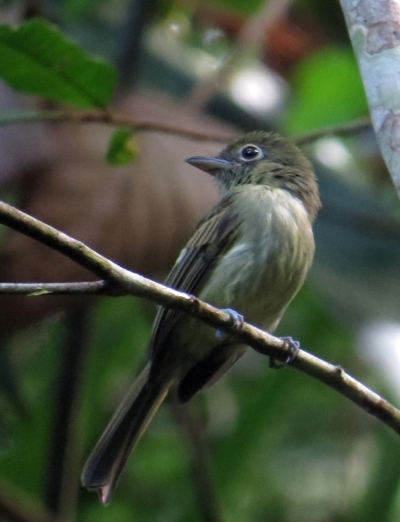
…. Olivaceous Flatbill ….
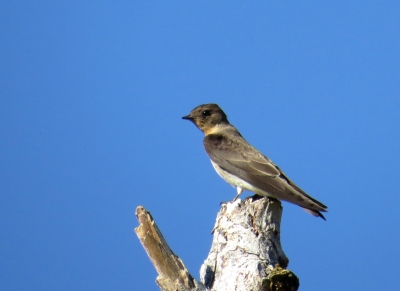
…. and Southern Roughwing ….
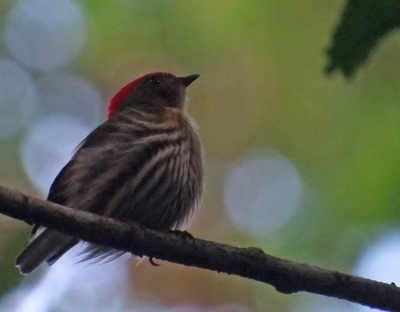
…. to the range restricted Eastern Striped Manakin ….

…. and Least Pygmy Owl.

Porto Seguro is famous as the first place in modern Brazil to be visited by Europeans, being first visited by the Pedro Álvares Cabral expedition in April 1500. As the area lay within the part of the world allocated to Portugal by the Treaty of Tordesillas, a Papal Bull declaring that all newly discovered lands were to be divided up between Spain and Portugal, the region was claimed for Portugal. This characature of Pedro Álvares Cabral was painted on the wall of the foyer of our hotel.
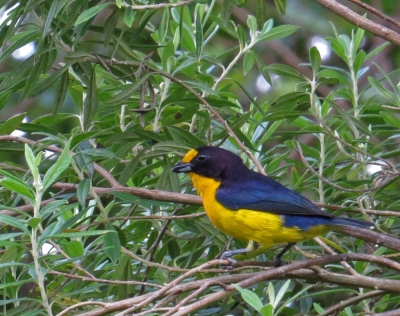
From Porto Seguro (the southernmost point of the trip) we headed north to Itacaré, our final birding destination. On route we stopped at our guide Eduardo’s brother’s house where we could see lots of nice birds coming to the feeder such as this Orange-bellied Euphonia ….
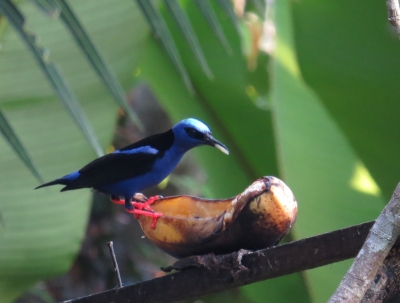
…. Red-legged Honeycreeper ….
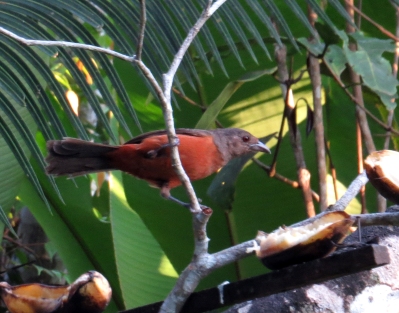
…. and a female Brazilian Tanager

The following day we birded nearby forests seeing many species such as this Black-necked Aracari ….

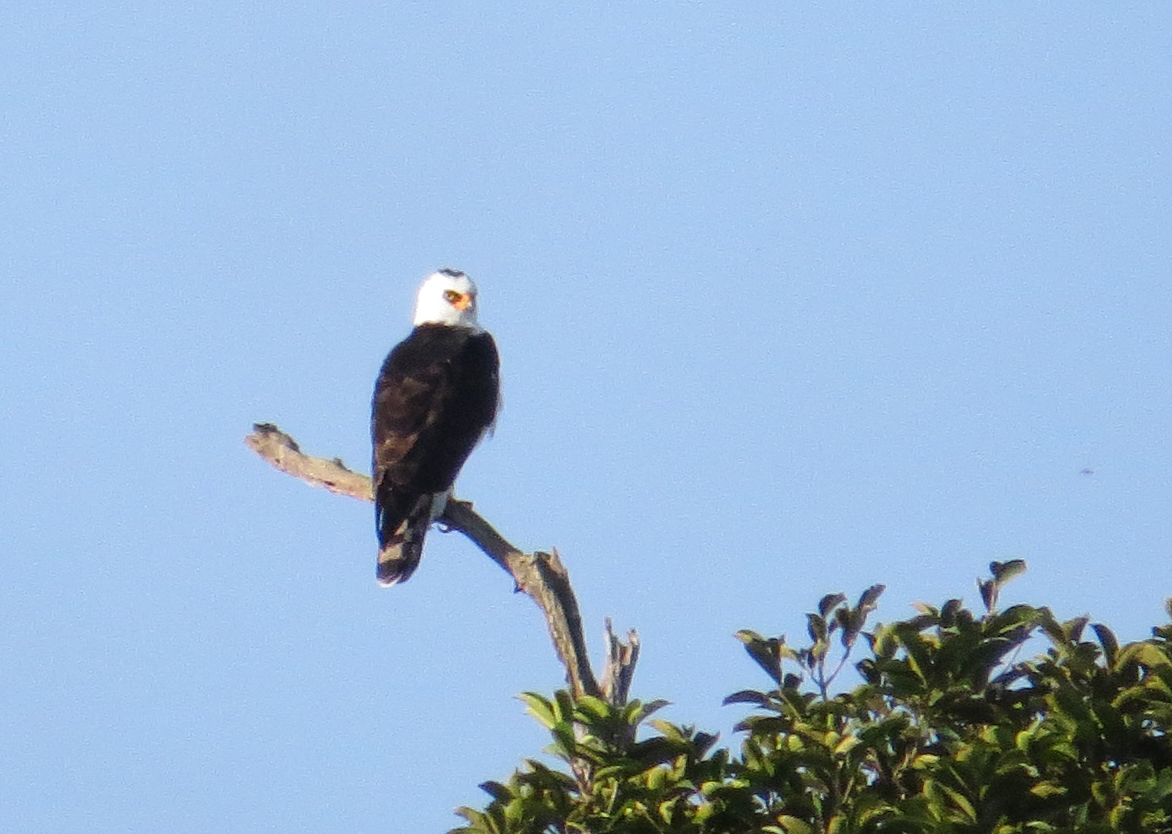
…. and this magnificent Black-and-White Hawk-eagle. This is the first time I have seen an adult of this species and the first time perched.
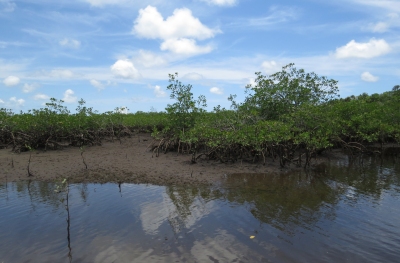
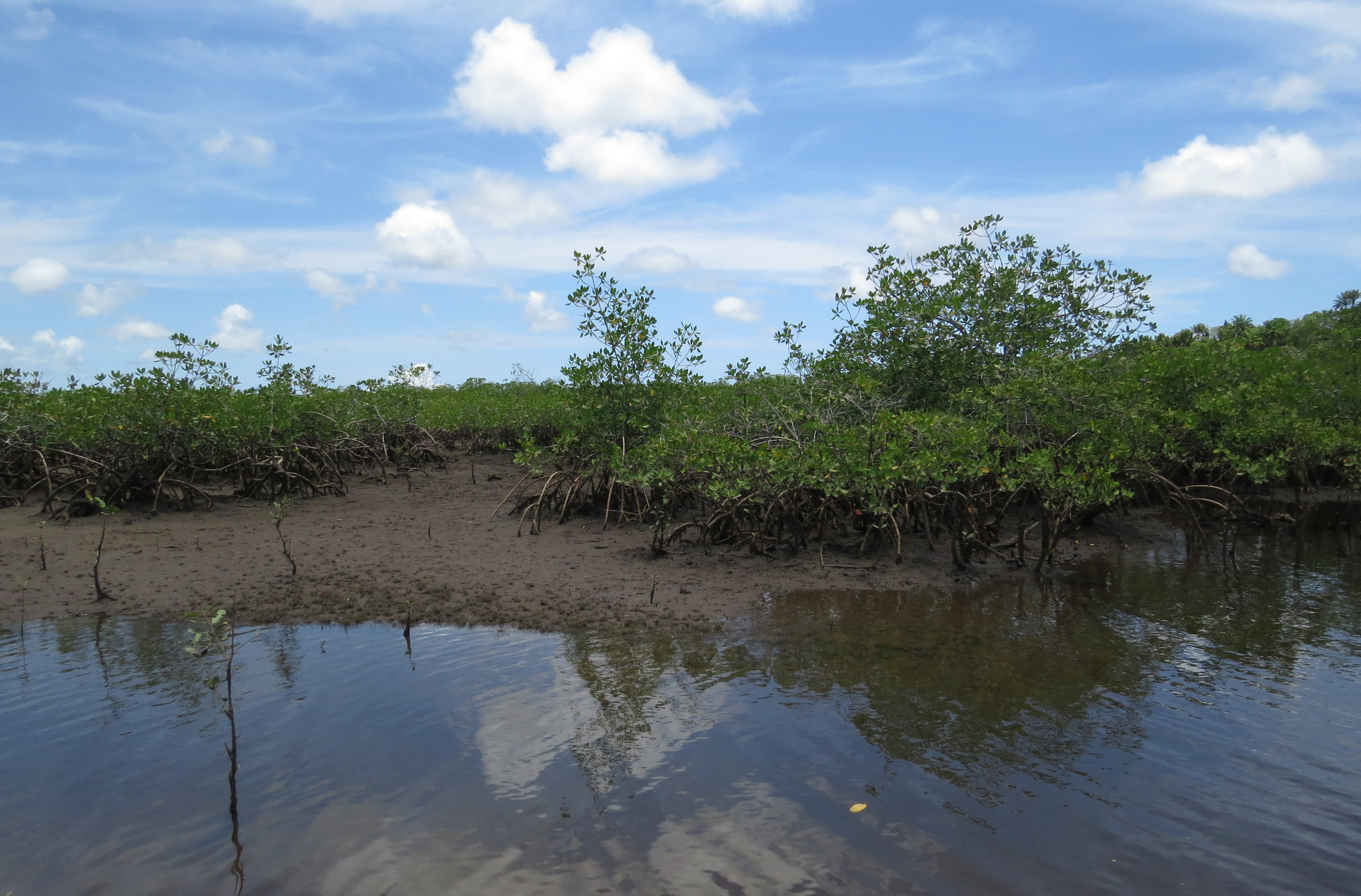
Later in the day we called in at an extensive area of mangroves in the hope of see the two species of rail that we had failed to find earlier in the trip, Little Wood-rail and Mangrove Rail. It was very hot and we had no luck. We hoped to return the next day but unfortunately it didn’t pan out that way.

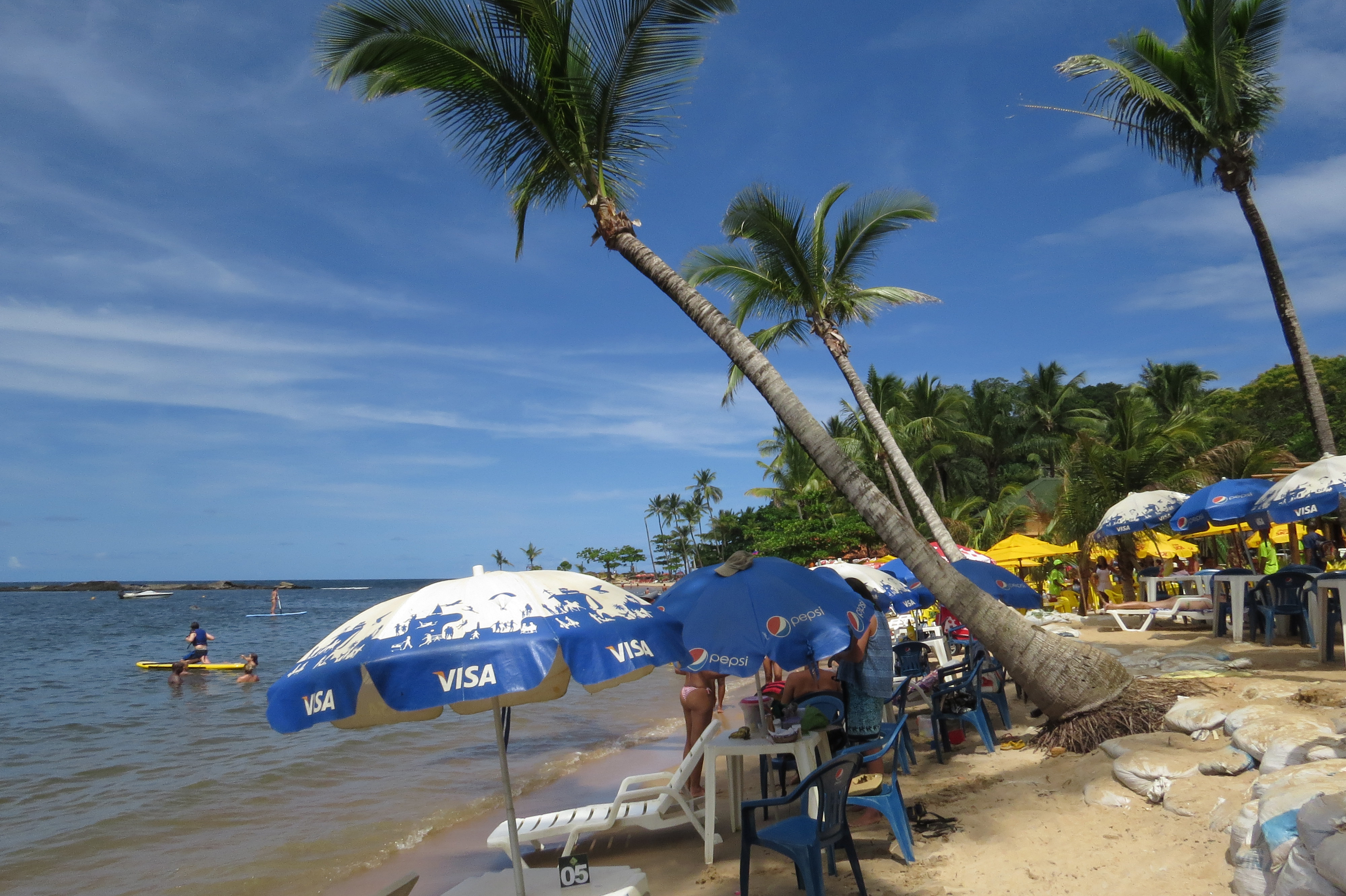
We had lunch by the beach at Itacaré ….

… at a beach restaurant run by (on the left) Eduardo’s brother Leo.

In the afternoon we visited the Catitu private reserve.

We saw four excellent species of cotinga, both Black-headed Berryeater

…. and White-winged Cotinga showed well. Bare-throated Bellbird was seen at a distance (but I only got very poor photos) but the best of all, the rare Banded Cotinga, was seen perched at such a distance that it couldn’t be identified until it flew.
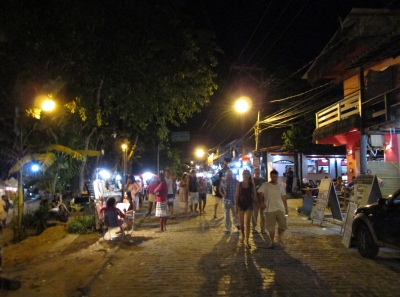
Our final night was again spent in the pleasant holiday resort of Itacaré. The following morning we revisited Catitu in the hope of better views of Banded Cotinga. We had a very birdy morning but failed with our primary target. This was the only day on the whole trip when I failed to pick up a life bird.

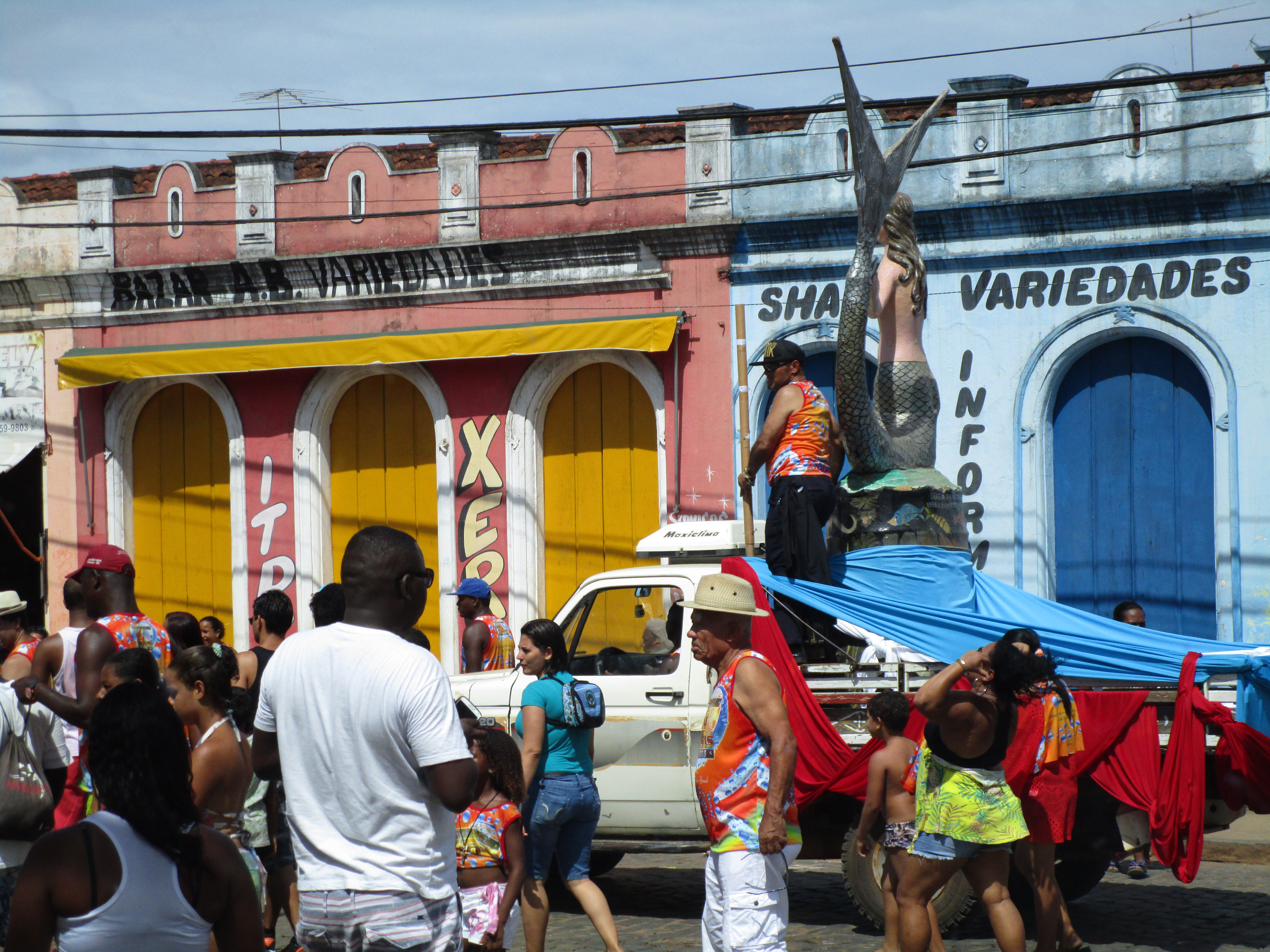
Then it was long drive north to Salvador for our flight to Lisbon and home. Initially following the coast road, the journey was delayed by poor roads, heavy traffic, a funeral procession and (above) a fiesta, but we arrived at the airport in good time, so concluding an excellent trip. I personally recorded just short of 500 species. I had expected 65 life birds, 70 if I was very lucky, I got 78 and saw a couple of fantastic species that I didn’t know were even possible on this itinerary. There is a lot of driving on this trip but the results make it more than worthwhile.

But I will finish this narrative with another bird that deserves the epithet of ‘bird of the trip’ and one that wasn’t on my radar at all at the start. We bumped into Ciro Albano and his group at Veracel reserve near Porto Segura and after dark we all were able to get great views of two White-winged Potoos. Photo by Ciro Albano from the Internet Bird Collection.
Continuing the journey south through north-east Brazil, our group arrived at Boa Nova in Bahia State on the afternoon of the 23rd.
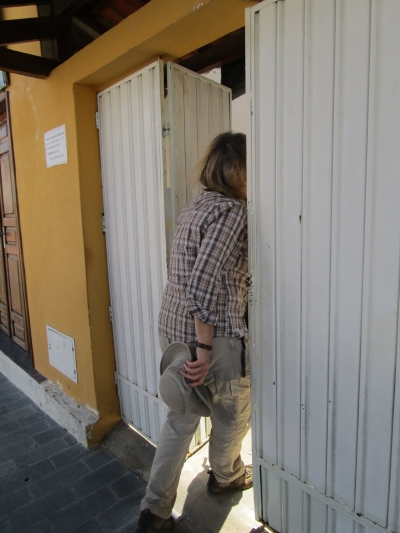
Although I have stayed in worse, the accommodation in Boa Nova was clearly the least luxurious of the trip. Entrance to our rooms was through a padlocked gate in the street. I understand that a new hotel has been opened recently so this shouldn’t put others off visiting.

Rooms were a bit dingy, there was a lot of noise from the street and I was plagued by mosquitoes in the night. There was even the legendary chewing gum on the bedstead (from 1950’s Lonnie Donegon song for those too young to remember).

The birding however was outstanding. This Black-billed Scythebill, a rare relative of the woodcreepers, gave reasonable views.

Several Pink-legged Graveteiro’s, showed in the canopy. This species of furnarid was only described in 1996.

Sharpbills gave their falling bomb whistles from the trees. This species has been considered to be a cotinga or has been placed in a family of its own, but has now ended up in the Tityridae along with such other neotropical oddballs as the tityras, royal flycatchers, schiffornis, myobious, purpletufts (see below), xenopsaris (see below), becards and some of the mourners.
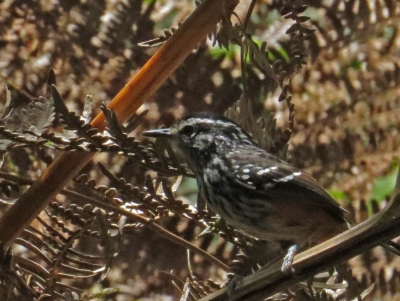
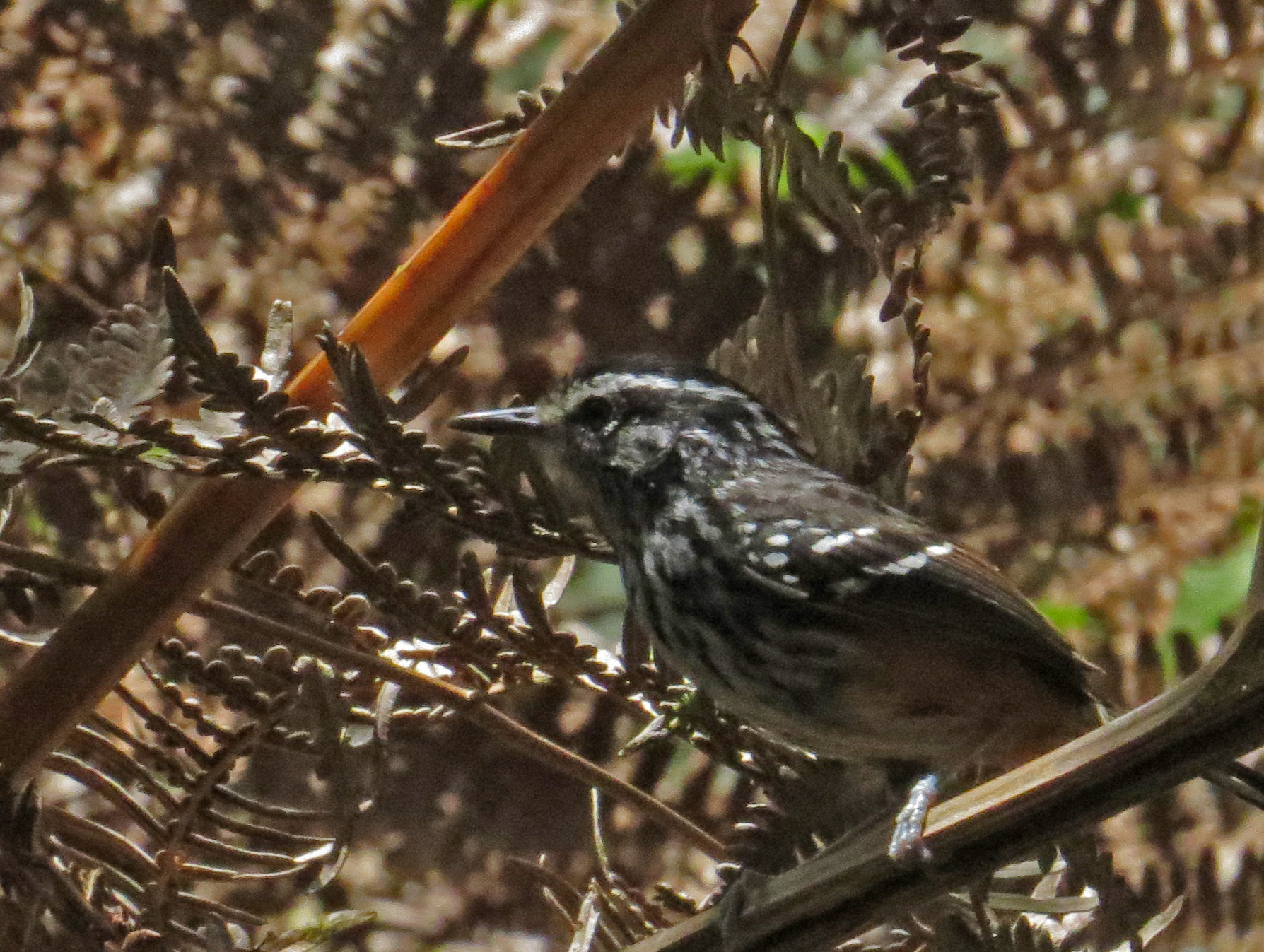
As usual ant-thingies were a regular feature. This is an Ochre-rumped Antbird ….

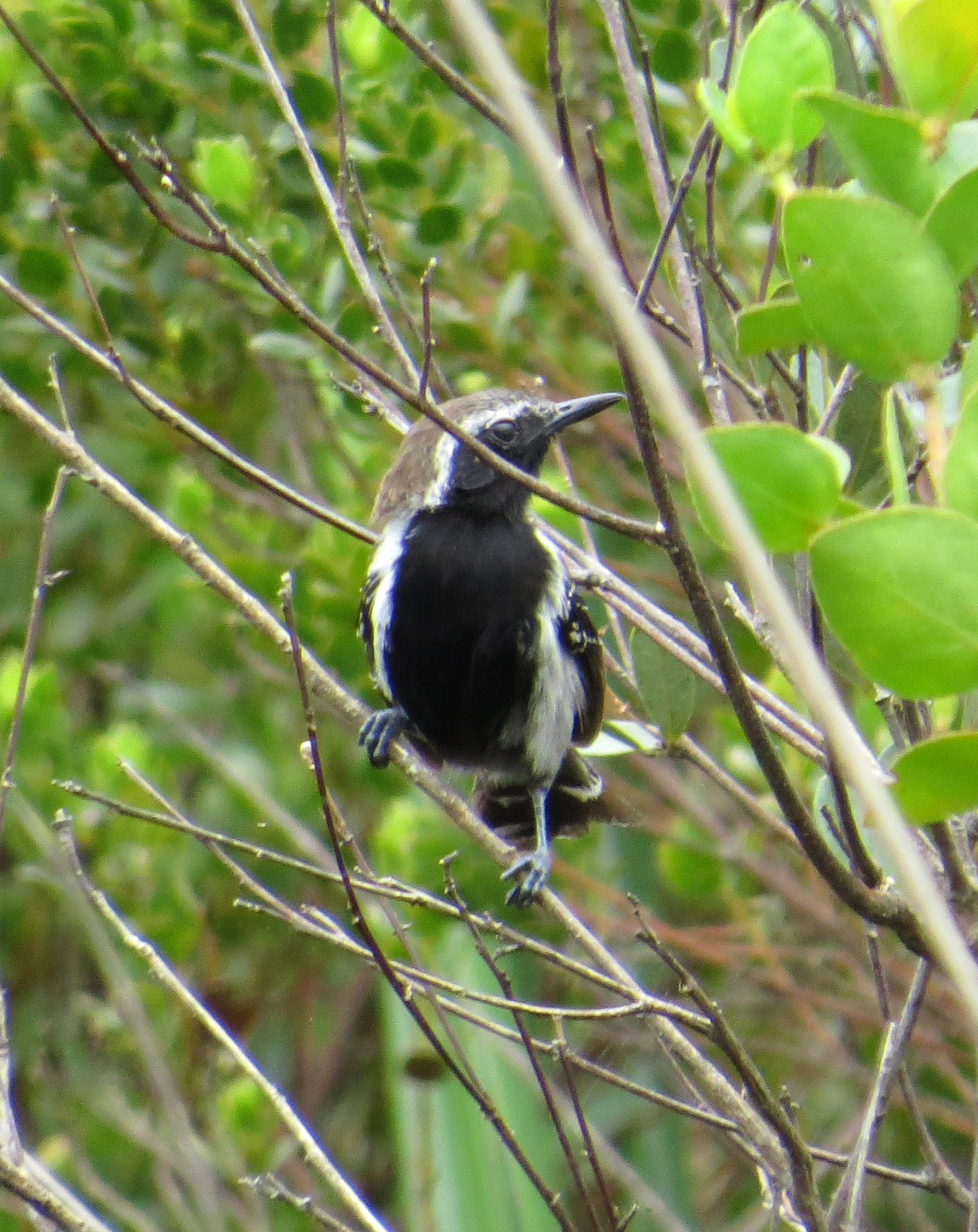
…. a male Slender Antbird ….

…. and here the even more elusive female Slender Antbird.
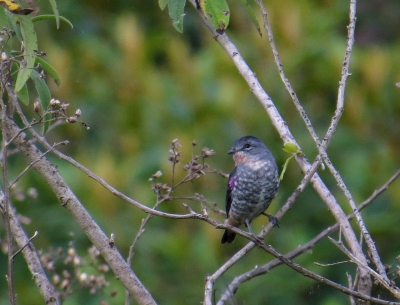
One of the cutest birds of the trip was the diminutive Buff-throated Purpletuft. Now, as I said above, a member of the Tityridae.

Mammals even got a look in. This is the rare Weid’s Black-tufted-ear Marmoset.

In a drier, more open area we saw a pair of White-naped Xenopsaris. This species occurs over a wide area but is always scarce. This is the fourth South American trip I have seen this bird on, but up to now it’s just been one per trip.

Part of two afternoons were spent searching a rocky outcrop ….
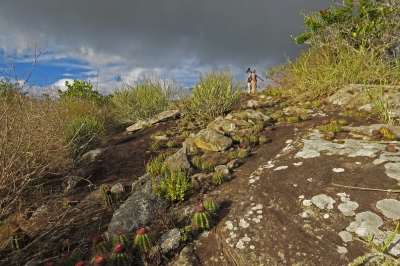
… it was covered in cacti so you had to watch your step.

We had great views of several seedeaters including this White-throated and the rarer Dubois’ ….
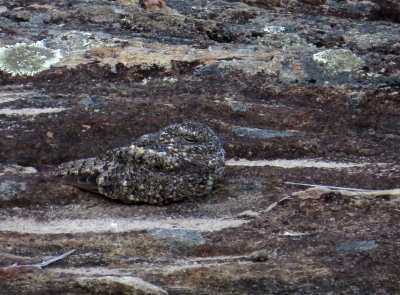
… but our main target was Pygmy Nightjar which we found just before dusk, perfectly camouflaged on the rock.

The flowers of the cacti attracted many hummingbirds ….

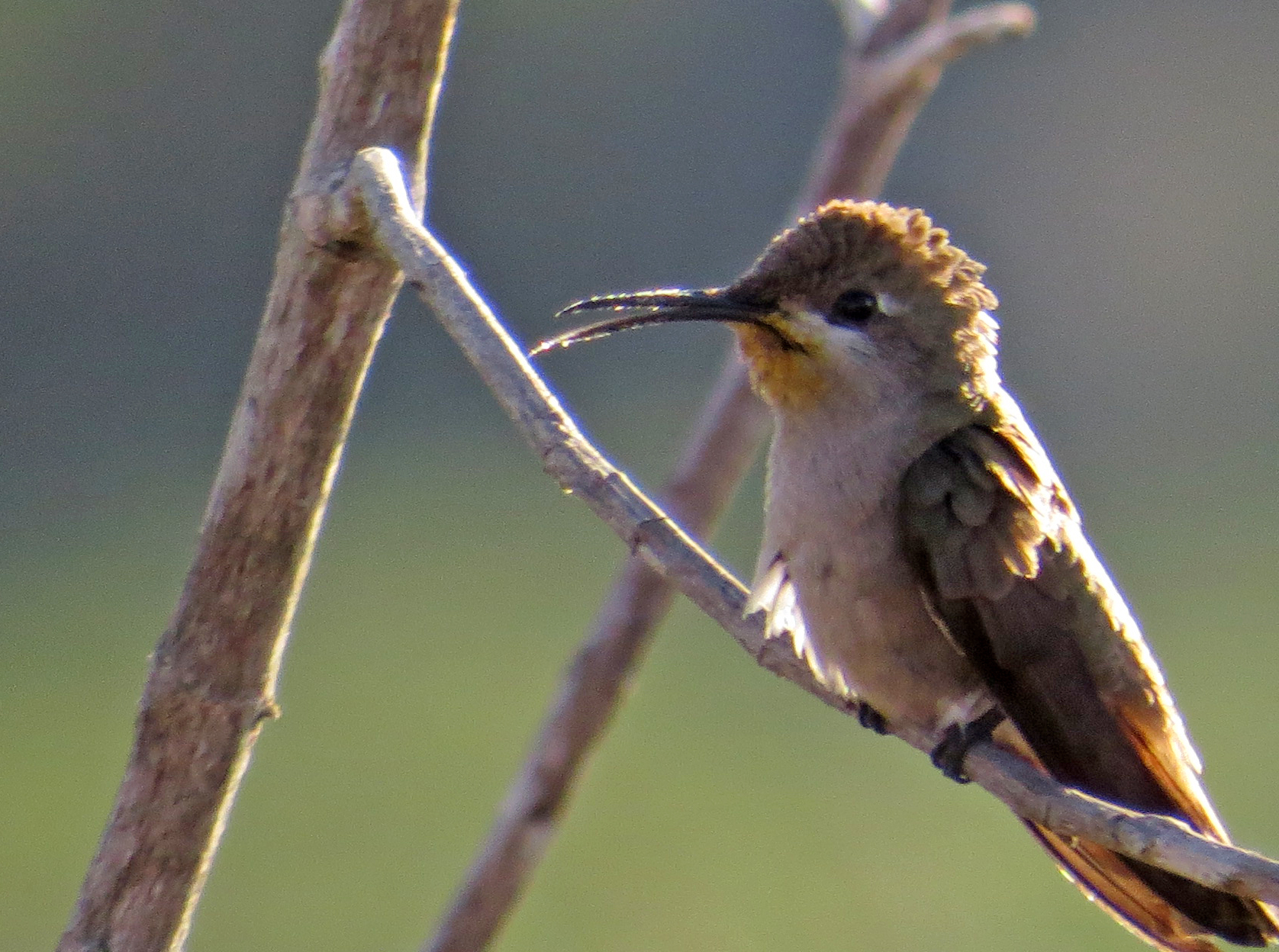
…. a female Ruby Topaz Hummingbird ….
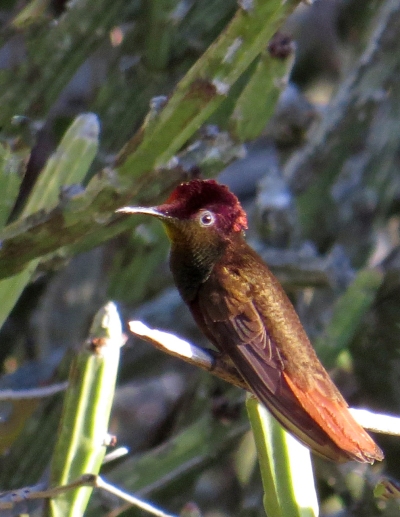
…. and the brighter male. Hummingbirds have feathers that shine iridescent from certain angles. The entire bird will never glow at the same time. As this bird turns its ruby crown will turn black but its gorget will light up a bright orange.
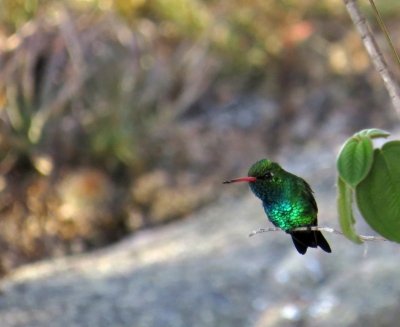
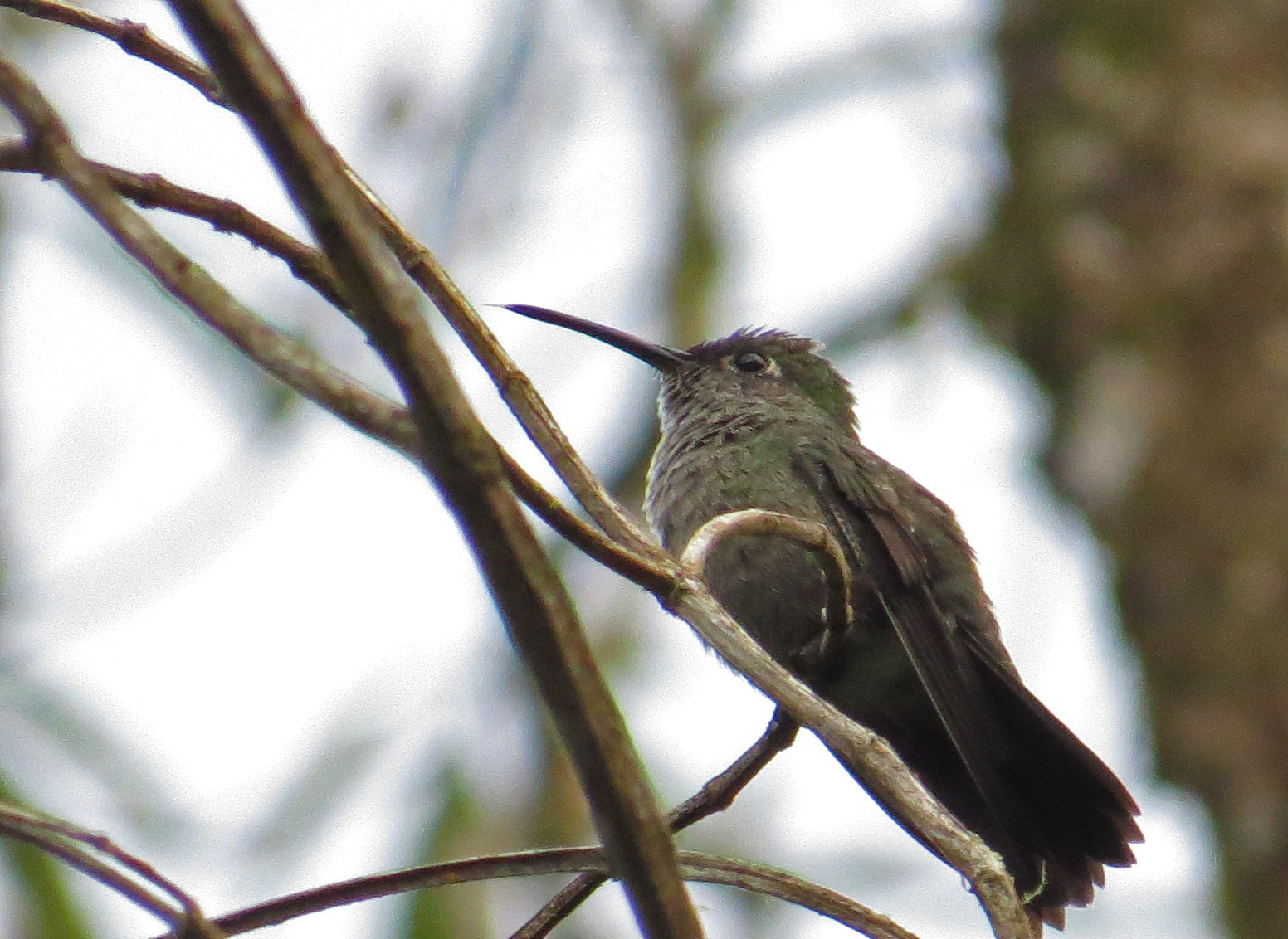
Similarly this Glittering-bellied Emerald will only live up to its name when viewed from a certain angle.
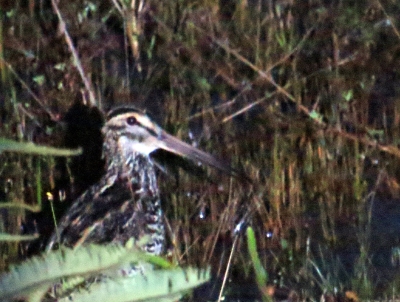
But the bird of the day, no, the bird of the trip, was seen at a nearby marsh after dark. We had fantastic views of a Giant Snipe by torchlight. Almost half as big again as a Eurasian Woodcock, this monster of the marshes showed well for several minutes. OK the photos aren’t brilliant but it was some way away and lit just by the torch beam. Araripe Manakin and Lear’s Macaws were expected highlights of the trip, this wasn’t, hence my decision to give it the honour of ‘bird of the trip’.
The last Brazil post dealt with our visit to the Canudos Biological Reserve and its wonderful Lear’s Macaws. From here we drove south-east to Jeremoabo and the following day continued to the coast at Palmares in coastal Pernambuco.

Pectoral Antwren, one of many species of antwren seen on the tour and one that is restricted to far eastern Brazil, was a highlight of our time at Jeremoabo.
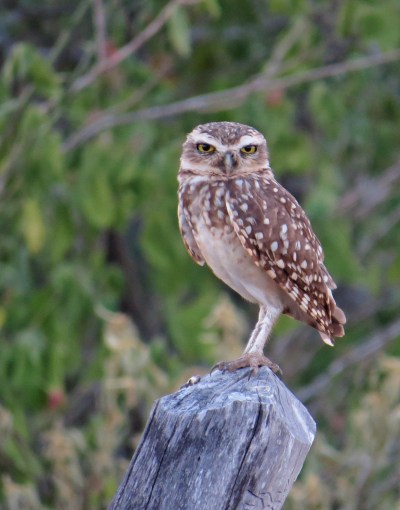
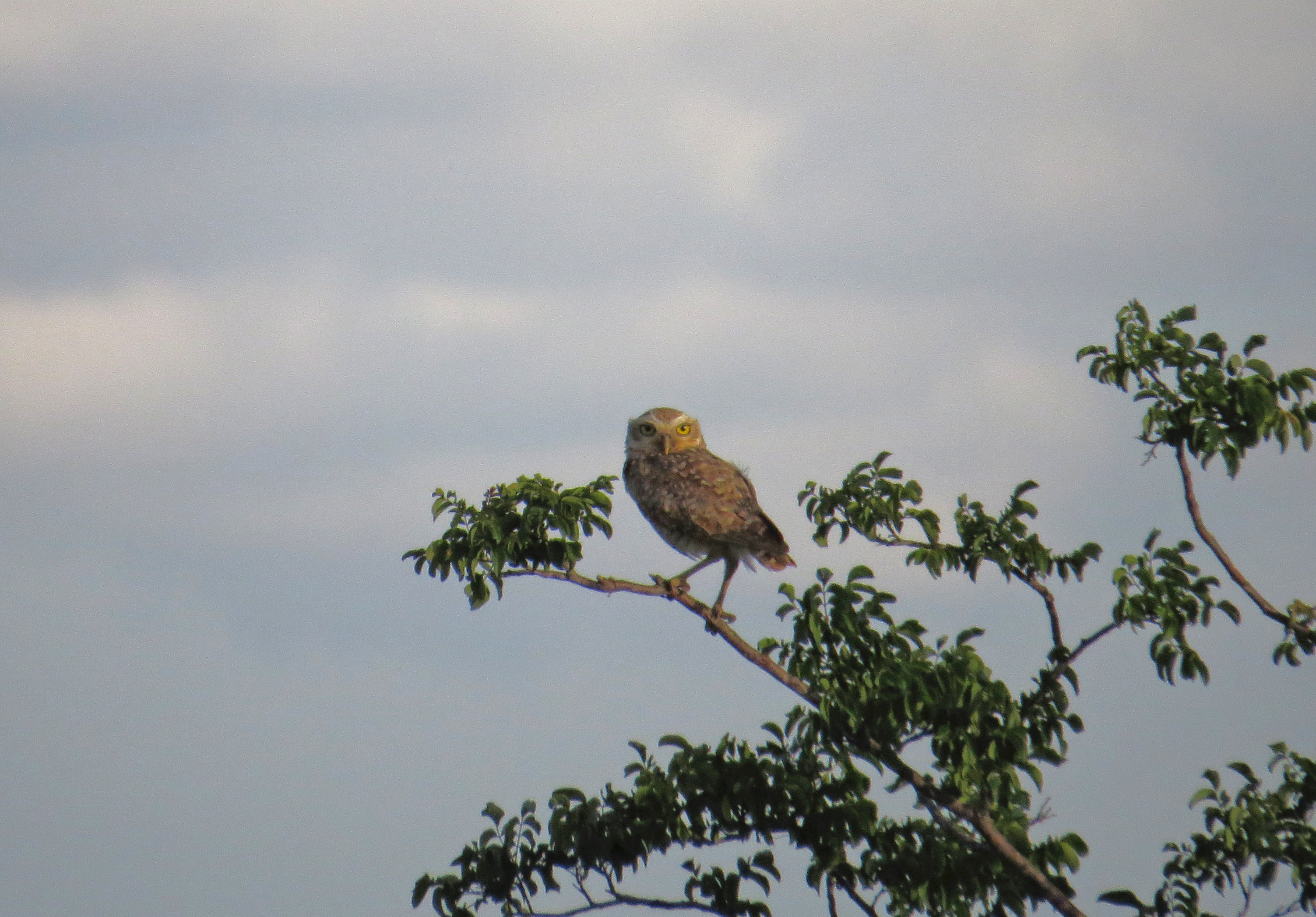
Burrowing Owls could be seen along the sides of the road in open areas.
The area around Palmares is part of the ‘Pernambuco centre of avian endemism’. Unfortunately the vast majority of forest has been converted to sugarcane or banana plantations and the remaining endemic birds are critically endangered. Some forest does remain, but it is severely fragmented. In Europe or North America forest birds would disperse from one patch to another so bolstering the population, but here each population becomes increasingly isolated and inbred so numbers are falling at an alarming rate. Alagoas Foliage-gleaner, Pernambuco Pygmy-owl and Cryptic Treehunter may already be extinct and Alagoas Antwren, Pinto’s Spinetail and White-collared Kite may soon be following them into oblivion. Originally three days were scheduled for this area but rather than ‘flog a dead horse’ our time was cut to a day and a half, allowing us to see some of the specialities without wasting time on birds that had already disappeared.

Frei Canaca reserve is typical of the plight of the NE Brazilian coastal rain forest, being encircled with and fragmented by plantations. We saw some good birds here but they were in very low density and it was hard work!

I wasn’t able get good photos of any of the Pernambuco forest birds but in coastal marshes we saw and photographed the equally rare Forbe’s Blackbird.

The attractive White-headed Marsh Tyrant is a much commoner and widespread bird.
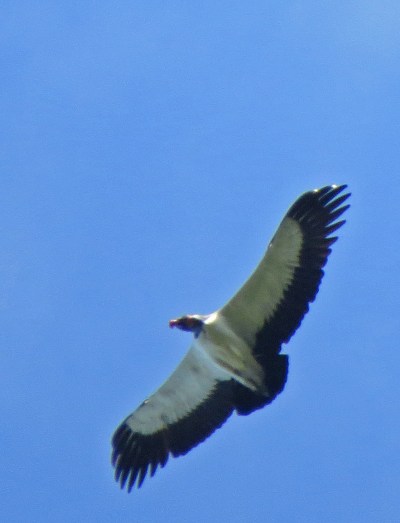
Overhead we had great views of the largest of the lowland New World vultures (the Andean Condor of course is the largest).
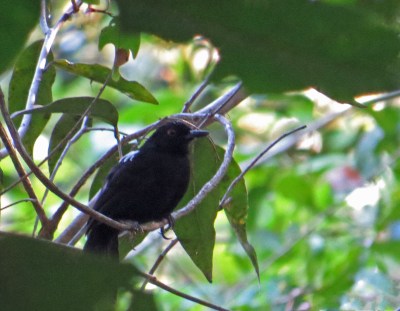
Further south in coastal Bahia State we came across another range restricted antbird – Fringe-backed Fire-eye.
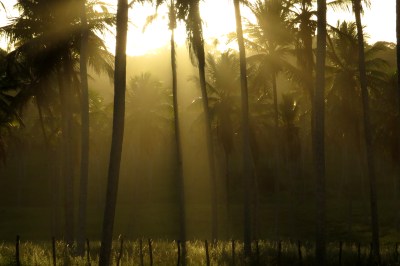
We visited nearby palms at dusk and were fortunate to see …
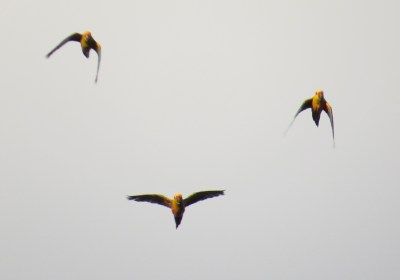
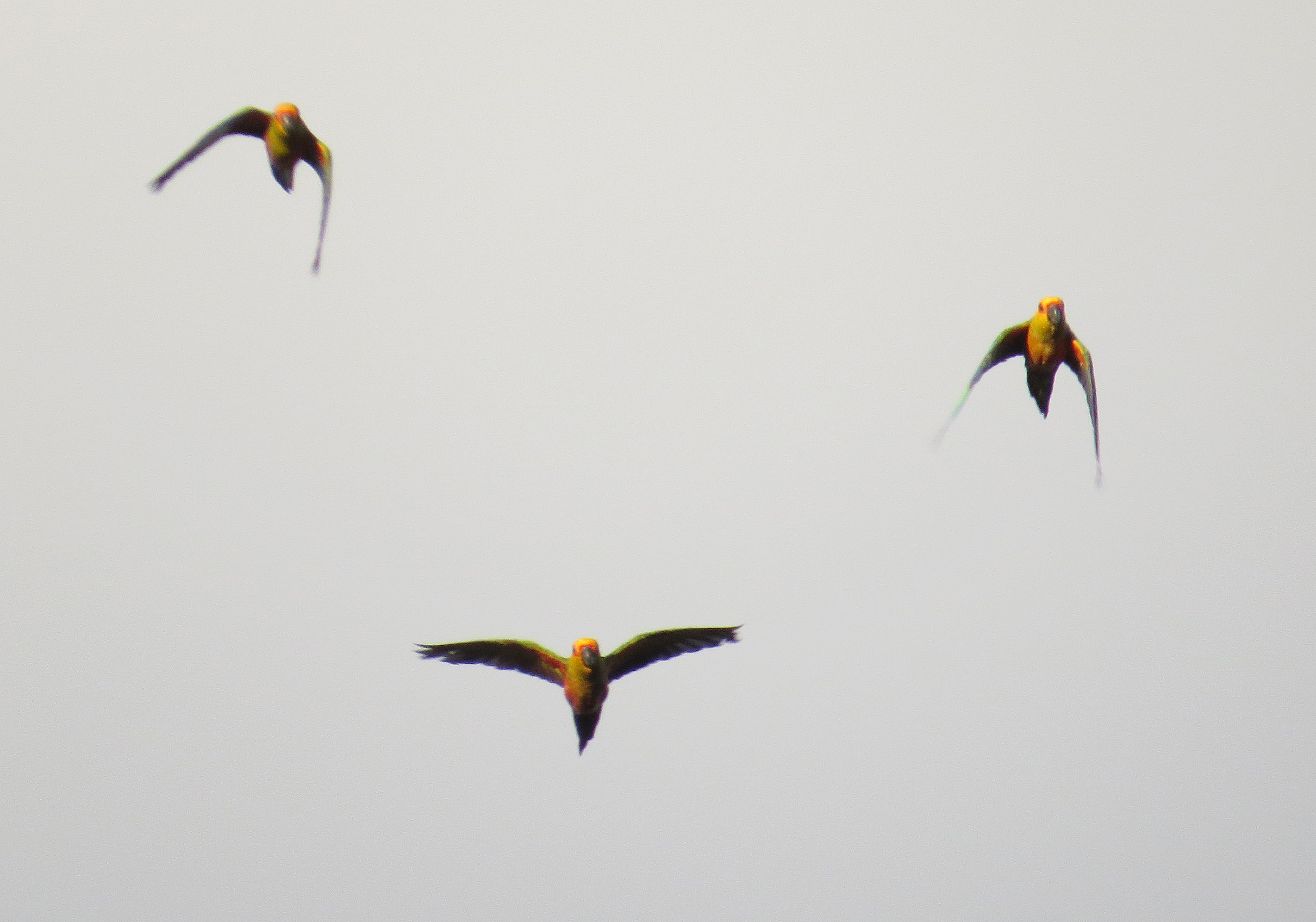
…. the endemic Jandaya Parakeets flying to roost.

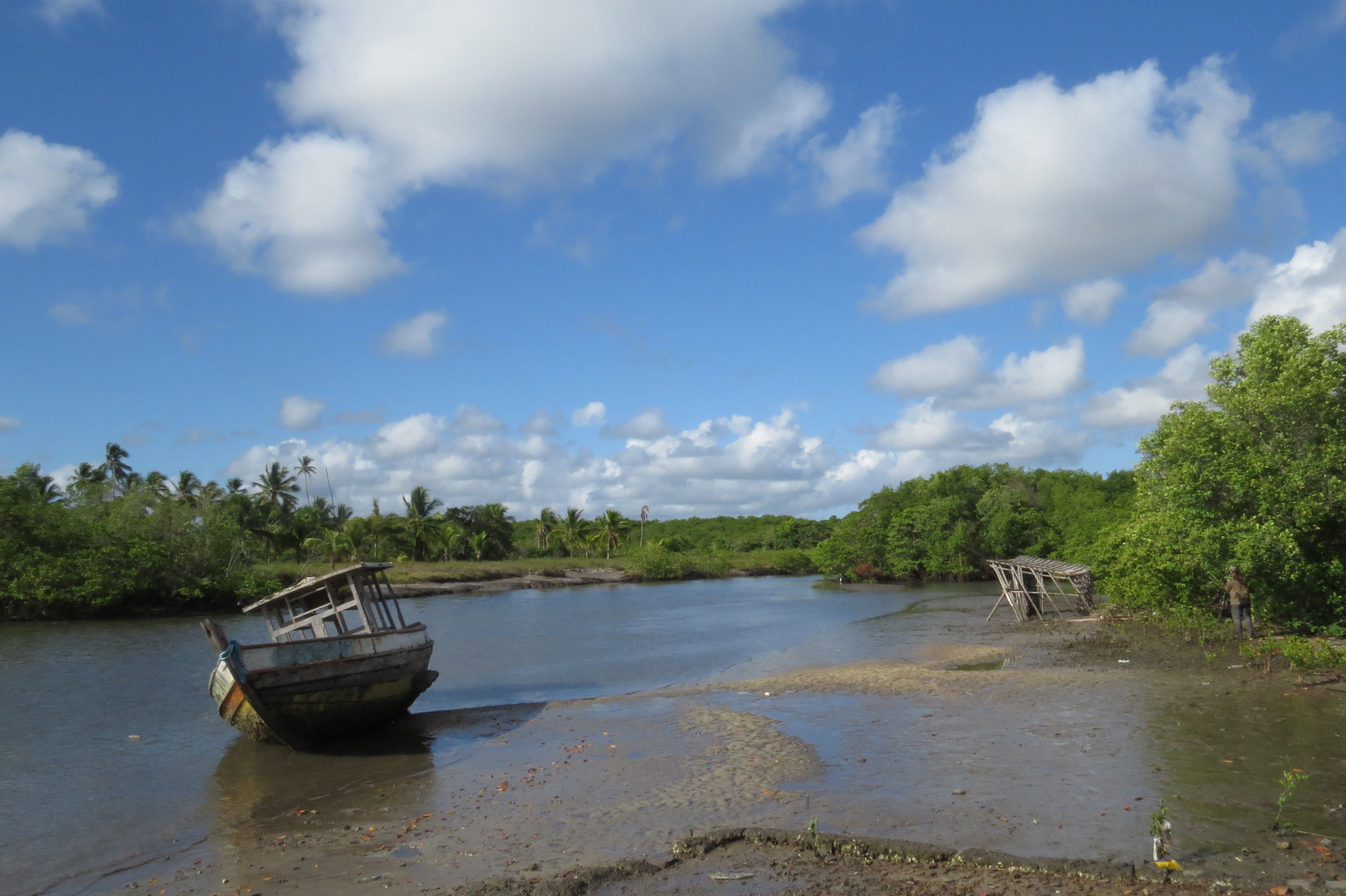
Searching mangroves the following morning we located several of the recently split Mangrove Rails, but they refused to be coaxed from deep cover and remained a ‘heard only’. However a chance encounter with another tour group gave us great scope views of the coastal Rufous Crab-hawk, but it was too distant for decent photos.
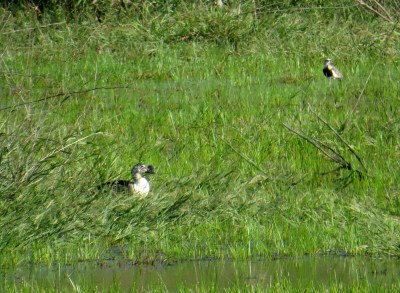
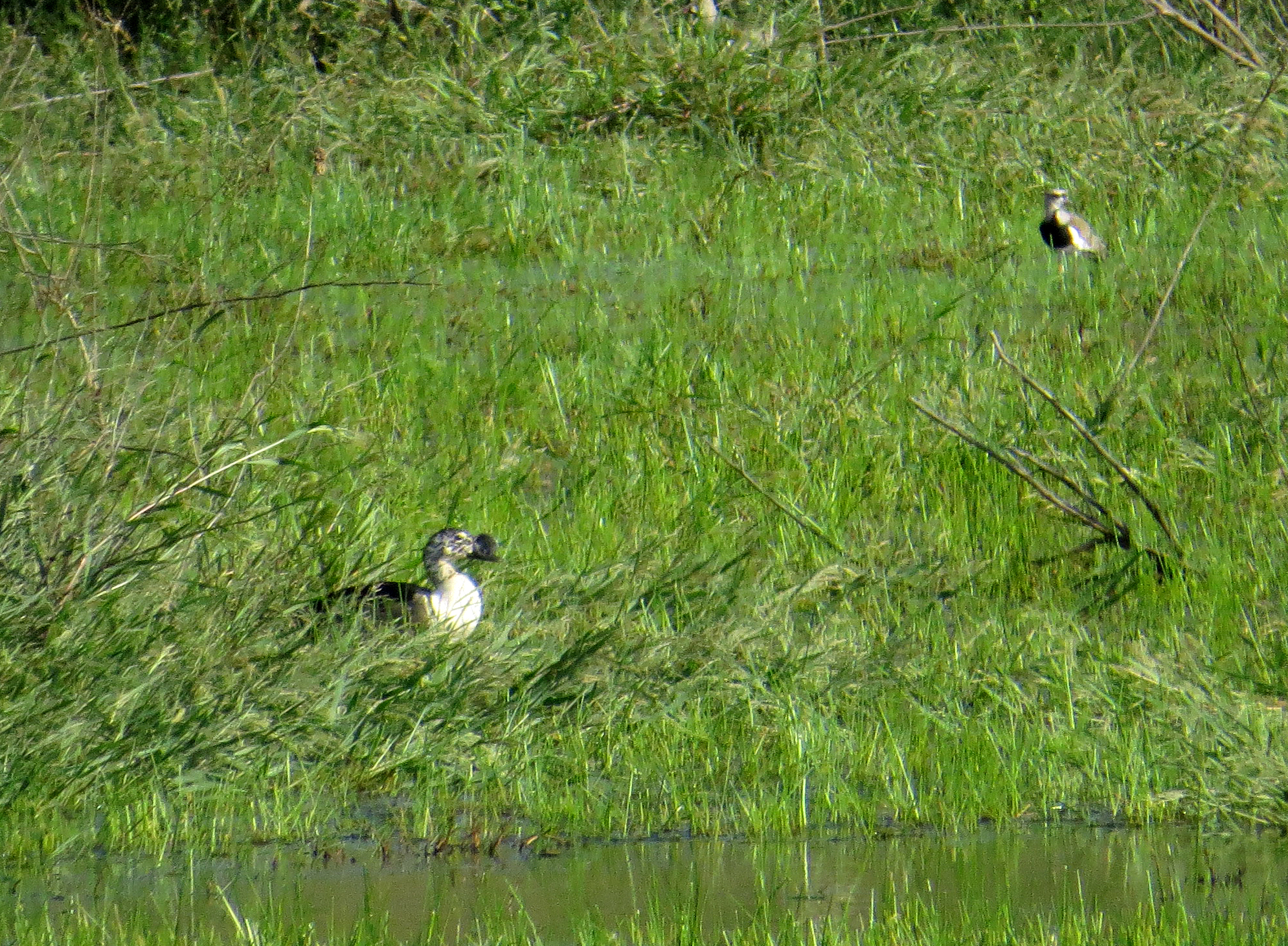
On route we saw the trip’s only Comb Duck, a species recently split from the Old World Knob-billed Goose.

Chestnut-headed Blackbirds frequented these roadside marshes.

Moving back inland, we stayed for a couple of nights in the charming town of Lencois. From here we explored the nearby Chapada de Diamantina and surround caatinga.

You’re not going to be confused as to which is which with these toilet door signs!
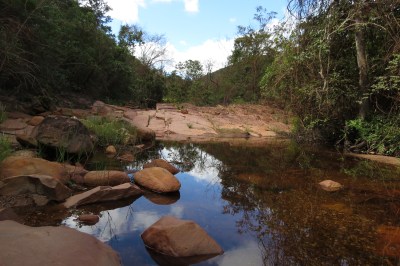
A nearby river valley held two very special birds ….

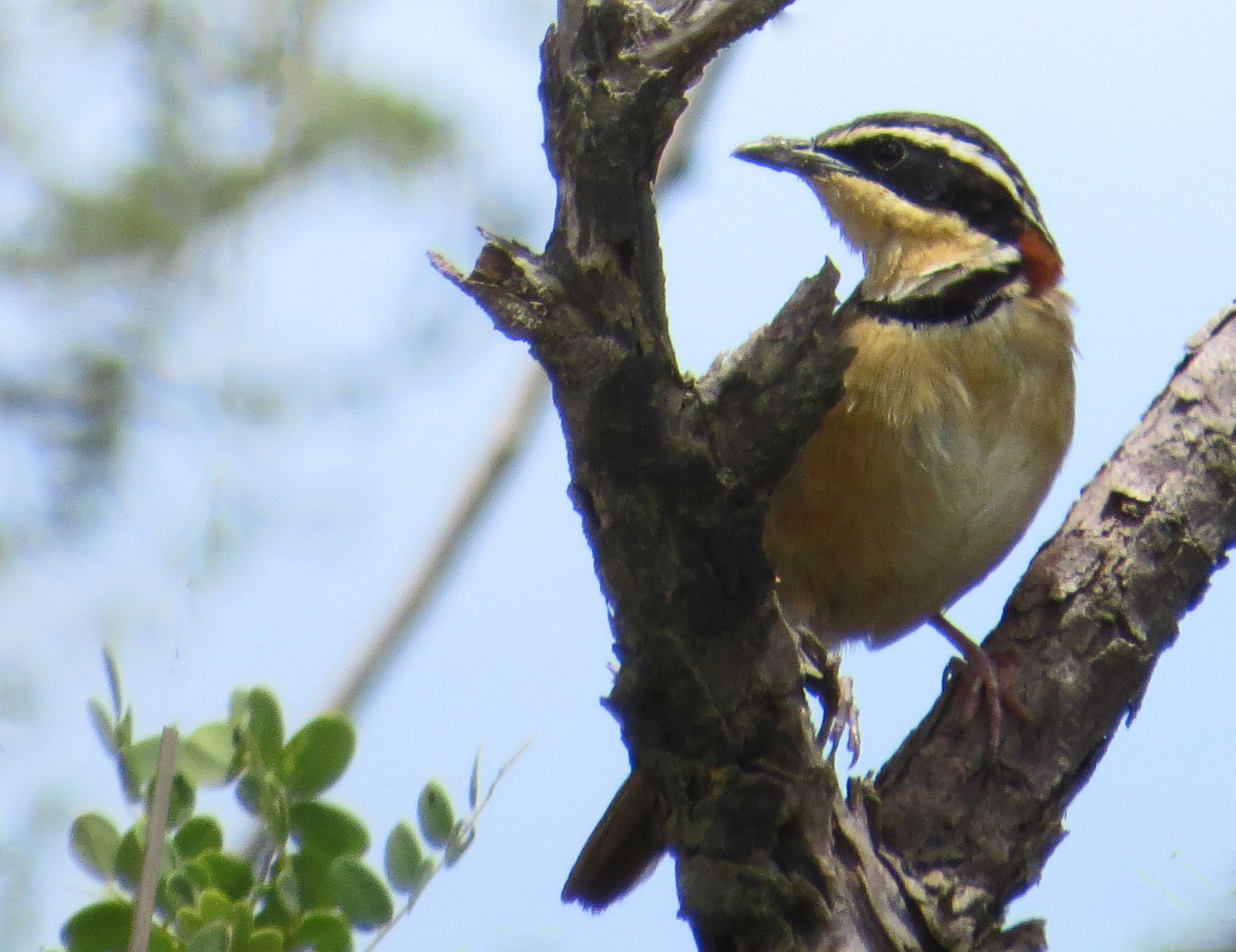
…. Sao Francisco Sparrow, named after the regions largest river ….
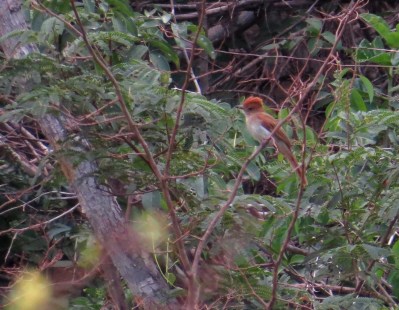
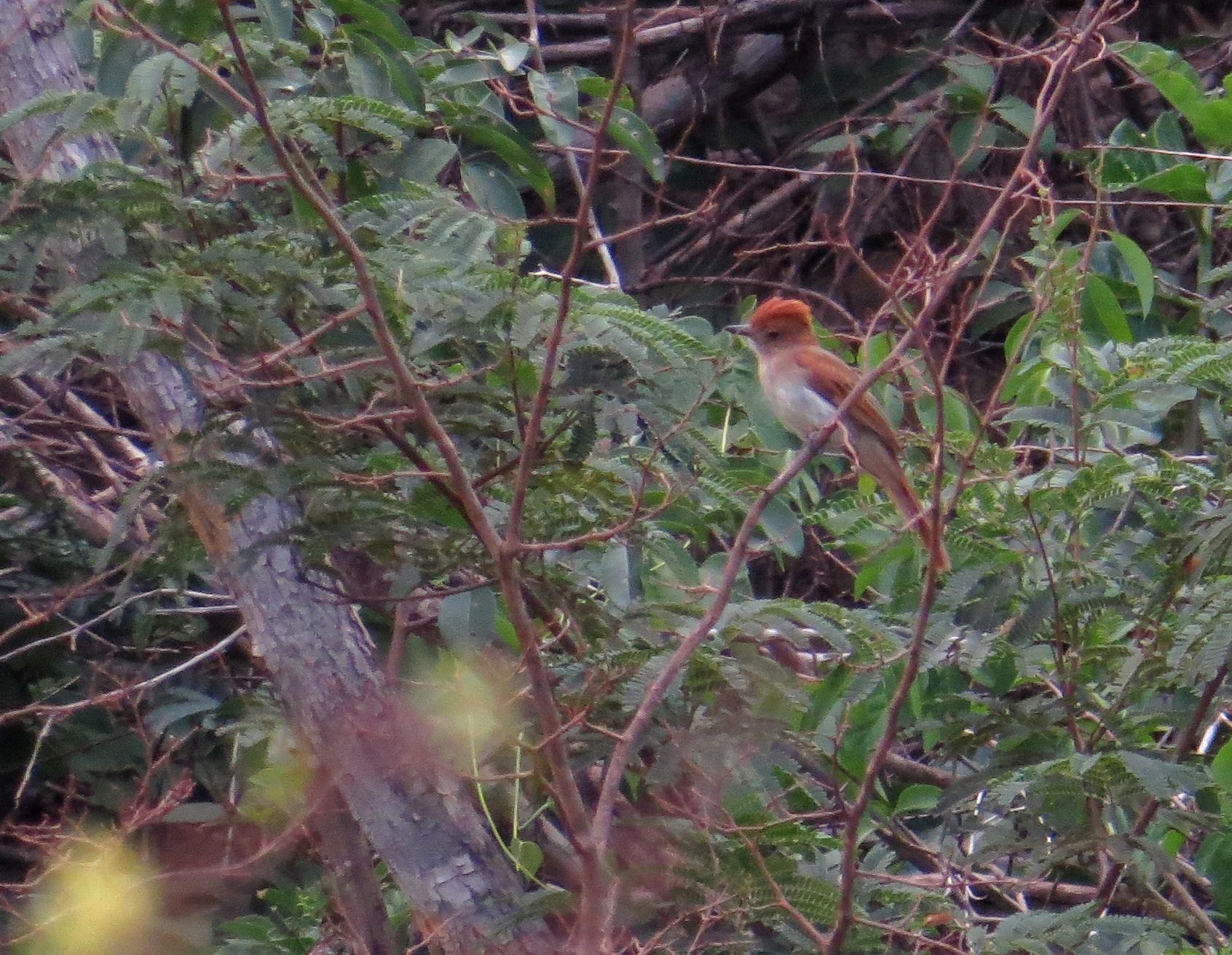
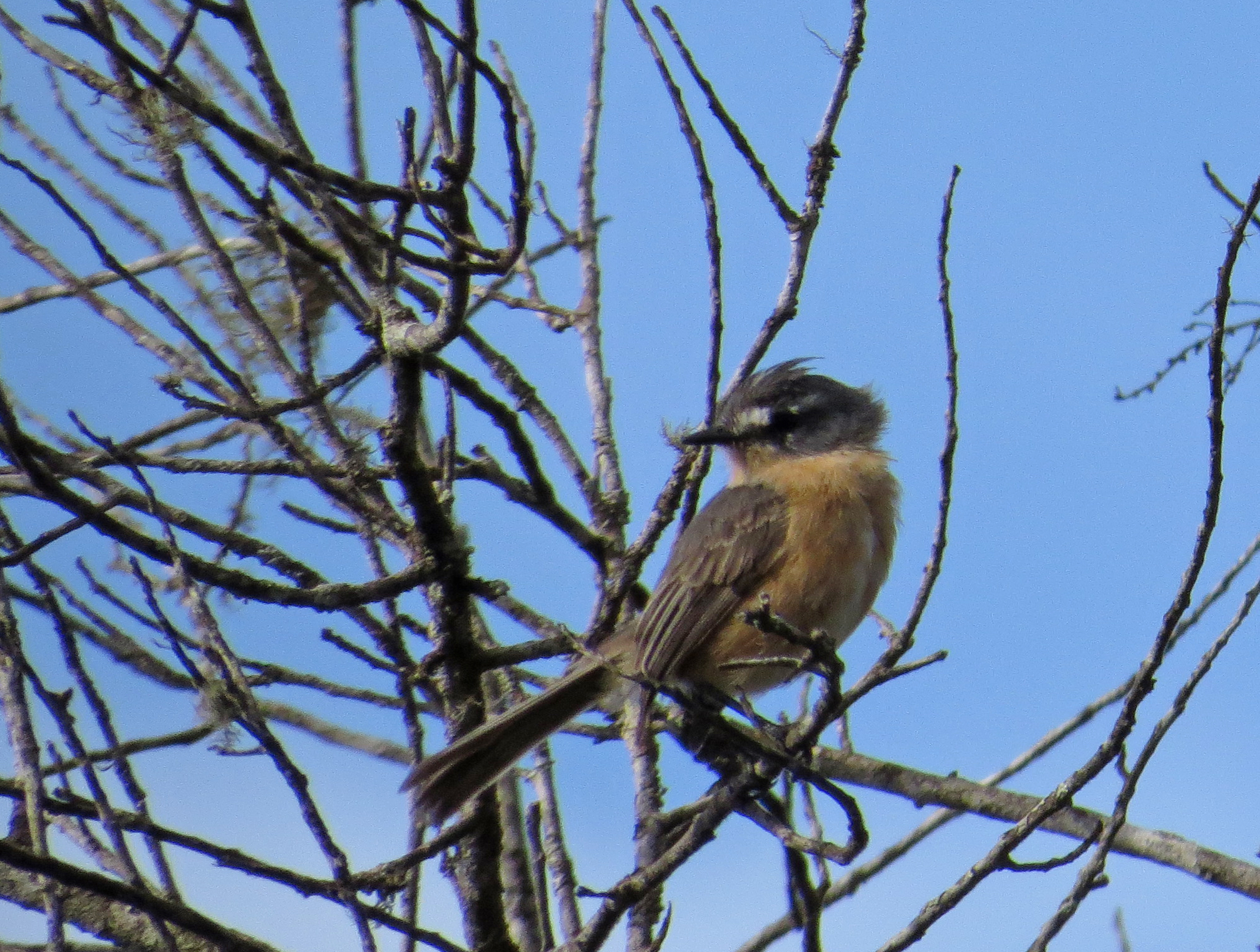
… and Ash-throated Casiornis, a seldom seen tyrant flycatcher that looks more like a furnarid.
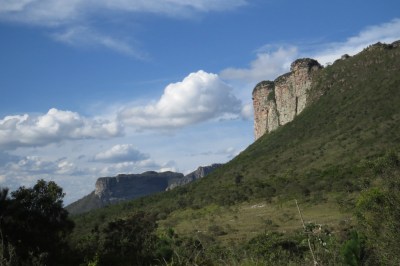
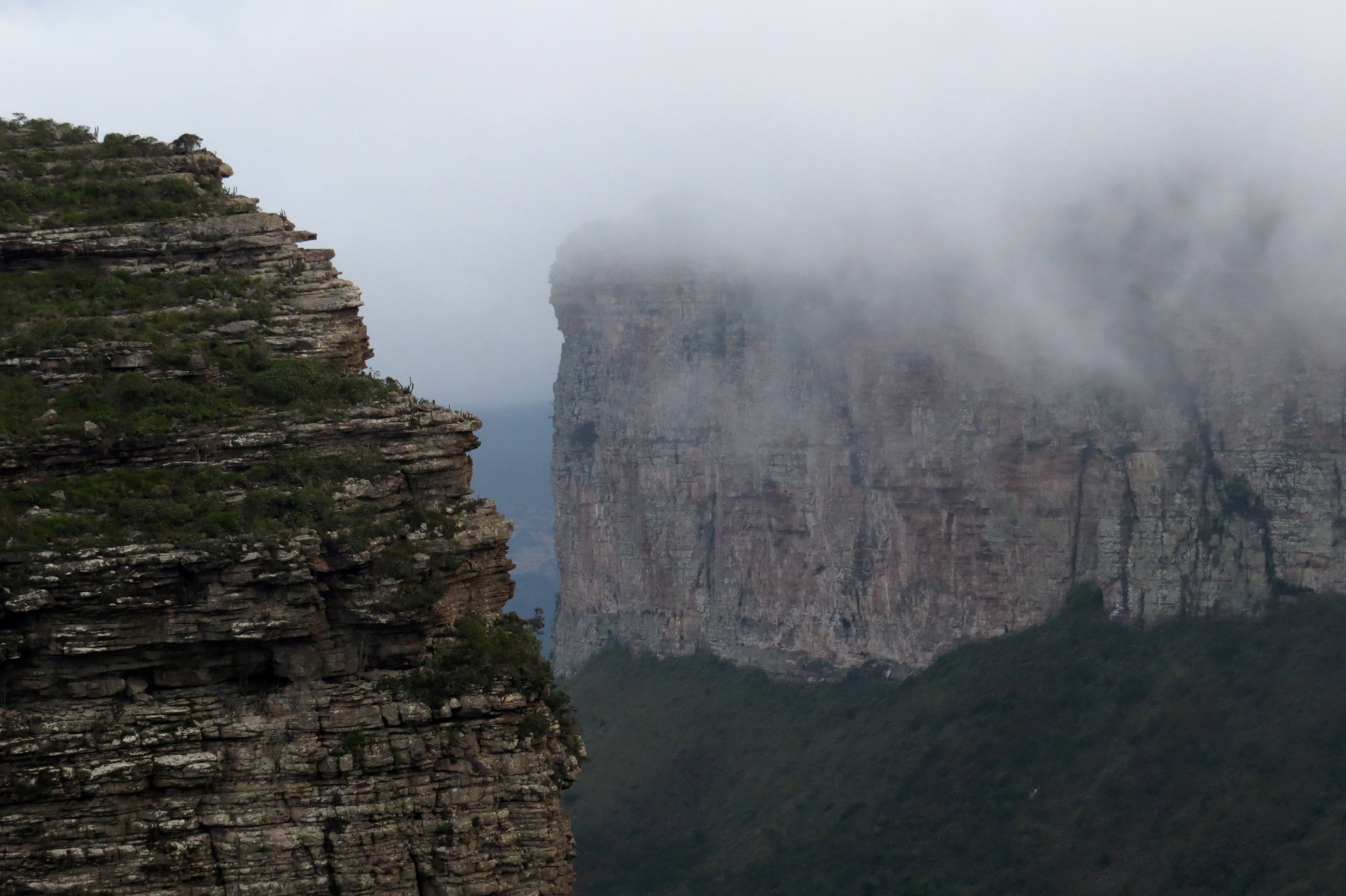
The Chapada de Diamantina consists of many tepui-like rock outcrops and is scenically very attractive.
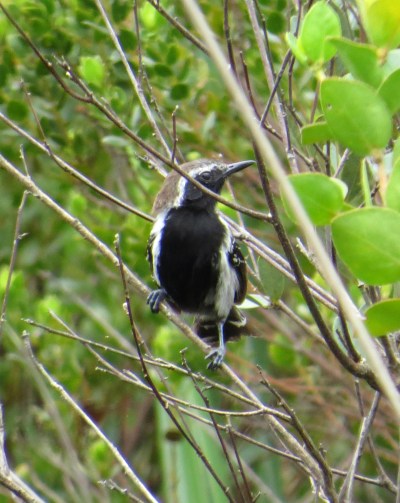
Among the many great birds we saw was Sincora Antwren, a bird described as recently as 2007 ….
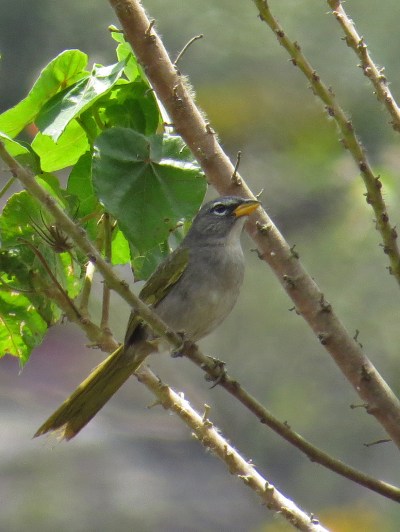
…. and Serra Finch, another eastern Brazil speciality.

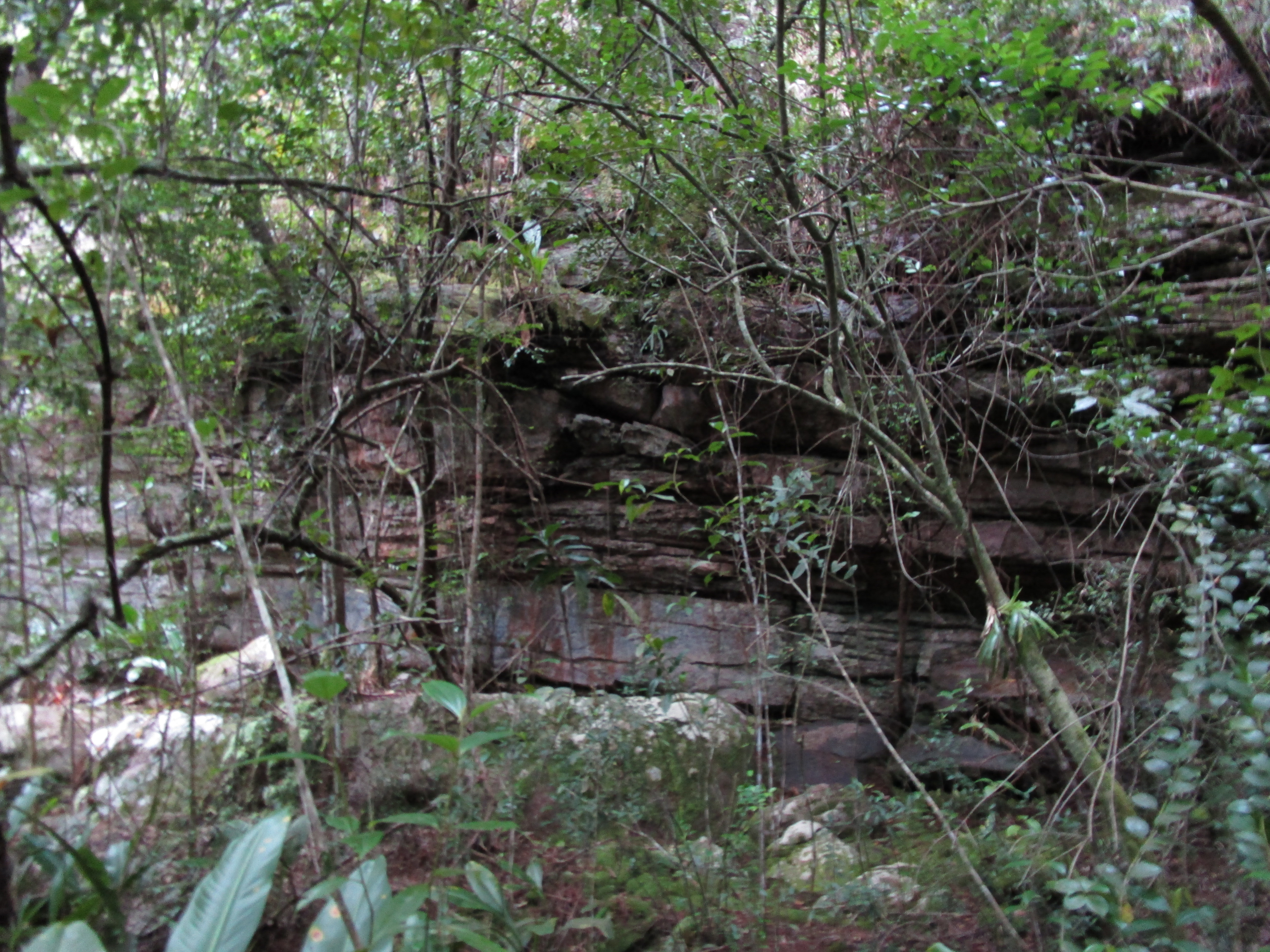
One of the best birds we saw in the area was another recently described species, Diamantina Tapaculo. To get to see this rarity we had to battle our way through thick scrub and climb down into this rocky gully. Our first attempt was unsuccessful, which was frustrating as our leader had already located it on a ‘recce’ whilst we were having lunch, so we knew it was there. But our attempt the next morning was successful, but no pictures were obtained of this little skulker.
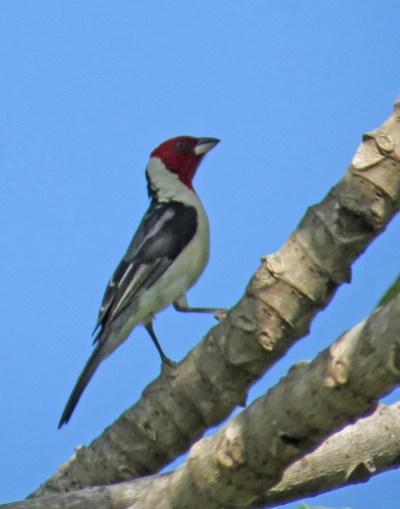
This slightly blurred photo of a Red-cowled Cardinal looks like (but isn’t) something out of John Dunning’s ‘South American Land Birds’. Long before any good field guides existed for South American, JD mist-netted many South American species and photographed them in a special photography cage, complete with a few branches to perch on and a pale blue background to mimic the sky. For a long time this book was the best guide available.
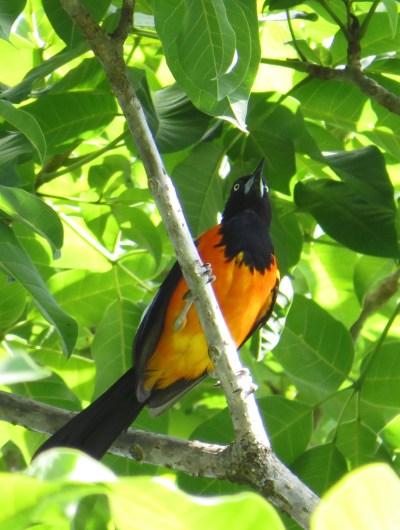
Also endemic to NE Brazil is the Campo Troupial, a species of icterid or New World blackbird.
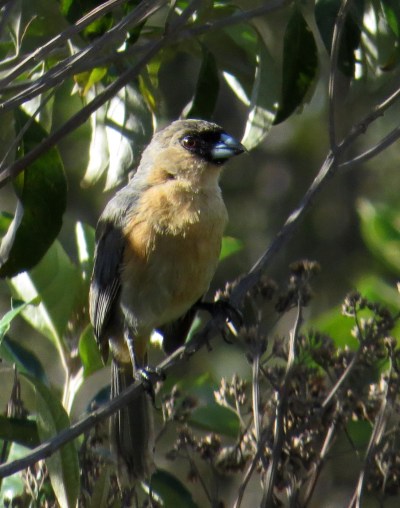
Cinnamon Tanager, another eastern Brazilian bird.
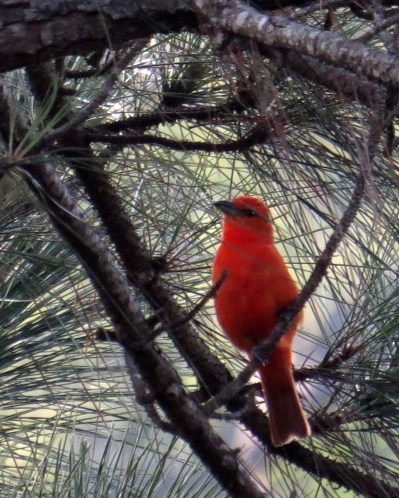
The former Hepatic Tanager has been split into three, the Central American populations which reach as far north as the south-west USA, retain the name Hepatic Tanager, the Andean forms are now known as Tooth-billed Tanager and this, the lowland form, is appropriately known as Red Tanager.
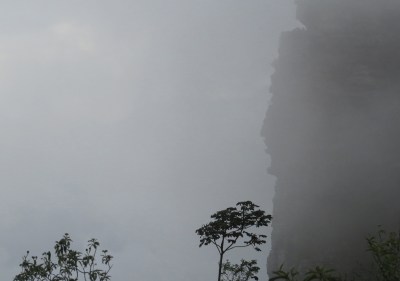
The following morning we climbed high into the tepui-like cliffs of the Chapada de Diamantina, but early morning mist obscured the views.
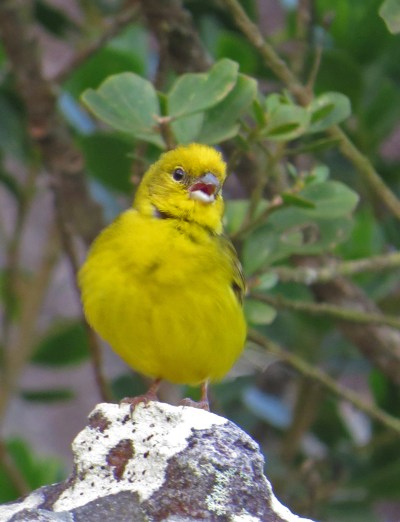
Out targets, Stripe-tailed Yellow-finch ….

…. the beautiful Hooded Visorbearer ….
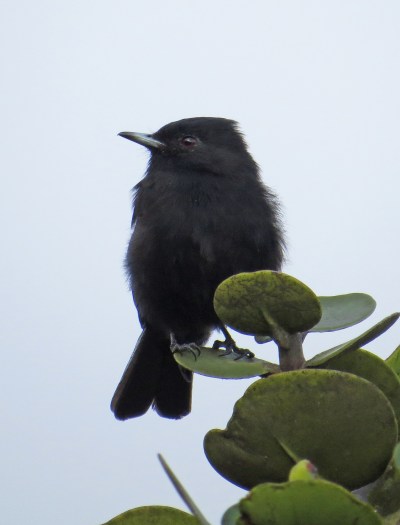
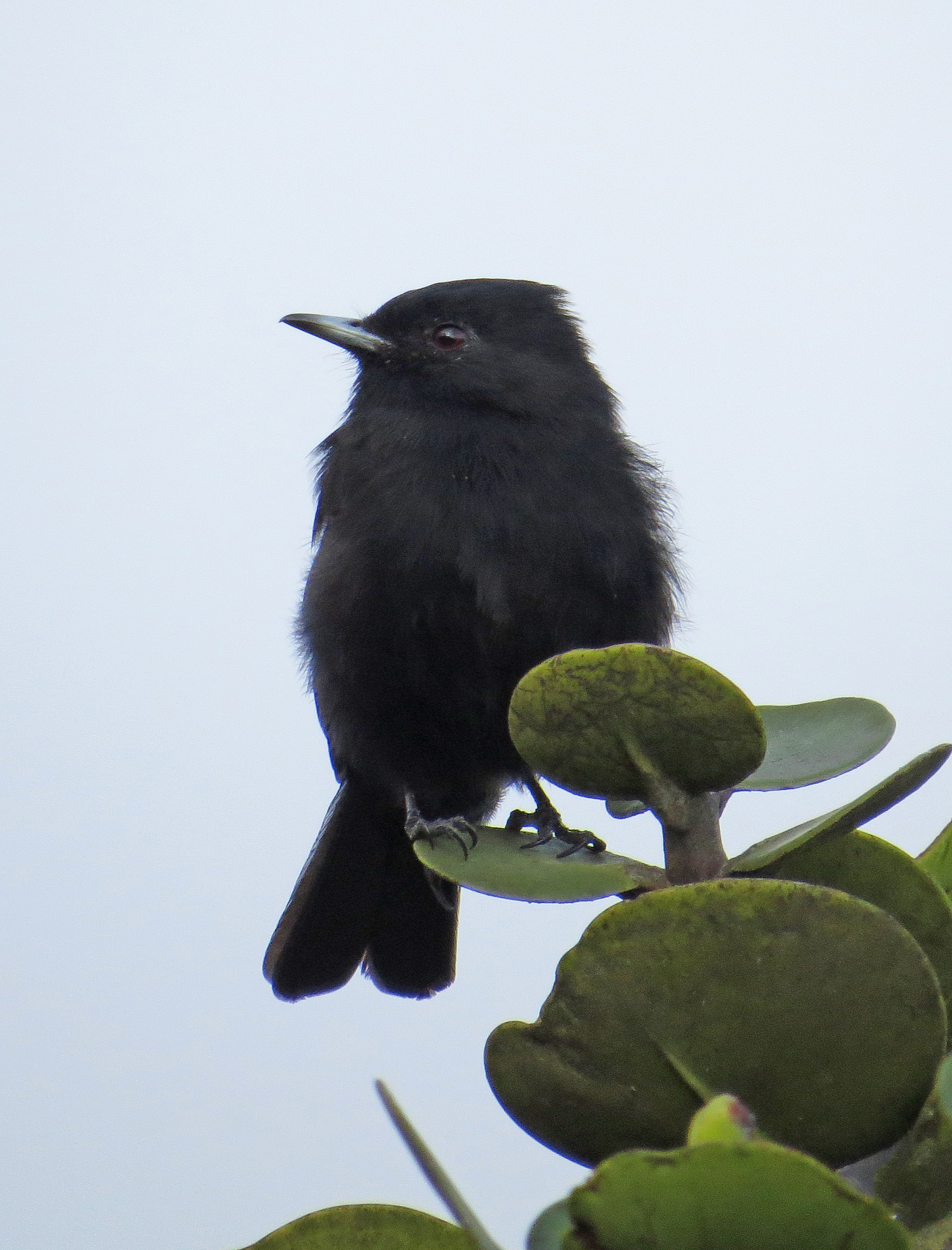
… and the drab Velvety Black Tyrant soon fell.
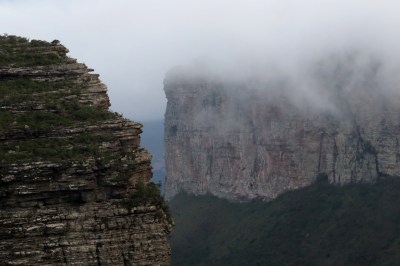
On the way down we found the cloud had lifted slightly, partially revealing the dramatic scenery.
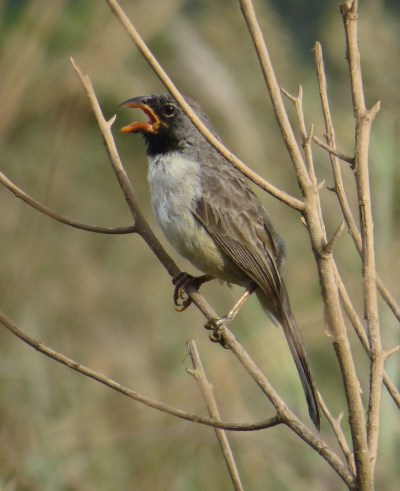
Lower down we found the stunning Blue Finch, but at a considerable distance. However this Black-throated Saltator performed at close range.

The Shrike-like Tanager is just that, a spitting image of the Old World Lesser Grey Shrike, apart from lacking a hooked bill and an evil look to its beady eye.
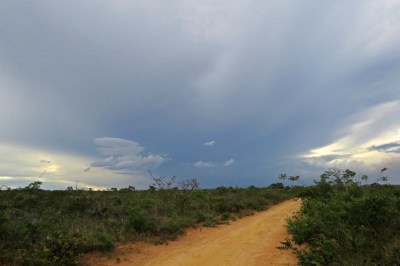
Not far from Lencois we birded an extensive area of caatinga.
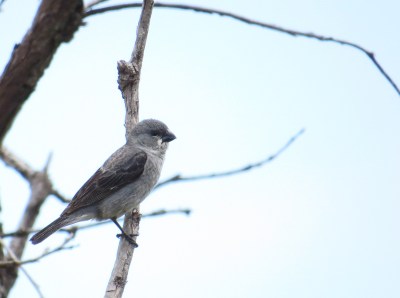
Plumbeous Seedeater was one of many scarce or range restricted seedeaters we were to see on the tour.
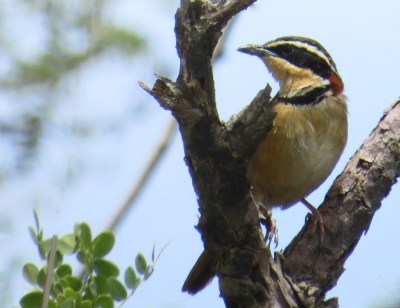
We had great views of Collared Crescentchest. The four species of crescentchest are now considered to be a separate family Melanopareiidae, rather than being included in the tapaculos.
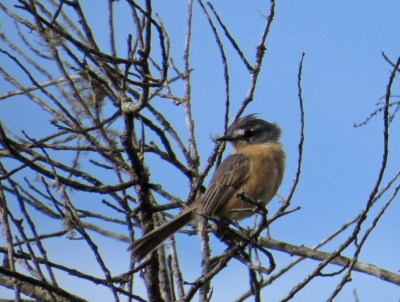
Other goodies included the tiny Grey-backed Tachuri, a diminutive tyrant-flycatcher ….

…. the dainty Sharp-tailed Tyrant ….

…. and some scary looking spiders.
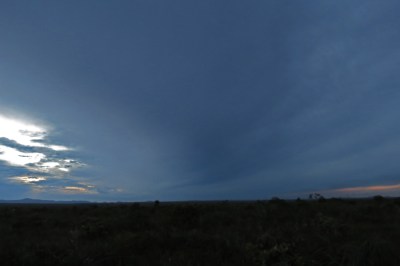
Dark clouds gathered as dusk fell ….

…. but that didn’t prevent an impressive gathering of 15 or so Least Nighthawks.
From here we continued south heading for Mucage and Boa Nova. This will be the subject of the next post.
Most countries allow you to enter without a visa, some make you pay for a visa on arrival (which isn’t really a visa but a type of arrival tax) and others charge you £50 or so for a proper visa, which means sending off your passport and documentation to the relevant embassy and waiting about a week until it is couriered back to you. I have been through this procedure many times, but never had so much hassle as I have experienced recently in obtaining a visa to visit Russia.
I have booked on a boat trip run by New Zealand based Heritage Expeditions to far eastern Siberia in May/June. It should be an excellent trip visiting Kamchatka, the Commander and Kurile Islands and Sakhalin but getting the visa has been far from easy. Once I had the necessary documentation from New Zealand I tried to download the application form from the relevant website, but however hard I tried I couldn’t access the site. Eventually I got a visa and travel company to obtain an application form for me. It took most of one day to gather all the information needed and then once I had all the documentation together I had to go to London to the Russian visa application centre to be fingerprinted. However once there the process was quite quick and (as I paid for the express service) I had my passport back with 48 hours. The whole thing cost about £200, an unexpected cost, but there again if the tour price had been £200 more I’d still have booked!
Margaret came with me and we caught (and almost missed) the 0530 bus to Victoria. We were finished with the visa business by 1000 and opted to spend the rest of the day sightseeing the Tower of London, a UNESCO World Heritage Site, something that Margaret hasn’t done before and that I haven’t done since 1972!

For 33 years of my working life I drove (and sometimes cycled) the three and a half hassle free miles to work. Every time I visit London I am shocked by mass of people crowded into the tube, rail and bus network, all rushing to get to work on time. Every time we go we say ‘what a great place to visit but what a dreadful place to live’. I’m sure there are many of you out there who would fundamentally disagree with that statement, but Dorset, at least away from peak holiday season, is a much more relaxed place to live.

Sandwiched between the modern skyline of Tower Hill, ….

…. the Thames with the Shard rising in the background ….

…. and the imposing Tower Bridge lies the ancient Tower of London.

Once inside the Tower of London, the first sight you come across is the so-called ‘Traitor’s Gate’, so named as it through here that prisoners were brought from a boat on the Thames for confinement in the Tower, although its official title is the Water Gate.

From here, led by a Beefeater, we walked though the Bloody Gate ….

…. into the central courtyard.

…. dominated by the White Tower. The Tower of London was first built by William the Conqueror in 1066, the White Tower dates from 1078. The Tower was originally built for defense and to dominate the Saxon population following the Norman invasion. It has been fortified as recently as WW II.

Being a nice and sunny, if cold day in the middle of the half term break, the place was packed with tourists.

Tours given by the Yeoman Warders, known for unknown reasons a ‘Beefeaters’ can be highly entertaining. Of course he concentrated on the more grisly details such as the disappearance of the Princes in the Tower in 1483, supposedly murdered on the command of their uncle Richard III or the various executions that have occurred in or near the Tower.

On or near this spot, three Queens of England, Anne Boleyn, Catherine Howard and Lady Jane Grey plus four others were beheaded. Only those close to the monarch were executed here, most ended their days at nearby Tower Hill where 112 people were executed prior to the 20th century. During both World Wars a number of spies faced a firing squad in the Tower.

To the right the White Tower, at the back the HQ of the Royal Regiment of Fusiliers and to the left the Waterloo Barracks, now the home of the Crown Jewels.

Sentries on guard outside the Waterloo Barracks.
Photography is not allowed inside the so the next two photos are taken from the internet. We joined a very long line to see the jewels, such is the press of tourists that to see the Crown Jewels you have to stand on a conveyor that takes you slowly past the display cabinets. The quantity of precious stones and gold items is just staggering. The Crown Jewels have resided in the Tower since the time of Henry III (1216 – 1272) however the original Crown Jewels were melted down in 1649 during the English Civil War and were recreated in 1660 when the monarchy was restored.

The Imperial State Crown as worn by Queen Elizabeth on her coronation

Crown Jewels in their display cabinet.

The Tower of London was once a royal menagerie. Henry VIII was given a Polar Bear by the King of Norway, this is now represented by a Polar Bear model made of wire.
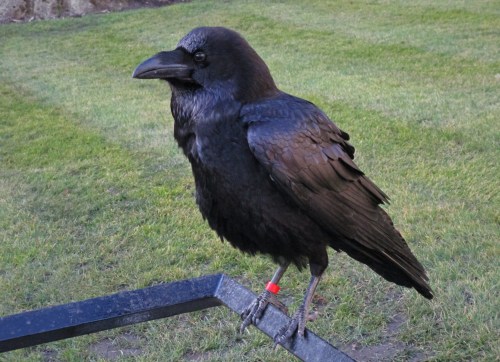
Of course there is the story that is the Ravens ever desert the Tower of London then the monarchy will fall. Just in case the birds are all pinioned!

Perhaps the most famous use of the Tower of London was that of a prison. Many captives were held in Beauchamp Tower and many of the prisoners carved inscriptions on the walls. Some of the graffiti consists of just the prisoner’s names but others are extremely elaborate, for example that of John Dudley, 1st Duke of Northumberland, executed in 1553 for his part in the attempt to place Lady Jane Grey on the throne following the death of Edward III. The Tower has been used as a prison as recently as WWII when Nazi Rudolph Hess was confined here.

The Tower was also the Royal Mint from 1279 to 1809 when the Mint was moved to an adjacent site in East Smithfield. Ahead of planned decimalisation, it was moved to larger premises in Llantrisant in South Wales in 1968.

As well as being a prison, a mint, a royal residence, barracks and a menagerie, the Tower has also been the home of the Office of Ordnance and Armoury. Within the White Tower is a collection of armour and weaponry some of which has been on display for centuries, making it the Britain’s oldest tourist attraction ….

…. many of the suits of armour were worn by royalty. This suit was made for Henry VIII, but some are clearly fanciful, one suit said for centuries to belong to William the Conqueror has now been identified to be of a style that wasn’t introduced until hundreds of years later.

The Medieval Tower adjacent to the Thames are one of the oldest parts of the Tower and have been recently restored.

Many of the artifacts date back to the time of the Plantagenets.

Re-enacting history for the kids.

After a final look round the World Heritage site we had to leave ….

….and as the sun set behind the Shard, catch the Tube to Victoria and get the bus back to Dorset. What I expected to be a day spent hanging around getting the Russian visa sorted, turned out to be a great day out with a fantastic insight into England’s complex history.
During the last week I have rather busy with paperwork and all of Wednesday was taken up with a trip to London (see next post) but we have got out a few times for birding or ringing.
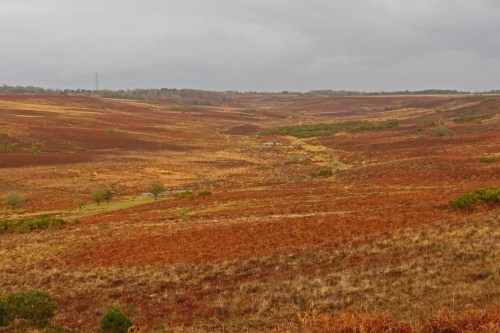
On the 16th we went to Blashford Lakes near Ringwood but saw little of note. It appears that many waterfowl are already leaving for their breeding grounds. Winter seems to be getting shorter every year, which might sound like a good thing, but isn’t from a birding perspective. Later we continued to an area of the New Forest where Hen Harriers are known to roost.

Surprisingly, in spite of staying until dark we didn’t see any harriers but a Merlin put on a good show as did this herd of Fallow Deer.

This is a bachelor herd of about 25 males. Unlike Red Deer which shed their antlers after the rut in November, Fallow Deer (a species introduced to England by the Romans) shed their antlers in April/May.

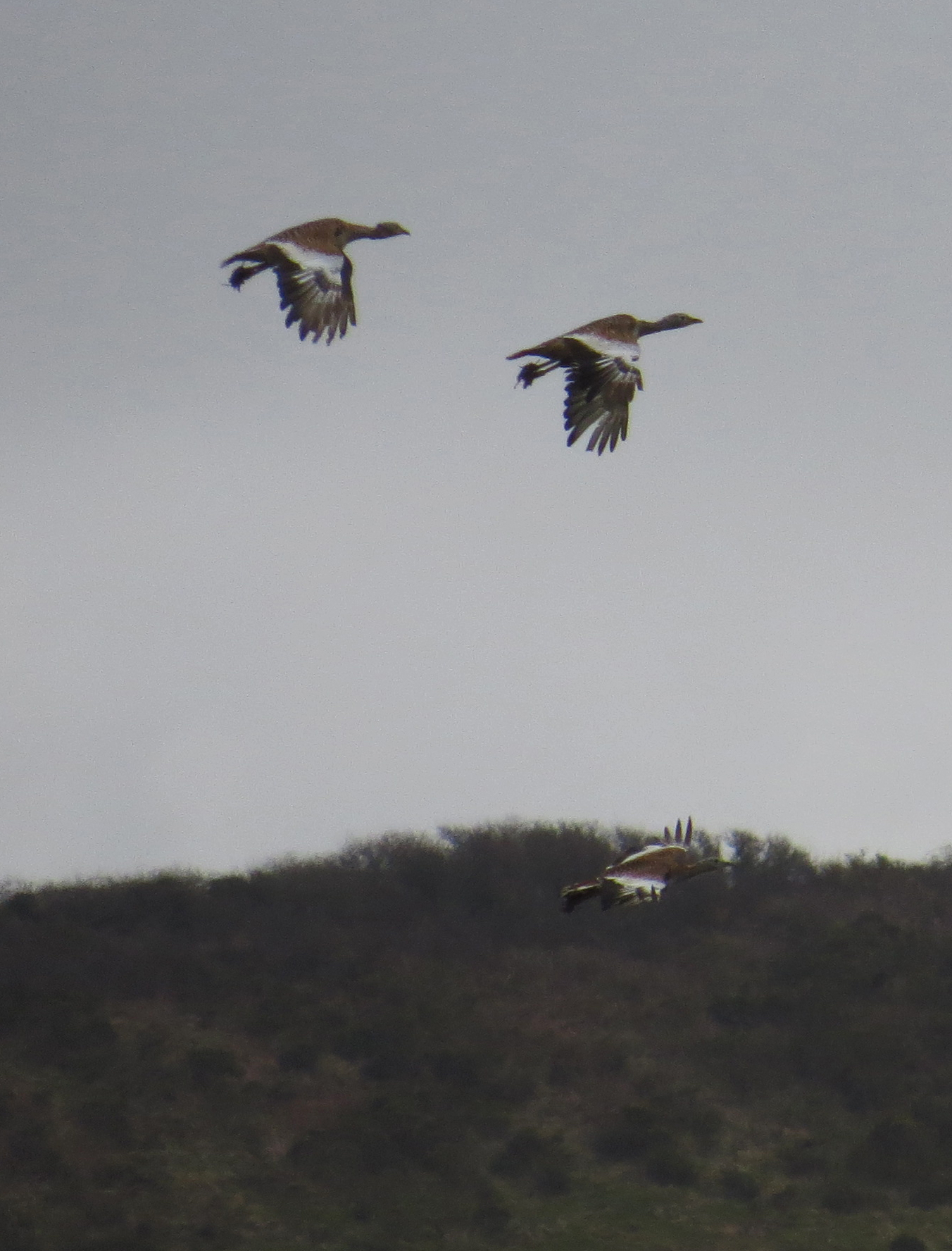
We had heard that three Great Bustards were spending the winter along the Purbeck coast. These birds are from the re-introduction program on Salisbury Plain, an ambitious and worthwhile project which is returning this magnificent bird to its former home. On arrival on the morning of the 22nd we saw the birds in the distance but after a while they took off and flew towards us…..
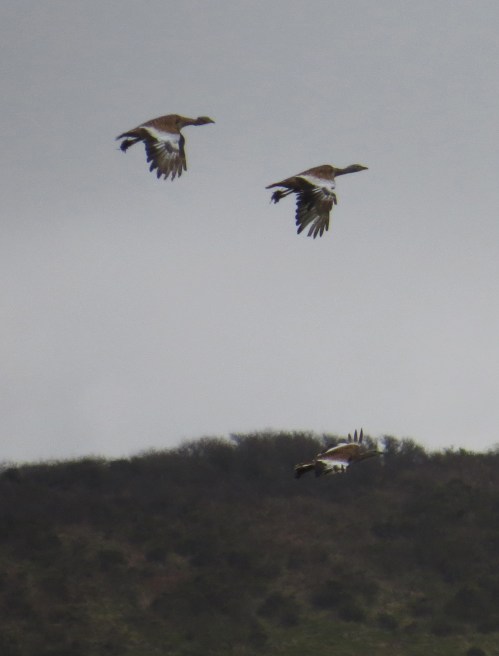
…. giving good flight views before settling in an other field. An adult male Great Bustard is one of the heaviest flying birds in the world. As far as I am aware this group consist of an immature male and two females. I really hope that this enormous, stately bird becomes re-established (the native population was shot out in 1832) and that winter occurences in Dorset become the norm.

We continued on to Mordon Bog/Sherford Bridge area where we met a couple who had just relocated the highly elusive wintering Great Grey Shrike. Two or three Great Grey Shrikes have been found this winter in Dorset with the same or slightly more in the New Forest, however they are often elusive and highly mobile, often flying for half a mile or so before perching. Our views were distant and brief so I have included a photo of another distant, but more co-operative individual, that I photographed in the New Forest in 2012.
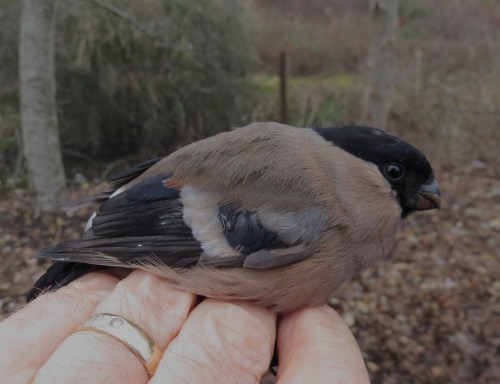
I spent a morning ringing at Holton Lee on 17th and Feet’s Lane on 21st. The former was predictably busy with common species like tits, Nuthatch etc trapped. After four winters of ringing there we are building up an interesting picture of the site fidelity and longevity of the birds, with retraps of several individuals that were hatched in 2011 or earlier. This female Bullfinch was ringed at Fleet’s Lane. The grey, brown edged alula and primary coverts indicate it is a first year bird, however the best ageing characteristic is brown edging to the carpal covert, a small feather that can only be seen on the closed wing.

We also retrapped a Firecrest that had been ringed earlier in the winter at Fleet’s Lane showing that it is remaining site faithful throughout the winter.

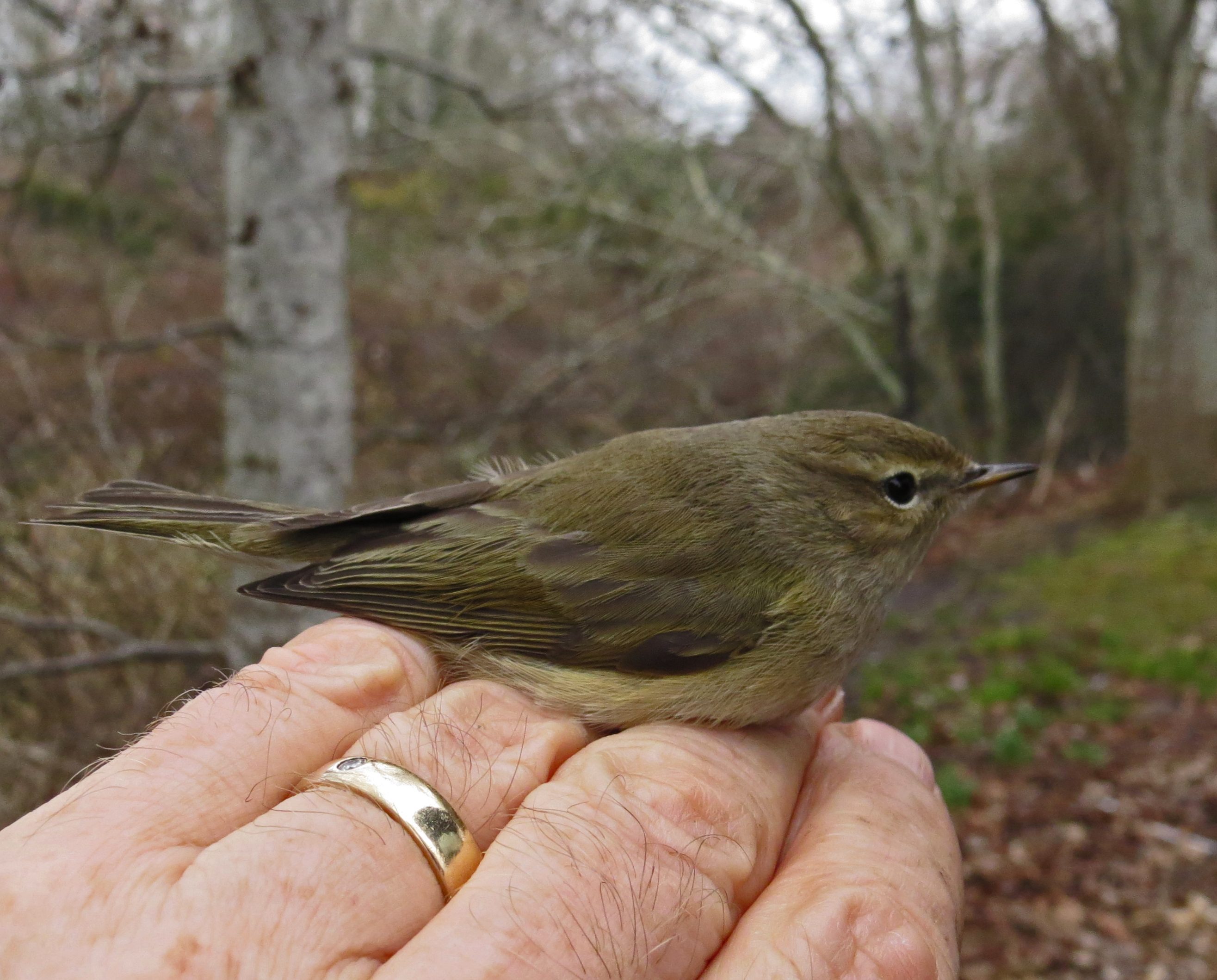
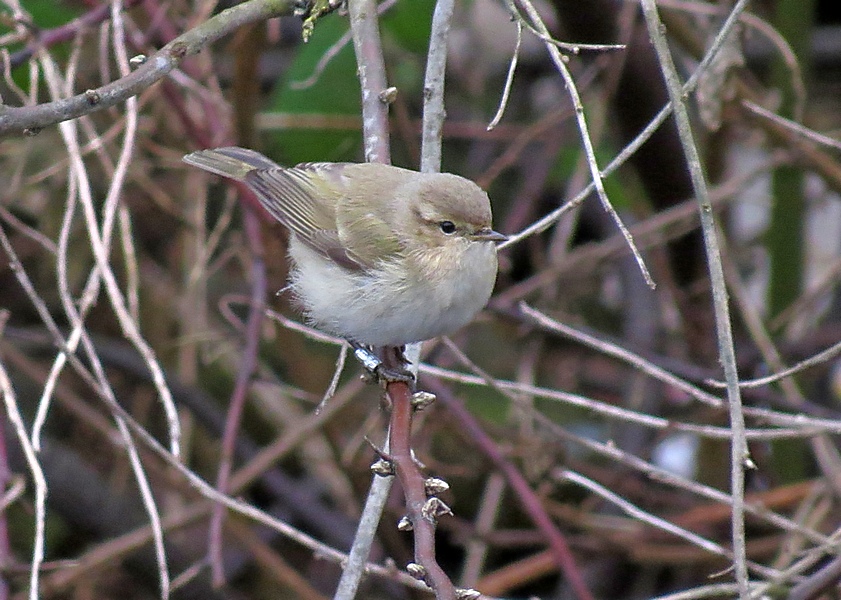
Our main reason to ring at the Fleet’s Lane site is to study wintering Chiffchaffs. Chiffs, normally a summer visitor arriving from late March onwards and departing from September to October, have become an increasingly common bird in winter. Nobody knows if the wintering birds are British breeders that have opted to stay for the winter or migrants from elsewhere. We have retrapped three or more birds over a number of winters, showing winter site fidelity and have failed to retrap wintering birds after March indicating that they depart to breeding grounds in spring. This individual is typical of the nominate western European race colybita.
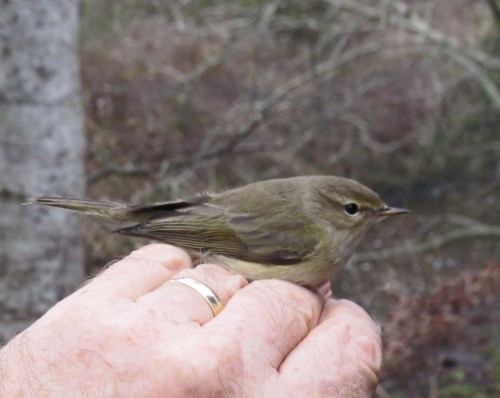
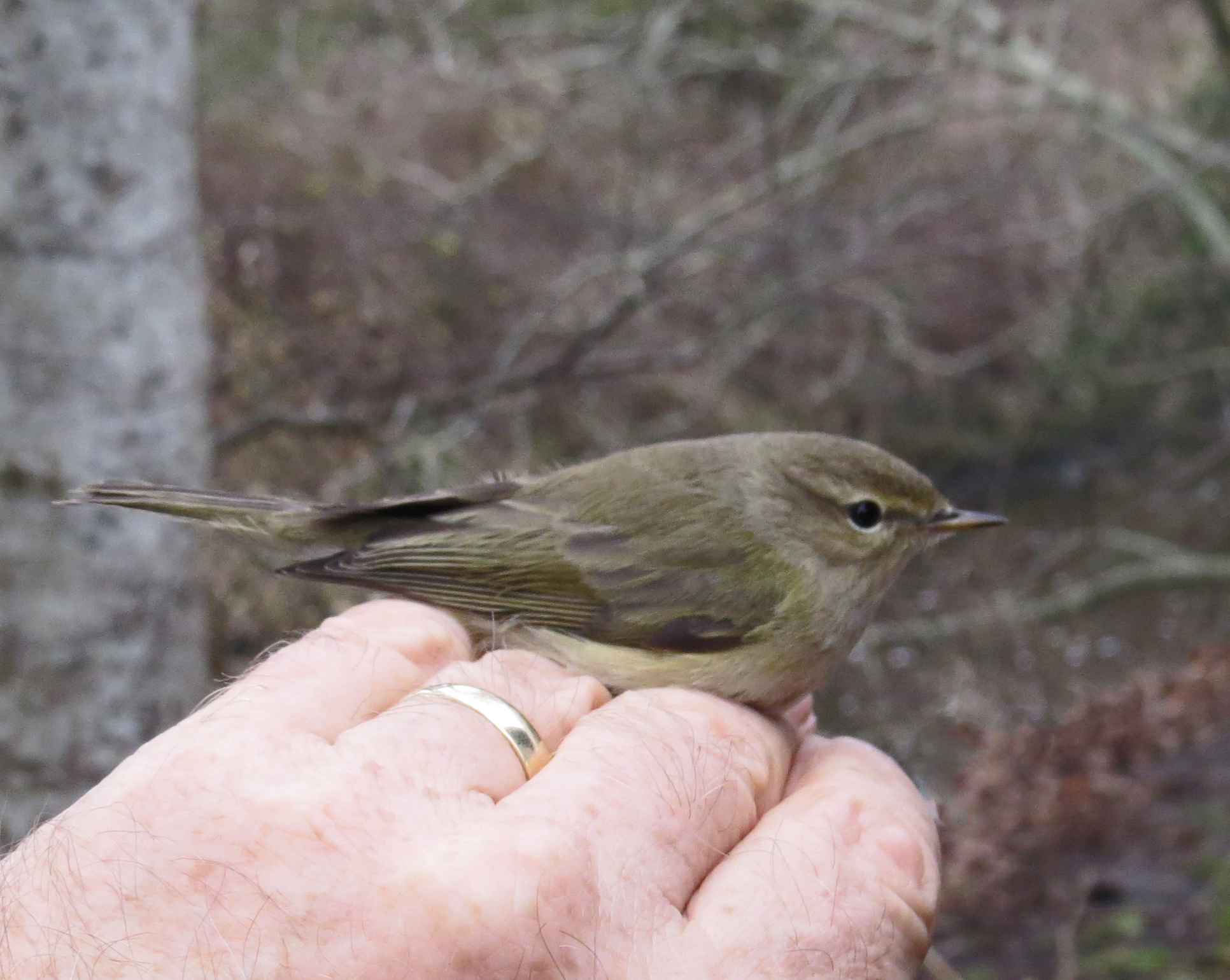
This individual is slightly duller but is still typical of colybita …..

…. but this bird, photographed by Ian Ballam and used here with permission, is more typical of the Siberian race tristis. I presume that this bird, which is still showing well, is the individual ringed by others in our group on 27th January. The grey tones to the upperparts, pure white belly, very fine wing bar and green edging to the primaries all indicate tristis. If it is the same individual then it was sound recorded on the date of ringing and shown to give the characteristic lost chick call of tristis. So we know that at least some of the Chiffchaffs that winter in the UK come from the eastern side of the Ural mountains, the cloest breeding grounds of tristis. Some consider tristis to be sufficiently differentiated to be considered a separate species.
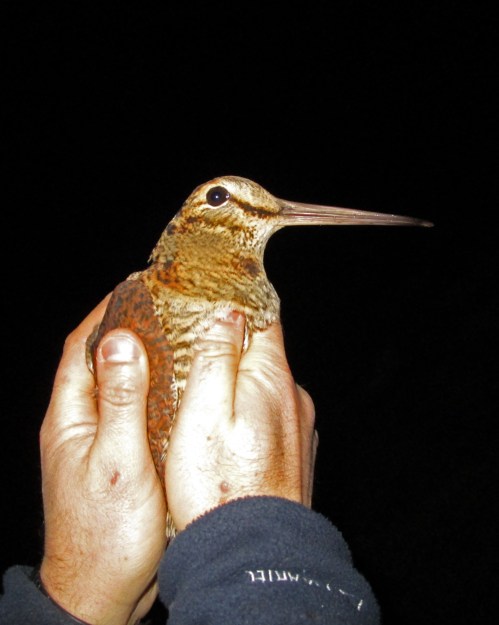
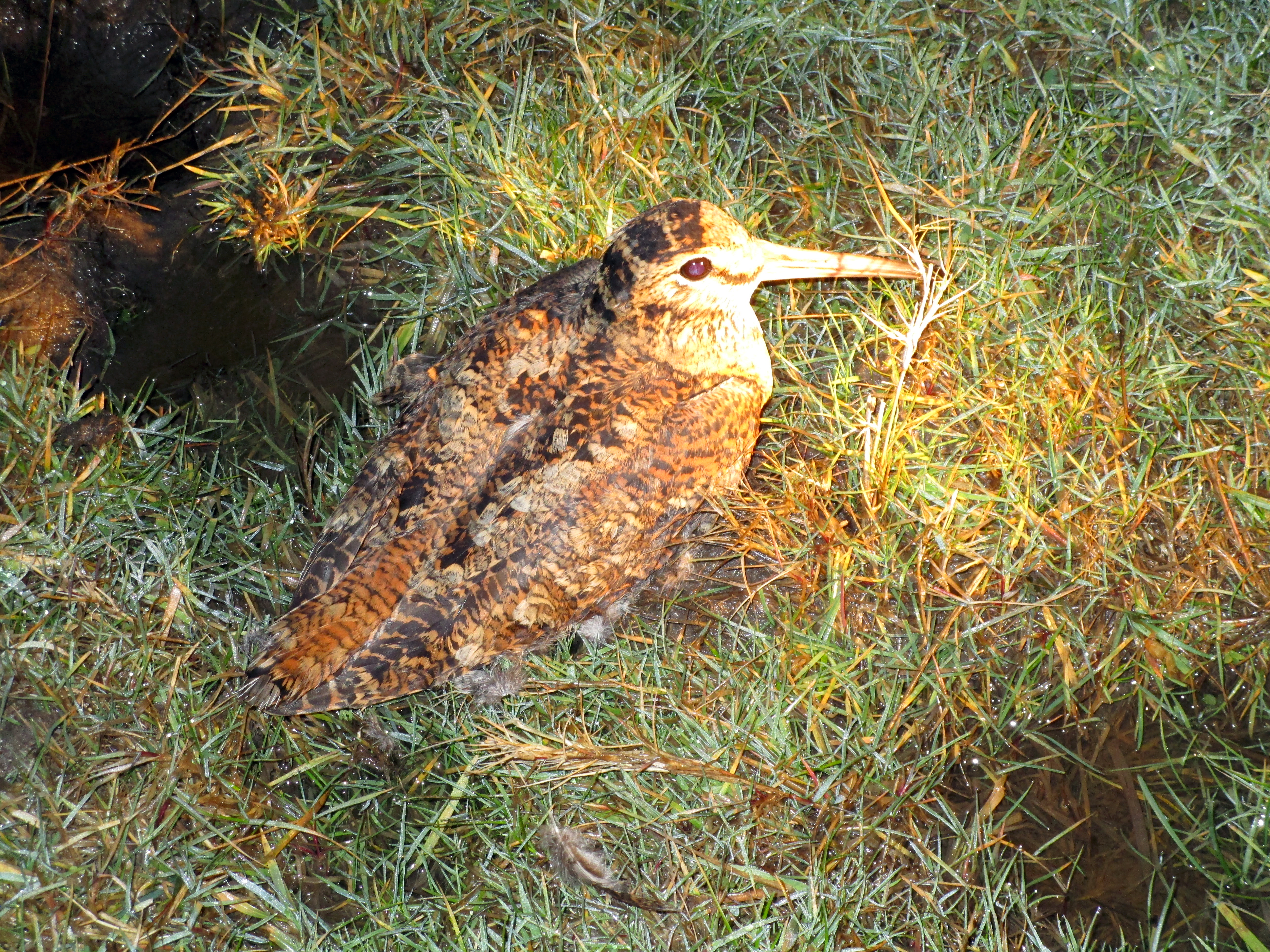
The only other ringing I have done this week is joining one of other group members near Corfe Castle catching Woodcock at night . This is a very interesting species to ring, as the breeding grounds can be far to the east in Siberia, even on the same longitude as Burma (but of course much further north). As Woodcock are regularly shot for food, both when wintering in the UK and on migration , then the ringing return rate is high.

Sometimes after processing the birds can be placed on the ground and remain still for long enough for photos to be taken.
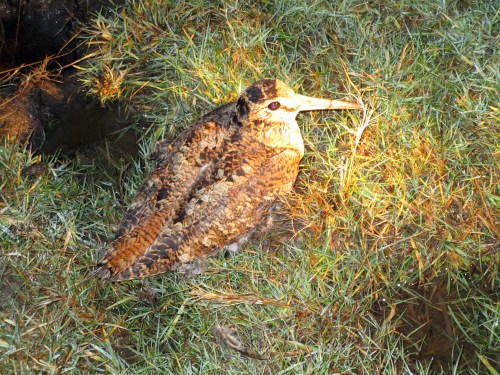
We ringed two individuals and saw at least 15, however most flew long before we could get near them. We also saw a Jack Snipe which stayed hidden until the last-minute before erupting at our feet.
As I mentioned above, Wednesday was spent in London, after the necessary tasks were performed, Margaret and I spent the day in the Tower of London where the pinioned Ravens performed for the crowds. More of our visit to the Tower in the next post.

This was the sticker on the wall of our accommodation at Canudos in the state of Bahia in Brazil, however we hadn’t come all this way to see Hyacinth Macaw, which occurs in the Pantanal in the far south-west, but its near relative Lear’s Macaw.
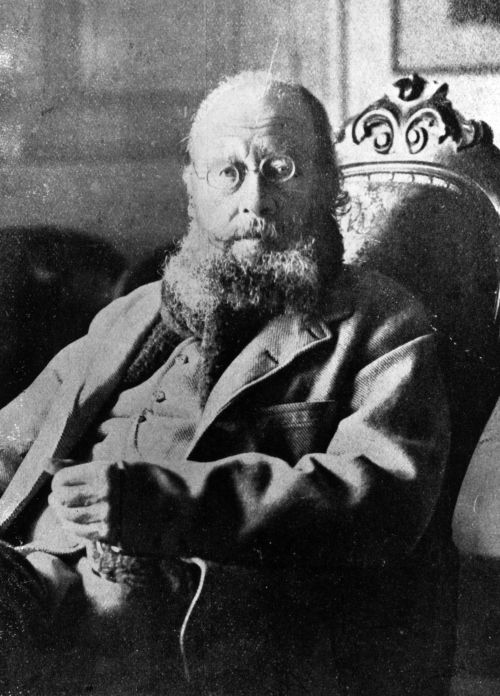
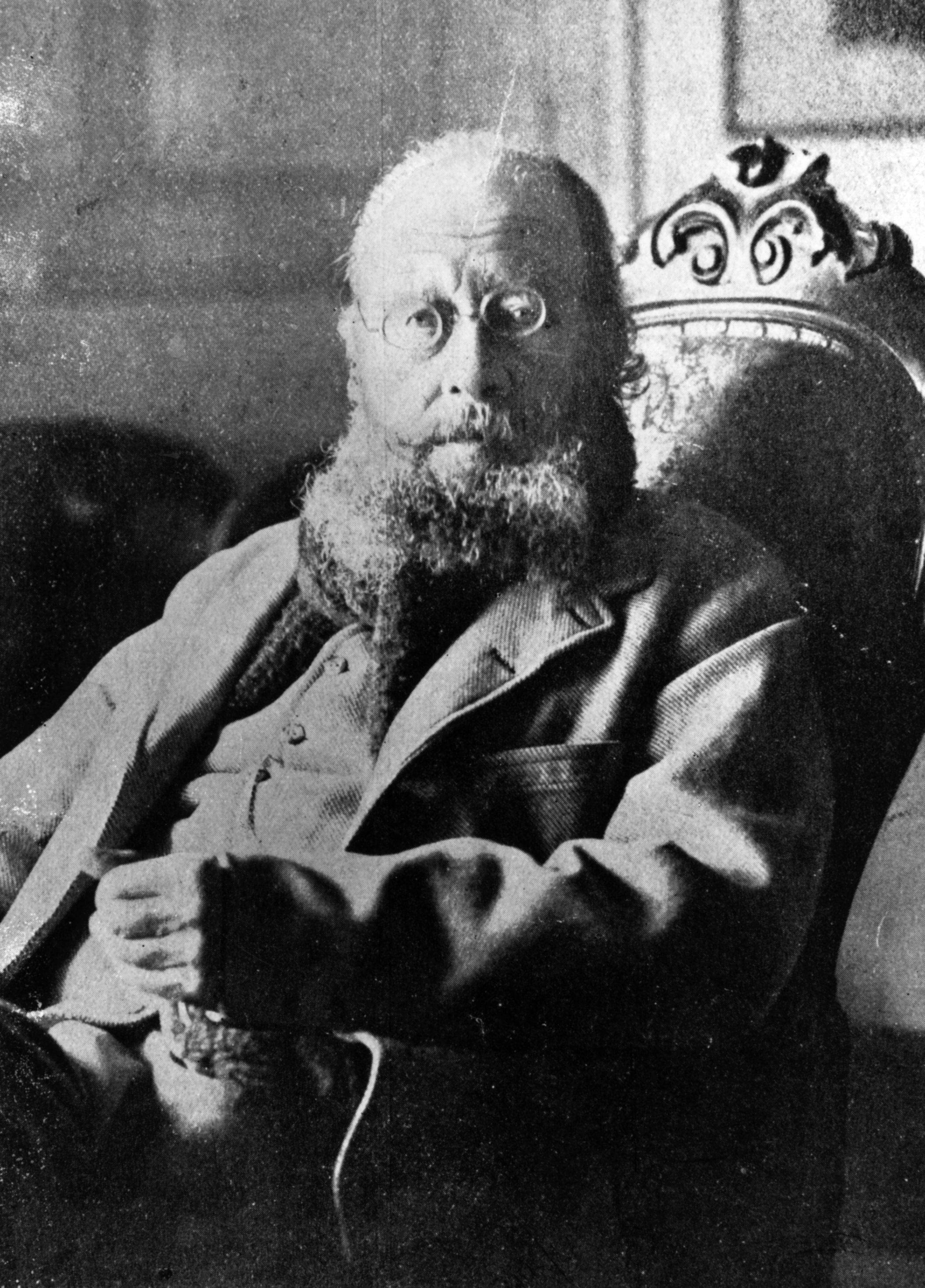
Many birds are named after people. Often these are the discoverers of the bird or ornithologists who the describer feels needs recognition. but only seldom are birds named after people who are more famous for their activities in other fields. There are a few exceptions, some birds are named after royalty (for example King of Saxony Bird of Paradise) and Allan Octavian Hume (1829 – 1912) is better known as a political reformer and the founder of the Indian National Congress than for his extensive work on the birds on India. Another Victorian ornithologist better known for his non-ornithological work is Edward Lear (1812 – 1888). Picture from Wikipedia.

Lear, of course, is best known for his comic poems and short stories, including the ‘owl and the pussycat’ and ‘a book of nonsense’, a collection of limericks. He was also a talented artist and was employed by the Zoological Society as an ‘ornithological draughtsman’. Picture from Wikipedia.
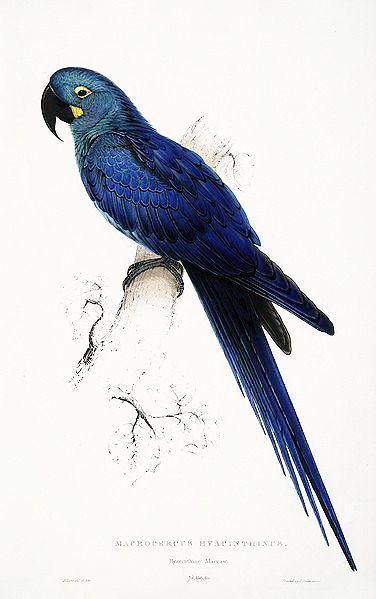
He painted many birds including the illustrations of the Family of Psittacidae, or Parrots in 1830, which contained this picture, thought initially to be either a Hyacinth Macaw or the now extinct Glaucous Macaw, but later recognised to be a species in its own right and named Lear’s Macaw Anodorhynchus leari after it’s illustrator . The trouble was nobody knew where it came from, occasional skins and birds in the pet trade would turn up but it wasn’t until 1978 when Helmut Sick mounted an expedition to a remote area in north-east Brazil that the breeding grounds of this enigmatic species were found. Thought then to number only about 250 individuals, this area now known as the Canudos Biological Preserve is protected and numbers have increased to around 1000. Picture from Wikipedia.
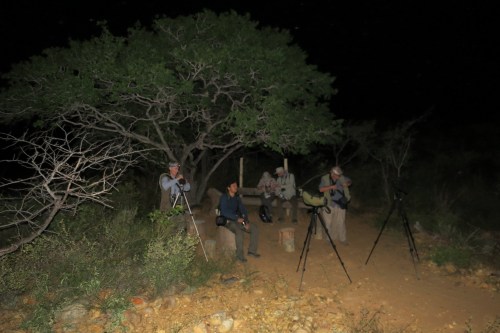
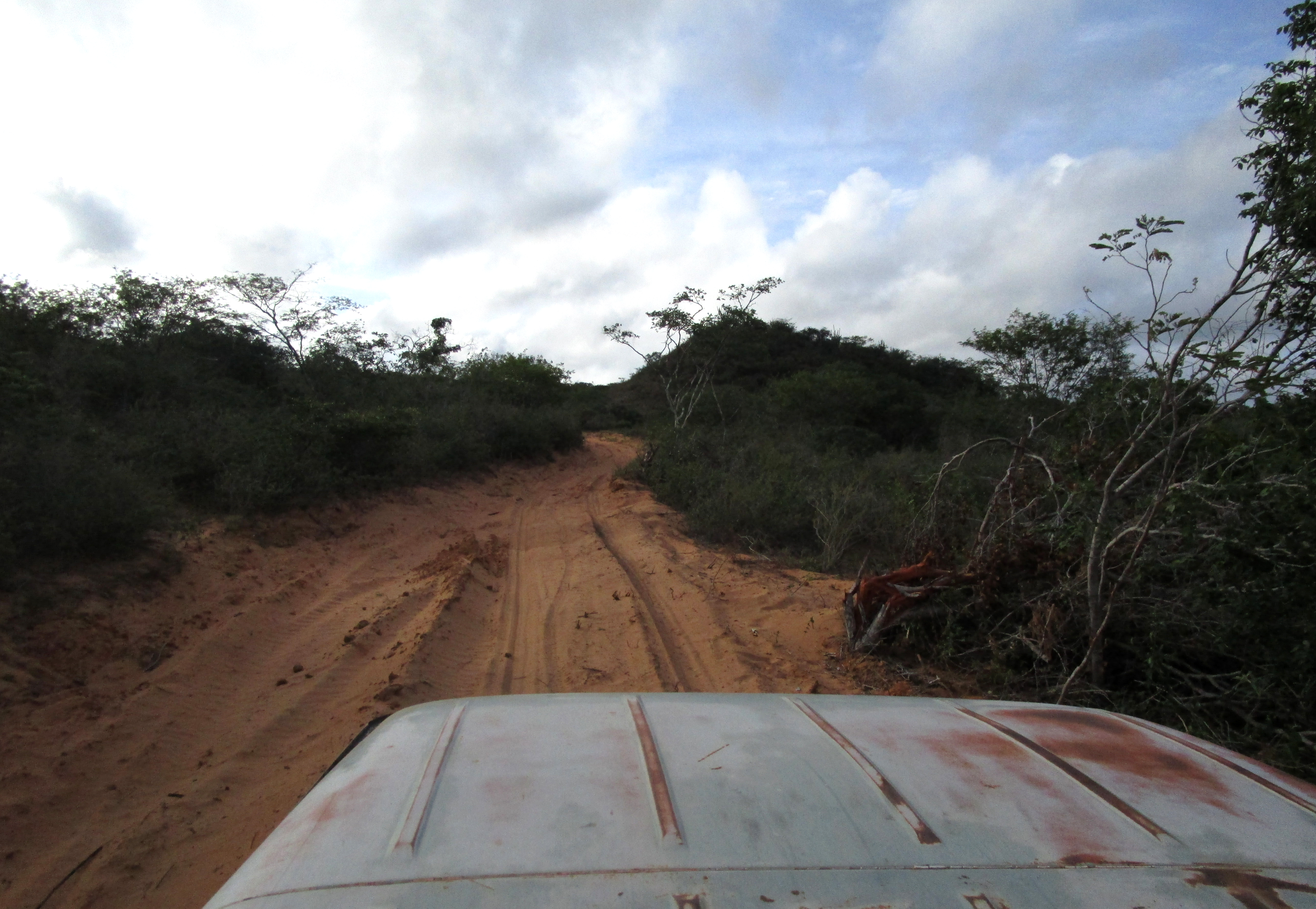
Of course, the area is now much more populated than when Sick first visited, but to be there for first light still requires a 0330 start from the town of Canudos. We transferred from our minibus to a open-backed 4×4 for an hour-long drive along bumpy tracks. We arrived at the lookout as dawn was breaking.

Soon macaws stared coming out of their roost but views were poor.
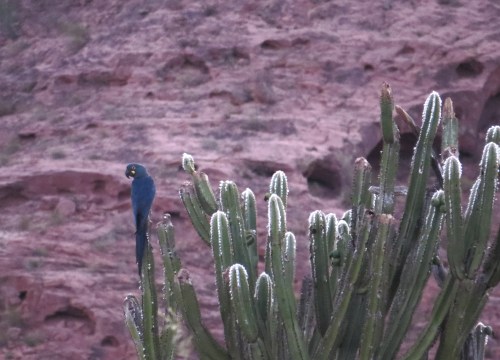
A small number perched on nearby cacti.

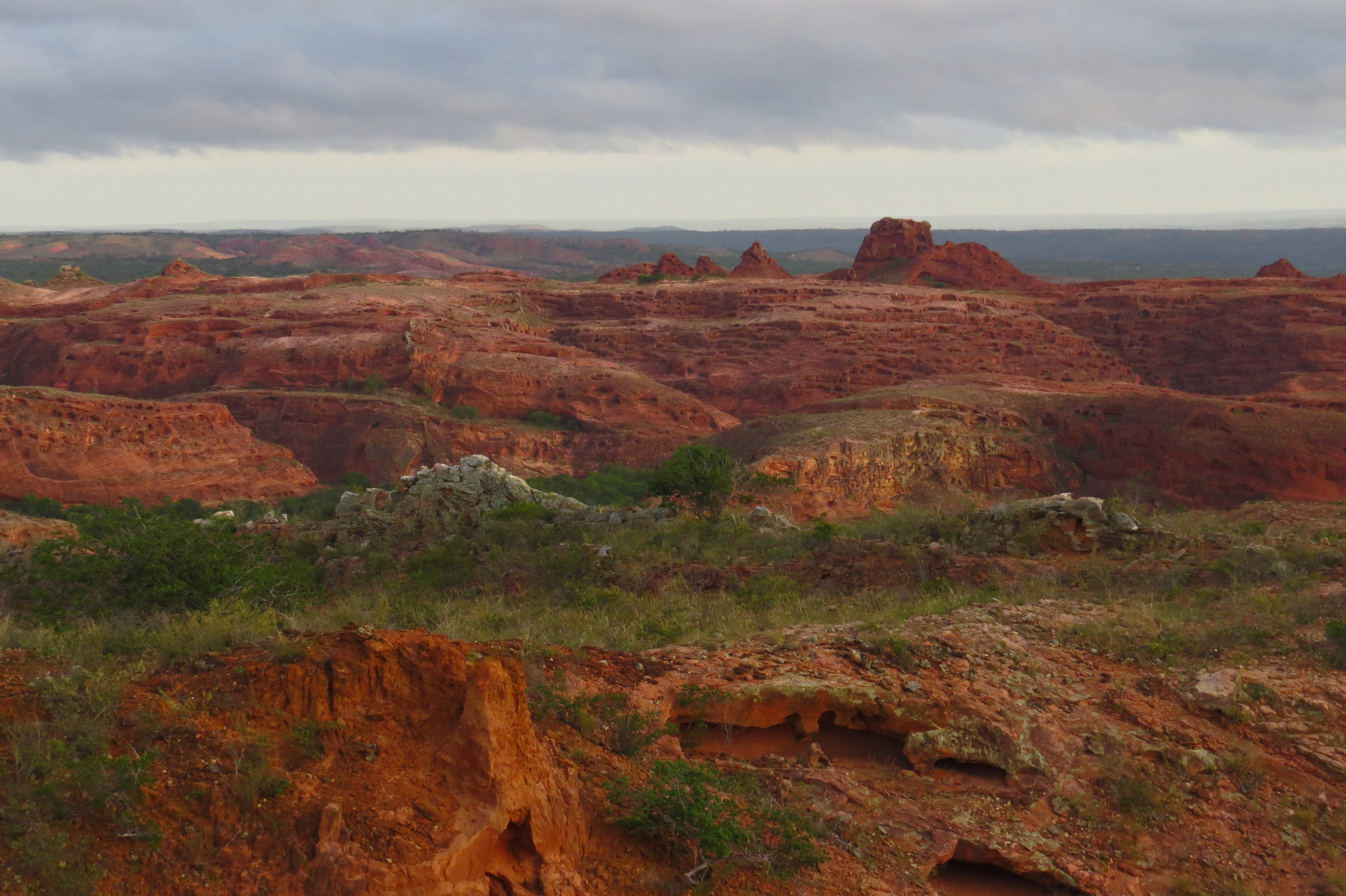
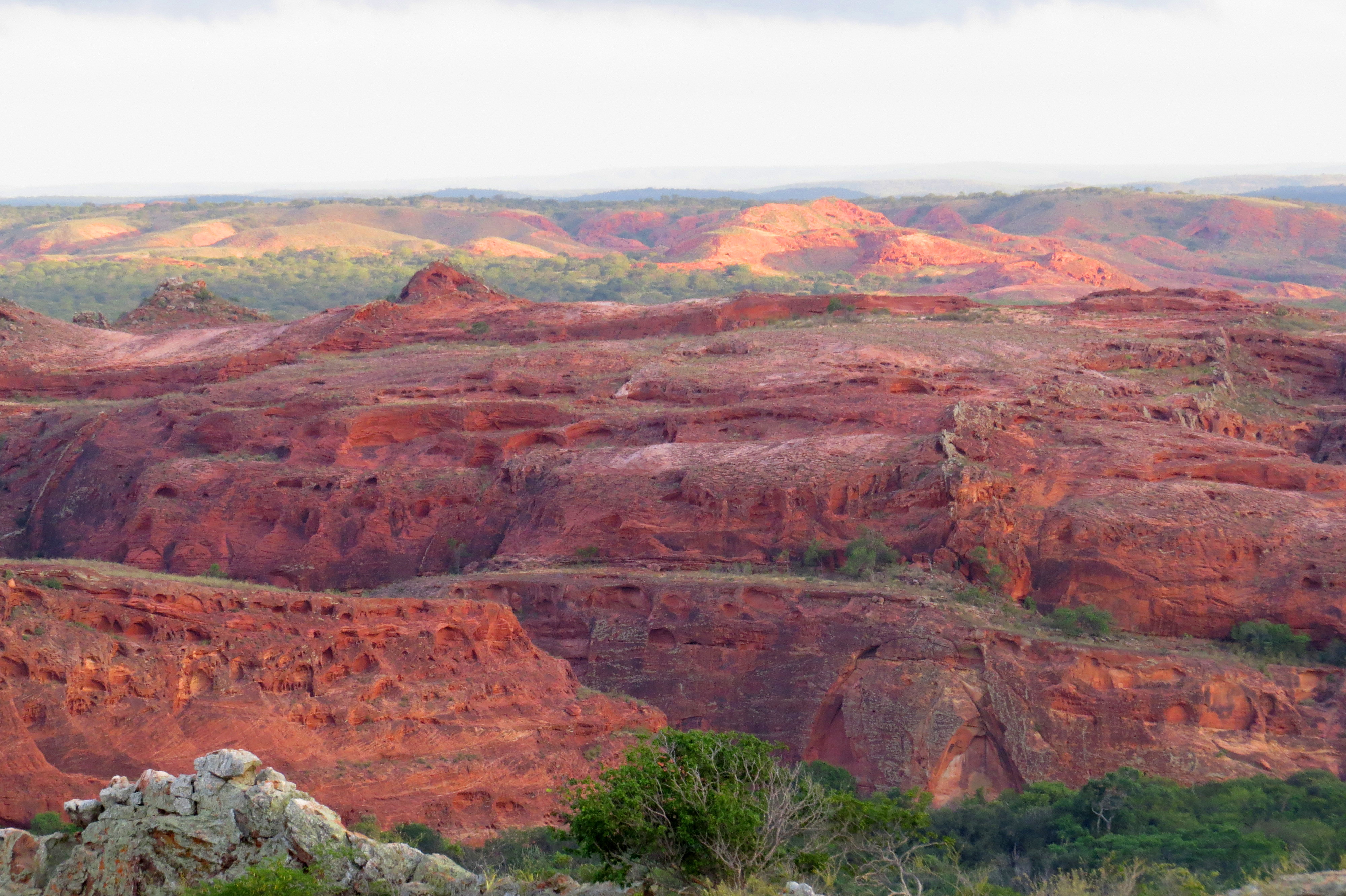
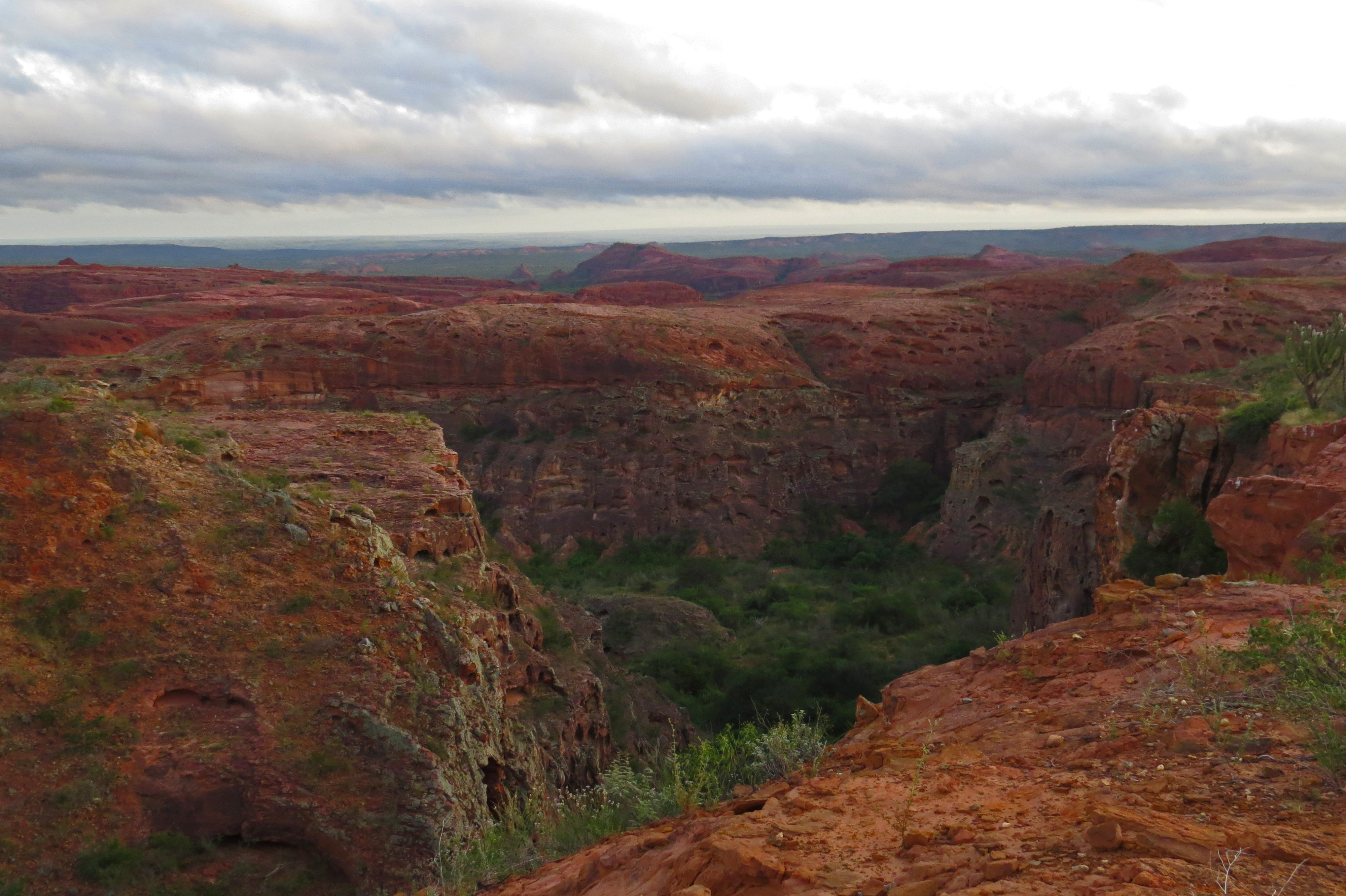
Once it was fully light we could appreciate the beauty of our surroundings.
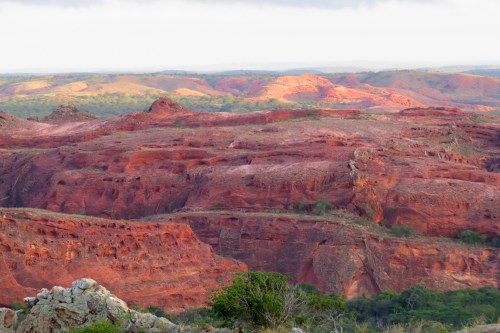
One sandstone ridge after another stretched to the horizon.

After a while all the macaws made their noisy departure, we thought that was it, but the local ranger took us to another nearby canyon ….
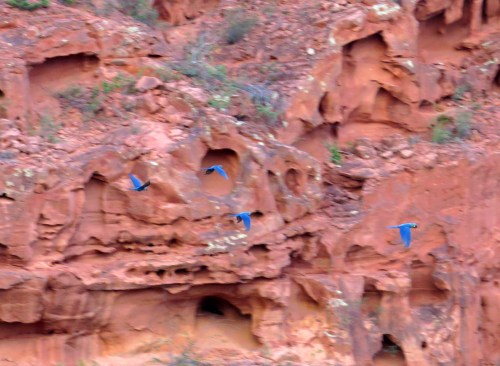
… here we had views of 50+ Lear’s Macaws, either perched distantly or in flight.
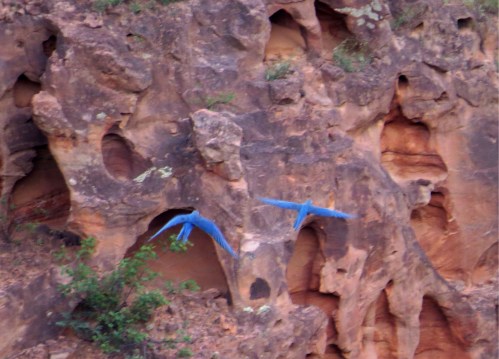
One group repeatedly flew close …..

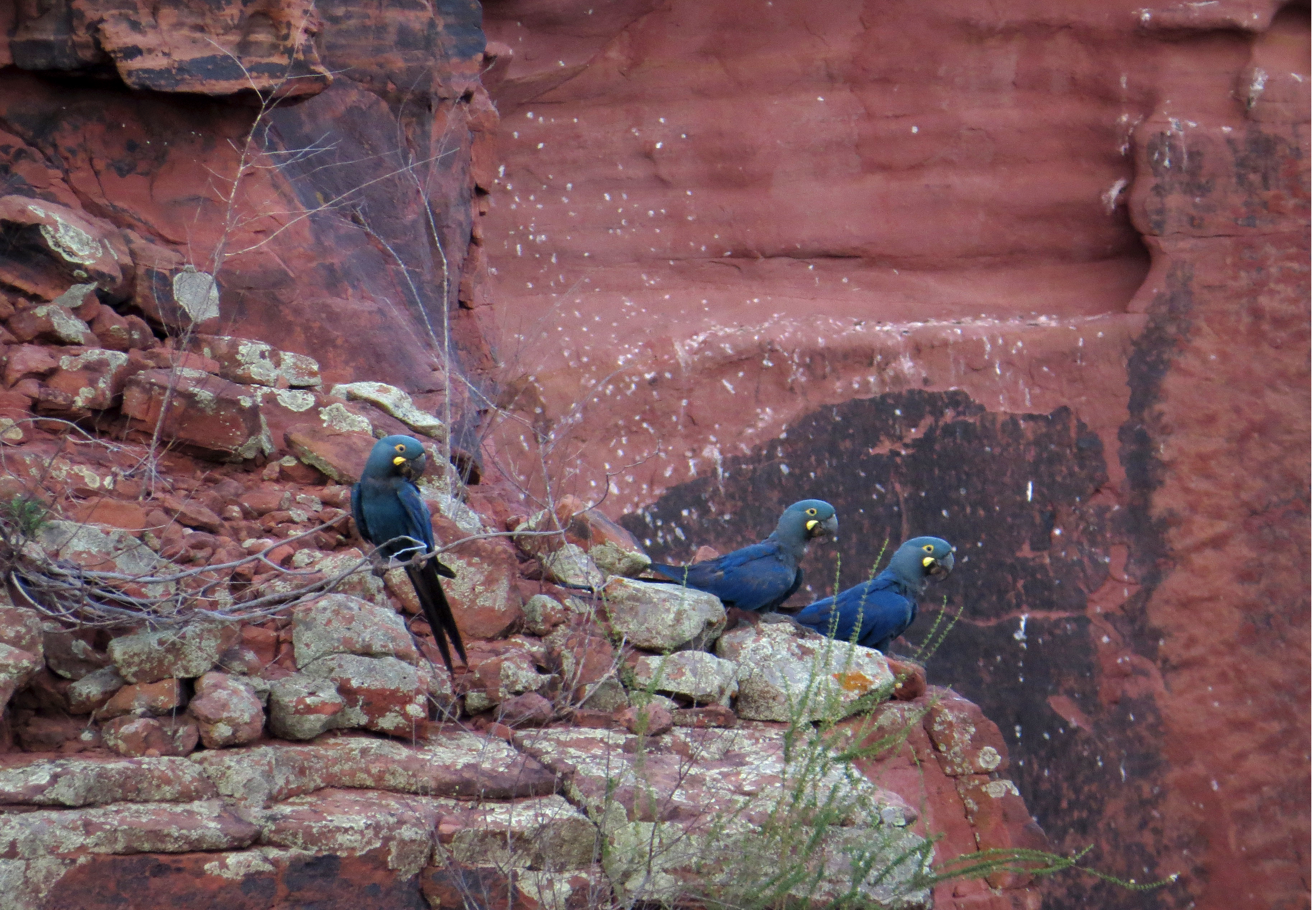
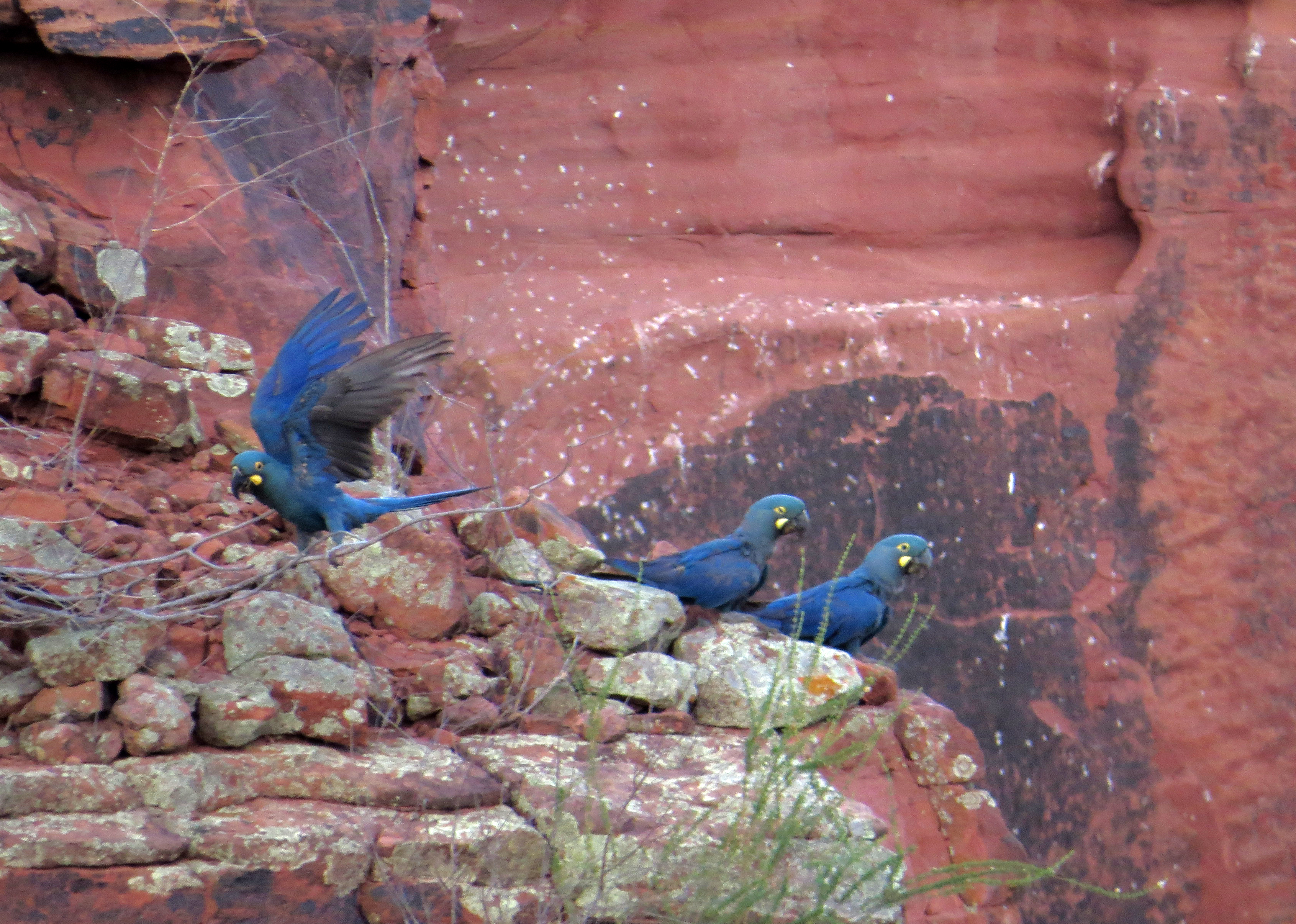
…. and perched up nicely on a nearby cliff ….

…. before flying off again.

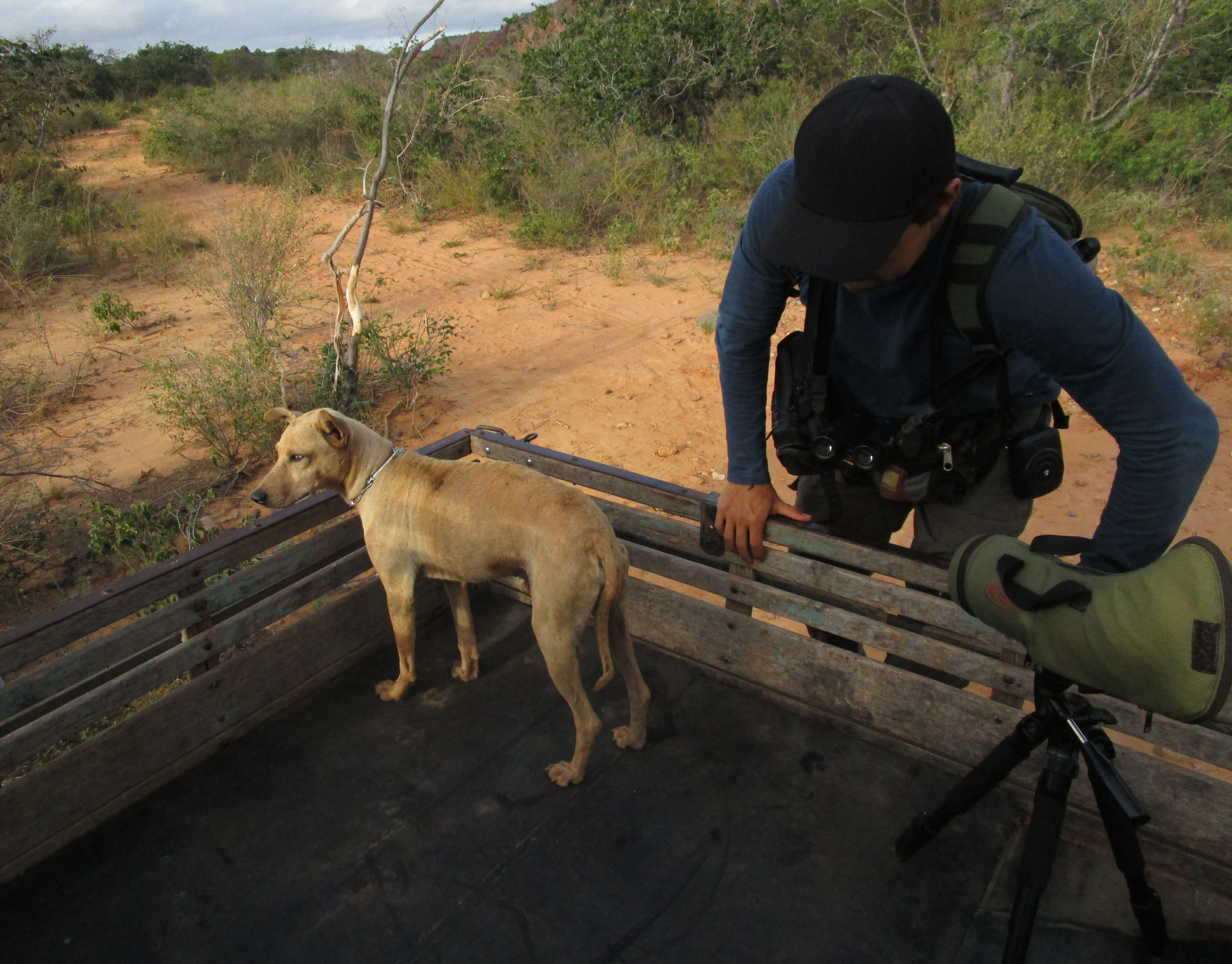
Then it was time to join the ranger’s dog in the back of the pick up ….
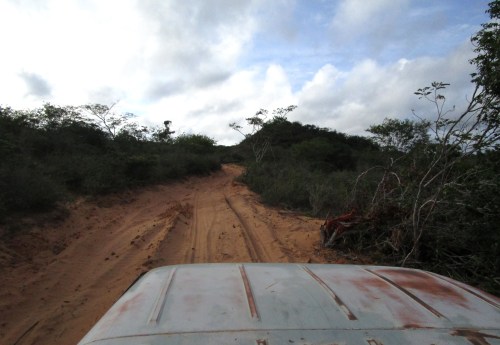
…. and hold on tight for another bumpy ride on the return to Canudos for a late and much appreciated breakfast.

Lear’s Macaw didn’t quite make it as bird of the trip, two complete surprises, Giant Snipe and White-winged Potoo, pipped it at the post ….
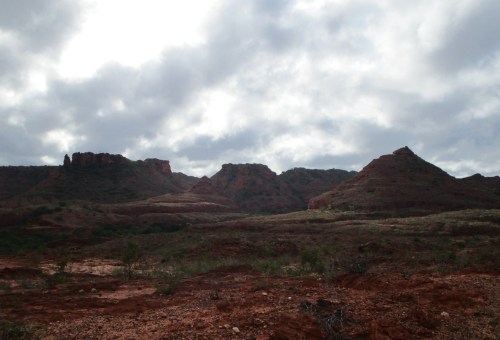
…. but the morning at the Canudos Biological Station, with its stunning eroded sandstone outcrops and canyons plus the wonderful macaws, certainly warranted the title of ‘experience of the trip’.
I have been to Brazil twice before, to the endemic rich forests of the south-east in 2003 and to the wetlands of the Pantanal, the grasslands of Canastra and the southern Amazonian rainforest in 2008. This trip visited the coastal forests, caatinga, cerrado and canyons of the north-east states of Ceara, Alagoas, Penambuco and Bahia. Although, obviously there was considerable overlap with the birds of the south-east, I still managed to see 78 new species, about 10 more than I had expected.
This post covers the northern state of Ceara, western Perambuco and northern Bahia.
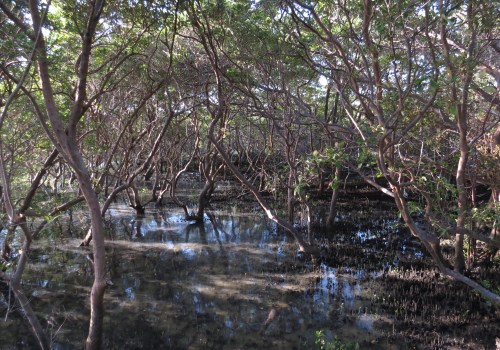
On arrival at Fortaleza we had a three-hour drive to our first destination. We didn’t get to the hotel until nearly 0200 so it was a rather short night. Soon after dawn we were birding at a nearby area of mangroves but our main target, the endemic Little Wood-Rail failed to show. Not the best start to the trip!
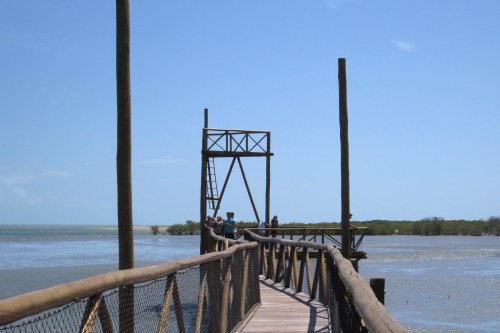
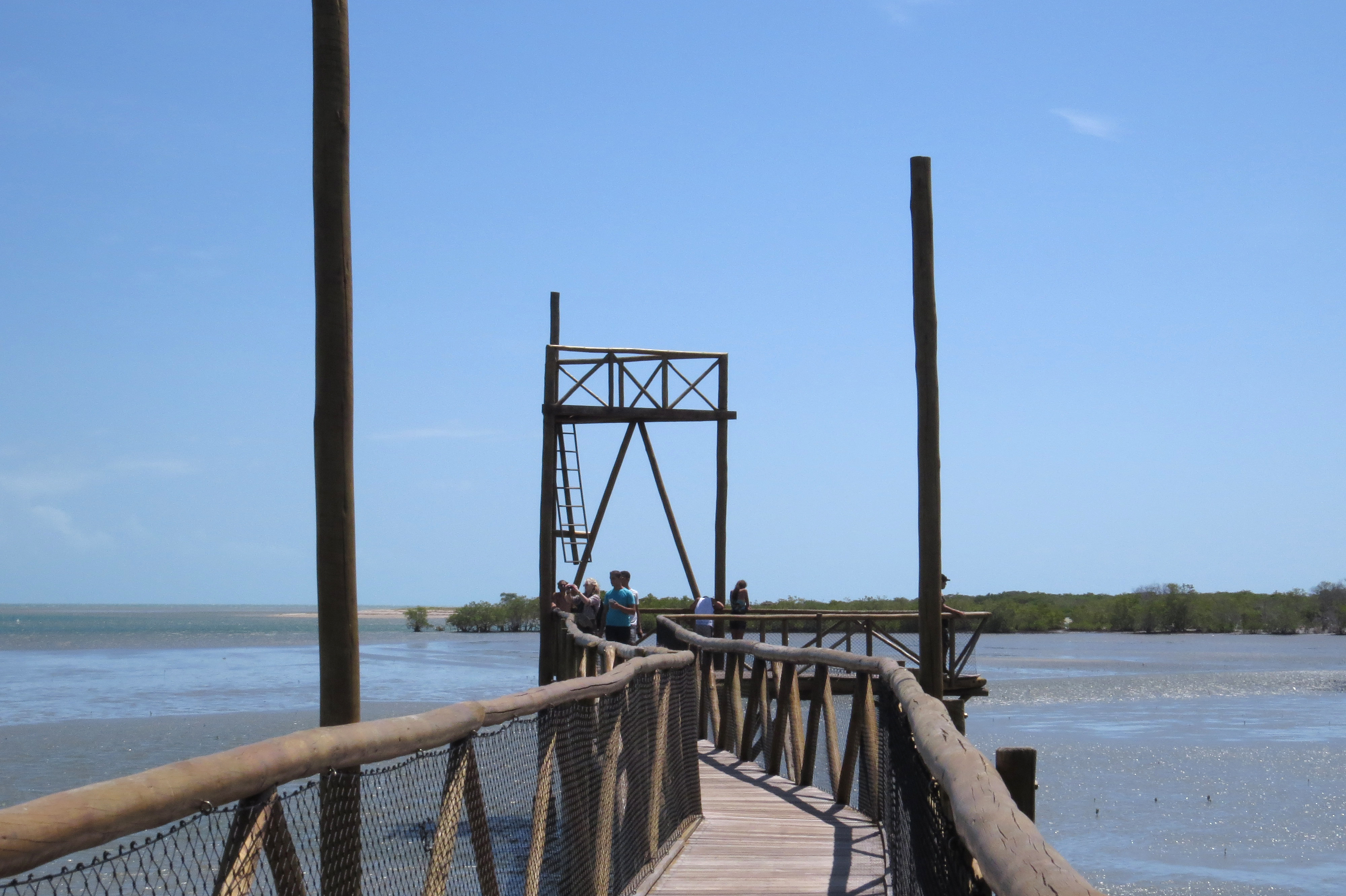
Birding from this boardwalk was pleasant but a few migrant waders and coastal herons was little compensation for a serious dip.
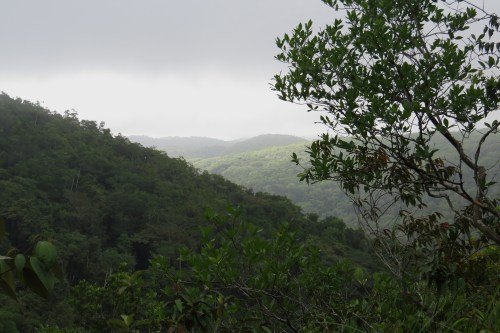
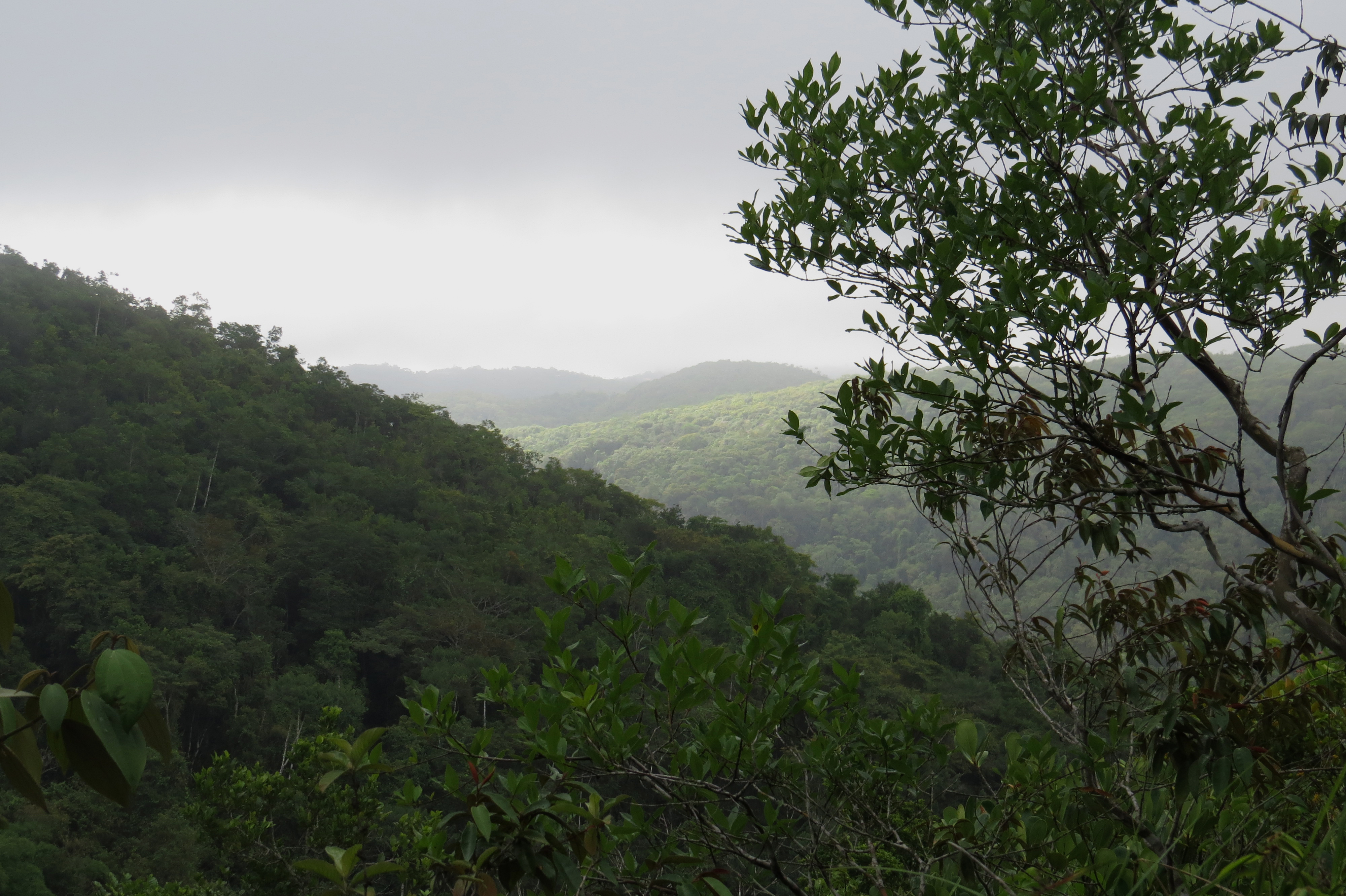
By mid afternoon we arrived at the Serra do Baturite, a coastal range covered in Atlantic rainforest.
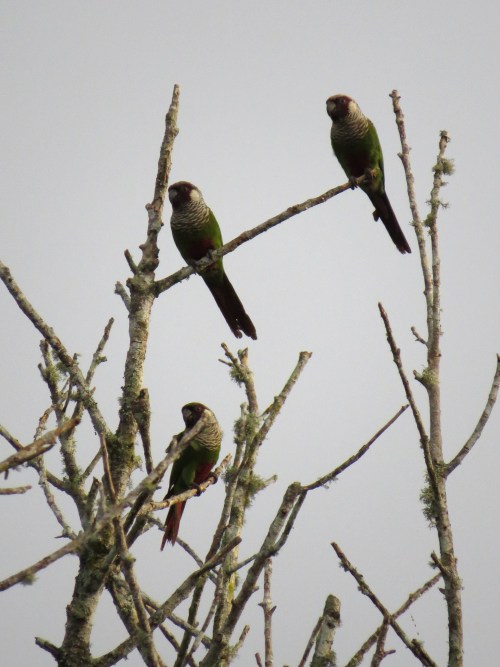
There was excellent birding in the area, which lifted our spirits considerably. Birds included the endemic Grey-breasted Parakeet ….

…. the beautiful Band-tailed Manikin ….

…. gorgeous Red-necked Tanagers ….

…. and one of the smallest woodpeckers in the world, Ochraceous Piculet, one of four species of piculet that we were to see on the trip.

Skulking on the forest floor we were able to glimpse a Rufous-breasted Leaftosser ….

…. and the recently split Ceara Gnateater.
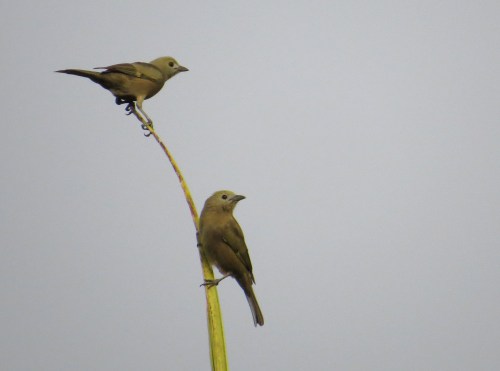
It wasn’t all about rare, endemic or spectacular birds. Common species like Palm Tanager

…. and House Wren competed for our attention. House Wrens occur from Canada to Argentina and various proposals have been put forwards to divide it into a number of species, but they yet to gain approval by the various checklist authorities.

One trouble with Brazil is that is so noisy. Many cars fit this sort of sound system in the boot of their car, which is clearly not intended as in-car entertainment but as means of annoying anyone who wants a good nights sleep.

From a ridge over the local resort we were able to scan the tree tops for raptors but had little success. The white dot on the lake is, of all things, a Mute Swan, but somehow it didn’t make it onto the trip list.

From Serra do Baturite we drove south to areas of extensive caatinga, a habitat comprised of xerophytic scrub interspersed with stands of cactus. Small differences in the level of aridity produce different height vegetation, which in turn leads to radically different bird communities.
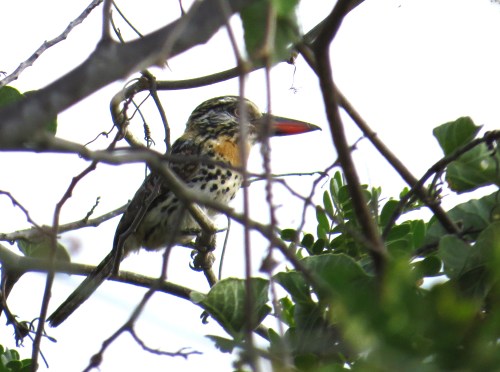
Birds of the caatinga include the appropriately named Caatinga Puffbird ….
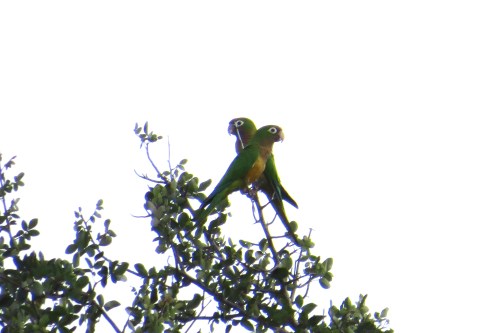
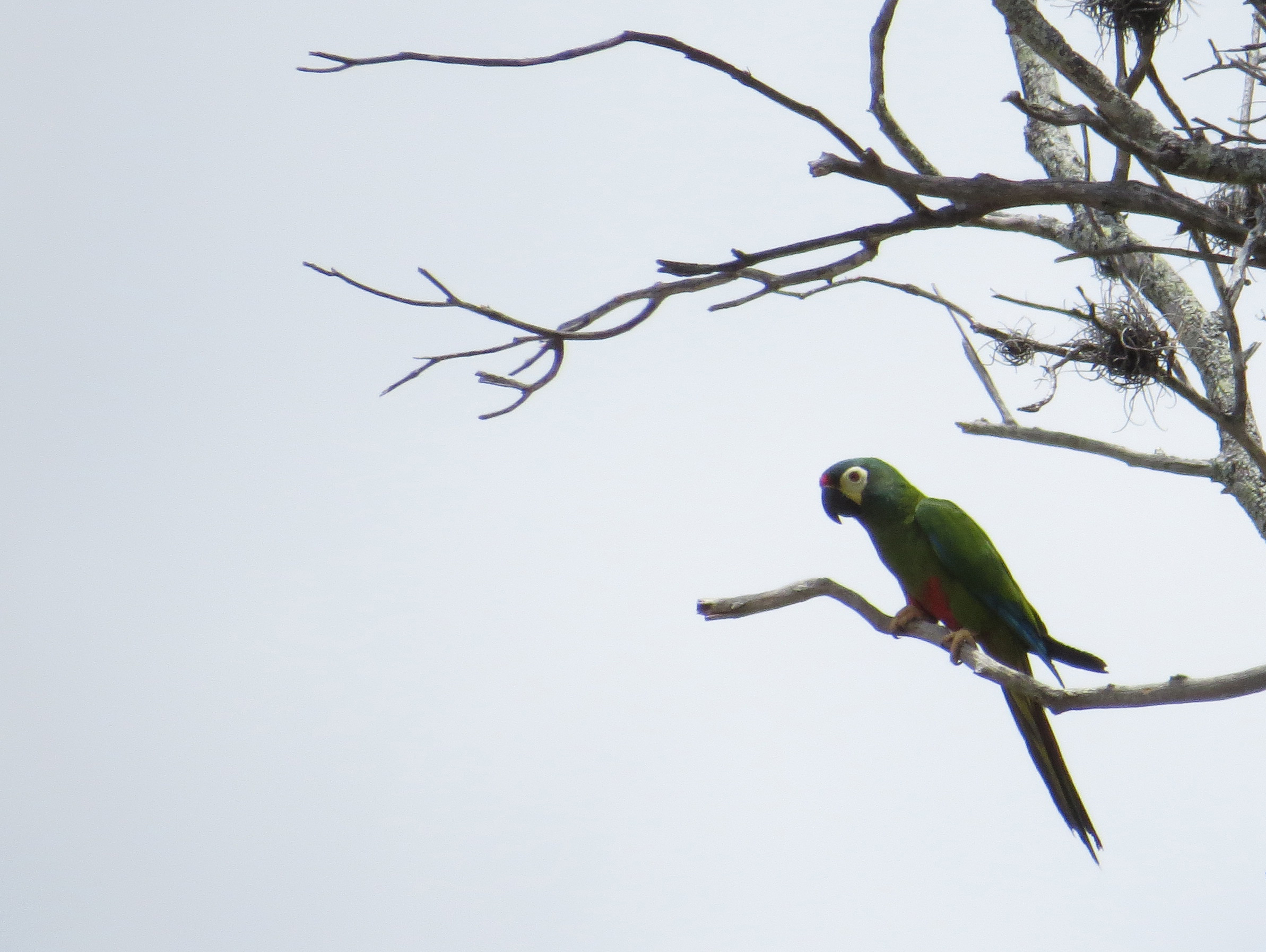
…. which was followed by the predictable Caatinga Parakeet ….

…. and (you’ve guessed it) the inevitable Caatinga Cacholote ….

…. which was captured nicely in flight.
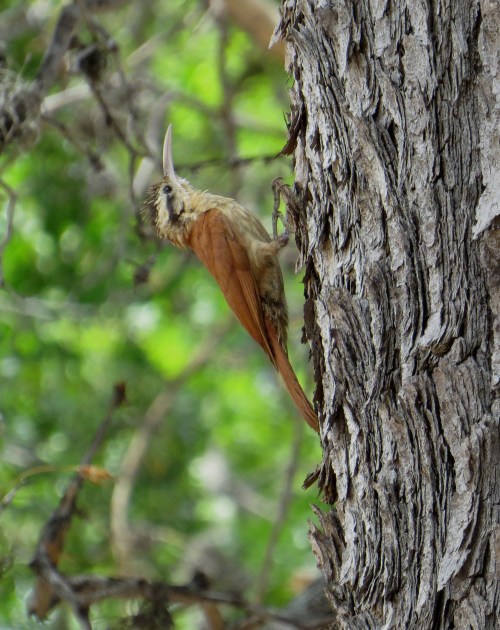
In wooded area we saw Narrow-billed Woodpeckers, one of eight woodcreepers we were to see on the trip and one of 48 (if you include the similar scythebills) in South America.
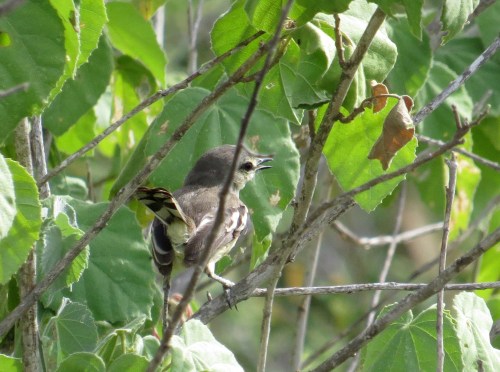
Two species of tyrant flycatchers have evolved to look rather like old world wagtails and somewhat unimaginatively are called Lesser and Greater Wagtail-tyrant. I have seen ‘Greater’ a number of times but ‘Lesser’ was a life bird for me. Imagine the confusion when we found a pair of ‘Lessers’ (above) in the same bush as a pair of ‘Greaters’.

We visited a dried up river bed in northern Bahia, a stake out for Blue-winged Macaws, a species that prefer the tall riparian habitat. In the whole of north-east Brazil there is only one river, the mighty Sao Francisco, that never dries up.

And there, just as promised was the lovely Blue-winged Macaw.
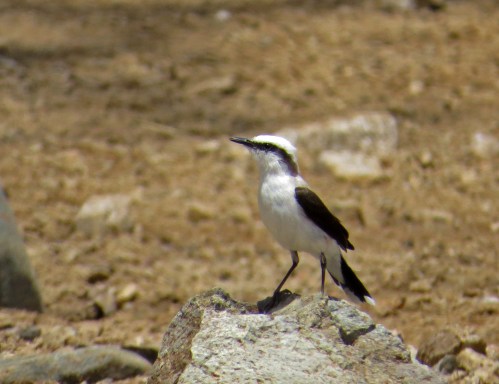
Earlier I mentioned tyrant flycatchers that have evolved to look like wagtails, well here’s one that has evolved to look like a wheatear – Masked Water Tyrant, living in what is currently a water free environment.

A more typical tyrant flycatcher (with 431 species, the largest bird family in the world) is the showy Streaked Flycatcher.

At the base of the isolated plateau of the Chapada do Araripe lies some tall woodland. Here in 1996 the gorgeous Araripe Manakin was seen for the first time. The population is estimated to be a mere 500 pairs. Although we got good views, our time with the bird was brief. The most accessible site has been converted to a theme park, we paid our entry fee but were told the park had to close, this seemed bizarre as it was only 11am, but we later learned that the park’s owner had died that morning and the staff were closing the park as a mark of respect.

With very little time available to get a decent image of this stunning bird, I have included (with permission) a wonderful shot by Ciro Albano, one of Brazil’s top birders and photographers.

We eventually reached the area around Canudos where we searched an area of scrub for the rare Scarlet-throated Tanagers, which we saw, albeit distantly. More showy species included the widespread Burrowing Owl.

As the sun set, the lake where the Scarlet-throated Tanagers could be seen glowed as if lit from within. We saw a couple of the very rare Lear’s Macaws flying to roost but we knew that we had a far better chance of seeing them well the following day. More of that in the next post.
To the regular readers of my blog an apology for not updating this blog since early January. I have spent three and half weeks in return Brazil and since my return a week ago I have been busy with shopping, decorating and other onerous tasks.
This post covers the first few days of January and a couple of trips to west Dorset over the last couple of days. I have yet to edit the many photos taken in Brazil, let alone update them to the blog, but they will follow eventually.

We had a couple of birding trips before I left for Brazil, to Blashford Lakes and to Wyke Down but the best by far was the intensive birding on our annual bird race on 4th January. Postponed from the day before due to bad weather, we had an excellent day, travelling from the Poole area to Weymouth and back again starting at 0500 and ending at 1730. Three teams took part and we won with a score of 126 species seen/heard during the day, three ahead of our nearest rivals and only 3 short of the all time winter record. Our first destination was Shore Road, Poole Harbour in hope for Bar-tailed Godwit. Why visit the foreshore of Poole Harbour in the dark, when the birds could be so much more easily later in day? Simple, if we could see Barwits before dawn we could later avoid the northern shore of of the harbour and all the potential delays that traffic and the Studland car ferry could produce. I’m glad to say we were successful, seeing the birds by the light of street lamps.
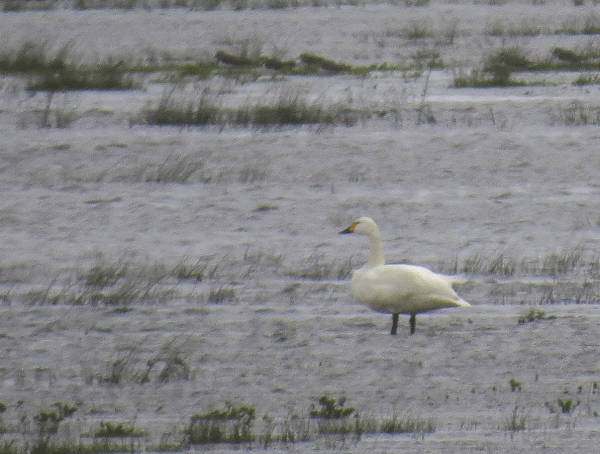
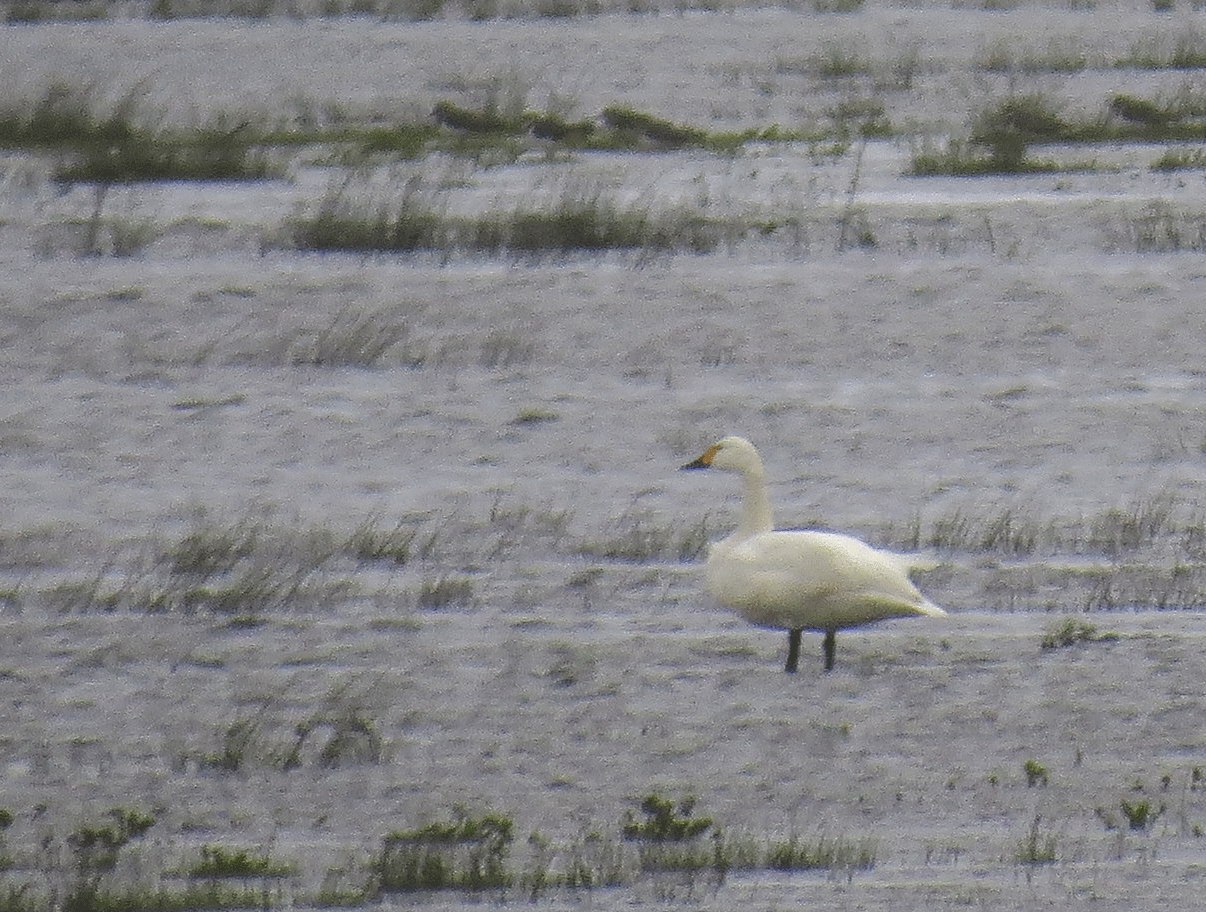
On 7th February Margaret and I had a day out in west Dorset. Our first destination was Tincleton near Dorchester where we located the single Bewick’s Swan in a flock of Mute’s. Bewick’s Swan was once a regular visitor to Dorset and adjacent areas with counts of up to 120 at Tinkleton and similar numbers at Ibsley in Hampshire. Milder winters have allowed more Bewick’s to winter on the continent and feeding at the WWT reserve at Welney has induced most of the birds that reach the UK to stay in East Anglia. The bird we saw at Tinkleton was hidden by trees so I have added a photo of a Bewick’s Swan I took at Ibsley in the Avon valley last year.
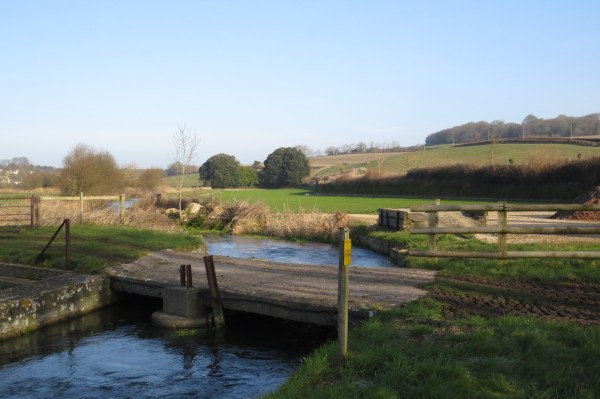
Earlier we called in at the cress beds at Bere Regis, a good spot for Green Sandpipers, Grey Wagtails and if you are lucky Kingfishers and Water Pipits, although we had no luck with the latter two.
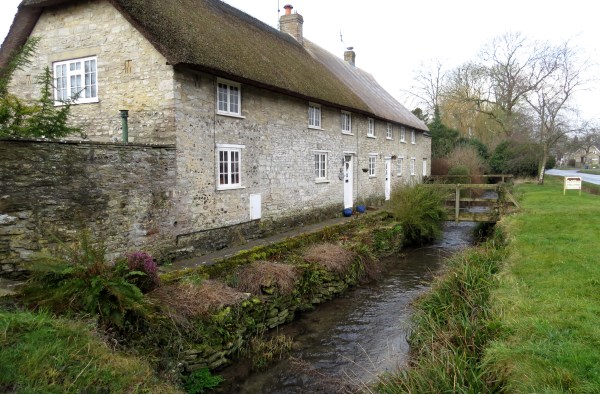
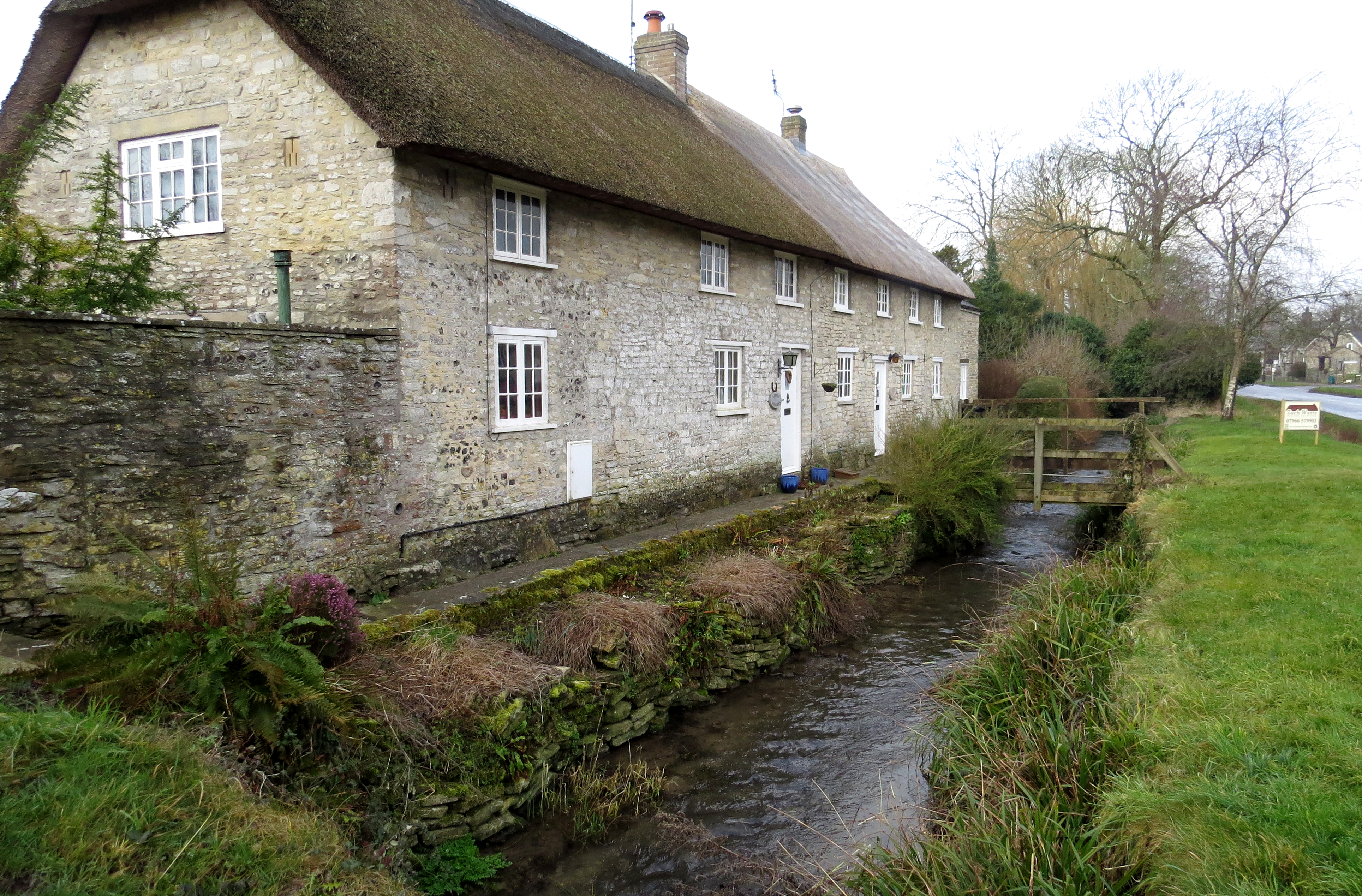
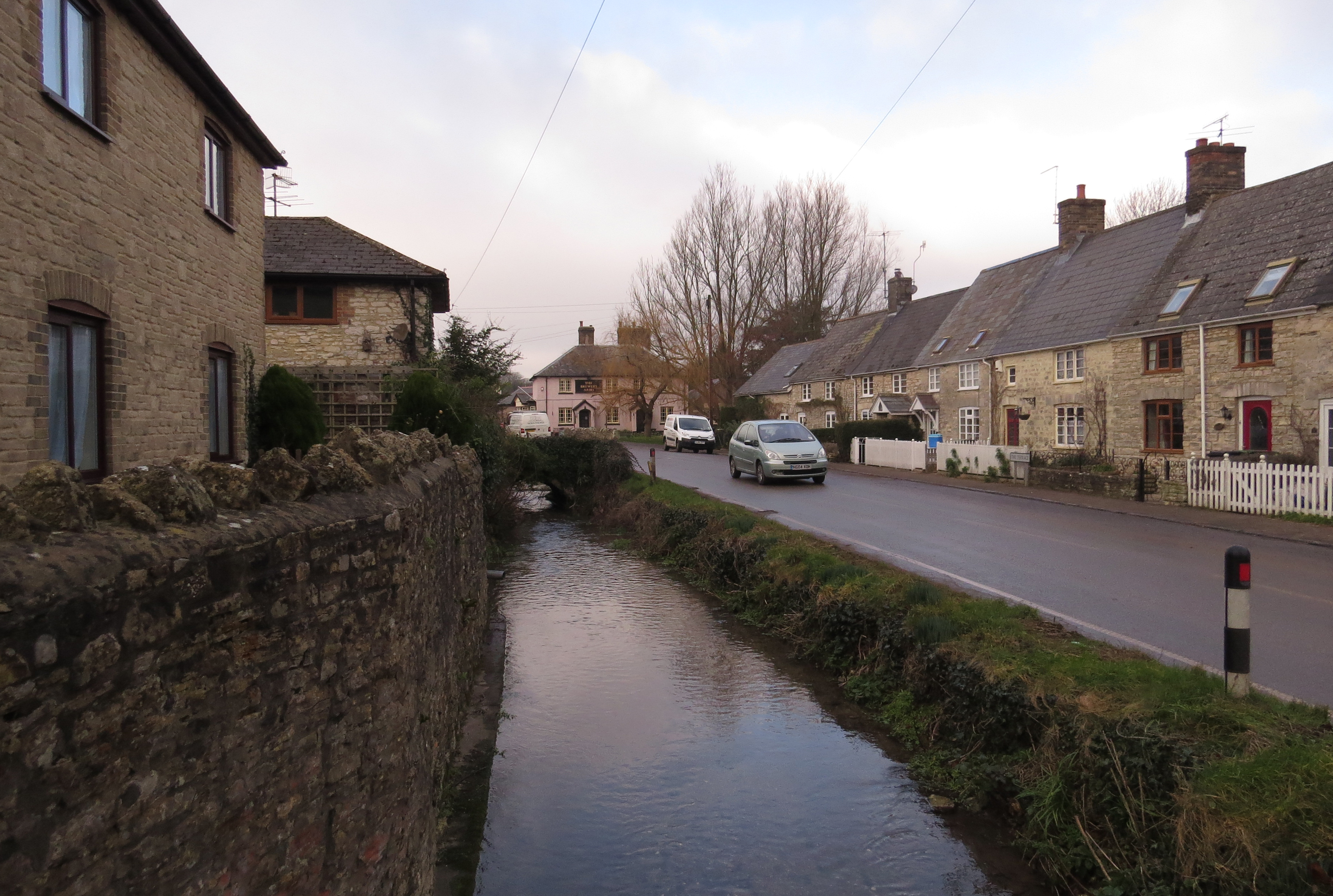
We then travelled westwards to Abbotsbury, on the way we passed through the picturesque village of Martinstown ….
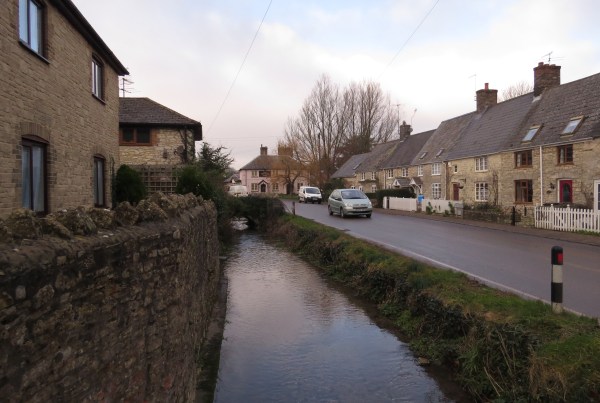
… which comprises a series of charming cottages with a stream for a front garden.

From here the road climbs up to Hardy’s Monument with panoramic views in all directions.

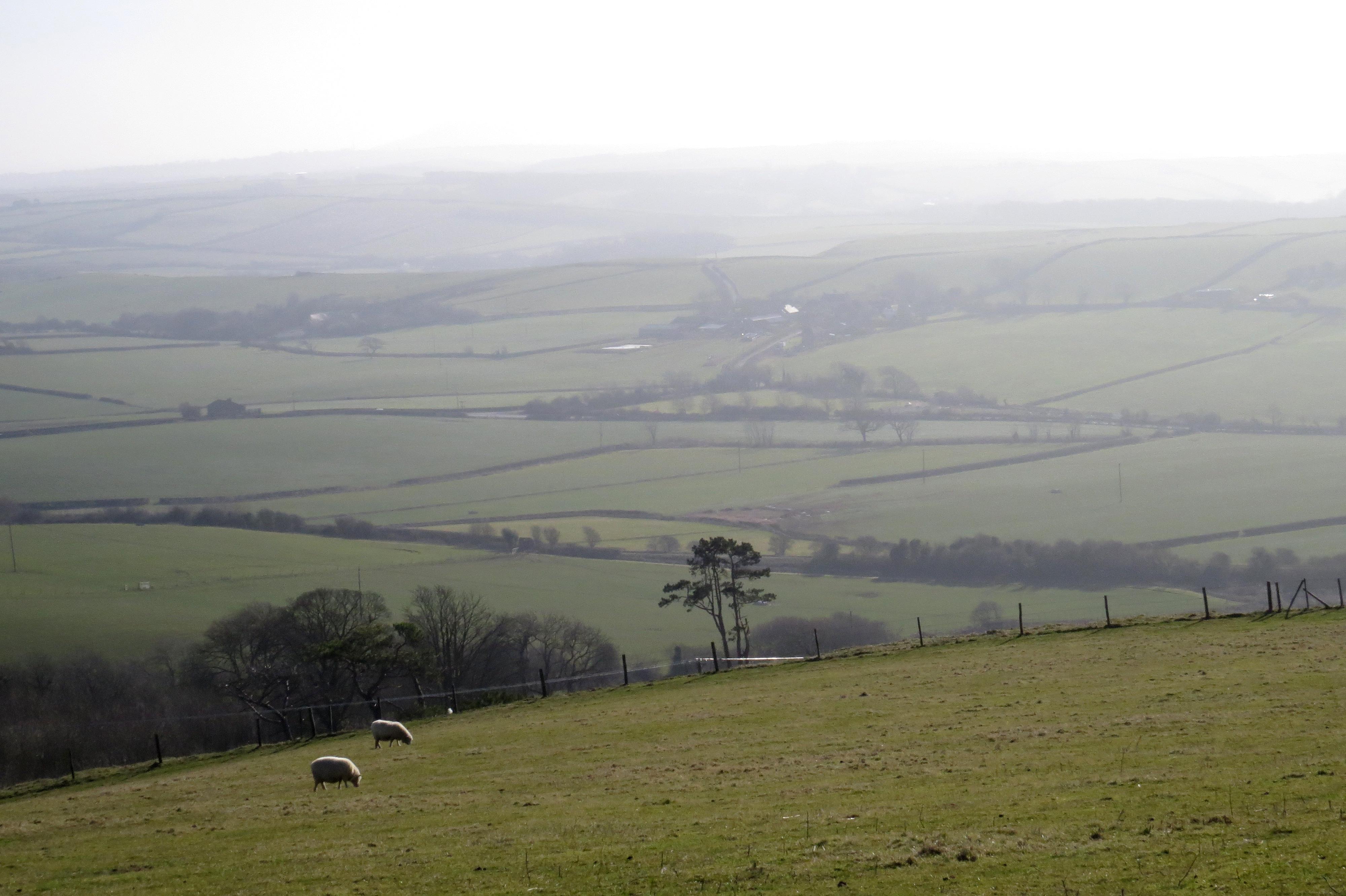
The road that leads from Hardy’s Monument to Abbotsbury is narrow and progress is slow, however the view more than compensates. This is perhaps my favourite drive in all of Dorset, but in the morning the view to the south is always into the sun. The Fleet and Portland can just be seen in the distance. Someday I’ll drive this way on a clear summer’s evening and take some better shots.

Abbotsbury Swannery is closed for the winter but distant views are available from the Rodden road. We saw the Greenland Whitefronted Goose briefly before it swam out of view and later we drove on to Langton Herring and walked down to the Fleet at Rodden Hive. The view to the north from Langton Herring is shown above.
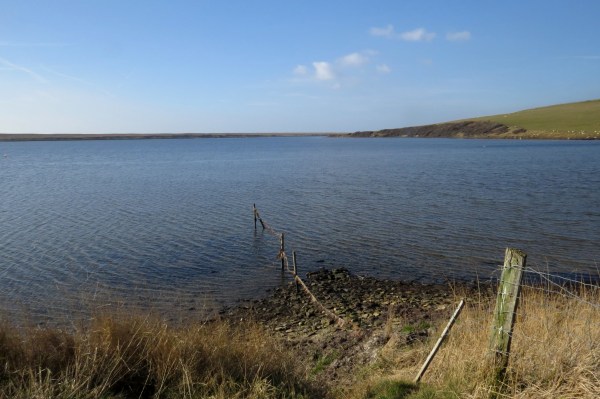
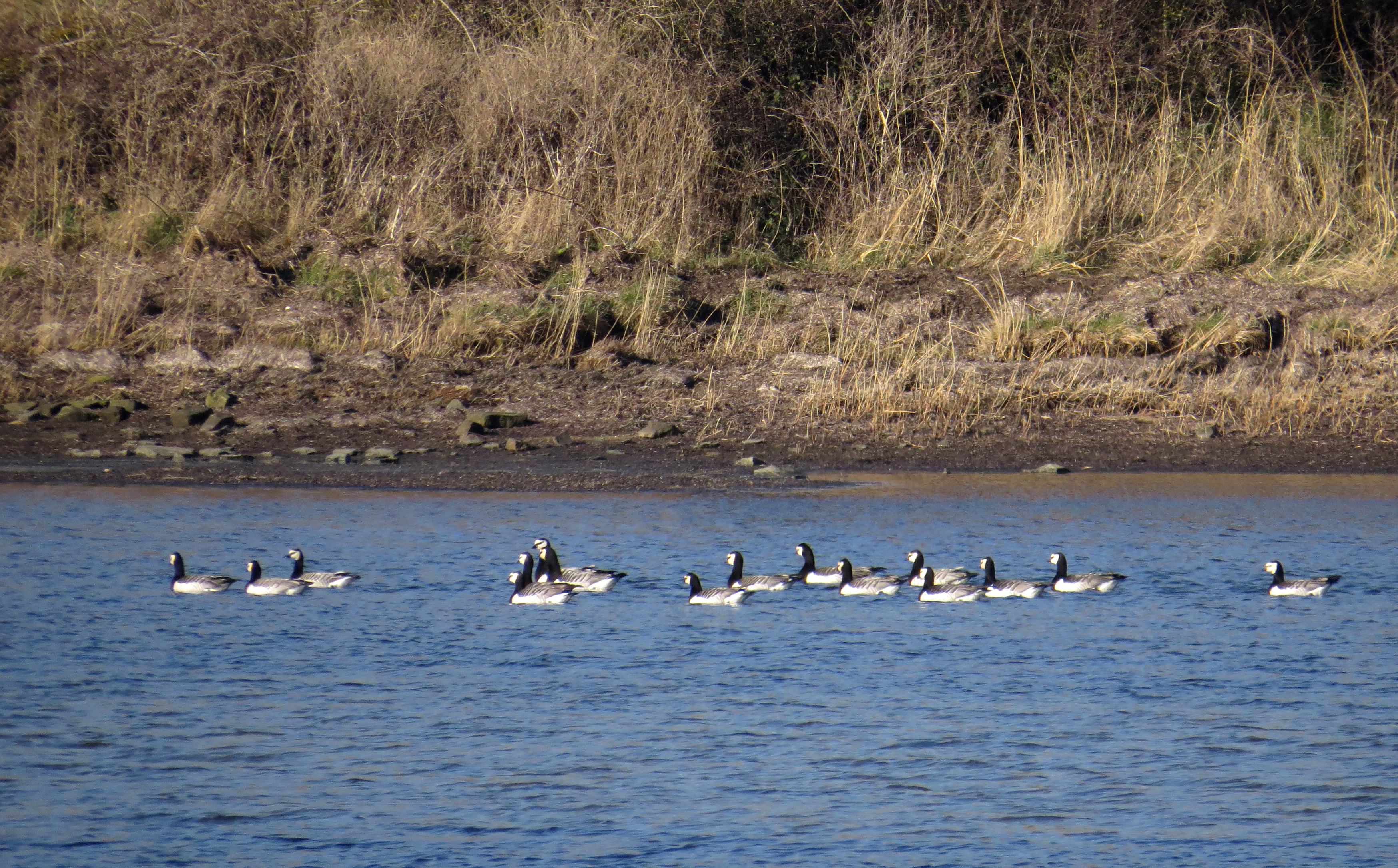
The Fleet, the 12 mile long brackish lagoon, separated from the sea by a shingle bank is one of the most outstanding features of Dorset, if not the entire UK. Rodden Hive is the most northerly point that is accessible on foot, with the exception of the Swannery itself. Large numbers of wildfowl can be seen on the Fleet in winter ……
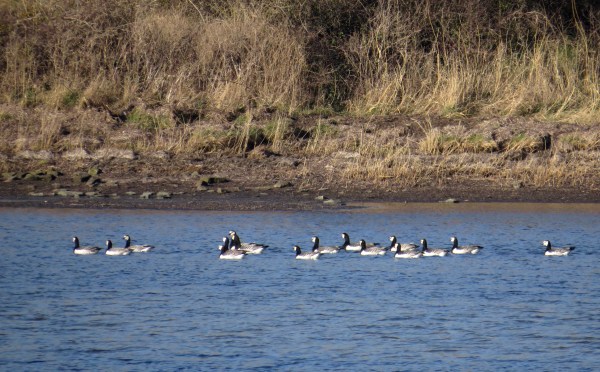
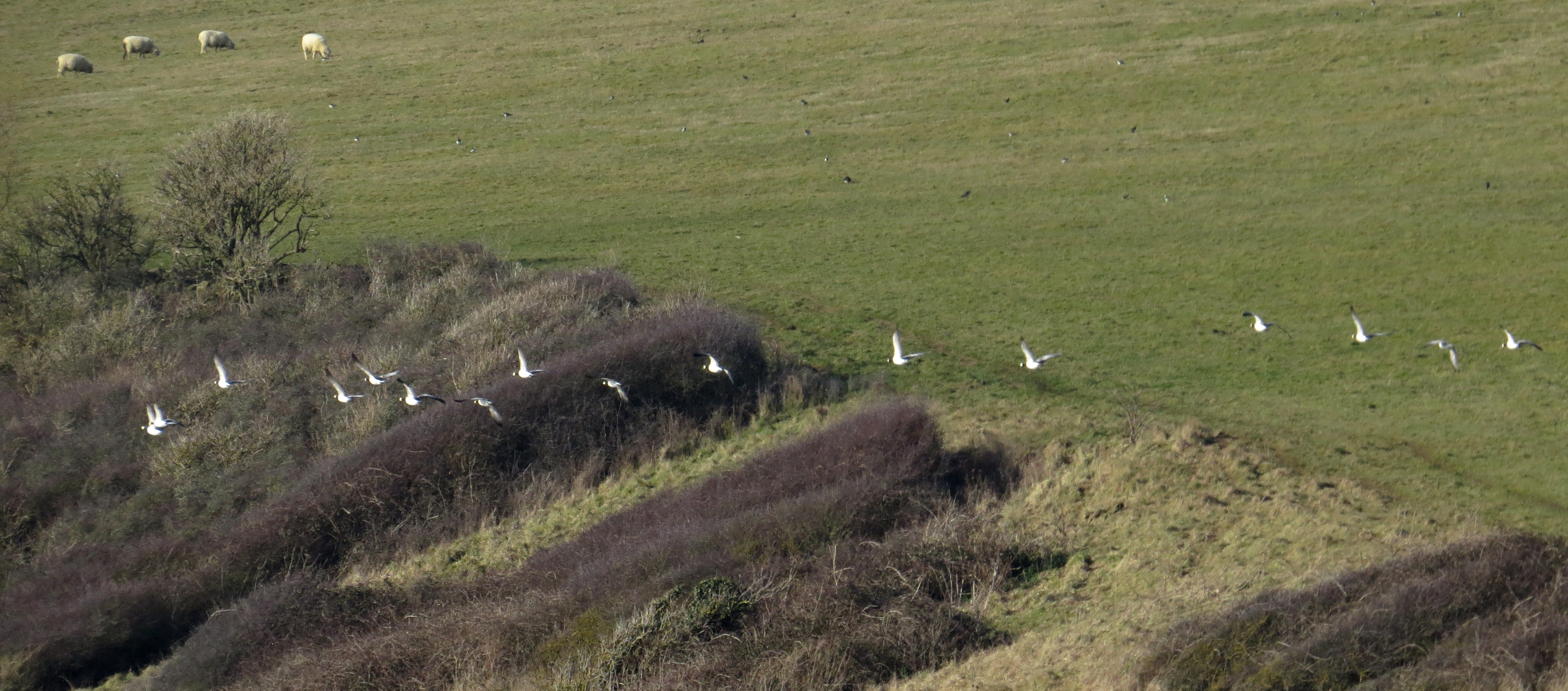
…. but we had come to see this flock of 16 Barnacle Geese. Barnacle Geese from Svarlbard and Greenland winter in Scotland but there is also a substantial number that winter in Holland It is debatable whether the occasional flock that turns up in Dorset in winter comes from the Dutch wintering population or from the feral population.
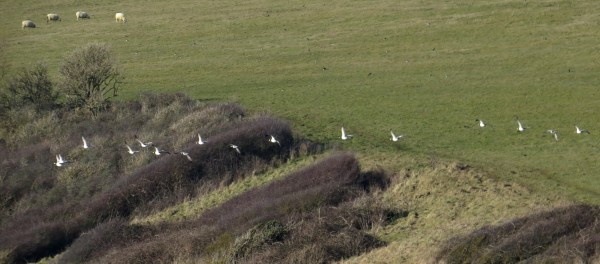
The fact that these birds were wary and flew off soon after we arrived, were unringed and don’t associate with Canada Geese indicate to my mind that a wild origin is probable. In fact using those criteria they are more likely to be wild than the Greenland Whitefront which has been associating with Canada Geese!
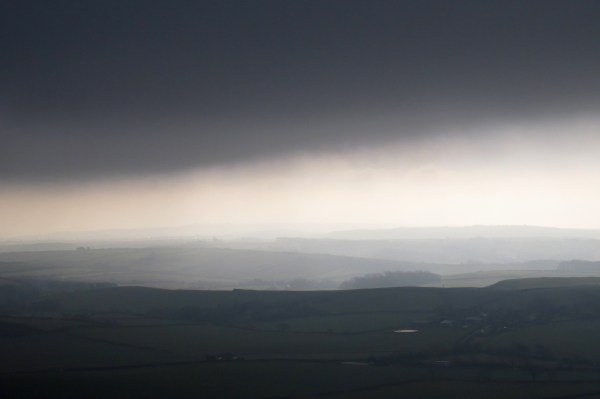
Rare bird news seldom breaks when it is convenient. I had just got home when I learned that three Cirl Buntings had been located a few miles from Abbotsbury. This species was once widespread in south of the UK but the range drastically contracted from the 1960’s onwards with agricultural intensification. The last breeding in Dorset was in 1971 and since I’ve been birding they have been lost from Somerset and almost lost from their stronghold in south Devon. Vigorous conservation measures, including a reintroduction program in Cornwall have turned their fortunes around and maybe, just maybe, they are beginning to recolonise west Dorset. The birds had been present for some time but local observers wished to keep this quiet until the site could be made secure from disturbance. This is the same view as above in much cloudier conditions, taken when I returned to see the Cirls on Monday morning.

The three Cirl Bunting showed well, if a little briefly. Far too far away for photos, I have included a shot of a male taken in Devon in June 2011, which was I think the first bird photo that I ever uploaded to this blog.










































































 gryllosblog
