Archive for the ‘Uncategorized’ Category
Sorry to any readers who may have visited this blog recently to find a series of photos with no captions. After uploading the photos I though I clicked on ‘save’ I must have hit ‘publish’ instead.
This is the 6th and final episode of my account to the West Pacific Odyssey, an epic 31 journey on the ship Professor Khromov (aka Spirit of Enderby) between New Zealand and Japan and covers our time from when we entered Japanese waters on 9th April until when we flew home from Japan on the 14th.

On 9th April we entered Japanese waters. The composition of the species we had been seeing had already changed from being predominately boobies, tropicbirds and terns to predominately storm-petrels and shearwaters. With a number of Matsadaira’s Storm-petrels being seen in the wake it was decided to drag a bag of chum behind the ship which brought them in closer. This in turn brought bird photographers off the foredeck to the stern (including stalwart birders Mike and ‘green sock’ Geoff who had both travelled with me in 2016 on the Atlantic Odyssey).
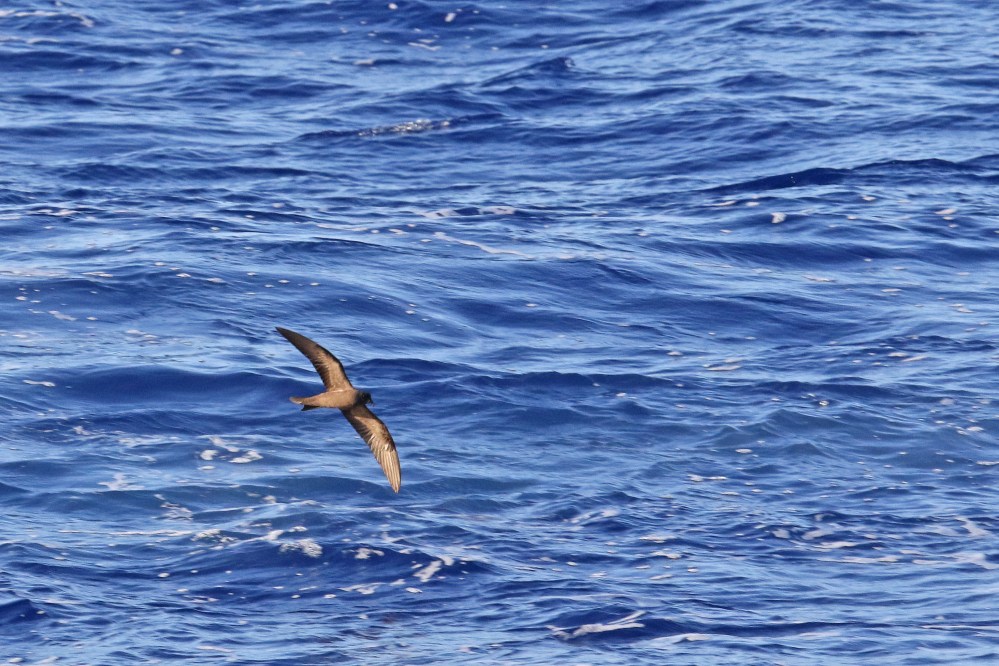
Matsadaira’s Storm-petrels are a large storm-petrel with a wing span 8cm or more than a Leach’s. Their wholly brown underparts …
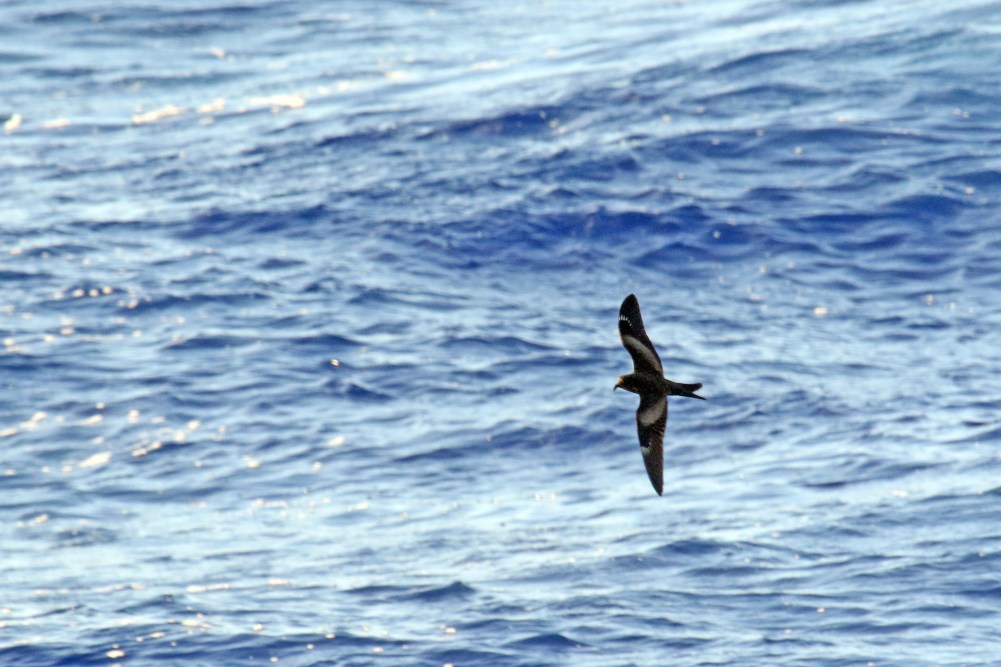
… and the white bases to their primaries give them a very different look. Around 1990 there was a spate of claims of this species in the UK although none were substantiated. Indeed it was shown that at least some of the records were Eurasian Nightjars, feeding offshore at dusk and performing a strange fluttering flight, something that totally baffled the observers at the time..
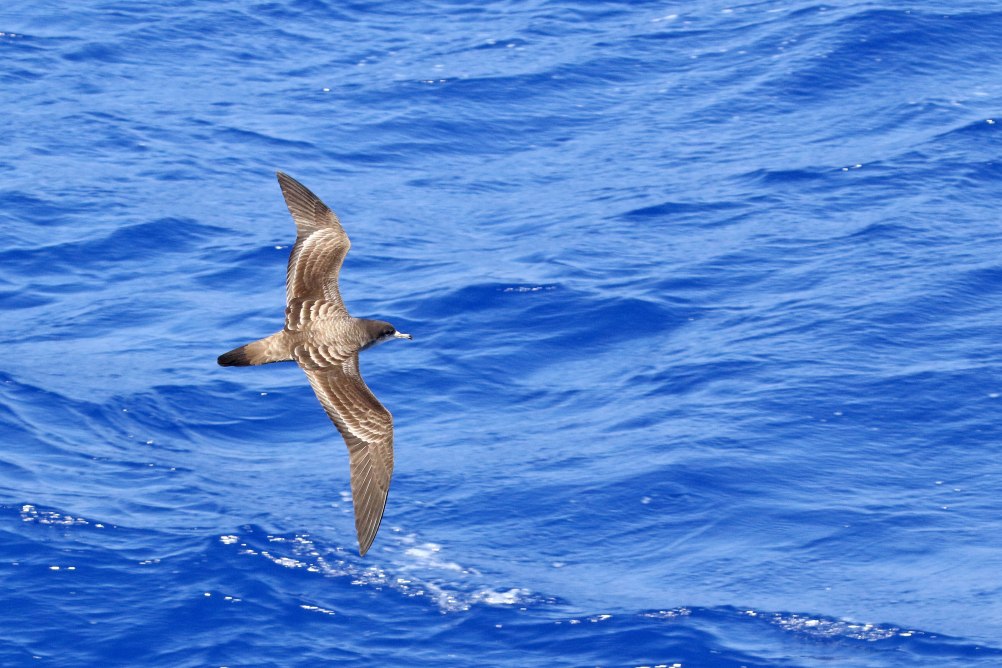
Wedge-tailed Shearwaters were relatively common. They have a wide range across the Indian and Pacific Oceans and breed in both hemispheres. Dark phase birds predominate in the southern hemisphere and light in north …
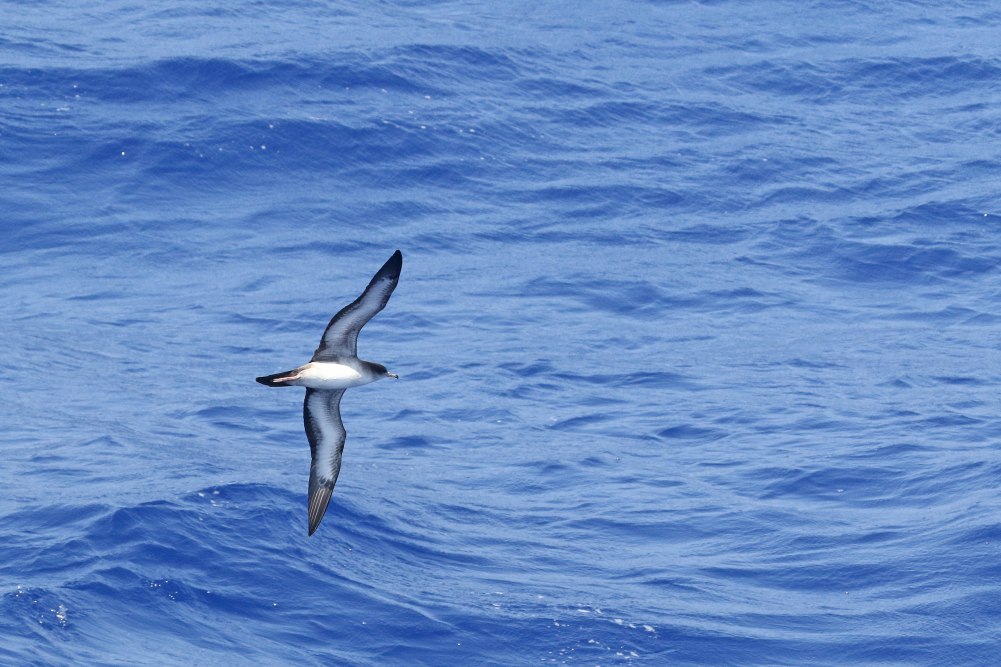
… whether this indicates incipient speciation is not clear but at the moment they are not acting like separate species.
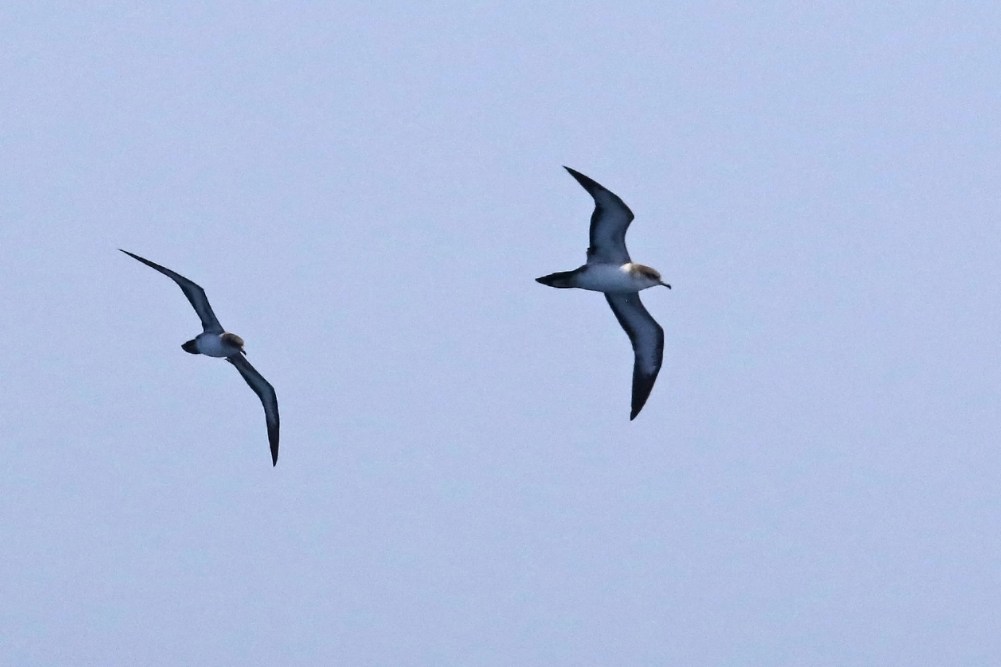
If you want to see some photos of dark phase birds then follow this link to part 2 of my account of the West Pacific Odyssey.

Also in these waters to the south of Japan we saw our first Bonin Petrels, the only Pterodroma I was to see in the northern hemisphere part of this cruise.
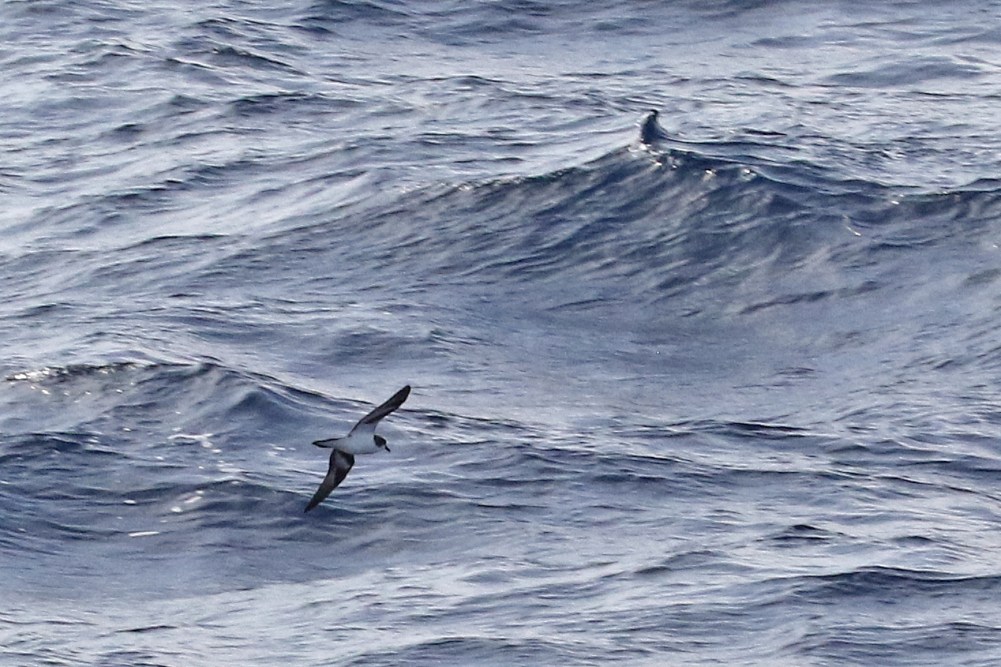
As well as a diagnostic underwing pattern …

… this species shows a much greyer back than other similar Pterodromas.
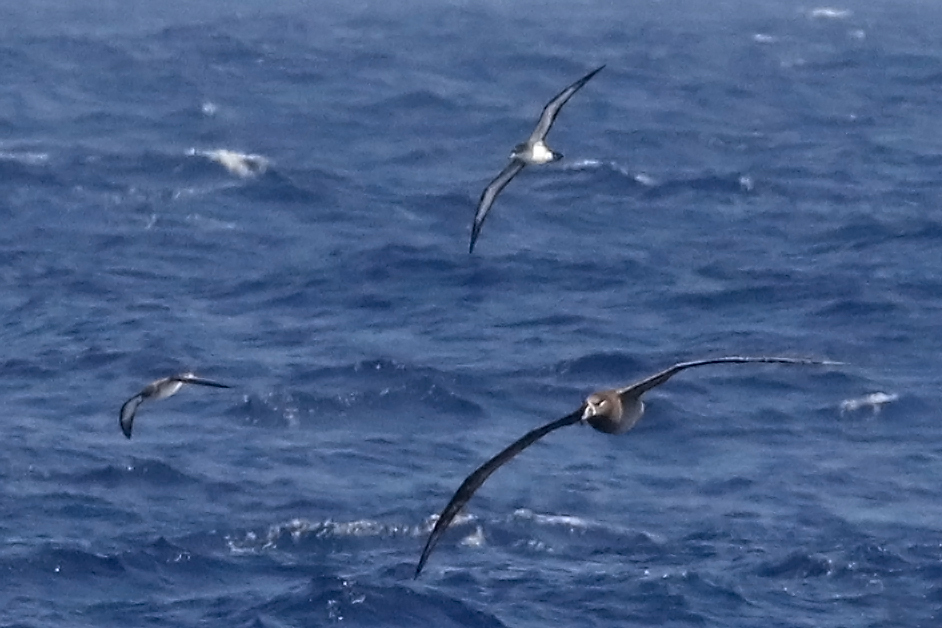
And along with the shearwaters we started seeing our first Black-footed Albatrosses. This is a species that breeds mainly in the Hawaiian chain but ranges widely over the North Pacific.
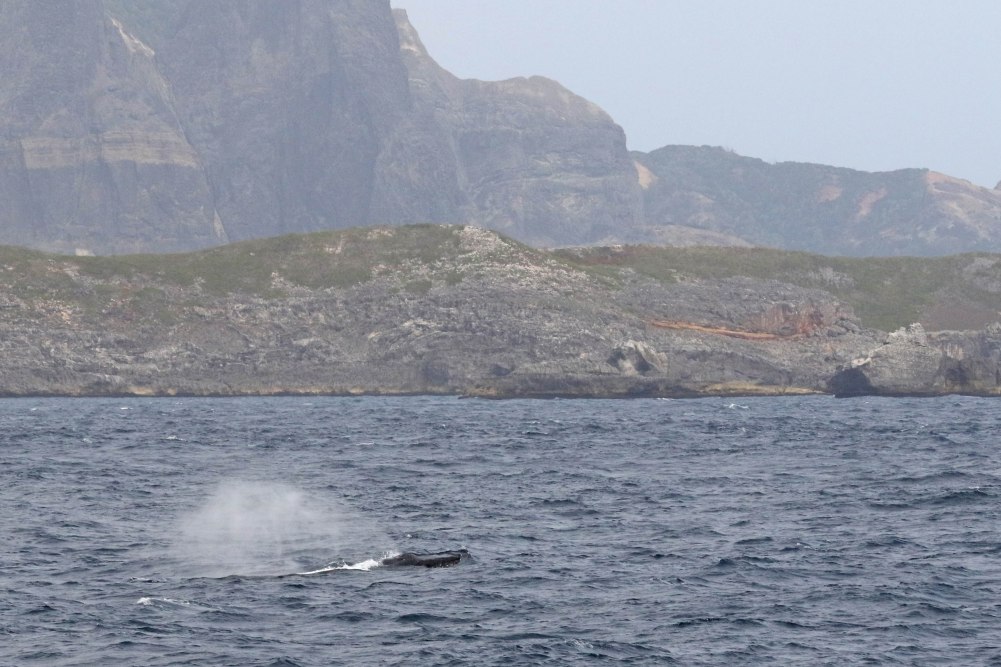
Early on on the 10th we passed the island of Hahajima in the Ogasawara (or Bonin) Islands. A Humpback Whale greeted us as we arrived. It was such a pity we couldn’t go ashore as it was calm then …

… but we had to head north to Chichijima in order to clear customs and have a bio-security check. The officials from Japan had spent days travelling by ferry from Tokyo and perhaps unsurprisingly insisted on doing a though job. We had expected that we could go ashore to clear immigration and then have a look around but instead they came on board. Even so it took four hours before they departed and then there wasn’t enough time to go ashore …

… at least there were more Humpback Whales to watch.

Not landing was a bit frustrating as we had been at sea for six days now and although there was no specific wildlife to see ashore, quite a few people wanted to ‘stretch their legs’. However for the birders (which meant almost all of the clients) a treat was in store …

… as the day drew to a close we headed round to the east side of Chichijima. We were on the look out for a very rare and recently described species of small known as Bryan’s Shearwater …

… however nobody had told me that Bannerman’s Shearwater, another small shearwater and one we had seen at sea further south, also occurred there as well. So in fact the first four or five ‘Bryan’s’ that I saw were in fact Bannerman’s … Photo by Niall D Perrins see here

… however eventually at least one Bryan’s Shearwater, smaller and with more white around the eye than Bannerman’s, flew down the starboard side. This is a very little known species, critically endangered and only recently described. This photo is by Hiro Tanoi, the ace Japanese seawatcher who along with his wife Shoko, was onboard the Professor Khromov with us, but was taken on an earlier trip to Chichijima. See here for his website.
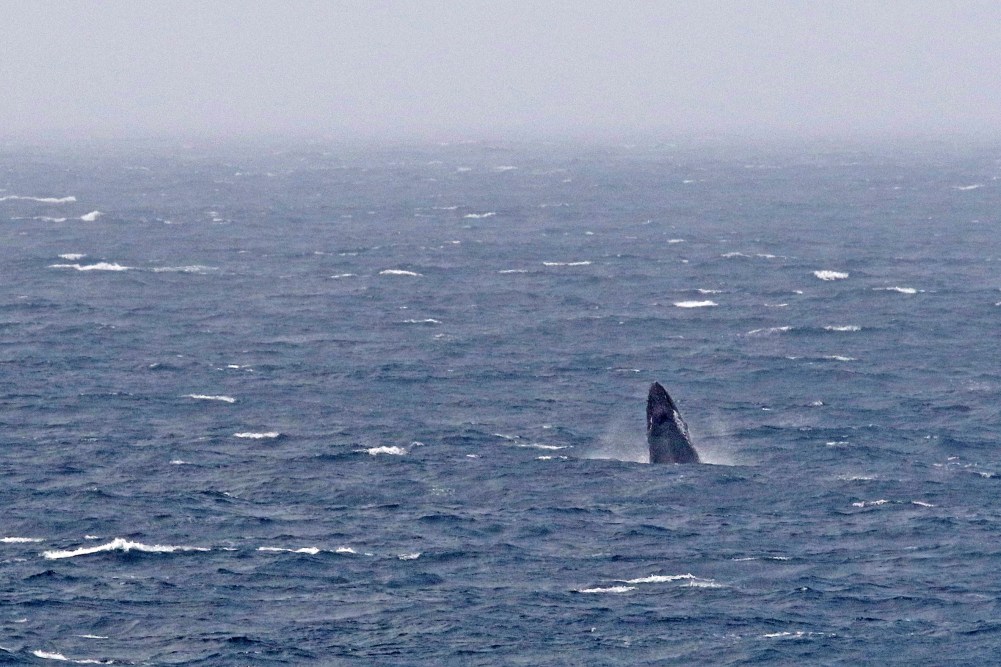
We were back off Hahajima at dawn but the weather was deteriorating. The Bonin Islands have two endemics, the Bonin Honeycreeper (actually a white-eye, albeit a very attractive one) and the soon to be split greenfinch. There was a a major blow when we were told at the last minute that customs had forbidden us to use our zodiacs in case we introduced foreign organisms into this pristine environment. So whilst the expedition organisers tried to get local boats to come and ferry us ashore we stood on deck and watched the antics of the local Humpback Whales.

Eventually the captain decided that as he couldn’t safely anchor any further inshore and the local boats might be bashed against the hull, so both for the ship’s safety and ours he would have to abandon the visit.
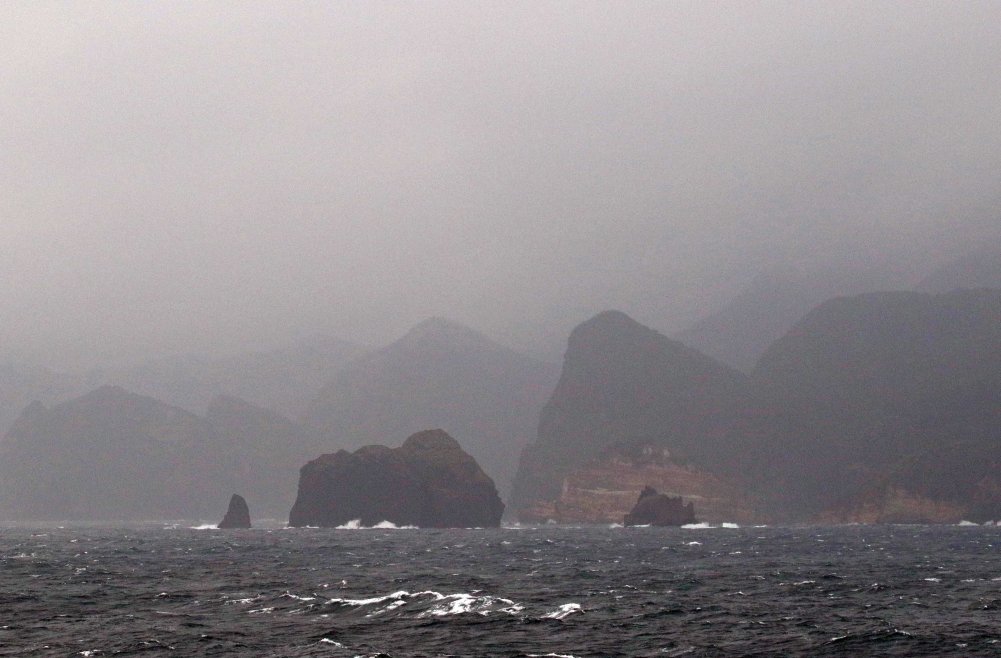
As you can see the weather (the tail end of a typhoon that has swept across the Tokyo area) deteriorated even further, so we had no option but sail north. Getting to Hahajima from Tokyo is a very difficult proposition so as we sailed away I knew that my only realistic chance of seeing those birds was sailing away with me.

However the day still had a goody in store for us. We started seeing the odd Tristam’s Petrel. Similar to Matsudaira’s but smaller, with a stronger pale bar along the greater coverts and lacking the white base to the primaries …

… this species was also high on my wanted list, as of course is any new species of seabird.

They didn’t come as close as Matsudaira’s had earlier, but as the day drew on they started appearing in staggering numbers, several flocks holding a thousand plus birds were seen and at times the surface of the sea looked like it was covered in a swarm of gnats.

On the morning of the 12th we approached the active volcano of Torishima.

Beautiful Black-footed Albatrosses sailed in front of the dramatic cliffs, but this wasn’t our main target.
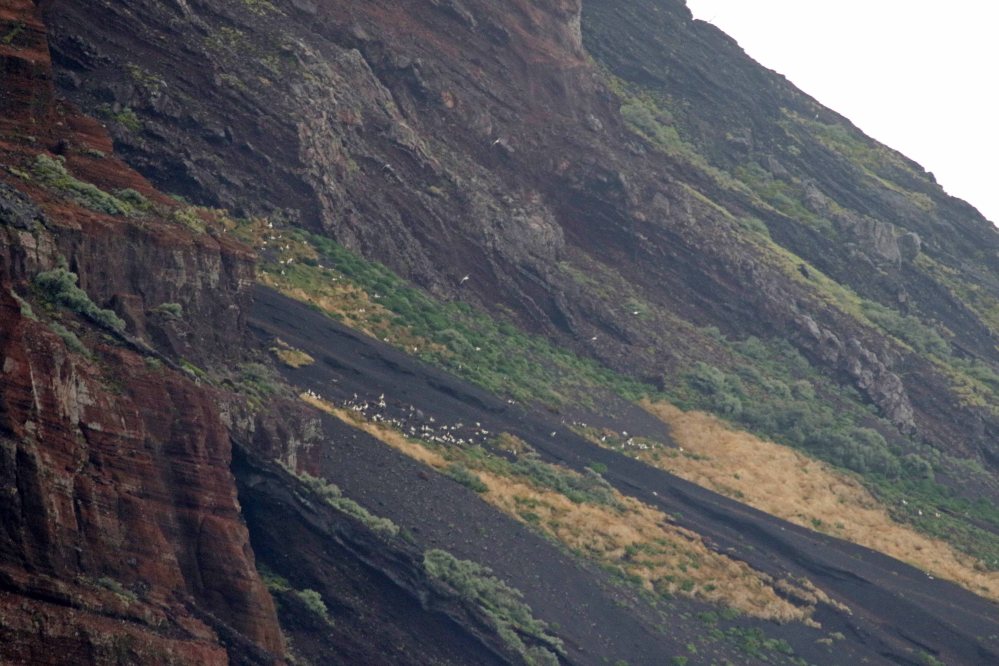
… distant white specks on the slopes were revealed to be what we had longed to see, Short-tailed Albatross colonies at their main breeding colony.
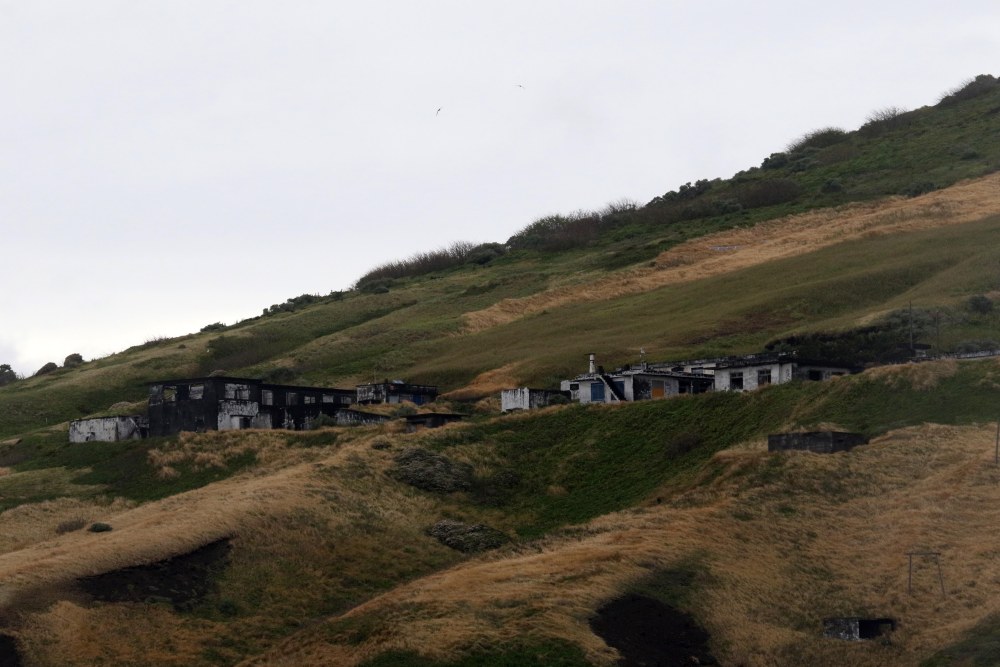
We could also see the research station, once the base for those who almost drove this magnificent species to extinction by killing them for their feathers. From Wikidedia: The IUCN classifies this species as vulnerable with an occurrence range of 34,800,000 km2 and a breeding range of 9 km2 . The Short-tailed Albatross came perilously close to extinction. They were hunted on an almost industrial scale for their feathers in the latter half of the 19th century, with some estimates claiming upward of 10 million birds hunted. By the 1930s the only population left was on Torishima, between 1927 and until 1933 hunting continued when the Japanese government declared the ban of hunting to save the species, by which time the albatrosses had stopped breeding on the island. At this point the species was assumed to be extinct and research became impossible with the outbreak of World War II. On 1949 an American researcher arriving on this island declared the species to be extinct, but an estimated 50 individuals, most likely juveniles, survived at sea (all albatross species take a long time to reach sexual maturity and will not return to their natal colony for many years). After the return of the birds they were carefully protected, and the first egg was laid by the returning birds in 1954. Varieties of albatross decoys were placed around on the island after it was discovered that like other albatross species, this species also were enticed to breed if placed in a group. Today, longline fisheries, and volcanic eruptions on Torishima are the largest threats; however, introduced predators, environmental contaminants, soil instability, and extreme weather are also threats. There are many measures underway to protect this species. Japan, Canada, and the United States list this bird as a protected species. Torishima is a National Wildlife Protection Area, and native plant species are being transplanted to assist in nesting. Also, most commercial longline fisheries use bycatch mitigation devices.
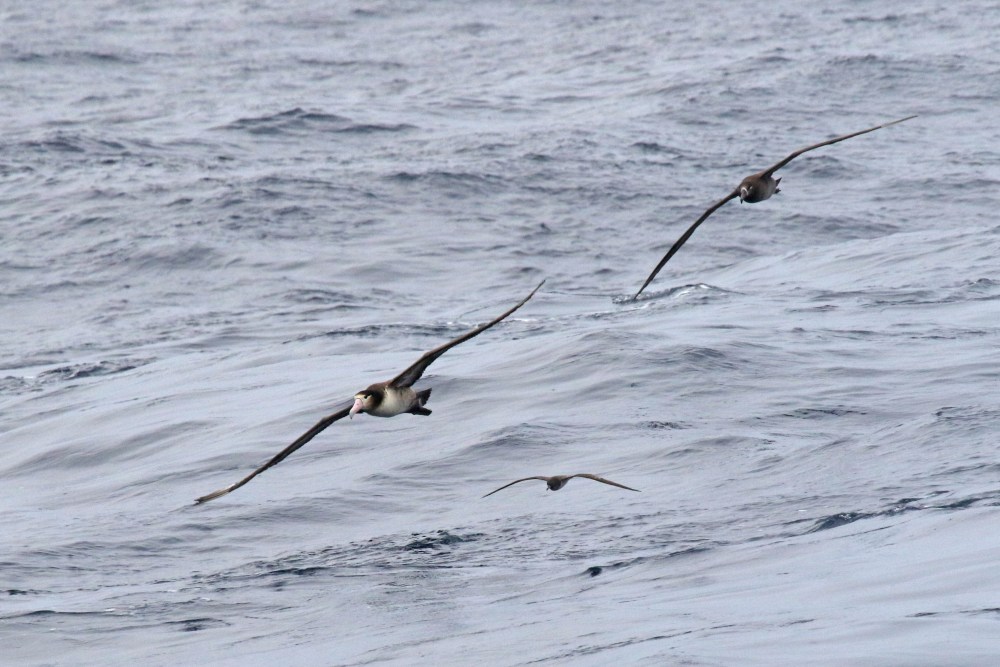
So the species survived thanks to the immature birds that remained at sea when all the adults had been slaughtered. Fortunately no feather collectors went back to check if there were any more left. As a size comparison here is an immature Short-tailed Albatross (left) with a Black-footed Albatross (right) and a Wedge-tailed Shearwater (lower centre).

The immatures (left) are great but the adult with its pink bill, white body and golden head and neck is a joy to see.

As the Wikipedia article says, there remains a threat from volcanic eruptions but now the population has reached around 2000 there would be a good population out at sea that could recolonise the island at a later date, certainly more than the estimated 50 that survived at sea after the end of the feather trade.
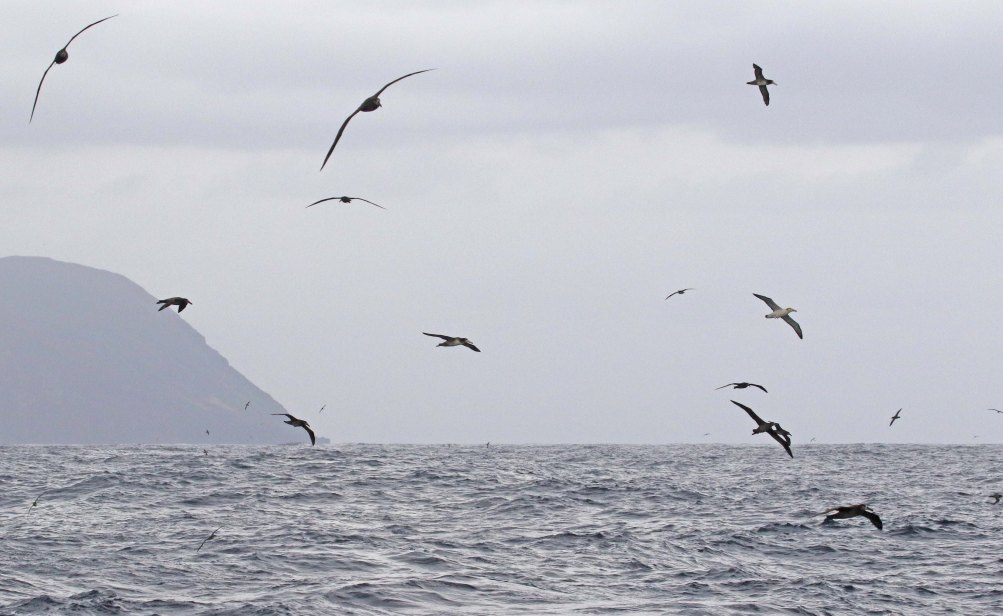
Of course landing by anyone other than researchers is banned and there is an exclusion zone around the island where fishing and the dumping of any material (including chum) is prohibited, so we steamed away from the island with a whole bunch of albatrosses and shearwaters in our wake …

… whilst Chris Collins …
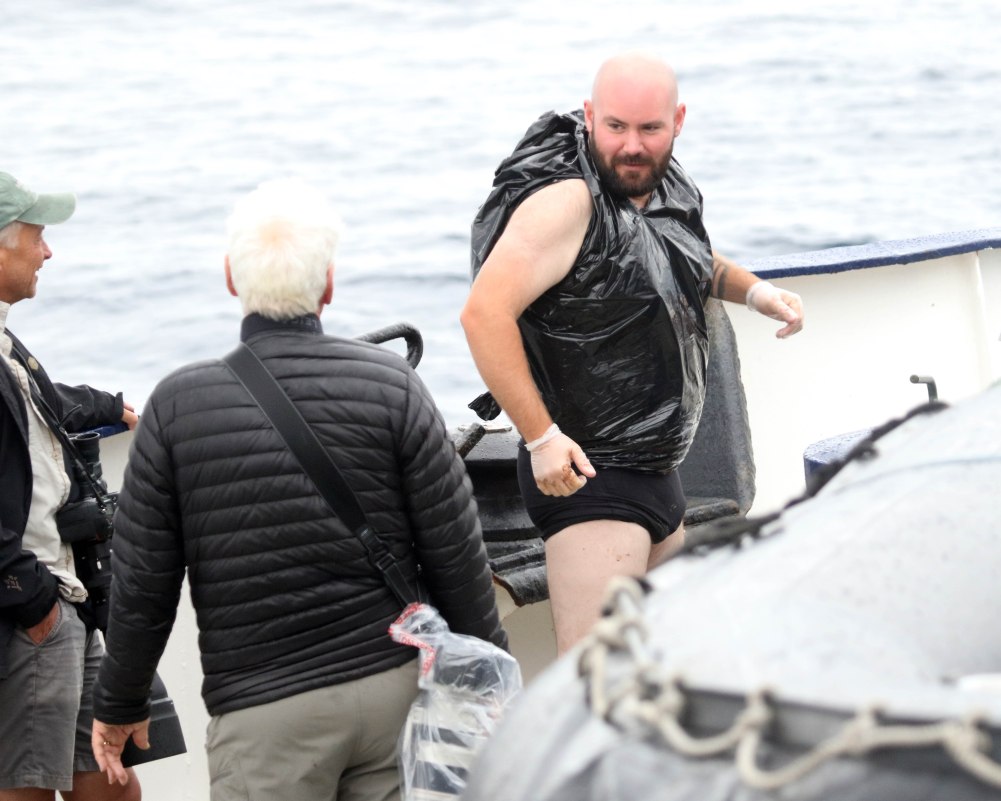
… and Lisle Gwynn got on with the unpleasant job of chum preparation.

Soon of course the albatrosses keen sense of smell told them there was food available …
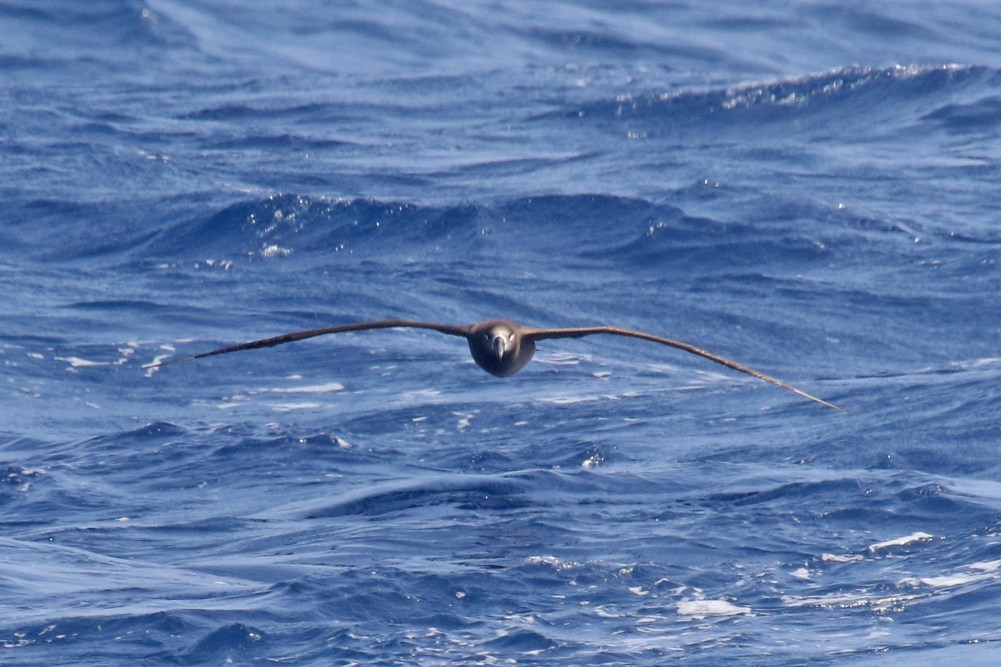
… and Black-footed Albatrosses glided in for a free feast (and the day brightened up as well).
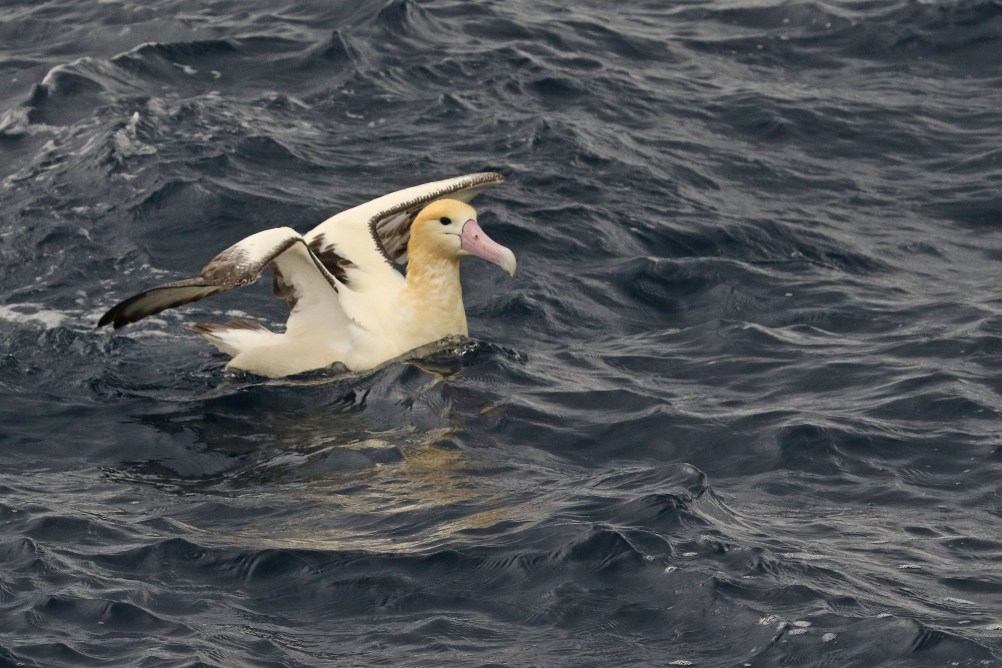
Short-tailed Albatrosses joined the melee of Black-foots and shearwaters around the stern …

… giving truly wonderful views. I saw a few of this species on my cruise (also on the Prof Khromov) off the Kuril Islands on the ‘Russian Ring of Fire’ trip in 2016 but views were distant and nothing like as good as this.

As well as the brown immatures there were a number of sub-adults. An albatross of this size (only out competed by the Royal and Wandering groups) will take ten years to reach maturity.

I had to ask the question when preparing this post: just how many photos of this wonderful and enigmatic species that almost went extinct, is too many? But I though I’d squeeze in another couple. If you want to see my review of all the albatrosses in the world posted for ‘World Albatross Day’ then click here

By my standards the photos were good, but here is a truly great photo of a truly great bird (in every sense of the word) by fellow passenger Toy Janssen. Short-tailed is hardly the best name. Some have suggested calling it Steller’s Albatross after its discoverer Georg Wilhelm Steller the first European to set in North America by travelling eastwards across Siberia, but no other albatross sports a patronym. I think a great opportunity was lost when they failed to call it Golden-headed Albatross.
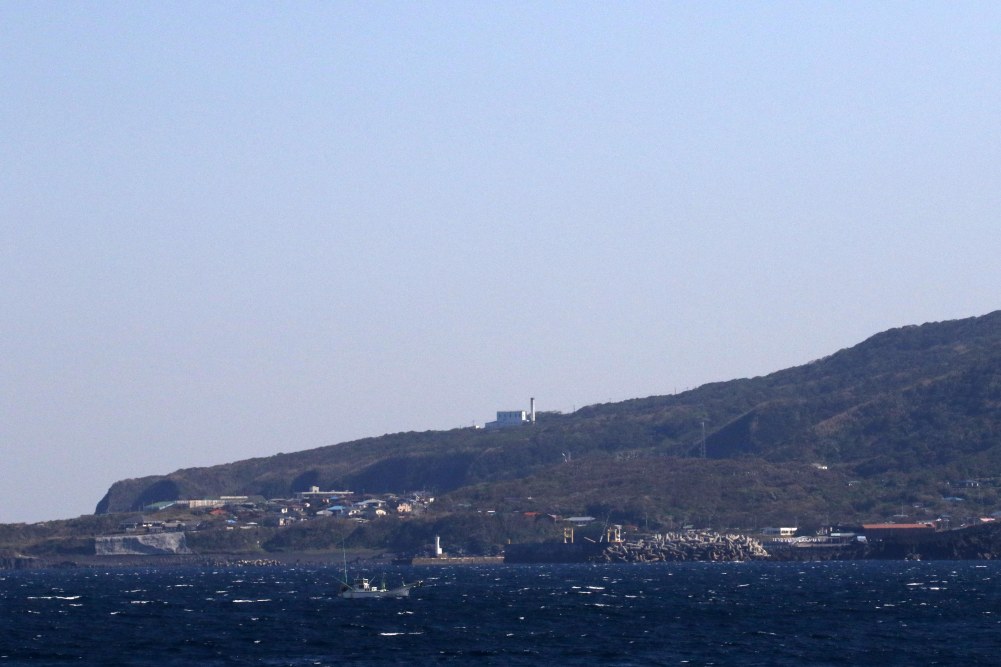
The following morning we anchored off Miyakejima in the Izu Islands. Then Helen dropped a bombshell. Although we had been ensured that we could use our zodiacs to get ashore but overnight the authorities had changed their mind and we would have to use local boats. We could see the busses hired to take us to the forest to see the endemic birds waiting by the quayside. Long dialogs ensued with the port, but the wind started to increase and the consensus was that the boatmen might be able to get us off but couldn’t guarantee getting us back on board again. I might add that Helen and the expedition staff did everything they could to try and get us ashore. The fault doesn’t lie with them.
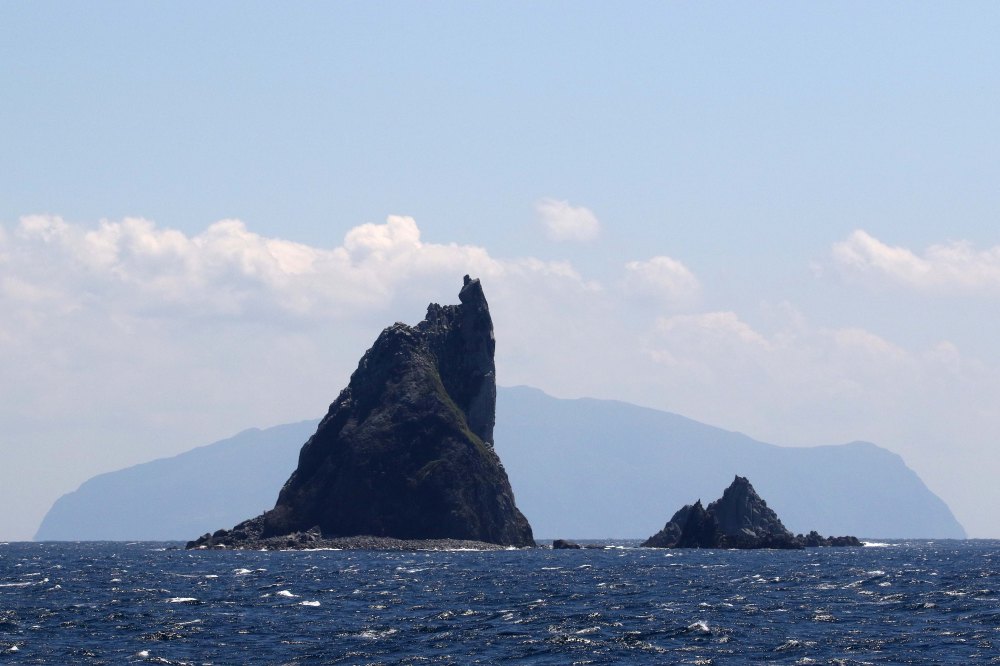
Having had three shore excursion cancelled in last four days we were all pretty pissed off. It would mean that we would be ten days at sea without landing, but far more important was that we would miss the island endemics and specialities, Japanese Woodpigeon, Ijima’s Leaf Warbler, Owsten’s Tit and Izu Thrush. However when I got home I found that the Birdquest spring tour of Japan includes the Izu islands and I had plan to do that tour sometime soon (pandemics permitting of course). So unlike the Bonin Islands all is not lost. Later we took a short excursion around some nearby rock stacks with Mijakejima looming in the background.
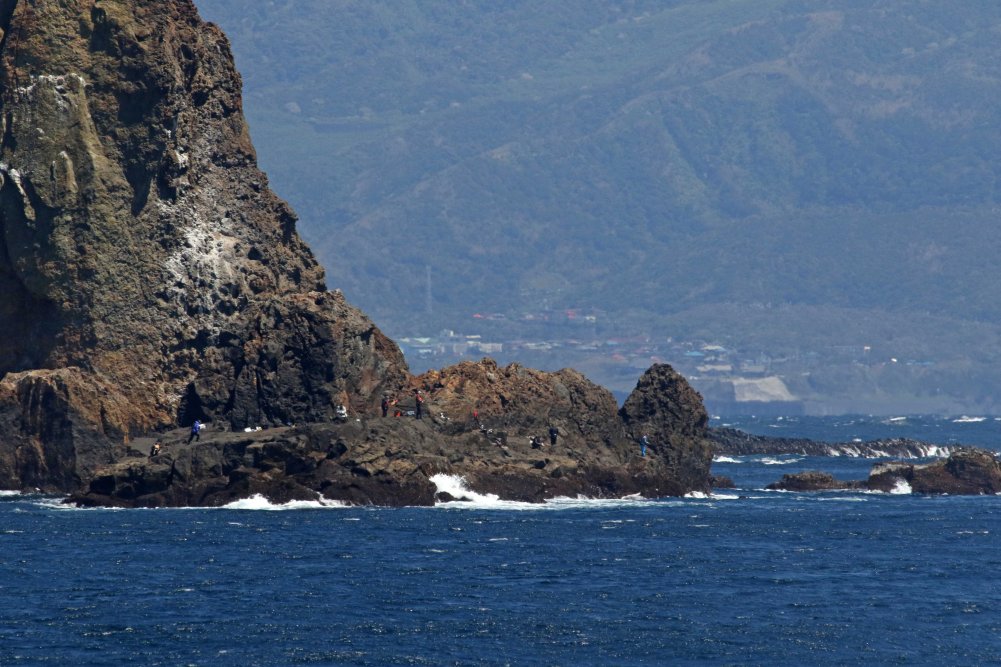
The rough conditions didn’t stop boatmen landing fishermen on these rocks!
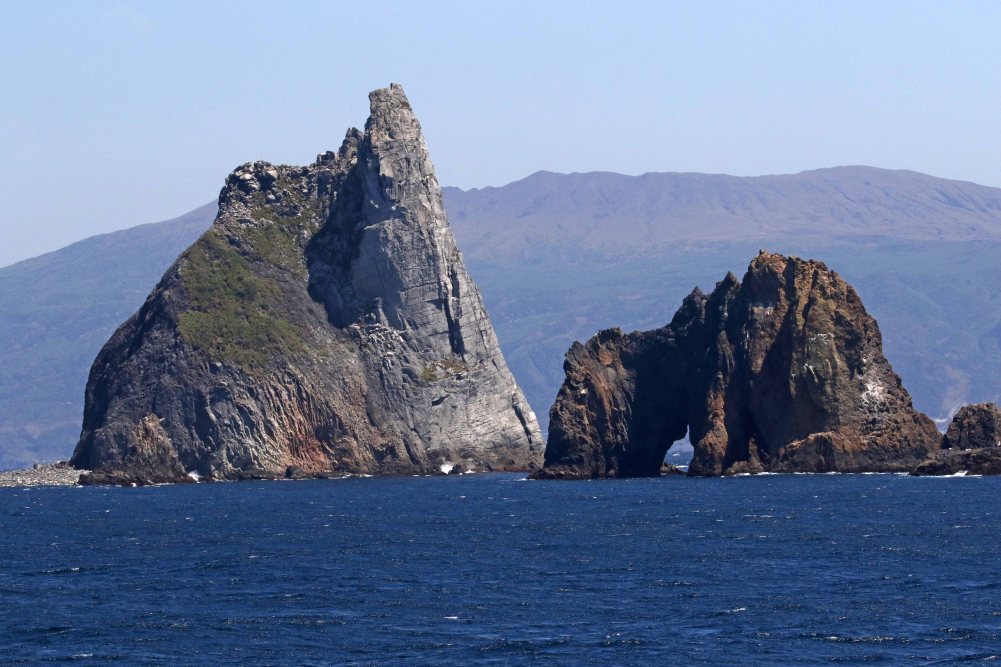
The day was sunny, the scenery magnificent and our target appeared right on cue …
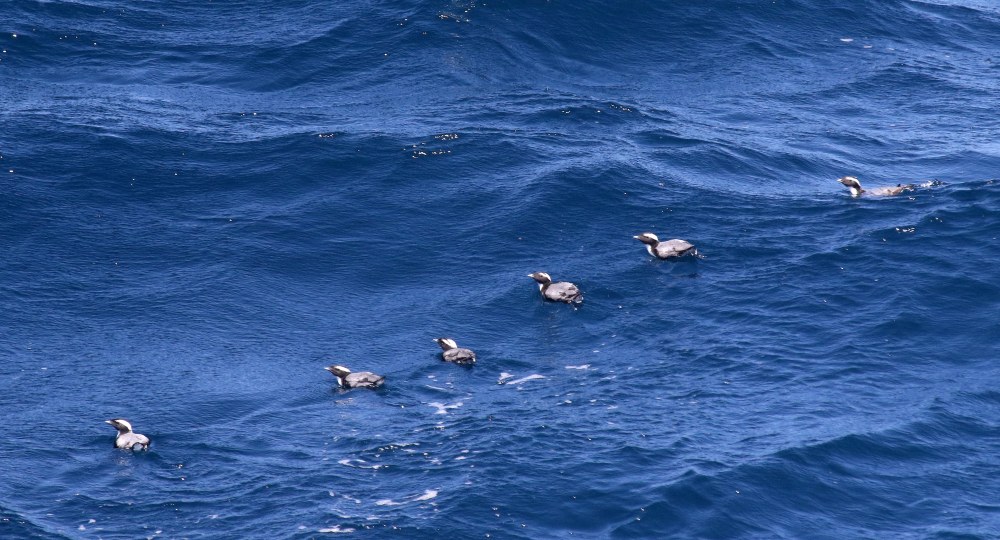
A flock of Japanese Murrelets, the only auks I saw on this trip.
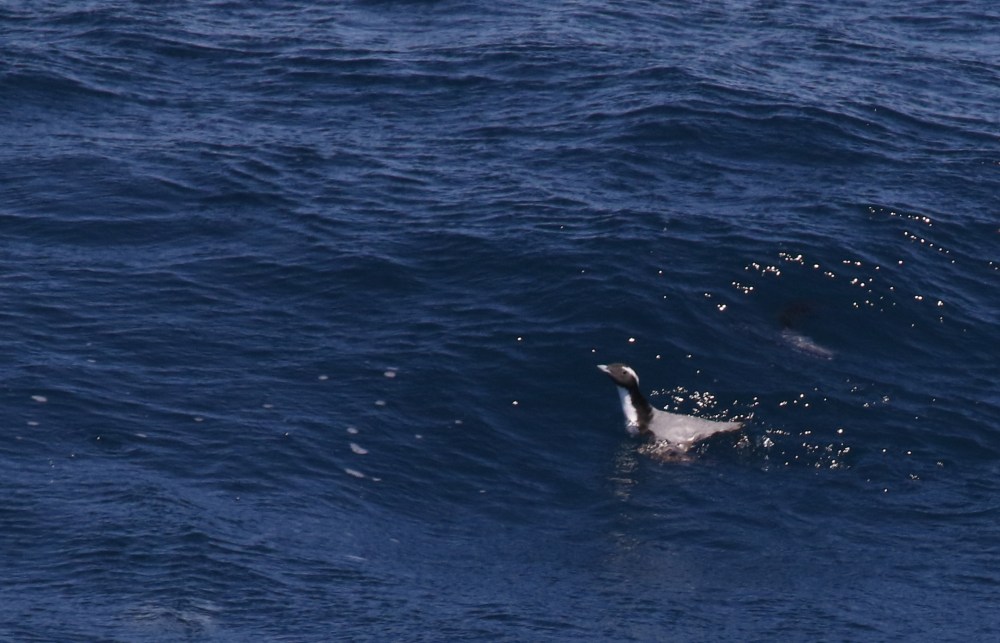
I had seen a couple of distant Japanese Murrelets from the bridge of Prof Kromov just to the east of Sakhalin on the ‘Russian Ring of Fire’ trip but the views this time were so much better.
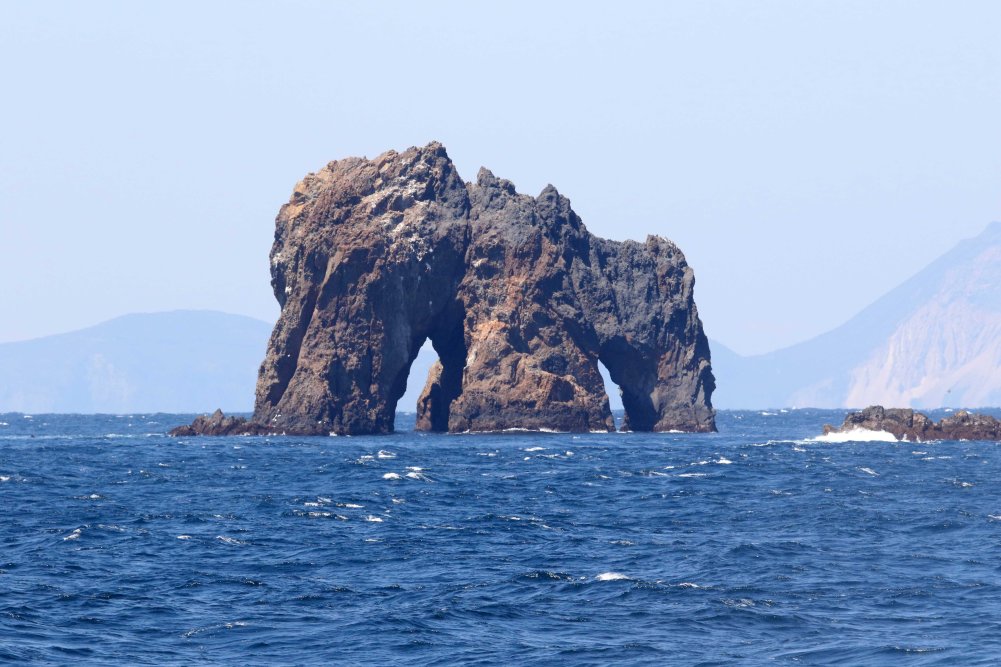
We circumnavigated the rocks and headed back towards Mijakejima before heading north towards Yokohama …
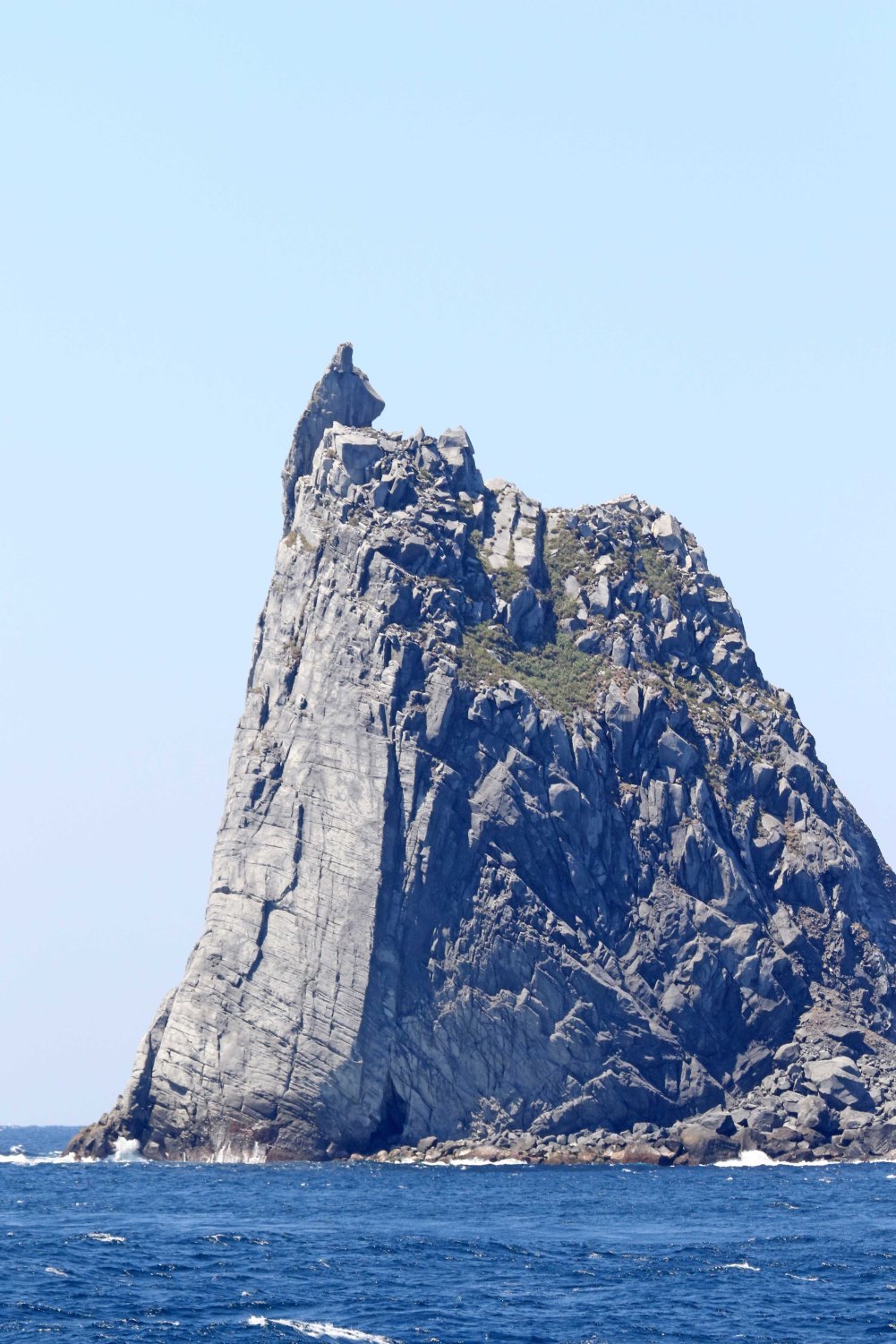
On the way back we noticed that the outcrop that we had seen from the other side now seemed to have a teddy bear perched on the summit!

A few Streaked Shearwaters had been seen by some of the birders ever since we we left the Solomon Islands, but now we were in the core of their range and they we positively abundant. Not so the Short-tailed Shearwaters from Australia which normally arrive by this time in order to moult. They were conspicuous by the absence.
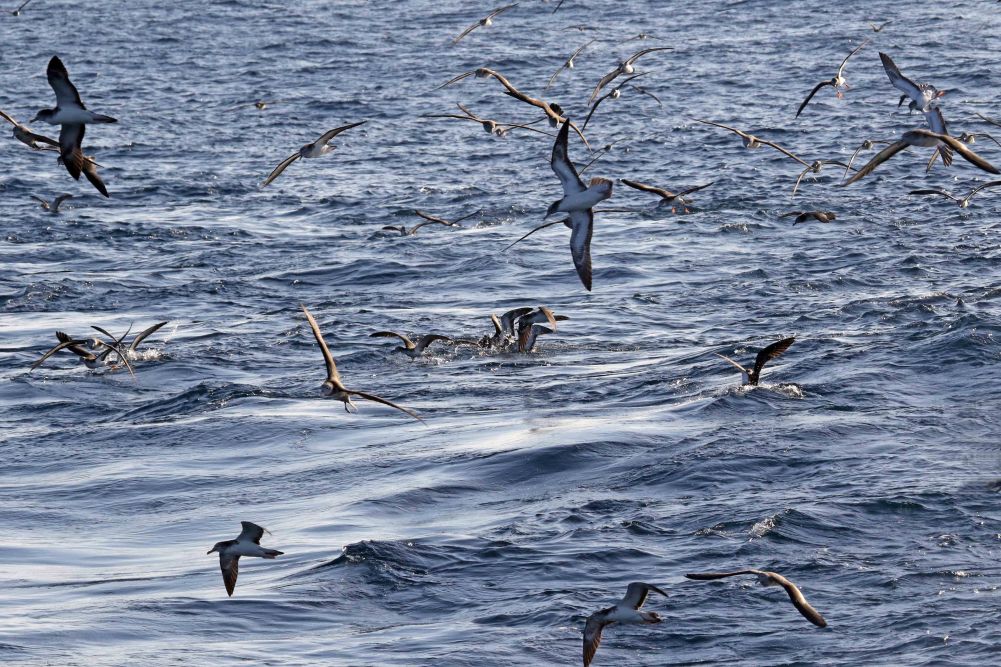
We were treated to hundreds of the speckled heads and white underparts of the Streaked Shearwaters (a species that has even been seen in the Western Palaearctic off Eilat) during our final afternoon.

Although this post is about a trip in 2019, it was 2020 before I posted it. This year we have heard of a Short-tailed Shearwater found moribund in Ireland, a White-chinned Petrel in Orkney, a Zino’s Petrel off Scilly, a Scopoli’s Shearwater in the North Sea, a Yelkoun Shearwater in Dorset (one that I did see) and multiple records of Brown Boobies. Something is happening to the world’s seabirds, undoubtedly caused by the warming of the oceans and the disrupting of currents. Maybe one day a Streaked Shearwater will reach Britain.

As evening approached we continued to sail north towards Tokyo and the volume of shipping traffic, which had been so light on on the cruise, dramatically increased.

On the morning of the 14th we entered Sagami Bay which leads to Tokyo Bay and the Port at Yokohama. We started seeing a whole bunch of new birds, such as Black Kites, Large-billed Crows and a whole host of gulls including Black-headed, Kamchatka (a race of Common), Vega, Slaty-backed, Glaucous-winged and this Black-tailed Gull.
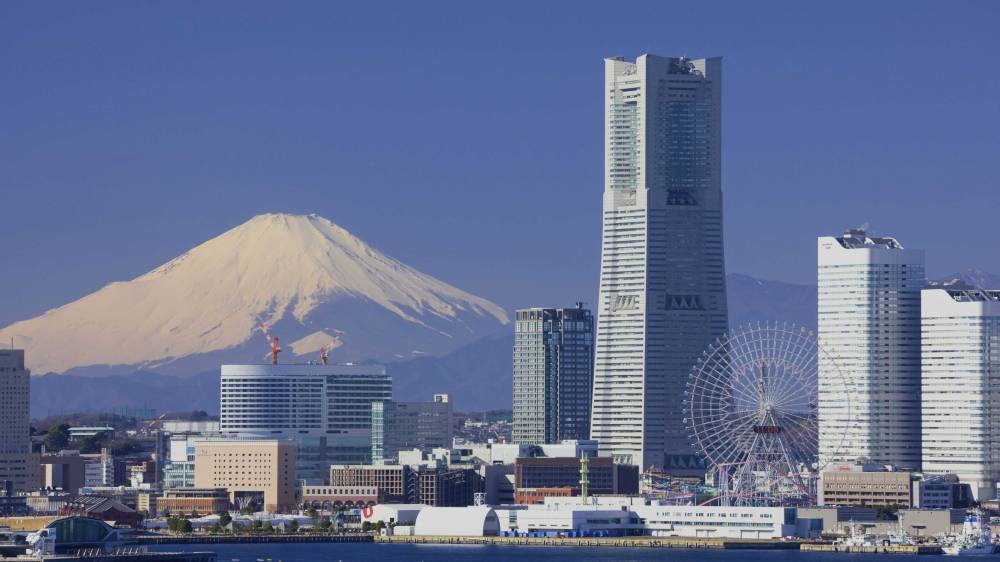
It was quite hazy as we approached the port at Yokohama and Mount Fiji could only be seen faintly through the haze, so I’ve used this photo from Celebratory Cruises . Note that this shot must have been taken in winter as there is far more snow on the mountain then when we saw it in mid-April.
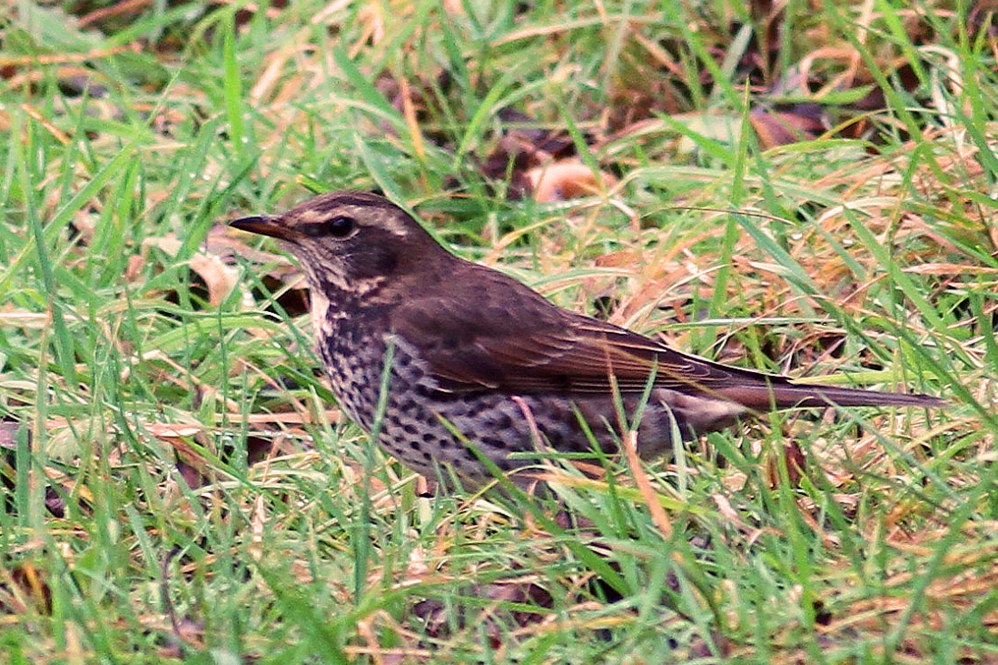
We were transferred to a bus that took us to the airport at Narita. There was some time to spare, so an hour or so was spent birding around the car park which produced views of a few good birds like Dusky Thrush. This photo is actually of a vagrant Dusky Thrush seen in Derbyshire in December 2016 taken by my friend Roger Howell when we twitched the bird.

We also saw Azure-winged Magpie (this photo taken by Janos Olay on my 2018 Mongolia trip.) I’d have loved to stay and spent some time birding in Japan but I’d been away for five weeks already, it was time to go home.
So for the last time I’ll post this map of our route. It had been an incredible journey of 5650 nautical miles (10,460 km) over 31 days (35 days away from home).
I landed on ten islands (plus photographed and admired many more from the ship) in six countries and entering the territorial waters of another two.
I saw 258 species of bird including those on New Zealand and Japan. That total included 42 species of ‘tubenose’ and 80+ seabird species (including all the gull, tern and cormorant species we encountered).
60 species were additions to my life list including 20 species of seabird (mainly ‘tubenoses’).
I saw 20 species of cetacean of which six where additions to my life list.
And I made many good friends.
On the negative side not being able to land on Rennell in the Solomons and Hahajima and Miyakijima south of Japan where serious blows but things went far smoother than say in 2020, when the ship having departed New Zealand had to sail to Vanuatu where the tour abruptly ended due to the Coronavirus pandemic.
It will remain one of the most rewarding trips I’ve ever undertaken.

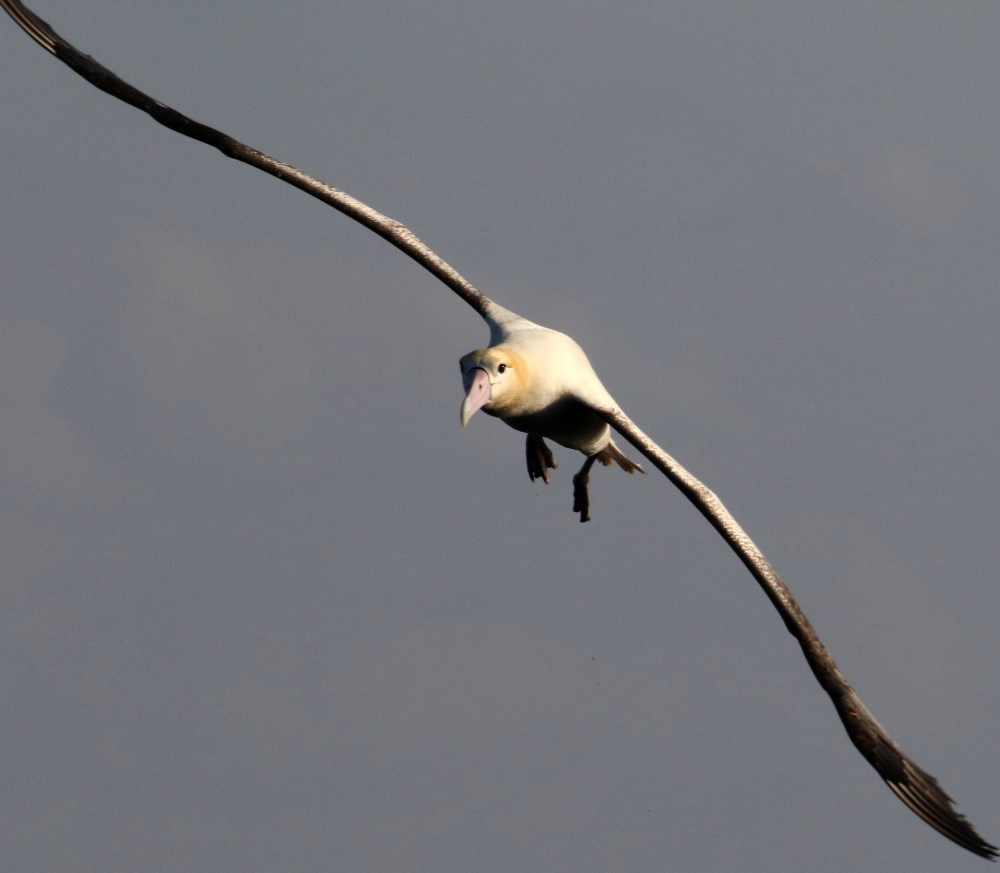
But if I have to choose one photo to end the account of this amazing trip it would have to be a Short-tailed Albatross approaching head on.
This post continues the story of the West Pacific Odyssey, the month-long epic journey on board the Professor Khromov from New Zealand to Japan.
We made a single landfall during this time at Chuuk (formerly spelled Truk) in the Federated States of Micronesia (Caroline Islands). I have visited Chuuk previously in 2010 as part of a wider tour of Micronesia. As I didn’t get to see much of the island group on this tour I’ve added a number of photos taken then.
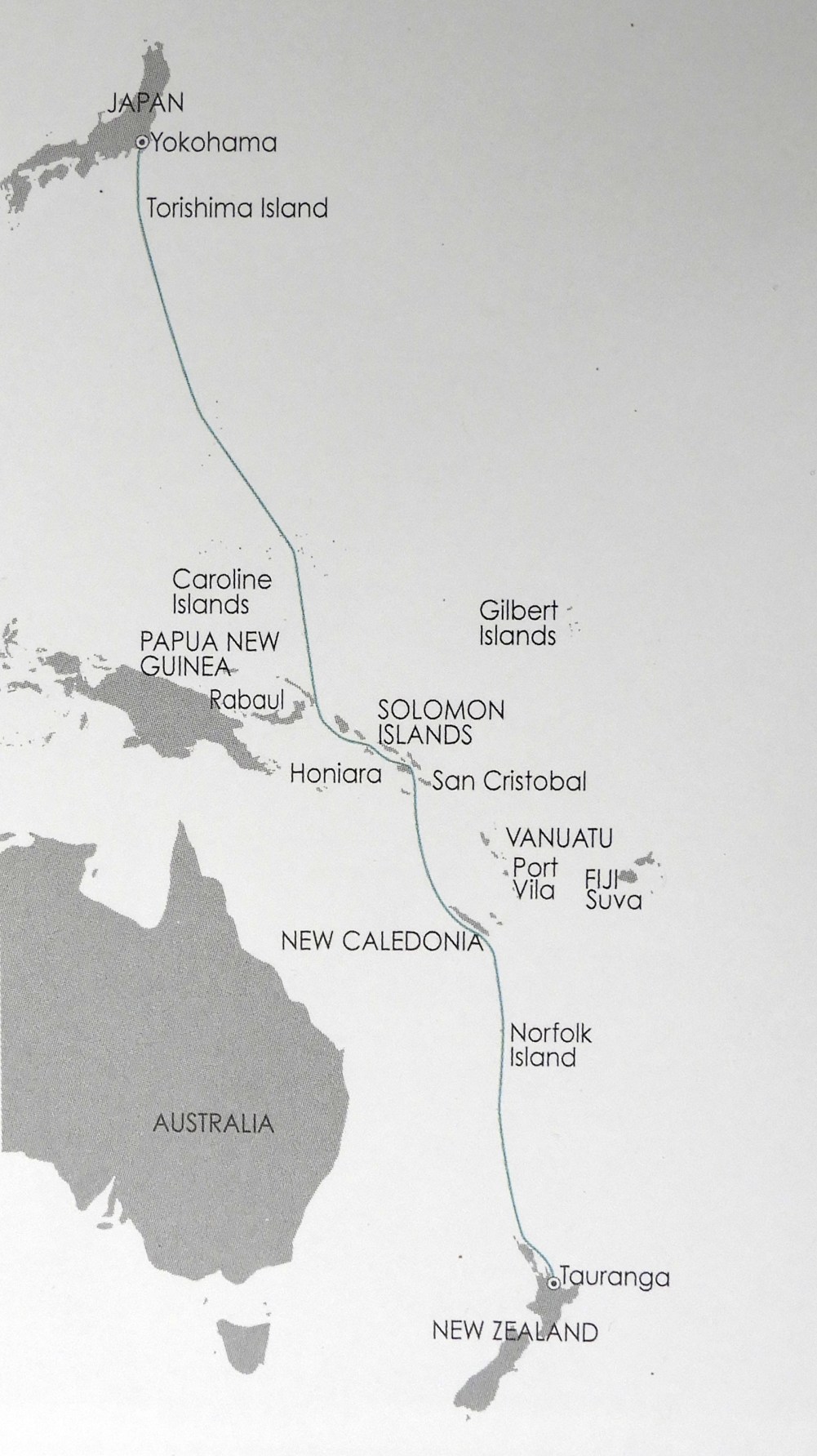
Leaving Kolombangara in the Solomon Islands behind we sailed along the western side of Bouganville and close to the southernmost tip of New Ireland. The following day we crossed the Equator and we spent the following day at sea as well. On 3rd April we arrived at Chuuk in the Caroline Islands and spent the latter part of the day and the following morning on the island. The next three days were spent at sea. We arrived in Japanese waters on the 9th.

As we left the Solomon Islands we had great views of the volcanic summit of Kolombangara (see post four on the WPO for more).
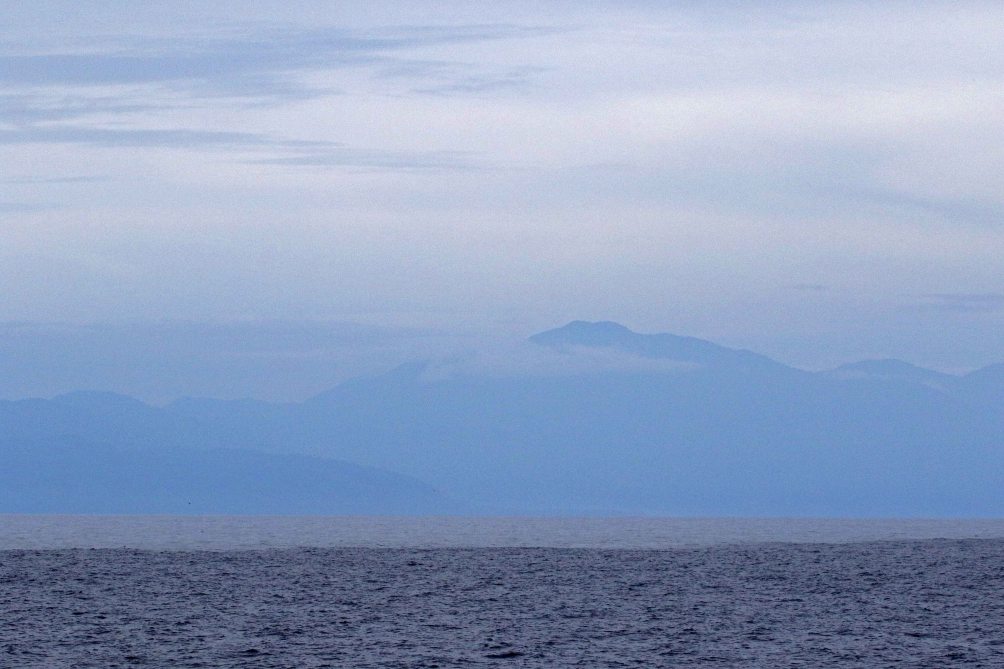
The following morning we passed to the west of the island of Bougainville. Although geographically part of the Solomons, administratively it belongs to Papua New Guinea although it has been lobbying for independence for a long time. Many of the tribes in the highlands jealously guard their territory and are suspicious or even show violence to outsiders. Recently the security situation has eased and a bird tour to this little known island with its myriad of endemics was advertised for 2020. I’d absolutely love to go but a) is it really safe? b) am I fit enough to hike up the top of that mountain? and c) could I afford it? its incredibly expensive. I think this is as near as I’ll ever get to Bougainville.
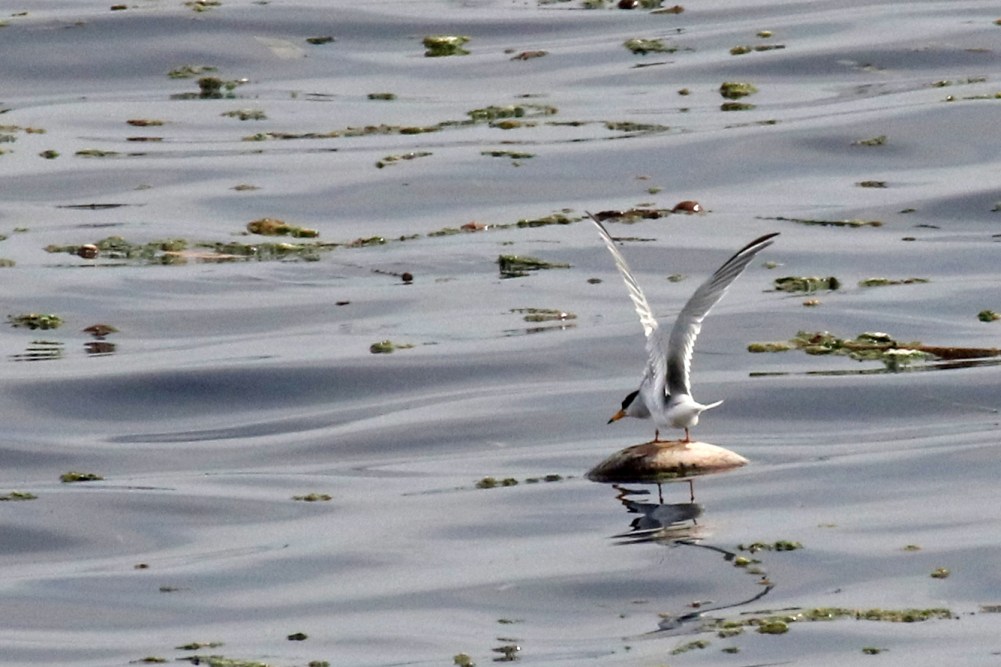
On route we found a few Little Terns roosting on floating coconuts …
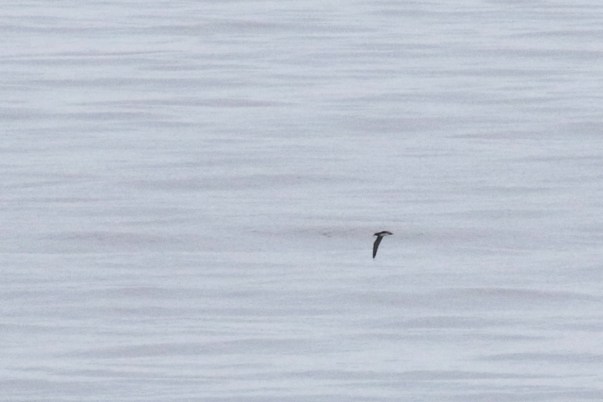
… but the birding highlight was this Beck’s Petrel, a small version of Tahiti Petrel which is mainly seen around Bougainville and New Ireland.

Beck’s Petrel. These images are shown at a smaller size as the bird was so distant.

Also in the area were some more Heinroth’s Shearwaters …
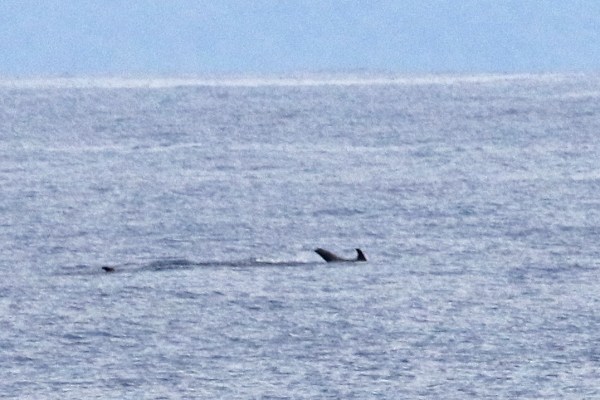
… and the next day, close to the PNG island of New Ireland we saw these Pygmy Sperm Whales.
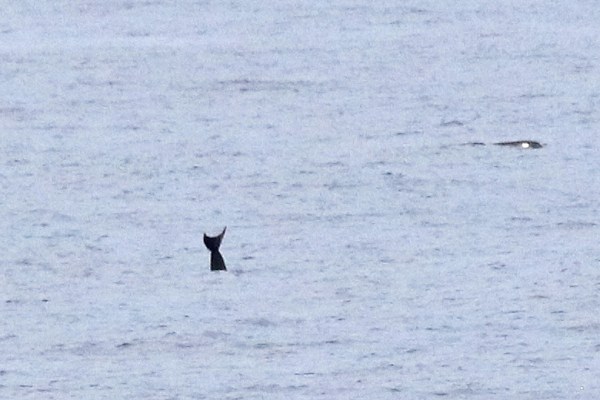
They are very hard to separate from Dwarf Sperm Whale but as Pygmy Sperm Whale has more of a falcated dorsal fin.

As we approached New Ireland the sea state got calmer and calmer …

… and just as happened when we approached the Equator on the Atlantic Odyssey three years earlier, the sea took on an oily appearance. We were entering the doldrums.

However that wasn’t to last long, with New Ireland disappearing away in the distance we saw a waterspout, that is a tornado at sea.

As the day drew on the clouds got darker and darker …

… and there was a dramatic sunset.

It was really rough in the night, not what we expected as we neared the Equator, with a big, slow swell that moved everything around in your cabin. OK I’ve been through much worse on the way down to Antarctica but this is supposed to be the doldrums. The outer bulkheads were closed and we were banned from going on deck. There had been plans to stop the ship and going for a swim at 0 degrees (latitude that is not temperature) but of course that was cancelled, as was all the usual tomfoolery that usually accompanies ‘crossing the line’.

All we could do was gather on the bridge and watch the GPS as we moved from the southern to the northern hemisphere. It was the 1st April, if there were any ‘April fools’ it was us.

Taken within four metres of ‘crossing the line’.
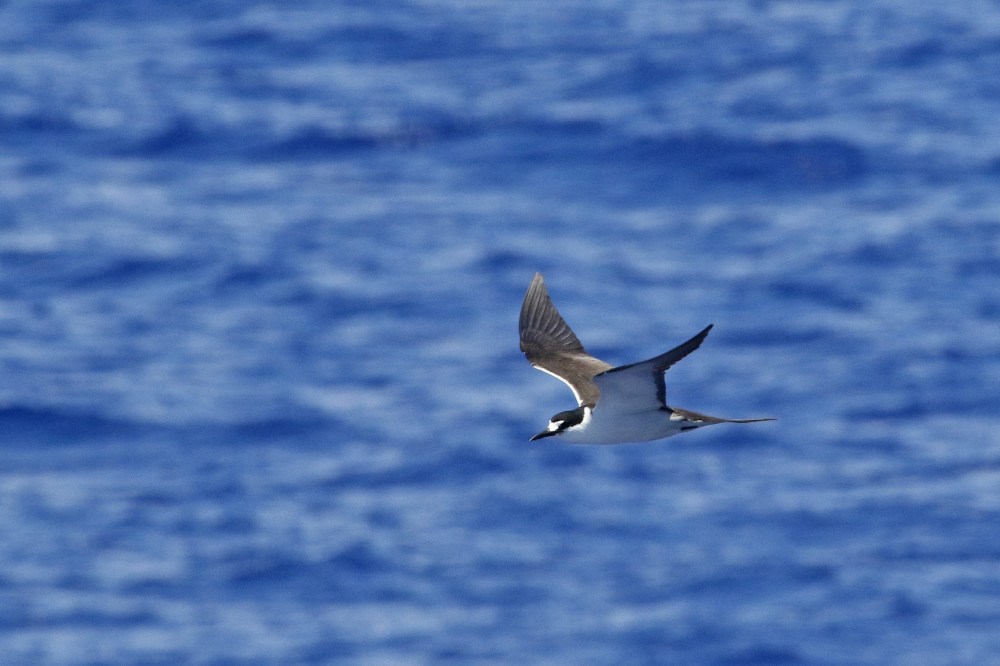
Around the Equator and during the bad weather we saw hardly any birds at all, but between the Solomons and New Ireland and to the south and north of Chuuk we had good numbers of the common tropical seabirds including Sooty Tern …

… Red-tailed Tropicbird …
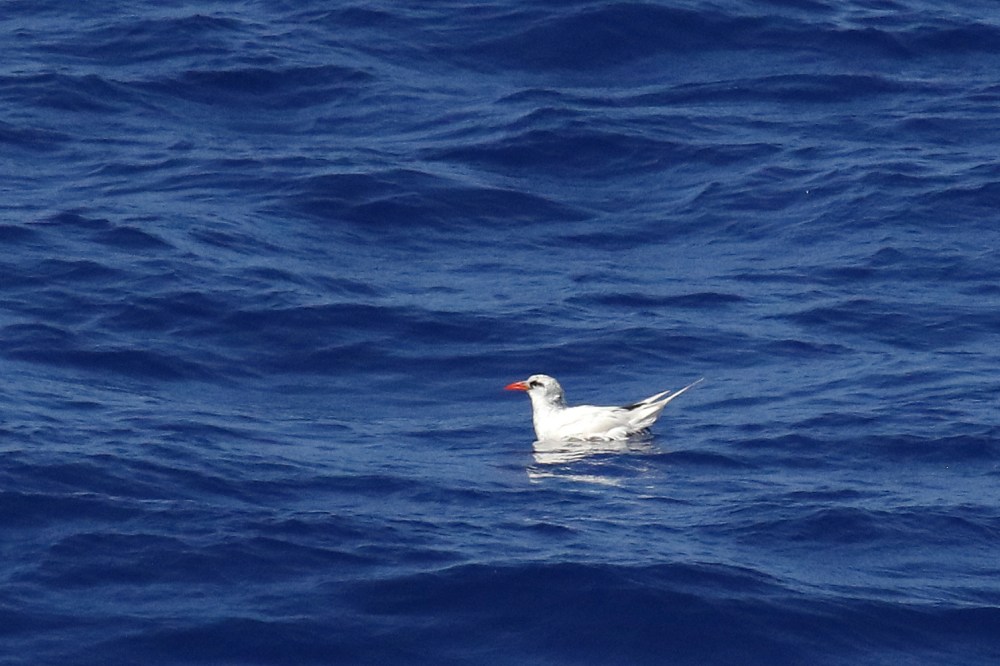
… this Red-tailed Tropicbird has a all white tail (just to confuse things).
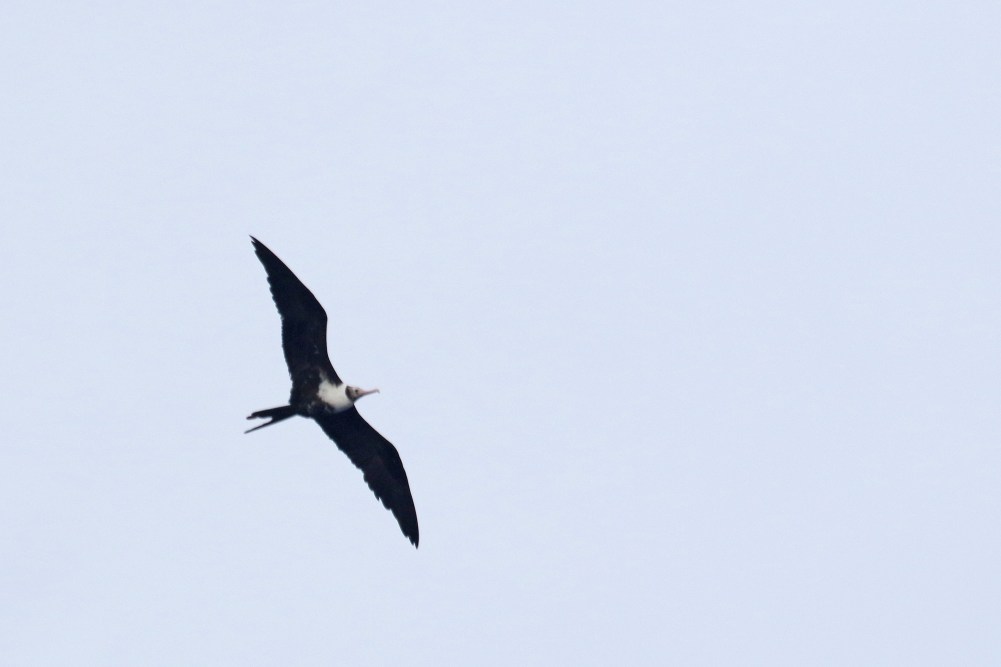
Also seen were frigatebirds, this is an adult female Lesser Frigatebird.
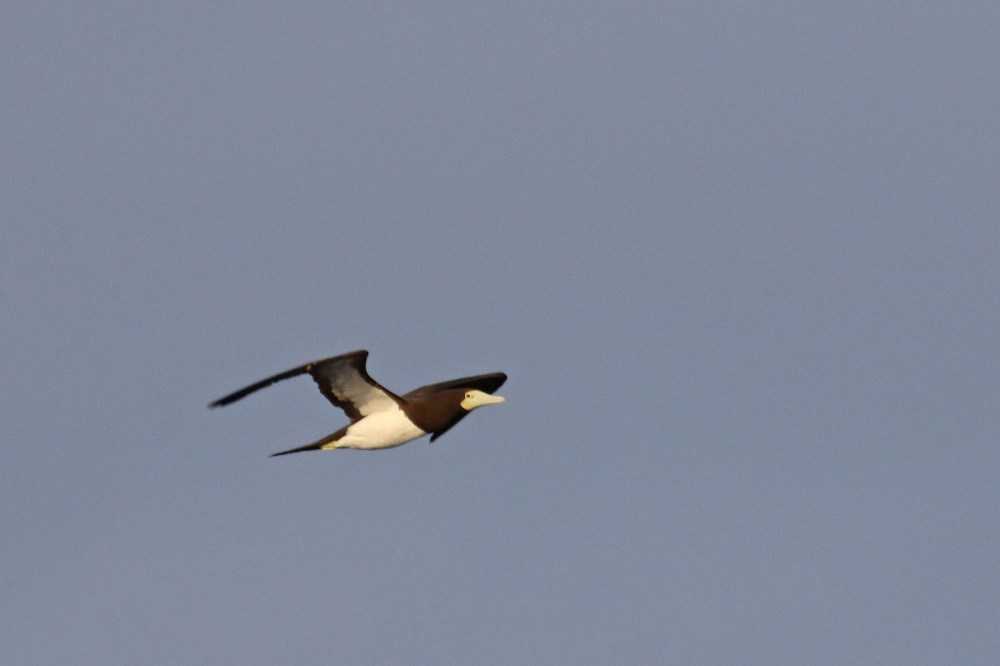
Three species of booby were commonly seen around the ship, chasing flying fish or roosting on the superstructure. This an adult Brown Booby.
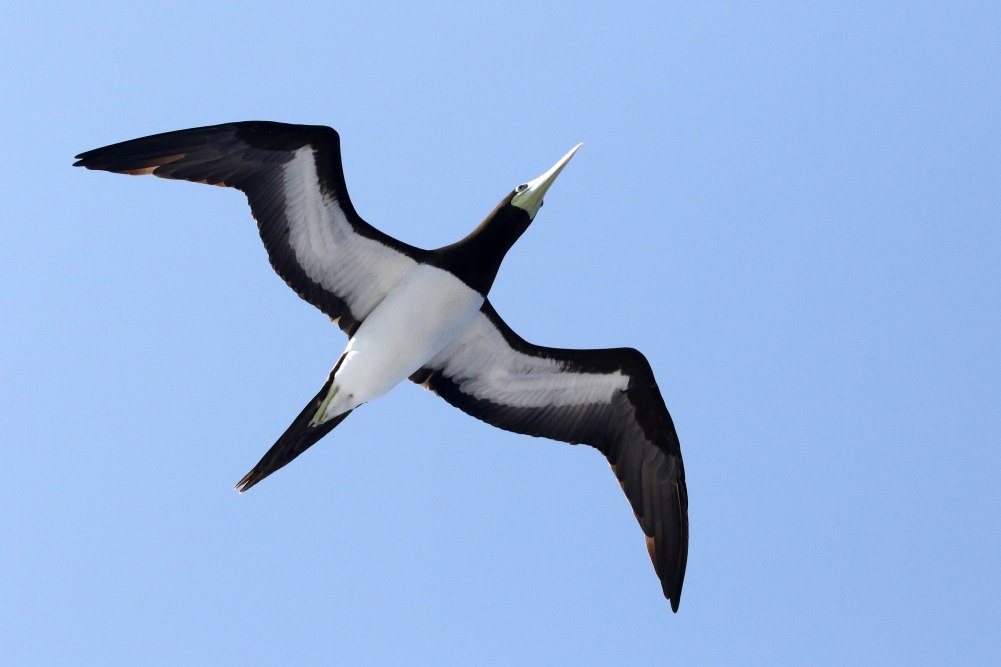
This Brown Booby can be sexed as a female on account of the greenish facial skin. A recent publication ‘Oceanic Birds’ by Howell and Zufelt, which wasn’t available when I did this trip, proposes that there are three species of Brown Booby, this is the Indo-Pacific form.

This is a adult Masked Booby …

… you can just see it’s pale eyes in the photo. The dark eyed race tasmani which occurs to off Australia has been illustrated earlier in my WPO account.
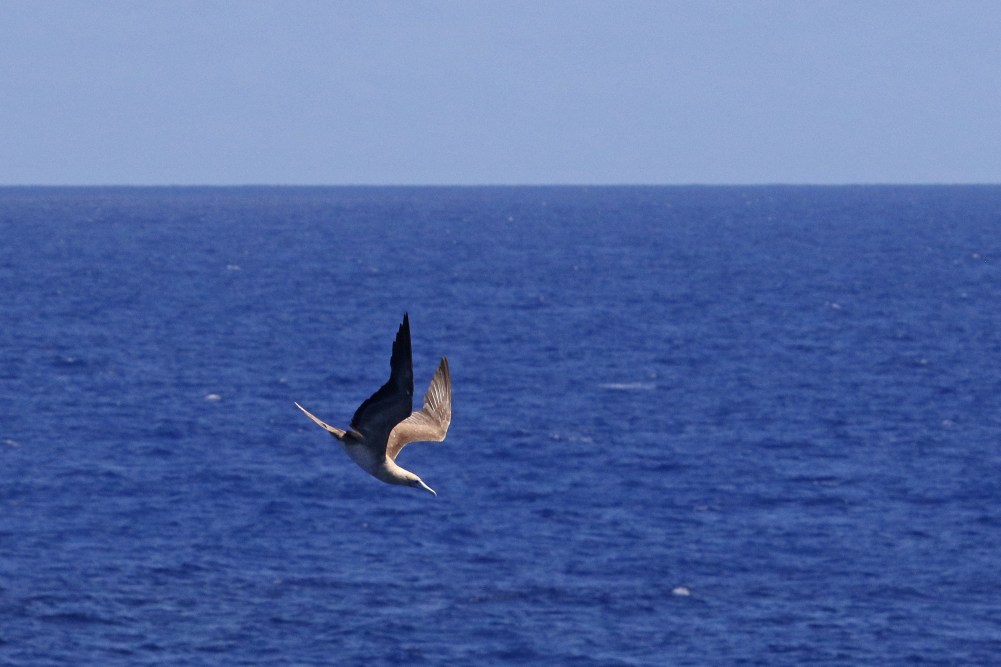
Red-footed Boobies come in several morphs. This is a typical brown morph here seen chasing flying fish.

This is the light morph. Red-footed Booby is the smallest of all the six species of booby.

Identification is complicated by these partially brown dark-tailed immatures.
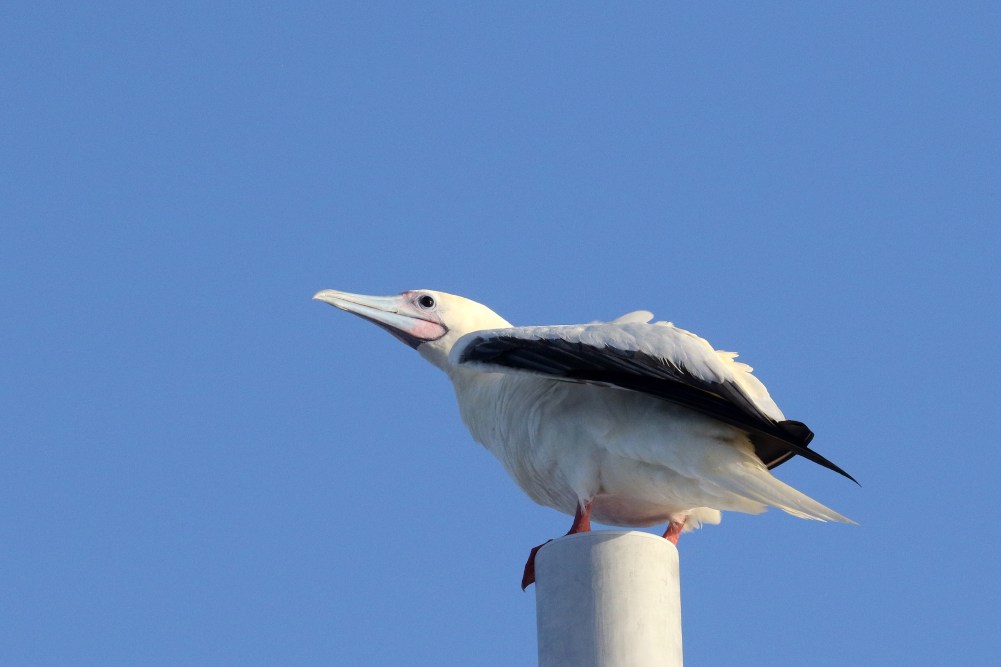
Boobies would often perch on the superstructure as they scanned the ocean for flying fish and would sometimes roost there.
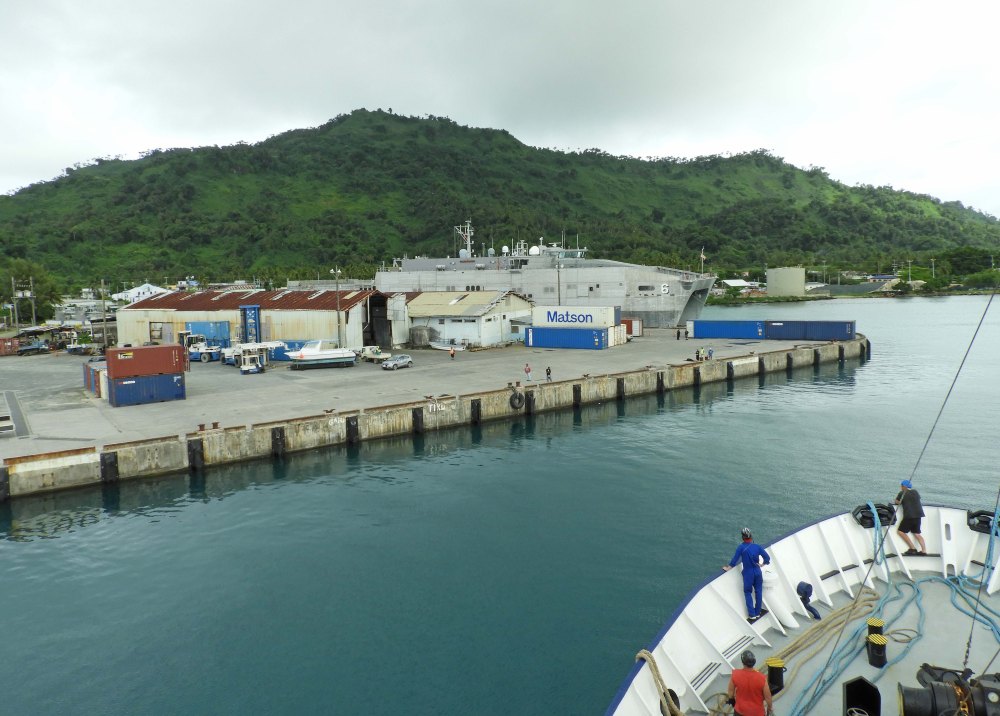
We arrived at Moen on the main island of Weno in Chuuk, one of the four states of the Federated States of Micronesia, in the afternoon but it took ages to get customs and immigration clearance.

… but as soon as we could we went for a walk …

Norfolk Island and New Caledonia were fully westernised developed islands, whilst the remoter villages in the Solomons were basic but rustic and attractive. Chuuk on the other hand just seemed tatty with derelict buildings and poorly repaired roads.

This derelict ship photographed over a line of washing between two tumbledown shacks sums up the air of neglect.
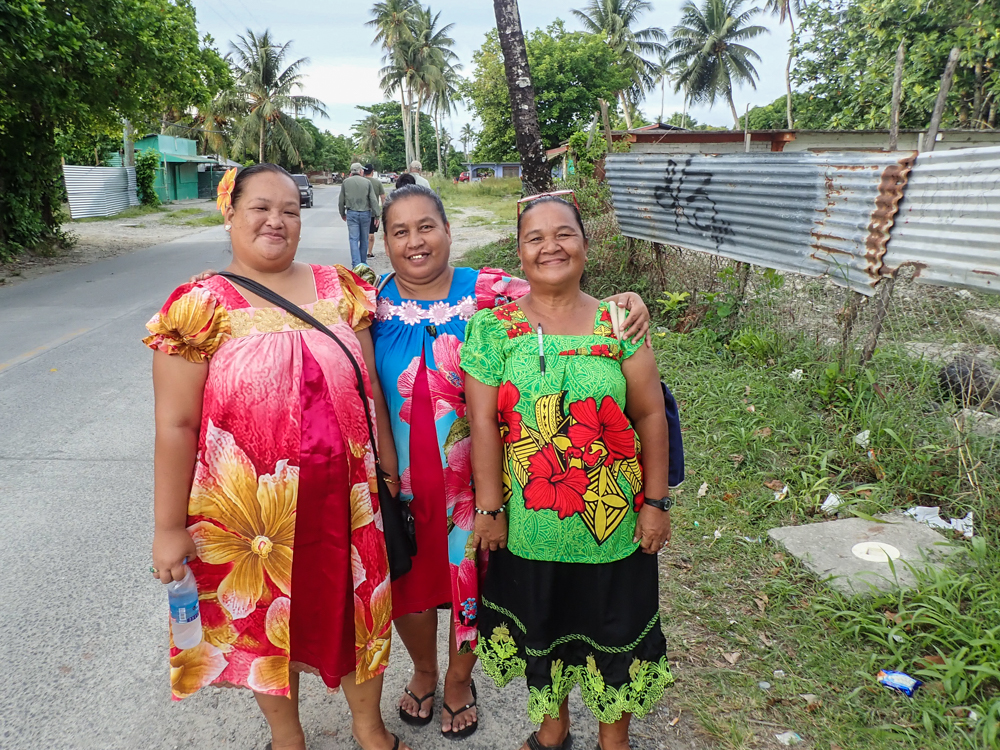
The people were welcoming enough though (see also the cheerful chappie in the photo two above)

In 2010 I did a comprehensive tour of Micronesia visiting some of the Mariana Islands, and Palau plus Chuuk, Yap and Pohnpei in the Federated States of Micronesia (Caroline Islands). As I didn’t take many good photos of Chuuk on this visit I’ve included some taken in 2010 to give a better idea of the scenery and wildlife of this island group. In 2010 we were staying in a hotel outside the town and so had to drive through it every time we wanted to visit anywhere. They were having big problems with the high tides flooding the streets. I don’t know if they have fixed it now or whether it was neap tides during our visit in 2019. This photo was taken in 2010.

In 2019 we birded an area of woodland around the ‘Japanese gun’ however you had to pay to see the gun itself and time was pressing. In 2010 we did visit the gun and accessed it via a tunnel through the hillside. Photo taken in 2010.
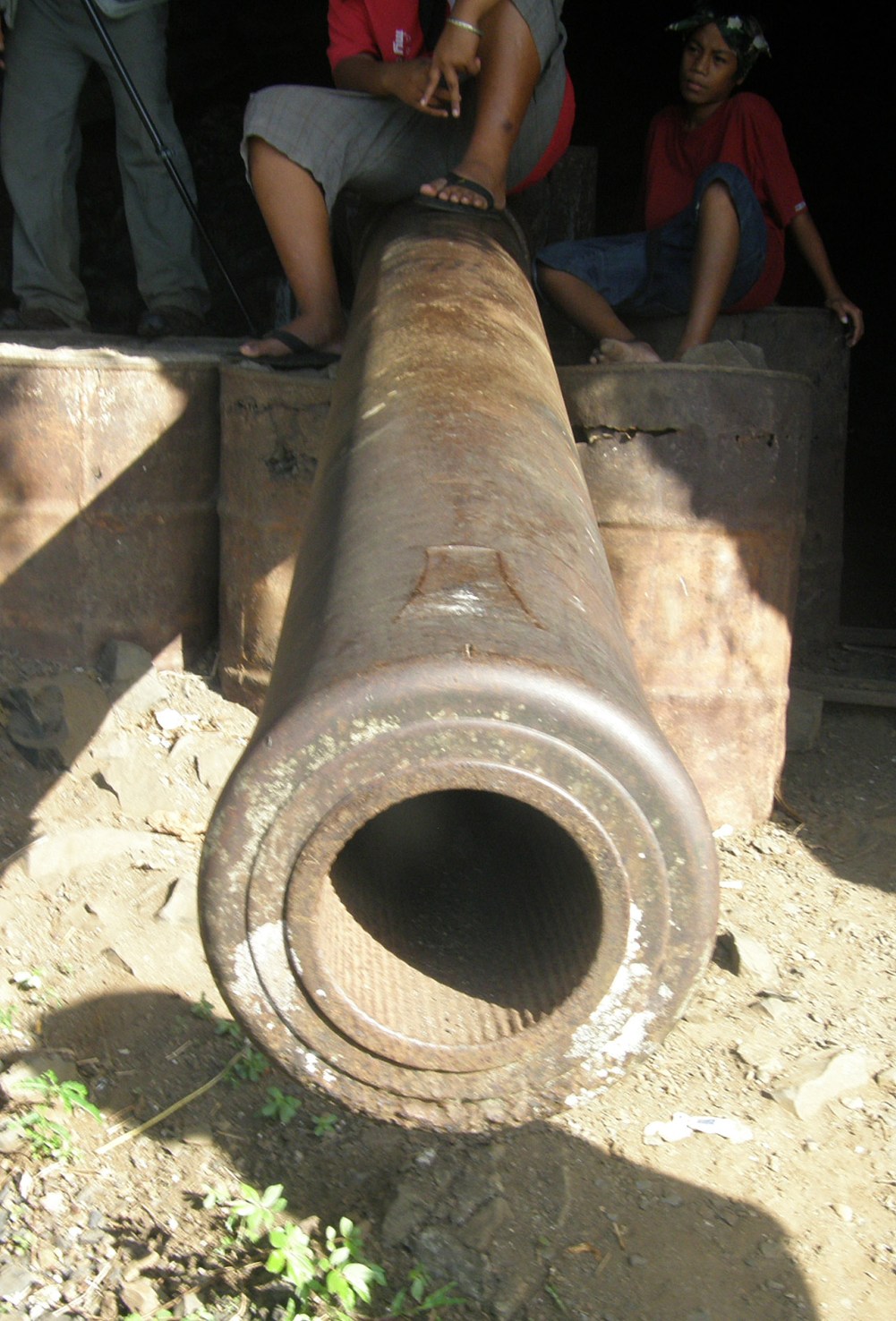
During WWII the Micronesian Islands were of great strategic importance, especially Chuuk due to the huge size of the lagoon and were occupied by the Japanese. This large gun was installed to defend the island of Weno from attack. Photo taken in 2010.
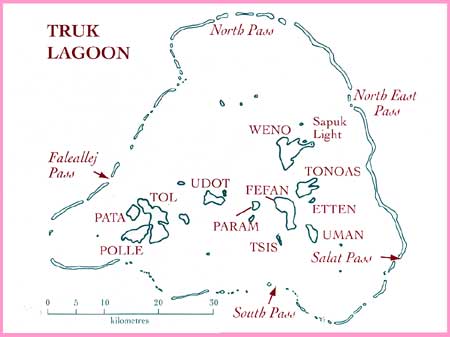
From Wikipedia:
Chuuk Lagoon, previously Truk Atoll, is an atoll in the central Pacific. About 1,800 kilometres (1,100 miles) north-east of New Guinea, it is located mid-ocean at 7 degrees North latitude and is part of Chuuk State within the Federated States of Micronesia. A protective reef, 225 kilometres around, encloses a natural harbour 79 by 50 kilometres, with an area of 2,130 sq km. It has a land area of 93.07 square kilometres (35.93 square miles), with a population of 36,158 people and a maximal height of 443 m. Weno city on Moen Island functions as the atoll’s capital and also as the state capital and is the largest city in the FSM with its 13,700 people.
“Truck atoll” was the Empire of Japan’s main naval base in the South Pacific theatre during World War II. It was the site of a major U.S. attack during Operation Hailstone in February 1944, and Operation Inmate, a small assault conducted by British and Canadian forces during June, 1945.
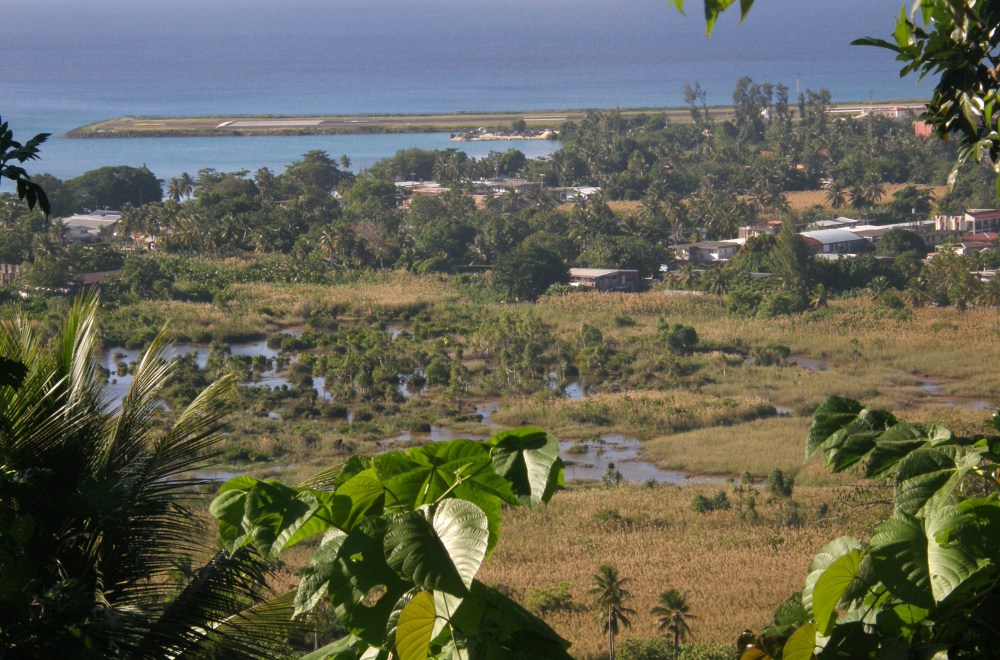
The gun was situated here to guard the approaches to Moen. However now the platform allows good views of the birds in the marsh below. Photo taken in 2010.
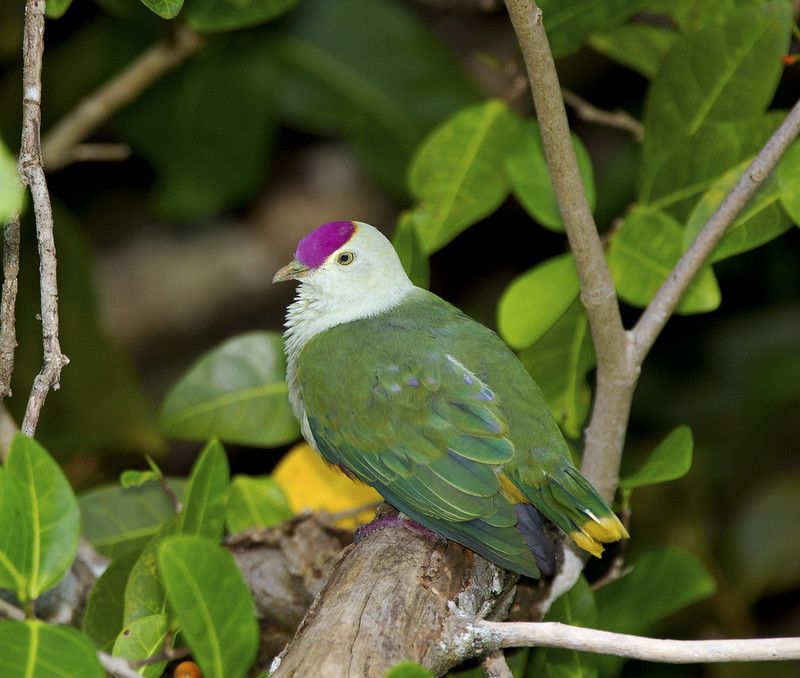
We saw a number of endemic or near endemic species in the area including this Purple-capped Fruit Dove. Photo by from weedmandan
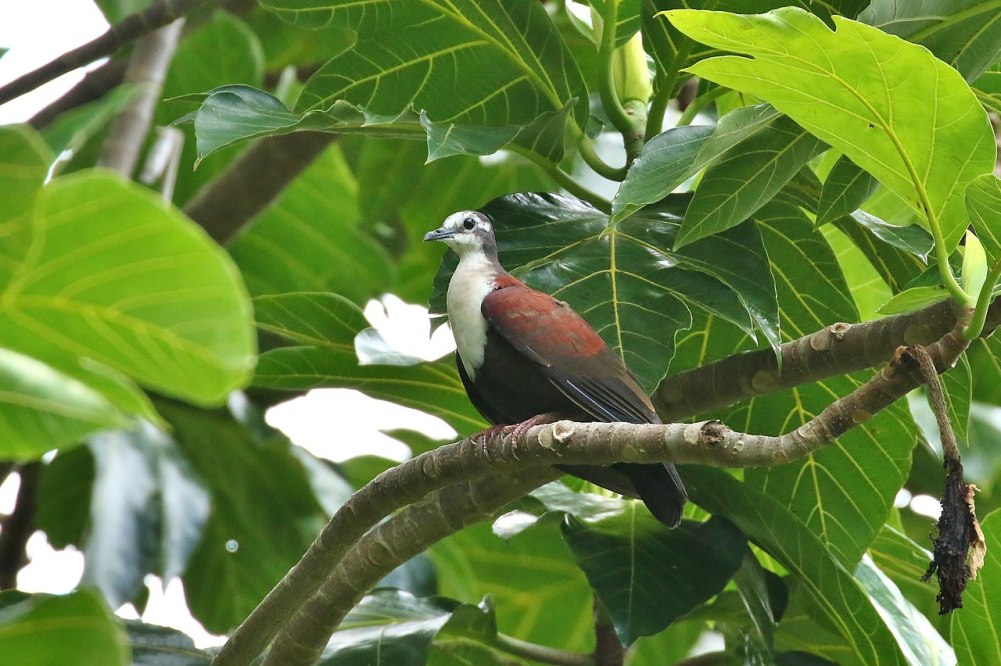
… and the endemic and elusive Caroline Ground Dove. Photo by from weedmandan
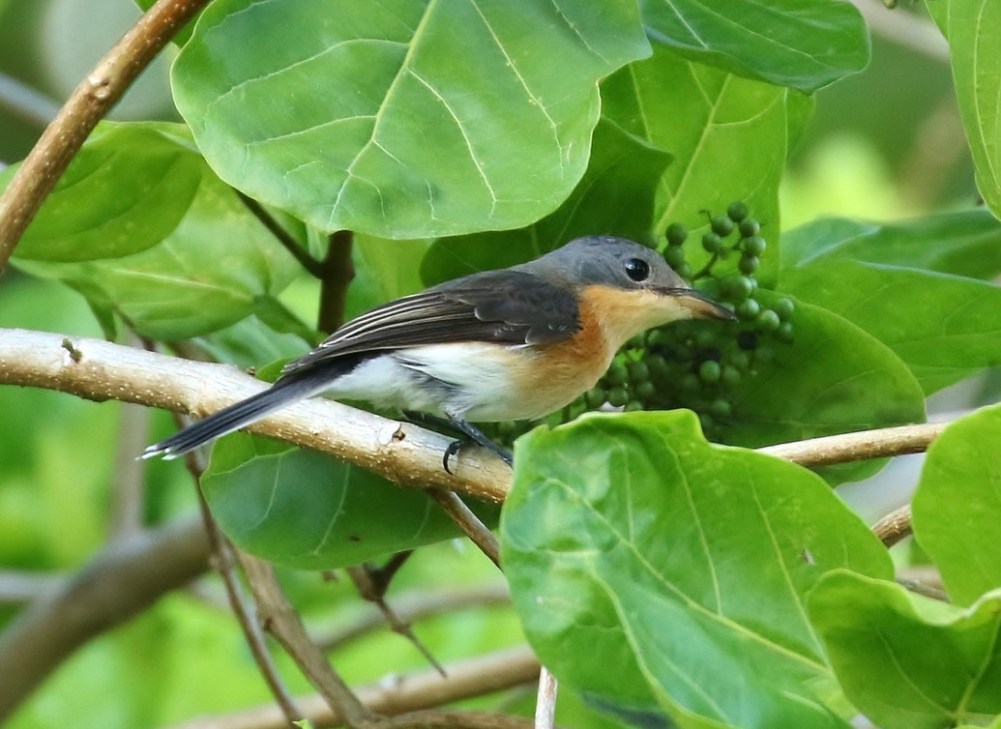
Another Caroline Island endemic seen was the Oceanic Flycatcher Photo from weedmandan

As it was April the Pacific Golden Plovers were now in breeding plumage and about ready to head for the Siberian Arctic. I was given this photo and the ones of the Teardrop White-eye and Chuuk Monarch by another participant. Unfortunately I didn’t note their name. If you are reading this please let me know and I’ll credit you accordingly.
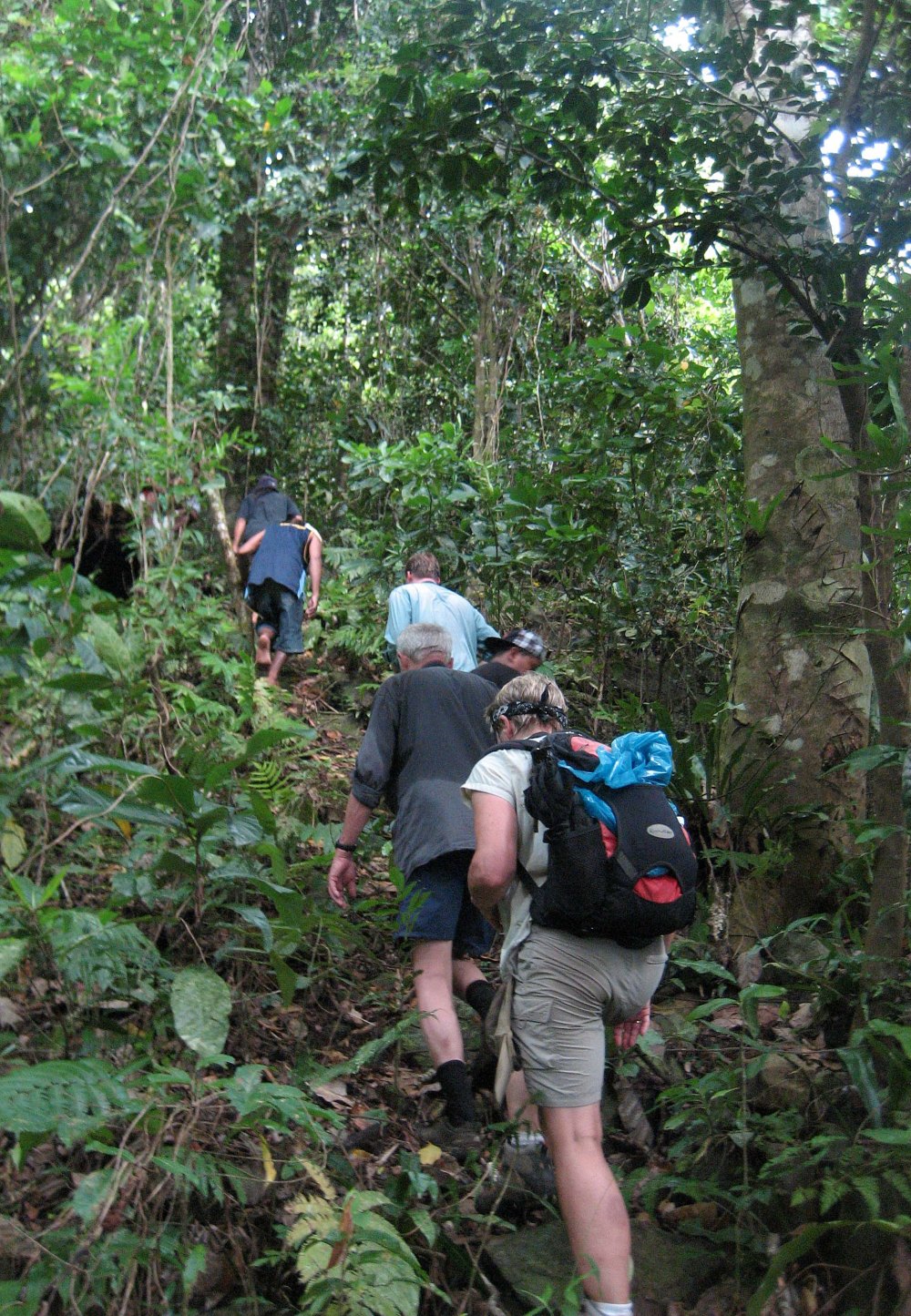
In 2010 we travelled to the island of Tol South in the south-west of the lagoon. There were two species, Teardrop White-eye and Chuuk Monarch that couldn’t be seen elsewhere. Also we saw Micronesian Pigeon which we also saw later in the trip. The climb was really tough and in parts much steeper than shown here. It was a real case of scrambling up on your knees. On the WPO a half-day trip to Tol South was offered but I declined. Those that did it managed to see the white-eye and the monarch ….

… indeed they saw something I didn’t see in 2010, the gorgeous white male monarch. As it was now the breeding season they might have been more conspicuous. Our late autumn visit in 2010 meant that the only ones I saw were drab juveniles.
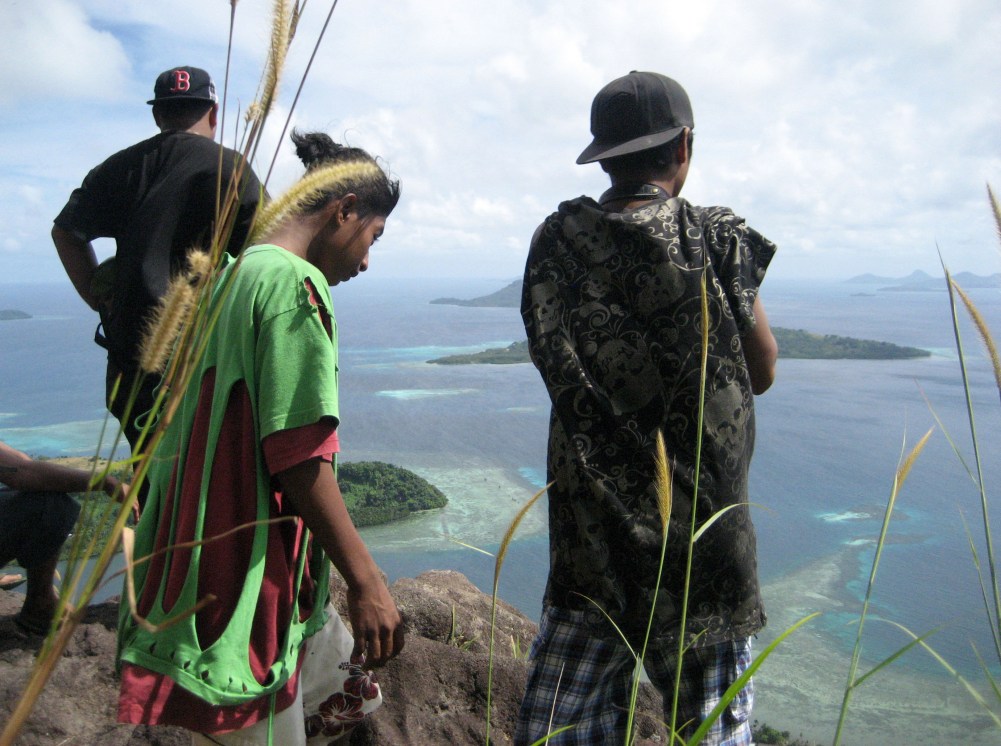
When I went nine years earlier we had some local guides, indeed the entire village tried to be our local guide – which wasn’t very helpful.

The view from half-way up across the lagoon was stunning. Some of climbed much higher up Mount Winipot to see the pigeon, it was a really tough slog. Photo taken in 2010.

Here is the Teardrop White-eye also known as Grand Chuuk White-eye, a species found only on this island.

Our tour in 2010 was much more relaxed. Infrequent flights between the islands meant that we often had time on our hands, not something that you see very often on a bird tour. So we took the opportunity to go snorkelling. I’m not a great swimmer and I found it a bit tricky but I thoughtfully enjoyed it. Participant Richard Clifford was a keen snorkeler and brought an underwater camera. Photo by Richard Clifford in 2010.
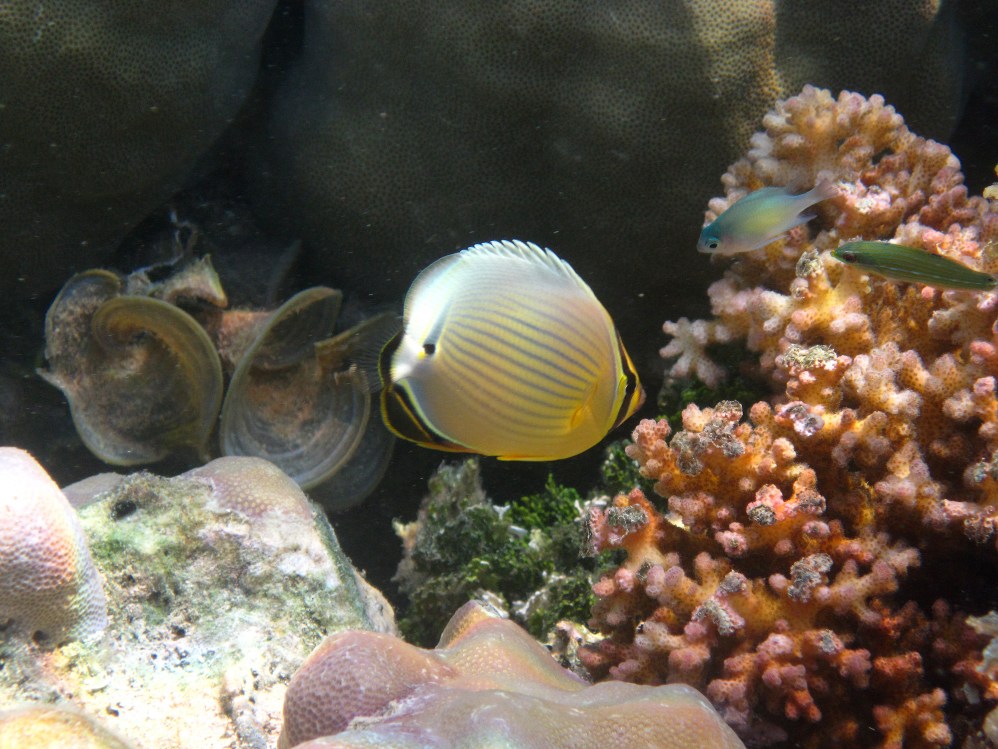
The coral reefs were beautiful and full of lovely fish, this one is a Redfin Butterflyfish. Photo by Richard Clifford in 2010
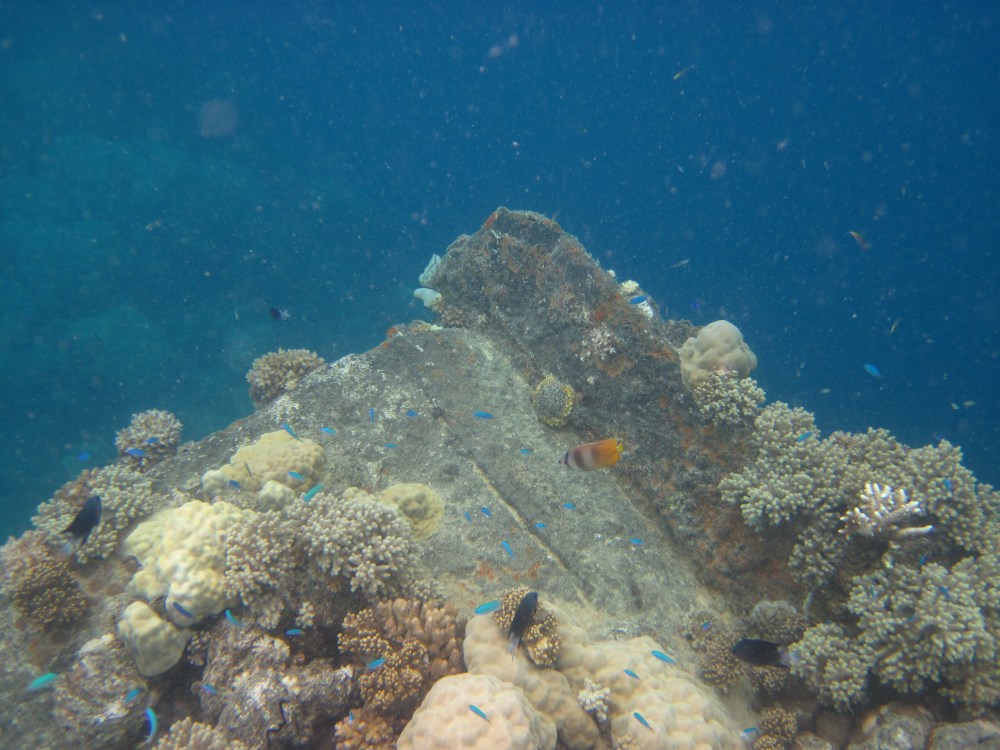
But Chuuk Lagoon has the reputation of being the best wreck diving in the world. The lagoon was the base of operations for the Japanese Navy, an attack ‘Operation Hailstone’ in 1944 caught the Japanese unaware and the Americans were able to inflict major damage see Wikipedia – here The lagoon is littered with wrecked supply ship and some military craft. Photo by Richard Clifford in 2010

I had been interested in military aircraft as a child, so seeing the remains of a Mitsubishi Zero on the bottom of the lagoon was pretty exciting. Photo by Clubmarine

As we left the Chuuk Lagoon and entered the open ocean we encountered a number of ‘Tropical Shearwaters’. The thinking is that these species are essentially non-migratory and so each breeding population has evolved into its own species with distinct vocalisations and plumage. However they are certainly difficult to tell apart. Some like Bannerman’s Shearwaters and Byran’s Shearwater have already been given specific status. This form Puffinus bailloni dichrous is colloquially known as ‘Atol’ Shearwater. Photo taken by Mike Danzenbaker in the Caroline Islands. see here
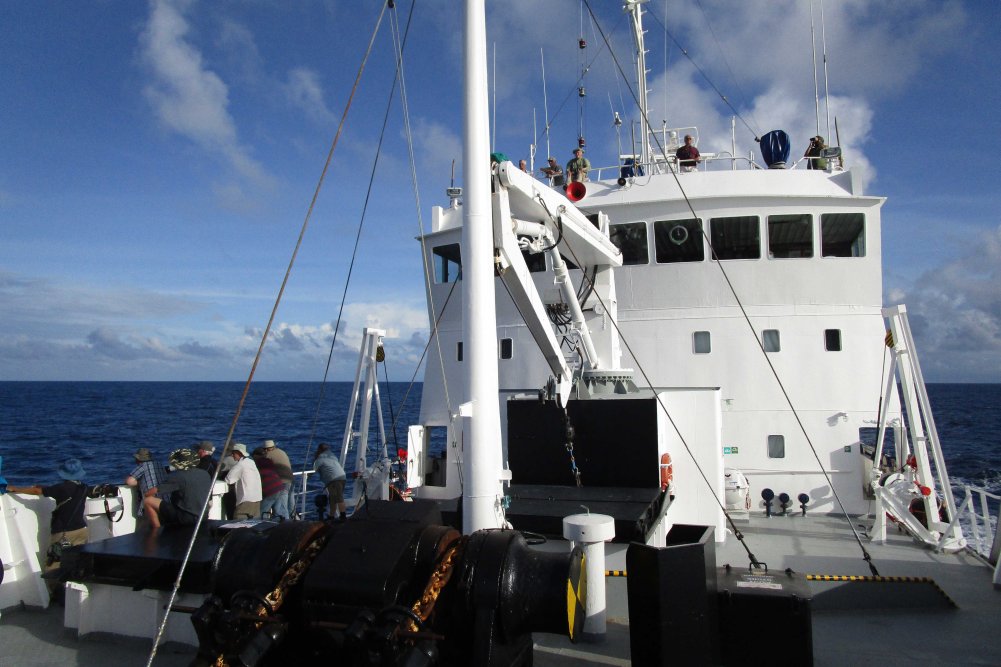
We slowly made our way north, first through Micronesian waters then through the waters of the Mariana Islands, crossing the Mariana Trench which at nearly 11,000 metres is the deepest point in the ocean.

Of course we saw many of the birds I have illustrated earlier but we also started to see a number of shearwaters and storm-petrels, evidence that we were heading out of the tropics but I’ll save most of those photos for the final post. We also saw a number of cetaceans including this close Omura’s Whale. This was a species I hadn’t heard of before, although it was formerly called the ‘small-form’ Bryde’s Whale. It was only described as a full species in 2003 which is later than the publication date of the cetacean guide that I use. It’s range is tropical west Pacific from Sumatra/Java east to New Ireland and north to Japan. It reaches a maximum length of 12m so would just fit in our garden.

We also saw four (but only caught two in this shot) of the rare Blainville’s Beaked Whale.

Not too far north of Chuuk we found our first Matsudeira’s Storm-petrel. We were getting into the realm of the Japanese seabird specialities. More of that in next and final post about the West Pacific Odyssey.
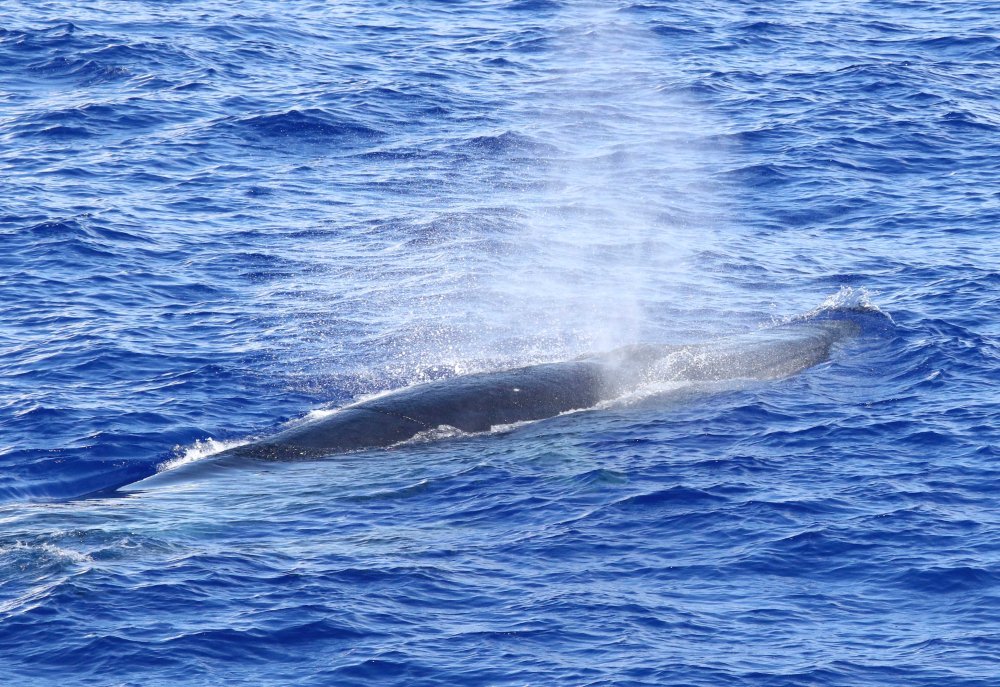
But I’ll conclude with this photo of an exhaling Omura’s Whale seen over the Mariana Trench.
This is the fourth post about the epic boat trip I undertook in 2019, travelling aboard the repositioning cruise of the Professor Khromov as it sailed from New Zealand to Japan.
This post is just about the Solomon Islands.
From Wikipedia: Solomon Islands is a sovereign state consisting of six major islands and over 900 smaller islands in Oceania lying to the east of Papua New Guinea and northwest of Vanuatu and covering a land area of 28,400 square kilometres (11,000 sq mi). The country has a population of 652,858 and its capital, Honiara, is located on the island of Guadalcanal. The country takes its name from the Solomon Islands archipelago, which is a collection of Melanesian islands that also includes the North Solomon Islands (a part of Papua New Guinea), but excludes outlying islands, such as Rennell and Bellona, and the Santa Cruz Islands.
In 1568, the Spanish navigator Álvaro de Mendaña was the first European to visit them, naming them the Islas Salomón. Britain defined its area of interest in the Solomon Islands archipelago in June 1893, when Captain Gibson R.N., of HMS Curacoa, declared the southern Solomon Islands a British protectorate. During World War II, the Solomon Islands campaign (1942–1945) saw fierce fighting between the United States, Commonwealth forces and the Empire of Japan, such as in the Battle of Guadalcanal.
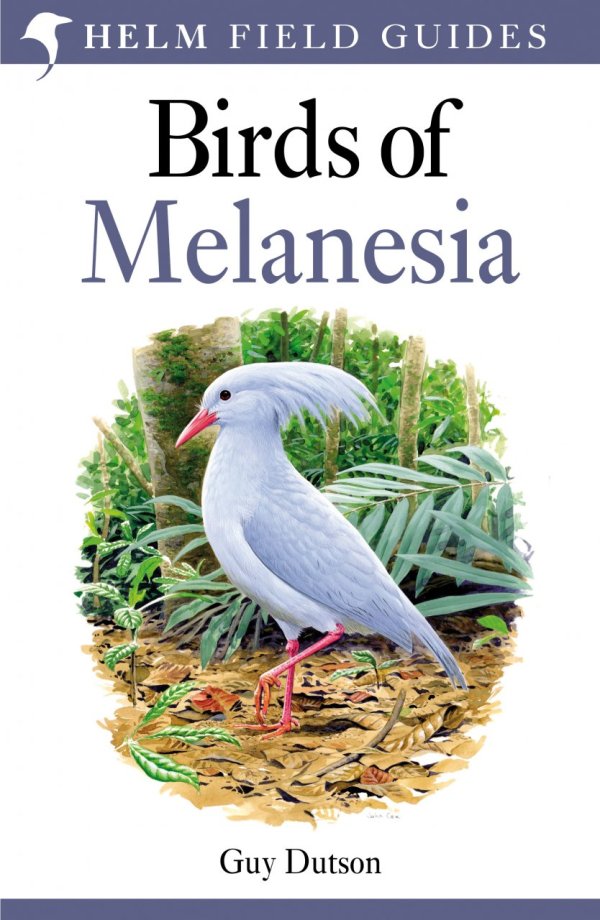
Back in the 80s several of us in Poole, Dorset got to know a young local birder called Guy Dutson. After Uni Guy spent a lot of time living and birding in Melanesia, especially in the Solomon Islands and went on to write the definitive bird guide to the area. Partially because it contained so many life birds for me but also because I had heard so many great stories about the islands from Guy, the Solomons became a much desired destination for me.
However the more I looked into it the more difficult it sounded. To do the islands justice you needed a full four week tour (plus travel time), which made it impossible to do when I was working and to see all the endemics in the upland areas you needed to be particularly fit, which I’m not. Visiting on the West Pacific Odyssey was an alternative but you end up spending a small fraction of the time birding compared to a full tour. However in the end I was able to see over 40 of the 90 or so species that are endemic or nearly endemic to the Solomons.
The route of the west Pacific Odyssey from New Zealand to Japan. The Solomon Islands form an oval to the SW of New Guinea. The capital is Honiara on the island of Guadalcanal.
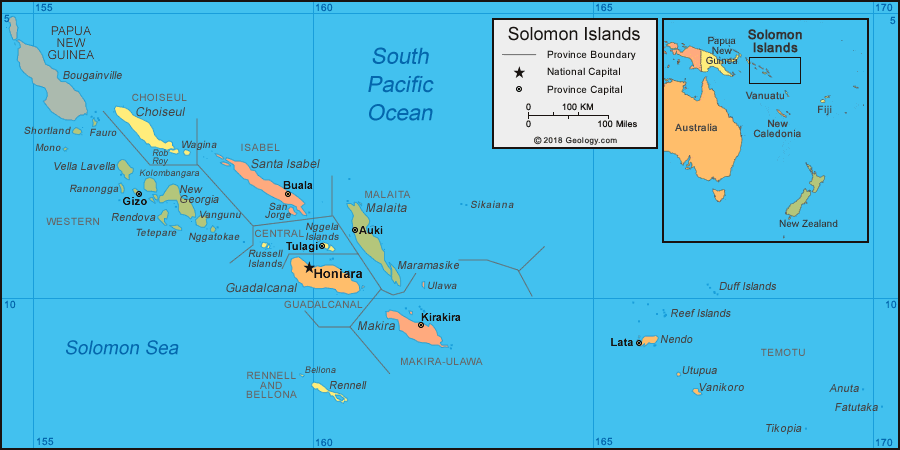
We made five landing in the Solomon Islands: 1) Santa Ana Island off the SE tip of Makira (on the map just above the ‘U’ in Makira-Ulawa); 2) Anuta Island off the west coast of Makira (on the map just right of the ‘a’ in Makira); 3) Guadalcanal accessed from the capital Honiara; 4) Tetepare (on the map an island below and right of Gizo); 5) Kolombangara (on the map just above and right of Gizo). Map from Geology.com

We were to spend a day ashore on the island of Rennell which has six or seven endemics, or near endemics. Tragically a tanker had recently gone ashore on a reef and had spilled oil everywhere. Whether this prevented landings or whether the Solomon government just didn’t want the world to see this environmental disaster we don’t know, but all landing had been banned. As a result we detoured to Santa Ana Island just to the south-east of the much larger Makira Island. Arriving about lunchtime we we were ferried ashore for an afternoon’s birding.

The Solomon’s are the classic South Pacific paradise, beautiful beaches dotted with coconut palms, sleepy villages with friendly but not intrusive inhabitants and of course wonderful birds.
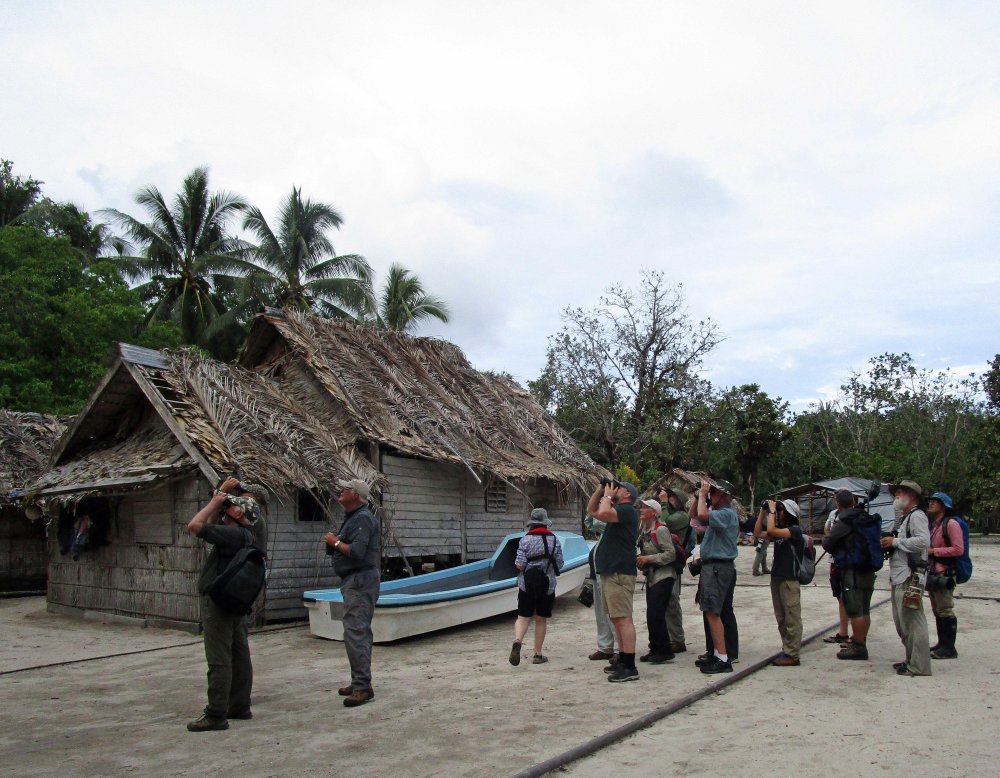
We were able to start birding as soon as we stepped ashore (and before some clients had taken their life jackets off) …
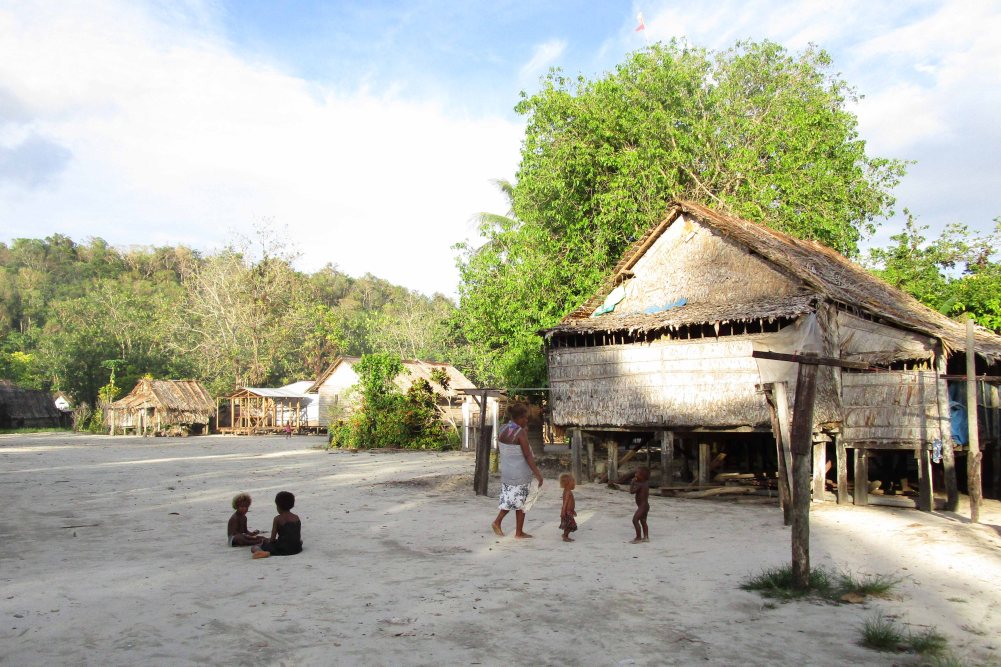
… with plenty of birds to see within the village itself …
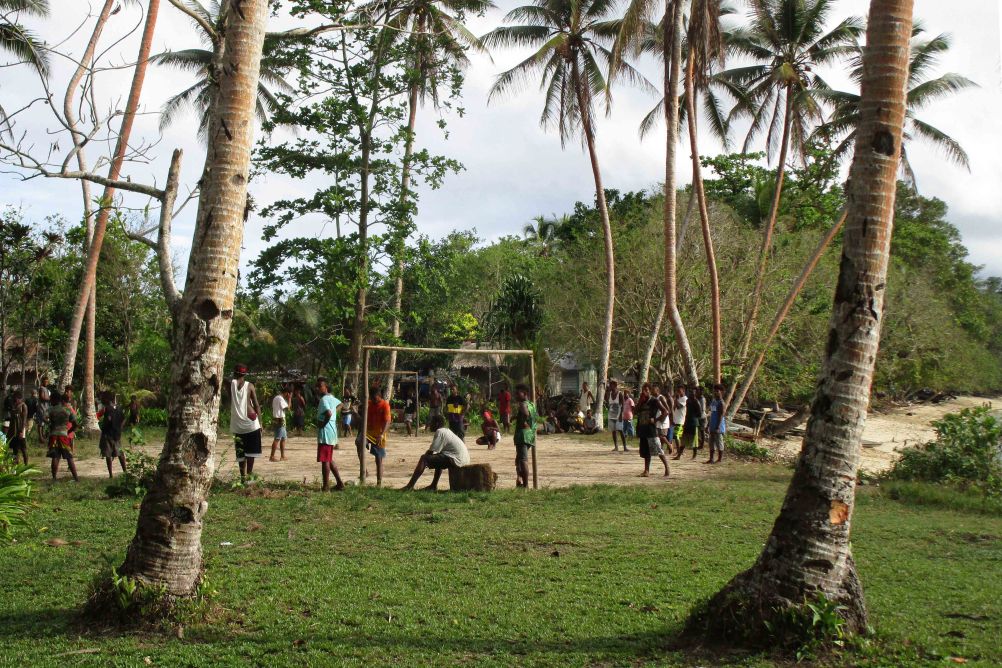
… and the adjoining football pitch.
.
Note that many of the bird photos taken on the island either had to be cropped to a large degree or were taken in poor light, so I have often posted smaller image sizes than usual to compensate.

Most of the birds we saw would be seen again on other islands. but this Silver-capped Fruit Dove was the one Rennell specialities that also occurs on Santa Ana and hence was we thought we had missed. Photo by Frédérik Pelsey from Oiseaux.net

Also seen was this Uig Monarch, a species only seen on a few islands to the south of Makira and unfortunately lumped in Chestnut-bellied Monarch by IOC.
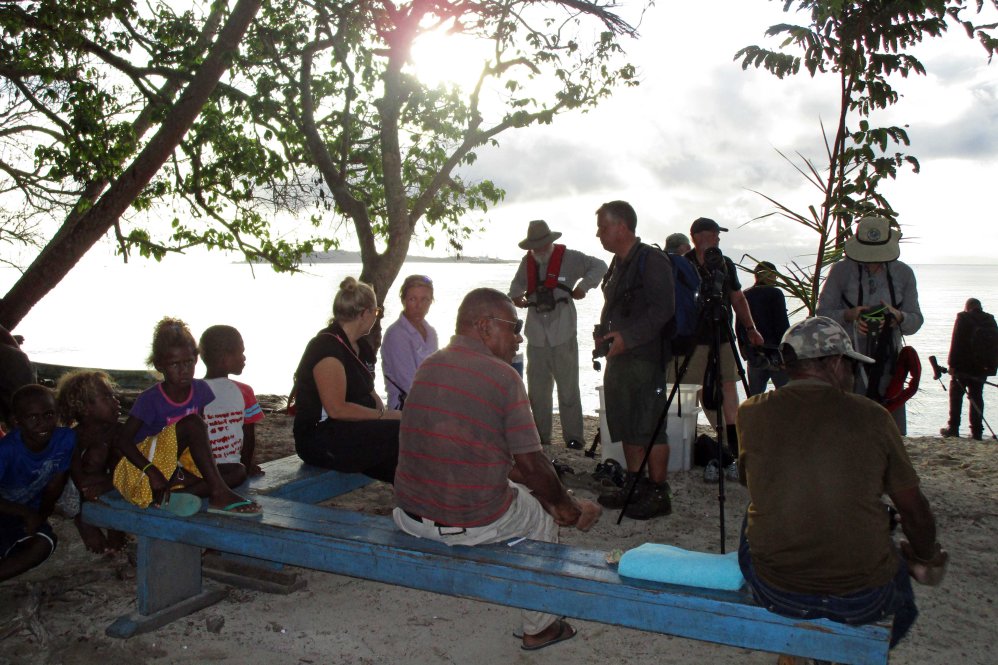
It had been a most fulfilling afternoon with about a dozen life birds under the belt but it was time to be ferried back to the ship …
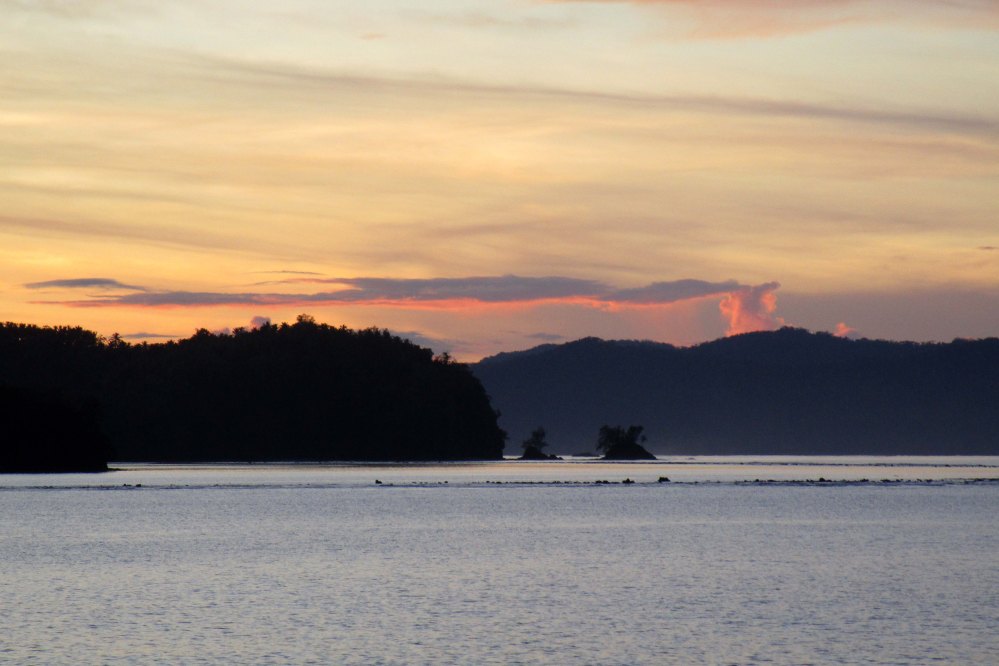
… and to sail north as the sun set.

We were heading for Anuta Island off the north-west coast of Makira.

The following morning we were zodiaked ashore to a small island just off Anuta in the Santa Cruz Islands (to the west of Makira).
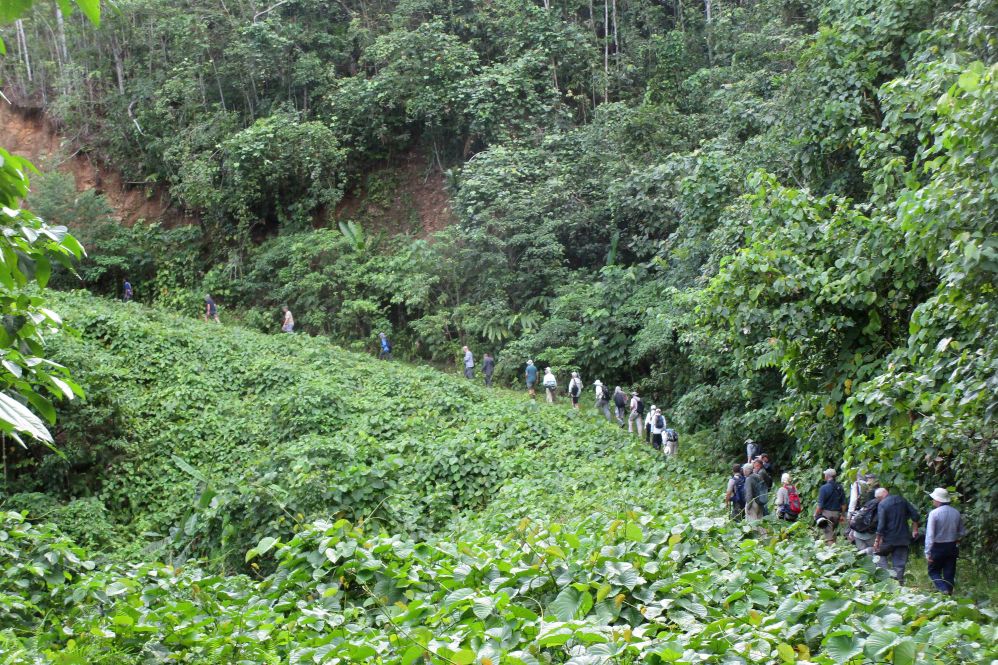
We set off on a narrow trail, you can really see the problem of birding in tropical forests with such a large group. However before long we naturally split into smaller units around each of the bird guides and still most of us got to see most of the birds.
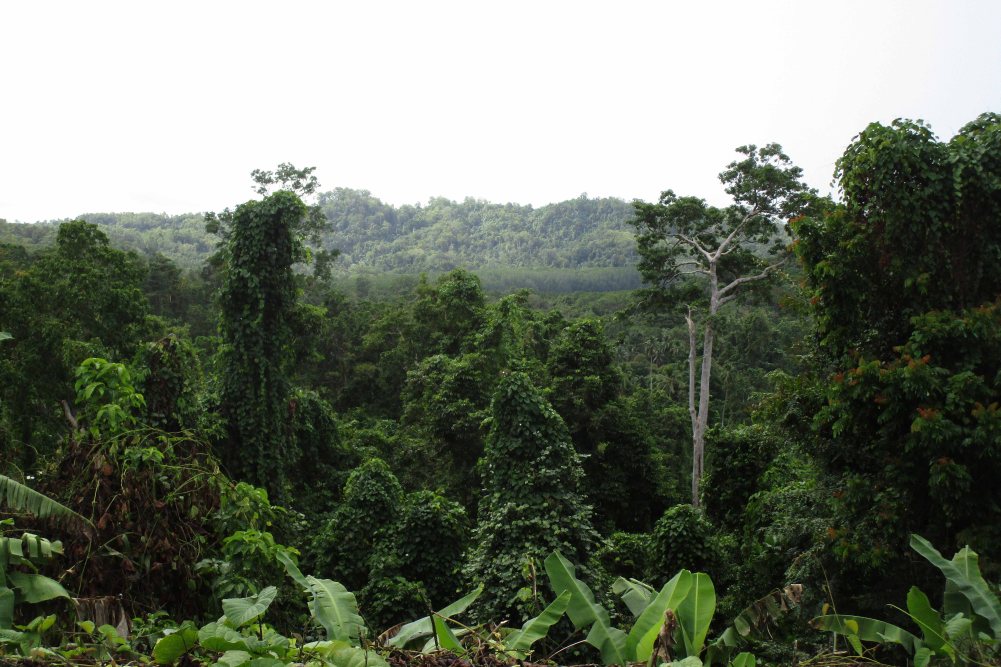
A lot of the forest was smothered by an introduced creeper, a common site on Pacific islands.
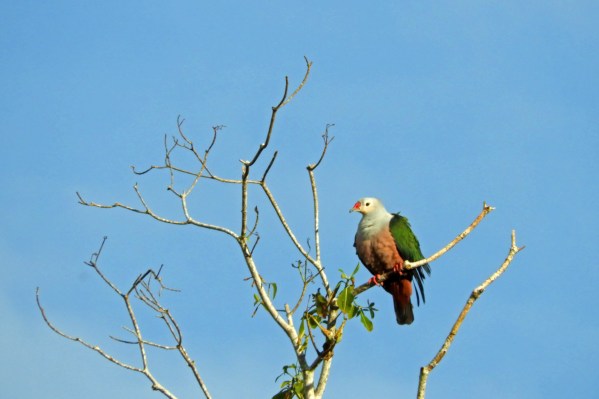
One of the species we saw was the beautiful Red-knobbed Imperial Pigeon. I first saw this species in New Ireland back in the 90s with my friend Guy Dutson. Guy is fluent in Melanesian ‘pigin english’ and when inquiring if the locals had seen this species he called it ‘im bilong strawberry on top’.

However Chestnut-bellied Imperial Pigeon was a new species for me …

… as was the little Sooty Myzomela, endemic to the islands around Makira.

As the day heated up we returned to the ship quickly changed out of our sweaty clothes and set off for the island on Anuta. Usually only two zodiacs were used to ferry us a shore but this time all five were out into the water.
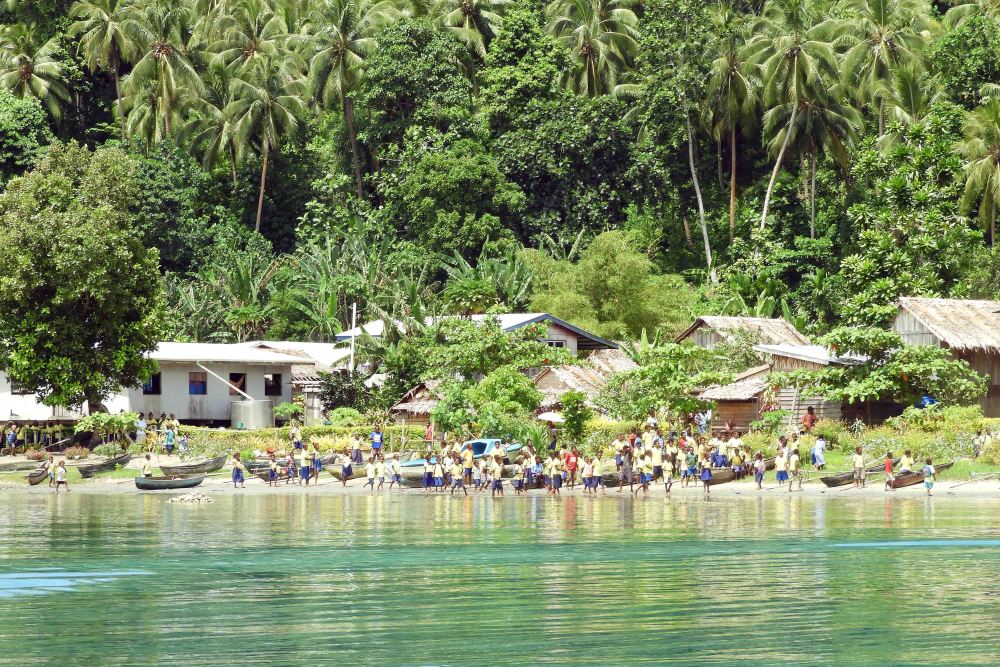
As we approached we could see the entire population of the island had turned out to greet us.

As we approached the reason for the simultaneous arrival of all the passengers became clear …
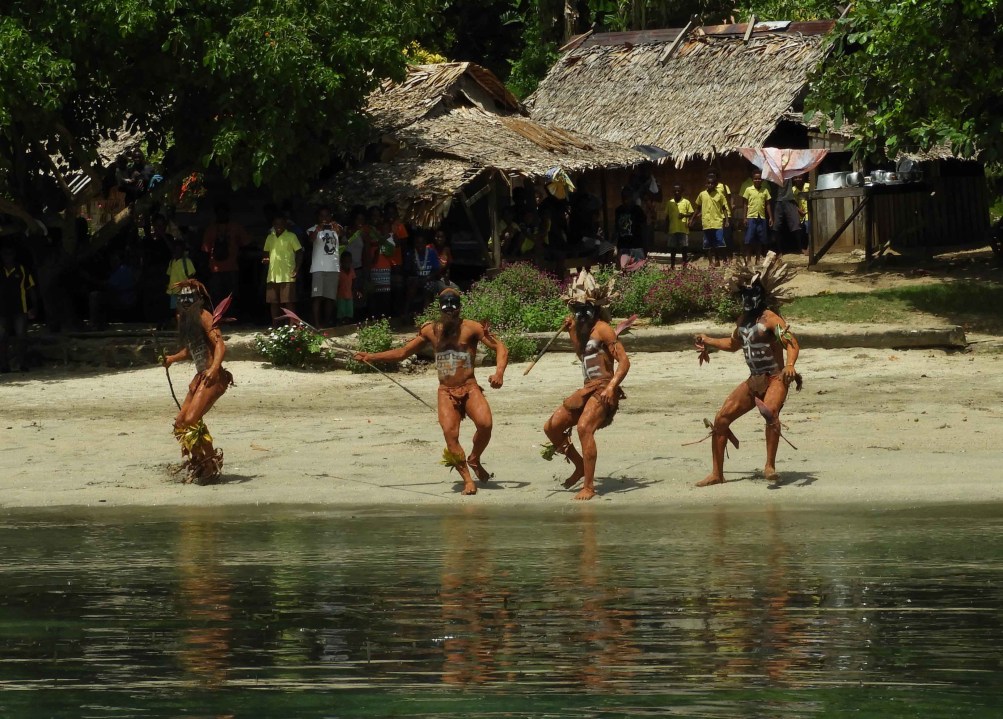
… some islanders had dressed up with masks and spears in a re-enactment of their historic attempts to defend their island from European intruders. As they ran into the water and brandished their spears you could see how conflict easily arose between European explorers and local tribes.

In fact our welcome was anything but hostile …

…we were greeted by lines of children and draped with garlands of flowers.

The ladies of the village sang a ‘we welcome you to Anuta’ song and the village chief gave a speech.
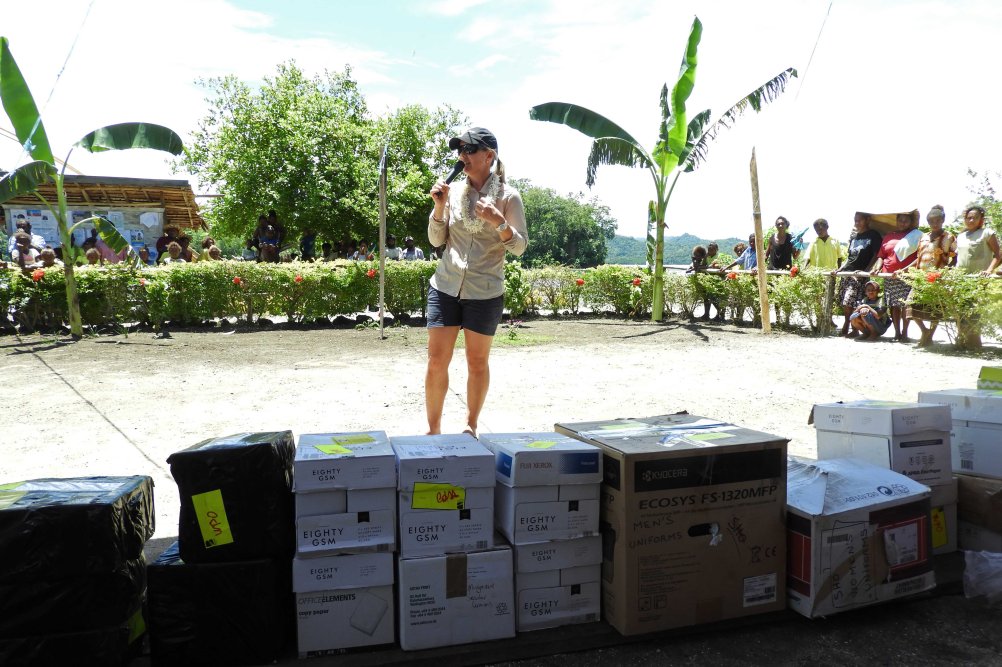
Expedition leader Helen replied on behalf of the staff and crew and Chris Collins expressed the thanks of all the birders and other clients. Helen had arranged for educational material surplus to requirement in New Zealand to be donated to the children (the contents of the boxes in the above photo) and this was gratefully received.
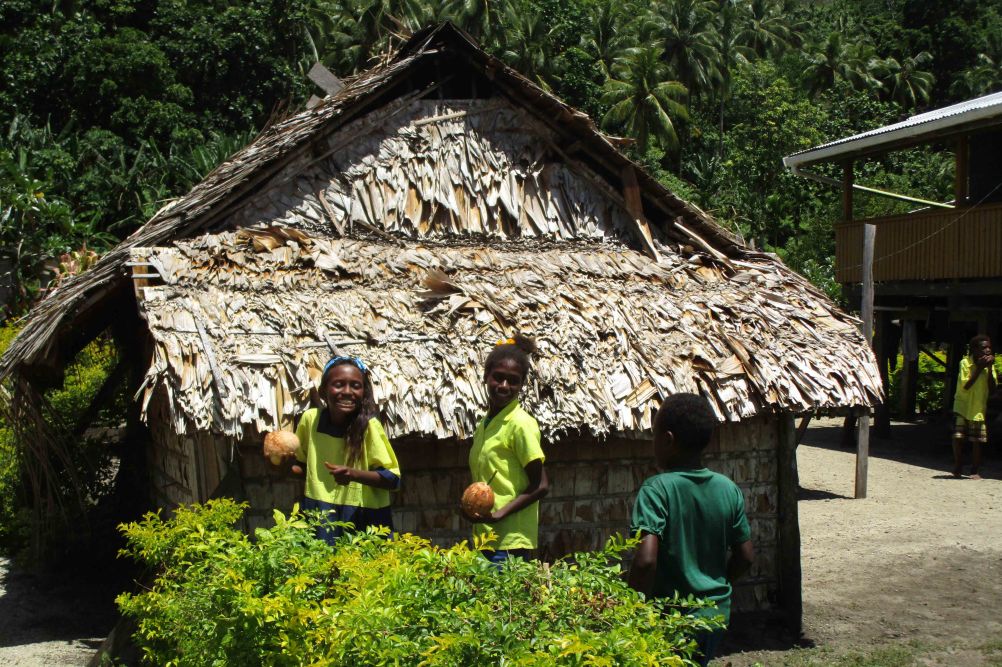
I don’t think I’ve ever seen such a happy smiling group of people …

… or had such a warm welcome.

‘Canadian’ John (as he was known) was a big hit, showing the children pictures of the birds on their island.

Of course this wasn’t a birding excursion but we did see a fantail known as Willie Wagtail around the village. This is a well known Australian bird that also occurs in part of Melanesia, Papua New Guinea and the Moluccas.

It was a lovely excursion but in due course we had to be ferried back to the Professor Khromov.

… and from the beach we had great views of Pacific Baza.
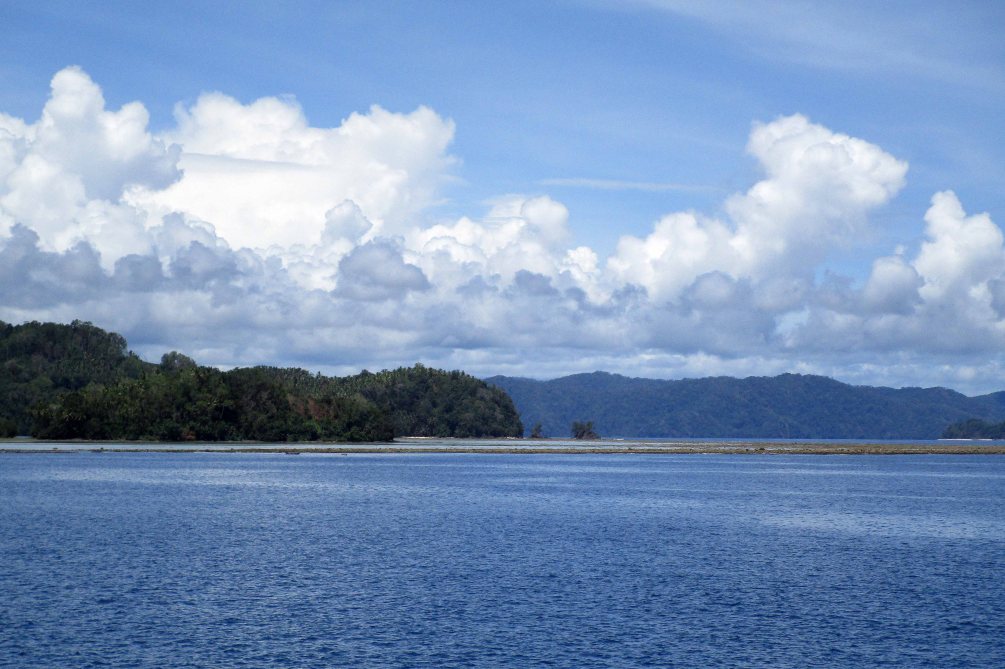
As we set sail and headed north along the west coast of Marika …
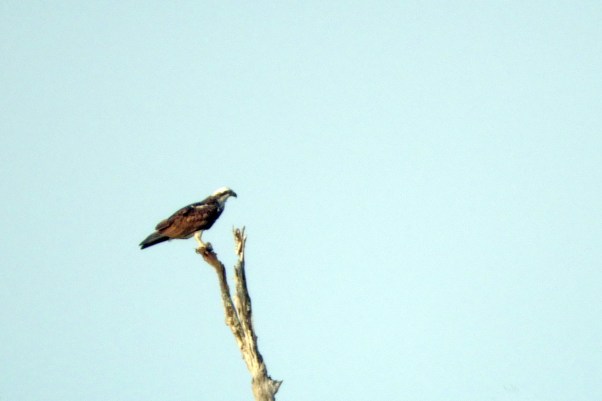
… we saw a couple of raptors, Eastern Osprey, a localised and smaller species closely related to our Western Osprey …

.. and the enormous and highly impressive Solomon’s Fish Eagle.
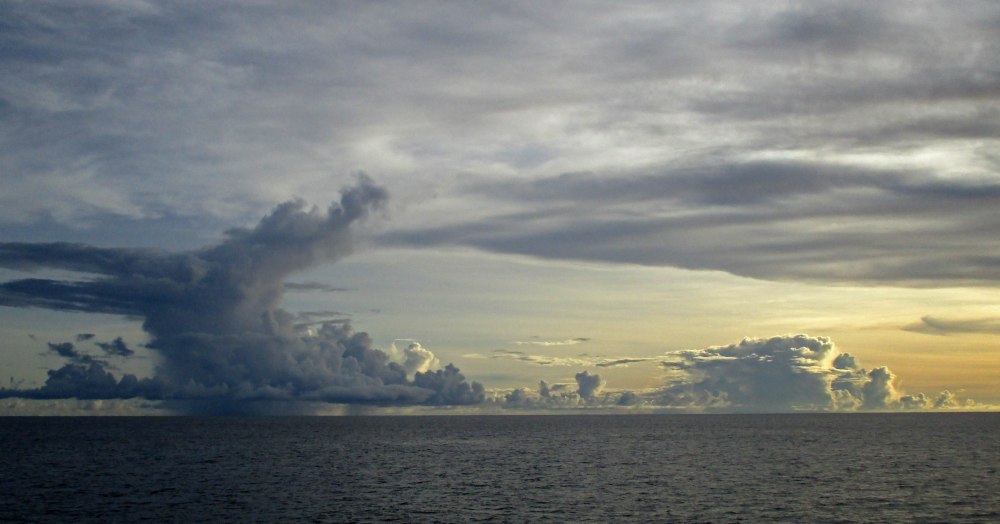
As always the evening brought wonderful skies and cloud formations …

… as we headed northwards to wards the capital Honiara on the island of Guadalcanal.

We arrived at Honiara overnight and left the ship whilst it was still dark (this photo was taken on the return). Guadalcanal was the location of some of the most ferocious fighting in WWII see Wikipedia

We were up in the hills above the capital city by 0600 and soon seeing lots of birds lie the widespread Welcome Swallow …

… and Moustached Treeswift …

… to more localised specialities like Song Parrot …
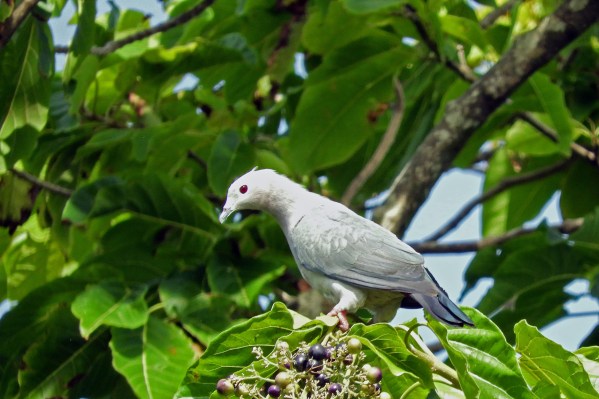
… and Island Imperial Pigeon.

The following day we landed on the uninhabited island of Tetepare which has been declared a nature reserve. We split into a number of groups and I ended up with one that explored the coastal wetlands. To be honest apart from a couple of Beach Thicknees we didn’t see much

So it was playing catch up for the rest of the day, but among widespread birds like this Coconut Lorikeet I saw half a dozen life birds, but few posed for the camera.
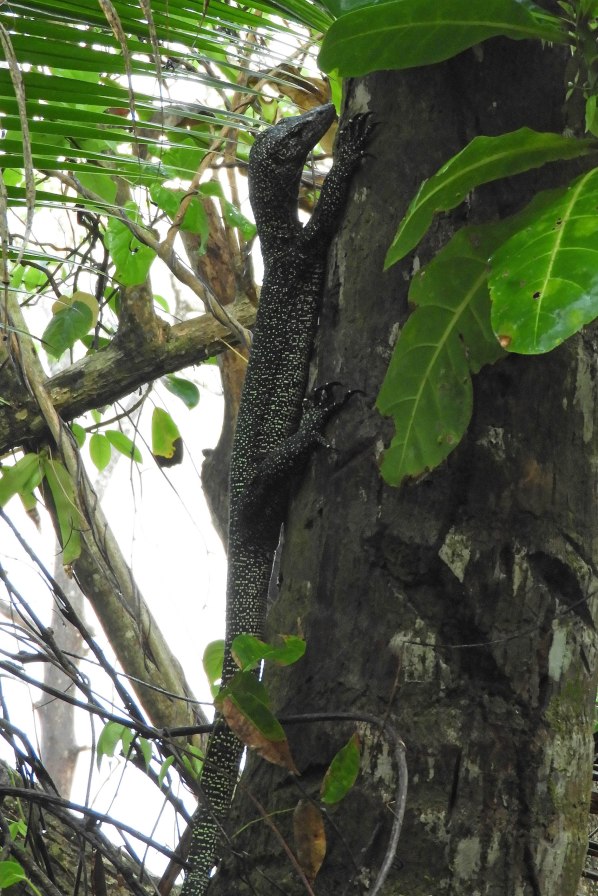
Large monitor lizards could be seen along the shore …

But the star of the show was a group of Melanesian Megapodes, one of a group of species that lay their eggs either in rotting mounds of vegetation or volcanically heated soil to incubate them. Photo by Frédérik Pelsey from Oiseaux.net

Our final landing on our final day was on the island of Kolombangara. Again we departed before first light in order to get to our destination soon after dawn.
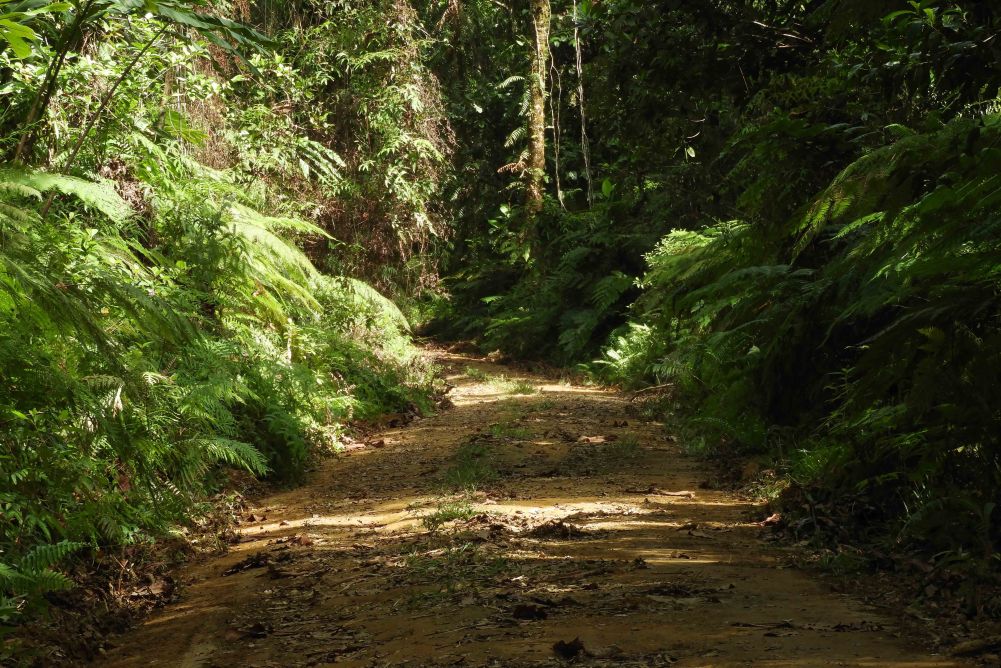
Much of our birding took place in the foothills along this forest track.

Quite a few endemic birds were seen ranging from the elusive Roviana Rail to this pretty Steel-blue Flycatcher (which is actually a monarch not a true flycatcher).
We also spent some time scanning from this lookout for various parrots and pigeons …

… the view was dominated by the island’s volcanic cone. Two species Kolombangara Leaf Warbler and Kolombangara White-eye are only found at the top. To see all the endemics of the Solomons several treks to the tops of mountains followed by rough camping are required. As I said in the introduction the West Pacific Odyssey allowed me to see about 45% of the endemics without excessive effort, although I really wish I could have done a full tour.

In due course we returned to the Prof Khromov and set sail. I was sad to leave these enchanted islands with their lovely welcoming people and wonderful bird life. It and remains the highlight of the WPO for me.

As the evening drew on we saw a number of the very rare and little known Heinroth’s Shearwaters passing the ship and heading towards Kolombangara which was still visible astern. The breeding grounds of this enigmatic species remain unknown although the crater of Kolombangara must be high on the list of candidate locations.
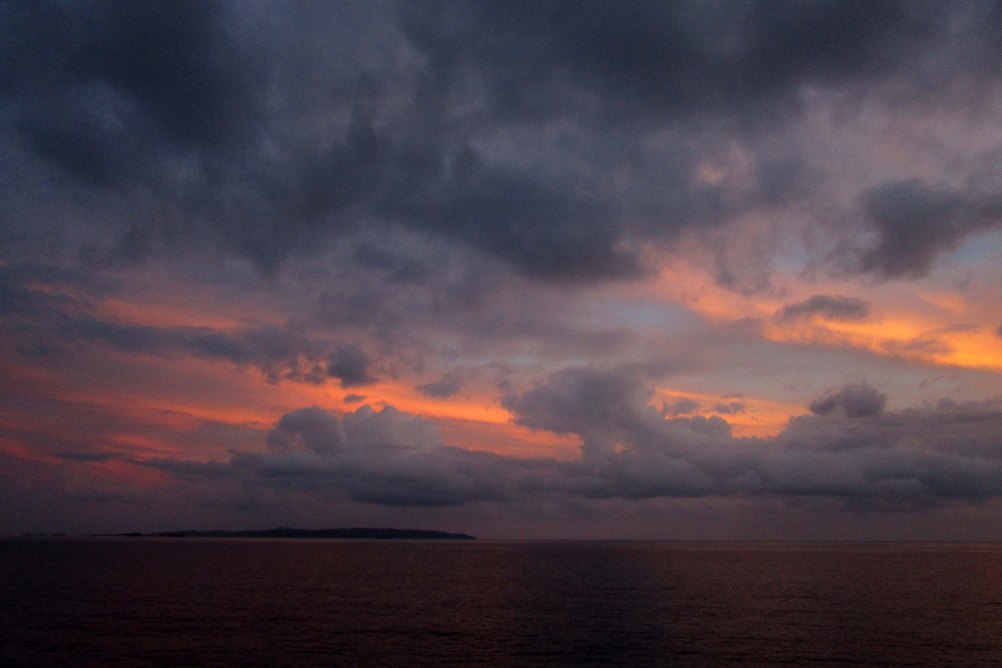
So as dusk fell we saw the islands retreating into the distance. A true South Pacific paradise.

I’ll conclude with a shot of the Professor Khromov (aka Spirit of Enderby) again a threatening sky.
The next post will cover our journey north over the Equator to the Micronesian island of Chuuk.
This is the third post about the West Pacific Odyssey, the cruise on the Professor Khromov from New Zealand to Japan in March-April 2020. It covers our time in New Caledonia and the sea journey as far north as the Solomon Islands.

We arrived at Noumea, New Caledonia early on the 21st March and spent the rest of the day and part of the morning of the 22nd there. In the late morning of the 22nd we sailed north to the Solomon Islands. We had received some bad news; due to a serious oil spillage. all planned landings on the island of Rennell had been cancelled. This meant that we would loose out on six endemic species. Instead we would head for the island of Santa Ana which is situated on the extreme bottom left tip of the S in San Cristobal. We arrived at Santa Ana on the afternoon of 25th March. The Solomon Islands will be the subject of the next post.

We arrived at Noumea early in the morning. For the only time on the trip we were able to dock, so we were soon disembarked and took a coach to Riviere Bleu, the prime national park in Southern New Caledonia. New Caledonia is a ‘Special Collectivity’ of France see here for more details. There are 22 endemic bird species, three of which occur on offshore islands. I have visited New Caledonia before, in 2013 on a trip which also took in Fiji and Vanuatu. That time we were there for a week not a day and a half and saw all but two of the endemics (one of which, the NC Owlet-nightjar once occurred in the north of the island and is now presumed extinct).

The weather was lovely at Noumea but by the time we reached the reservoir formed by the damming of Rivierre Bleu the clouds had gathered and rain was on it’s way.

This bridge is no longer considered suitable for vehicles. On my last visit we had difficulty with ongoing transport once we had crossed the bridge and had to hitch a lift in a pick up truck, but all worked well this time. My friend and cabin-mate Steve leads the rather damp march to the awaiting vehicles. For more details of my 2013 trip see here

Once deep in the forest we hurried on to a site where we could see our main target, a very special bird indeed. New Caledonia is the smallest and most remote fragment of the ancient super-continent of Gondwanaland and is the only site for a very ancient bird, one that is the only species in its family – the Kagu.

About the size of a chicken and remarkably tame, as there were no ground predators before Man arrived, the Kagu is flightless in spite of having fully formed wings, As you can see in the photos, in spite of there being about 50 of us, we all eventually got close up views and photographs.

The drizzle we experienced earlier soon turned to heavy rain. We saw a good collection of the endemics but not all.

At least the huge Goliath Imperial Pigeon posed nicely.
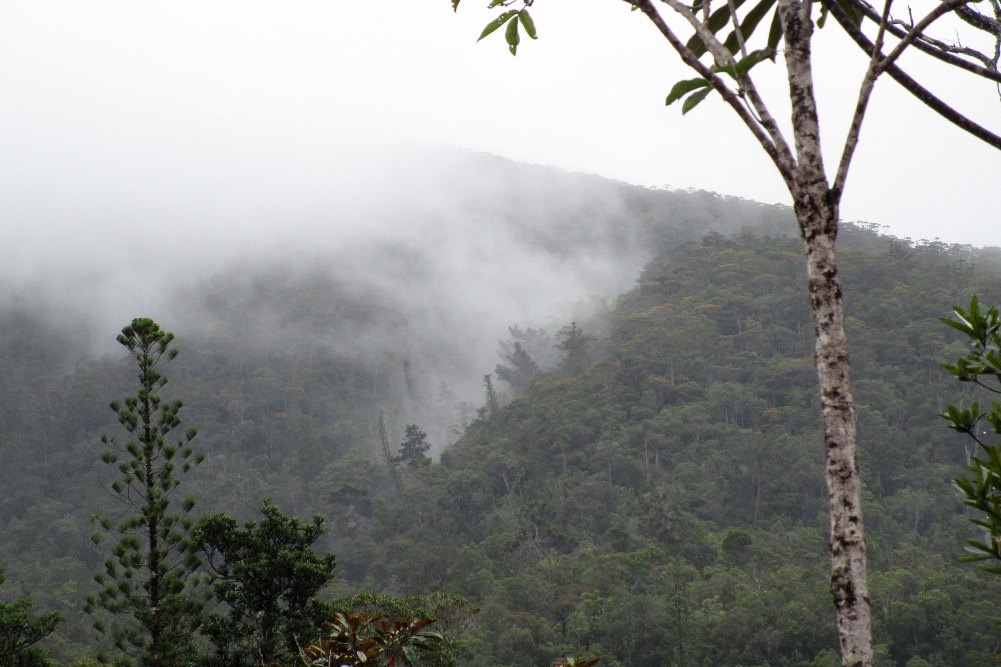
As conditions for photography (see above) were so bad I’ve included a few bird pics that I took in 2013.

Six years earlier the sun was shining on the reservoir …

… we got great views of Yellow-bellied Flyrobin …
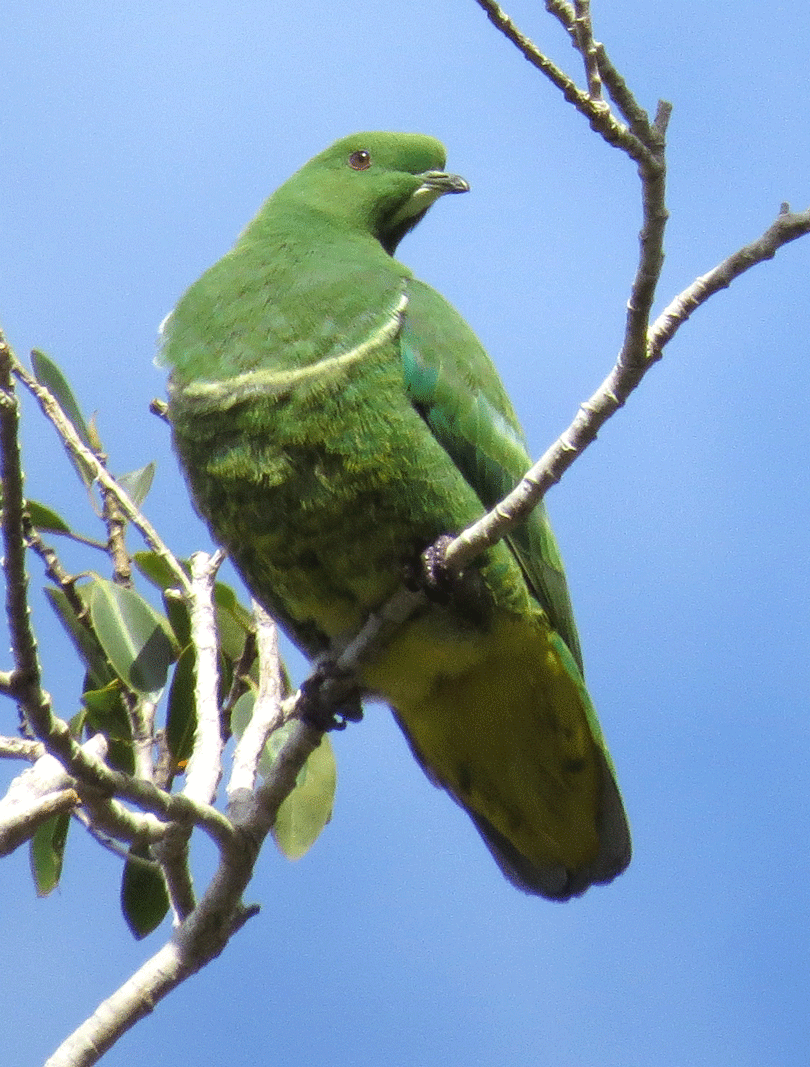
… and the gorgeous Cloven-feathered Dove …

… which is just as impressive in a rear view.

Also seen was Dark-eared Honeyeater …
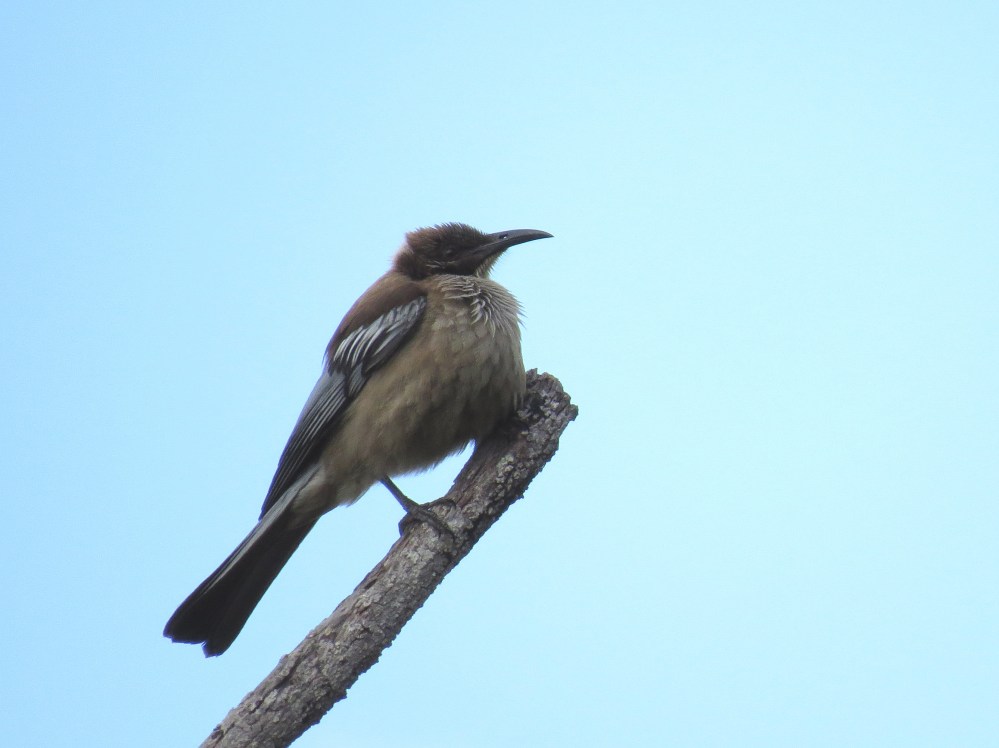
… and New Caledonian Friarbird (another species of honeyeater).

The local guy Patrice, who has done much to protect these wonderful birds from predatory feral dogs, is seen here in 2013 with a group of tourists demonstrating just how tame the Kagus can be.

When he approached too closely they spread their wings in this impressive threat display.

But coming back to 2019, the weather had turned from bad to awful so there was little option but to return to the bus and head back to Noumea … (photo Suzanne Gucciardo)

… of course once away from the mountains the weather improved and we could see Noumea below us basking in sunshine. A problem arose when the clutch on the bus failed halfway round a major intersection in the middle of the rush hour. Pretty soon the gendarmes arrived and they cleared some of the traffic jam whilst we pushed the 50 seater bus off the road. It took surprisingly little time for a replacement to arrive, a reminder that New Caledonia is effectively a part of the EU and not some impoverished island state.

The nice thing about being docked at Noumea is that we could leave Prof Khromov in the evening and get a decent signal to phone home. The following morning we set off before dawn to Mount Khogi where we hoped to get a few more endemics under-the-belt before our departure.
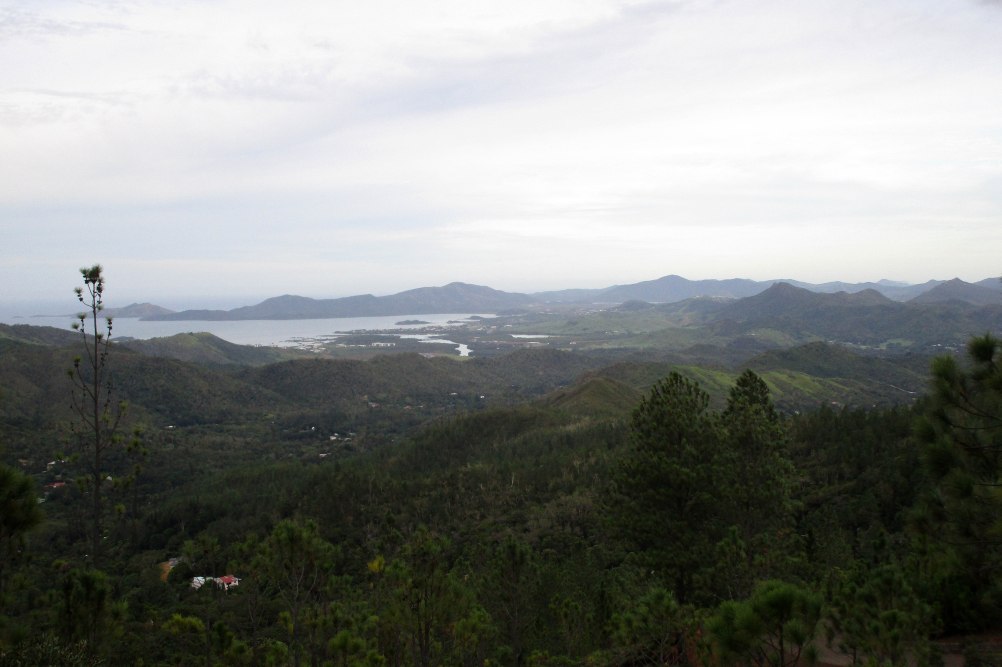
The views from the mountain were pretty impressive and fortunately yesterday’s rain had cleared.

Birds seen on the mountain included the widespread White-breasted Woodswallow (taken in 2013) …

… Metallic Pigeon …

… the endemic Barred Honeyeater (taken in 2013)

… also photographed in 2013 but seen well on this trip was the New Caledonian Crow, said to be the most intelligent bird in the world. Captive individuals have solved puzzles that involve shaping tools and going through seven different stages to get a food reward.

But the highlight for me was brief views of the mega-skulking New Caledonian Thicketbird. I heard about four singing in dense roadside vegetation and even got a brief view as it moved though the bushes. This was the only endemic species (other than the probably extinct owlet-nightjar) that I didn’t see in 2013. My views were nowhere near as good as those previously enjoyed by photographer Lars Petersson (see his website here)

Unfortunately the trip schedule is already 31 days long, any longer and they probably wouldn’t be able to sell any berths, so most of our disembarkations seemed far too short. But although we’d missed a few of the endemics, I had seen them before and so I was quite content when we started back to Noumea at about 0900.

We were told that we must be back early as we had to sail about 1000 or else we wouldn’t get to the Solomon Islands in time. As we approached the dock we got caught in a huge traffic jam. We decided to get out and walk. The issue was a big rally, I think in favour of independence for New Caledonia, right outside the dock. That’s some of our group on the right pushing our way through the crowds.

Once boarded and tags turned (a necessary precaution to prevent anyone being left behind) we could watch the demo from the deck. Years ago I visited the Comoros, a group of four former French islands in the Indian Ocean. Three islands, Grande Comore, Moheli and Anjouan voted for independence from France in 1974, the fourth Mayotte voted against. The three independent islands are impoverished to say the least, whilst Mayotte looks like the Cote d’Azur transplanted into the Indian Ocean. I can understand the desire for self-government but hope the inhabitants have considered the economic implications.
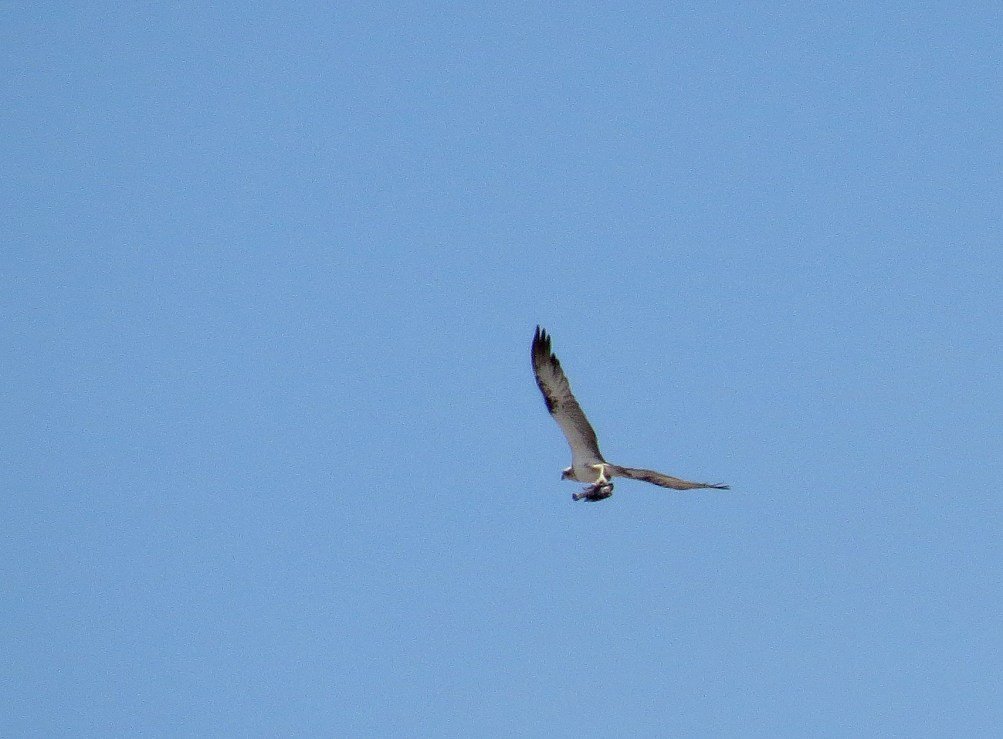
As we left an Eastern Osprey flew over the dock with a rather large fish. This species has been split from (Western Osprey) on account of being 25% smaller and having a different head pattern.

So farewell to New Caledonia, after two visits I doubt if I’ll be back even if the owlet-nightjar is pinned down. There’s just too many beautiful places in the world to see.

We headed out of the lagoon, so we were no longer ‘atol protected’!
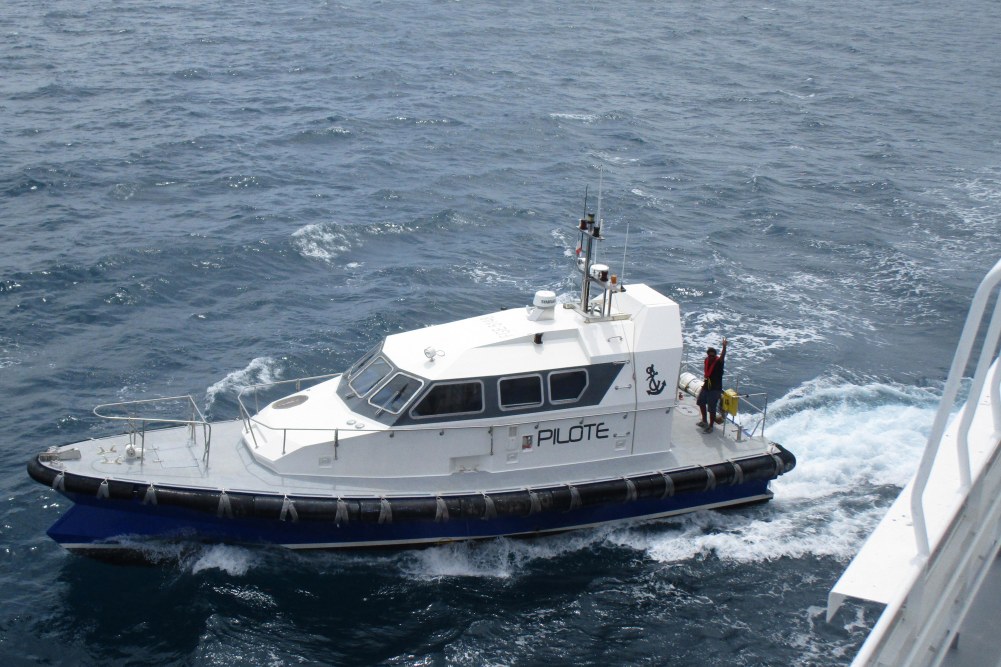
… and waved farewell to the local pilot.
A bird we really wanted to see was the so-called ‘New Caledonian Storm Petrel. There is no evidence that it breeds at NC, or if it does, no evidence that it only breeds at NC, so it can’t be considered an endemic. In fact it’s not clear that its an actual separate species. The bird was discovered on the West Pacific Odyssey in 2008 and has been seen several times since. It is clearly similar to the recently (re)discovered New Zealand Storm Petrel but is larger with broader wings and less white in the underwing. Birds fitting this description have been found off Queensland on pelagics led by Paul Walbridge (brother of Portland birding stalwarts, Grahame and Duncan Walbridge). He suggests the name Coral Sea Storm Petrel as they are not restricted to NC waters. It seems likely that they are the bird described as Pealea lineata and considered by Murphy et al as aberrant Wilson’s Storm Petrels in 1952 ( a fate that also befell New Zealand Storm Petrel). This taxa is still being evaluated and as far as I know efforts to catch one at sea have proved unsuccessful.

Seawatching from the upper deck was now becoming unbearably hot. Several expedition staff helped erect this awning and somehow got expedition leader Helen to climb the mast to secure it.

Manager Heidi Dohn also was co-opted to do the climbing.

Now in tropical waters you would expect never-ending sunshine but instead we got a whole succession of showers. The cloud formations were incredibly dramatic and made a great back drop to our seabirding.

Tropical species like Great Frigatebird …

… Brown Booby …

… and Red-footed Booby became common.

At night boobies would come and roost on the superstructure and cover the foredeck with booby poo.

By now we had all got to know each other, I have known Neil Bostock for many years having been on a pelagic trip with him in the central Pacific in the 90s and seen him a number of times when birding in the UK.

Japanese birders Hiro and Shoko Tanoi were some of the finest seawatchers I’ve ever met and Hiro probably found more quality birds than anyone else on the trip. They could always be found at the same spot on the fore-deck, from dawn to dusk, continuously scanning the ocean.

Jeff and Mike were also always on deck and found many good birds. I met them on the Atlantic Odyssey in 2016.
However when things got quiet I sometimes would get bored and go down for a coffee or sometimes go to a talk in the lecture room. Some 250 nautical miles off Santa Ana I did just that and missed a real cracker. There were three sightings (once of two together) of a bird that no-one could initially identify. Fortunately later on there was a 4th. They had striking, white flashes in the upperwing and underwing and at least the one I saw had a bright white dot on the flanks below the wing. Photos and videos were later compared and two of the earlier birds showed a most bizarre flight, possibly a display. Lisle Gwyne said they were identical to a bird he saw off one of the Lava Islands off Vanuatu a few years before and called them ‘Lava Petrel’. I thought as they were so ‘obscure’ they should be called just that, but in deference to their skua like wing flashes it should be spelt ‘Obskua Petrel’! In size and shape they looked most like a Pseudobulweria species, like Tahiti Petrel. I thought they resembled an extreme dark variant of Kermadec Petrel in plumage if not in shape and others have suggested Providence Petrel.
As the ship had always gone to Rennell in previous years and this year was heading to the east to reach Santa Ana then we may have sailed through a previously unbirded part of the ocean. Did we discover a new species for science? I really don’t know and wonder if those who said we had at the time are having second thoughts, but it was one of the most exciting moments of the trip.
Whilst the last of these four birds was flying past a rather large Band-rumped Storm Petrel flew in the opposite direction. Given how confused the taxonomy of this group is, its perfectly possible that this was also an undescribed taxon. Chris Collins later commented that ‘it isn’t very often that birders largely ignore an undescribed bird because something more interesting is flying in the opposite direction’!
The following low res photos were taken from the Wild Wings web site. Photos © Chris Collins. See here. I know better quality photos were taken but I don’t have access to them.
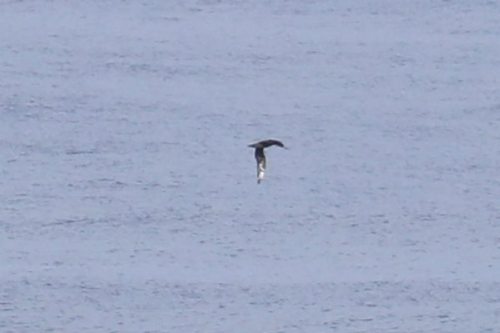

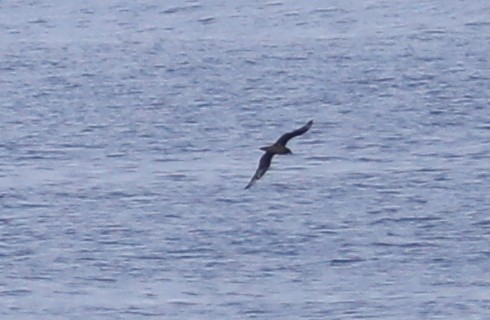

I’ll conclude with one of the dramatic cloudscapes that were such a feature of this part of the trip.
Today I planned to complete the third instalment of the account of my West Pacific Odyssey. However looking through emails this morning I realised that it was ‘World Albatross Day’, a day to bring attention to the conservation of these magnificent birds. check this link for details
Now I don’t have many pictures that depict efforts to conserve these species but I do know that they face many threats from – for example:
- long-line fishing see here
- alien predators like mice and rats see this link
- mistaking plastic in the ocean for food another link to check out
However this post is on a happier note and celebrates the wonderful times I had watching these, the most magnificent of all seabirds.
When I started birding 43 years ago there were 13 species of albatross. Taxonomic change means that there are now 21. In fact there are a total of 24 forms/subspecies (there are three additional subspecies which haven’t been awarded species status, although this may change in the future).
I have seen all but one of these 24 forms and I have seen an individual that looked so much like the 24th as to be indistinguishable in the hand.
Many of the photos shown below were taken in 2004 before I got into digital bird photography. Pete Morris and Dick Newell offered a CD to the clients on the Sub-antarctic Islands of New Zealand trip in exchange for a donation to the ‘Save the Albatross’ fund. Hence many of the best photos in this collection are their’s. I also have used some photos that Dave Fisher gave me after the Atlantic Odyssey.
So here’s the story of how I got to see all (or almost all) of the most magnificent seabirds in the world.

In 1978 I went to a talk by RSPB warden Bobby Tulloch on the beautiful Shetland Islands. I was very taken by his slides of his homeland but what really got me was the fact that he showed photos of a Black-browed Albatross flying up and down the cliffs of Hermaness in the most northerly island of Unst. It looked stunning and impossible to miss, I knew Janet and I had to go and see it. So in 1979 we drove all the way up to Aberdeen took the car over to Lerwick and two more ferries to get to Unst. Needless to say we were unsuccessful. This photo is not Bobby Tulloch’s but © Richard Fairbank who has given me permission to use his scanned slide.

Well the albatross kept coming back year after year and after getting some great gen off my friend Paul Harvey (who was about to move to Shetland where he remains to this day) I found out that the bird spent most of its time on a nest waiting in vain for a mate. In 1982 once more we drove up to Shetland and on to Hermaness. The nest was only visible from a few angles and one of those involved getting perilously close to the edge. Photo from a scanned slide © Richard Fairbank
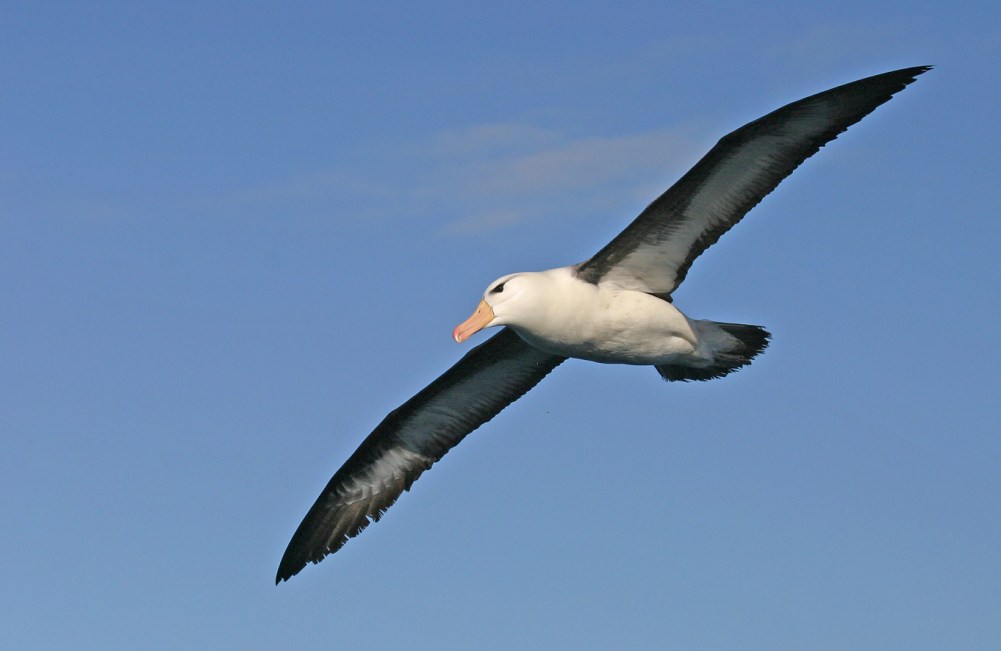
We have to fast forward to 1991 before I get another encounter with a Black-browed and that was on pelagic trip off Cape Town, SA on a trip led by Ian Sinclair and Iain Robertson. We saw three albatrosses on that trip, Black-browed, Shy and Yellow-nosed. Since then I’ve seen this species again off Cape Town, from two one-day pelagics out of NSW, Australia and from land in Western Australia, in the Cook’s Straight Argentina and on three major cruises, to Antarctica, Sub-antarctic Islands of New Zealand and the Atlantic Odyssey. In total I’ve seen about 8000 individuals. This photo was taken on the Subantarctic cruise with Heritage Expeditions and is © Pete Morris.

Whilst we are on the subject of Black-browed Albatross I’d better mention number 2, Campbell Albatross which breeds only on Campbell Island in New Zealand’s subantarctic islands. It is fractionally smaller than Black-browed but with a startling pale eye when seen close and thicker black margins to the underwing. Photo © Dick Newell

Being at sea where the albatrosses follow the ship and pass by at eye level is undoubtedly the way to get great views. Photo © Pete Morris

I’ll come back to Yellow-nosed and Shy Albatrosses later, so number 3 is the mightiest of them all – Snowy Albatross. In 1998 I went on a fantastic trip to the Falklands, South Georgia and Antarctica. During the first night we sailed out of the shelter of Drake’s Passage and into the South Atlantic and I started sliding around in my bunk. When it got light I managed to haul myself onto the deck and virtually the first bird I saw was a ‘Wanderer’ with a 3.5m wingspan. Just fantastic and seen just in time before I had to rush below and be sick!. The taxonomy of the ‘wandering albatross’ group is a bit complex and I’ll return to it later. Photo © Pete Morris.
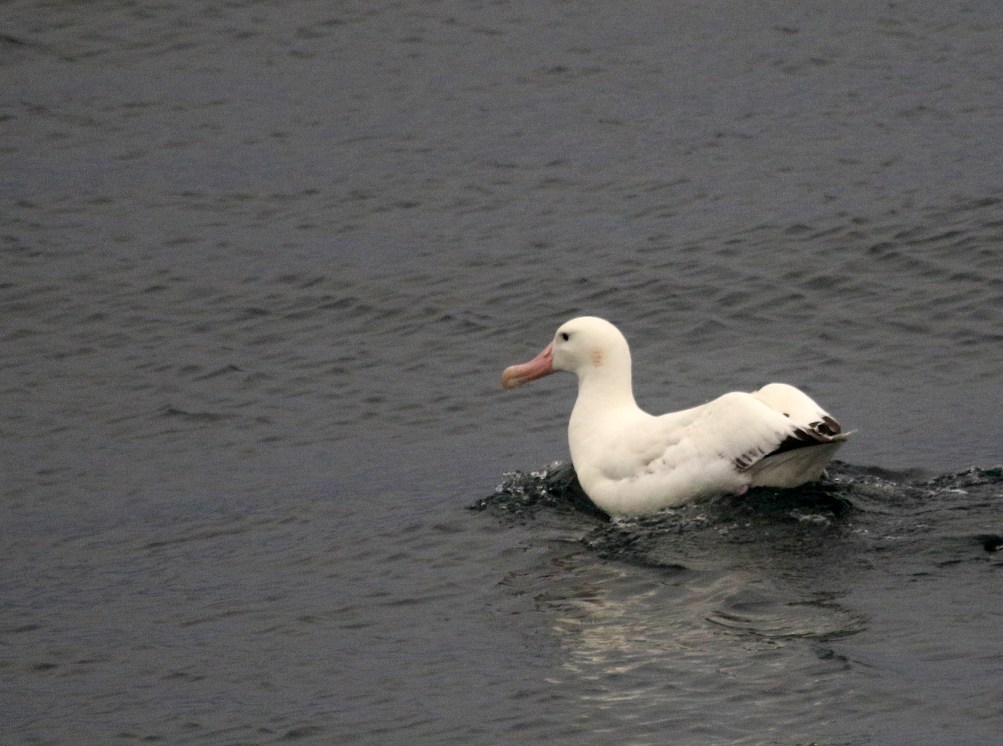
The plumage succession in albatrosses is complex especially in the ‘wandering group’. Generally the older a bird gets the whiter it becomes – but only up to a point. Females don’t become as white as males and exulans, the true ‘wanderer’, better called Snowy Albatross to distinguish it from other members of the ‘wandering albatross complex’ is whiter than the other species. So this bird photographed at South Georgia is about as white as they come. Snowy only breeds south of the Antarctic convergence at South Georgia, four islands in the southern Indian Ocean and on Macquarie.

South Georgia is a fantastic place to see Snowy Albatrosses on the nest. I have seen about 230 of this avian giant on the the three southern ocean cruises that I’ve been on (Falklands-South Georgia-Antarctica, the Atlantic Odyssey and the sub-antarctic Islands of New Zealand) plus one off New South Wales, Australia. For more pictures of the Atlantic Odyssey including South Georgia see here

Albatross number 4 is Grey-headed. Breeding a little to the north of Snowy, off southern Chile and at Campbell Island to the south of New Zealand as well as the islands of the southern Indian Ocean. I have seen a little over 100 of this species on my three southern ocean cruises, but 40 or so were chicks on the nest in South Georgia. Only eight were seen in the NZ Sub-antarctic Islands where this photo was taken by © Pete Morris

9-11 species (depending on your taxonomy) of medium sized southern ocean albatross are known as ‘mollymawks’ Here are two, Black-browed on the right and number 5, Shy Albatross on the left (along with a White-chinned Petrel).
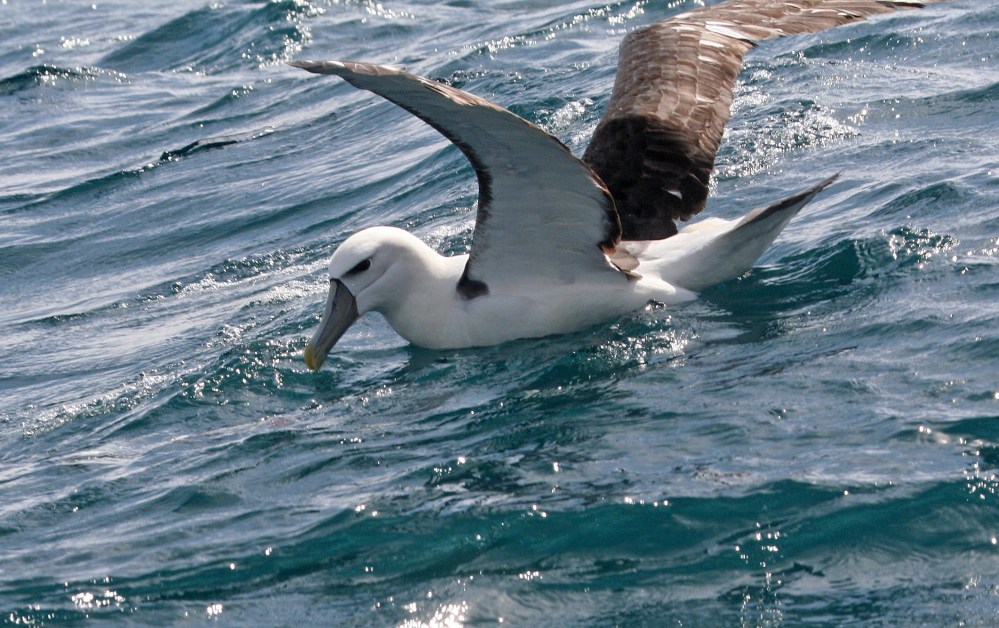
The ‘shy albatross’ group contains three or four species. ‘Tasmanian Shy’ or ‘nominate race Shy’ depending on your taxonomy breeds only around Tasmania but travels as far west as Cape Town which is the only place I’ve seen it, with about 250 seen on my two Cape Town pelagics . Note the back mark in the ‘armpit’ which is a characteristic of all the ‘shy albatross’ group. This bird has not got a yellow base to the upper mandible which means it might be a ‘White-capped’ from New Zealand and the bird in the first photo (with the Black-browed) is an immature so can’t be identified beyond Shy/White-capped. However I have seen undoubted nominate Shy in these waters.

The other race/species is White-capped Albatross which breeds in Aukland Island and Antipodies Island south of New Zealand. IOC lumps it in Shy; Howell and Zufelt’s ‘Oceanic Birds of the World’ and HBW’s Illustrated Checklist split it. Photo from NZ’s Subantarctic Islands © Pete Morris
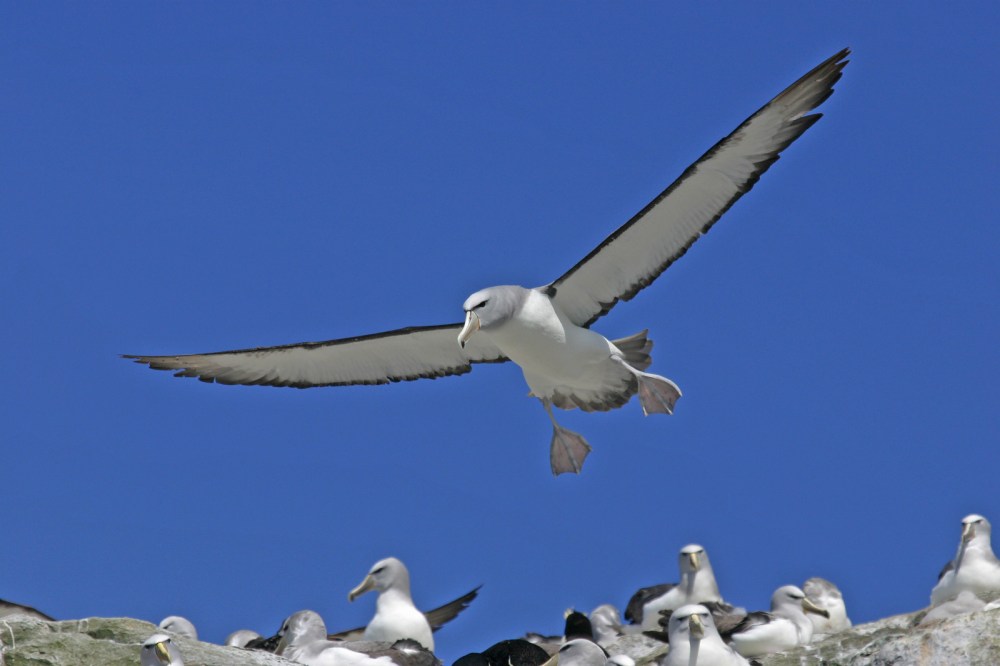
The other two species in the ‘shy albatross group’ are number 6 Salvin’s Albatross which we saw breeding in great numbers, 10,000 or more, on and around Snares Islands south of New Zealand. I also saw one on a pelagic off Lima, Peru. Photo © Pete Morris.

…and number 7 Chatham Albatross which breeds only a single pyramid shaped rock south of the Chatham Islands where I saw a minimum of 5000. Photo © Dick Newell.
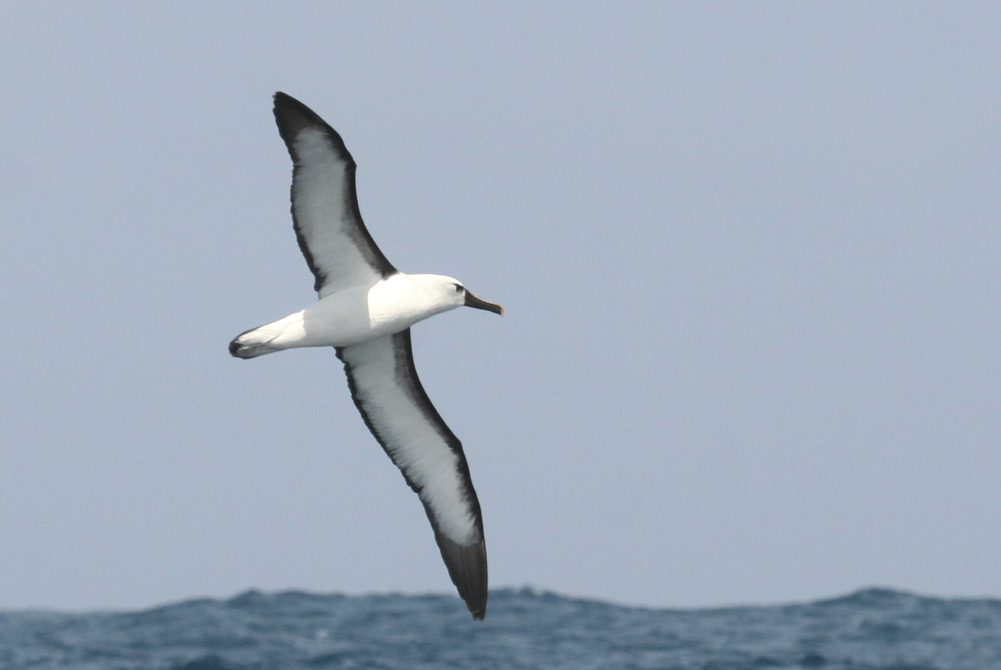
Another species pair that can be seen off South Africa is number 8 Indian Yellow-nosed Albatross which breeds in the Indian Ocean to the north of the Antarctic Convergence. It has a light-grey wash to the neck. I have seen 2 off Cape Town in 2011 and 2 from shore in Western Australia. In addition some 30 Yellow-nosed Albatross sp were seen on my 1991 Cape Town pelagic.
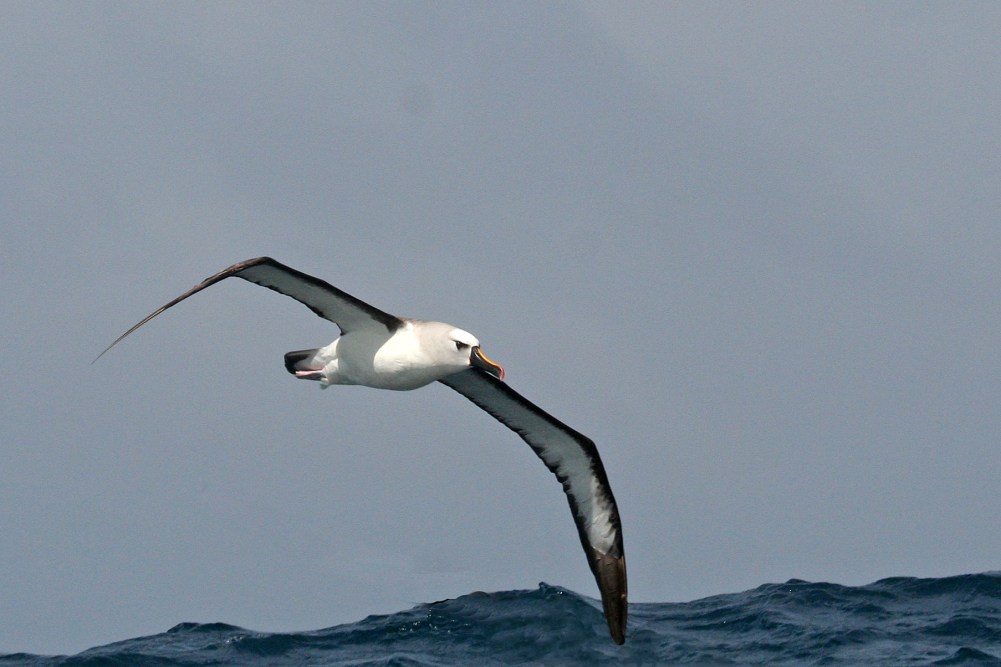
However this individual photographed on the same pelagic looks intermediate between the Indian pictured above and the Atlantic pictures below. It is possible to to separate them based on the exact shape of the yellow on the bill but I think you would need a photo of it coming straight for you to do that.

Number 9 is Atlantic Yellow-nosed Albatross which has a darker grey hood making the white crown stand out more clearly. When I did my first pelagic off Cape Town in 1991 I was unaware of the pending split, so I was pleased to catch up with undoubted Indian Yellow-nosed when I did another pelagic out of there in 2011. In 2016 we went on the Atlantic Odyssey and passed Gough and stopped at Tristan da Cunha where Atlantic Yellow-nosed breeds in good numbers with a minimum of 250 seen.

We landed on Nightingale Island and climbed to the top to see the endemic Wilkin’s Bunting on route we passed some Yellow-nosed Albatross chicks almost ready to fledge. At this age they lack the yellow on the bill and the grey wash to the neck. A lot were sitting on the path and we had to carefully pick our way around them.

We certainly got close up views. Photo © Dave Fisher

Moving back to the Pacific we come across a couple of albatrosses with yellow on the upper and lower mandibles as well as the gape, that are usually treated as races of the same species (even by the very splitty ‘Oceanic Birds of the World’) number 10 is Buller’s Albatross of the southern form that breeds on the Snares and Solander Islands where we saw about 15. Photo © Dick Newell

… and the Northern or Pacific Buller’s which breeds mainly on the Chatham Islands east of New Zealand, about 75 were seen. Photo © Pete Morris.

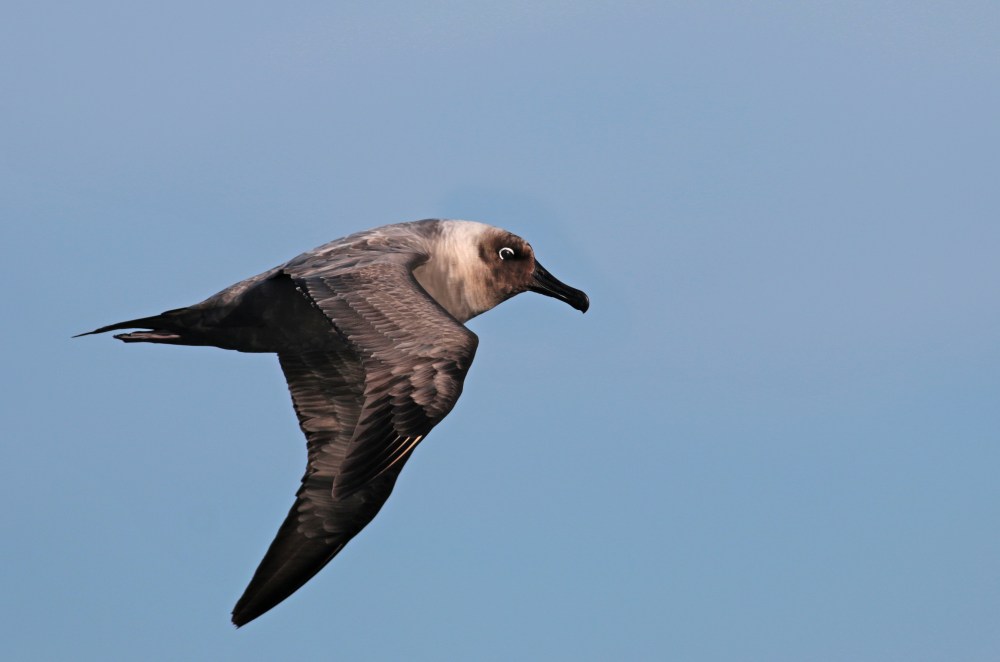
Another group of albatrosses is the ‘sooty albatross’ group. Variously called Light-mantled and Sooty or alternatively Light-mantled Sooty and Dark-mantled Sooty. Photo © Pete Morris

Light-mantled Albatross number 11 breeds across the islands of the sub-antarctic and ranges further south into Antarctic waters. I have seen around 200 spread over the three southern ocean cruises that I have taken. Photo © Pete Morris

It (along with Sooty) is the smallest and most graceful of the albatrosses. The synchronised display flight of a pair along the cliff edges is a beauty to behold. Photo © Dave Fisher.
Younger birds have a paler neck and mantle with the wing feathers lightly edged. Photo © Dave Fisher.
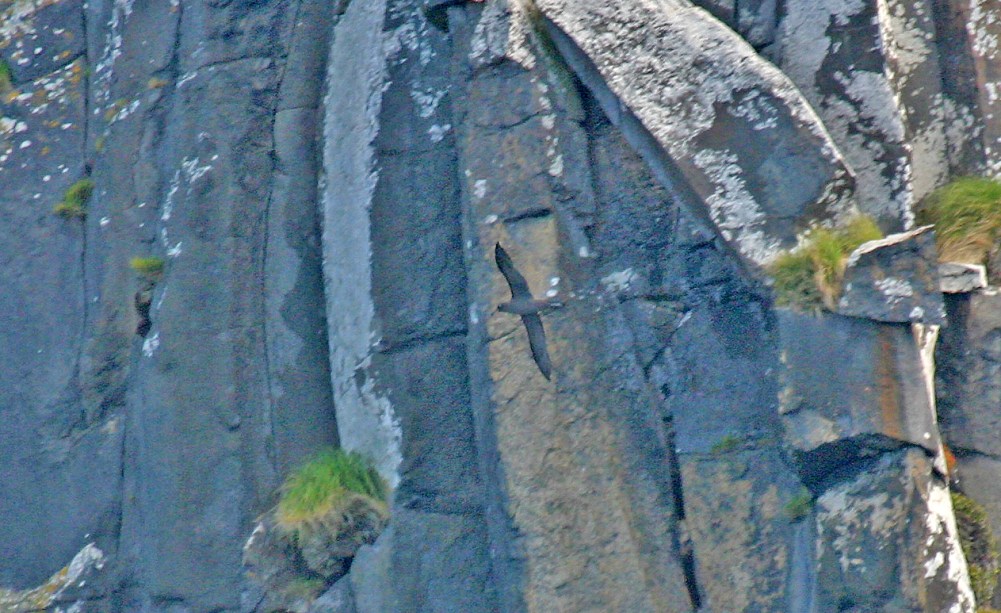
The discovery of number 12 was a real surprise. We were at the Antipodes Islands on the Sub-antarctic Island cruise (exactly the opposite side of the world to London, hence the name). Leader Pete Morris was off on zodiac cruise with some clients and I was waiting my turn. I found this all dark ‘mantled’ albatross gliding around the cliffs, I was so chuffed to have found a vagrant and couldn’t wait to tell Pete, but when he got back I found that he’d seen it and photographed it from the zodiac. A somewhat enlarged version of © Pete Morris’s photo.
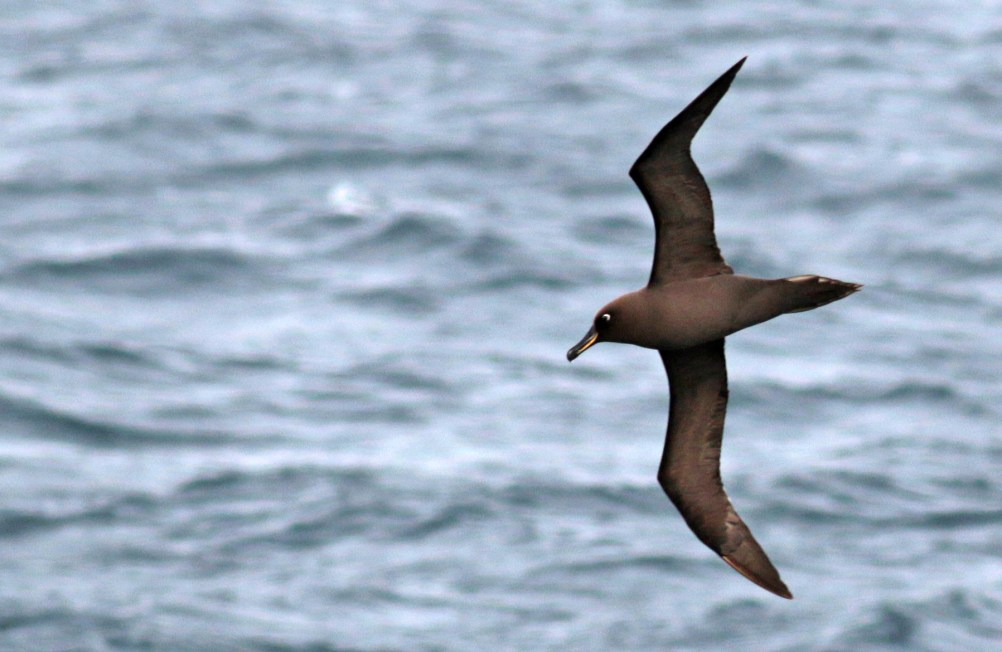
The reason I was so excited about it is that Sooty Albatross breeds on Gough Island in the south Atlantic and so was thousands of miles off course. On the Atlantic Odyssey we saw around 50 at sea from a bit north of South Georgia to the Tristan group. Photo taken near Gough Island by © Dave Fisher
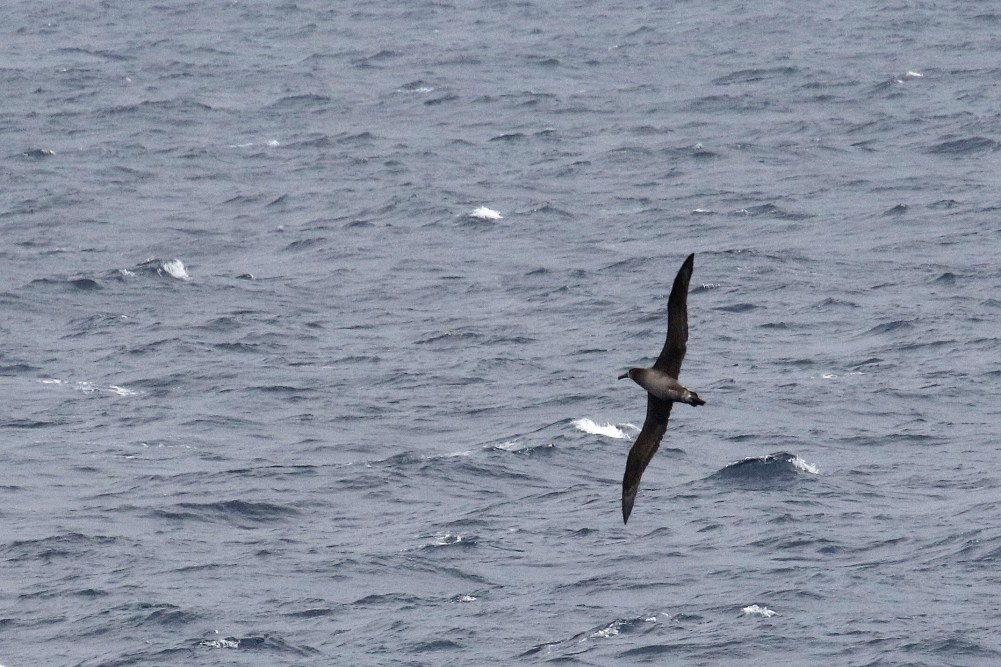
We now turn our attention to the four species of ‘north’ Pacific Albatrosses. Number 13 is Black-footed Albatross which breeds in the Hawaiian Island chain. I first came across the species on a couple of pelagics out of Monterrey California where 13 were seen. I have since seen one off the Kuril Islands, Far-eastern Russia and 150 to the south of Japan.
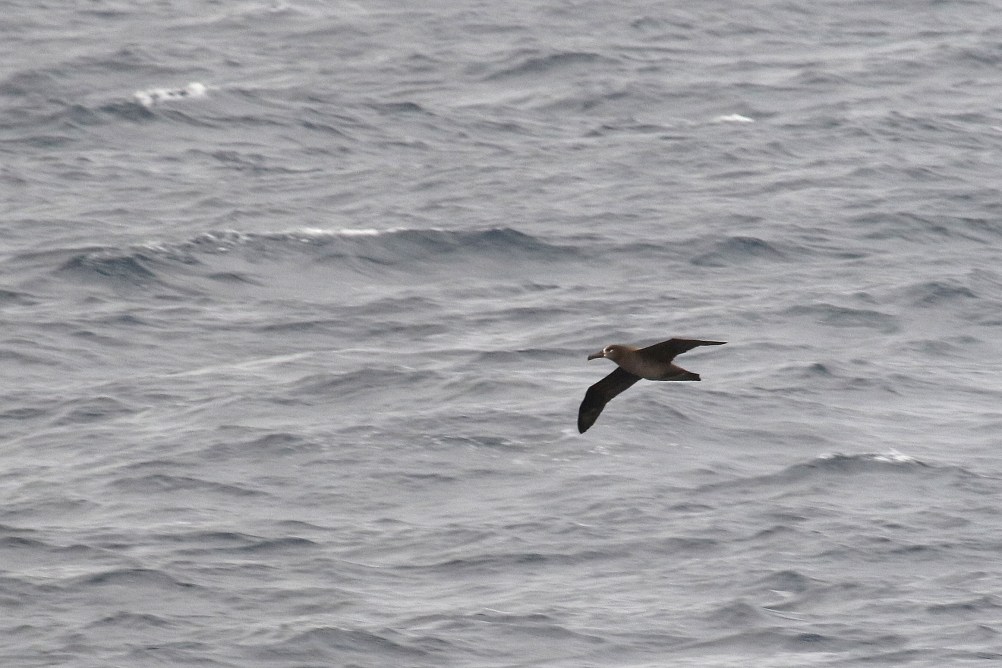
Seen close up the feathering around the bill and under the eye is quite distinct.

I first saw number 14 Laysan Albatross breeding on Oahu, Hawaii where some 10 adults were displaying, but as the name suggests it also breeds all along the Hawaiian Chain. I’ve also seen it off the Russian Far East where it was common with c400 seen but …
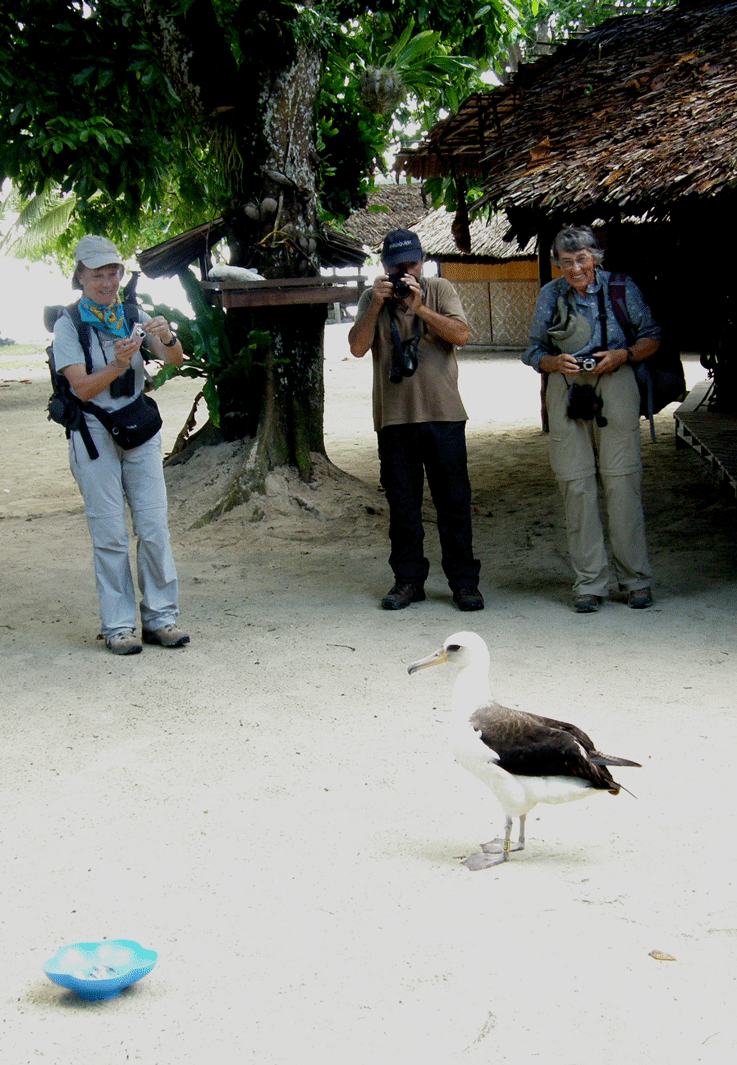
… the most bizarre sighting, indeed the most bizarre sighting of any albatross was on Nusa Island, Papua New Guinea. We had caught a small boat from New Ireland to New Hanover to see the New Hanover Manikin, on the return the boatman asked if we wanted to see the albatross. After a bit of questioning from his incredulous clients he detoured to Nusa Island where we treated to the sight of a Laysan albatross wandering around the village and feeding out of a plastic bowl.
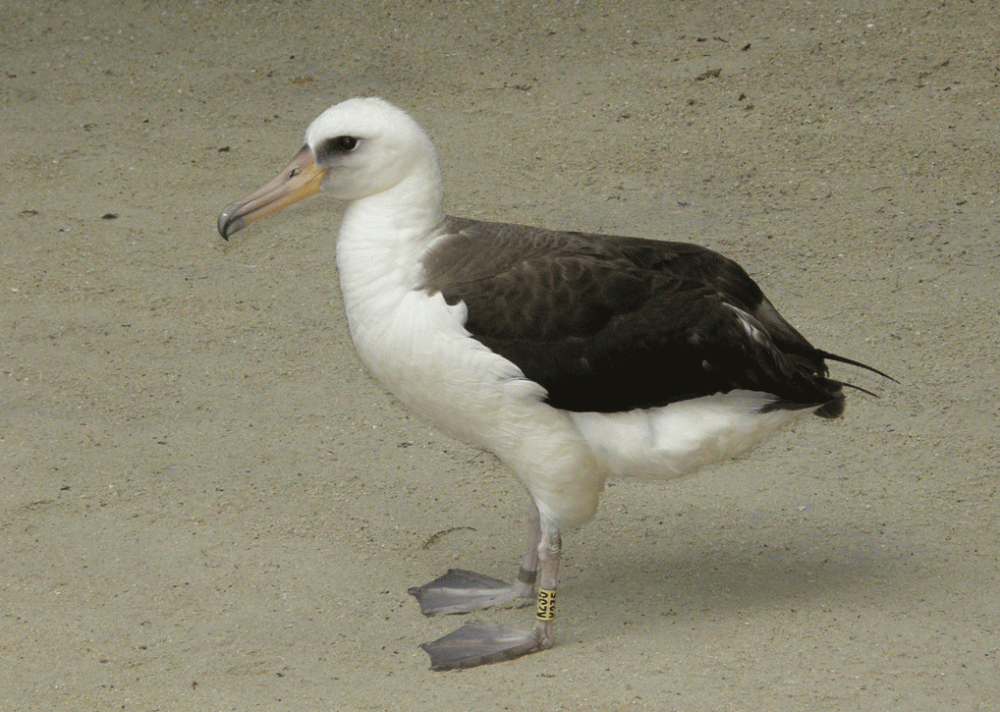
Apparently it was picked up becalmed at sea and brought to the village to be fed. It was shepherded into a hut at night to keep it safe from dogs. The villagers hoped to release it once the winds increased. It was later discovered to be ringed 12 years previously as a pullus on French Frigate Shoals in the Hawaiian chain.
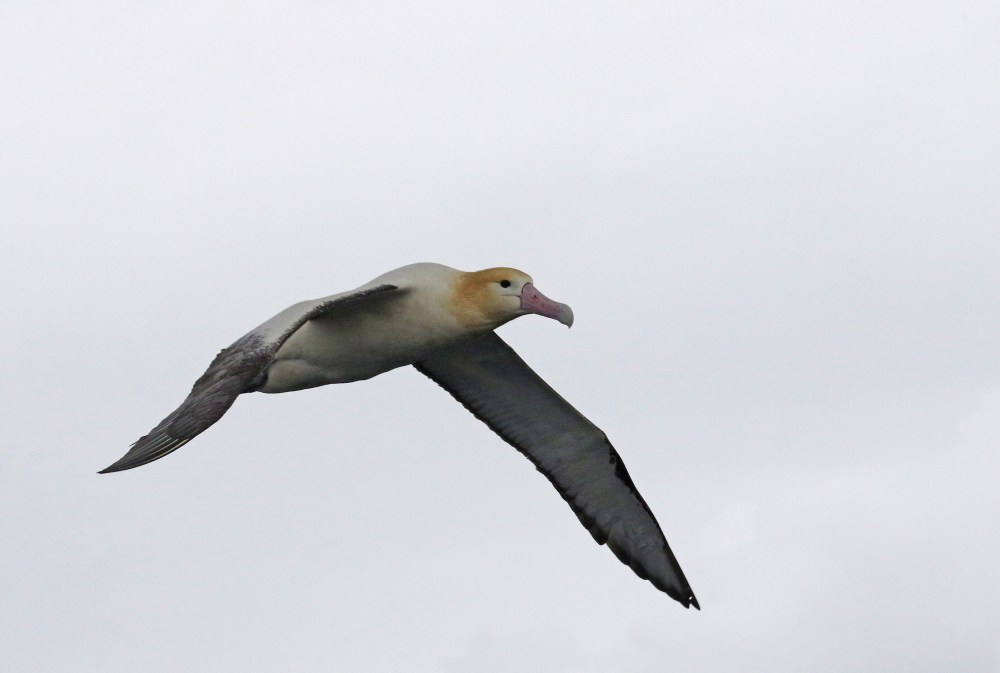
Returning to the West Pacific Odyssey, during the latter part of the cruise we sailed close to Torishima Island south of Japan (more photos of this albatross and of Torishima will appear when I post the last episode of my West Pacific Odyssey) …

… here we had the most wonderful views of number 15 Short-tailed Albatross. This species was believed extinct as by 1930 every single one of them on their only breeding island had been killed for their feathers. Fortunately a few immatures must have survived at sea and 25 or so years later a tiny number were found to be breeding back on Torishima. Now they are carefully protected and numbers are increasing. This wasn’t the first time I’d seen this species, we encountered around a dozen off the Kurils three years earlier but this time we saw at least 700. It is such a wonderful story how this bird came back from the dead.

Of all the vernacular names given to albatrosses ‘Short-tailed’ must be the worst. It would be far better to name it after Georg Stellar (of jay, eider and sea-cow fame) who first collected it or perhaps call it Golden-headed Albatross for obvious reasons. On appearance alone it has to be one of the best of them all.
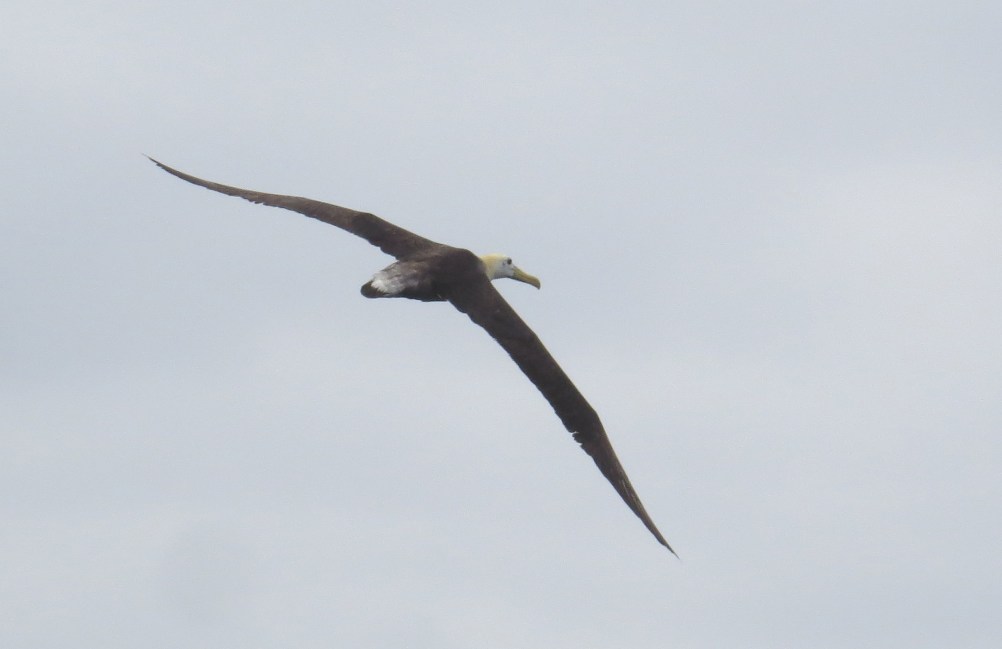
Last of the Pacific albatrosses and the last albatross that I got to see (and the last new one that I will ever see) is number 16 – Waved Albatross.
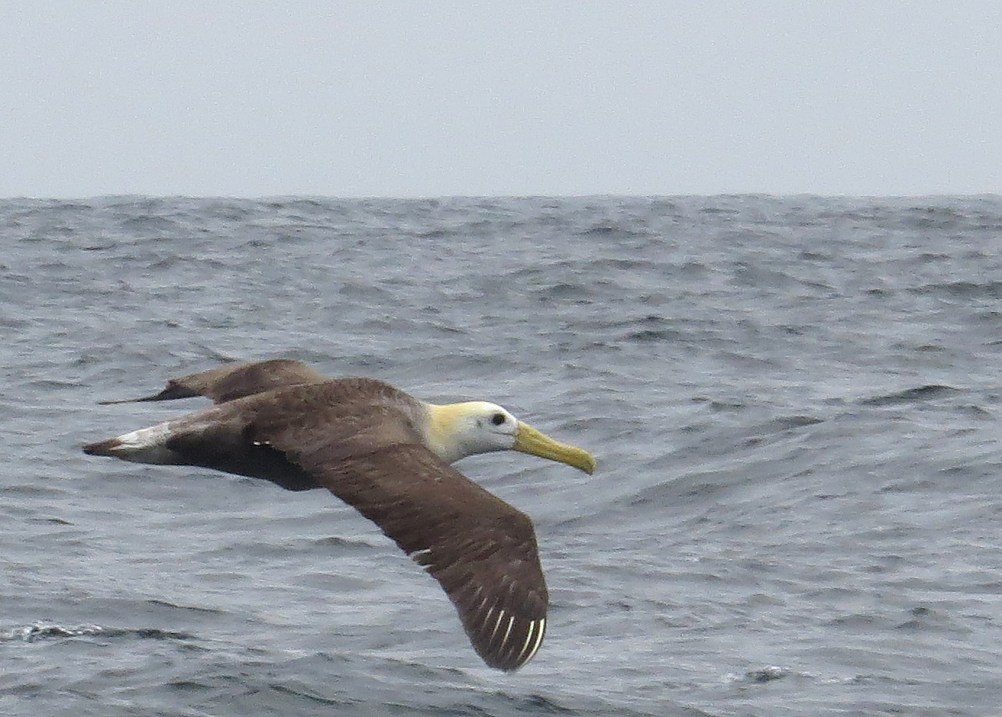
This magnificent bird nests almost entirely on the Galapagos, a place I have yet to visit, so my only experience is of this one bird that made a close pass of our boat whilst on a pelagic out of Lima, Peru.

Now we return to the ‘great albatrosses’, the ‘royal’ and ‘wandering’ groups. the ‘royal group’ consists of two species. This is an adult Northern Royal (number 17) and with its all dark wings with a dark leading edge and black cutting edge to the bill is possibly the easiest of all the ‘great albatrosses to identify. Photo © Pete Morris.
©

Some older Northern Royals get a bit of white speckling in the wing. This species breeds mainly on the Chatham Islands with a few on the NZ mainland near Dunedin but wanders all over the southern oceans. I’ve seen about 10 in South Georgia area, 250 in New Zealand/Chatham Island waters and one just to the north of NZ on the WPO. Photo© Pete Morris

Southern Royal (number 18) which breeds primarily on Campbell Island, whitens with age from the mantle outwards … Photo © Pete Morris.

… and along the wing, especially on the already white leading edge. This is a fully adult bird. ‘Great albatrosses’can take over 10 years to become fully mature. Photo © Pete Morris.

Southern Royal Albatross on the nest Campbell Island. Photo © Pete Morris
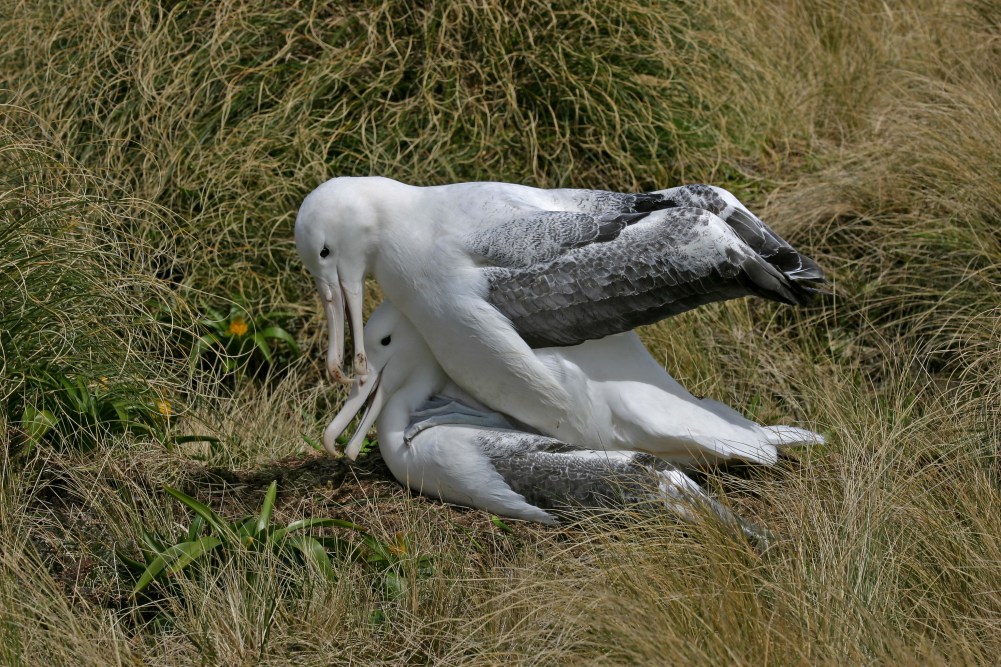
Southern Royal Albatrosses OTJ on Campbell Island Photo © Pete Morris.
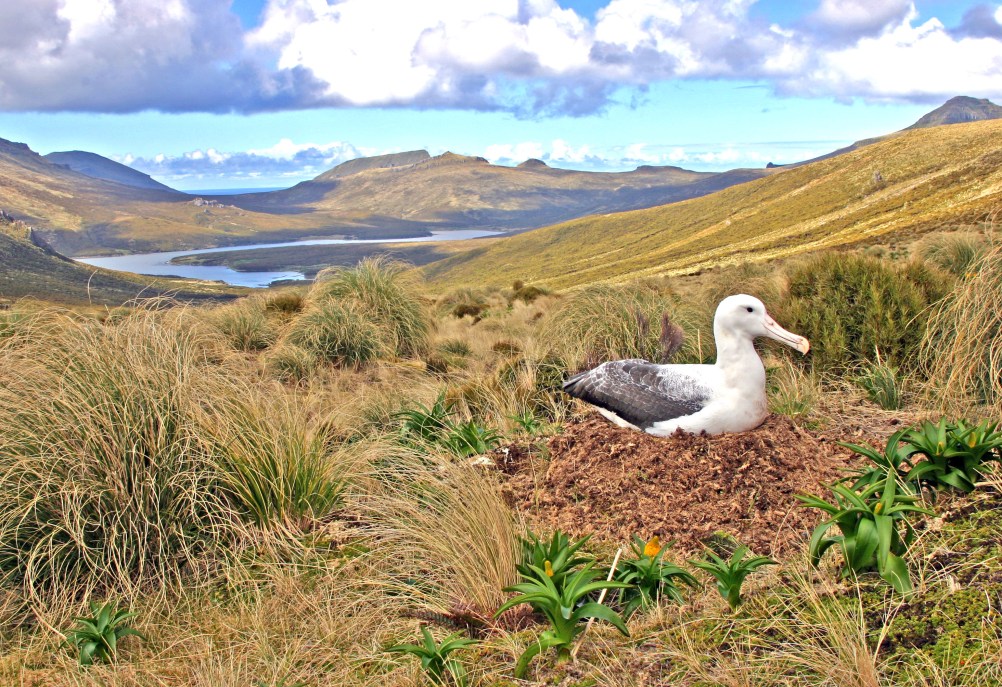
A Royal Albatrosses’ view of Campbell Island. Photo © Pete Morris.
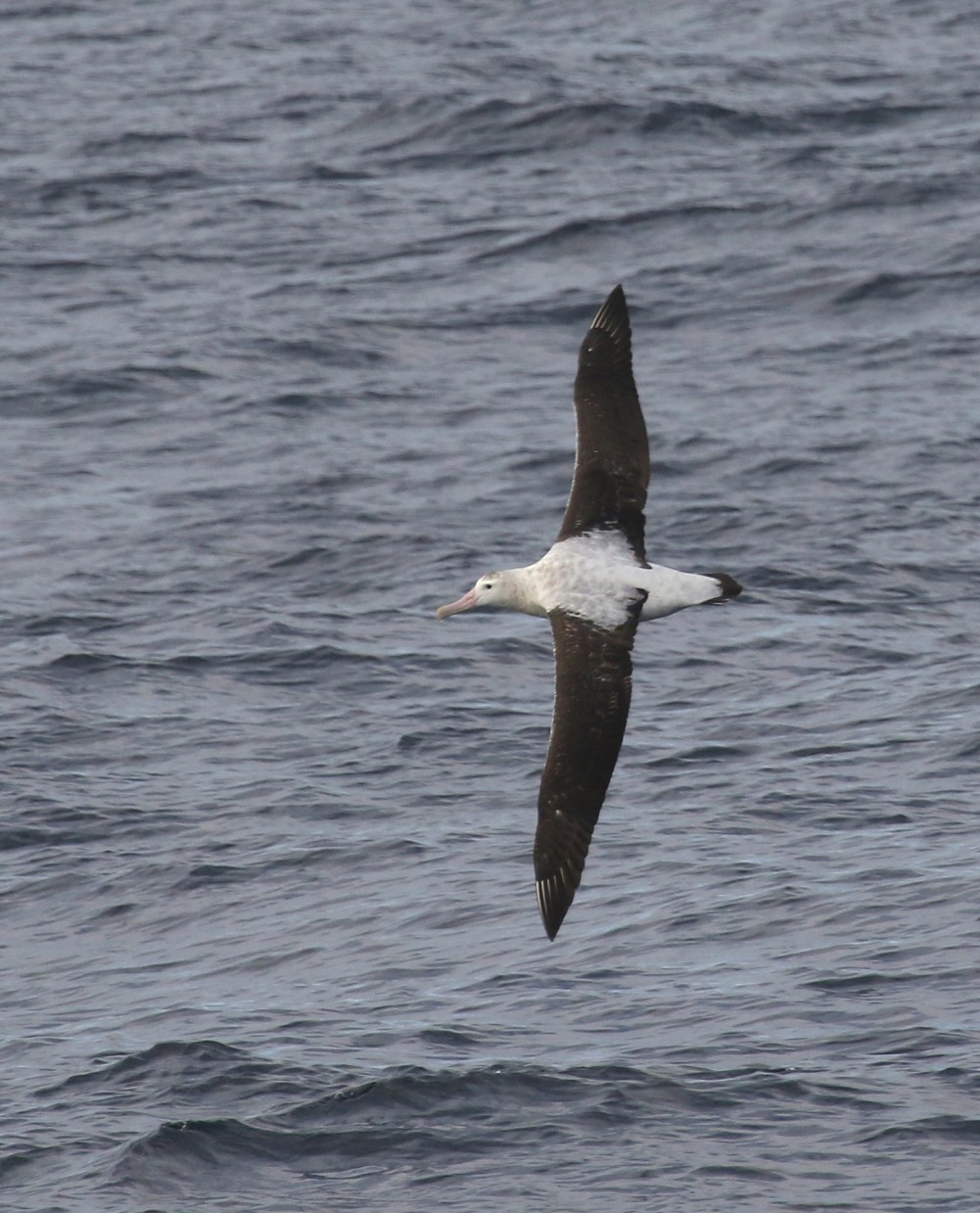
There are a couple of other species to add in the ‘wandering’ group: number 19 Tristan Albatross, a slightly smaller and darker version of Snowy that breeds in Tristan da Cunha and Gough Island that we saw well on the Atlantic Odyssey. This species is endangered as the young are being eaten by mice! We had about 100 sightings on the Atlantic Odyssey between South Georgia and Tristan da Cunha but a) it’s hard to know how many when the same bird can follow the ship for hours and b) it was hard to tell when the last Snowy Albatross that breeds in South Georgia was seen and when the first Tristan’s was encountered.

And another in the ‘wandering group’ number 20 Antipodean Albatross which breed mainly in the Antipodes Islands south of New Zealand. I have seen about 80 on the Subantarctic Islands of New Zealand cruise, 40 on pelagics out Kaikora, NZ and a very small number off New South Wales. Photo © Pete Morris.

.. and Gibson’s Albatross which is usually treated as a subspecies of Antipodean. It usually retains some gingery tones into adulthood and keeps a dark tip to the tail. It breeds mainly on Aukland Island. About 85 were seen on the Subantarctic cruise, 8 off NSW and one north of New Zealand on the West Pacific Odyssey. Photo © Pete Morris.
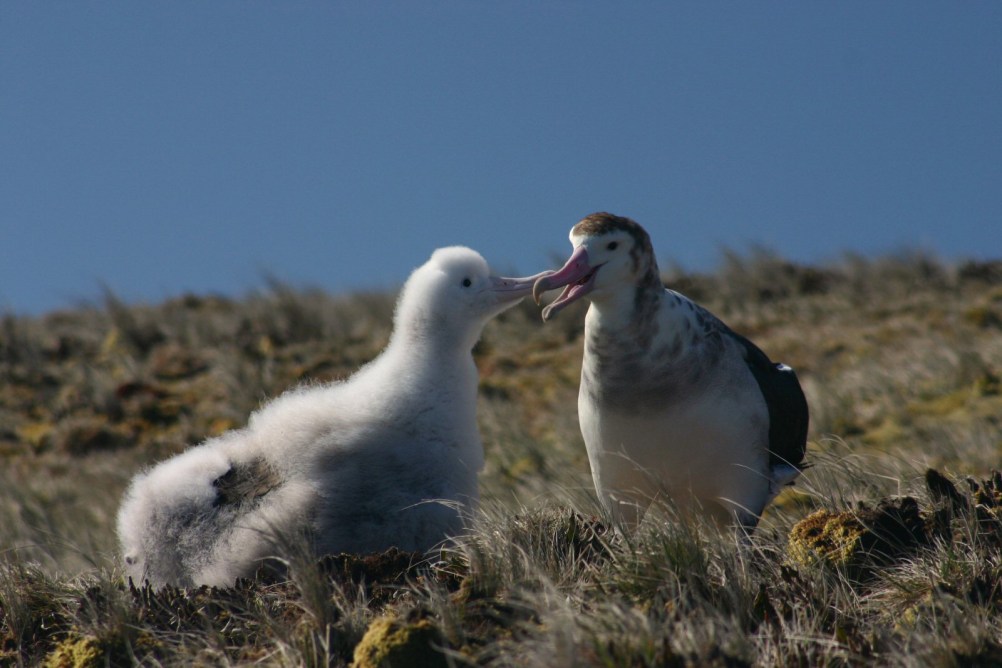
I said there were 21 species of albatross and I had only seen 20. Well here’s the 21st! Amsterdam Albatross, seen only by the lucky few who get to visit Amsterdam Island in southern Indian Ocean, the most remote of islands. With a population of less than 130 birds and 25 breeding pairs (just 5 pairs when first discovered) the chances of encountering it at sea are low to say the least. And visiting the island isn’t easy either unless you’re a researcher and French. Photo © Vincent Legrendre via Wikipedia.
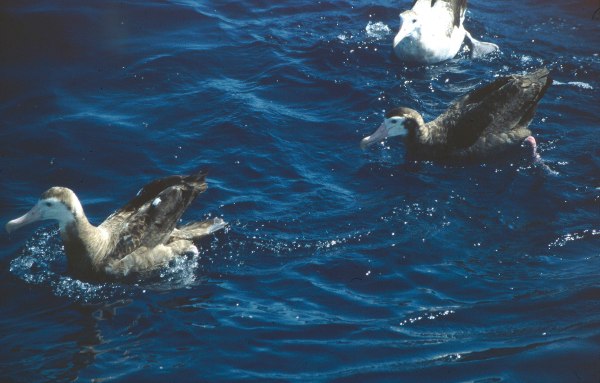
However on a pelagic out of Sydney in 1999 we encountered a most unusual bird. It’s presences was already known and it was obvious the pelagic organisers were targeting it. The bird on the left is a typical juvenile Antipodean but the bird on the right has the dark cutting edge to the bill, green gonys and paler face of an Amsterdam. Photo taken from a scanned slide

With a bit of manoeuvring and careful placement of chum the bird was caught and brought on board. It looked like an Amsterdam but French researchers later said the entire population of Amsterdams are ringed and it wasn’t. I don’t recall if a blood specimen was taken but apparently it was logged as an unusual juvenile Antipodean. So I might not have seen the rarest of world’s albatrosses but I’ve seen a bird that looks just like one! Photo taken from a scanned slide.
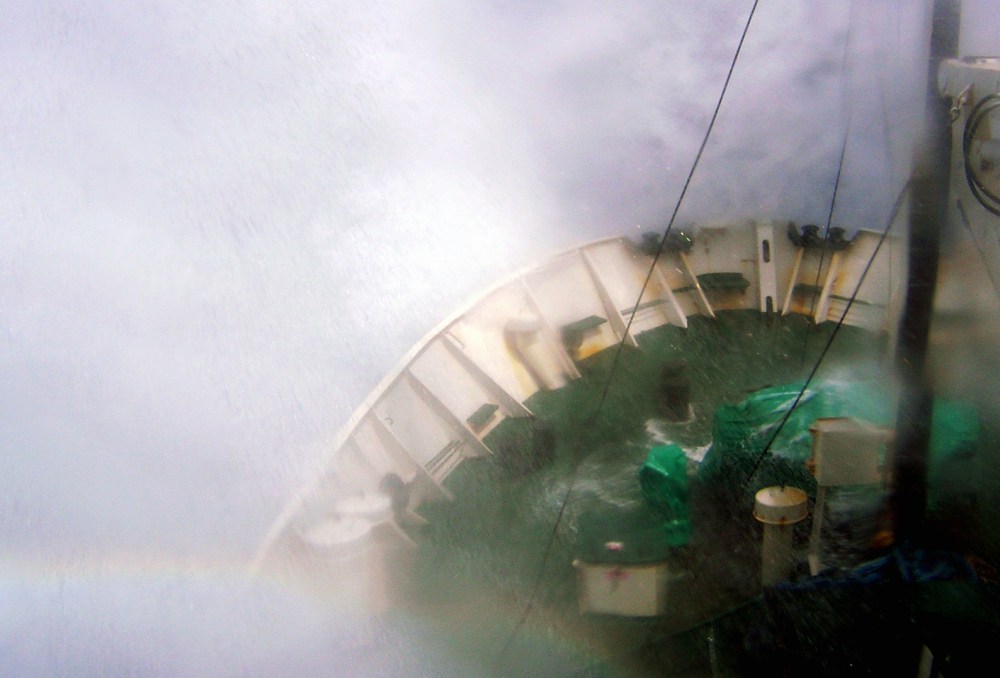
If you go searching for albatrosses in the southern ocean you’ll be bound to encounter some rough seas …

.. but you’ll also get views of albatrosses on a daily basis and see wonderful places like Campbell Island. Photo © Pete Morris.

Celebrated in literature, poetry and Monty Python sketches, few birds inspire like the albatross does. Photo © Pete Morris
This post has taken far longer and has involved many more photos then I originally imaged (the initial idea was to post just 24 images) but it has allowed to go back and look at how much joy these, the most majestic of all birds have given me and this is my contribution to ‘World Albatross Day.
This post covers the second part of the West Pacific Odyssey (WPO), an epic boat trip from New Zealand to Japan and deals specifically with the the short visit to Norfolk Island and the sail north to New Caledonia.
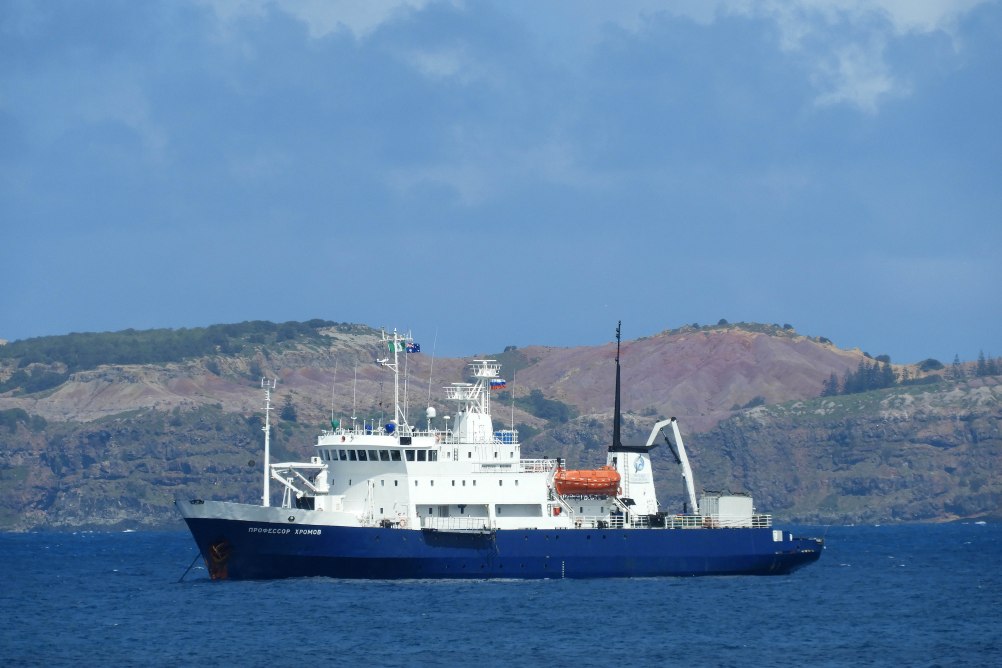
Here is the Professor Khromov anchored at Norfolk Island.

There to greet us was a ‘Tasman Booby’ the dark-eyed race of Masked Booby that breeds on the island. The cloudy conditions early on soon cleared and we had a nice sunny morning.
We headed ashore by zodiac, a White Tern flew in front of us as we neared the shore.
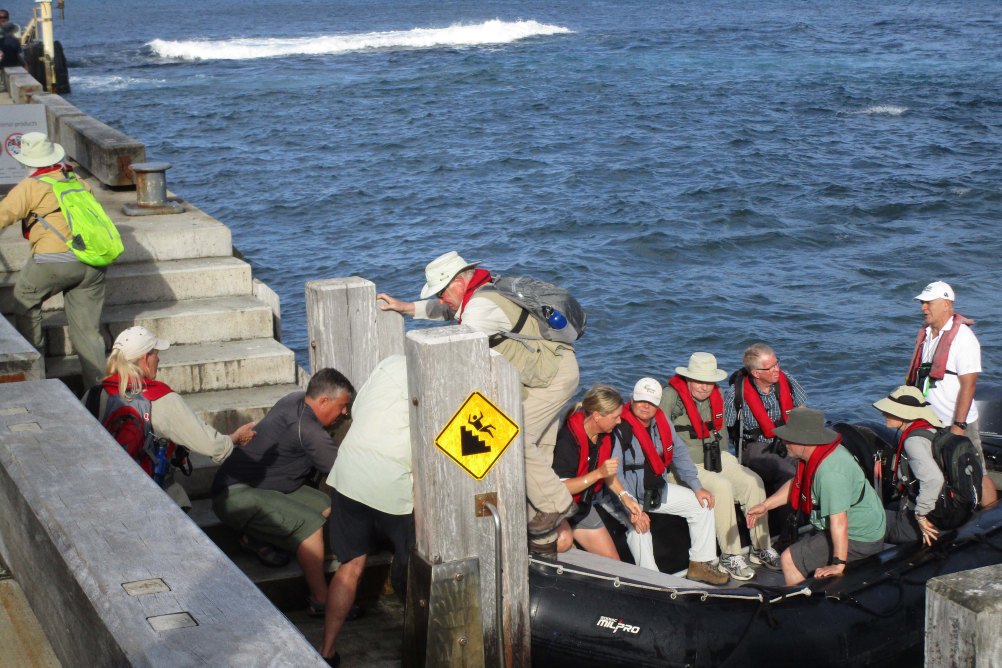
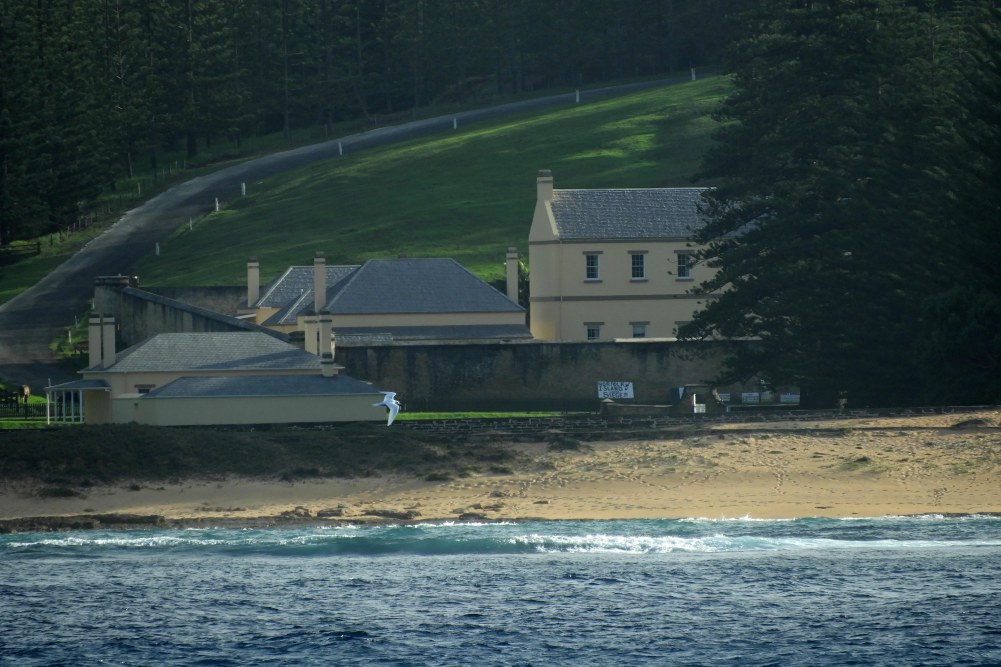
Landing at the pier …

… we had good views along the shore where a number of waders fed on the tideline …
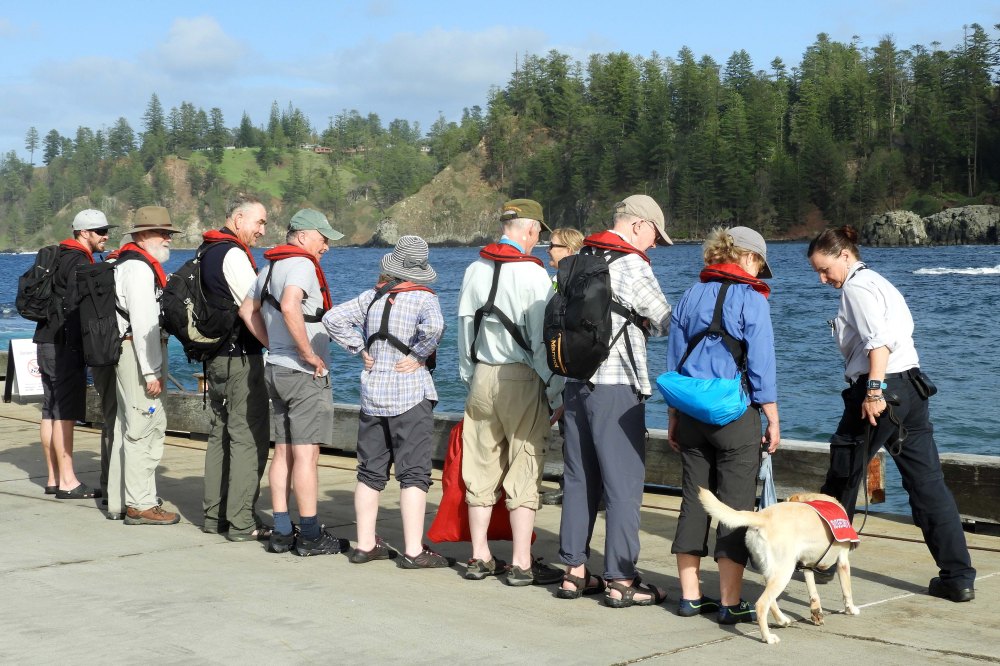
.. put first we had to go through a customs check. Norfolk Island belongs to Australia and the official and dog were checking that we weren’t bringing foodstuffs ashore.
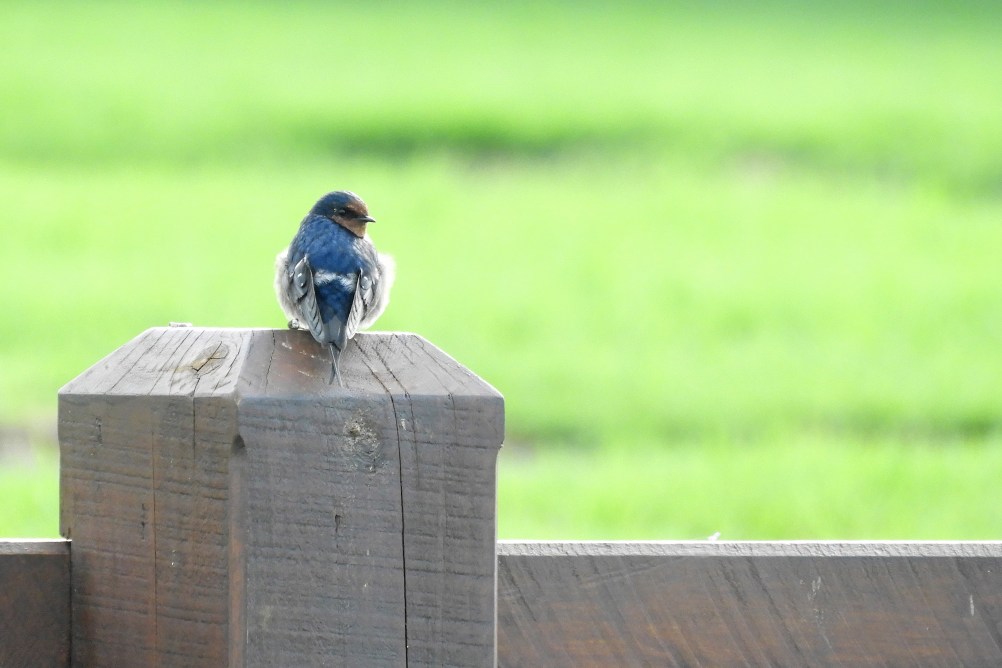
A Welcome Swallow did just that …
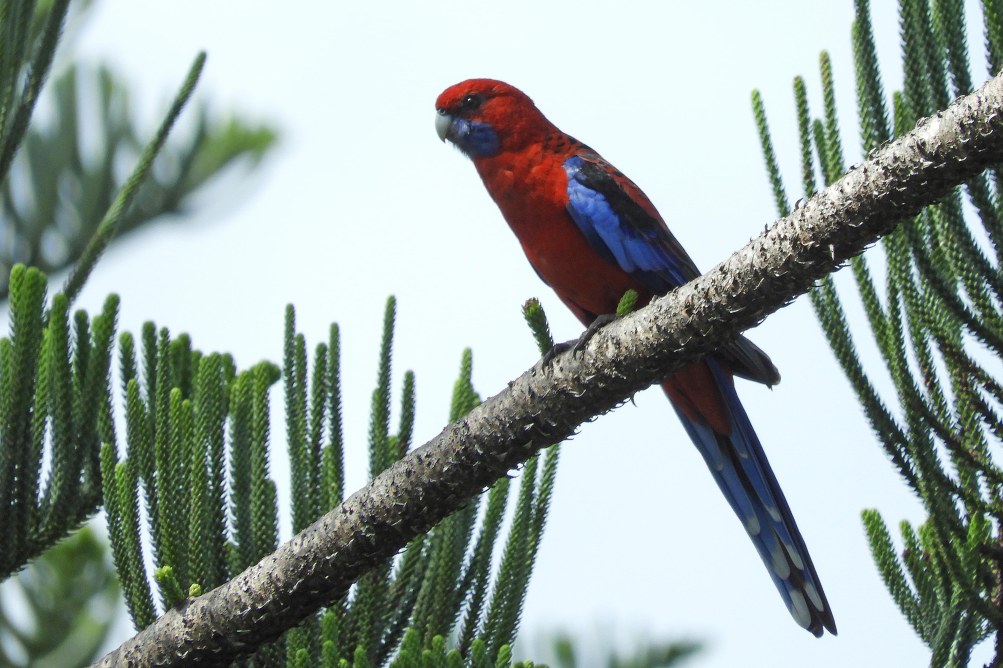
… although perhaps the sight of an introduced Crimson Rosella was less welcome. Actually Norfolk Island has a lot of introduced birds like California Quail and if we had of had time I’d have liked to have sought them out so I could add them to my Aussie list.

Along the shore were a number of Pacific Golden Plovers beginning their moult into summer plumage. Soon they will set off on a epic flight to the Siberian tundra to breed. We also saw a number of Wandering Tattlers which breed in Alaska but they were distant and my photos are poor.

Perhaps Norfolk Island’s most famous endemic is the Norfolk Pine. Planted everywhere around the world as an ornamental tree, it was originally endemic to the island.

A small proportion of the clients went on a guided tour of the island but the majority of us headed for the hills where we were to look for the endemic birds.
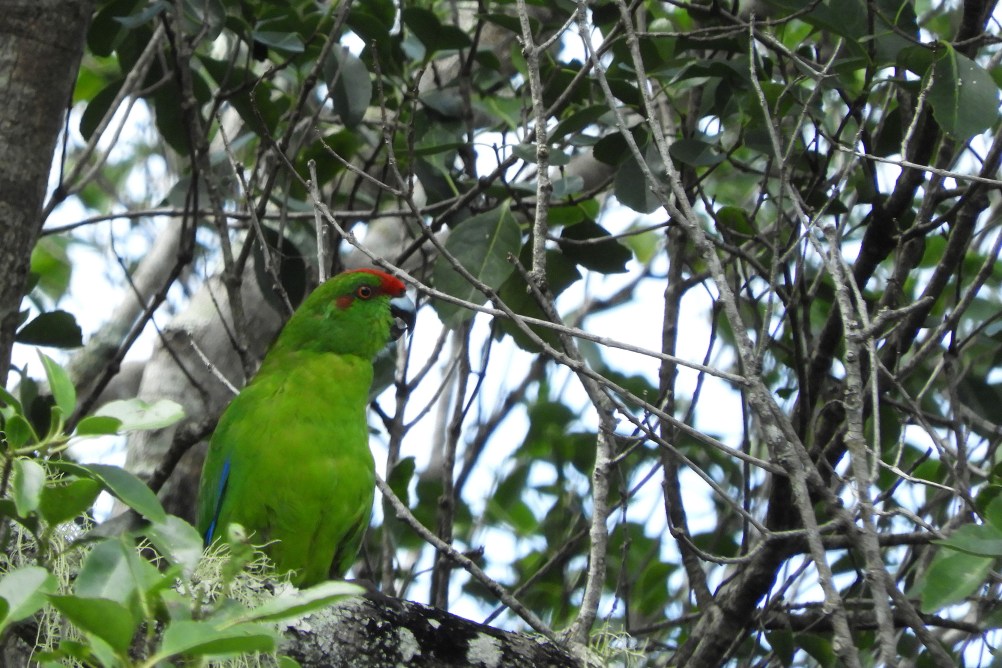
One of the most obvious of the endemics was the Norfolk Parakeet …

… a few of which showed well around the clearing.


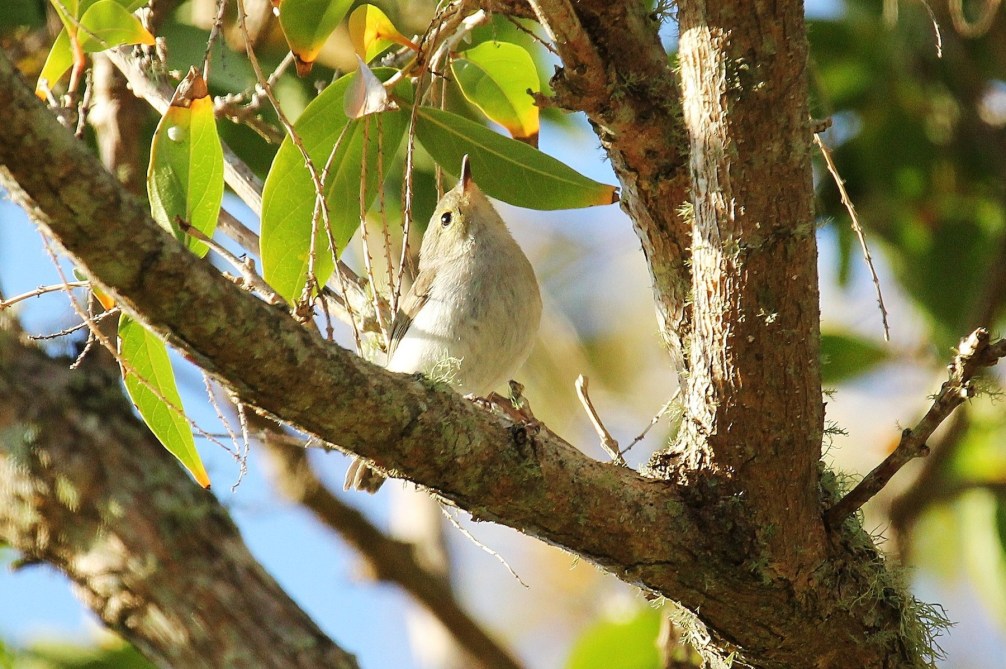
Inevitably Norfolk Island has it’s own white-eye know surprisingly as the Slender-billed White-eye rather than name with ‘Norfolk’ in it. Birds in the genus Zosterops are known as ‘great speciators’ ie birds that colonise islands and then rapidly evolve into a new species to match the opportunities offered in their new environment.
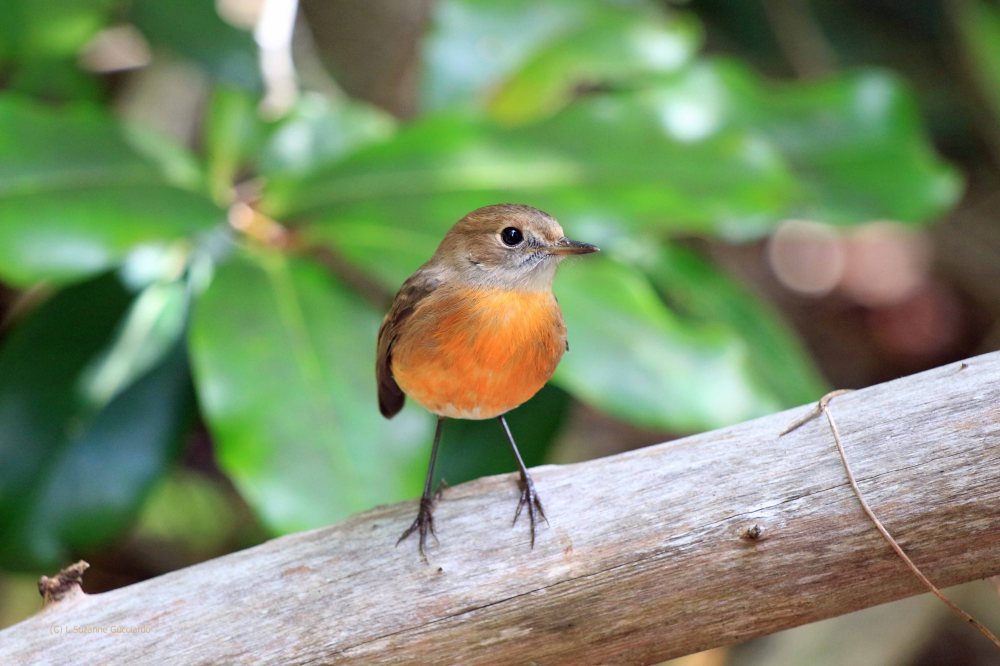
Another ‘great speciator’ are the Petroica robins, a group in a completely different family from the Eurasian robins. This is not surprisingly known as Norfolk Robin. Photo by fellow traveller Suzanne Gucciardo.
The final endemic species was the Norfolk Geregone, one of a group of non distinct Australian Warblers found in the Australo/Papuan/Melanesian area. Photo by Alex Ferguson from https://birdsoftheworld.org
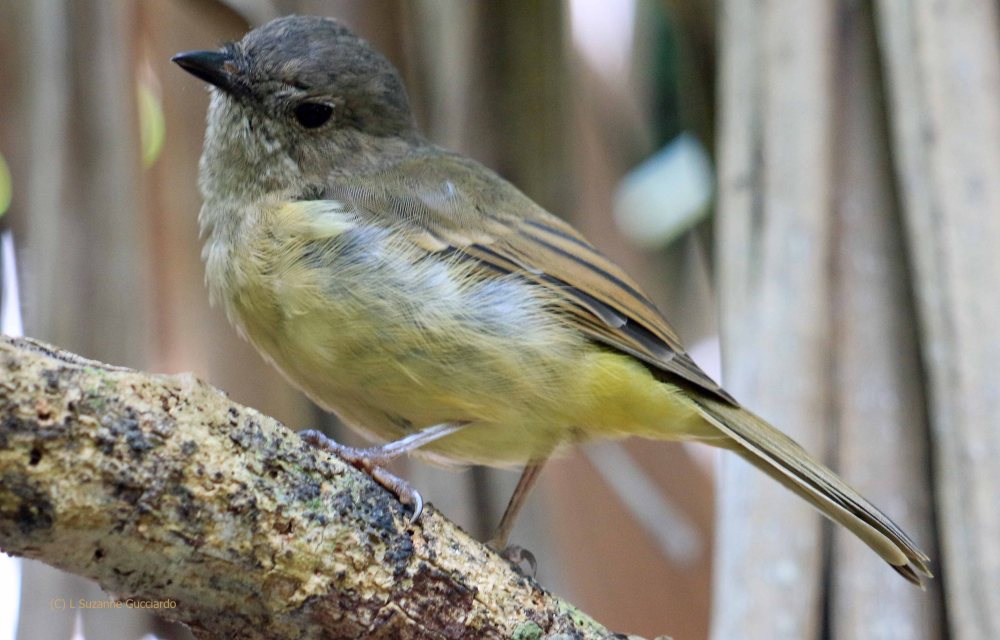
There really should be a fifth endemic. The taxonomic status of the Golden Whistler complex has been debated for decades. There are/were between 59 and 73 or so subspecies (depending on which authority you follow) making Golden Whistler the species with the highest number of subspecies in the world. Following a review some have been split but not xanthoprocta, the one on Norfolk Island Here both males and females have a plumage like the females seen on mainland Australia. Photo by fellow traveller Suzanne Gucciardo.

It took around an hour to see the five species well but we were allowed around four hours. I would have liked to board the buses and go on an island tour for part of that time, after all I’m never going to be coming back.
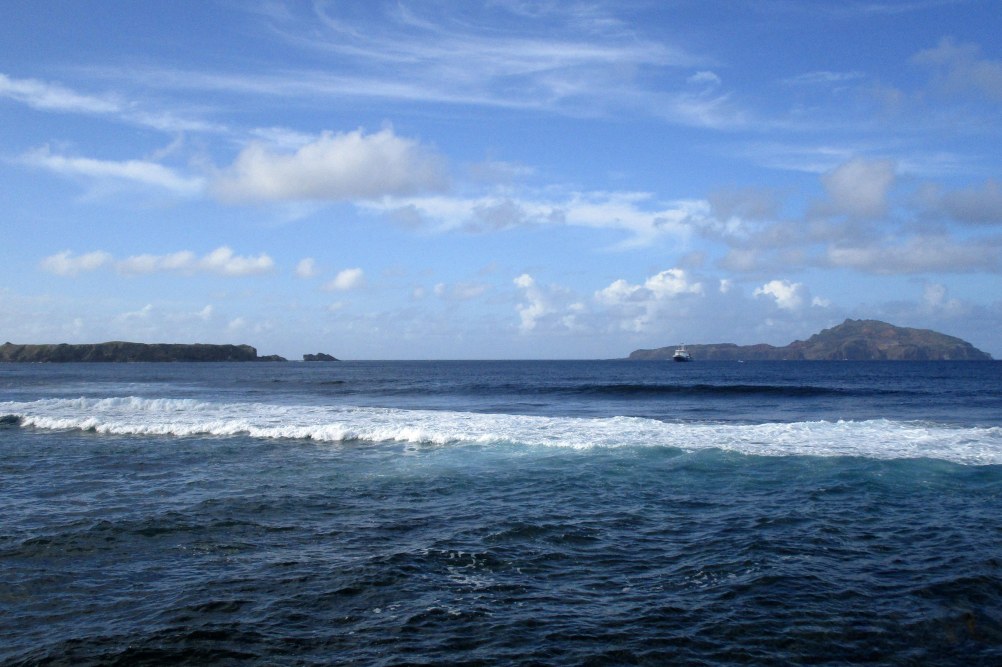
Soon we were back on the pier and being shuttled back to Prof Khromov by zodiac.
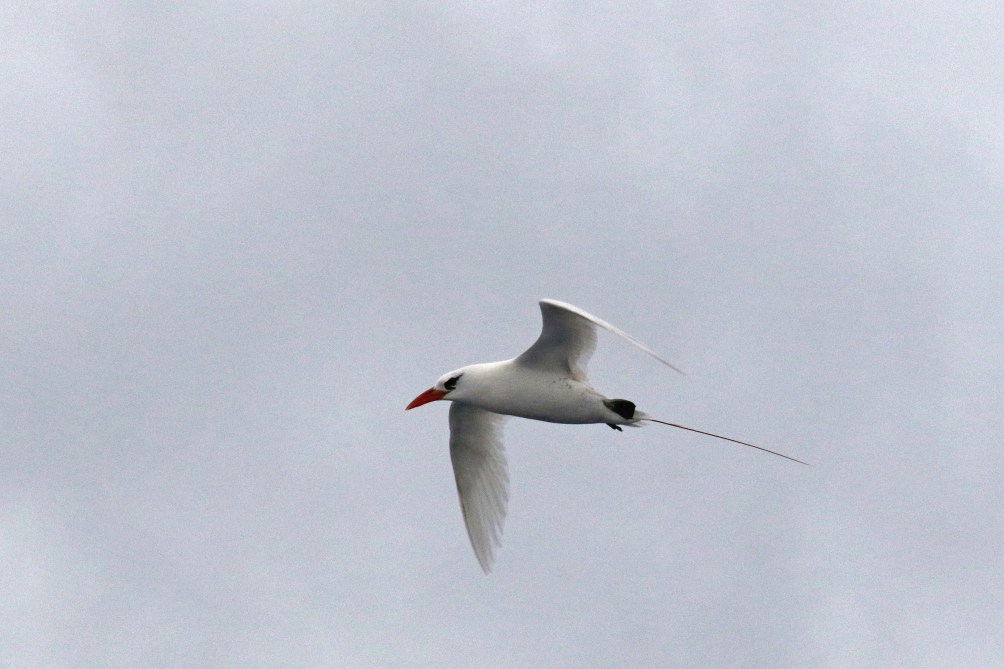
During that afternoon and all of the following day we sailed north towards New Caledonia. As well as some species familiar from our earlier time at sea we saw new birds like Red-tailed Tropicbird …
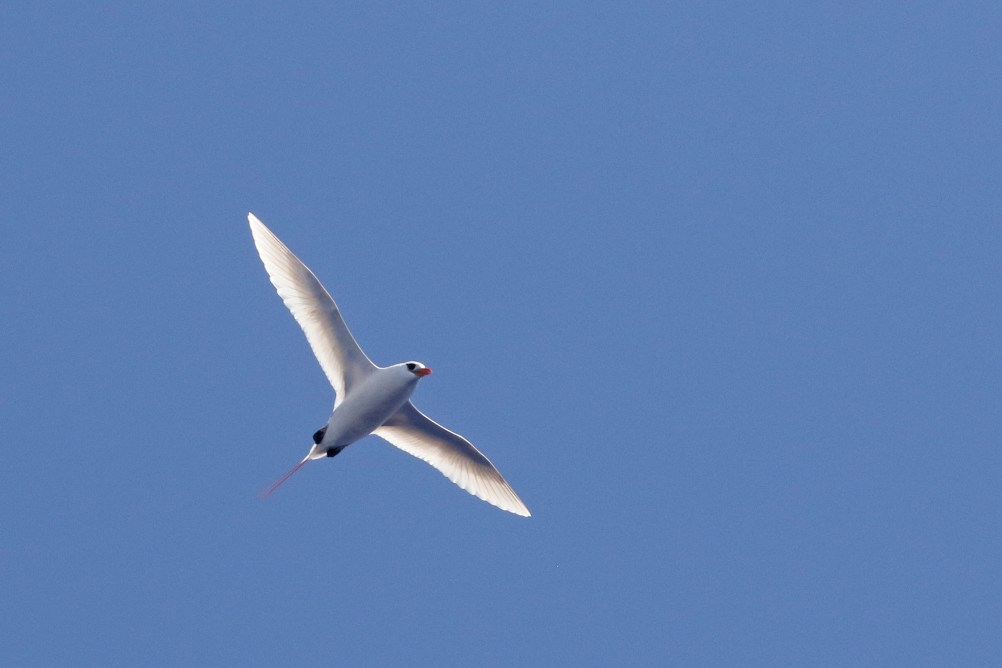
There are three species of tropicbird in the world, Red-billed is confined to the coasts of the Americas, the Atlantic island and Arabian sea but Yellow-billed and Red-tailed occur in the Pacific.

We were to see all three northern skuas (jaegers) off and on during the trip. This area was good for Long-tailed Skua (Jaeger) with up to 15 seen.

The views in general weren’t all that close. These birds would have been wintering in the area, or perhaps have been further south and now on their way to the Siberian tundra to breed.
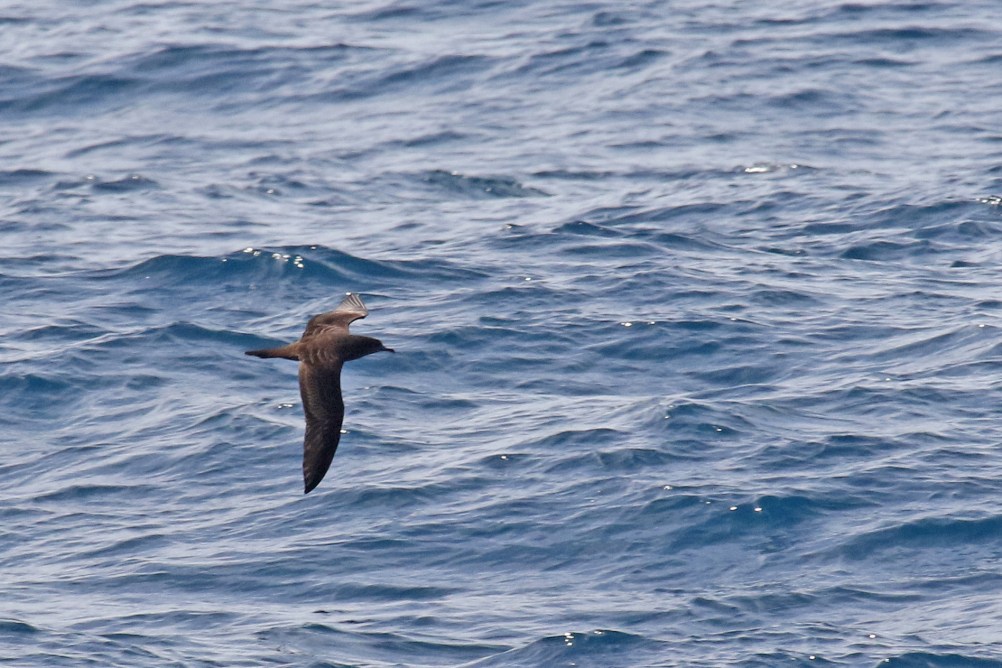
A common species was Wedge-tailed Shearwater usually abbreviated to ‘Wedgie’ …
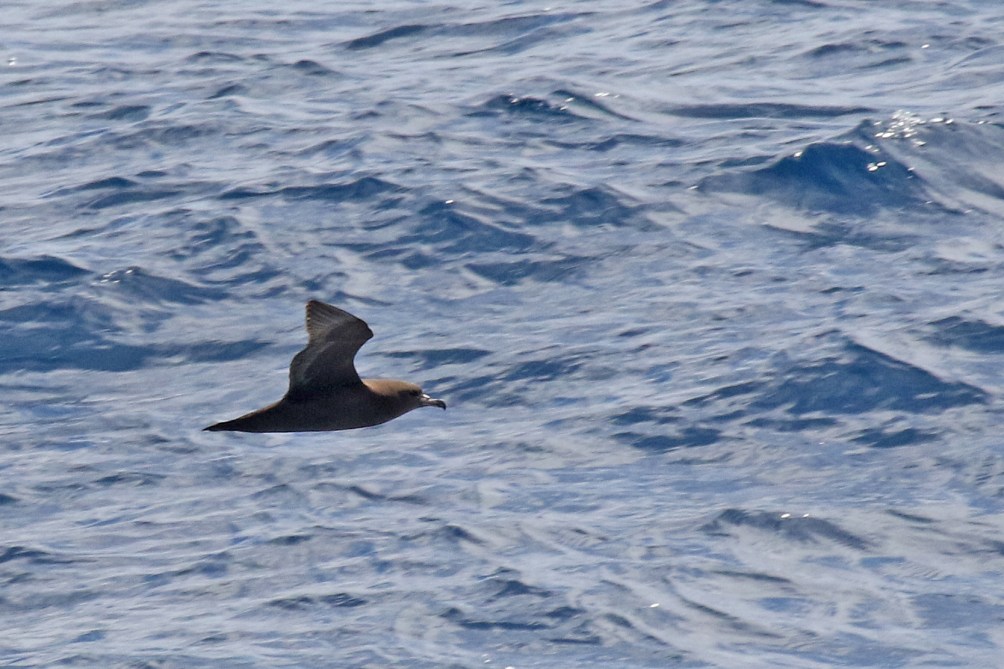
They exist in two morphs, the dark morph is seen in mainly in the south-west Pacific, the light morph in the north-west Pacific and the Indian Ocean.

Other species seen included Black-winged Petrel, a Pterodroma with a wide distribution in the SW pacific …
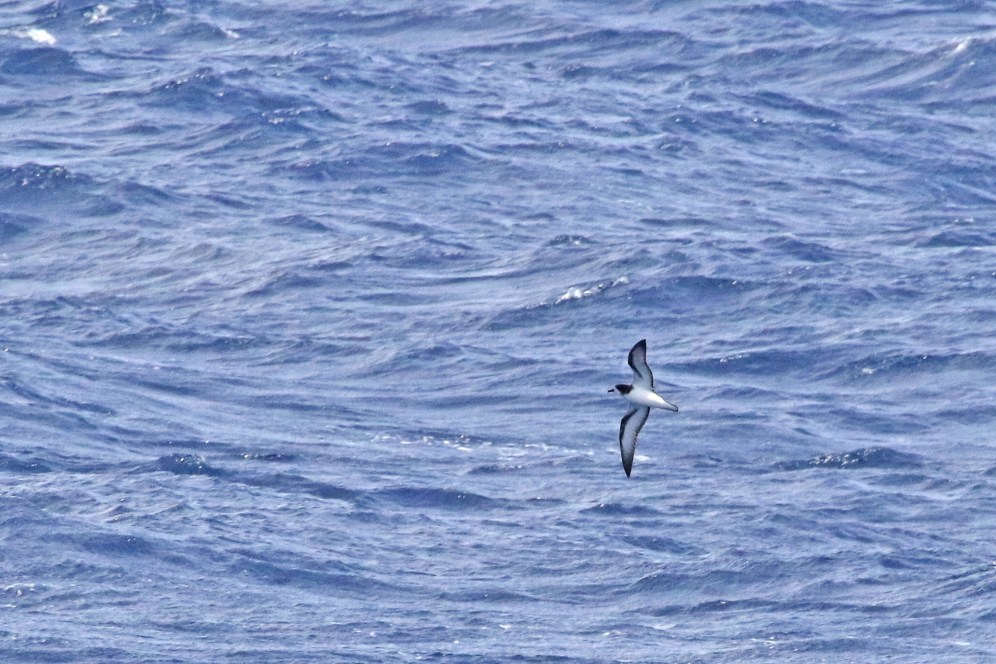
… and Gould’s Petrel which breeds on an island just off the Australia east coast and on New Caledonia.

Yet another Pterodroma was Kermadec Petrel which has a wide breeding range across the islands of the southern Pacific. It also has a number of morphs, appearing in light, dark and intermediate forms.
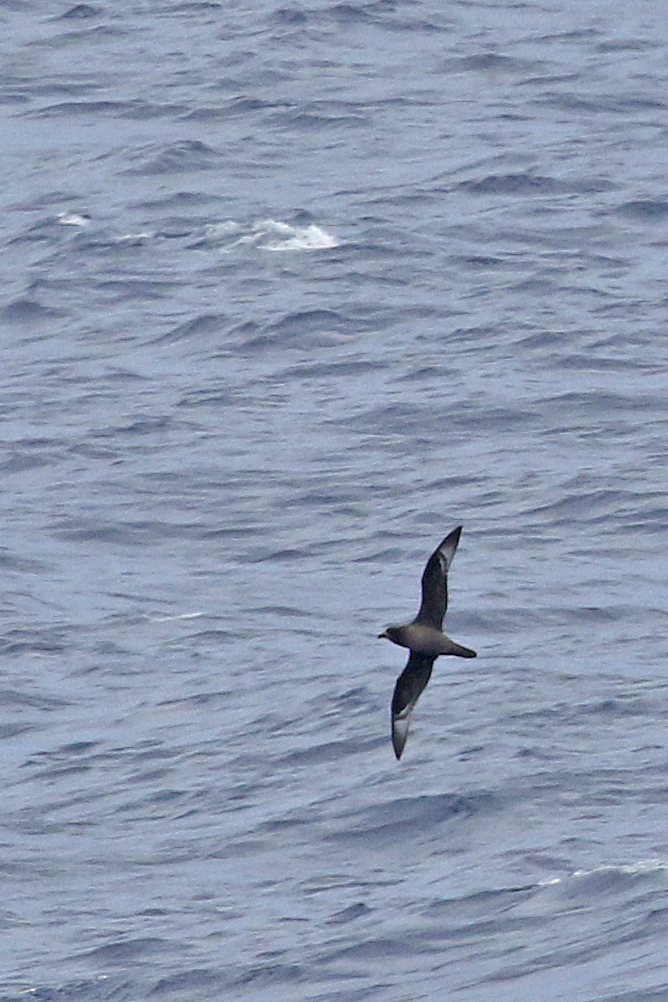
This bird however, photographed a bit further north, is the very similar Providence Petrel. It has shorter wings and the uppersides don’t show the skua like flash at the base of the primaries. This bird was so named because the once huge colony of Norfolk Island was harvested by settlers/convicts during a famine in 1790 and was dubbed the ‘bird of providence’. However introduced rodents and pigs soon wiped the colony out and it breeds mainly on Lord Howe Island today.

We also saw the impressive Tahiti Petrel, in the genus Pseudobulweria it has a less arcing, acrobatic flight than the Pterodromas

Although I’ve blown quite a few photos up to show detail, this was the sort of distance that most birds were seen and photographed from. This flock contains White Terns, Black Noddies and presumed Providence Petrels.
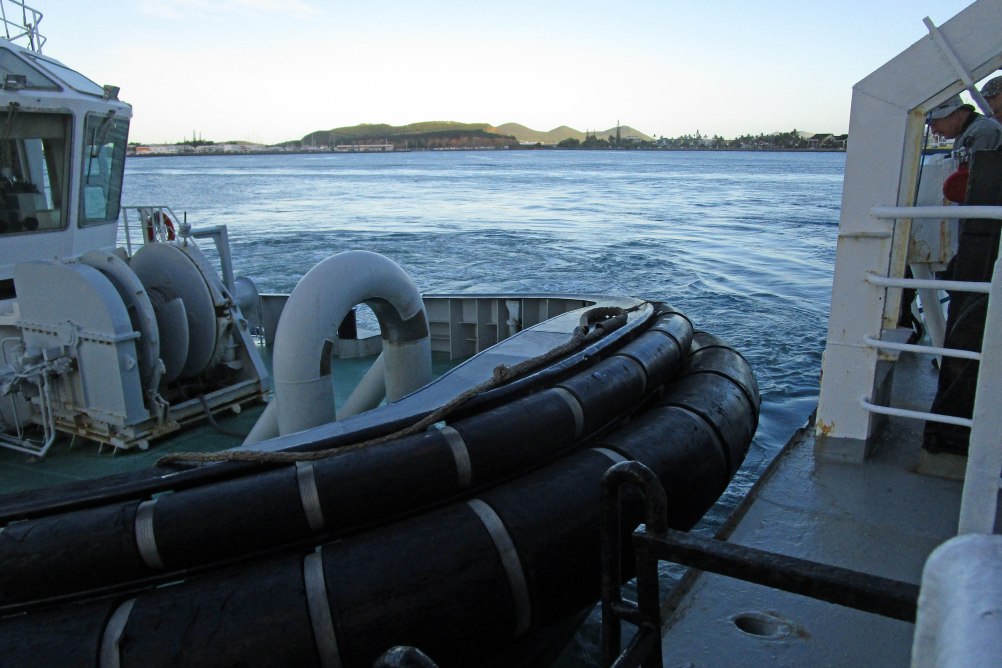
On the morning of 21st March we docked at Nouméa, the capital of New Caledonia. We arrived at about 0630 and after a tug had pushed us into place docked and were able for the only time on the cruise (away from Tauranga and Yokohama) disembark by the gangway. Our day and half on New Caledonia will be the subject of the next post.

During the cruise we experienced a number of superb skies and cloud formations, so rather than the dingy Nouméa docks, I’ll conclude with a lovely sunset.
The West Pacific Odyssey (often abbreviated to WPO) is a classic birding journey. Just like its ‘sister voyage’ the Atlantic Odyssey, this comes about every (northern) spring as Heritage Expedition vessel Professor Khromov (aka Spirit of Enderby) is relocated from the Antarctic at the end of the southern summer to the Arctic for the start of the northern summer.
This gives birders and other interested travellers a chance to see the diverse seabirds of the western Pacific as well as a number of seldom-visited islands on-route.
Due to earlier problems in visiting sites in Japanese waters this trip had been truncated to the South-west Pacific Odyssey but these issues were resolved and the full trip was offered for 2018. However there were ‘operational problems’ (timing of the annual refit etc) which prevented the trip from going ahead and it was deferred to 2019 – and fortunately those who transferred, kept the 2018 price.
This the first of a number of posts about the voyage, I don’t know at this stage how many there will be, but there will be a mix of pelagic seabirds and cetaceans along with photos taken on land. Not all of the planned landings took place, this was the only downside to an otherwise excellent trip.
Most of the photos are mine, the few that aren’t or were taken from another pelagic trip are cleared marked.
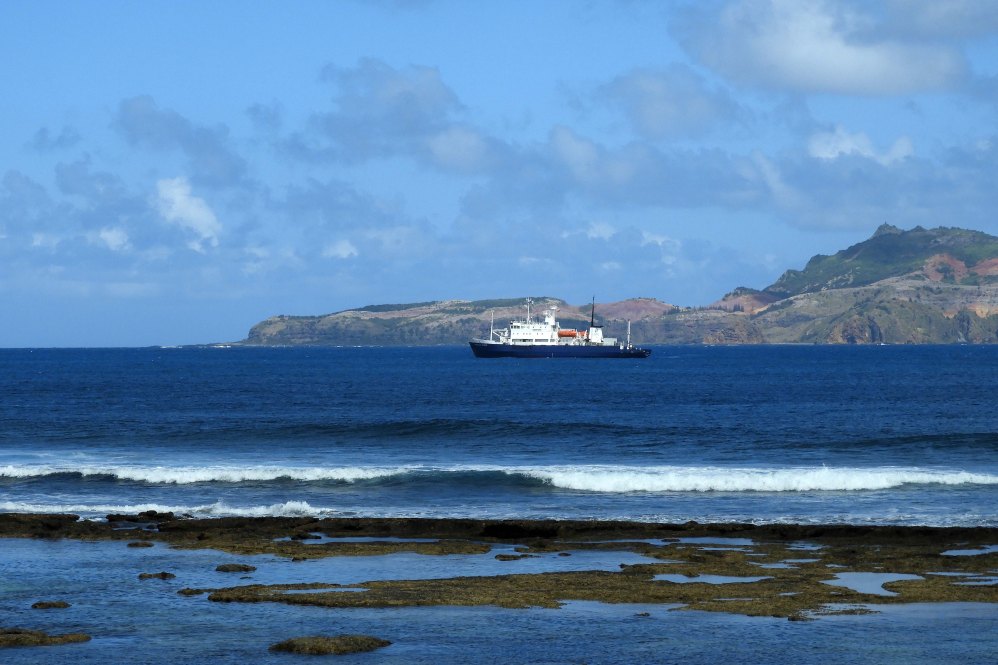
We travelled on the Professor Khromov, which the New Zealand company Heritage Expeditions likes to call ‘The Spirit of Enderby’. I’ve been on two other expeditions in this vessel; to the Subantarctic Islands of New Zealand in 2004 and to Russia’s Kuril and Commander Islands, Kamchatka and Sakhalin in 2017. I’ve also been to the Falklands, South Georgia and Antarctica on the sister ship Akademik Shuleykin in 1998. There were nine ships of this class built in the 80s as Russian ‘research’ vessels (a euphemism for American submarine detection) and were ice strengthened and had the capacity to remain at sea without re-provisioning for extended periods of time. As soon as they were in service the Cold War was over and many were converted for ‘adventure tourism’ in high latitudes. They have given good service but are now looking rather dated. The electronics on the bridge and communication room looks 1940s vintage but they are tough and can withstand anything the polar seas can throw at them. The Professor Khromov is seen here moored off Norfolk Island.

The cruise from Tauranga in New Zealand to Yokohama in Japan took 31 days, add to that three days to get there and one to get back and I was away from home for almost five weeks. We disembarked at Norfolk Island, New Caledonia, four places in the Solomon Islands and Chuuk in Micronesia. Unfortunately due to mixture of bad weather and official intransigence we made no landfalls in Japan except at Yokohama. The cruise covered 5650 nautical miles (10500km), we collectively saw 248 bird species including 48 ‘tubenoses’ and 21 species of cetacean. We visited eleven islands in six countries.
I left home on the 12th March 2019 and took a flight from Heathrow to Hong Kong. With the time difference it was mid morning on the 14th before I landed at Auckland in New Zealand. After two very long flights I was glad to get off the plane. My friend Steve, who had gone to NZ a few days earlier to attempt to see a Kiwi met me at Auckland airport. I’m glad he was driving as I was far too tired to be behind the wheel.
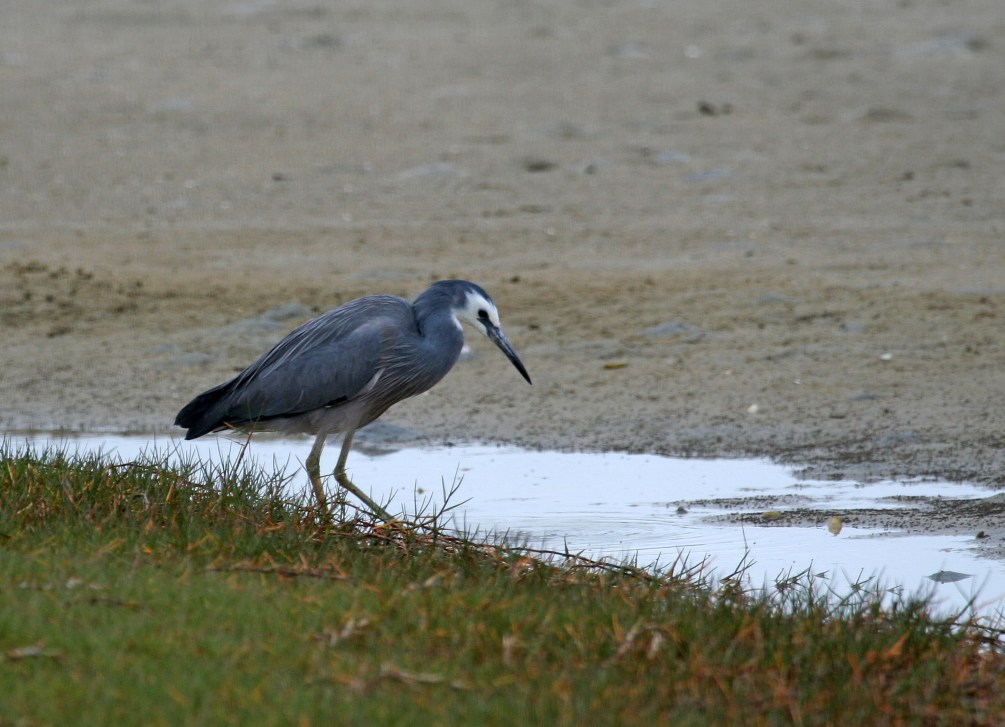
We stopped at the wader spot spot of Miranda. The waders were some distance away as the tide had dropped but we were able to identify Wrybills and Double-banded Plovers among the many Bar-tailed Godwits. More approachable birds included this White-faced Heron …
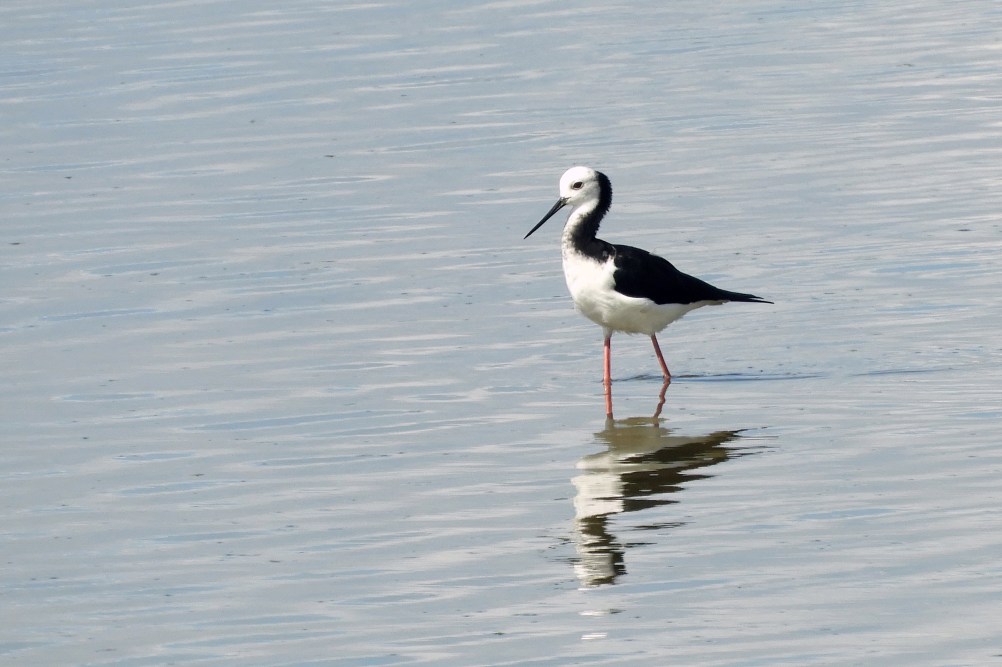
… and the inevitable Pied Stilts …

… and Grey Teal.
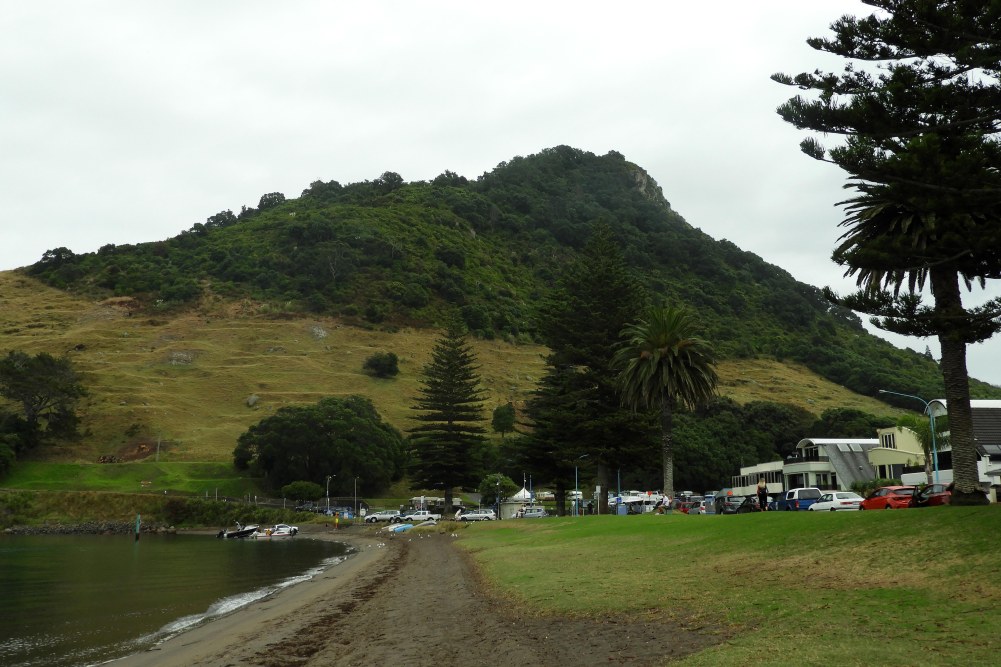
We stayed overnight in Tauranga …
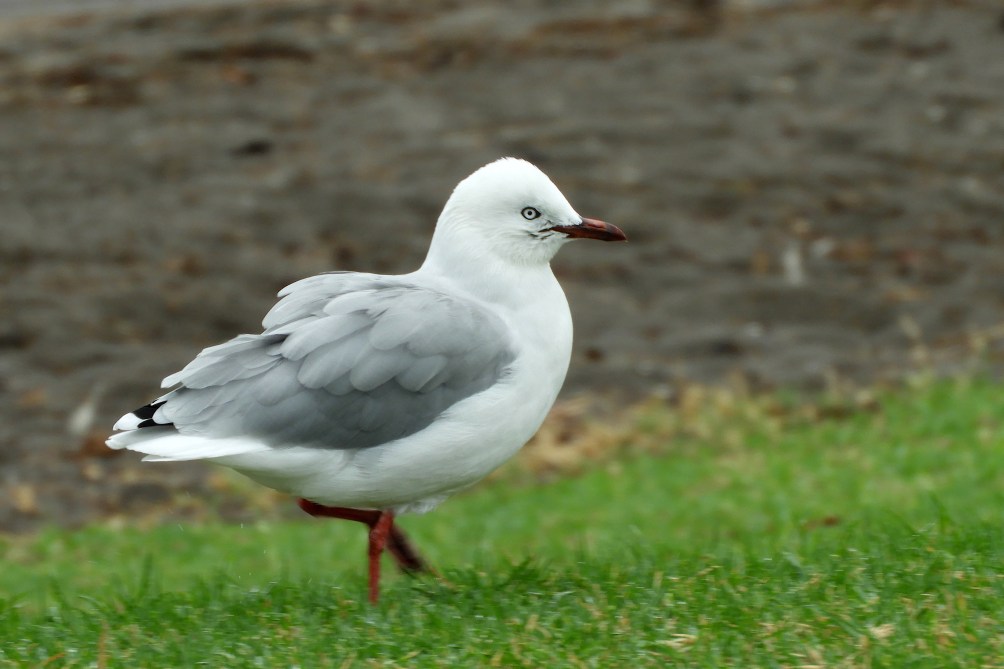
… where we saw a few more birds like Silver Gull (formerly split as Red-billed Gull but now lumped with the Australian species) …

… the introduced Black Swan …

… and the only endemic New Zealand passerine I was to see on the tour – the Tui (one of four extant bird species that have the honour of having the shortest English name of all – I’ll let you puzzle over the other three).
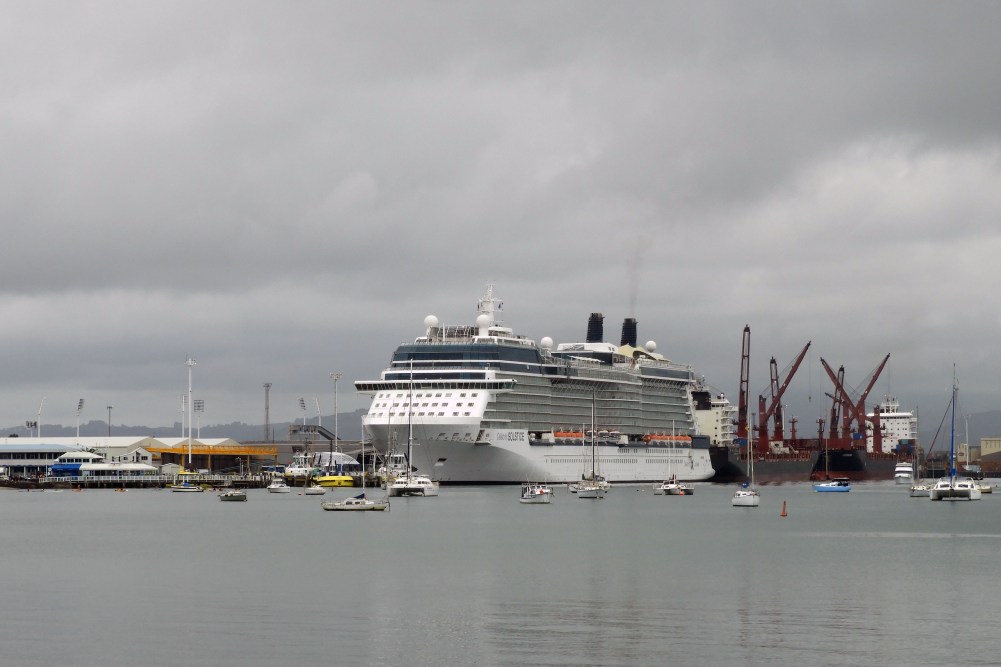
The clients met up at a hotel, there were 48 of us. At least a dozen I knew from UK birding or previous foreign trips. There was time to wander around before the bus came to take us to the docks. People in the shops kept asking if we were from the big cruise liner that was already docked. Certainly not – our ship was much, much smaller.
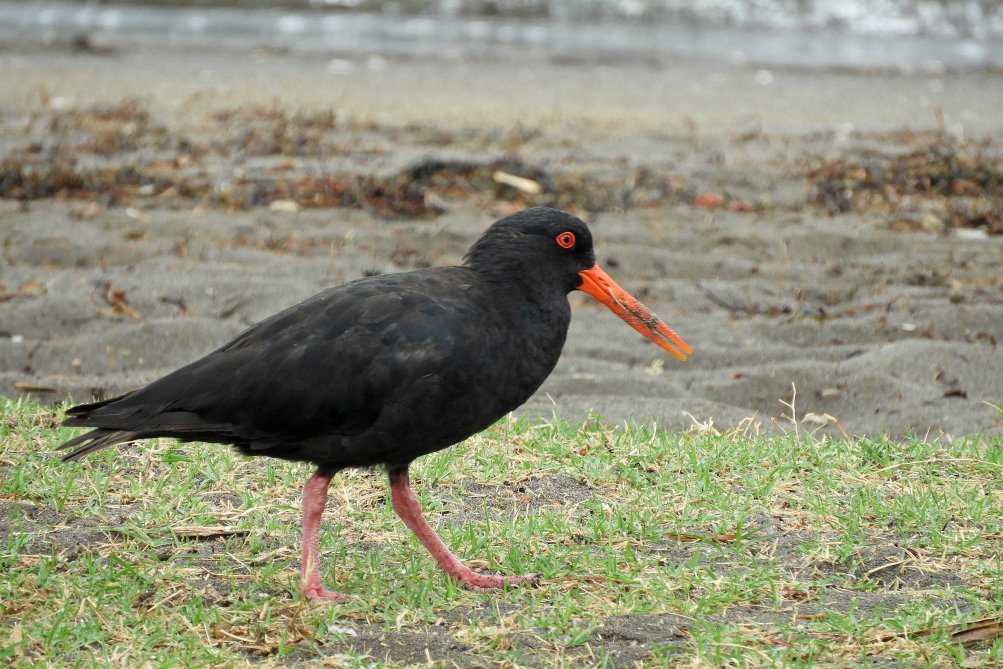
Along the shore at Tauranga there were good numbers of Variable Oystercatchers …

… and a bird that is very widespread in the Southern Hemisphere – Kelp Gull. This is an adult …
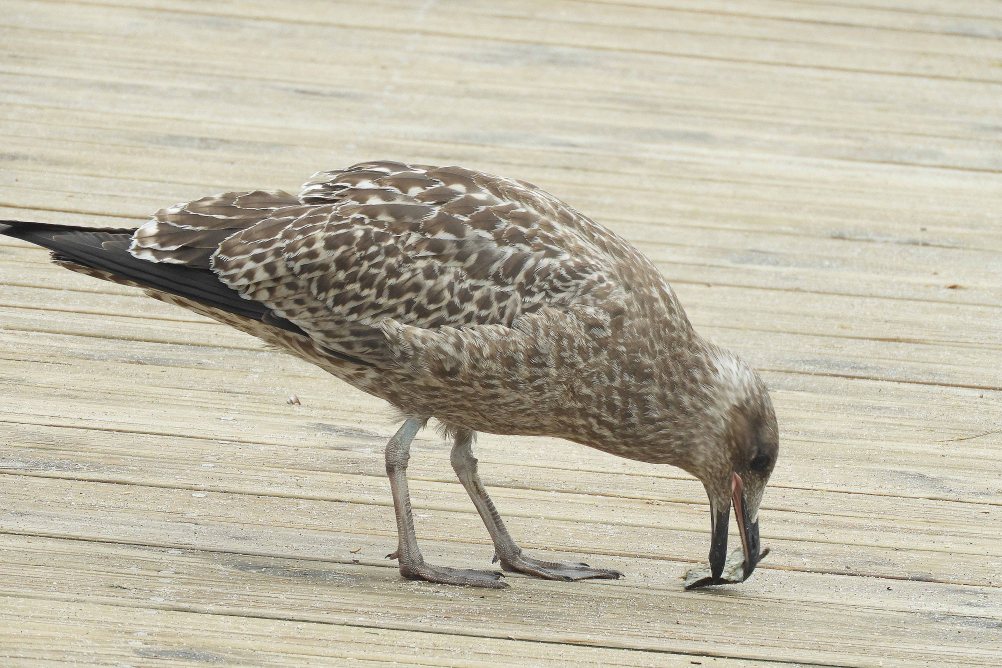
… and this is a first year bird.

In the late afternoon with the cabins all allocated, luggage stowed, customs cleared etc we cast off and the voyage began. Our starting location was 37 39’S 176 01’E.

We made our way out of Tauranga bay and into the open ocean …

… we passes a number of islands to port as we headed north. The rest of the day was taken up with introductions, orientation lectures and the inevitable lifeboat drill.
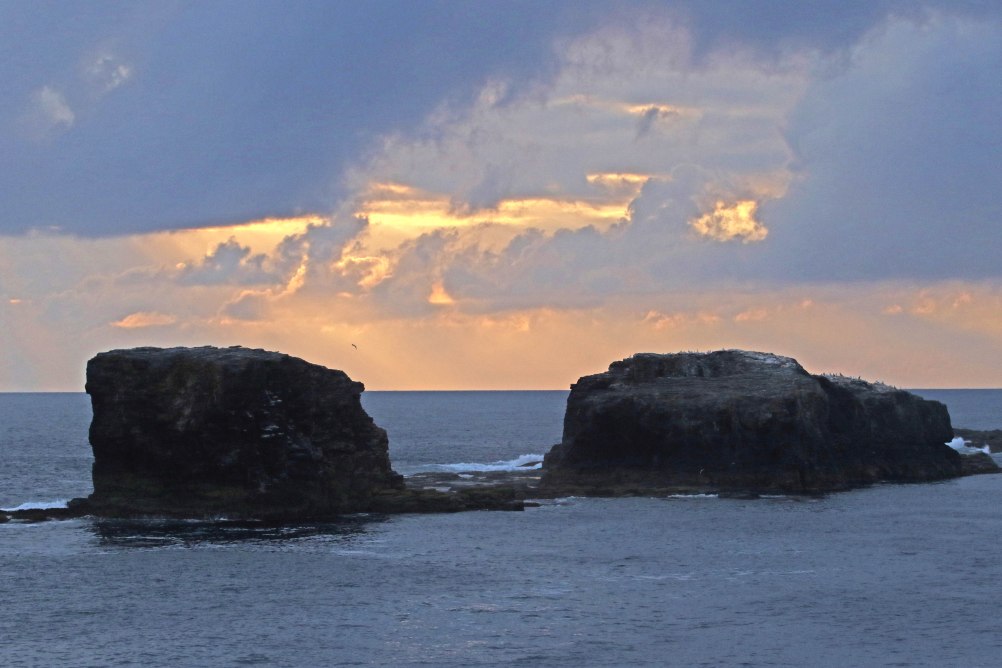
We woke the next day at the northern end of the Hauraki Gulf. We approached the Mokohinau Islands …

… the site of a Australasian Gannet colony.

Australasian Gannet breeds, as the name suggests, in New Zealand and Australia and is very similar to our Northern Gannet except for having black in the secondaries and a long black gular stripe. We saw several hundred today, a single one the next day, then none.

We came across this dense flock of Silver Gulls feeding on what was presumably a huge bait ball. A few Buller’s Shearwaters (Top right) joined the flock …

… also seen were a number of the small Fluttering Shearwaters and a couple of the tiny Grey Ternlets (or Grey Noddy).

Grey Ternlet was the first life bird of the trip for me!

In 2009 I did a comprehensive birding tour of New Zealand which included a pelagic trip into the Haukaki Gulf. We did well, but missed one species, the Black (or Parkinson’s) Petrel. There were no such problems here as we were to see around 30 today and similar numbers the next day.

The northern most tip of New Zealand is a group of islands known as the Three Kings. We were 13 miles off there at dawn at 33 57’S 172 24’E and approached closer during the morning, sea birding was superb but our number one target was storm-petrels.
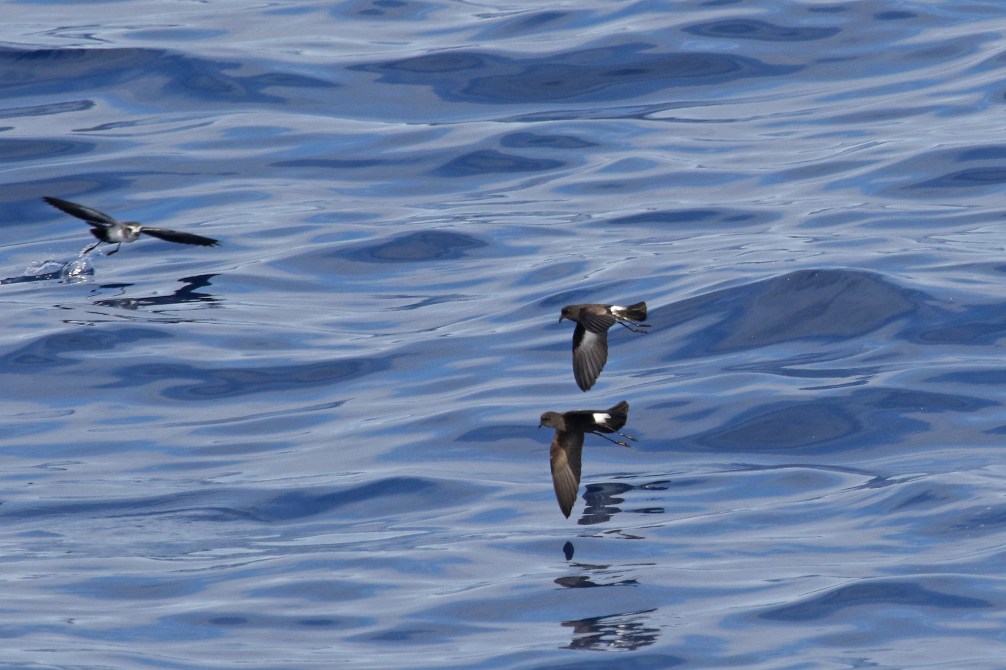
In this one photo there are three species of storm-petrel, White-faced on the left, Wilson’s lower centre and above it the enigmatic New Zealand Storm-petrel.
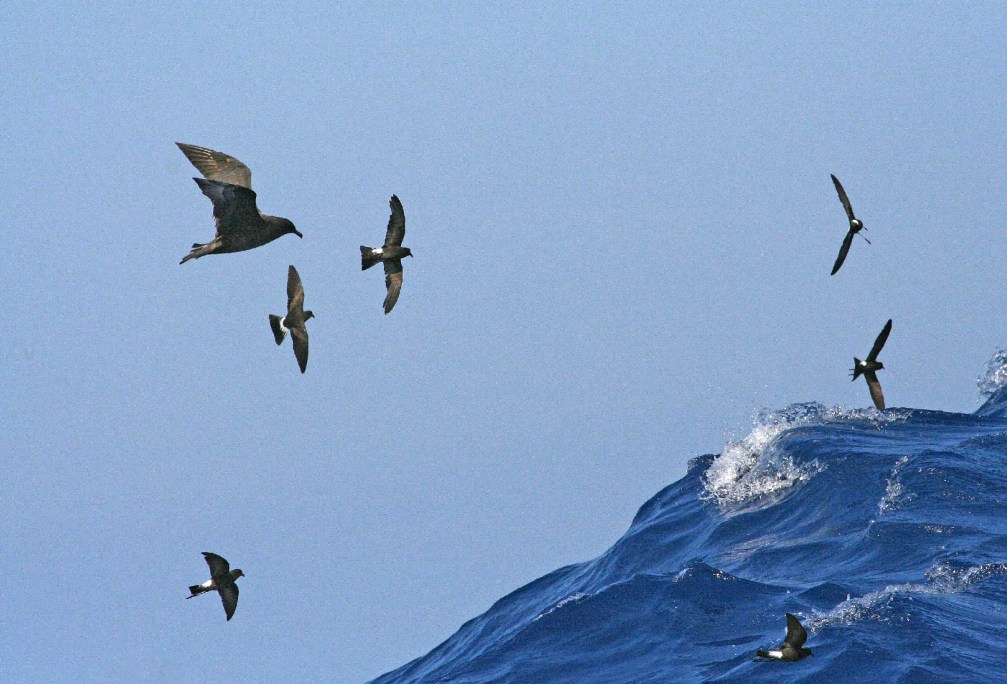
This photo wasn’t taken on the trip but from a small boat off the coast of North Carolina but it shows a number of birds we saw on the WPO. The large bird is an Arctic Skua (or Parasitic Jaeger) a bird that breeds in the arctic and subarctic (as far south as northern Scotland) and winters as far south as NZ. The two storm-petrels close to it are, as far as I can tell, Band-rumped. This complex probably consists of multiple species. We were only to see a few on the WPO and all were to the north of here and included one of a larger form that could be as yet undescribed. The lower left bird and the three on the right are Wilson’s Storm-petrels, the most numerous seabird and one of the most numerous of all birds in the world. Breeding in the Antarctic they are found in most oceans of the world at some time of the year. I saw a number off the Three Kings and others saw the odd one further north. Bizarrely it has been shown that the so called ‘northern storm-petrels’ are not closely related to ‘southern storm-petrels and they are found before and after the albatrosses in world bird lists. So the top two stormies on the left are not even in the same family as the top two on the right!

But the stormy we all wanted to see was the New Zealand Storm-petrel. This bird has a most interesting history. First collected in 1827, it was later claimed, without any justification, that Wilson’s Storm-petrels have paler streakier bellies the nearer they bred to the equator. So after this it was forgotten about and lost to history until it was rediscovered by a group of British and New Zealand birders in 2003 and given back its rightful specific status. It is likely that it persisted in tiny numbers all those years, breeding on a rat-infested island in the Hauraki Gulf. When the rats were removed, as they have been from many of these islands, the population started to bounce back. On my pelagic in 2009 I saw just one, here we saw 25 …
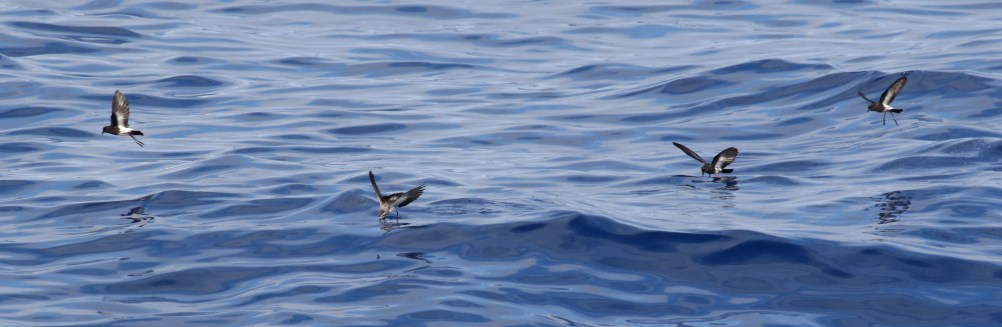
… including three together along with a White-faced Storm-petrel.
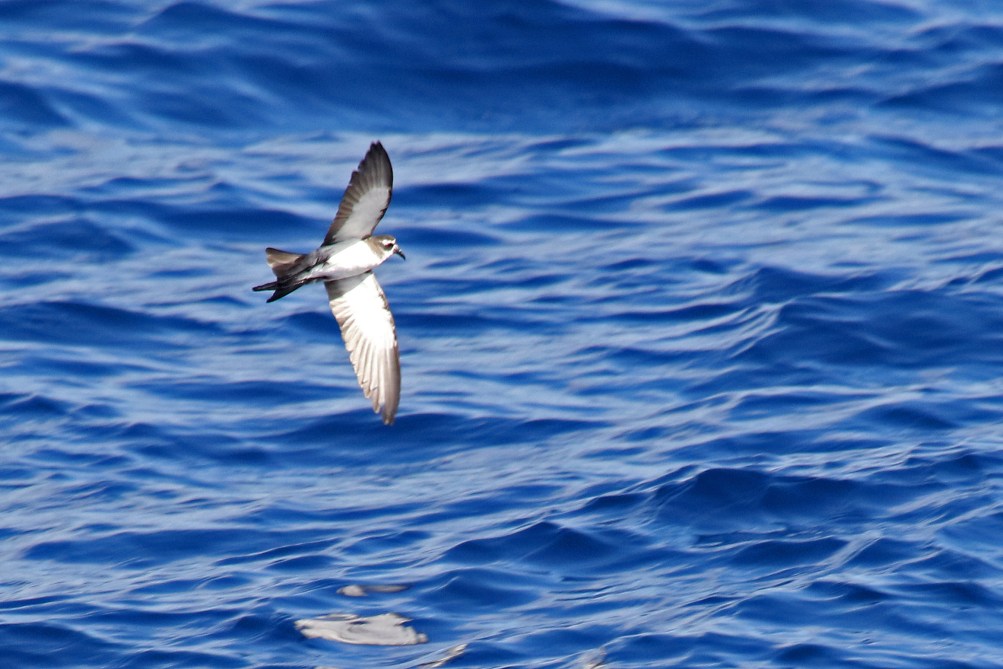
White-faced Storm-petrel breeds in the North Atlantic, South Atlantic, off South Australia, around Kermadec Islands and New Zealand and according to the book ‘Oceanic Birds of the World’ by Steve Howell et al they could comprise between 4 and 6 different species!
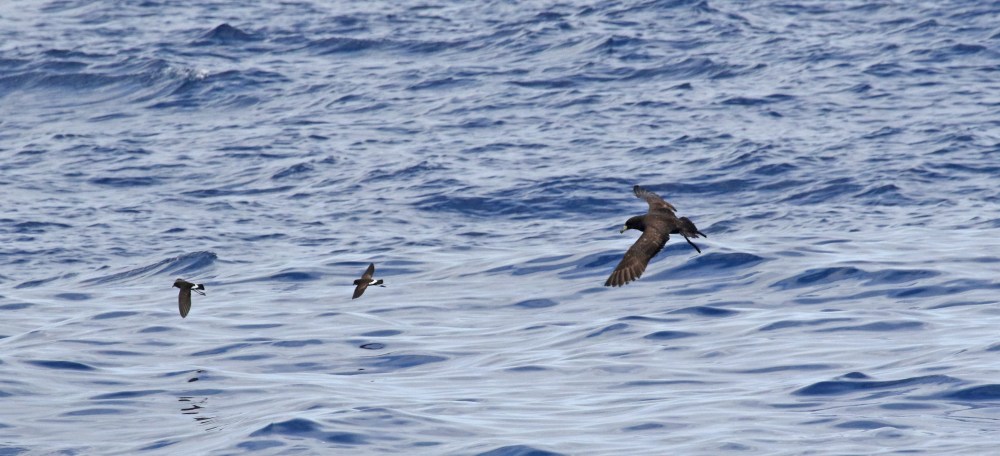
Here L-R is a Wilson’s Stormie, a New Zealand Stormie and a Black Petrel.
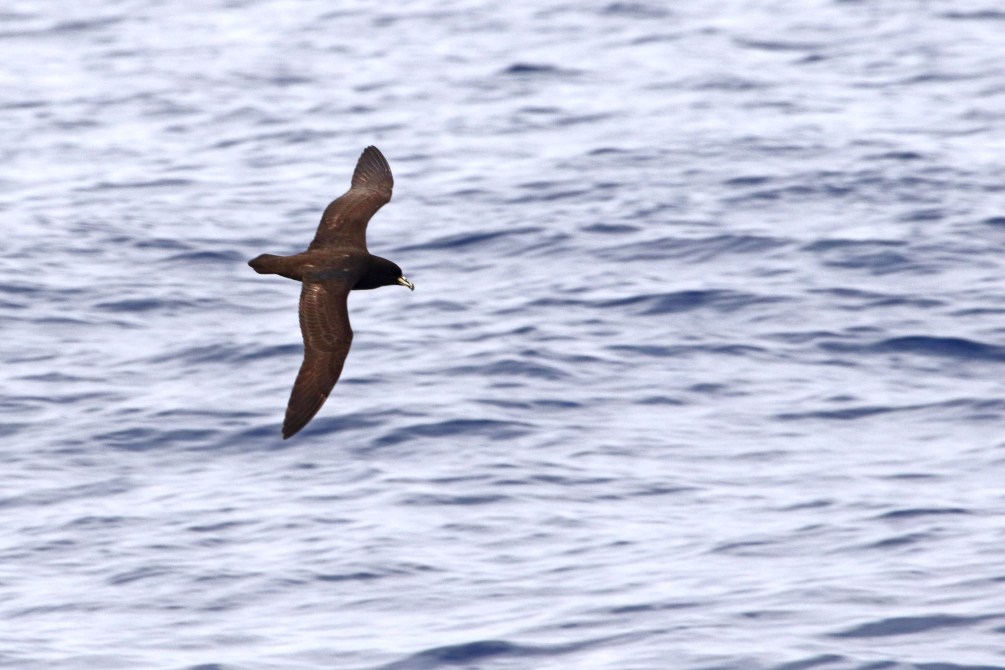
Black Petrels were seen regularly in these waters, like NZ Stormie they only breed around the Hauraki Gulf and have been heavily impacted by introduced rats and cats. With these aliens being slowly removed their numbers are increasing from being close to extinction to perhaps 10,000 birds today. On upper mandible, close to the base, you can see the salt excreting tubes that give tubenoses (members of the Order Procelliformes) their name.
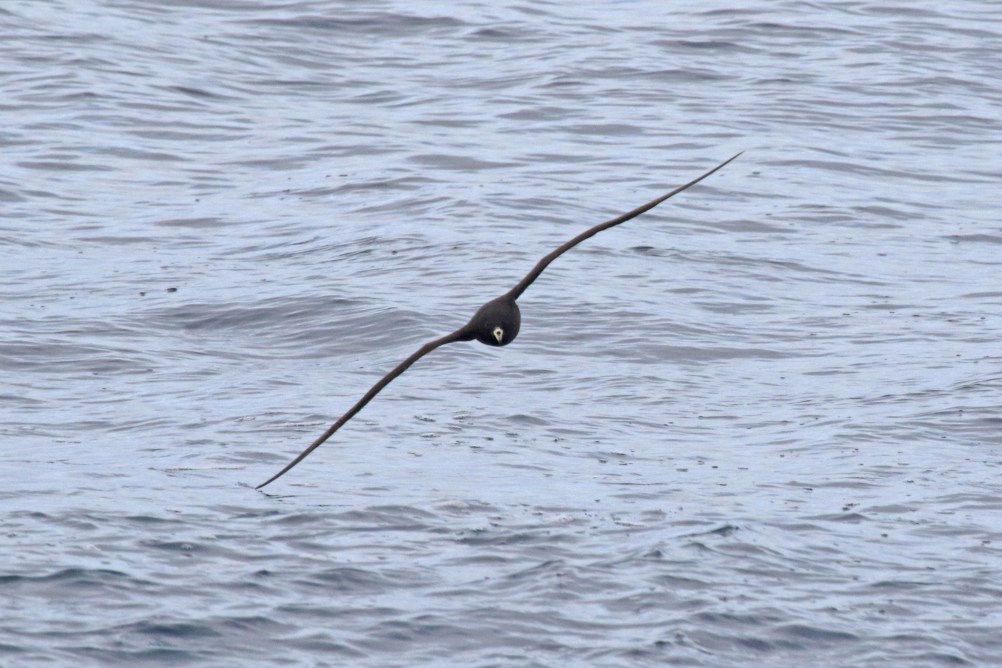
Black Petrels are in the genus Procellaria (along with White-chinned, which has recently occurred in the UK and two other species). They have a very different jizz and flight action to the Pterodroma petrels and certainly are an impressive sight, especially when seen head on.
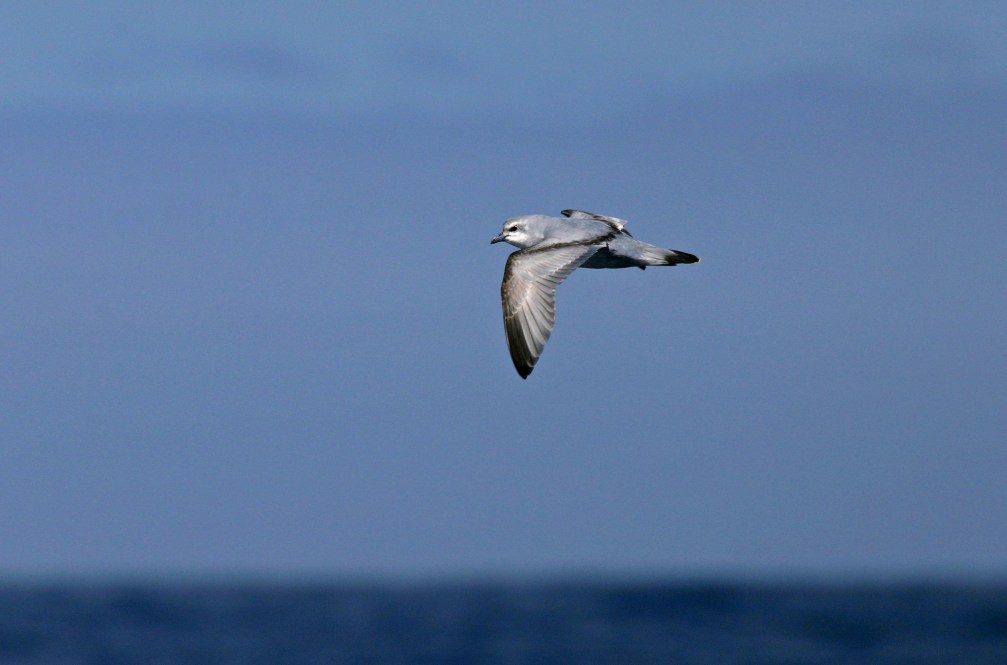
Another species that we only saw in the southern leg of the trip was this Fairy Prion. Prions are a group of six fast moving and hard to separate tubenoses that occur mainly in subantarctic/antarctic water. This Fairy Prion was photographed by Pete Morris on the Subantarctic Islands of New Zealand cruise in 2004.
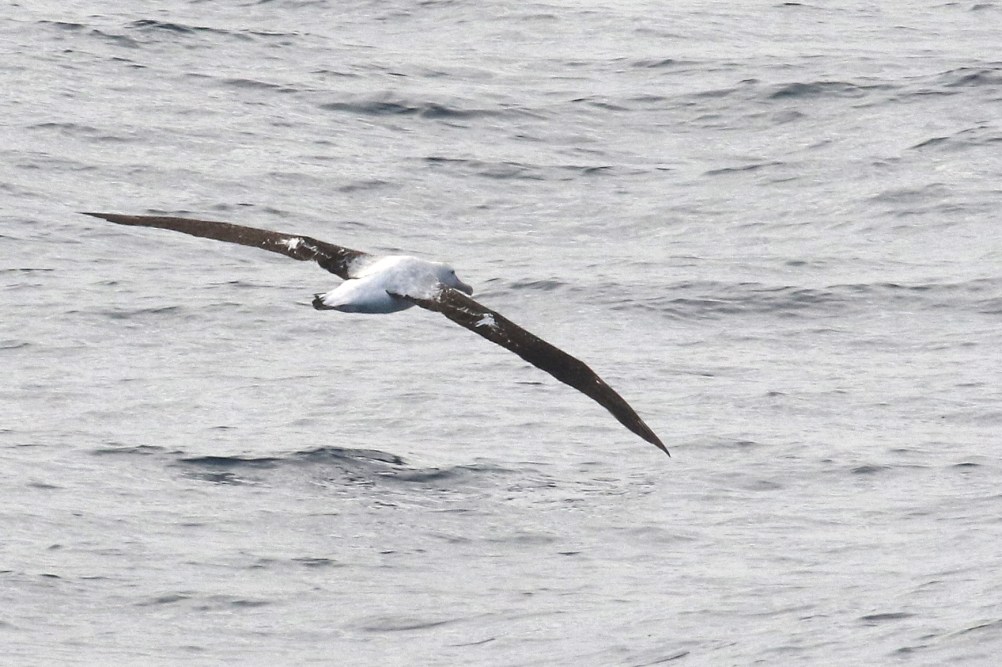
The waters around New Zealand are probably the best in the world for albatrosses, however we saw few on this trip. Most move to the south to feed and this year the water was particularly warm so wouldn’t have been suitable for these subantarctic birds. This is a Antipodean Albatross, a split from Wandering Albatross, of the race gibsoni which breeds on islands to the south of NZ.
Another albatross seen was this Northern Royal Albatross, which breeds in the Chatham Islands and at Dunedin in South Island of NZ. The solid black wings (with some specking as in here on older males), lack of black tip to the tail and a fine black cutting edge to the bill distinguishes it from the ‘wandering’ group. Photo taken by Pete Morris on the Subantarctic Islands of New Zealand cruise in 2004.
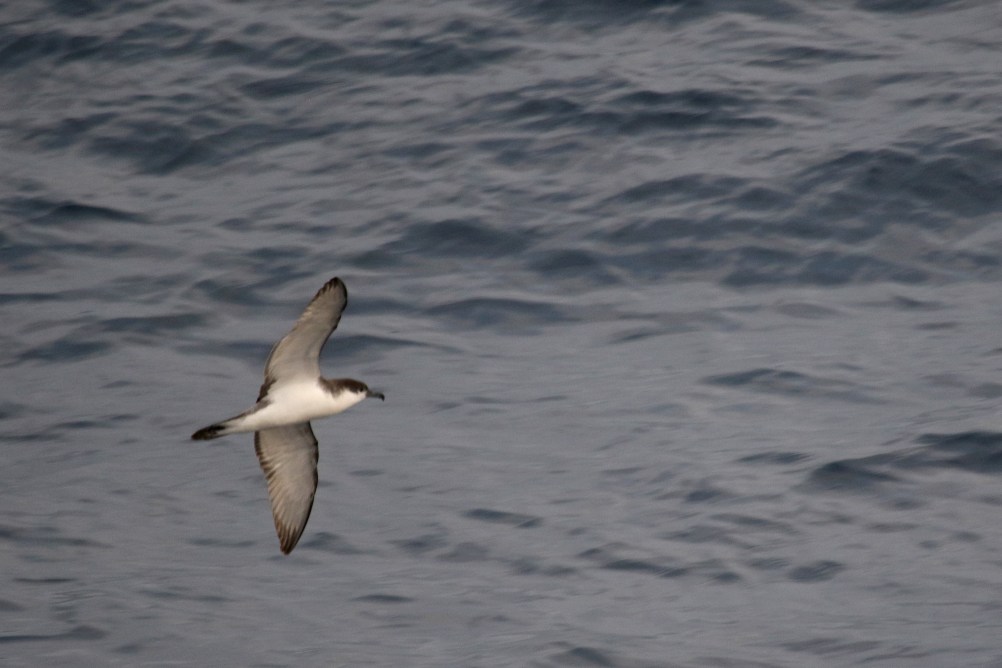
Of the several species of shearwater, Bullwer’s was the most numerous …
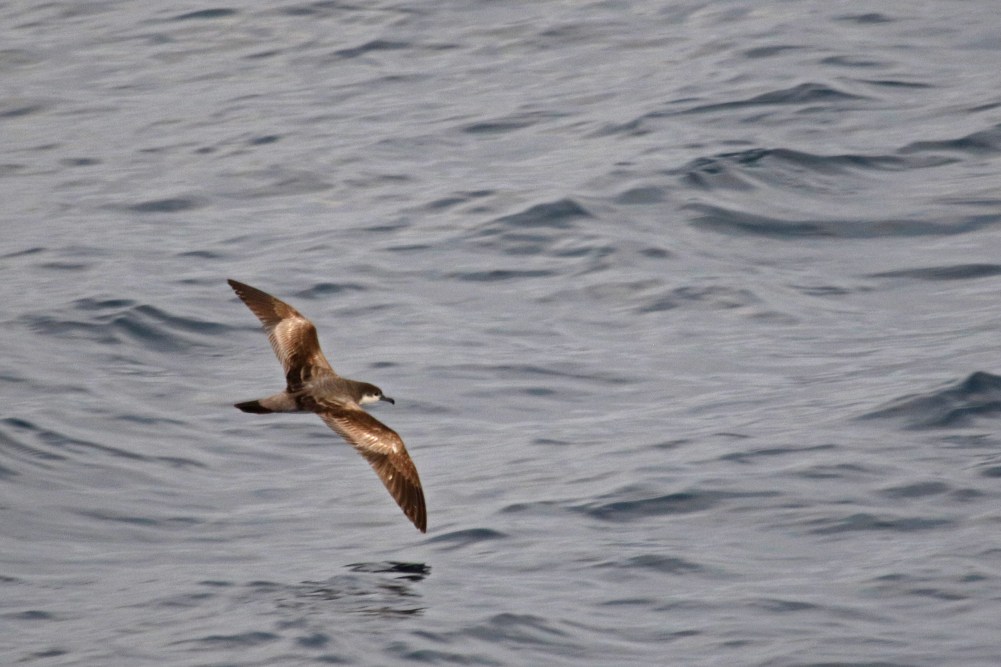
… easily identified by its striking upperwing pattern, these birds wander as far as California in the non-breeding season.

Two petrels in the genus Pterodroma – Cook’s Petrel …
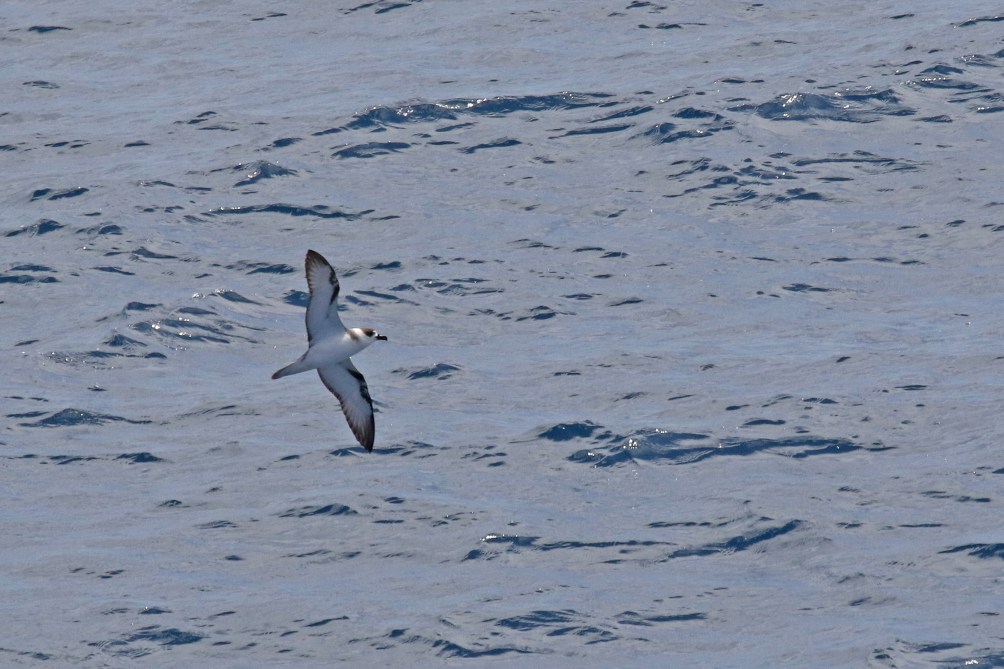
… and White-necked Petrel. With their fast, high arcing flight and elegant appearance Pterodroma petrels are among the most sought after of all seabirds.
There were a number of other excellent sightings none of which I got photos of; the first was ‘Magnificent Petrel’ currently described as a race of Cook’s Petrel but probably deserving species status in it’s own right, see here for an account of its recent discovery, Grey-faced Petrel (the first time I’ve seen it since the split from Great-winged), the local form of Little Shearwater (which like most of the Little Shearwater complex is probably a species in its own right), the rarely observed Pycroft’s Petrel, Kermadec Petrel which we’ll see in the next post …

… and what appeared to be the incredibly rare Fiji Petrel. I was slow getting on to this bird when it was first found and struggled to pick it up. The situation was made worse as ace Japanese seawatcher Hero Tanoi called ‘it’s got a black body’ unfortunately in the commotion all I heard was ‘it’s a Black Noddy’ which isn’t rare at all! Fortunately the ship was turned round, a chum slick was laid and the bird was encountered again. The known breeding population near Fiji is only about 50 pairs but as there have been other sightings in the Western Pacific it may be that there is an undiscovered population there, alternatively these birds may be a different species. This photo of an undoubted Fiji Petrel is by Dr. Jorg Kretzschmar/NatureFiji-Mareqeti Viti Fiji.

I haven’t mentioned cetaceans yet, we certainly saw a good variety throughout the trip. Here a number of Long-finned Pilot Whales are seen with Bottle-nosed Dolphins. The photo looks a little confusing. On the left a Pilot Whale is spy-hopping showing the characteristic mark on the throat, a smaller individual has risen out of the water beside it, whilst a dolphin swims in front and another dolphin is seen just left of centre.. Further back two more Pilot Whales swim towards the camera
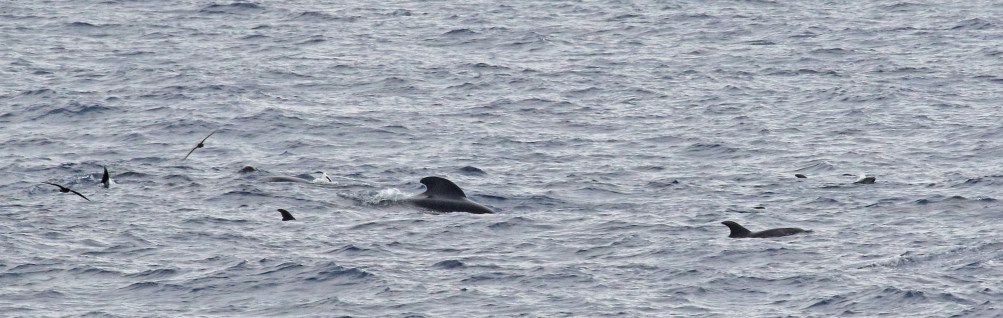
The characteristic dorsal fin of an adult Pilot whale can be seen, the other fin belong to dolphins. The birds are Black Petrels.
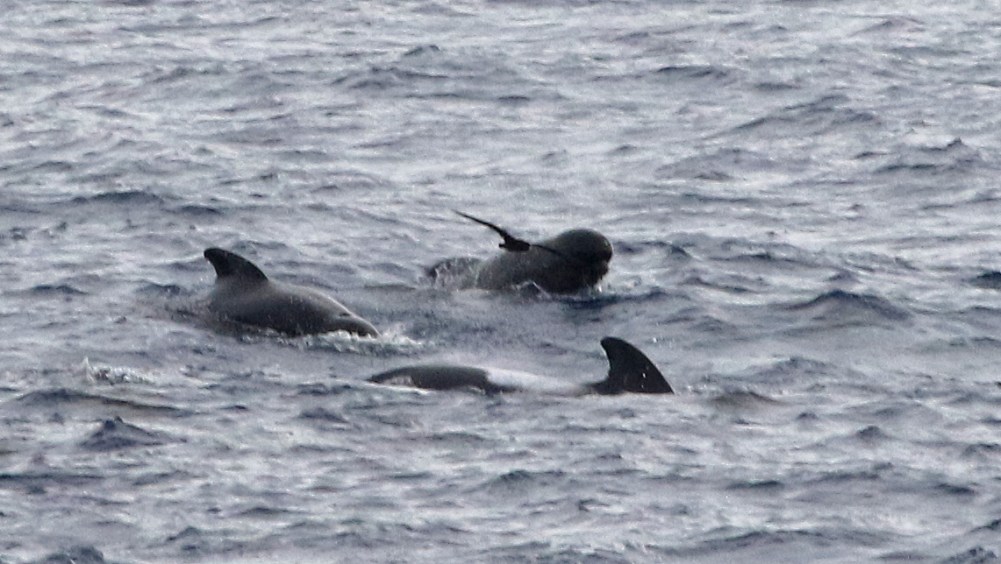
The bulbous head of a Pilot Whale and the white patch on the back of an adult male can be seen in this photo, with a Black Petrel for company of course.
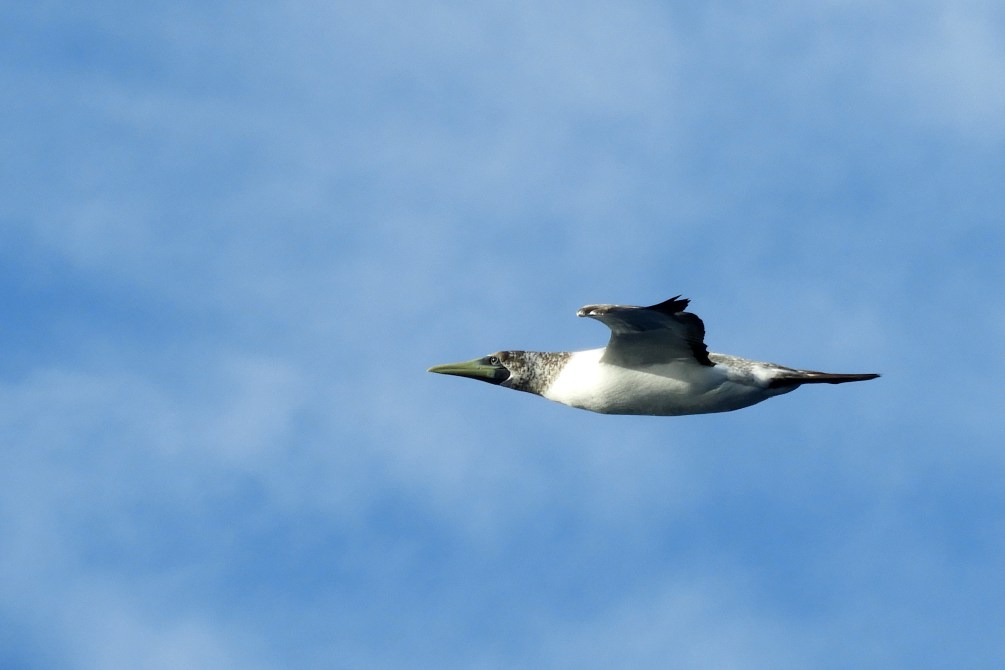
One further seabird is worth mentioning in these southern waters the ‘Tasman Booby’ a race of Masked Booby that breeds on Lord Howe, Norfolk Island and the Kermadecs. Unlike the other races of Masked Booby it has a dark eye.
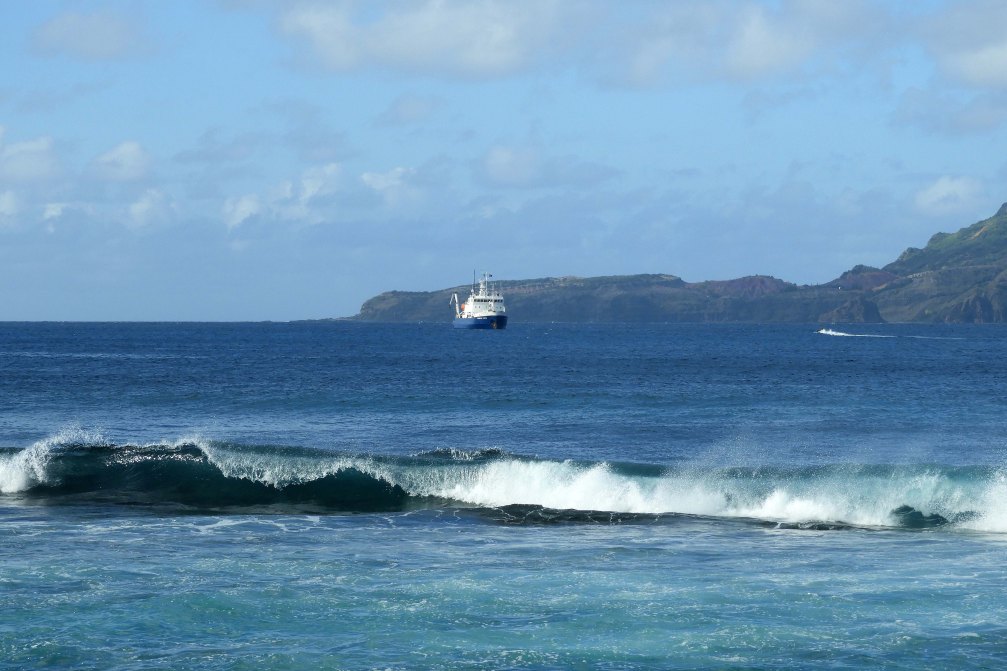
This must have been the most seabird rich section of the entire trip, certainly so for the Southern Hemisphere. On the morning of the third day we anchored off the Australian administered Norfolk Island (at 29 04’N 167 57’E) which will be the subject of the next post.
For this 4th and final part of the trip I’ve uploaded photos from the Barig Mountains (near to the Khangai range, Hustai NationalPark, the Khentii Mountains and Ulaanbaatar.

A very roughly drawn map of our route. With few roads to follow the lines on the map are only approximate. Post 1 covered from Ulaanbaatar (UB) to the Khentii Mountains, back to UB and south as far as the red dot. Post 2 covered the journey south and then west as far as the next red dot. Post 3 covered the Altai and Bodj Mountains, the intervening lowlands and the Khangai Mountains by the next red dot. This final post covers the nearby Barig Mountains, Sangiin Dalai Nuur, Hustai NP due west of UB and a return visit to the Khentii Mountains.
As I wrote in my last post we managed to see our target Asian Rosy Finch at White Rocks Pass (in this photo) quite quickly so with some time on our hands we headed to the nearby Barig range in the hope we might find the rare White-throiated (or Hodgson’s) Bush Chat.

We arrived in the early evening and set up camp in this valley. A couple of sheepdogs from a dwelling about a mile away came over. They were no trouble and hung about for the evening. All was quiet during the night until the early hours when the dogs went ballistic. We think a Wolf may have passed nearby.
Surprisingly the minibuses just drove up the mountain, it was incredible how they manged to get over the rocks. It was a bit like driving to the top of Cairngorm from the ski lift car park. Eventually they couldn’t get any further and we hiked the last bit. Unfortunately the weather was turning and we didn’t get the panoramic views we enjoyed at the other mountain ranges.

The habitat was the same as in the Bogd Mountains a few days ago, rounded boulders covered with orange lichen and like the Bogd we found Water Pipits on the rocks but no Bush Chats. They must have been held up on migration from their wintering areas in northern India.
We also had good views of Siberian/Stejneger’s Stonechats. The recent separation of these two species on genetic grounds has been problematic for birders. Subtle differences can be seen in 1st winter or fresh autumn plumages but these are hard to detect in worn breeding plumage. The balance of probability is that these birds south of the boreal zone are Siberian Stonechats whereas the ones we saw in the Khentii were Stejnegers. (copyright János Oláh/Birdquest)
We arrived at Sagiin Dalai Nuur in the later afternoon. The wind was still strong and the terrain, mini sand-dunes like a never ending vista of molehills, was most uncomfortable to drive on.
Flocks of White-winged Terns flew back and forth just above the ground …
… and a number of Steppe Eagles hunted the omnipresent Brandt’s Voles. (copyright János Oláh/Birdquest)
In the evening the sun came out and gave good light for photographing species like Mongolian Lark (copyright János Oláh/Birdquest) …
… or this Asian Short-toed lark. I included this photo in the last post in error. Although we also saw this species at the lakes further south János took this photo at Sangiin Dalai Nuur. More importantly we had our only sighting of the recently split Mongolian Short-toed Lark (split from Greater STL) at this sight but no photos were taken. (copyright János Oláh/Birdquest)

We saw a great range of species here ranging from the graceful Demoiselle Crane to Corsac Fox, Asiatic Dowitcher, Oriental Plover, Red-necked Stint …(copyright János Oláh/Birdquest)

… and the familiar, yet always graceful Pied Avocet. (copyright János Oláh/Birdquest)

It was a difficult night, the wind buffeted the tents and soon it started to rain heavily. The next morning we tried birding in the lee of the mess tent and added Red-throated Diver and Slavonian Grebe to the list.
Taking down and stowing wet tents in a gale wasn’t easy but had to be done.
As we left we came across an enormous herd of domestic horses. This is just a small part of the herd. Although Mongolia only has about a population of 1.5 million away from the capital the livestock numbers reach close to 70 million. Much of the natural pasture is severely overgrazed and as you can see the wind whips the exposed soil away creating this pink tinged sky.

We had quite a way to go but at least we were now on tarmac roads! In the early evening we arrived at Hustai Nation Park, a short distance due west of Ulaanbataar. We were planning to camp just outside the park gates but when we saw there was a ger camp we pleaded with János to allow us to stay there as much of our gear plus the tents were still wet. Fortunately he agreed and gers were available. As you can see the bad weather that we experienced today was just clearing as the sun set.
The weather was fine the next morning when we explored the grassy slopes of Hustai National Park. A remnant of the once extensive natural grasslands that covered this area.
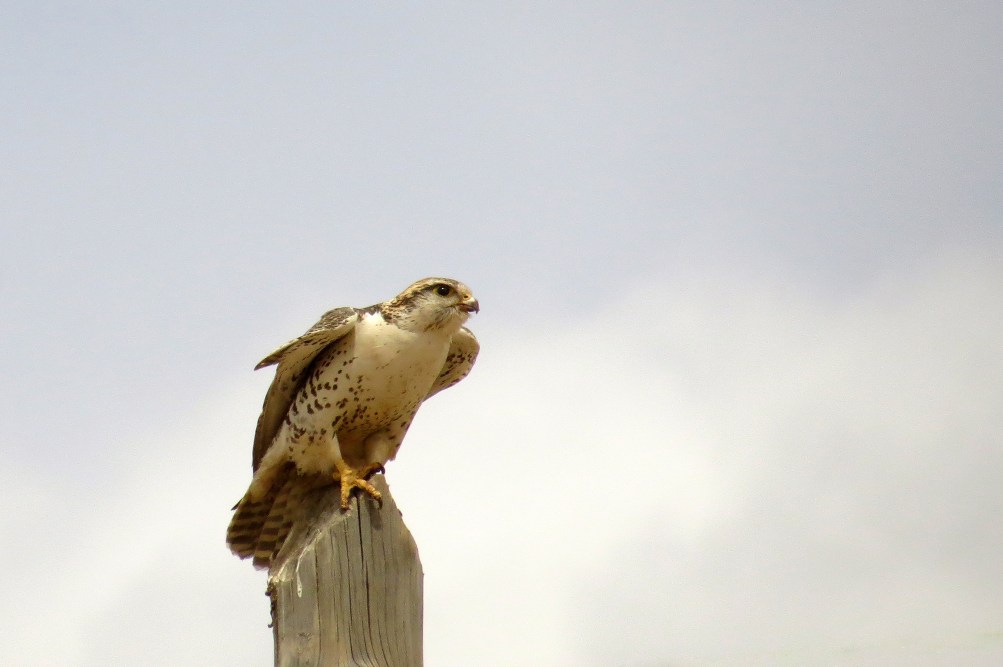
There were several raptors in this area such as this fine Saker …

… impressive Cinereous Vultures (copyright János Oláh/Birdquest)

… and this poorly photographed Golden Eagle.

Passerines like this Meadow Bunting were seen in the bushes (copyright János Oláh/Birdquest)
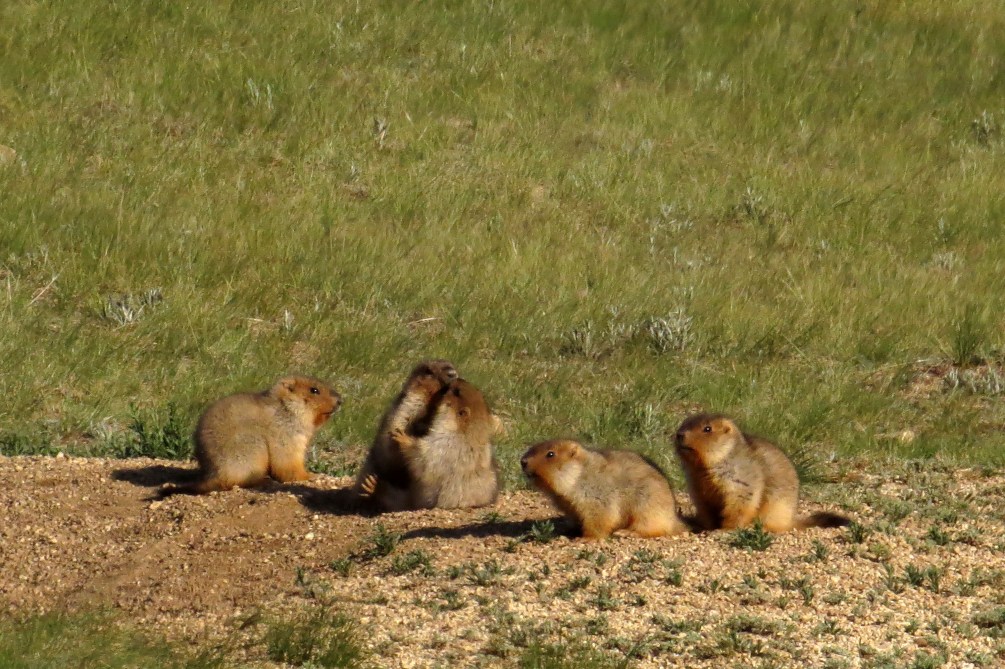
Our (or at least my) main target was mammalian and no it wasn’t these endearing Tarbogan Marmots.

We were looking for the legendary Przewalski’s Horses but these aren’t they! Disappointingly our first sighting turned out to be feral domesticated horses. That was quite troubling because they shouldn’t be in the NP. The possibility of contaminating the gene stock of the Przewalski’s exists and worryingly the left hand individual had a short stiff mane like the wild animals. I’d have any such animals rounded up and released well away from the NP.

I’ve seen plenty of Red Deer in my life but never seen them running past the moon.

A bit further on we found the ‘real McCoy’ Przewalski’s Horses feeding with Red Deer. Why such excitement over a horse. Well, I’ve looking forwards to seeing Mongolia’s birds for a decade or two, I’ve been looking forwards to seeing Przewalski’s since I was about 10!

Przewalski’s Horse is the only true ‘wild horse’ all others such as the mustang of North America or the brumby of Australia are feral domesticated horses. The species became extinct in the wild in the late 60s due to hunting. A number of individuals existed in zoos but after WW2 there were only 9 in captivity. A individual captured from the wild in the 50s was used for breeding and brought in much needed genetic diversity. By the end of the 90s some 1500 individuals existed and after re-introduction programs over 400 now exist in Mongolia with a smaller number in China.

With cave paintings from Palaeolithic Europe of stocky horses with upright manes and muscular cheeks dating back 35,000 years ago or more it is tempting to conclude that Przewalski’s were the ancestors of modern horses. In fact the two lineages diverged over 160,000 years ago, long before modern humans had left Africa. In fact the ancestor of the modern horse is more likely to have been the Tarpan which went extinct in Poland in the 19th C. Photo credit: French Ministry of Culture and Communication, Regional Direction for Cultural Affairs, Rhône-Alpes region, Regional Department of Archaeology.

Another photograph of this magnificent (copyright János Oláh/Birdquest)

Now it was back to ‘civilisation’ and the traffic of Ulaanbataar. It took quite a few hours to cross the city from the west to the east but eventually we made our way back to the Khentii Mountains and camped at the same site as we did on day two of our trip.

There was no need to climb up to look for Capercailles so we checked riverine forest and low scrub for two late arriving migrants, Yellow-breasted Bunting and Chines Bush Warbler.

We certainly added quite a few species to our trip list, many species had arrived during the last two weeks but how ever hard we tried we couldn’t find our two targets. This was likely due to different reasons. the Bush Warbler is a very late arrival from its wintering grounds and by the middle of June would have been common. The tour could have been run later but we would have had no chance for the Capercailles. The Yellow-breasted Bunting was absent for a very different reason. Once abundant it has now become Critically Endangered due to mass trapping for food in China.
Among the birds we did see were Greater Spotted Eagle (the most ‘fingered’ of the ‘aquila-type’ eagles) …

… Common Rosefinch …

… a female Daurian Redstart …

… and lots of Olive-backed Pipits … (copyright János Oláh/Birdquest)
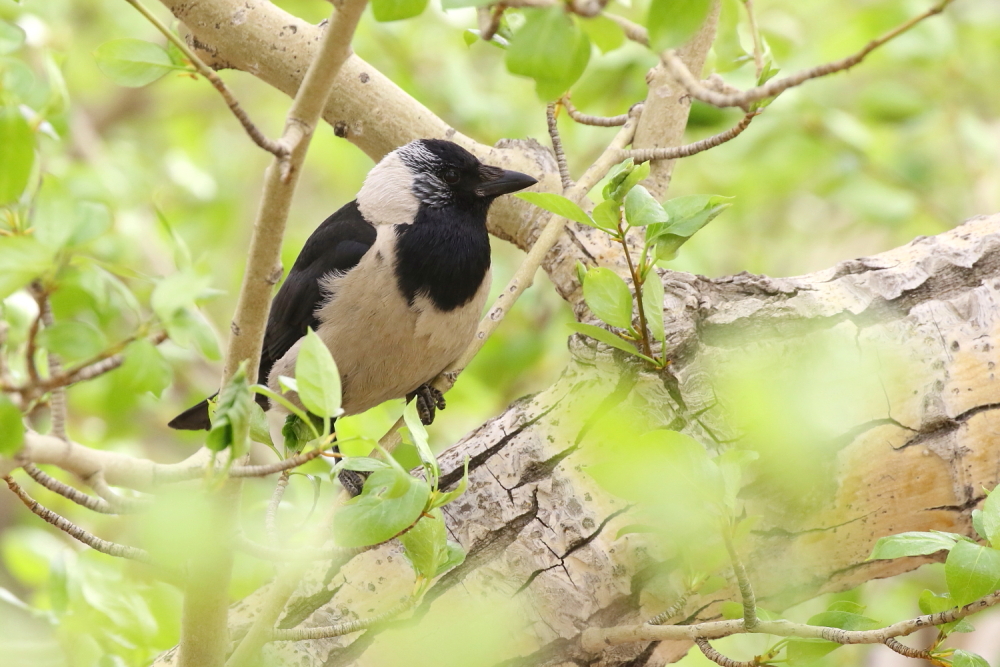
… and the inevitable Daurian Jackdaws (copyright János Oláh/Birdquest).
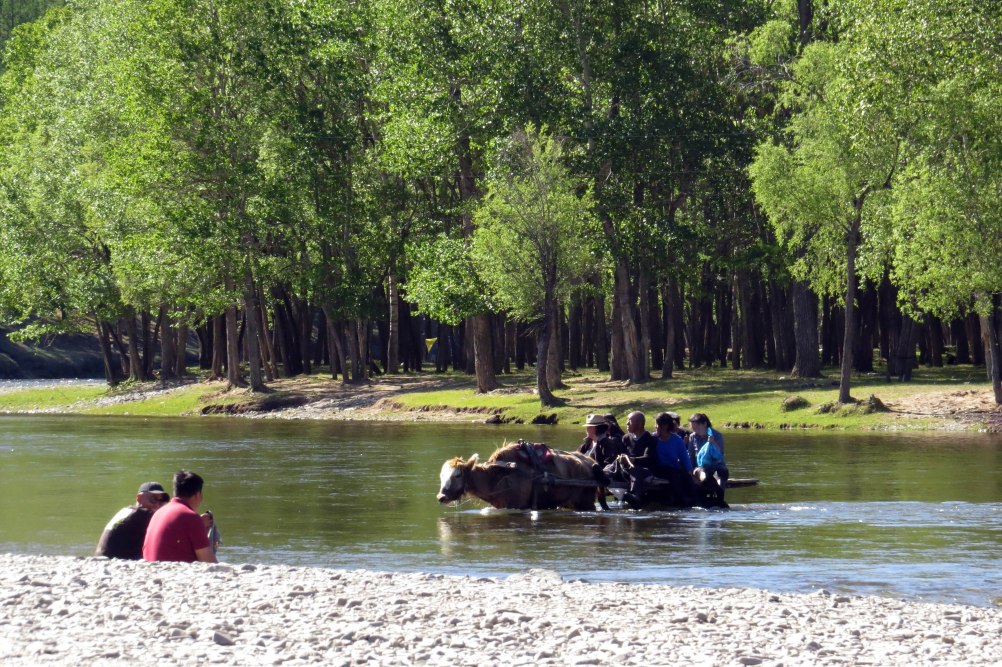
Eventually we headed back towards Ulaanbataar we watched the locals crossing the Tuul River …

… and then did it ourselves.
Our final camp of the trip was in this grassy meadow beside a large rock outcrop.
We searched in vain for Chinese Bush Warbler but had to content ourselves with more Red-throated Thrushes just two weeks ago that had been my number one wanted bird) …
… Two-barred Warblers …

… and Pallas’ Leaf Warblers. (copyright János Oláh/Birdquest)

János suggested a last spotlighting session but we declined as we were tired, so he sat alone by the mess tent and spotlighted a Wolf trotting away into the forest! The following morning those up before it got light were treated to a Grey Nightjar but I just heard it from the tent. Here is most of the group for a final photo with János second from the left and Terbish on the far-right. The three drivers and two cooks, whose names I can’t remember did us proud with excellent driving and meals throughout.

The trip wasn’t quite over, we returned to Ulaanbataar for a final night and after 16 nights under canvas enjoyed the luxury of a hotel with all the amenities . However there was still time for some final birding the next day.

Compared to the natural wonders of the deserts, mountains, steppes and forest of Mongolia navigating the industrial heart of Ulaanbataar was a bit of a come down.

Our destination was an area of scrub and ponds which was rapidly disappearing due to development and has probably vanished completely by now.
Among the birds we found was this beautiful male Long-tailed Rosefinch. (copyright János Oláh/Birdquest)
We also found Azure-winged Magpies. This species has, or rather had, an unusual distribution – eastern Asia and Iberia. I was once told by an eminent ornithologist that this was due to Portuguese sailors bringing them back from Macao and releasing them at home. However sub-fossil remains in Spain from long before humans existed in Europe and differences in plumage and DNA showed that hypothesis to be invalid. They are now treated as two species. The Asian form keeps the name Azure-winged Magpie whilst the Iberian one is know as Iberian Magpie. I was in Spain earlier this year and all the clients still confusingly called the Iberian one Azure-winged Magpie. It would have been better the world checklists had used the rather longer Iberian A-WM and Asian A-WM. (copyright János Oláh/Birdquest)

Well it took a while but we eventually found a singing male Yellow-breasted Bunting. (copyright János Oláh/Birdquest)

This species used to have a breeding range from Finland to the Pacific but now few are found west of Lake Baikal. In the 90s I saw 150+ in eastern Russia and in 2005 100 in Cambodia and in 1993 I even saw one in Dorset but sightings are few and far between now. The reason for the decline is mass trapping for food in China. Apparently its the done thing to knock off work and pop down to a local bar and eat a few ‘rice birds’ which means Yellow-breasted Buntings or related species. This species is echoing the Passenger Pigeon, a once abundant species hunted to extinction for food in just a couple of decades. (copyright János Oláh/Birdquest)
I’ll finish these four posts with one of my favourite mammal from the trip which I’ve wanted to see since about 1960 when I was given a Time-Life book as a present – the enigmatic Przewalski’s Horse.
So concludes my trip to Mongolia, some 228 bird species seen but only five ‘lifers’ (out of a possible seven) Altai Snowcock, Relict Gull, Koslov’s Accentor, the recently splt Mongolian Short-toed Lark and Red-throated Thrush. Even the stunning Black-billed Capercaille I had seen before briefly in Kamchatka. But the scenery, the great mammals and the adventure of travelling and camping in such a wilderness was outstanding. If you’ve travelled a bit in the Palaearctic then Mongolia won’t do wonders for your life list but will be one of the best travel experiences of your life.
In the last post I showed some photos of the southern Gobi-Altai Mountains and parts of the Gobi Deserts that lies to the south and north of the mountain range. This post covers part of the Altai known as the Bodg Mountains, the desert/steppe lakes of Kholbooj, Orog Nuur and Boontsagaan Nuur.
As with the last two posts I have included a number of photos from tour leader János Oláh as they are so much better than mine. These were supplied to the clients with the tour report.
As we travelled west from we spent some time to the south of the Bogd Mountains and had to climb up a pass to reach the northern slope. This ‘chorton’ a Buddhist shrike was at the top.
Of course once we had descended to the desert on the northern side of the mountains we saw yet more Pallas’ Sandgrouse … (copyright János Oláh/Birdquest).
… but our main target was one of Mongolia’s avian specialities, Henderson’s (or Mongolian) Ground Jay (copyright János Oláh/Birdquest).

There are four species of ground jay in the world, all inhabitants of arid areas in central Asia and named after ornithological pioneers: Henderson’s (above) Mongolia and northern Tibet, Pander’s in Uzbekistan and Turkmenistan, Biddulph’s in NW China and Pleske’s in Iran of which I’ve seen the first two. There used to be a fifth, Hume’s Ground Jay of Tibet but DNA evidence showed that it belonged in the Paridae not the Corvidae – so it went from being the smallest crow in the world to the biggest tit in the world. (although other nominations are available for that honour). (copyright János Oláh/Birdquest).
From these desert plains we continued on to the lakes at Kholboolj Nuur and camped overnight and later went up to the Bodg Mountains above, however as we visited a number of other lakes after our descent from the Bodg I’ll treat all the lakes together and show pics from the mountains first.

The long ascent to the Bogd was up this very rough track.

There were wonderful views to the desert to the desert to the north.
Eventually we reached the top and started scanning the distant ridges.

Having dipped on it in the Gobi-Altai our main quest was the elusive Altai Snowcock. Finding a ‘fat partridge’ in this vast area would be no easy task but eventually one was heard.

The bird, seen here in the bottom left of the photo was eventually found on the far side of the valley. This photo is greatly enlarged. Some of the group saw another in flight at much closer range but I missed it.
Of course I’d like to show what one looks like close up so here’s a photo from Goyo Mongolia Tours

Among the many other sightings we had in this scenic area were Guldenstadt’s Redstart (copyright János Oláh/Birdquest) …
… Ala Shan Ground Squirrel …

… and lower down Chukar (copyright János Oláh/Birdquest) …

… and Hill Pigeon (copyright János Oláh/Birdquest). However we failed to see our other main target White-throated (or Hodgson’s) Bushchat. They should have arrived from their wintering grounds in India by now so we were pretty disappointed not to find this very localised species.

On our descent the views over the desert lakes were stunning.
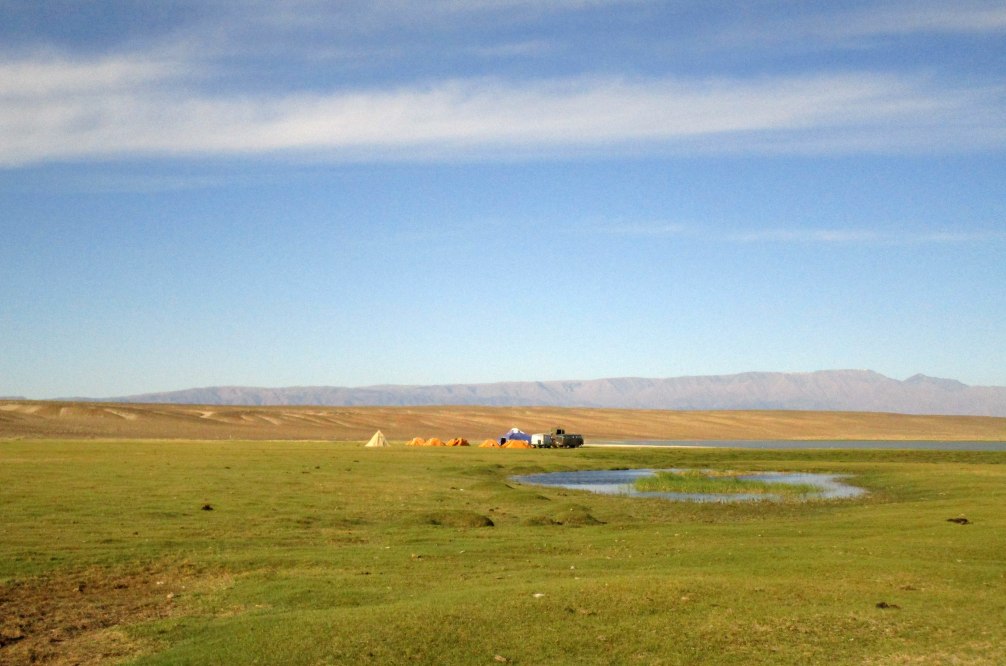
We spent one night at the lake of Kholboolj Nuur.
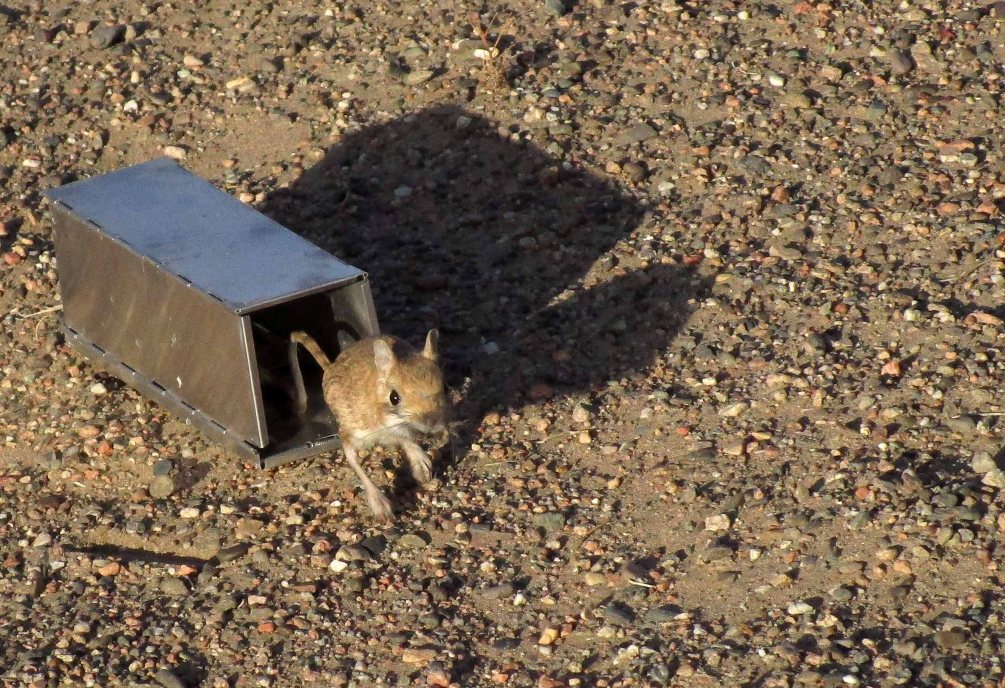
Naasta had brought some small mammal traps with him which meant that as well as spotlighting we had a chance to see Gerboas, Jirds etc in the morning.
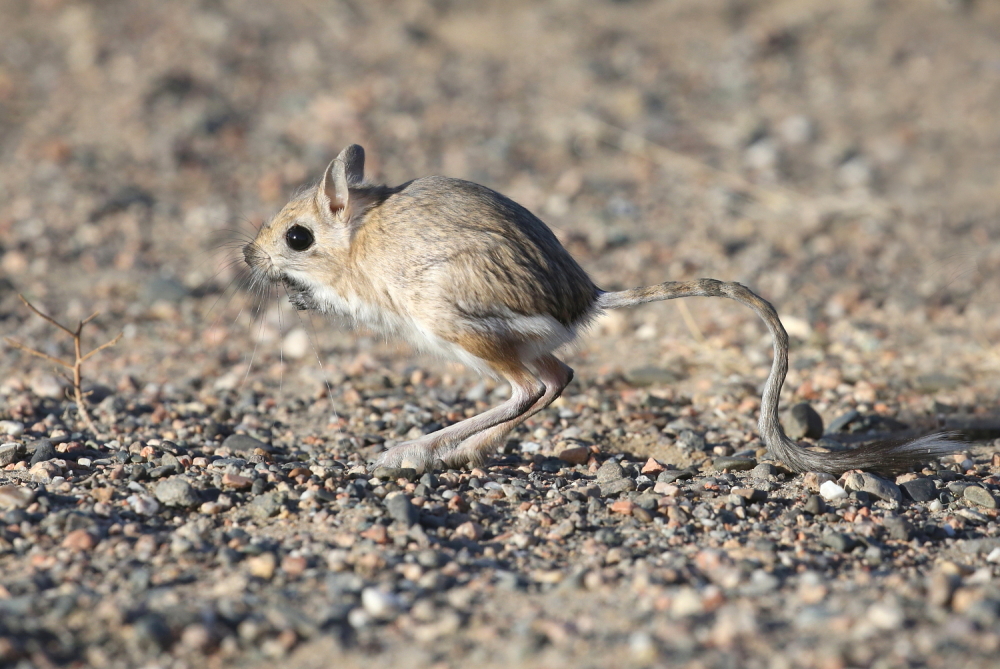
This is an Andrew’s Three-toed Jerboa (copyright János Oláh/Birdquest).
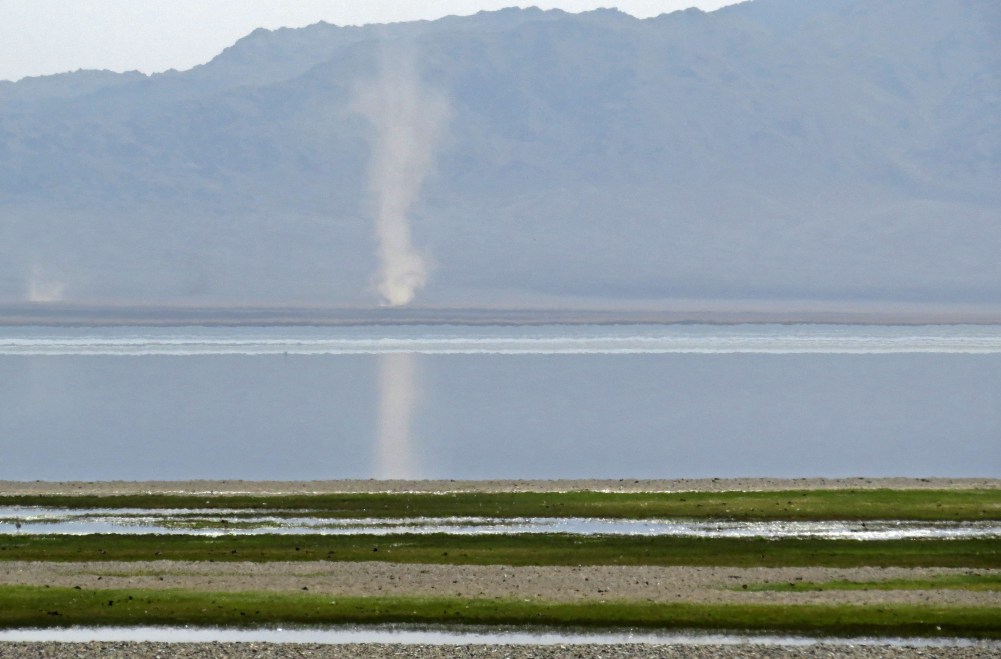
We spent another night at a lake called Bootsagaan Nuur. The wind would get up in the afternoon and create mini tornadoes on the far shore.
On the north shore of Bootsagaan Nuur was this crescent shaped sand dune know as a a barkan. The wind blows the sand more strongly at the distal parts of the dune and so moves it forwards more creating the characteristic shape.

The barkan made a great lookout, the local lad has cycled over to see what we were doing whilst the local goat shows its indifference (photo copyright Liz Charter). The sparsity of people through this remote part of Mongolia meant you could drive for 20km and see one yurt with a couple of horses or motorbikes outside and a herd of sheep, goats or camels and then drive another 20km before you found another.

I said in the first posts that our Russian vans were uncomfortable although reliable. This was particularly true for our tall Dutch companions, Wim and Willem, although Tim was almost as tall. On most trips there is daily seat rotation but on this trip that was impossible as the taller guys just couldn’t fit into the smaller of the two vehicles.

At Bootsagaan Nuur on one side there was a ridge of alluvial material which could almost hide a camel.
You’re looking the wrong way Naasta! Actually there were three Pallas’ Fish Eagles on the ridge and Naasta is trying to photograph one of the others.
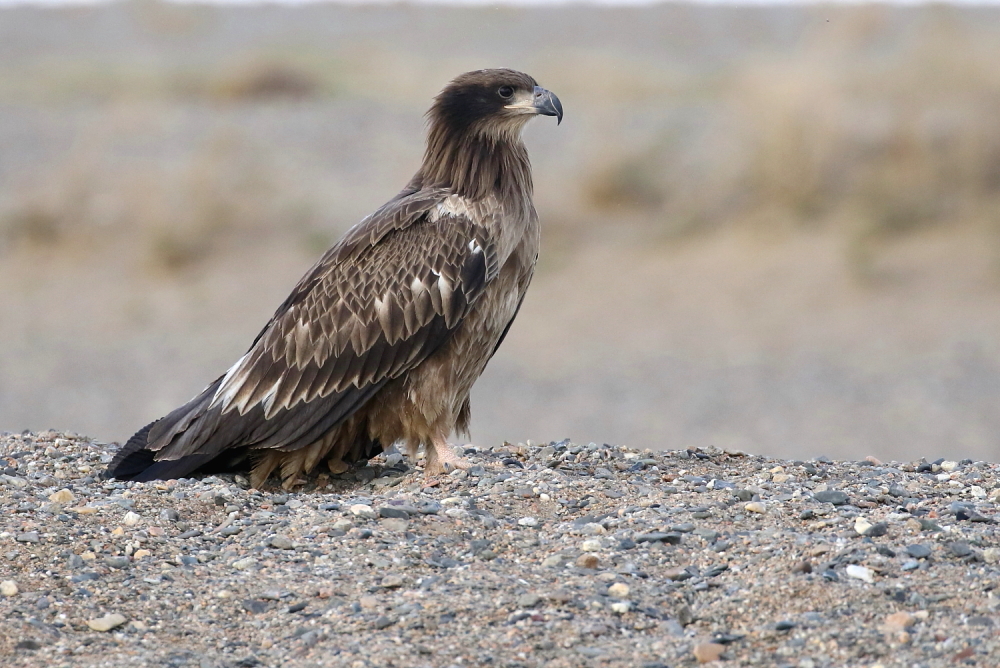
I don’t know how Naasta’s photo came out but János’ were superb! (copyright János Oláh/Birdquest).

There was a great variety of birdlife around the lakes from the local race of Merlin … (copyright János Oláh/Birdquest).
… resident species like Asian Short-toed Lark … (copyright János Oláh/Birdquest).
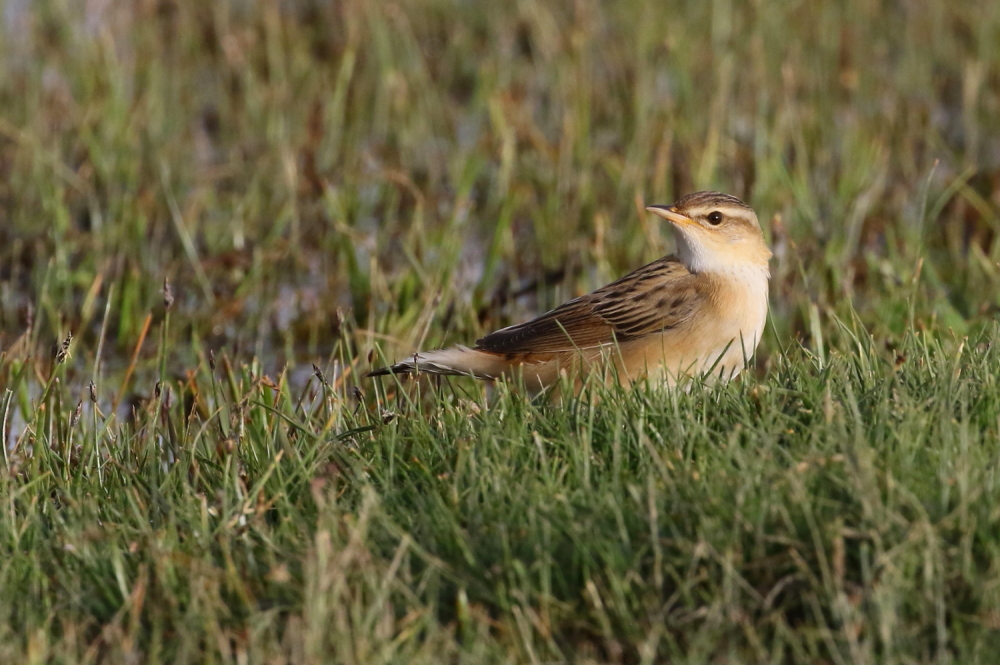
… to migrant Pallas’ Grasshopper Warblers, affectionately know as ‘PG Tips’ by British birders on the account of the pale tips to the tail. (copyright János Oláh/Birdquest).

Particularly interesting were the Pallas’ Reed Buntings. Peter Simon Pallas must have more birds named after him than any other ornithologist, at least as the colloquial names are concerned. Three races occupy the boreal forest zone from north east Russia to the Pacific but the race lydiae occurs only around the Mongolian wetlands. With the increased amount of white in the wing and a very disjunct distribution it must be a candidate for splitting. (copyright János Oláh/Birdquest).

Of course it was the wildfowl and other wetland birds that were the main attraction around these lakes. We tend to associate Whooper Swans with northern climes as our wintering birds come from Iceland but here were breeding whoopers at the same latitude as Rome! (copyright János Oláh/Birdquest).
Bar-headed Geese are some of the highest flyers of all birds as they overfly the Himalayas at altitudes of 8000m+ to reach their winter grounds in northern India. Birds incredible ability to cope at altitude seems to have a very ancient origin. 250 million years ago all the continents came together to form Pangea, the resultant massive outpouring of volcanic rock and CO2 at the end of the Permian period caused the greatest mass extinction of all time with 95% of species dying out. Oxygen levels dropped to as low as 12% at sea level. One group of reptiles evolved a highly efficient gas exchange system in their lungs, they went on to become the dinosaurs and as O2 level rose again they were able to become massive due to their improved respiration allowing efficient oxygenation of all the tissues. Birds of course were an offshoot of the dinosaurs and after the next mass extinction 65 million years ago they diversified like never before. Other Permian reptile groups that maintained the inefficient earlier lung system became the mammals and eventually us. (copyright János Oláh/Birdquest).
Swan Geese are a rare and localised species seen In Mongolia and parts parts of China and south-east Russia.
Just as Greylag Geese are the wild origin of domestic geese so Swan Geese are the wild origin of the domesticated ‘Chinese goose’ (copyright János Oláh/Birdquest).

The widespread Ruddy Shelduck was plentiful. (copyright János Oláh/Birdquest).

We are used to seeing Goosander on large rivers rather than desert lakes. (copyright János Oláh/Birdquest).
There were plenty of Demoiselle Cranes in the area (copyright János Oláh/Birdquest).
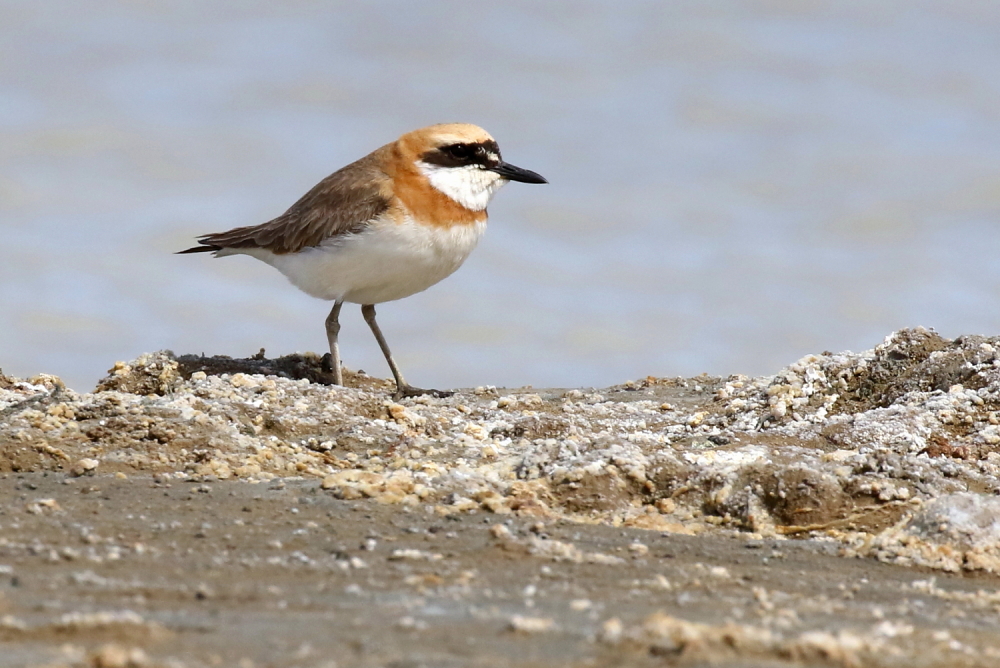
Waders included Greater Sandplovers although we couldn’t find any Lesser Sandplovers in spite of their specific name being mongolicus … (copyright János Oláh/Birdquest).

… and the more familiar Little Ringed Plover – usually abbreviated to LRP, was a regular site. (copyright János Oláh/Birdquest).

Baillon’s Crakes, here of the nominate race which might be a different species from the European ones, patrolled the lake edges. (copyright János Oláh/Birdquest).
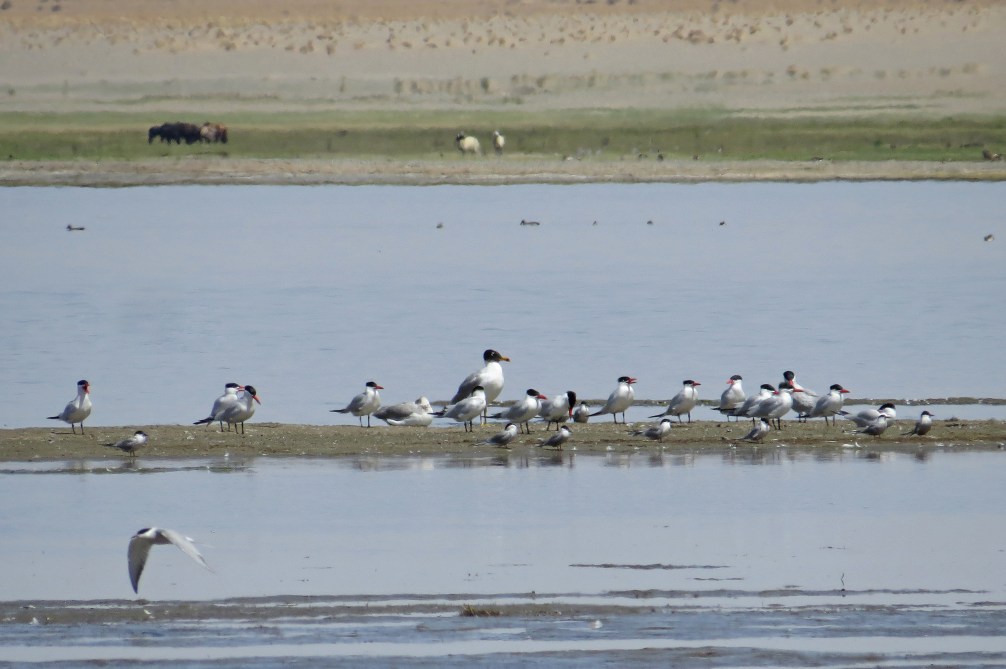
This photo allows for some size comparisons. The smaller birds are Common Terns, (here intergrades between our familiar red-billed birds and the eastern race longipennis). The large terns are the huge Caspian Terns but lauding over it all is the massive Pallas’ Gull – yet another species (the 5th in this post alone) that has been named after PSP. The gull asleep in the middle is Mongolian Gull a somewhat variable taxon that no one really knows what to do with.

But probably the most sought after bird on these lakes (except perhaps Relict Gull, which we didn’t see here but did see at the start of the trip) is Asian Dowitcher. I have seen this rare wader a few times in the wintering areas or on migration but this was the first time I’ve seen it in breeding plumage or in numbers – we had 45 in total.
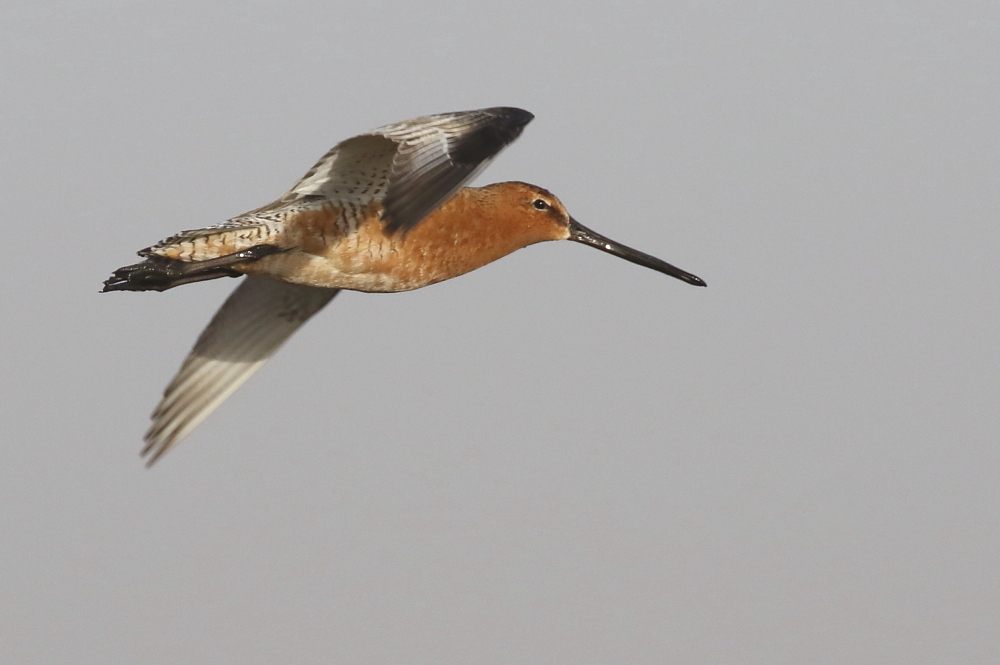
Although its head shape is similar to its North American cousins, this is a bigger bird, more godwit sized and has a striking white underwing. (copyright János Oláh/Birdquest).
Well it was time for us to leave the bird rich although windy lakes and head for the Khangai Mountains. On route we stopped at the town of Bayankhonogor to restock and had our picnic lunch. As well as it being the first town we had seen for eight days it was our first tarmac road for eight days as well.

As we turned off the road and headed into the mountains we passed the Buddhist monastery of Erdenesogt.

Birds regularly seen in the uplands included Red-billed Chough … (copyright János Oláh/Birdquest).
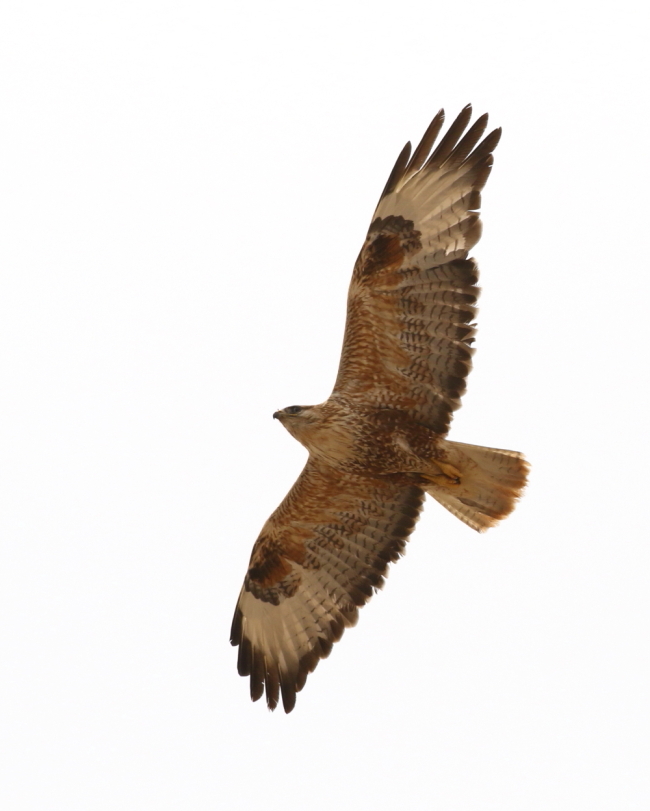
… Upland Buzzard (copyright János Oláh/Birdquest) …

… and Saker Falcons, regrettably a declining species due to trapping for falconry … (copyright János Oláh/Birdquest).

… and the pretty little Mongolian Finch (copyright János Oláh/Birdquest).
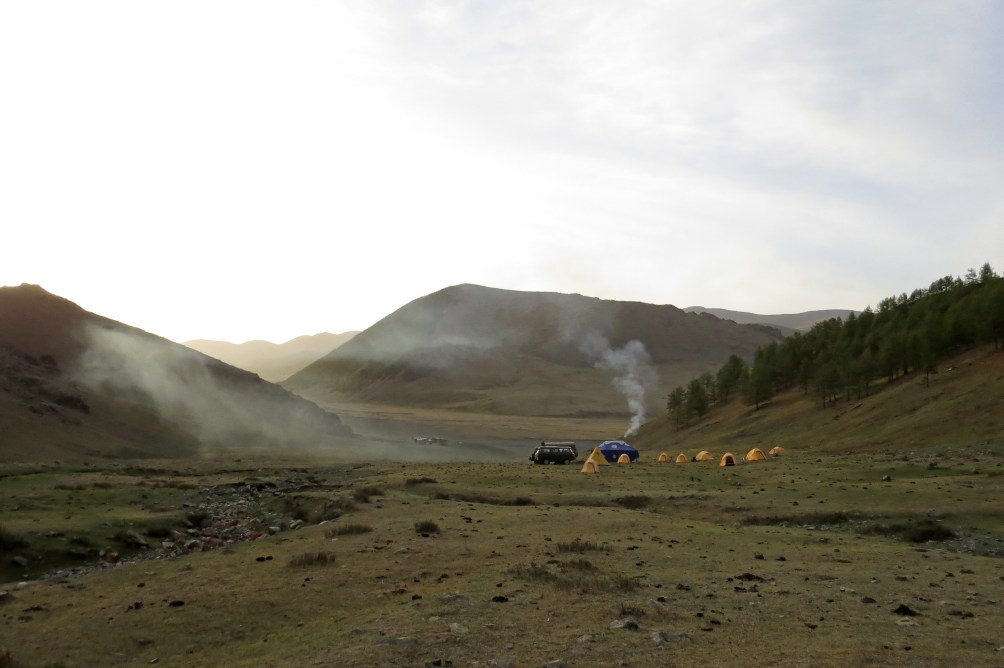
We arrived in the Khangai Mountains in the late afternoon and set up camp in this pass. Hume’s Leaf Warblers and Ortolan Buntings serenaded us that evening.

Local yak herders came by on horseback. Much stock herding is now done by motorbike so it was nice to see that the traditional approach is still upheld in some areas.
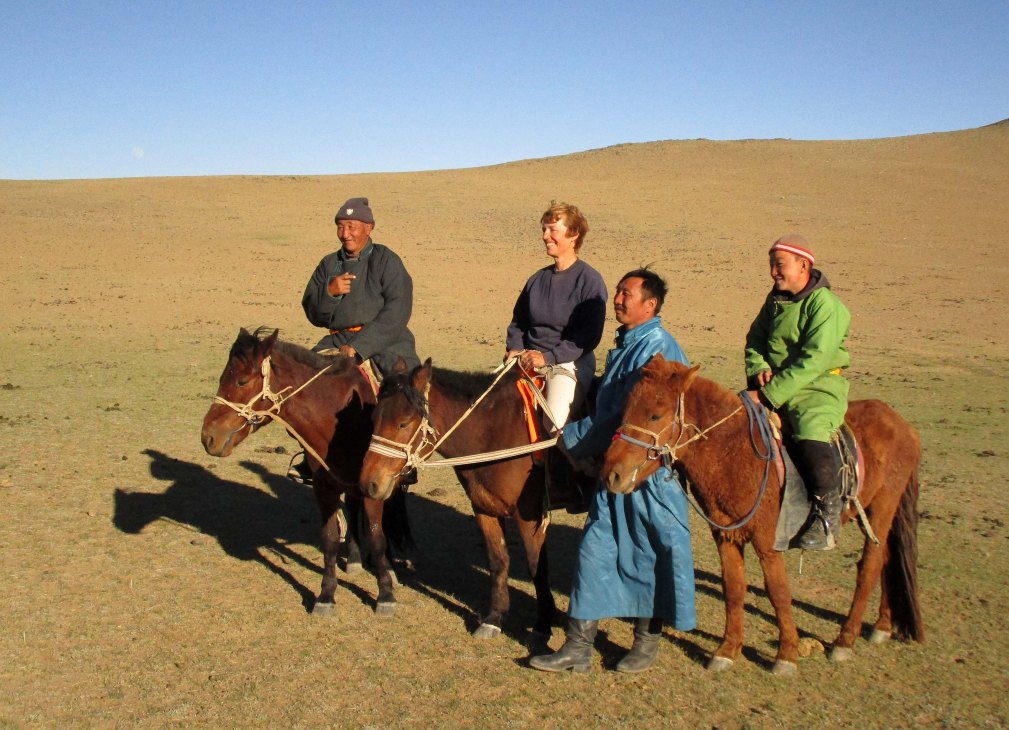
Some came over to see what we were up to and Liz asked if she could have a photo with them. They insisted she get on one of the horses.
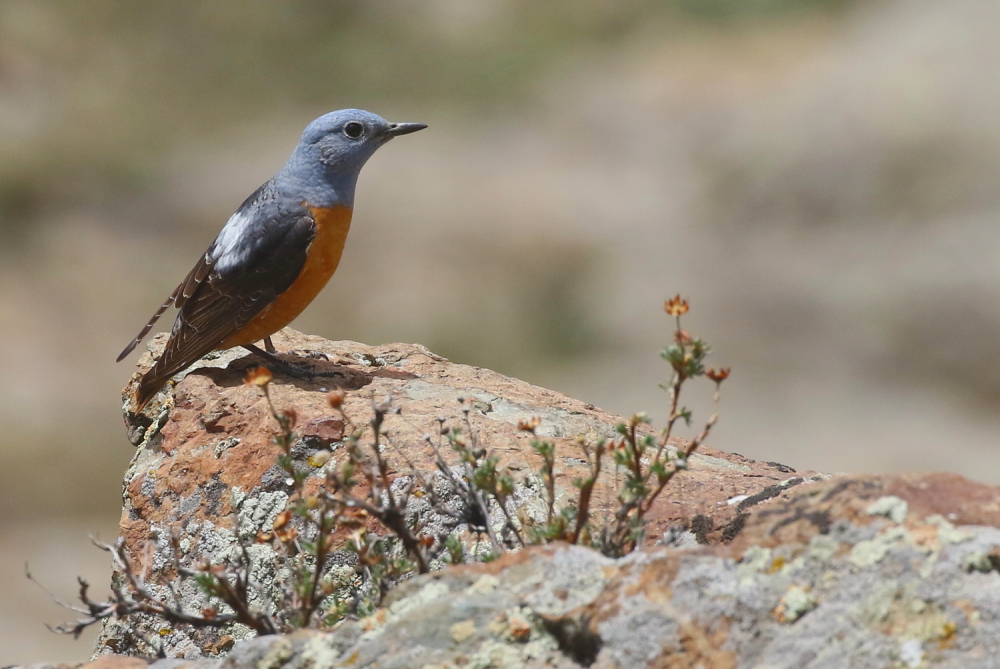
Birds in the area included the widespread Common Rock Thrush, which breeds in the mountains of Europe as well as Asia … (copyright János Oláh/Birdquest).
… and the pretty Eversmann’s Redstart (copyright János Oláh/Birdquest).
Probably the best bird in this area was the lovely Asian Rosy Finch. This is a different form to those I’ve seen in Japan or in the the Aleutian Islands and is good ‘insurance’ against a future split (copyright János Oláh/Birdquest)
The Rosy Finch was seen at the scenic White Rock pass.
We still hadn’t seen the elusive White-throated Bush Chat and we were running out of options. János suggested another mountain range to the north-west and so we headed in that direction. That, the grassy plains of Hustai NP and our return to the Khentii Mountains will be the subject of the final post in this series.
Although I have my own photographs of most of the subjects I have used many that leader János Oláh supplied with the tour report as they are far better quality than my own.
The last post covered our time around Mongolia’s capital Ulaanbaatar and our time in the Khentii Mountains. After leaving there we returned to the capital and drove south for nearly 200km and camped in the desert about a km from the road.
There were a loads of Mongolian Gerbils around the camp. Rodents and other small mammals like, jerboas, gerbils, ground squirrels, voles, pikas and marmots were to be a real feature of this trip. (copyright János Oláh/Birdquest)

After dinner some of us went out spotlighting. We were surprised to find a migrant Brown Shrike, on its way to its Siberian breeding area foraging on the ground. (copyright János Oláh/Birdquest)

Amazingly we found this Marbled Polecat, a rarely seen mammal hunting jerbils (copyright János Oláh/Birdquest).
A tent with a view, well a view of the toilet tent. The following morning it was very windy. As I took the tent down I removed the final peg from the inner tent before I removed the the supporting struts. The wind caught it and it rolled away far faster than I could catch it. Naasta and one of the drivers jumped in the supply lorry and chased after it – it took 3km before they could catch and secure it!!
Liz befriending a lost lamb at breakfast time. As well as the Birdquest leader, János Oláh, we had two local guides, Naasta and Terbish, three drivers for the two minibuses and the supply truck and two cooks who travelled in the supply truck. At each camp site the drivers put up/took down the big dining tent and the loo tent, assembled the stove etc whilst the cooks got on with the meal (which were really varied and tasty). We put up/took down our own tents with varying degrees of success.

The morning birding brought some excellent birds the local brandtii form of Horned Lark which may be a future split (splits in the Horned lark group are inevitable, but its not clear yet whether the steppe races will be combined with the Himalayan race(s) or not),

Desert Wheatears were common throughout the desert regions, especially around habitations.
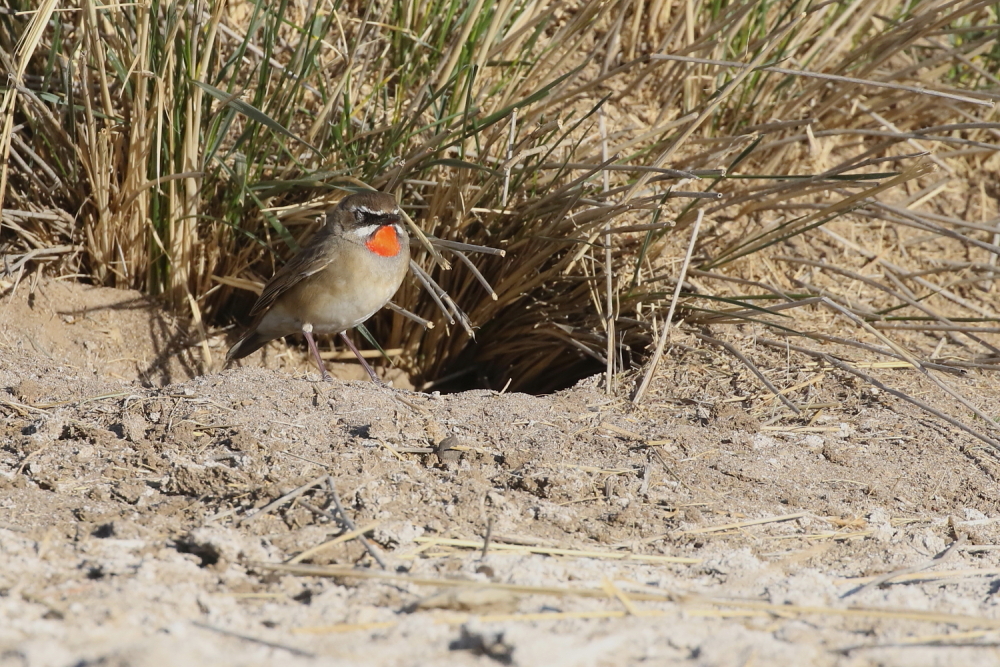
At this time of year there were still plenty of migrants about, this male Siberian Rubythroat was foraging along the edge of a dune.

If any bird typified the wide open desert landscape it was Pallas’ Sandgrouse. Named after 18th C Prussian scientist and explorer Peter Simon Pallas, this species range covers much of central Asia. In the past periodic irruptions resulted in it breeding in Europe including the UK but now it just an extreme vagrant to Europe.(copyright János Oláh/Birdquest)
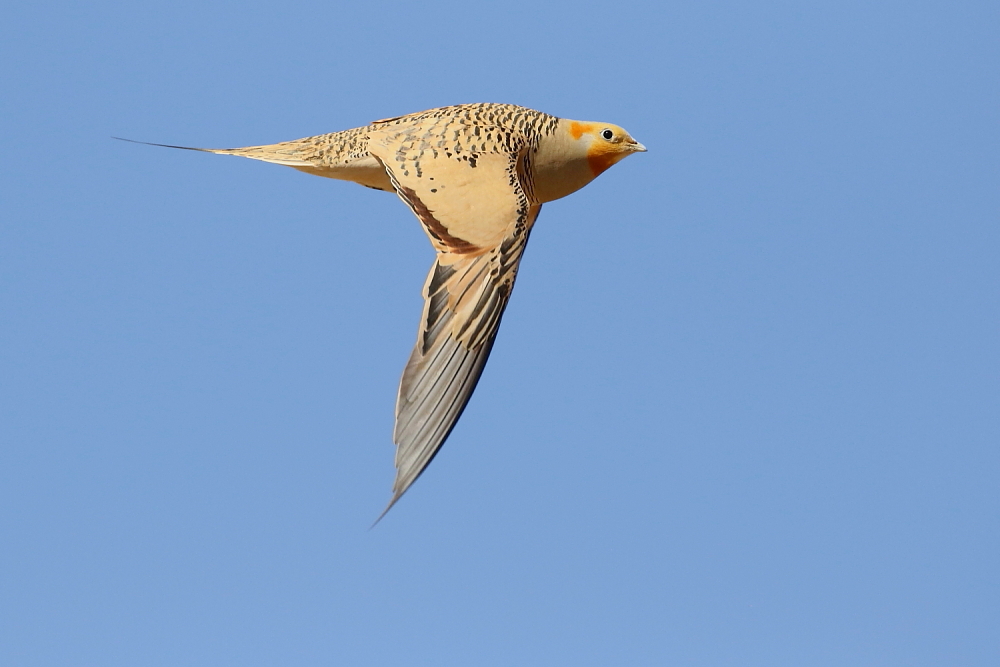
We would oftern see these gorgeous birds flying over in the morning on their way to a pool to drink. (copyright János Oláh/Birdquest)

As we travelled south we came across a number of Mongolian Gazelles. (copyright János Oláh/Birdquest)
We carried on through the stark desert landscape for much of the afternoon pausing in the town of Dalanzadgad to top up our supplies. (copyright János Oláh/Birdquest)
Not far from the town we stopped at an area of open desert to search for the enigmatic Oriental Plover. No luck there, our best find was a number of Himalayan Griffon Vultures. This one is defending the carcass of a young camel from the others. We continued on to the Gobi-Altai National Park only to find they were shut. János managed to persuaded them to let us in and we set up camp at dusk at the foot of the mountains. A night drive brought us views of Pallas’ Cat, a rare feline but one that I’ve been lucky enough to see on three trips now. (copyright János Oláh/Birdquest)

Between the previous night’s spotlighting and the 0345 wake up, there was little time for sleep. Bleary-eyed, yet full of anticipation we hiked up the mountainside in the dark. Our main target was Altai Snowcock, which would have been the my 5th and last snowcock.

The sun had broken the horizon by the time we reached the top, wonderful views …
… but however hard we tried we couldn’t find any snowcocks.

There was compensation in the form of a small herd of Argali rams. Probably the best set of horns on any species of wild sheep. (copyright János Oláh/Birdquest)
Several Siberian Ibex were on display as well. (copyright János Oláh/Birdquest)
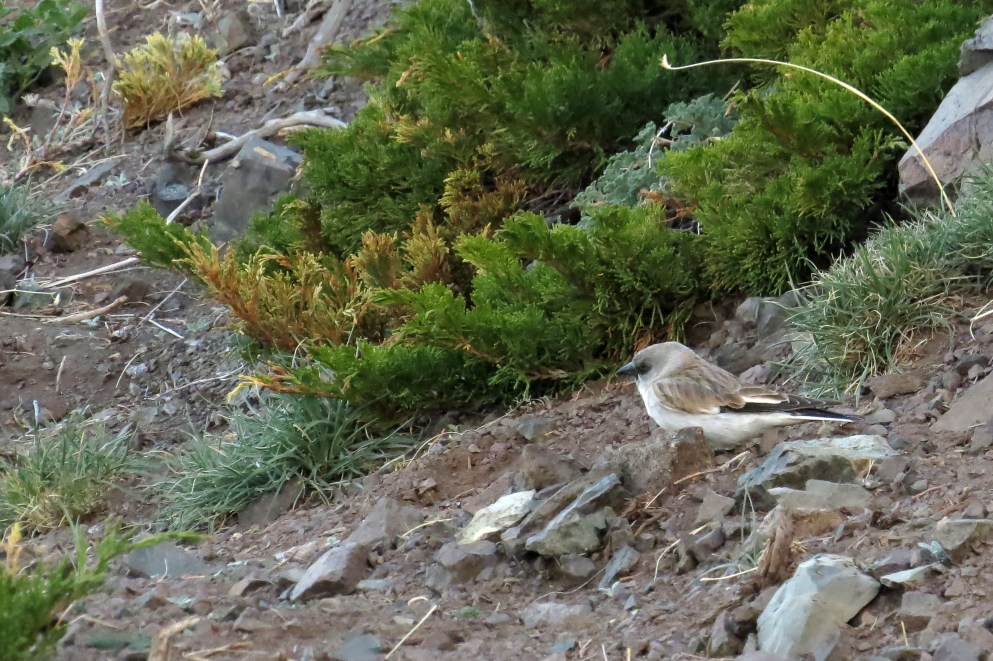
Among the birds that we did see were White-winged Snowfinch (the same species that is found in the mountains of Europe) …
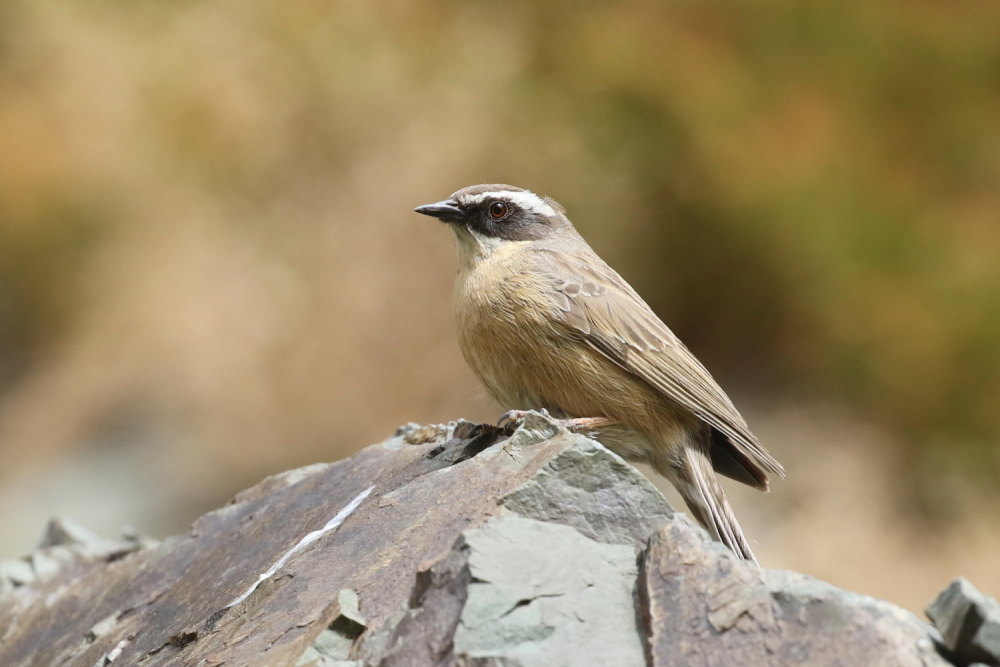
… Brown Accentor …

… and on this trip at least, the ubiquitous Isabelline Wheatear.

The skies were constantly patrolled by a pair of Lammergeiers, now often called Bearded Vultures because the name Lammergeier translates as ‘lamb vulture’ but like all vultures they don’t prey on live animals (and in fact this species specialises in eating bone marrow by dropping long bones from a height in order to smash them open).

One last scan for snowcocks before it was time to descend.

We had another ‘mega’ to look for in the juniper scrub at the base of the slope …
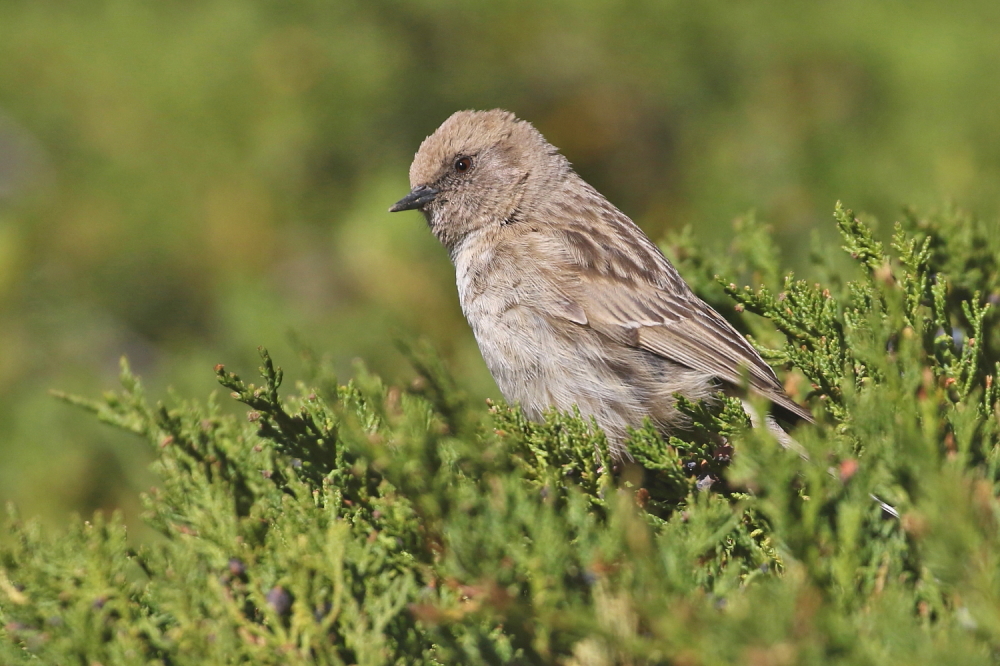
… Mongolia’s only breeding endemic (it has no true endemics as almost all birds depart south in winter or are widespread across central Asia) – Koslov’s Accentor, an accentor that makes our Dunnock look gaudy. As Anthony McGeehan said about dull yet rare birds in his book ‘Birding From The Hip’, ‘its not what it looks like that matters, it’s how it makes you feel’! (copyright János Oláh/Birdquest)
It was now mid-morning and far below us we could see our vehicles bringing us a very welcome breakfast.
Later passing herds of grazing yaks …
… and drifts of winter snow that had yet to melt …

… we entered a gorge where we found lots of migrants and a few other specialities ..

… a male Citrine Wagtail …

… localised Mongolian Finches …

… Black-faced Buntings … (copyright János Oláh/Birdquest)
… and best of all, the superb Wallcreeper. This species, with a range from the Pyrenees to Tibet has occurred on a few occasions in the UK, the last time just after I started birding in 1977, although I had no connection to ‘the grapevine’ in those days.
Also in the gorge was another species names in honour of Peter Simon Pallas – Pallas’s Pika … (copyright János Oláh/Birdquest)
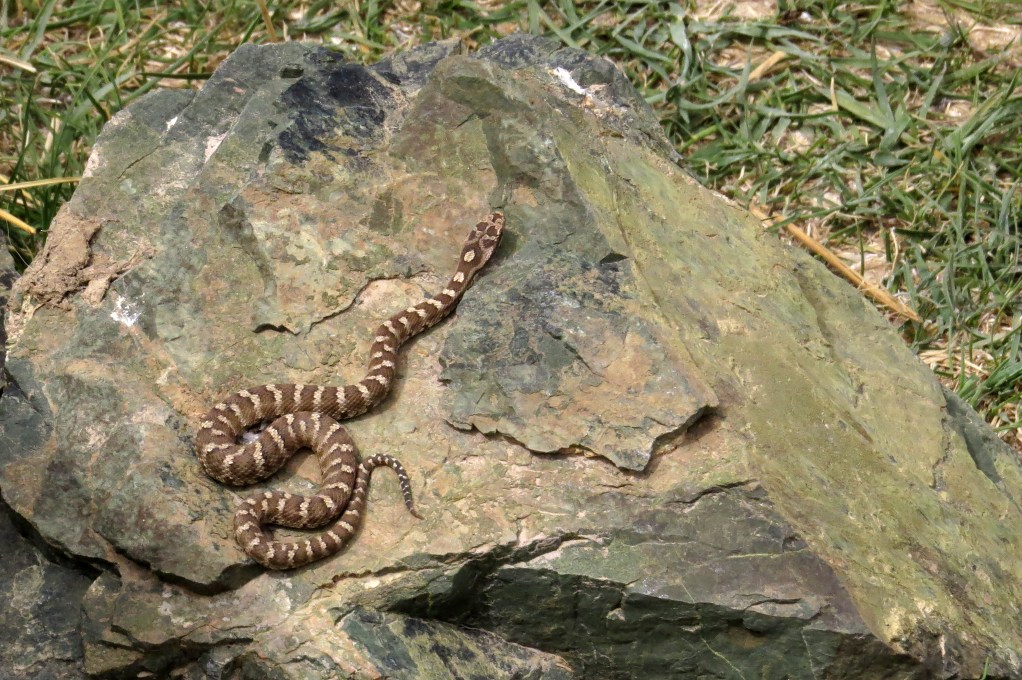
… and this Haly’s (or Central Asian) Viper. (copyright János Oláh/Birdquest)

From here we headed westwards, skirting the northern flank of the Gobi Altai mountains. On these endless plains our main target was Oriental Plover …

… which we not only saw well but saw in it’s bizarre wing fluttering display flight. (copyright János Oláh/Birdquest)

A few days further on we came across a female on the nest but we only stopped briefly to minimise disturbance. (copyright János Oláh/Birdquest)

We were not to see paved roads again for more than a week. Muck of the time we were following tyre tracks in the desert, sometime we just headed for a feature in the distance and cut across country. As the day drew on the wind blew the fine sand into a dust storm. We were approaching the big sand dunes at Khongoryn Els.
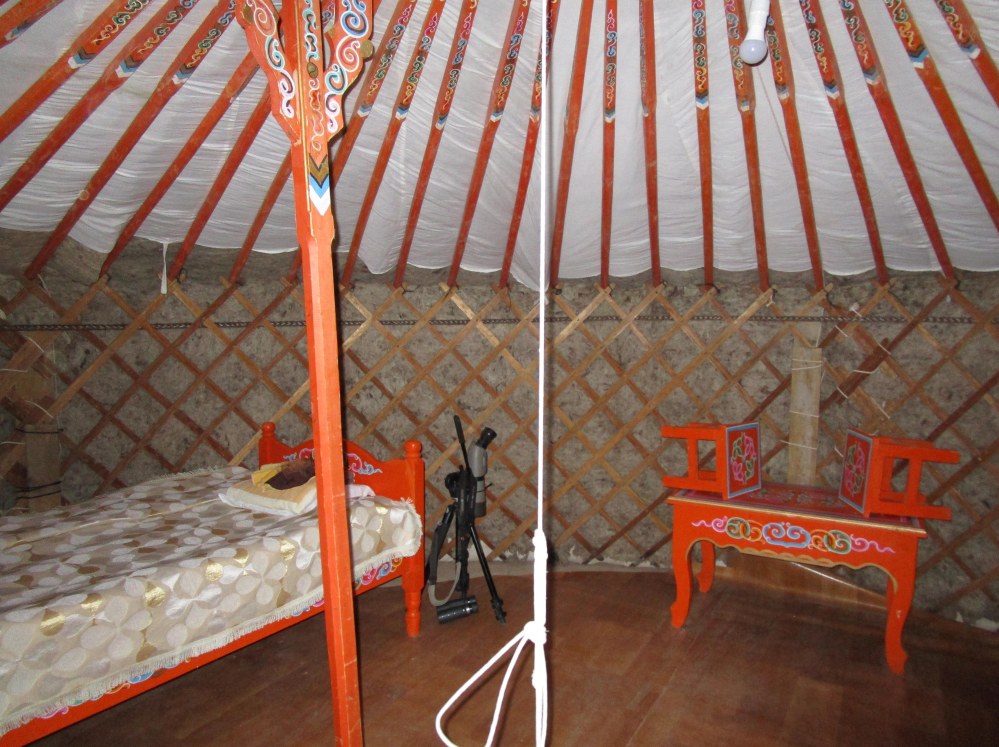
These sand dunes are a popular tourist destination (well popular by Mongolian standards which isn’t all that popular at all) and we were treated to a night in a ger and the chance of a hot shower and a shave.

The highlight of that night’s spotlighting was this cute Long-eared Hedgehog. (copyright János Oláh/Birdquest)

The air was still hazy with fine dust as our supply truck left the camp the following morning.

In the thorn scrub we found Asian Desert Warbler … (copyright János Oláh/Birdquest)

.. and in this ancient and twisted Saxaul Tree against the backdrop of the mighty dunes we found this Hoopoe …

… and the range restricted Saxual Sparrow. (copyright János Oláh/Birdquest)
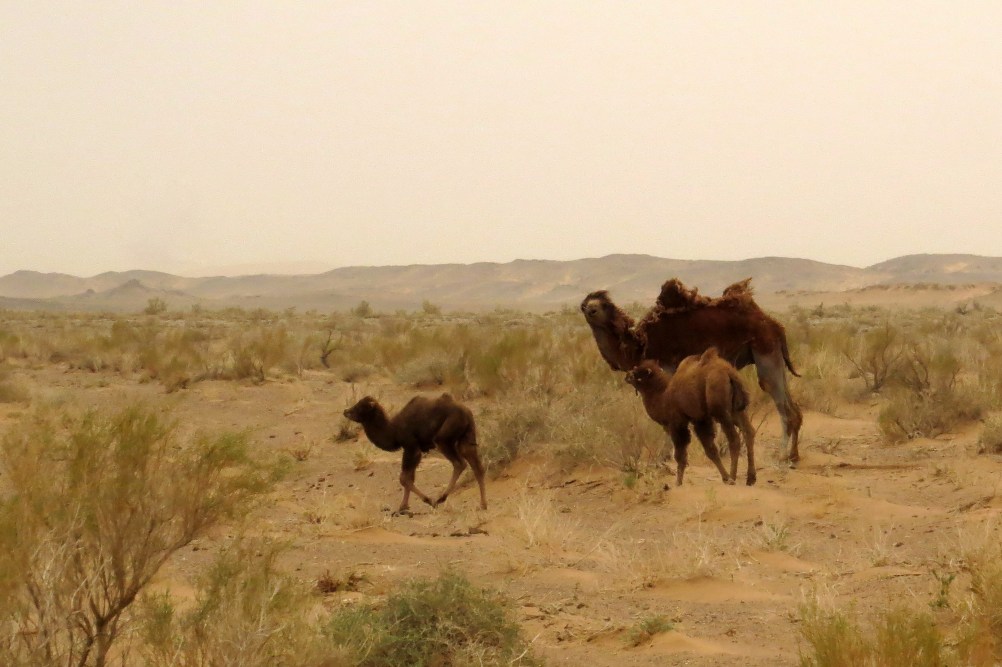
As the day hotted up the wind got stronger and the windblown dust turned the sky pink. We saw lots of Bactrian Camels. Unlike the one humped Dromedary there are still a few genuinely wild Bactrian Camels but these aren’t they. At best they are feral but most likely are someone’s stock allowed to roam free and many have ribbon tied to their ears to identify the owner.

With the sand dunes behind us we slowly made our way across the alluvial flat lands to the north of the Altai Mountains. Sometimes we crossed dried out braided rivers where we would climb up and down the multiple (dry) channels like a roller coaster ride.

With the sun already setting we stopped for the night by a small stream. It wasn’t the easiest place to camp, with a brisk wind it was hard to put up the tent. The ground was hard and stony and I bent most of my tent pegs doing so. In addition I hit my thumb with the hammer. Heading for the mess tent I thought I’d relax with a cold beer – only to find they’d all gone. I wasn’t best pleased and the rest of the trip the others would say ‘don’t forget to keep Ian happy and stock up with beer’!
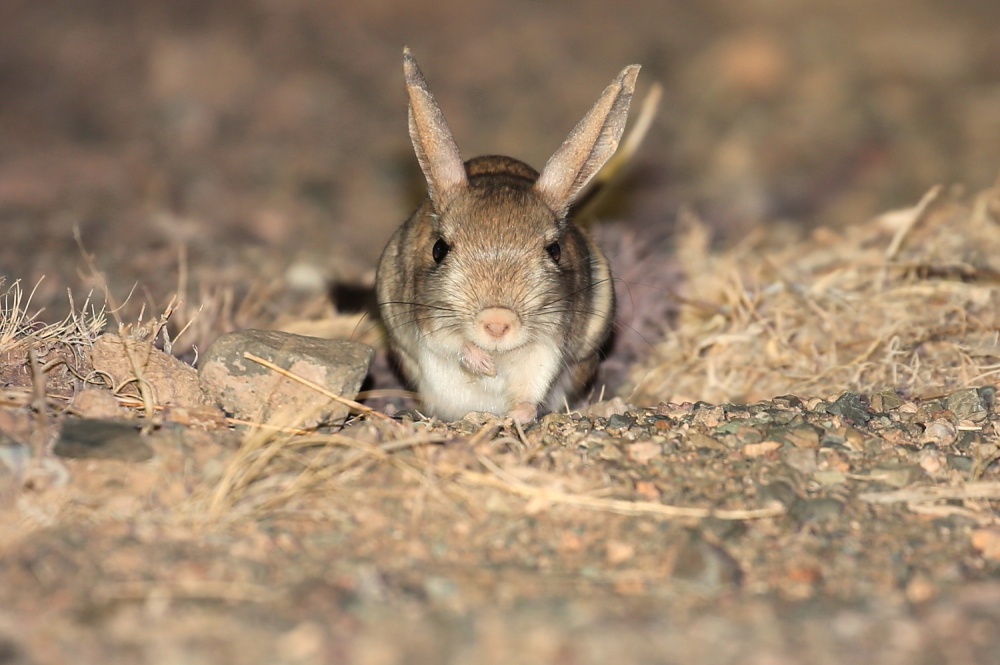
However spotlighting that night produced one of the most delightful critters of all, Siberian Jerboa. (copyright János Oláh/Birdquest)
Pre-breakfast the next day we had a look along the small stream …

There were a lot of these, parasitic plants called Desert Thumb in the area.

Along the stream we found familiar birds like Grey Wagtail …
… and less familiar ones like this migrant Long-toed Stint.

Always looking for a nice image to end on I’ll post another one of the endearing Siberian Jerboa. (copyright János Oláh/Birdquest)
In the third instalment of our epic Mongolian journey, we’ll continue north-west re-visiting the Altai Mountains and a number of desert lakes.

 gryllosblog