Archive for the ‘Uncategorized’ Category
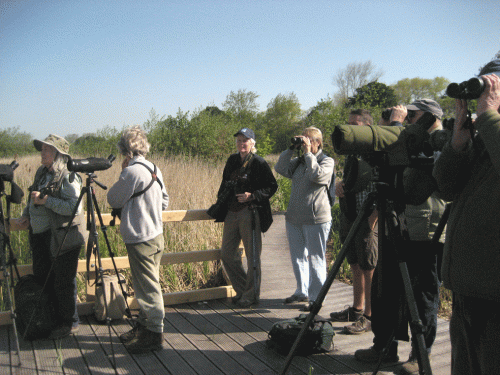
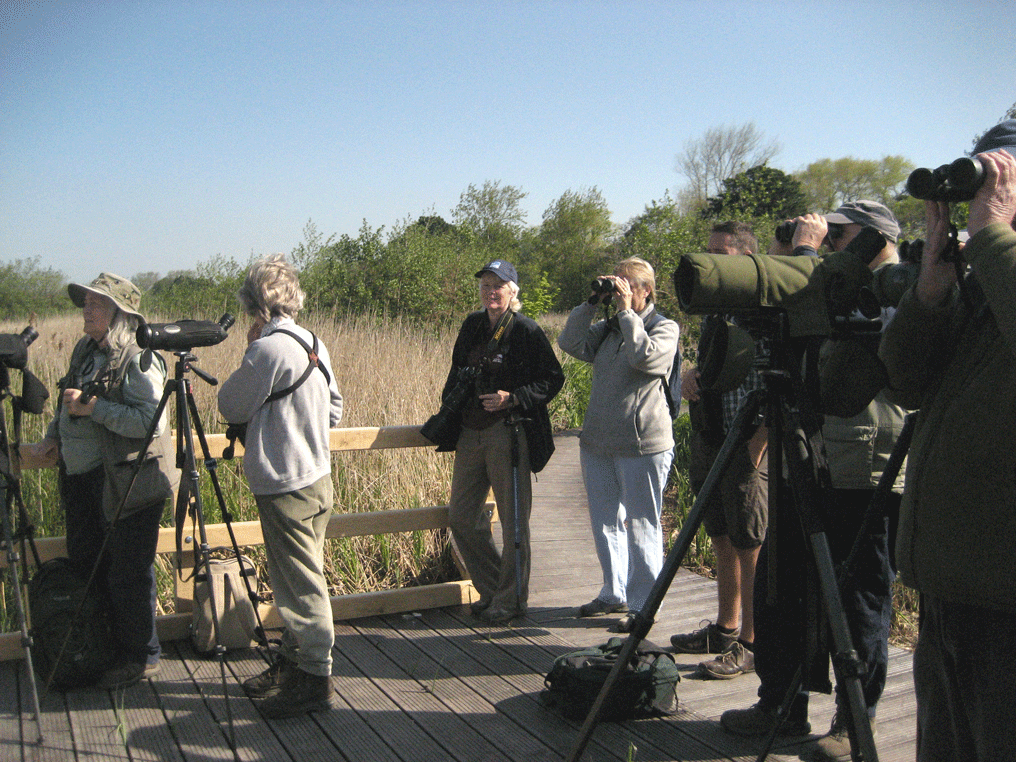
Birders gather on the new observation platform at Radipole
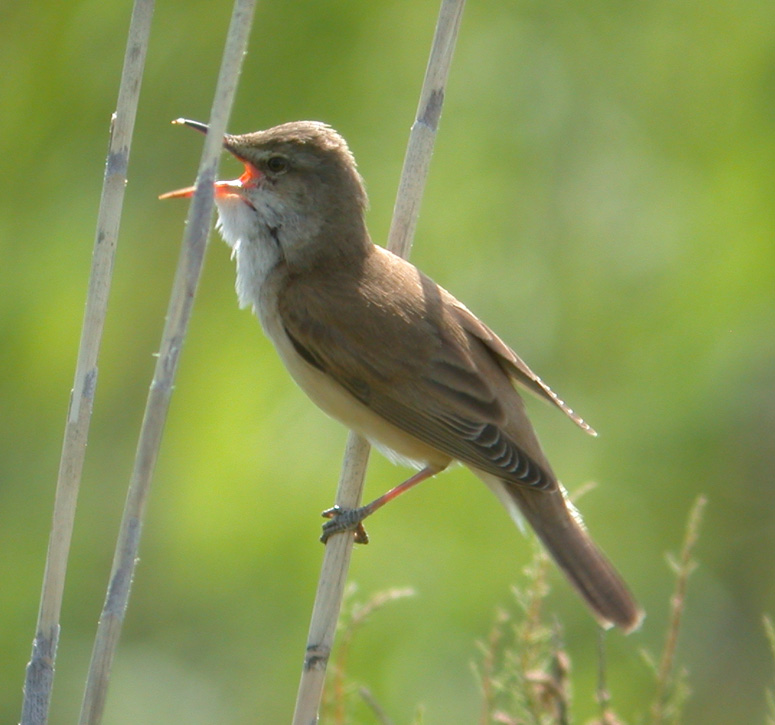
Quite early on Tuesday morning I received news that a Great Reed Warbler had been found at Radipole at Weymouth. I arrived by 0830 and immediately heard the characteristic guttural ‘kara kara gurk gurk’ of the Great Reed. It took quite a while before I saw the bird, I even got a scope view.This is a rare visitor to the UK, my 5th in the UK but only the 2nd in Dorset, interestingly that bird on 31/5/02 was in exactly the same locality.
Click here for recordings of Great Reed Warbler’s gutteral song.
http://www.xeno-canto.org/europe/browse.php?query=Great+Reed+Warbler+%28Acrocephalus+arundinaceus%29+76&species_nr=mvnwge
I had left home without picking up a suitable sun hat. With the hot sun threatening to burn my ‘spam head’ I had no option but to wear a wooly hat that I found in the car to avoid sunburn. Talk about overdressed. The temperature later reached 27 C, 15 degrees hotter than this time last week!
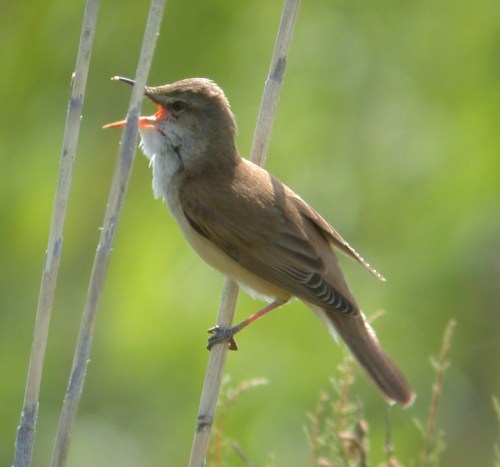
Great Reed Warblers are substantially larger than our familiar Reed Warblers, but are very similar in colouration and shape.

Several Gadwall showed well……
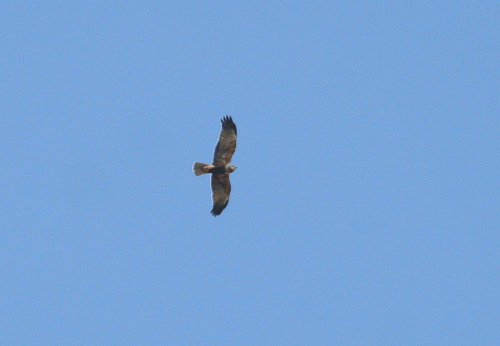
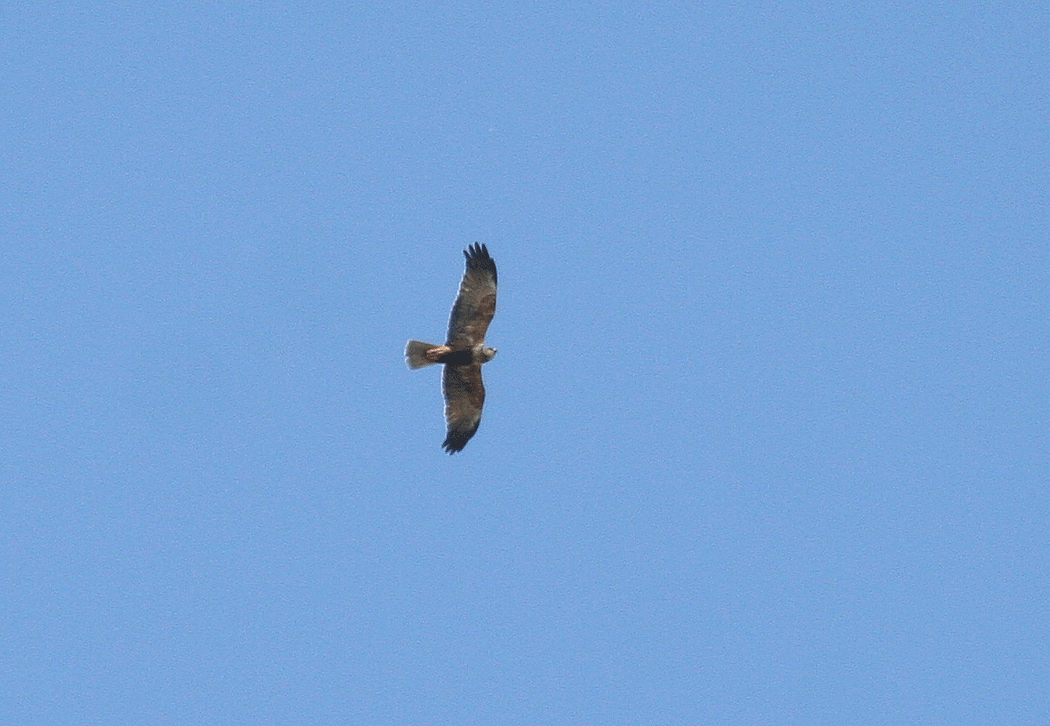
… whilst the local Marsh Harriers flew high overhead.
During the evening I returned to Martin Down with my friend and former colleague, Tim Kellaway. Tim has never seen a Woodchat Shrike in the UK but unfortunately it had gone but we had a pleasant wander seeing Turtle Doves, Red-legged Partridges, Whitethroats and Yellowhammers. A singing Reed Warbler was an unusual find in scrub habitat. There seems to have been a huge increase in Ravens in the area, we saw at least 30 and some have reported over a 100 in the area. Most were first year birds in pristine plumage which could be told from the moulting adults even when high overhead.
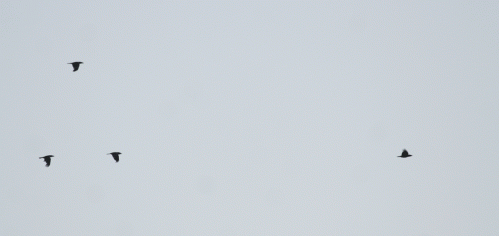
Just four of the 30+ Ravens that flew over Martin Down, presumably to roost.
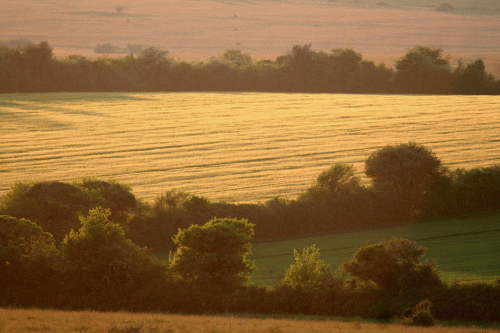
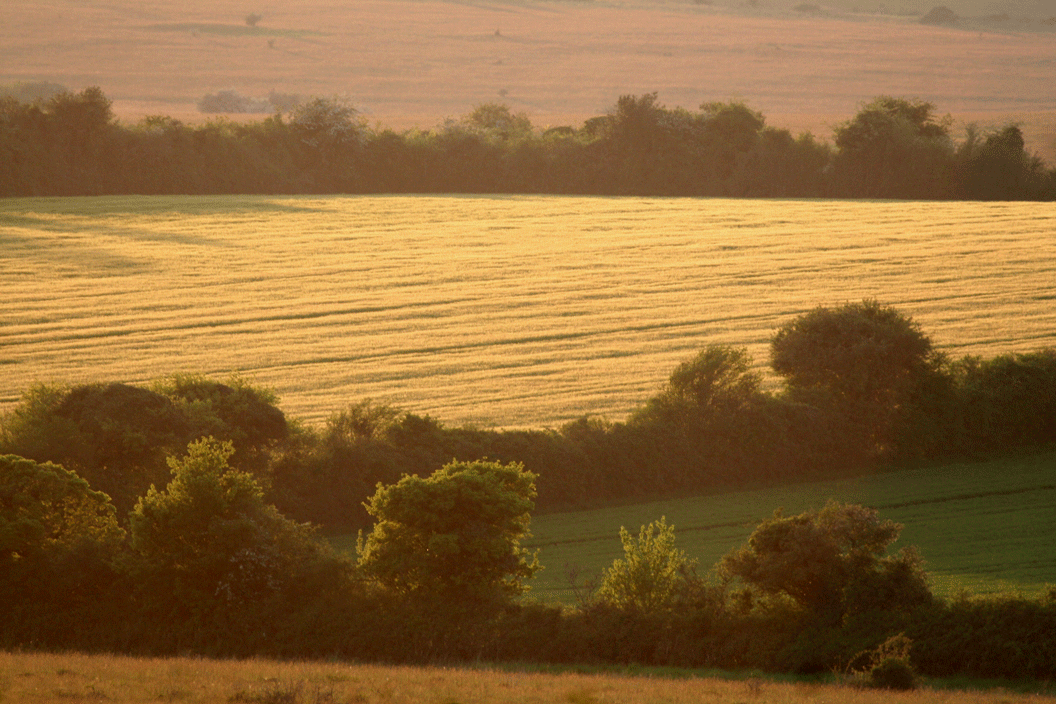
A mixture of farmland, dense heges and chalk downland make the Martin Down area a haven for wildlife.
I hate having to keep bird locations secret but even in the 21st century sites have to be suppressed for the sake of the birds. This is particularly true in the case of rare breeding raptors.
Reasons really are three-fold:
1) Disturbance at the site from birdwatchers and photographers. In some instances this can be controlled with for example a hide set some difference from the nest but often the location must be kept secret.
2) Egg collecting. Even today there are a few egg collectors who will stop at nothing to get the eggs of rare breeders. One such person has recently been banned from Scotland during the breeding season for the rest of his life! See http://www.bbc.co.uk/news/uk-scotland-18042109
3) Direct persecution. I’m afraid that there are still some gamekeepers who consider anything with a hooked beak to be their enemy. This is especially true in our upland areas. It has been estimated that there is enough habitat for 300+ pairs of Hen Harriers in northern England. This year not a single pair bred succesfully.
The bird I was after on the 21st was Honey Buzzard. Between 30 and 100 pairs breed in the UK, they are no threat to game interests as their food is mainly wasp larvae, but they are susceptible to disturbance and hence should be watched from a distance. A few breed in the New Forest but they have been late returning from Africa this year. I know of anothe site and after about 90 minutes of watching I was rewarded with views of one.
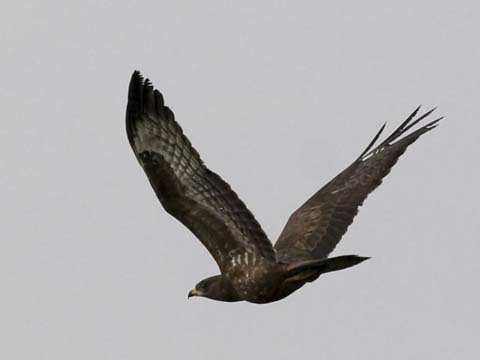
I obtained a view comparable to this, although much further away, as the Honey skimmed the tops of the trees. Photo from the internet.
On the 21st I was after another rare raptor, Montague’s Harrier. This is a very rare breeder indeed, with perhaps less than ten pairs in the entire UK. There used to be a pair that could be seen from an accessible site in north Dorset, but in recent years there have been few sightings. A juvenile bird was seen on the 20th at another ‘undisclosed location’, but as it is less than a year old, it probably was a migrant rather than a bird looking to breed. Either way, searches of the area drew a blank.
I continues on to Martin Down, a wonderful area of chalk downland just over the border into Hampshire. Another Woodchat Shrike had been seen there and after a bit of searching I had good views, considerably better views than the dot in the distance that I saw at Keyhaven just over a week ago. Other interesting birds included a purring Turtle Dove, two Grey Partridges and a singing Quail. Quail arrive late from Africa; in some years we get a second invasion as birds that have hatched in southern Europe move north in their first year before migrating south in the autumn. Almost always located by their lovely ‘wet-my-lips’ song coming from tall or inaccessible vegetation, this is a species that is almost always a ‘heard only’. A link to the song of Quail and Turtle Dove is included below.
Quail: http://www.xeno-canto.org/europe/browse.php?query=Common+Quail+%28Coturnix+coturnix%29+26&species_nr=rwghms
Turtle Dove: http://www.xeno-canto.org/europe/browse.php?query=European+Turtle+Dove+%28Streptopelia+turtur%29+22&species_nr=
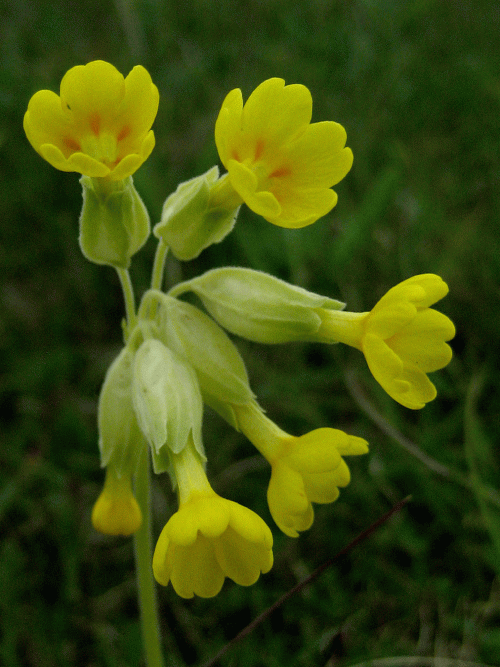
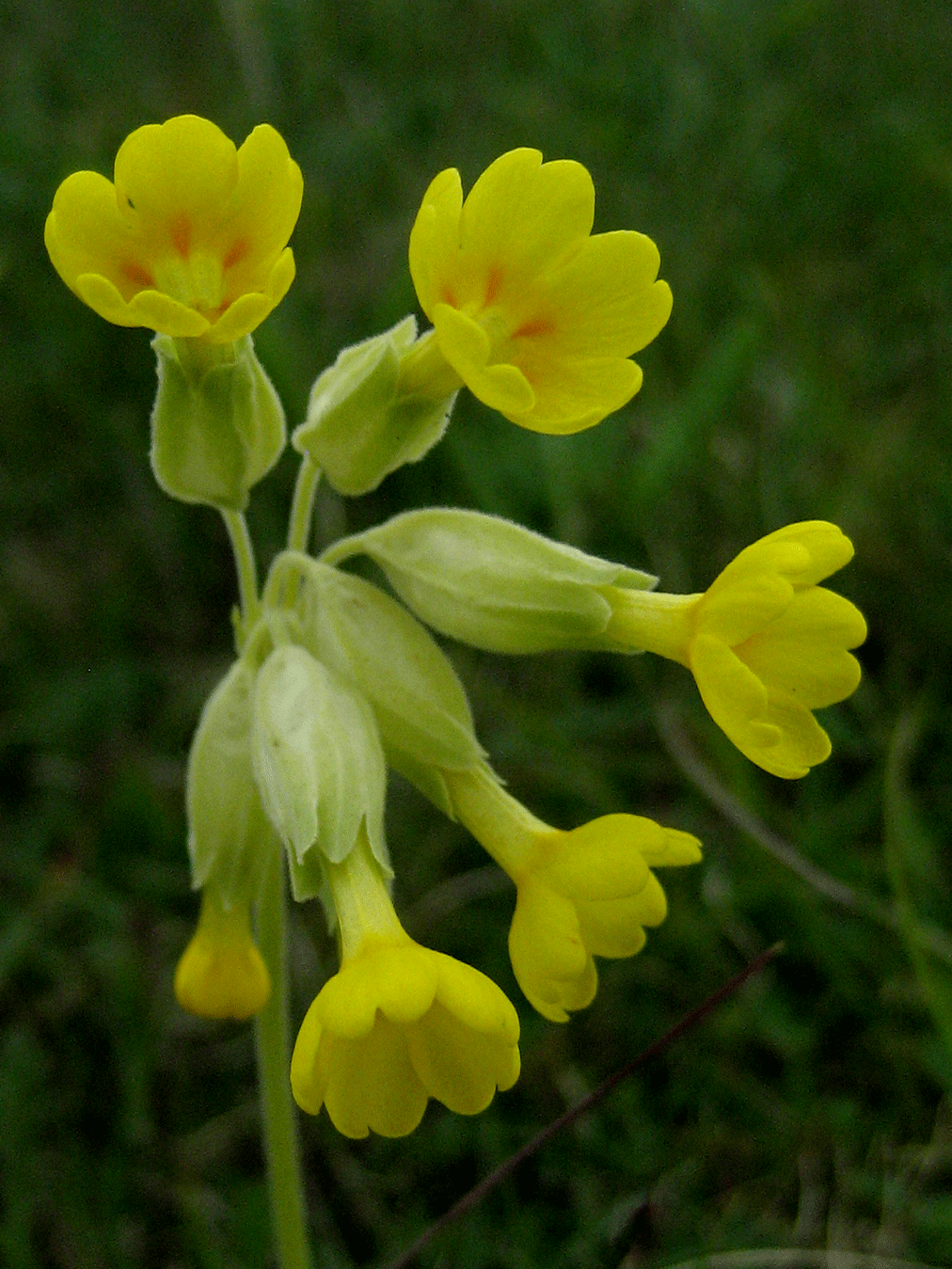
The down was carpeted in Cowslips
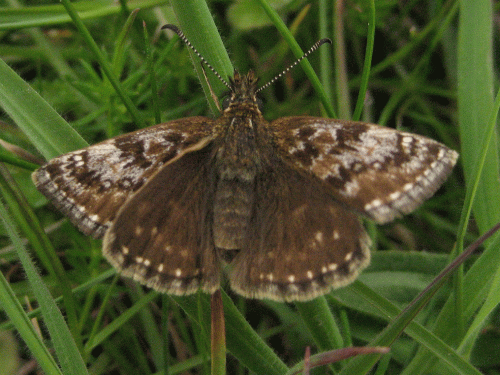
A Dingy Skipper
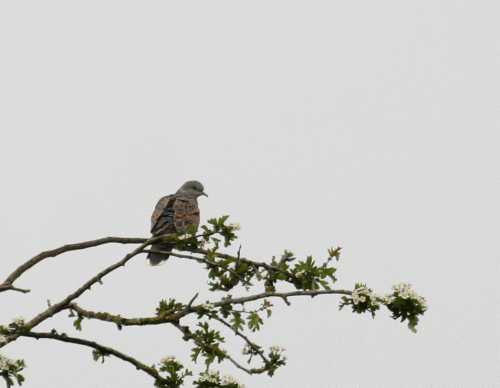
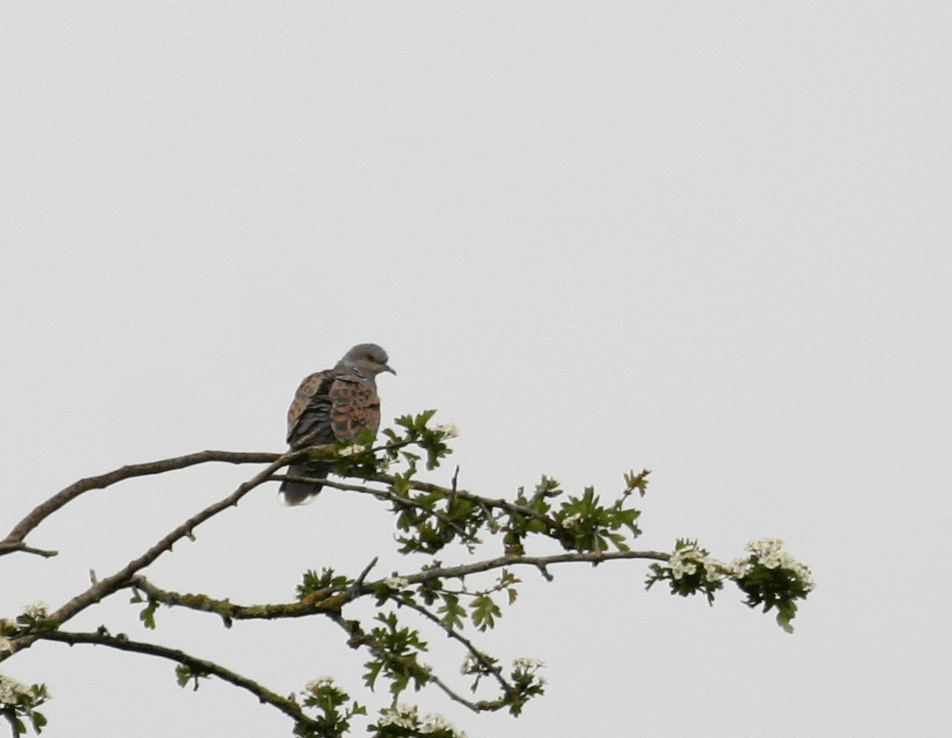
This Turtle Dove purred from this branch for some time. A massive decline in recent years means this bird could go extinct as a British breeder in a few decades. Reasons include agricultural intensification, winter habitat destruction in Africa and hunting on migration.

This Woodchat Shrike is hardly a frame filler but its a dam sight closer than the Keyhaven bird. Click to enlarge
There is some good news on the rare bird breeding front. I have just learnt that a pair of Great White Egrets have bred succesfully in Somerset, the first time in the UK!
And finally: maybe summer is on its way. Although cold this morning, the sun came out at lunchtime and for the first time since March the temperature exceeded 20 C
Early on Saturday evening Margaret and I went for a walk around the old disused airfield at Tarrant Rushton. Used in the D-Day invasion in 1944, the base has been decommissioned and the area has reverted to agriculture, the old hangers being used as farm buildings. There is public access are the old perimeter road and the area can be good for the rarer farmland birds like Corn Bunting and Quail.
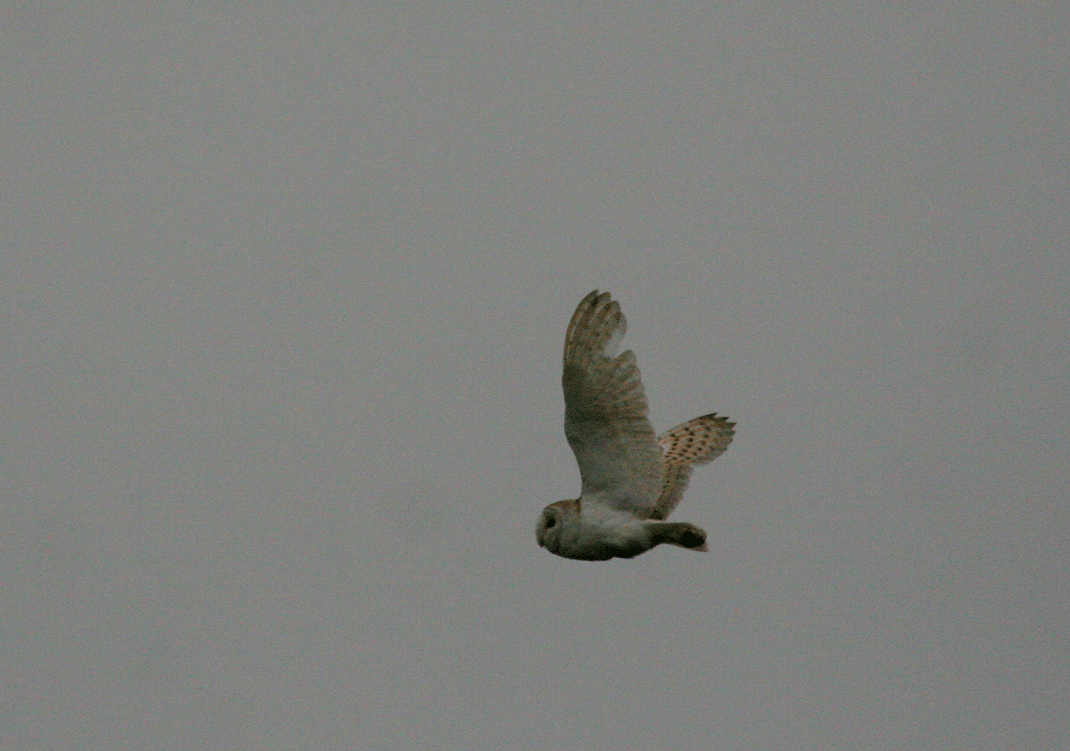
We had no luck with Quail but did see a couple of Cuckoos, a few Corn Buntings and best of all saw a Barn Owl fly out of one of the disused Nissan huts.

This memorial is to all those who served at the Tarrant Rushton airfield
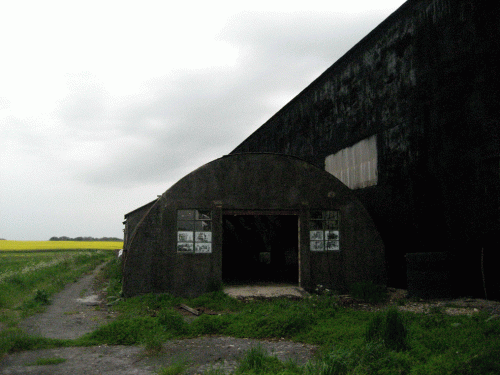
Old hangers and Nissan huts contain agricultural stores …..

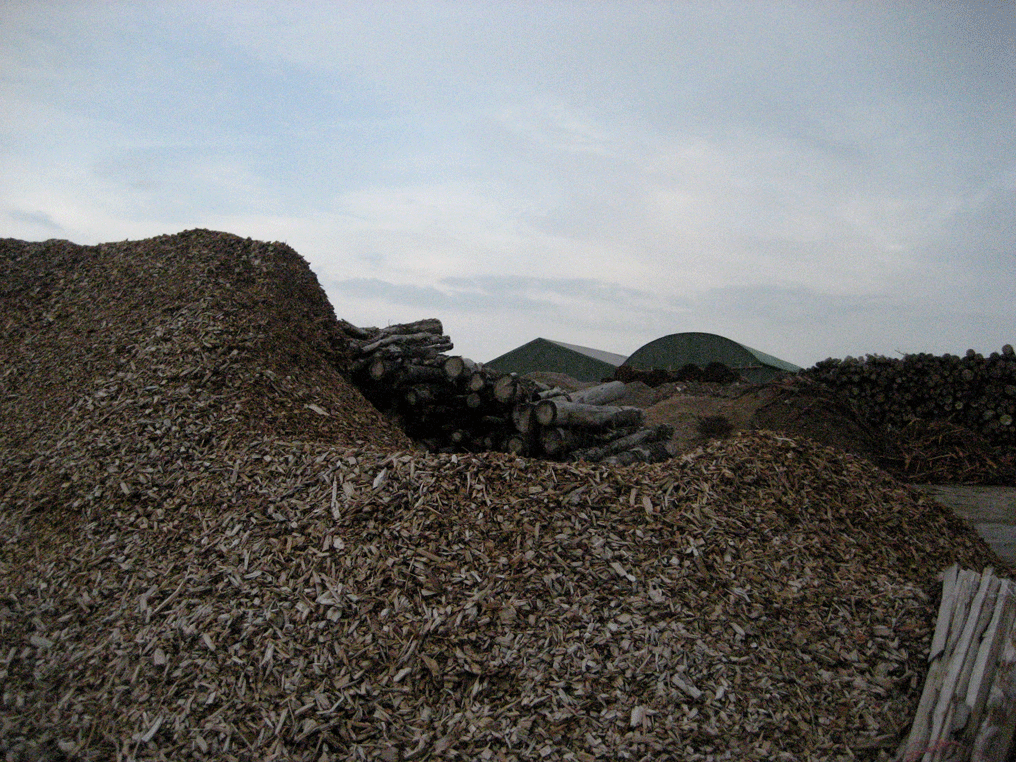
… or have been converted into a wood chipping factory.

A couple of primaries are missing on the left wing of this Barn Owl, however they don’t undergo a full moult until late summer so the feather has probably been lost accidentally.
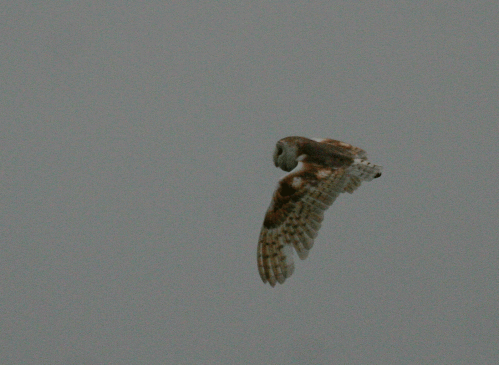
On the other hand, body and wing covert moult goes on all year, so these pale patches on the coverts are probably due to the pale bases of underlying feathers showing during the moult process.
We continued on to Lydlinch Common near Sturminster Newton and arrived just before dark. Our timing was perfect as a Nightingale started singing soon after we arrived and was still going strong when we left 30 minutes later at 2100. The bird was singing so close that its song was almost deafening but they can be so skulky that all I saw was a brief glimpse. The song of the Nightingale is one of the most complex and richest, not only in the UK, but in the entire world. A link to recordings on Xeno-Canto is included below.
http://www.xeno-canto.org/europe/browse.php?query=Common+Nightingale+%28Luscinia+megarhynchos%29+130&species_nr=jkzown

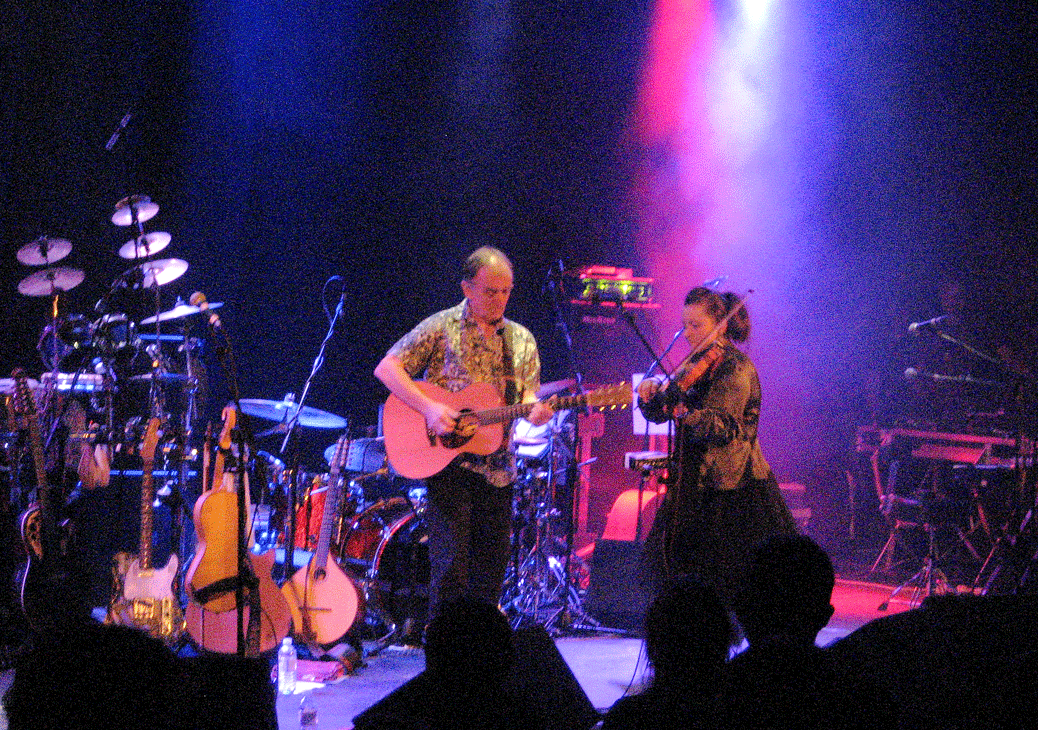
In the first set Eliza Carthy and father Martin play a duet. I saw Eliza at the Poole Lighthouse last year, but I first heard Martin (now 71) play in 1969 in an early Steeleye Span line up
On Thursday evening Margaret and I along with our friend Jessica Pietrangelo and her son Paul (Gio was back in Italy) went to the Electric Palace in Bridport to see The Imagined Village. This imaginative ten piece folk band was started by Dorset birder Simon Emmerson and has featured a number of folk legends in their line up.
Their music represents traditional folk music updated for today’s multicultural society, with a line up that includes a cello, sitar and Indian percussion along with the expected fiddle and double bass. Their music comprises of their own compositions, traditional numbers and old folk songs brought up to date, for example ‘My Son John’ a song about a returning amputee from the Napoleonic wars has now in Martin Carthy’s words has been ‘tweaked’ to include the current conflict in Afghanistan.
From Jackie Oates’ opening rendition of the tragic ‘Captain’s Apprentice’ to Martin Carthy’s encore, a slow version of Slade’s ‘Cu On Feel The Noize’ it was a wonderful evening that I most certainly recommend, whatever your musical tastes.

Fiddles at dawn! Jackie Oates and Eliza Carthy line up for a duel.
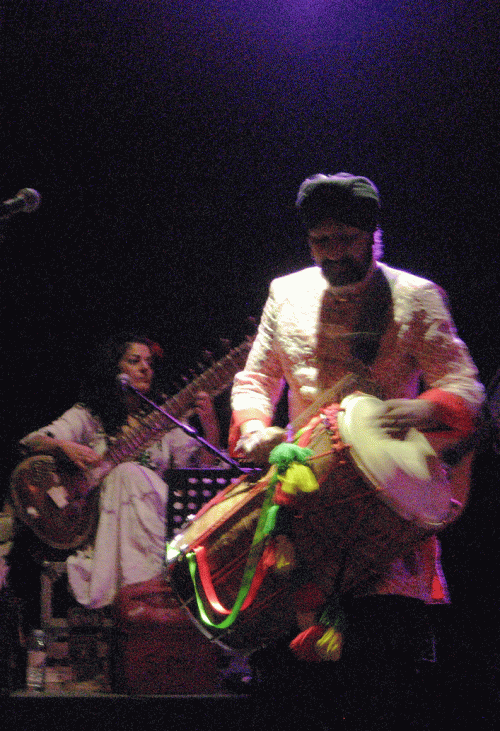
Sheema Mukherjee on sitar and Johnny Kalsi on percussion and dhol drums gives a wonderful Indian flavour to many numbers

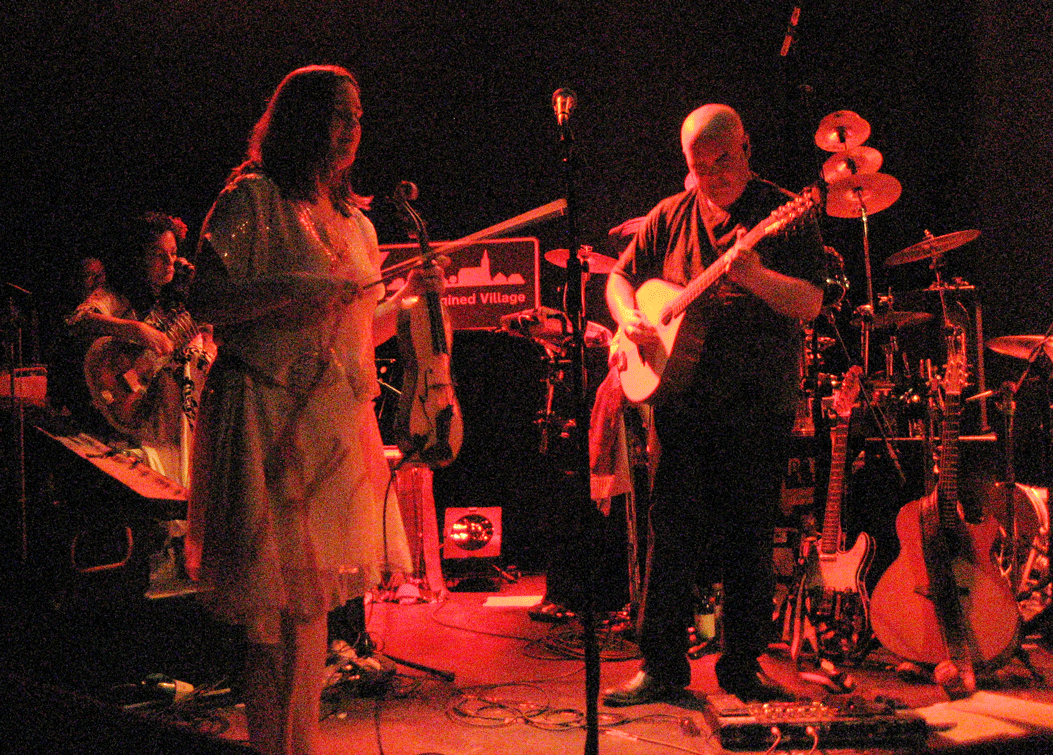
L-R Sheema Mukherjee, Jackie Oates and Simon Emmerson
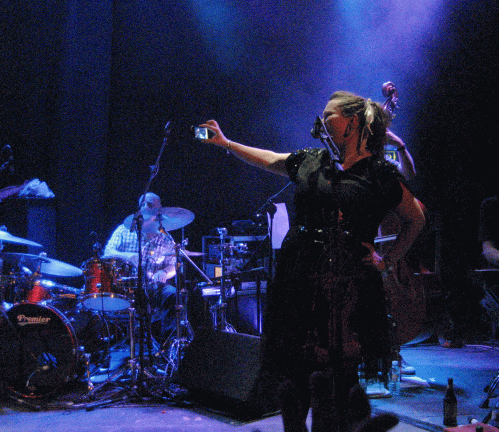
Eliza films dad singing a very slow version of Slade’s ‘Cum On Feel The Noize’ for an encore before joining in on the fiddle.

- Jackie Oates, Simon Emmerson, Marin Carthy, Ali Friend (bass), Simon Richmond (keyboards) and Eliza Carthy take a bow. Not featured in the photos are Barney Morse Brown (cello) and Andy Gangardeen (drums)
Regular readers of this blog may be forgiven for thinking that I must have gone into hibernation. The truth is I’ve been feeling a bit under the weather this week, but have taken the time indoors to reorganise and file several years worth of birding journals and sort out my large library of bird books. Just in time too as I found that the existing shelving is coming away from the wall and the whole lot is threatening to crash down on my PC.
I have also completed a job I should have done at the end of 2011, write-up my trip to Ethiopia last November. It’s all done now, if anyone wants a copy then please e-mail me.
I did escape to do some birding on Thursday. News of a Roseate Tern at Lodmoor in Weymouth had me heading there before you could say Sterna dougallii.On arrival I found that the Rosy had gone but as it may have just gone to Weymouth Bay to feed, I hung around. While I was waiting I had plenty of time to admire the 70+ Common Terns present, many of whom were involved in courtship feeding or were copulating, a group of a dozen migrant Sandwich Tern and a single Arctic Tern. The latter bird has been returning to this Common Tern colony for the past four years and attempts to breed with a Common Tern. There is something about this Arctic Tern that doesn’t look quite right, maybe it has a few Common Tern genes mixed in there, but I was having it as a year tick anyway (although they will be abundant when we go ‘up north’ so I don’t have to worry).

These artificial islands at Lodmoor have been highly succesful for breeding Common Terns. The ‘half pipes’ are to allow the chicks to shelter and avoid predation from Kestrels etc.

Terns at a colony undergo what is called ‘dreads’, suddenly all taking off together when there is no apparent predator on view.

Most terns do not return from their African wintering grounds until they are two years old. The bird on the lower left with a white forehead is a first summer bird that has returned early. This plumage was first noted at Portland many years ago and was called the ‘portlandica’ phase until it was realised it was just the normal first summer plumage. Behind the terns 1 Whimbrel and 2 Bar-tailed Godwits and an out of focus Dunlin the foreground.
On the basis that having seen the Arctic Tern then ‘one good tern deserved another’, I hung on for about two hours and eventually the Rosy was found on the mud behind the colony. Rosy’s are our rarest breeding terns, with small colonies in Northumberland and Ireland. Although a pair once bred on Brownsea, we see them almost entirely on migration and it was a pleasing addition to the year list.
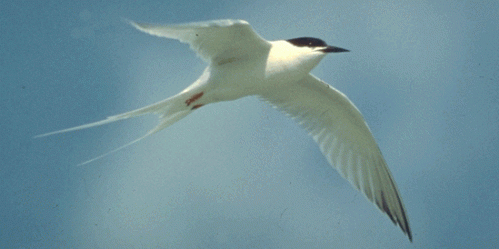
A black bill, sometimes with a reddish base, paler overall especially on the wings, longer tail feather with white outers and longer legs identify Roseate Tern. Only birds in breeding condition have the rosy flush to the breast. Too far away for photos, so I took this one from the Internet.
As I have said before, this is a funny spring, some birds arrived very early but most very late. For example,the Ospreys at Loch Garten were on eggs by 7th April and have chicks now, but migrant Ospreys are still arriving along the south coast in mid-May.
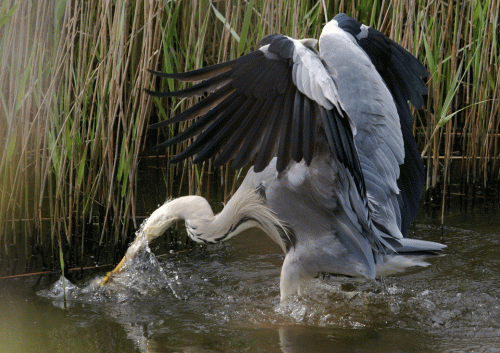
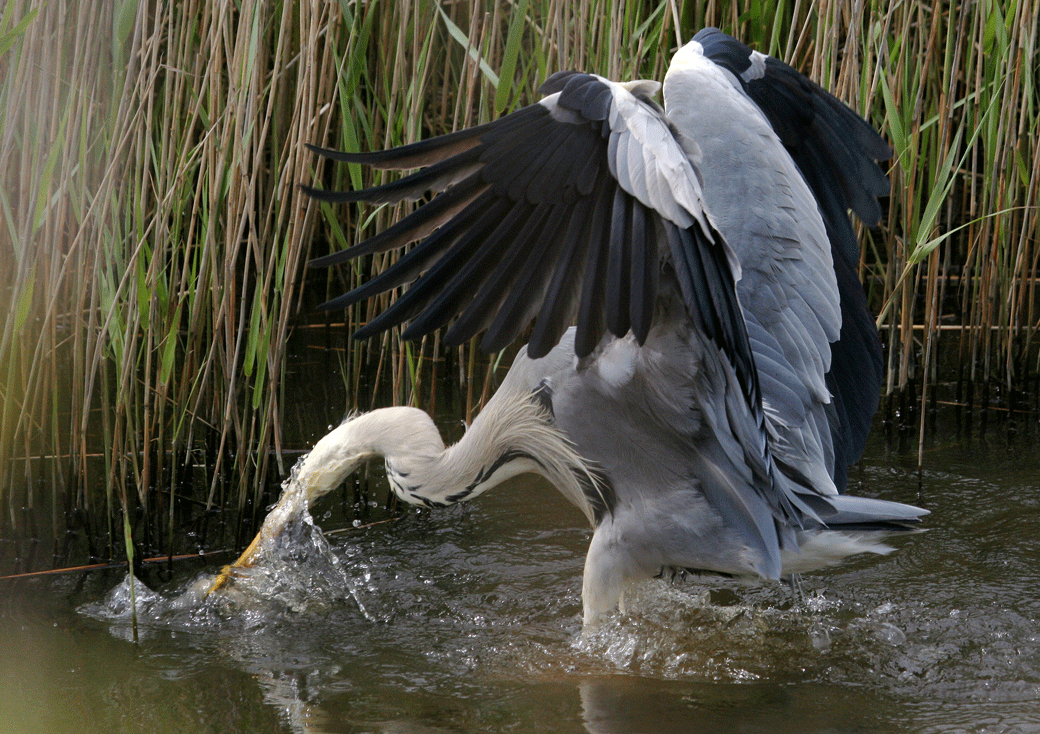
A great sequence from this Grey Heron whilst I was waiting. It lunges at an eel, drops it then tries again.The eel is speared but not held securely …….

…. in order to kill it, the heron flies off to dry land with the still struggling eel ……..
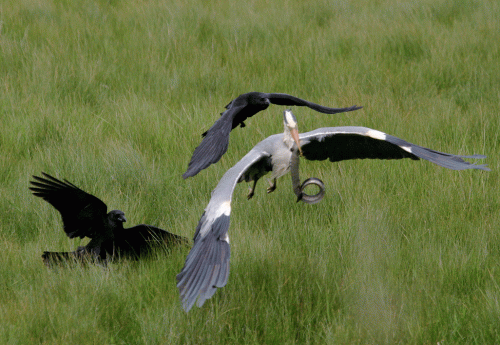
…. but having transferred the eel to between its mandibles, the heron is attacked by two crows who persist until the heron flies off ……….
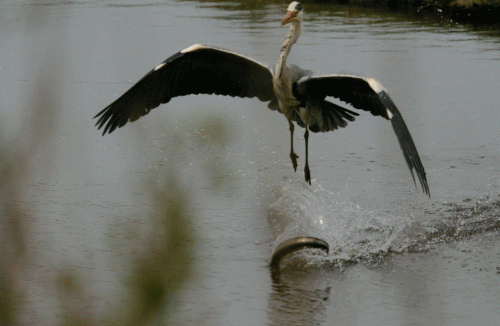
…. and ends up dropping the eel into deep water, end result, one dead or at least injured eel and three hungry birds!
Our granddaughter Kara has uploaded a clip of her singing ‘Perfect Two’ on YouTube.
Please do us a favour and click on the link below and then click ‘like’ It would mean a lot to her.

Kara and her guitar.
http://www.youtube.com/watch?v=NhOa9TAEiPs
Ian and Margaret
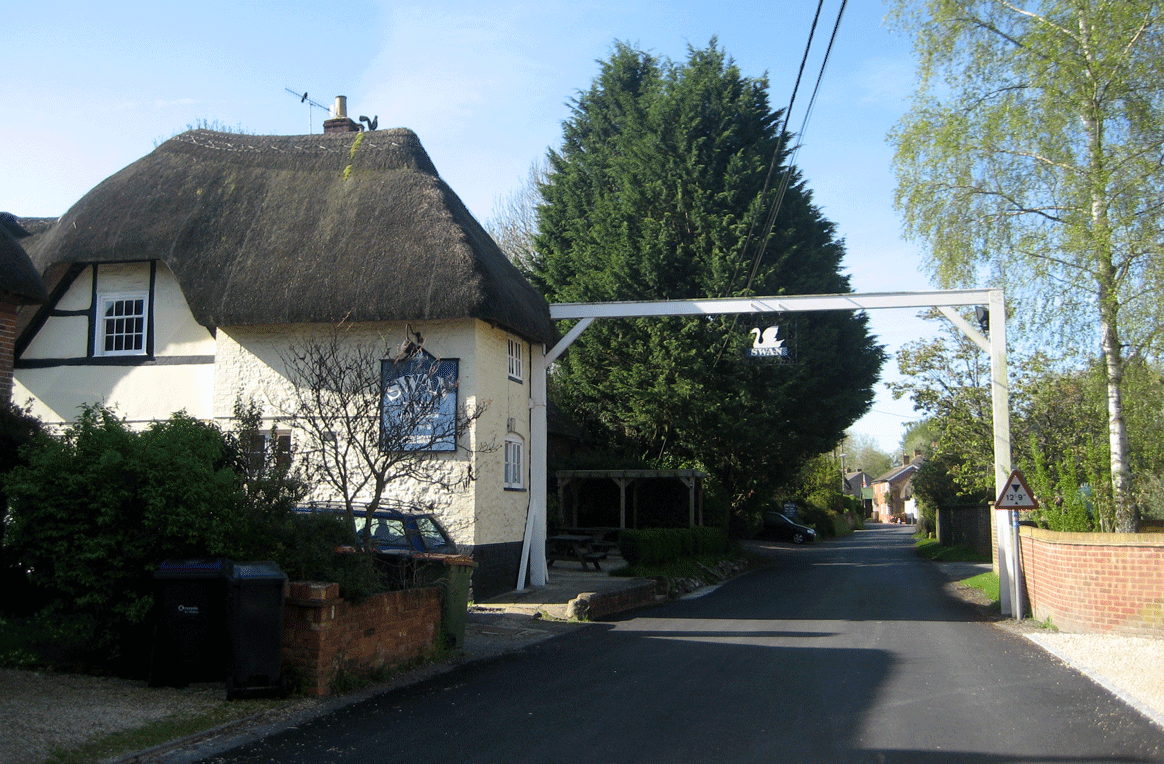
Today Margaret, Ewan and I went to see the Great Bustard re-introduction scheme on Salisbury Plain. My interest was two-fold, to see the bustards and to year-tick the Stone-curlews that nest inside the release pen. You are not allowed to search for the bustards yourself, partly to prevent disturbance and partly because it’s a military area, so we joined the guided tour that left the pretty village of Enford at 0930.
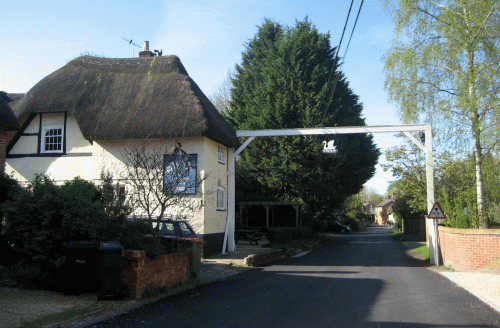
We joined the tour at the pretty village of Enford.
The re-introduction of Great Bustards to Salisbury Plain is not without its critics, some see it as unnecessary waste of money that could be spent on other aspects of conservation, others see that collecting Bustard eggs in Russia might damage the native population. Both criticisms are without foundation. Much of cost is privately funded through subscriptions or donations to the Great Bustard Group and eggs are only collected from areas where the nests would certainly be destroyed by agricultural processes. For more information on the scheme and how to visit see http://greatbustard.org/
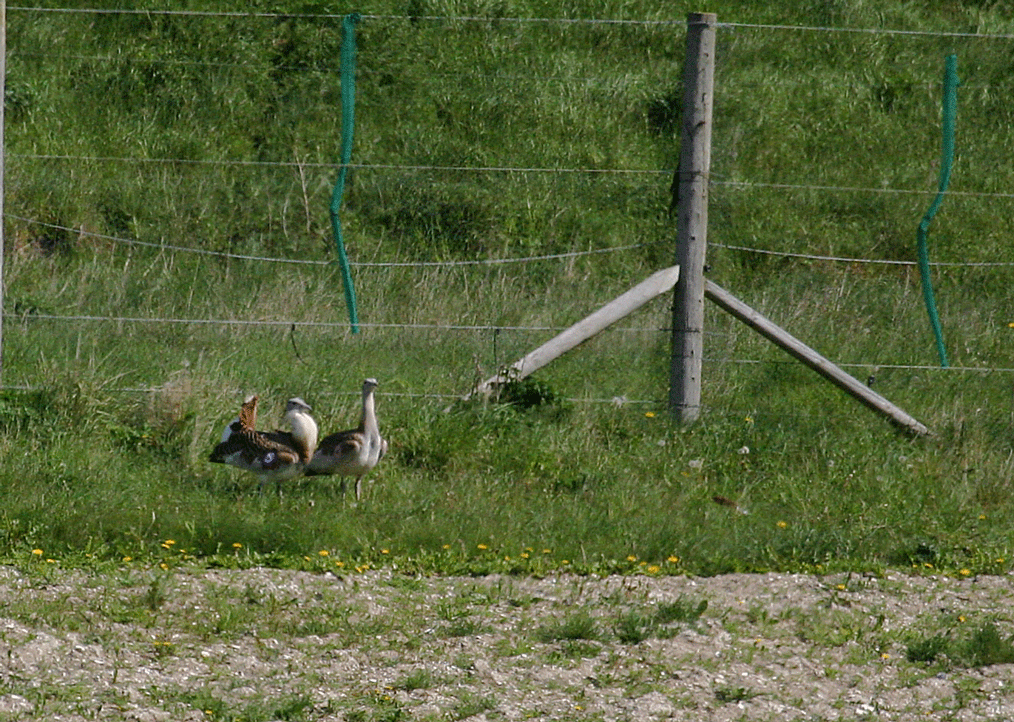
Although over 150 birds have been released over the last nine years less than 20 are known to still survive, although a few may occupy areas of the Plain that are completely inaccessible due to the high risk of unexploded shells. An 80% mortality is normal in wild reared populations mainly due to fox predation and the foxes on Salisbury Plain have taken their toll. Although several females have bred over the last few years it is not known if any young have reached maturity. One or two non wing-tagged individuals exist but they might be birds that have lost their tags. Several males have reached full size, about the size of a cock turkey, they at least are immune to fox attack.
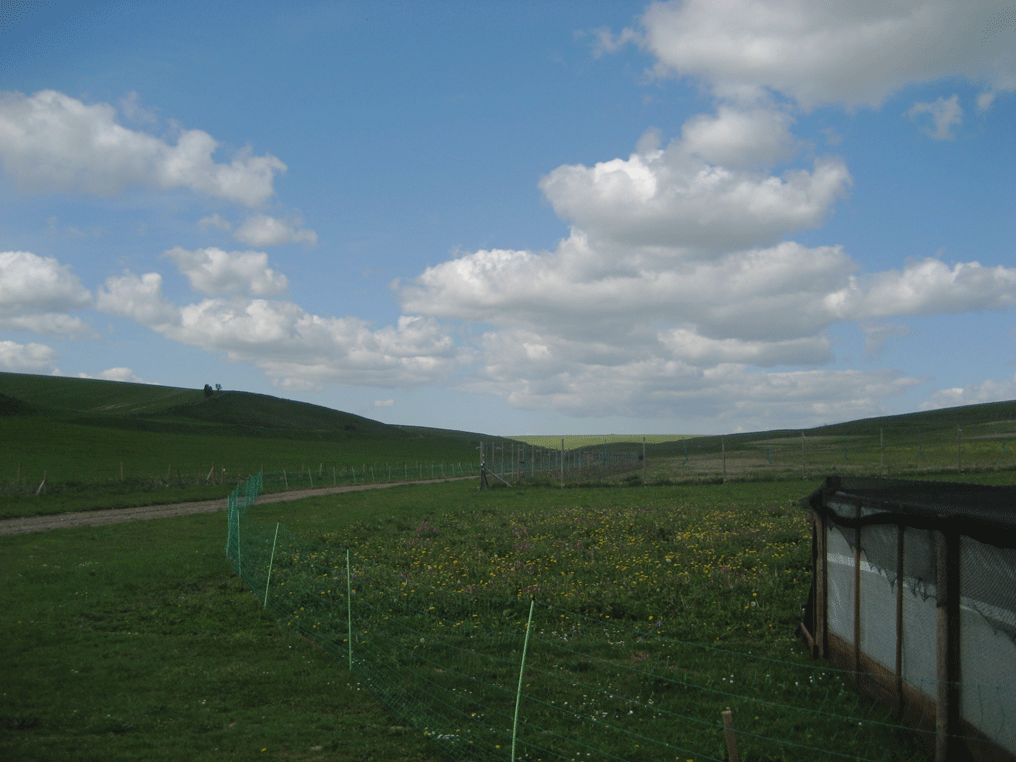
The release pen is not a cage, the birds are free to come and go as they please, but it is fox proof and the area is planted with the crops they prefer. There are also decoys to attract the birds, which are sufficiently realistic to cause the big male to mate with them. Currently five males, a five-year, a four-year and three one-year olds regularly using the release pen and can be seen from the hide that overlooks the area. It is hoped that most of the females are on eggs somewhere.
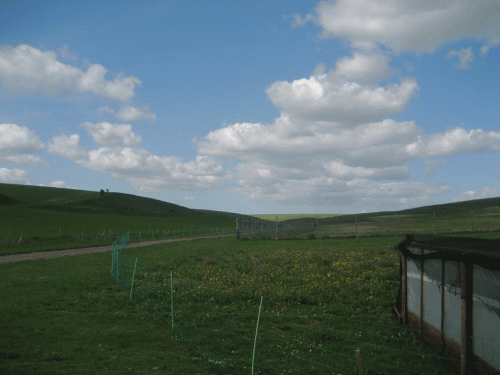
The release pen from the quarantine area. The viewing hide is on the hill to the left.

All five birds were by the rear fence of the enclosure. The big male, challenged by the younger male took one of its tail feathers …………..
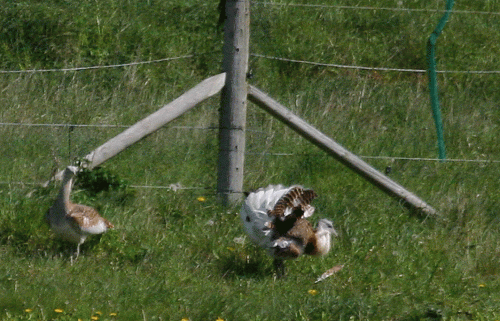
…. and then proceeded to peck and shake the feather repeatedly before starting to display …..

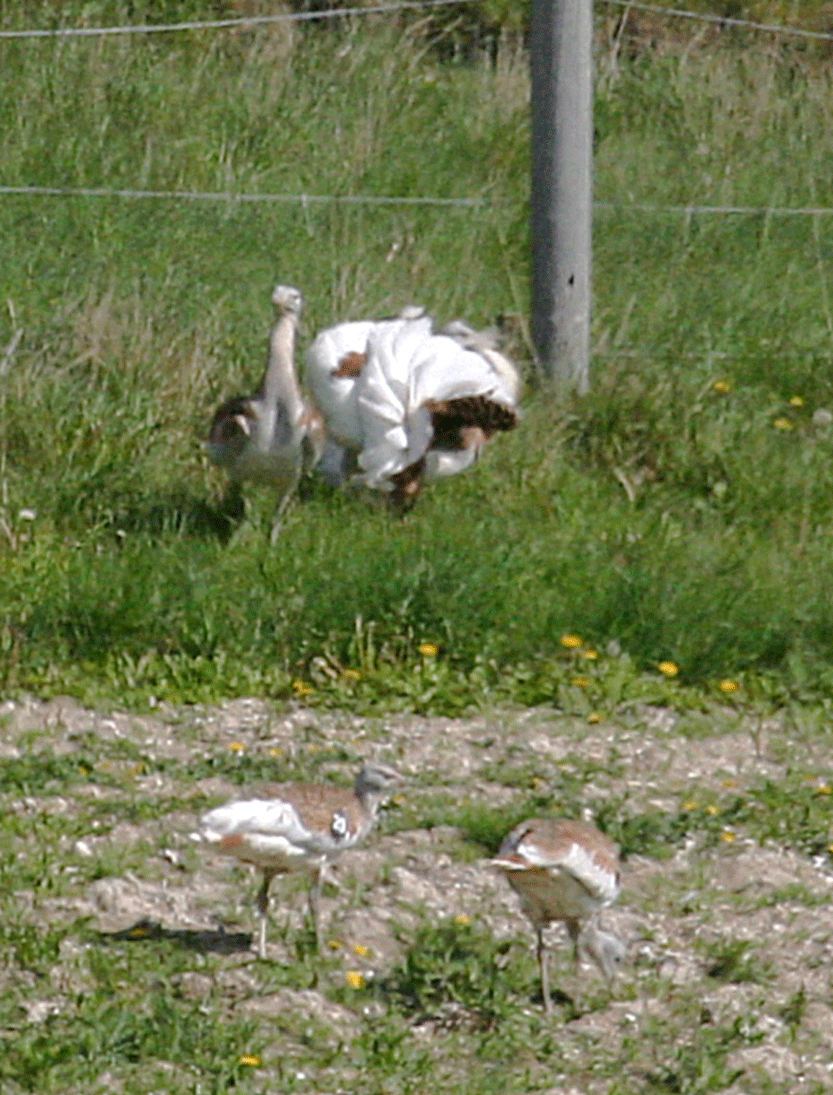
…. and turned ‘itself inside’ out in the famous ‘foam bath’ display. There is no doubt who is in change on the Plain. Two of the one year old males can be seen in the foreground.
A pair of Stone-curlews take advantage of the fox proof enclosure. This poor digiscoped shot shows the distant pair with a single pullus between them.
During the evening Margaret’s friend Jenny came round for a meal after attending a music workshop nearby. Jenny came on our South African trip in early 2011 along with my friend Ewan.

Margaret and Jenny absorbed watching ‘Countryfile’
We had another ringing attempt at Durlston, with six of present we decided to ring at both sites. I was lucky and went to the best area, the goat plots which was sheltered from the cold northerly breeze. We trapped 19 birds whereas Shaun and Bob in the garden, only caught five (although that did include a Carrion Crow and Garden Warbler). Our best birds were a Redstart, Spotted Fly and a Green Woodpecker.

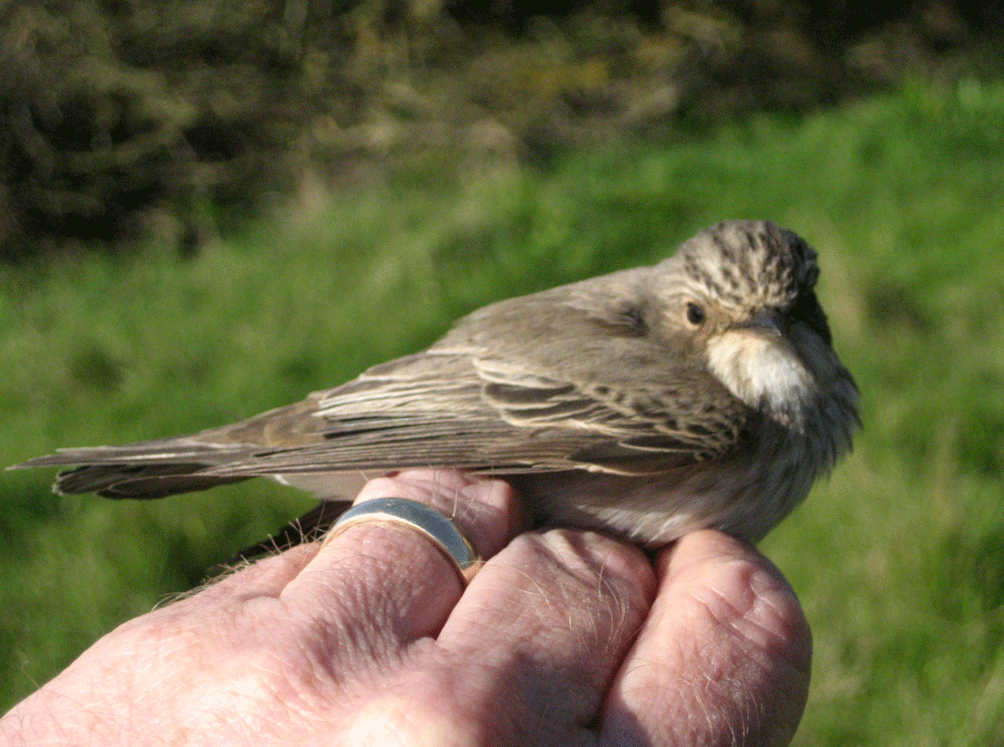
One of the last migrants to arrive in spring. We only trapped one Spotted Flycatcher last year.

This Green Woodpecker was caught with its bill was stuffed with ant larvae. The red in the moustachial stripe identifies it as a male.
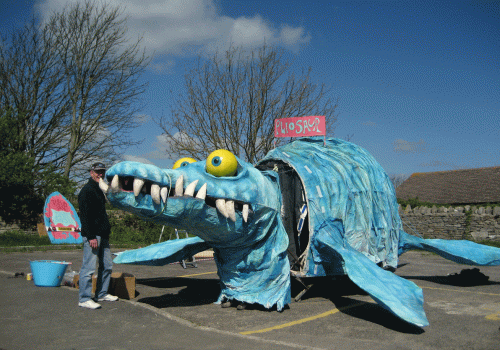
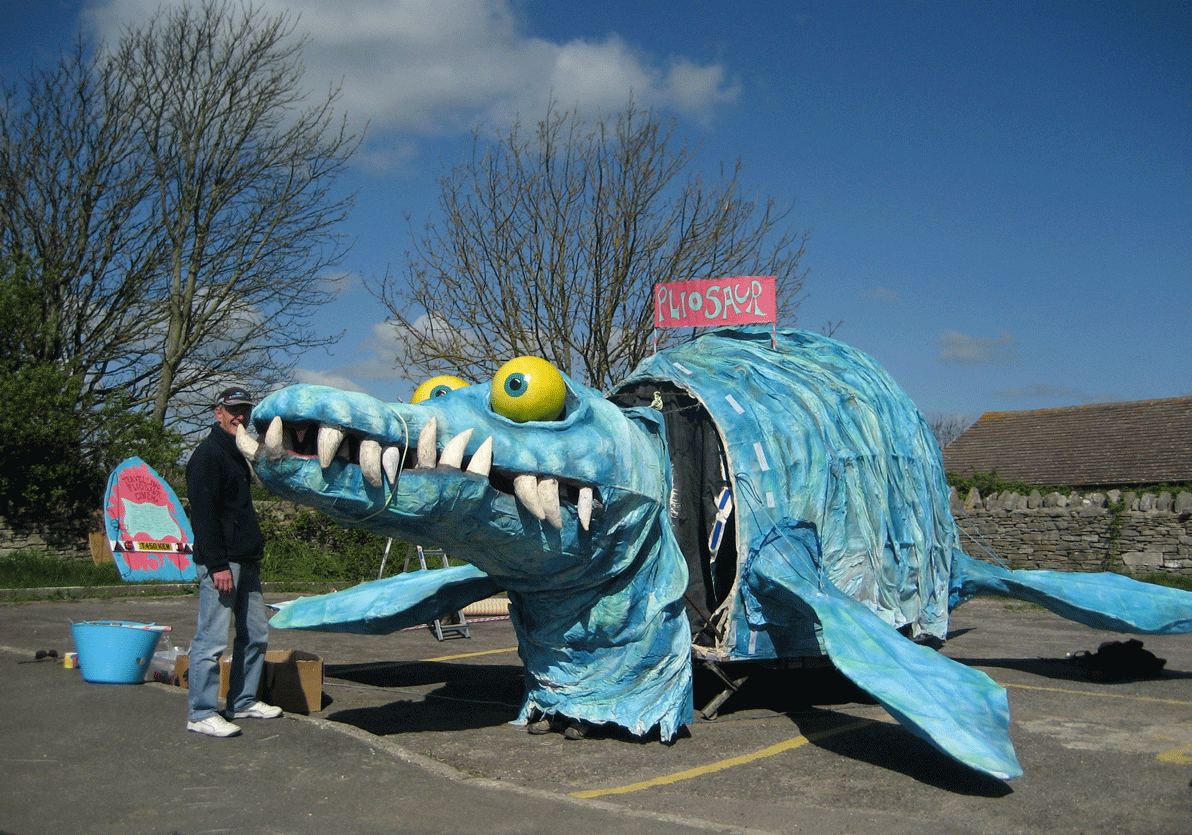
This model Pliosaur contains a little cinema and is touring the area to promote the Jurrasic Coast. I never knew they were bright blue with yellow eyes.
By the time we left at around 1030 it had turned into a warm and sunny spring day, quite unlike the conditions early on. Back home I heard of a Woodchat Shrike at Keyhaven but I was so tired after my 0430 start that I couldn’t face the hour-long drive in traffic. After forty winks and some supper I finally left for Keyhaven at about 1800 and saw the bird distantly from the car park. Woodchats are annual overshoots from the Mediterranean to Dorset and Hampshire but most records are in the spring. I’m glad I made the effort for this one.
This is a a digiscoped image of the Woodchat (the pale dot on the left of the bush) which just shows how distant it was.
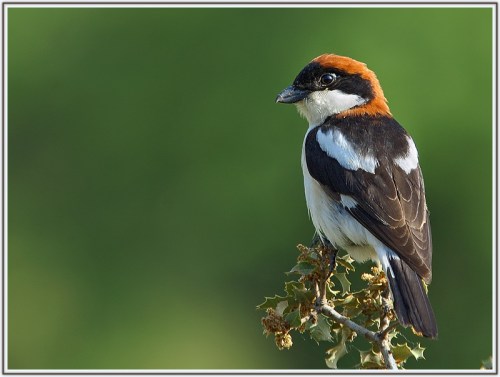
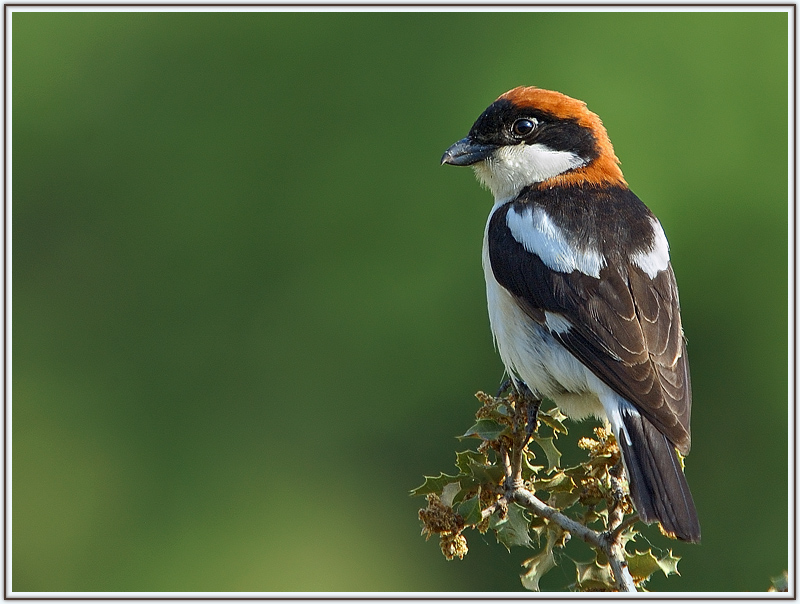
A much closer and sharper picture of a male Woodchat Shrike. Photo from the internet.
I met an old acquaintance there, Ron King, who I have known since the late seventies. Recovering from heart surgery, he is still a keen twitcher, indeed he had just returned that day from East Anglia after twitching an apparent Pacific Swift that wasn’t. He told me of a Wood Sandpiper that he had seen the day before at nearby Pennington marshes so I quickly drove around and although the light was fading, had good scope views of my second year tick of the evening.

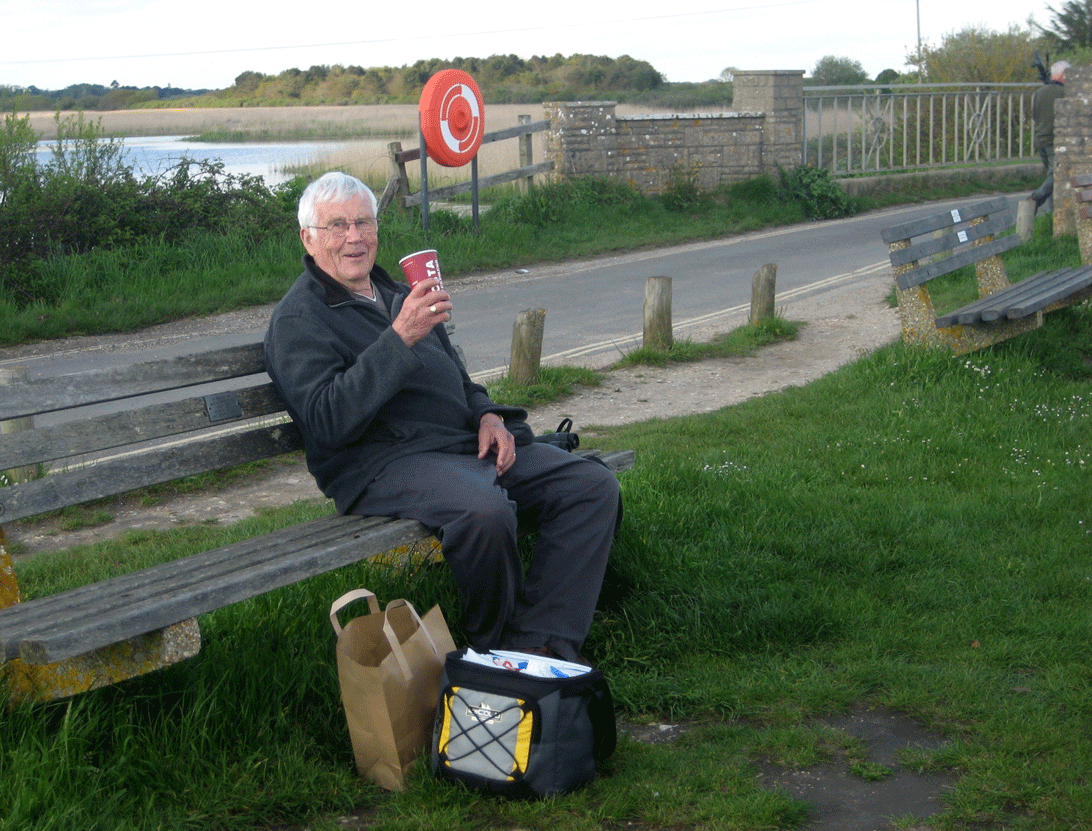
Ron King aka. ‘Chunky’

A digiscoped shot of the Wood Sandpiper. Wood Sands are only encountered on migration and are much commoner in autumn than spring.
There were many birds around, singing Whitethroats, screaming Swifts, a few Bar-tailed Godwits and Whimbrel overhead and best of all a Short-eared Owl over one of the wet fields.
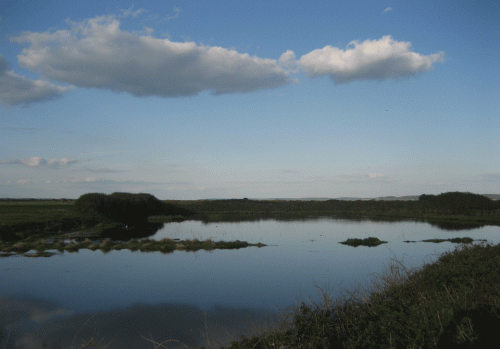
Late evening at Pennington
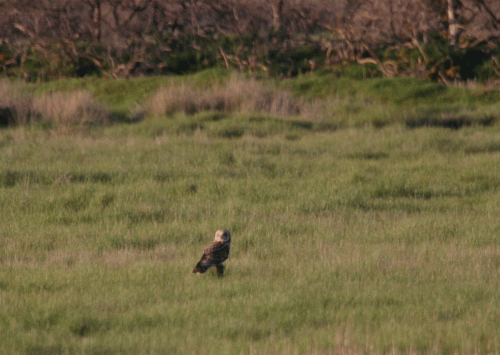
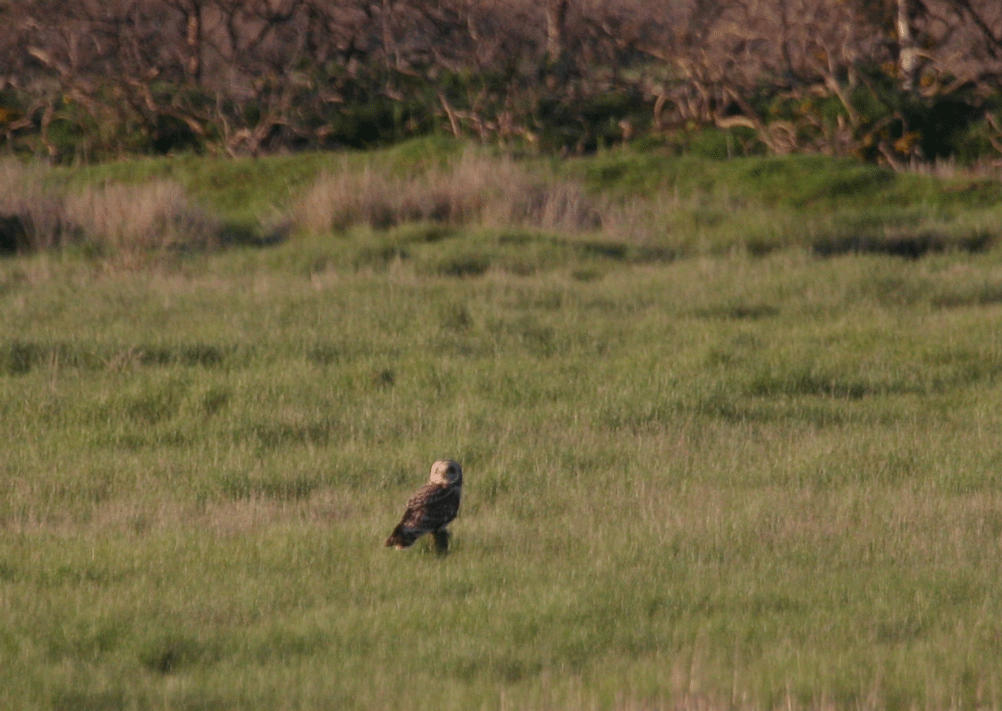
This Short-eared Owl flew off whilst I struggling to get my camera on the tripod!
Amber was staying with us, as Janis and Andy were away for the weekend (Kara was staying with friends), I was back at 2100 to find Margaret and Amber engrossed in a program about a competition to turn celebrities into operatic conductors.
On the evening on the 8thwhilst Margaret went to choir practice, I decided to go birding at Longham Lakes. An unusual race of Yellow Wagtail had been seen that morning but I didn’t expect it still to be there. On arrival I found that a group of canoeists were using the large lake and nearly all the waterbirds had moved onto the small lake. Light was fading but I managed a few photos of birds you don’t usually see in flight like Coot and Great Crested Grebe.
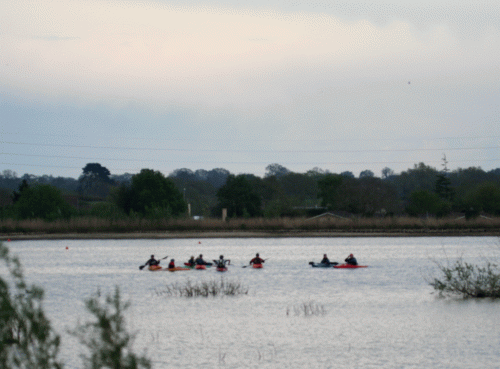
I’m sure they have as much right to use the lake as fisherman or birders, but these canoeists certainly disturbed the waterfowl.
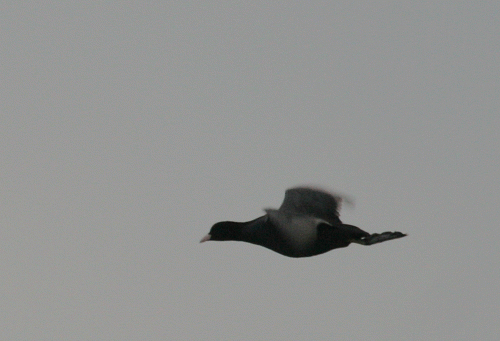
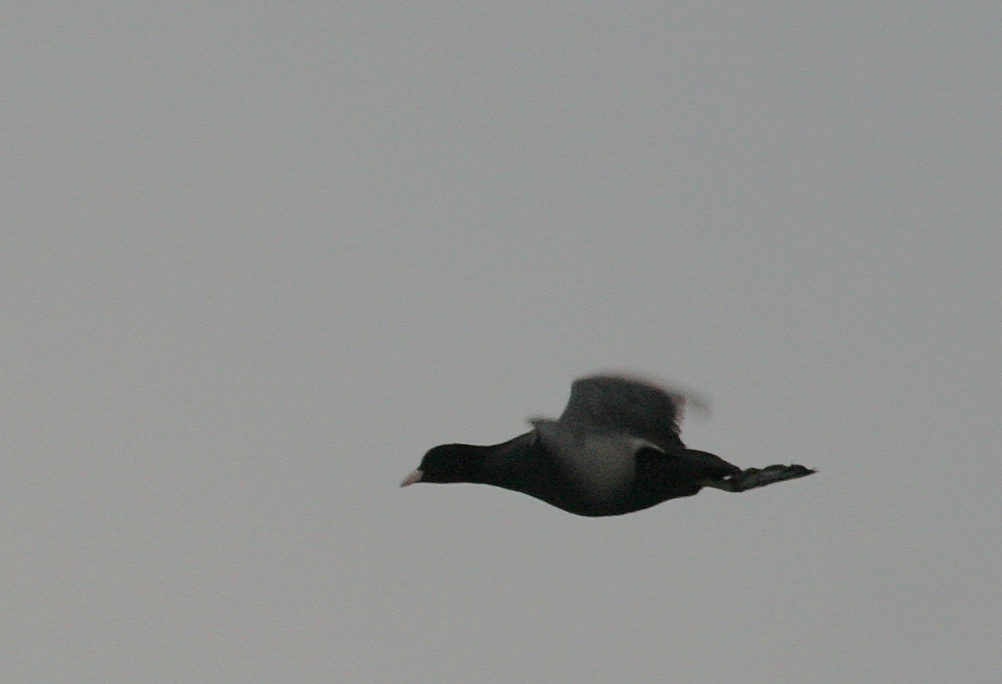
You seldom see Coots flying more than a few feet above the water. Large numbers arrive in winter but I have never seen any on migration.

A poor photo in poor light but it goes does show how ungainly Great Crested Grebes can appear in flight.
Walking back along the causeway a number of Pied Wagtails flew off, presumably to roost and with them was an unusually looking Yellow Wag, presumably the bird in question.
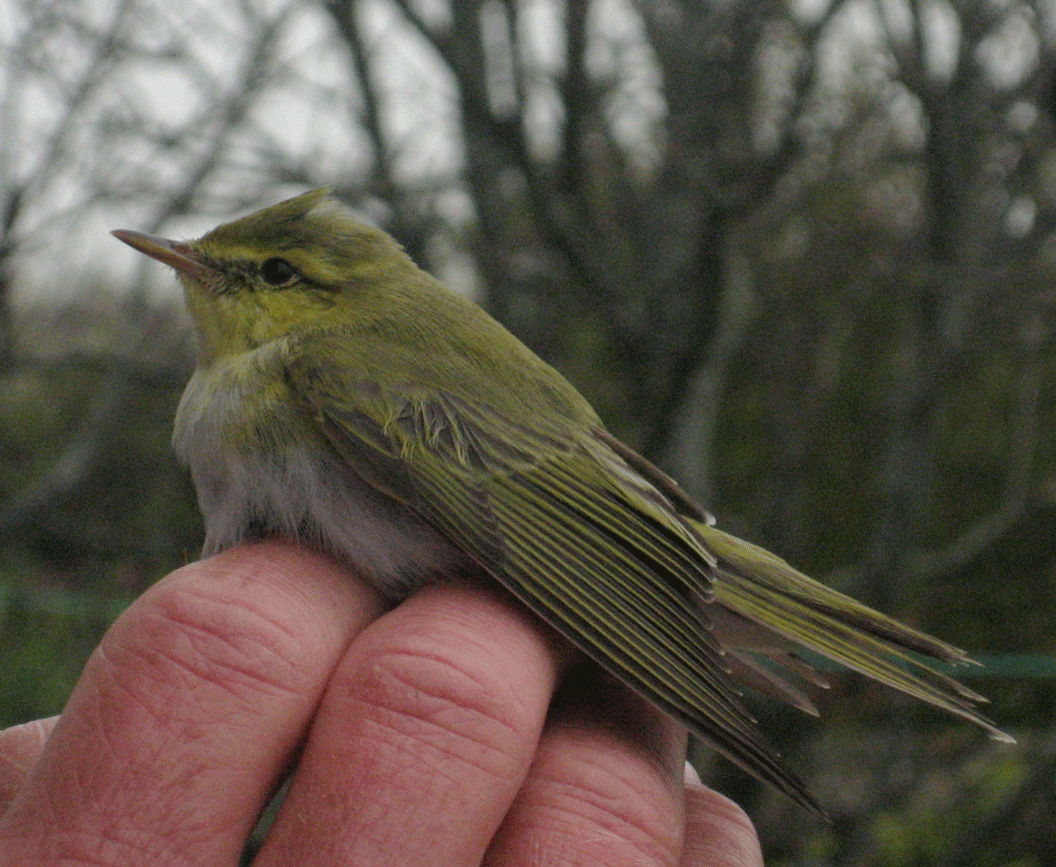
Late on the 9th a vagrant Subalpine Warbler was found at Portland Bill (see http://www.portlandbirdobs.org.uk/) but I was meeting Margaret after work and decided to leave twitching it until tomorrow. On the 10th the weather at Portland was foggy, you couldn’t even see the sea from the Observatory and of course the fog horn blew all day. There was no sign of the Subalpine, although one person may have heard it near the Obs and another may have glimpsed it, however I had compensation in the form of a Wood Warbler that had been trapped moments before I arrived.

The largest of our Phylloscopus warblers, the Wood Warbler is regular in small numbers in ancient woodland, but is seldon seen on migration.

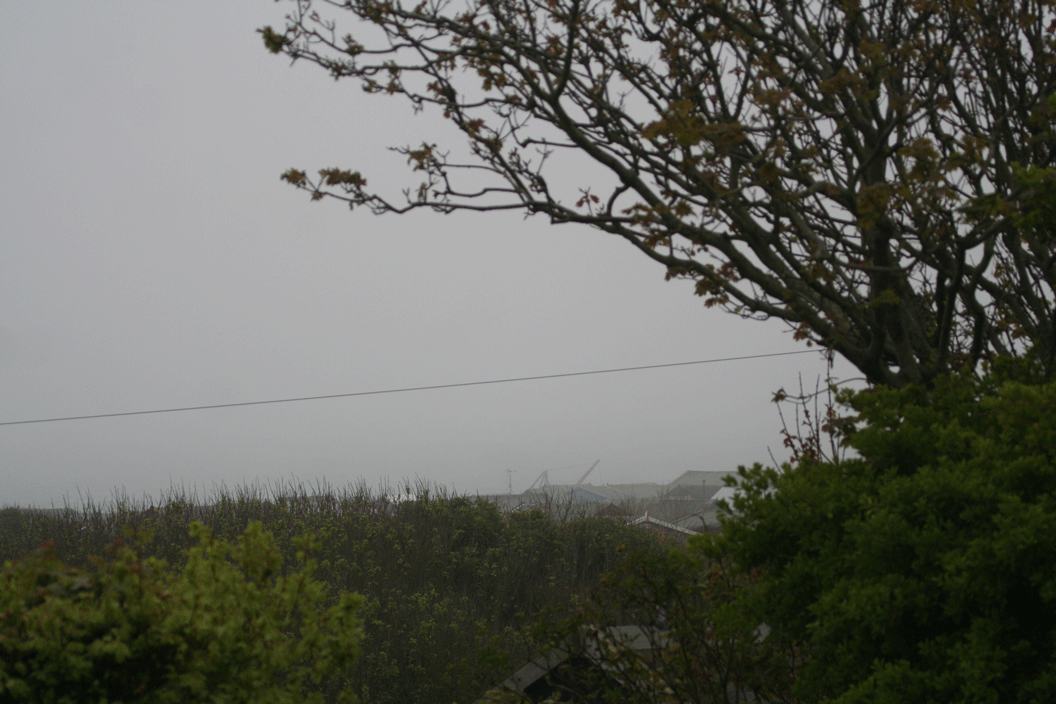
It was hard to see the hut fields, let alone the sea from the Observatory patio
As Martin and Pete were the only ringers, I asked if I could participate and Martin suggested I open the six double panel nets that were furled up in the fields opposite the Obs. I didn’t catch many birds, about a dozen – several of which were retraps, but the selection, Blackcap, Whitethroat, Sedge and Willow Warbler was nice. The ringing session was stopped by a sudden downpour in the early afternoon.

The Crown Estate Fields opposite the Obs are managed for birds. This crop of kale provides cover and invertabrate food for migrants.
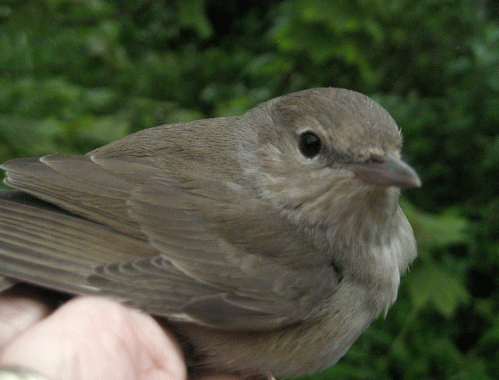
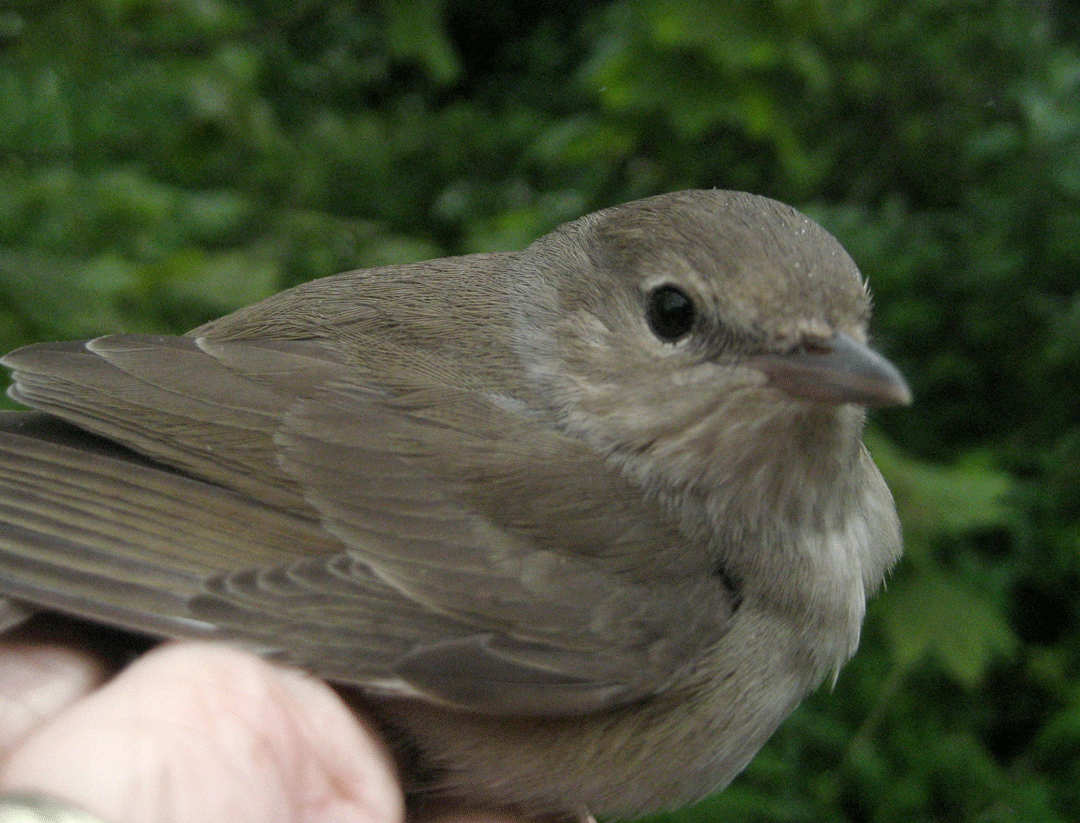
Perhaps the plainest of UKs warblers, but Garden Warblers have a certain charm.
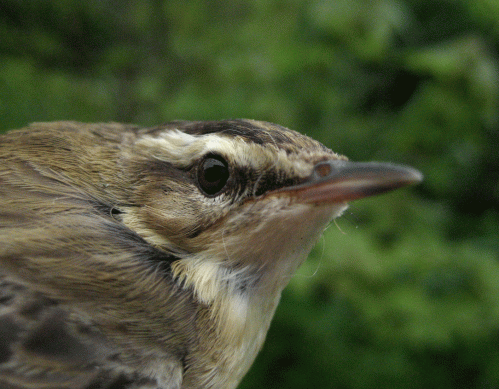
Sedge Warblers are usually encountered in wetland habitats but can be seen on migration in scub and low vegetation.
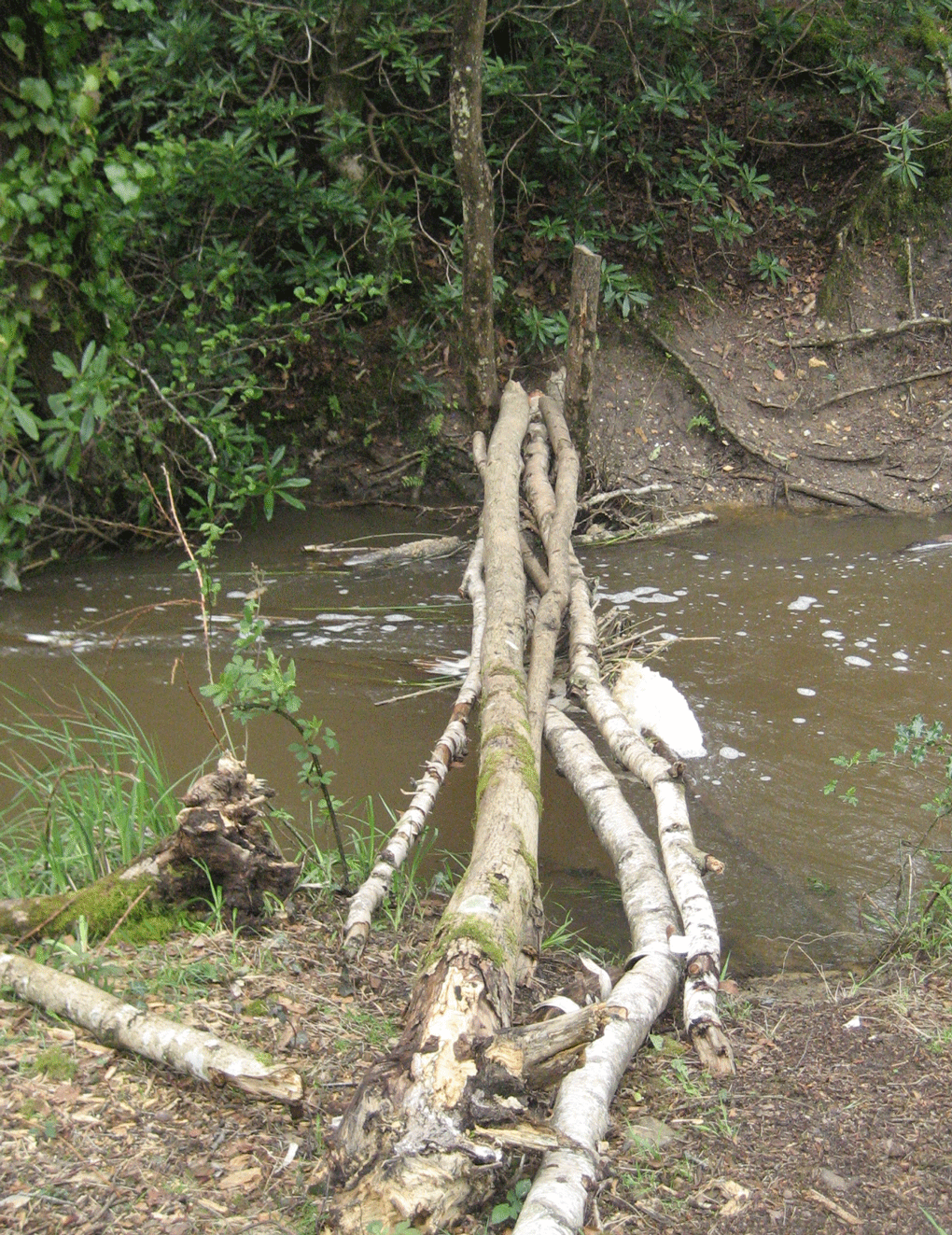
I spent the morning of the 11th at Sherford Bridge / Mordon Bog. Good birds included a couple of Cuckoos (the first I have seen this year), two Hobbies and a pair of Peregrines. There were plenty of Blackcaps and on Mordon Park Lake Great Crested Grebes were incubating on their floating nests. The outflow was very strong and although I tried to cross the nascent River Sherford on a stick bridge, I thought better of it half-way across and had to go the long way round.

The River Sherford is flooding the surrounding area.
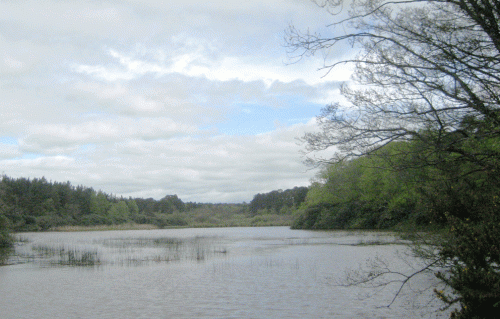
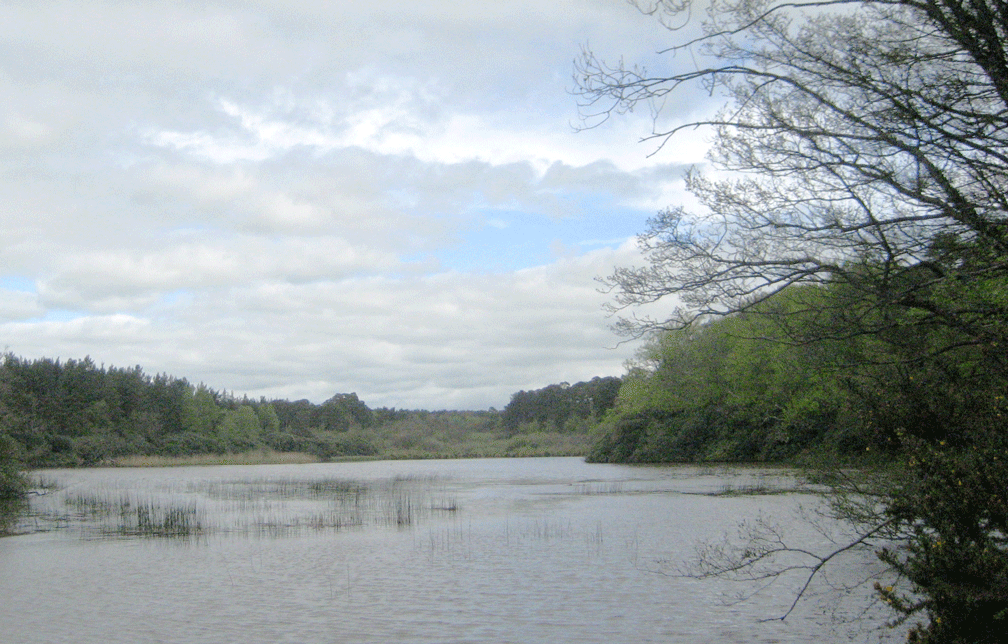
Mordon Park Lake, a secluded refuge for water birds.

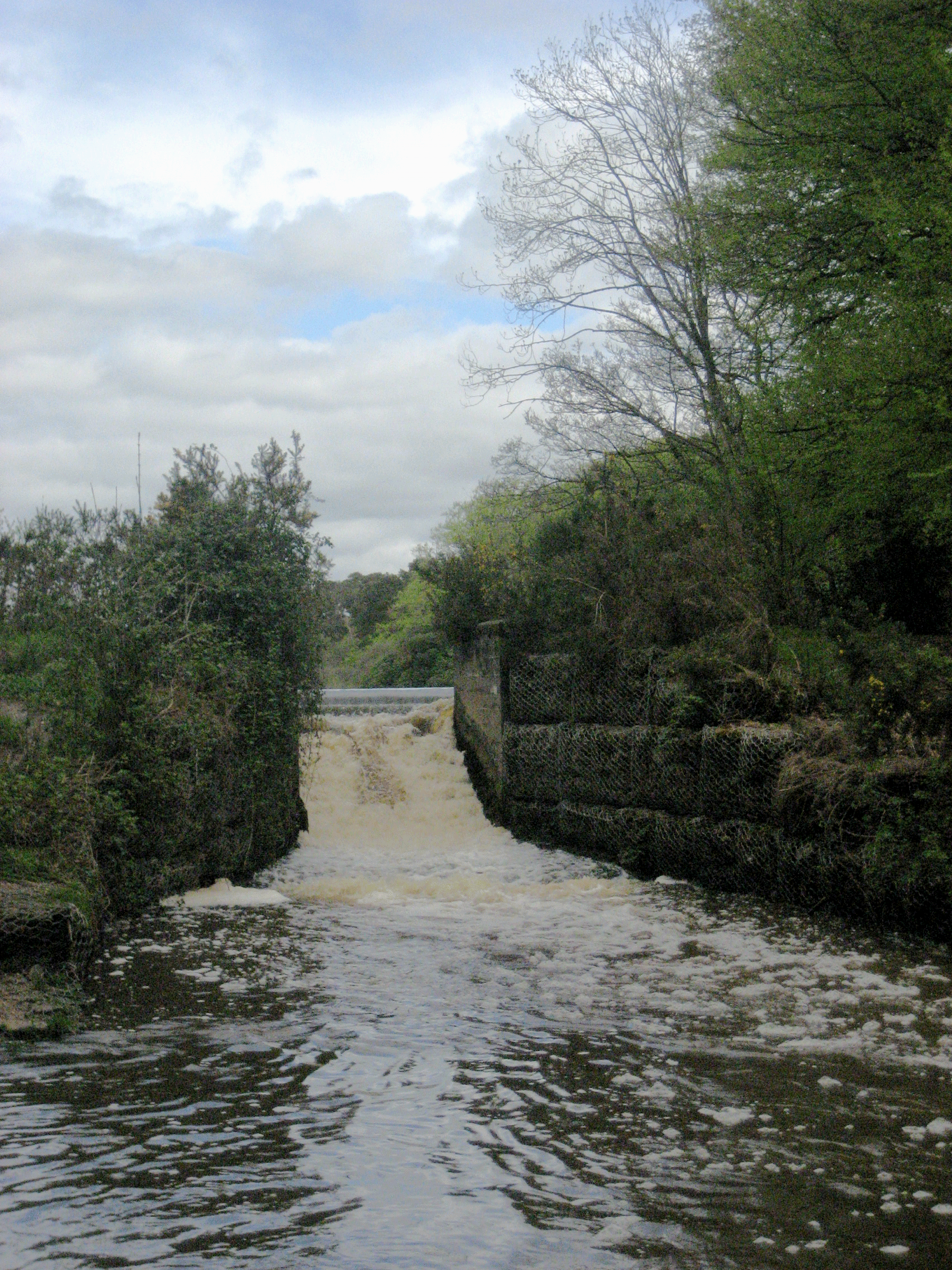
The outfall from the lake, was flowing at full force.

Without anything to hang onto crossing this bridge was difficult and I gave up half way across.
I heard that a Golden Oriole had been ringed at the Bill and I was sorely tempted to head there but Orioles usually move on quickly. However it was seen a couple of times afterwards and if I had gone immediately I might have seen it.
On the 6th I joined Ian Alexander and his colleague Sarah for some ringing at Durlston. Again it was cold with a stiff north-east wind and low cloud. We didn’t catch many birds, 13 to be precise but it was enough to demonstrate some ringing to Sarah. Interestingly we have trapped 14 Common Whitethroats this year, 5 of which have been retraps from last year, showing a high degree of site fidelity. Other good birds seen included two Hobbies and two Black Redstarts.

The first Reed Warbler we have ringed in 2012. This species has an extended migration period with some birds still arriving in June.

This female Blackcap has compacted pollen above its bill picked up on refueling stops on migration. A study is underway to identify the plants concerned and if possible their location.
On Sunday evening we invited Nick and Jackie Hull round for a meal. They moved from Fordingbridge to Upton just three days ago and we thought they would appreciate an evening away from unpacking. We had a pleasant evening discussing many aspects of birding and travel.
Nick and Jackie run a local birding company called TwO Owls Birding, see http://www.twoowlsbirding.co.uk/www.twoowlsbirding.co.uk/Home.html
All of Monday was spent doing jobs at home. Janis, Andy, Amber and Kara, on hearing there was cottage pie and apple crumble on offer, came round for dinner.
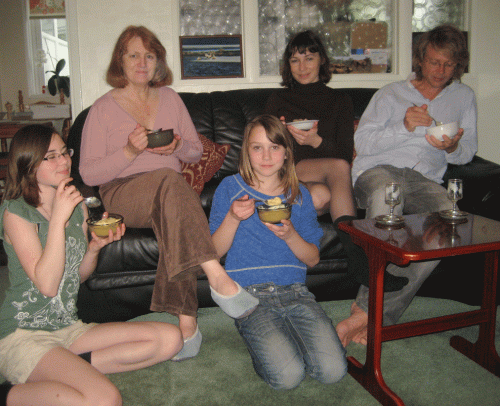
I know its stating the obvious, but Amber and Kara are look more grown up every time I see them.
With rain overnight and the wind dropping to a light southerly breeze, the 8th promised a lot, but delivered little at Durlston. As on Sunday we ringed few birds, but we did retrap both the Lesser Whitethroats we have caught this spring and showed them to be a breeding pair.
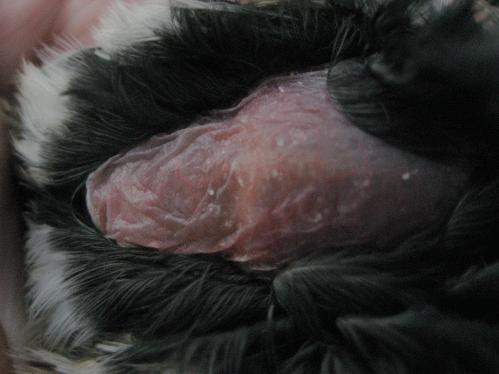
Some birds can be sexed on plumage and others on measurements, but in spring most female passerines lose belly feathers and form a vasculated brood patch to aid incubation, this allows almost all species to be sexed at this time. This Dunnocks brood patch was hard to photograph as with the camera in the way I couldn’t blow on the belly to reveal the patch!
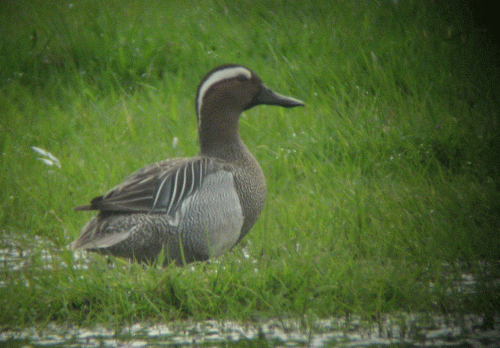
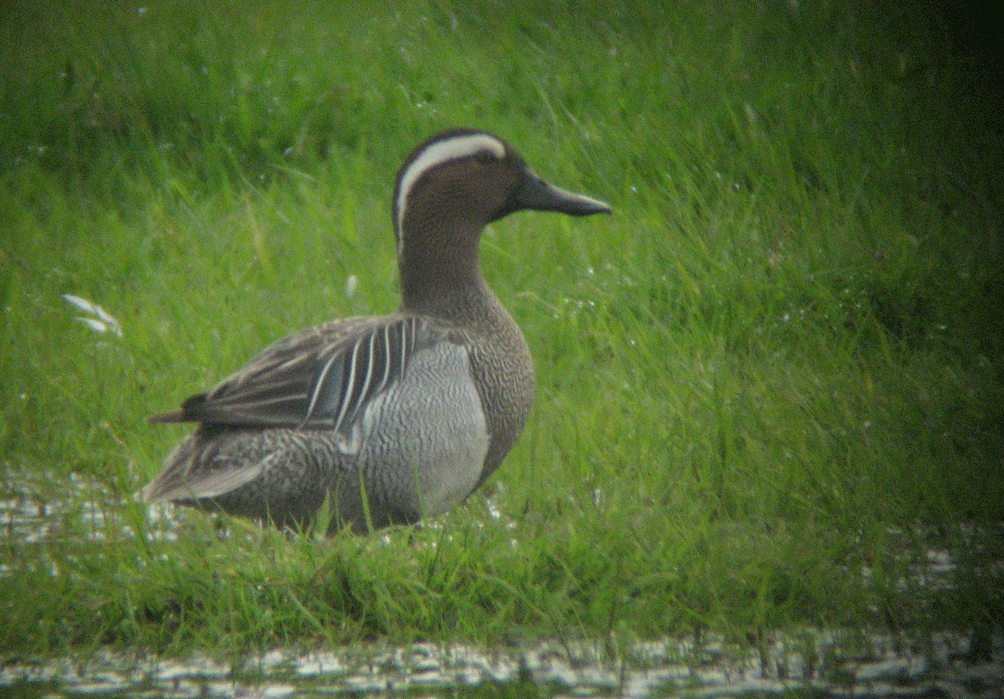
I called in to Swineham on the way home and had great views of this Garganey male and also a Hobby.


























 gryllosblog