Archive for the ‘Uncategorized’ Category
This is the fourth (of five) blog posts about my tour of Western Australia, in addition there is a post on Christmas Island which was offered as a pre-tour extension.
The post covers our journey along the Gibb River Road from the town of Derby (close to Broome) to Kununurra near the state border with the Northern Territory.

As I mentioned before all of the journey was on dirt roads, this was particularly tricky if you were in the second vehicle and were driving into the sun (as we were driving to the north-east this occurred in the morning).

Guess which vehicle was in the lead and which was following!
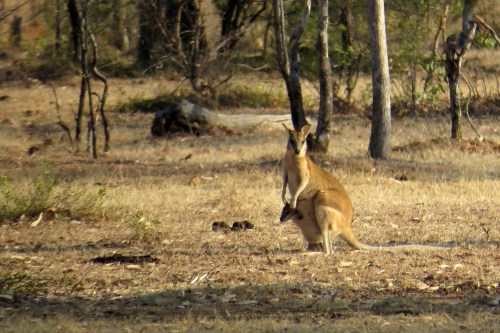
We had spent much of the morning birding in the Derby area so the afternoon was taken up with the long drive to Mt Elizabeth Station. We arrived at 1700 so there was only a short time to had time for bird around the guest chalets, but we did see a number of Agile Wallabies ….
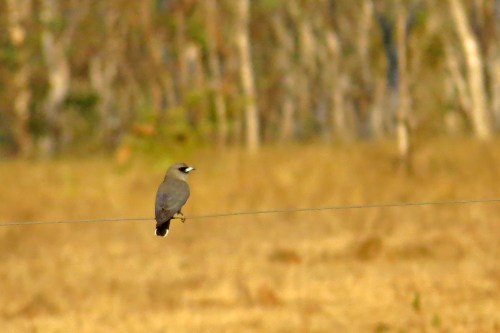
…. and Black-faced Woodswallows.

The following morning near the Station we saw our first Silver-backed Butcherbirds. Formerly lumped with Grey Butcherbird which replaces it to the south, this species is actually more closely related to Black-backed Butcherbird of New Guinea and the Australia’s Cape York Peninsula.
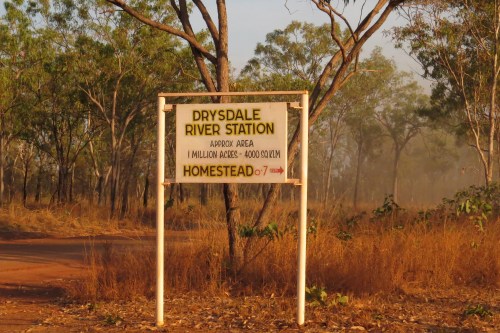
We birded along the Gibb River Road the following morning and then turned north on the Gibb River-Kalumburu Road. We arrived at our accommodation at Drysdale River Station mid-afternoon (a ranch of a mere million acres) but didn’t stay long as we had some birding to do at a nearby billabong ….

…. but the sign that greeted us as we left didn’t fill us with confidence!
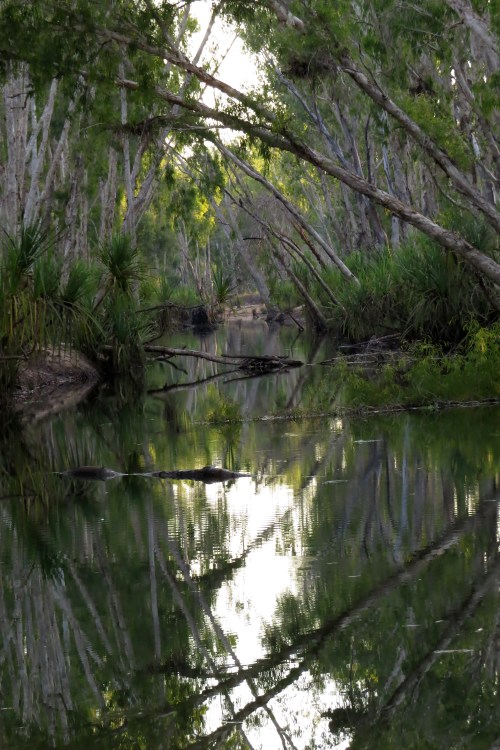
The partially dried up river bed (or billabong ) was a great place to bird.
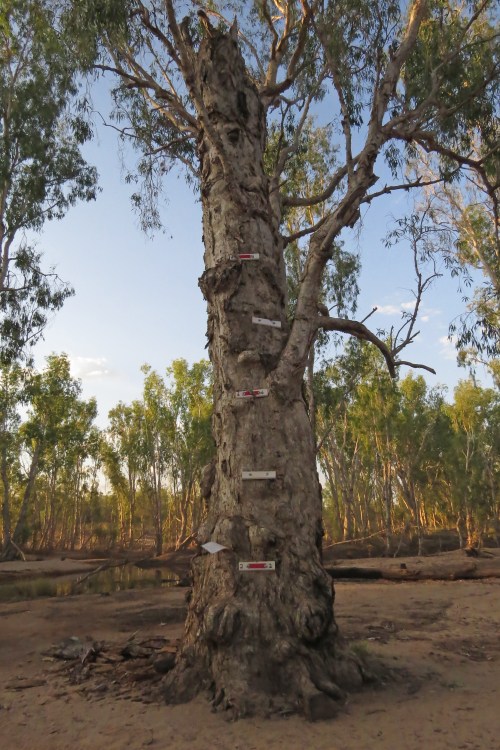
The water levels were low but marks on a tree by the river bed reminded up of just how high the flood water can reach.

The area was home to several species of kingfisher, Sacred ….

…. and the diminutive Azure.

Also during our travels in the north we came across a number of the enormous Blue-winged Kookaburras, one of the largest kingfishers in Australia.

Along the edge of the billabong we saw some Paperbark Flycatchers, a recent split from Restless Flycatcher and named after the paperbark trees of the northern woodlands.

Our main target was the exquisite Purple-crowned Fairy-wren a declining species that has become quite hard to find in recent years.
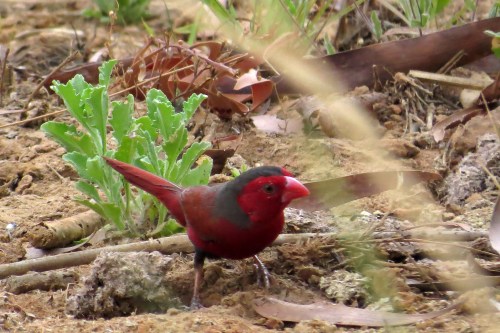
Crimson Finches …
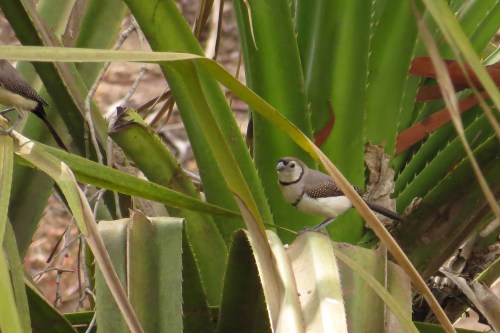
… and Double-barred Finches enlivened the proceedings.

We stayed on till dusk …
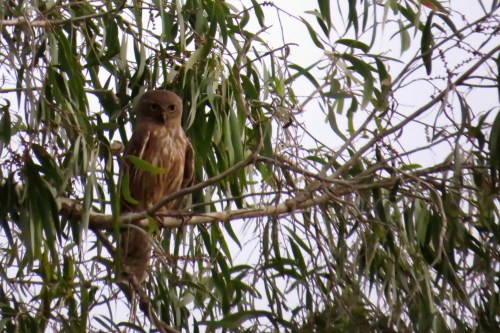
…. and not only saw but were able to photograph a restless pair of Barking Owls.

The following day was one of the most exciting of the whole tour. We had been warned from the outset that there would be a very early start, but even so the announcement of a 0100 departure was a bit of a shock. We headed northwards bumping along the Gibbs River-Kalumburu Road in the dark. A few of the grou saw Spotted Nightjar on route and we all saw a female Bush Stone-curlew with two chicks in the middle of the track that she tried protect by hiding them under her wings. We arrived at the remote Mitchell Plateau just after 0500. I say remote, but there was a well-developed campsite and a helicopter service that took tourists to see a nearby waterfall. The area can become very hot and we were warned that we must not wander off on our own (as has happened in the past), drink lots of water and protect our skin. To get to this rocky outcrop was a bit of a scramble …

… but soon we reached level ground which afforded great views over the surrounding forest.

Our target birds fell one by one, the restricted range White-quilled Rock Pigeon …

… Kimberley Honeyeater, which is endemic to the Kimberley region …
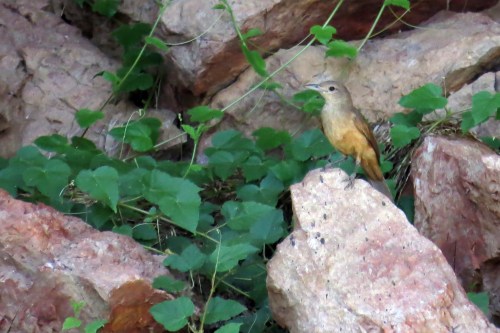
… and the more widespread Sandstone Shrikethrush.

But the outstanding sighting, indeed the main reason for making the long drive through the night, was to see the diminutive and elusive Black Grasswren. The eleven species of grasswren (related to the fairy-wrens) are some of the most skulking of Australia’s birds, usually only affording brief views as they scuttle through the undergrowth. Most trips to the Mitchell Plateau just glimpse the bird as it runs from one rock to another but we had a pair out in the open singing and we saw it well long before the area heated up to it’s 40 plus degree norm.

Even the leader Andy, who had made this trip several times, had never seen them so well. It was not surprising that this was unanimously voted ‘bird of the trip’.

We spent a while overlooking the lake and scanning the distant horizon and saw some distant displaying Pacific Bazas and a number of cockatoos, but with all species except Partridge Pigeon (which I have seen before in NT) under the belt we left by 1020, hours earlier than on most previous tours.
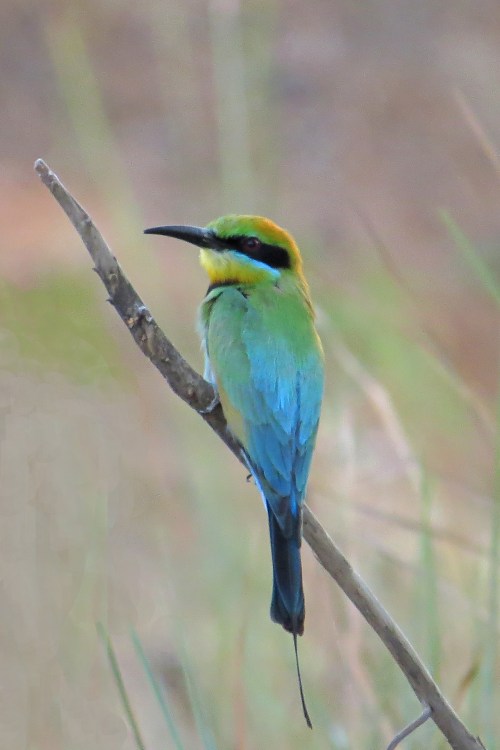
The early return gave us plenty of chances to stop and bird on the way back. Rainbow Bee-eaters showed well …
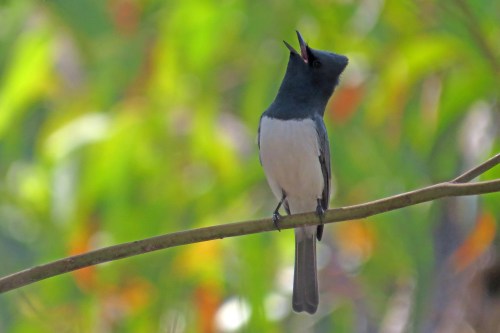
… as did this singing Leaden Flycatcher.
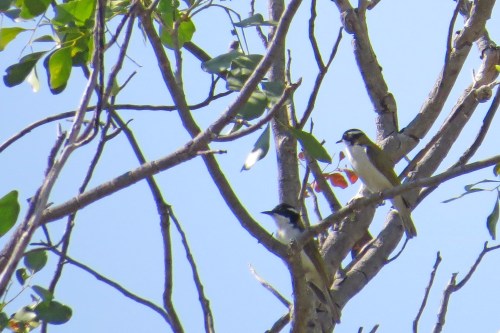
White-throated Honeyeaters were no big surprise …

… but this was! We walked an area of dry eucalypt forest in the hope we might flush a Chestnut-backed Buttonquail. We didn’t flush a single one – but we found a group of six feeding out in the open. So good were the views of this normally mega elusive species (well mega-elusive family to be more precise) that it got voted number two ‘bird of the trip’.

We were back at Drysdale River Station by mid-afternoon. Some opted to rest after the extremely early start but the rest of us returned to the billabong where we saw much the same as the afternoon before.
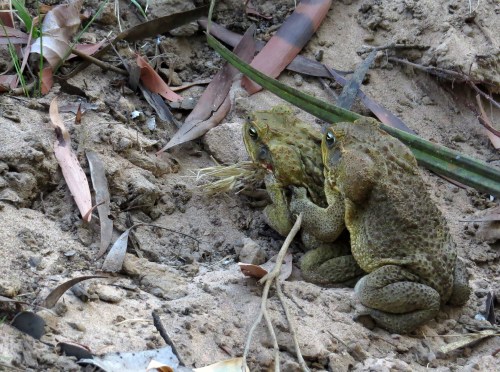
One species we didn’t want to see was the infamous cane toad. The introduction of these toads to Australia has been described as the worst decision in the country’s history. Cane toads, native to the Neotropics were introduced to coastal Queensland in 1935 to control the native cane beetle which was damaging sugar cane production. Cane Toad numbers now exceed 200 million and have spread as far west as the Kimberley. They have failed to control cane beetles but due to their poisonous neck glands, which can clearly be seen in the photo, they have almost wiped out native predators like quolls, goannas and snakes and have killed many cats and dogs plus some humans who have inadvertently come into contact with their poison. They predate many smaller species and compete with others for food supplies. By killing goannas the number of crocodiles has risen due to reduced predation of their eggs and a huge decrease in dung beetles due to the toad has resulted in a massive increase in cow dung which may lead to disease outbreaks in cattle. They are a classic example of the folly of introducing a predator into a region where the native wildlife has no natural defense against them.

So it was back to the chalets at Drysdale Station and an early night to catch up on sleep.
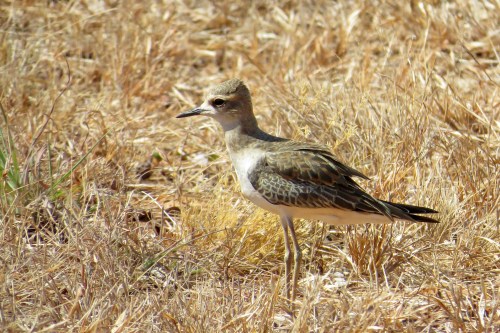
We heard from the staff at Drysdale Station that there were some recently arrived Oriental Plovers on their airstrip.

We also found a very dark falcon. Hopes that it was the rare Black Falcon (which would be a lifer for me) were soon squashed and it proved to be a dark example of the much commoner Brown Falcon.
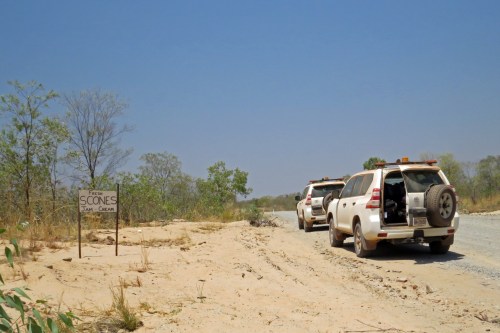
The drive through the desert scrub was long and at times uncomfortable, but who would have expected a sign advertising scones, jam and cream out in this wilderness!

This area was populated with a number of boab trees, the name an Australian contraction of the African name baobab. This genus (of nine species) is found only in Africa and in particular in Madagascar. Probably evolved too recently to be a Gondwanaland relict, the species probably reached Australia as seeds in rafts of vegetation carried on sea currents.
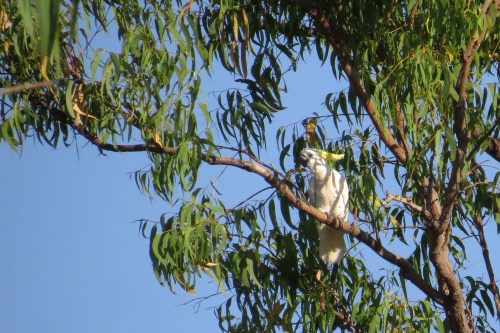
More birds were seen on our journey, Sulphur-crested Cockatoos ….
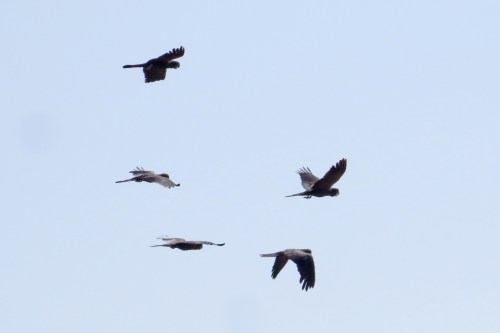
…. and Red-tailed Black Cockatoos,, a bird that looks very like a Black Kite in flight.
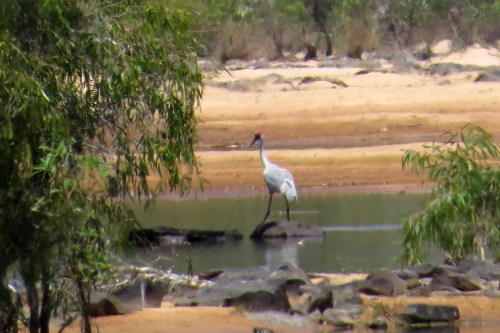
A distant Brolga, a species of crane that largely avoided the photographers on this tour, was seen in this creek.
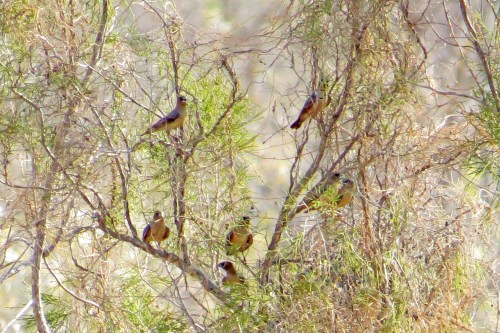
Here we found a group of Pictorella Mannikins, a new bird for me although they were hard to photograph well in the heat haze and glaring light.

Hardly surprisingly given the rough road conditions, we had a puncture. We then realised that sharp shale fragments had been used as a road dressing and this had caused the flat. We met several other vehicles all with the same problem along this stretch.

A river crossing had a few pools along its edge, home to this group of Magpie Geese. This species is so different from all other wildfowl that it’s in its own family.

Also by the river were a number of the gorgeous Spinifex Pigeons. This made it as number three ‘bird of the trip’ even surpassing the amazing Noisy Scrub-bird by one point.

Eventually we reached an open area with views across the Pentecost River flood plain towards Kununurra …

… and another hour or so of dirt road driving got us to the tarmac on the Wyndham – Kununurra highway, a route that will take you all the way to Katherine in the Northern territory if you wish.
We arrived at Kununurra just after dark for a three night stay. The past four days had been a bit tough on hot, dusty and bumpy roads (but I’ve known worse) but we had traversed some real wilderness and seen some great birds.
Our time around Kununurra, Lake Argyle and Wyndam will be the subject of the final post in this series.
This is the third post about mainland Western Australia (the fourth if you include Christmas Island) and deals with the area around the town of Broome on the northwest coast.
We flew from Perth at 0700 and arrived at Broome at 0920 and after collecting the vehicles and dropping baggage off at the hotel we were straight out birding (well we were hardly going to rest in the shade with so many top quality birds to see!).

The flight from Perth to Broome took us over some amazing desert scenery which helped pass the time.

We arrived at Broome mid morning ….

…. and after collecting the 4×4 cars and meeting Stuart who was to be be second leader and second driver on this section of the tour, we made a quick visit to the hotel to drop off our gear ….
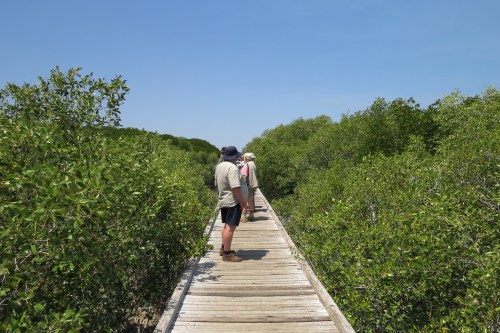
….. and headed down to a jetty in the mangroves.

…. a site of local historic importance as the pearl lugger fleet used to disembark and unload here.
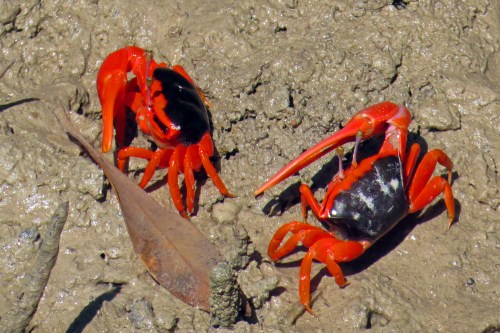
There were plenty of Fiddler Crabs on the mud below us but the birds tended to be elusive in the 35 degree late morning heat.

However at a nearby overflow pipe Red-headed Myzomelas, a tiny species of honeyeater, arrived for a drink.

Magpie-larks were common throughout the town ….
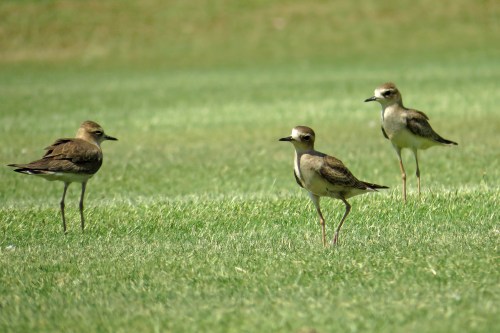
….and we had a real treat when we scanned a cricket pitch in the town centre, a group of eight Oriental Plovers fresh in from Mongolia were giving excellent views.
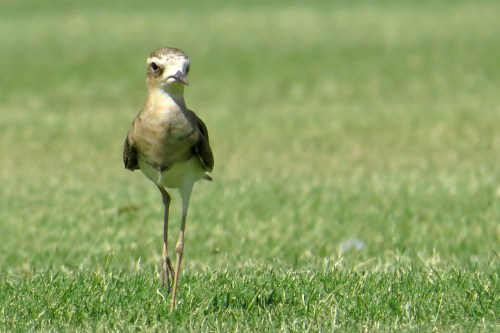
This enigmatic species can be hard to find but I have been lucky to see this species on two previous trips (Java and Australia’s Northern Territory) and saw it at three locations on this trip, but I have never encountered it in its gorgeous breeding plumage. However I will be visiting Mongolia in May this year so should catch up with that plumage at long last.
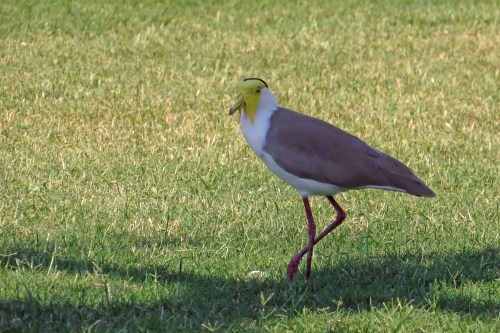
Also on the pitch were a number of resident Masked Lapwings.

We spent some time at the water treatment works where an elevated platform had been erected to let you watch the birds. There were many species here, ducks, waders, terns and these Australian Pelicans.
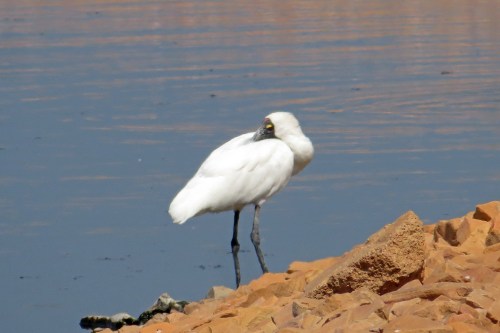
Among the many birds we saw were Royal Spoonbill ….
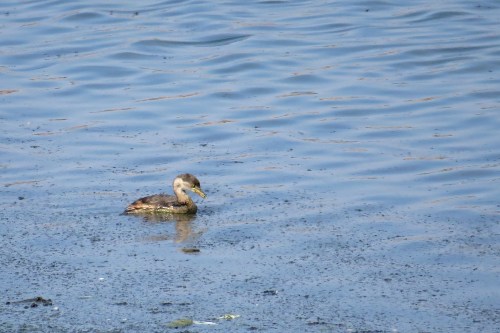
…. and Australasian Grebe.
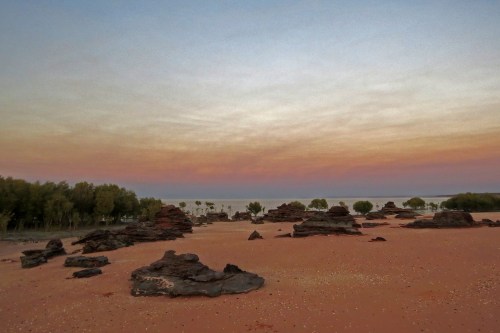
Later that afternoon we visited nearby mangroves and walked along the sandy beach ….
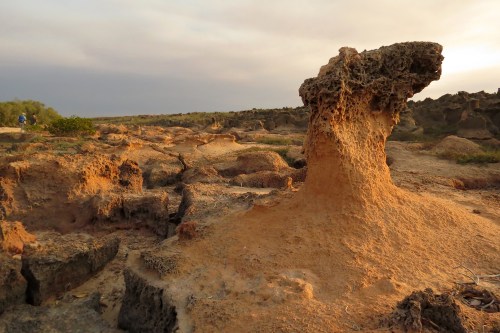
…. and admired the rocks carved into bizarre shapes by wind and water.

Our main target here was the ‘Kimberley Flyrobin’, a very plain race of Lemon-bellied Flyrobin that was once treated as a separate species. The two subspecies group look different, occupy different habitats and are allopatric so there is no gene flow between them. The Handbook of the Birds of the World ‘Illustrated Checklist’ treats them as full species, its a shame IOC doesn’t as well.

Other mangrove species we saw in the area were Mangrove Fantail ….
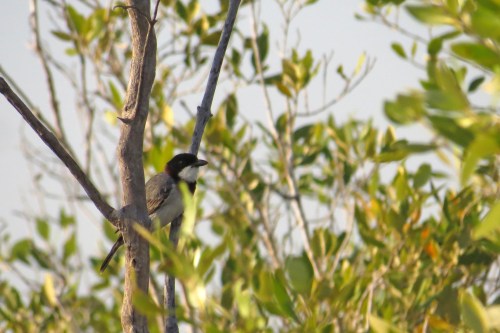
…. White-breasted Whistler ….

…. and Dusky Gerygone, a species of Australian warbler.

We were back in a nearby area the following morning but our main targets were now waders (or shorebirds as they are known in North America).

A few White-headed Stilts were seen along the tide line. This species/race is found throughout Australasia. If we exclude the very different Banded Stilt of southern Australia and the similar but all-black Black Stilt of New Zealand, we are left, worldwide, with four stilt ‘species’; White-headed, White-backed, Black-winged and Black-headed, all of which differ only in the exact distribution of black and white on the head, neck and back. In the contrary situation to the Kimberley Flyrobin, IOC splits them all and HBW lumps them all. Obviously I like the idea of having the extra life birds on my list, but in reality I think the days of having four ‘pied stilt’ species are numbered.

The vast majority of the waders (or shorebirds if you are from North America) were very distant but as the tide rose we headed back along the track ….
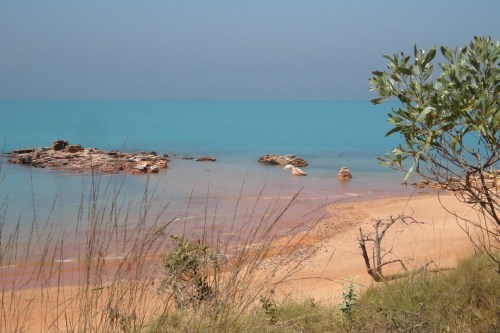
…. to a number of lookouts where we could scope them (note the wader flocks along the shoreline, especially behind the grass).
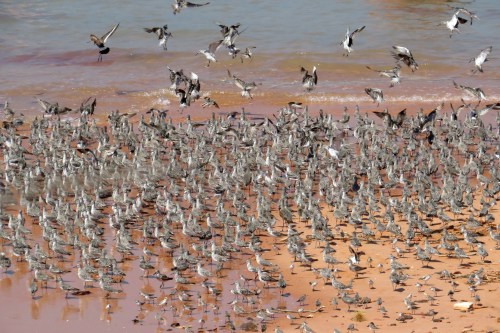
…. although any attempt to get closer just resulted in flushing them. In this photo a few Black-tailed Godwits, tattlers and others can be seen in flight but the majority are Great Knots with a few Red-necked Stints in the foreground.
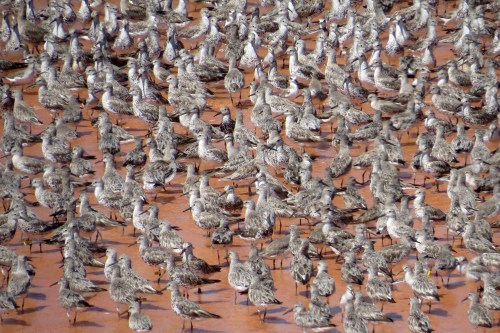
However in a few locations we could at least photograph the flock, if not individual birds. Great Knots predominate in this photo as well. There is one still in partial summer plumage at about 10 o’clock to the centre. Like many of the species present, Great Knots breed on the tundra of eastern Siberia and winter in Australia.

This photo shows mainly Red-necked Stints, plus a few Curlew Sandpipers and sand plovers.
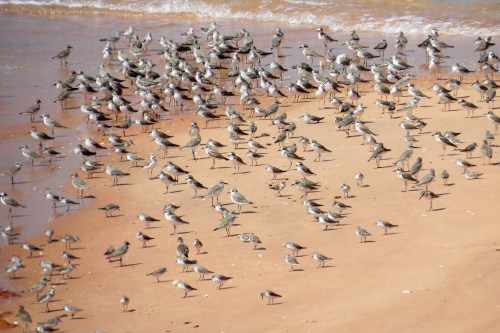
And there’s more! Greater and Lesser Sand Plovers, Curlew Sandpipers, Red-necked Stints and a few Terek Sandpipers are illustrated here.
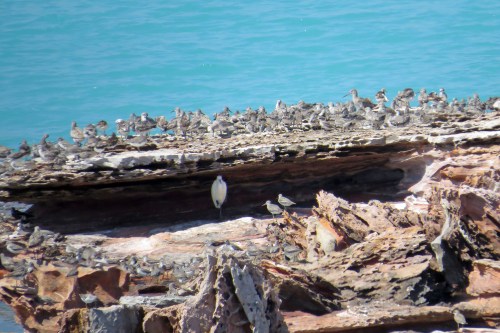
A lot of Grey-tailed Tattlers, plus a few Black-tailed Godwits and Turnstones were roosting on the rocks, and a Pacific Reef Egret is taking shelter from the ferocious sun ….

…. as was this Great Egret.
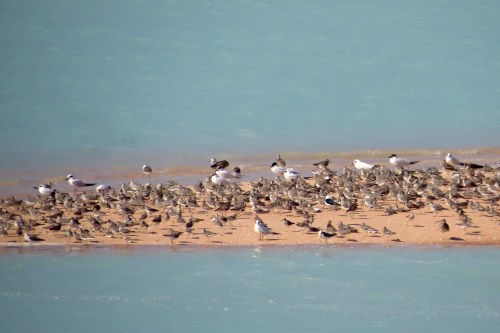
On this sand spit smaller waders are joined by the odd Whimbrel, Greenshank and Bar-tailed Godwit. Also in the photo are a number of Gull-billed (or gullible as I like to call them) Terns. These are interesting, as the HBW Illustrated Checklist treats the Australian population macrotarsa as a separate species based on its larger size, differently shaped bill and nomadic and kleptoparasitic behaviour.

Also in the high tide roosts were a number of Crested Terns, Silver Gulls ….

…. and the odd White-faced Heron.
The roosts at Broome are one of the great wader gatherings in the world. Destruction of coastal wetlands in Korea and China has led to a marked reduction of the population of some species (most notably Far-eastern Curlew and Little Curlew of which we only saw fifteen and one respectively) and the general opinion was that we were too early and there were still enormous numbers of birds still to arrive. That said, our estimate of wader numbers in Broome area was amazing and an estimate of numbers is given below: (an asterisk indicates that the species was mainly seen away from the high tide wader roosts).
Bush Stone Curlew* 1
Pied Oystercatcher* 10
Sooty Oystercatcher* 4
White headed Stilt* 1
Masked Lapwing* 10
Red-kneed Dotterel* 2
Pacific Golden Plover 50
Grey Plover 80
Red-capped Plover* 10
Lesser Sand Plover 1000
Greater Sand Plover 500
Oriental Plover* 8
Black fronted Dotterel* 5
Black-tailed Godwit 50
Bar-tailed-Godwit 800
Little Curlew 1
Far Eastern Curlew 15
Whimbrel 30
Marsh Sandpiper* 2
Greenshank 500
Common Redshank 4
Wood Sandpiper* 1
Grey-tailed Tattler 200
Terek Sandpiper 200
Common Sandpiper 12
Ruddy Turnstone 30
Great Knot 10,000
Red Knot 5
Broad-billed Sandpiper 3
Sharp-tailed Sandpiper* 10
Curlew Sandpiper 200
Red-necked Stint 1000

Back at the hotel for lunch and a chance to scan over the mangroves and see birds like

…. Brahiminy Kite ….
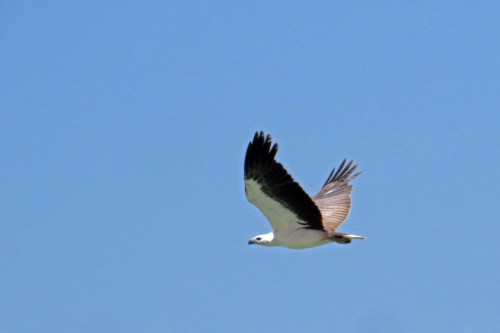
…. and White-bellied Sea-eagle.
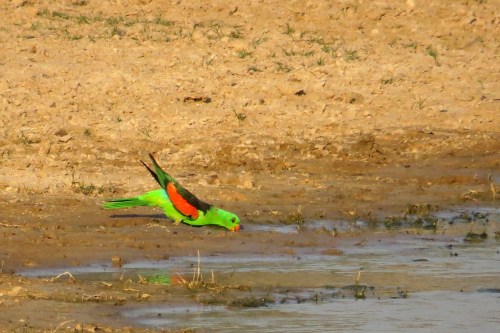
During the afternoon we watched a number of roadside pools which was surprisingly successful with a nice range of species like Red-winged Parrot ….
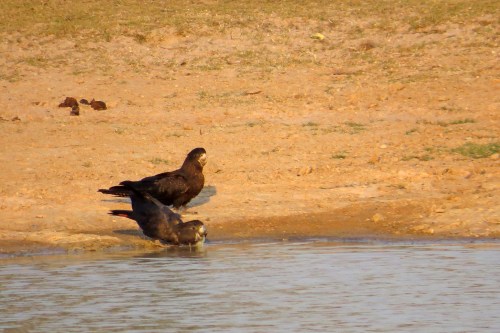
…. Red-tailed Black Cockatoo (the red panel in the tail can just be seen on the foremost bird) ….
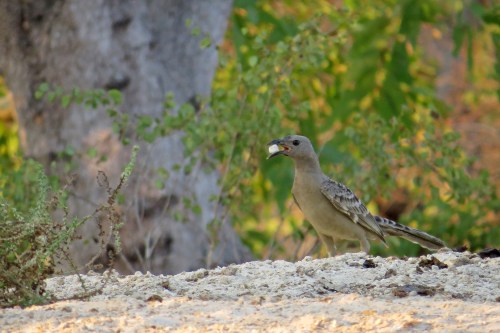
…. and Great Bowerbird, although this individual looks more interested in collecting pebbles to decorate its bower than coming for a drink).
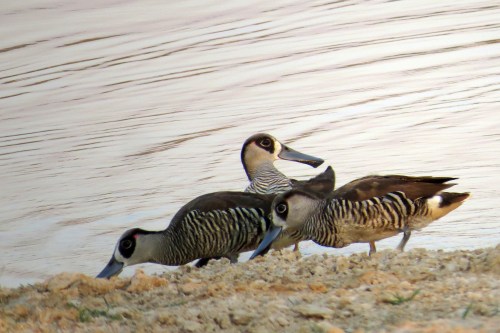
Dabbling around the edge around was a trio of Pink-eared Ducks. You have to look hard to see the ‘pink ears’ but can just make out a small pink area behind the dark surround to the eye.

On the 21st we packed up and left Broome and drove towards Derby (a town that is presumably named after the British city where I spent much of my teenage years.). On route we saw our only flock of Budgies.

Seeing wild Budgerigars is always a high on the wish-list of any birder visiting Australia, but the species is nomadic, travelling from one area that has had rainfall to the next and the flocks are restless and not prone to posing for photos.

Whistling Kites were quite common (primary moult in this individual gives it an unusual outline) ….

…. and at a river crossing we saw the magnificent Black-necked Stork ….
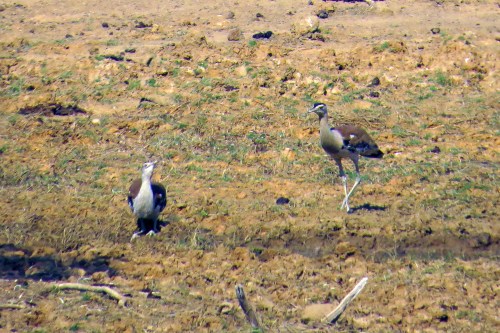
…. the equally magnificent Australian Bustard ….

…. and the more mundane Intermediate Egret.

Other species seen on route included the delightful and diminutive Diamond Dove ….

…. the ubiquitous Magpie-lark (a relative of the monarch flycatchers and not either a magpie or a lark) ….
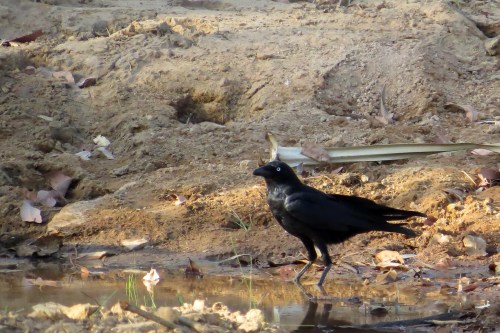
…. and another common bird, Torresian Crow, which replaces Australian Raven, Little Raven and Little Crow in the north.
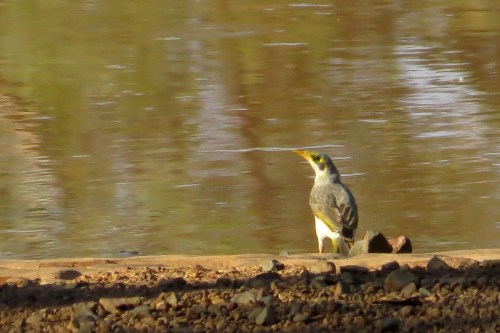
Yellow-throated Miners (a species of honeyeater) ….

…. and Little Corellas also kept us company.

In due course we reached Derby, had a very late breakfast and then headed west along the Gibb River Road. We weren’t far out of the town when we ran out of tarmac.
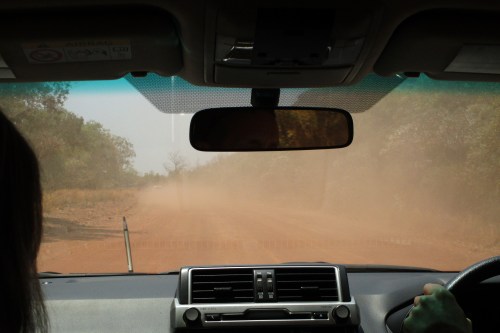
We wouldn’t see a paved road again (apart from a few short stretches over bridges) until we were almost at Kununurra in three days time. It was a given, especially for those in the second vehicle, to be enveloped in dust at all times. Note the radio aerial on the left of the bonnet has snapped of from all the vibration.

Our drive across the Kimberley region will be the subject of the next post, however I like to end with an eye-catching shot (mainly because Facebook has stopped selecting a photo at random and now choses the last one to head up a post). This sunset was photographed at the rocky beach at Broome where we visited the on the first day to look for Kimberley Flyrobin.
This post continues my travels in south-west Australia on Birdquest’s Western Australia tour. Previous posts have covered my time in Christmas Island and the drive from Perth to Albany.

One of our first birding sites in the Albany area was Emu Point, where there was a notable lack of Emus and I suspect that has been the situation for a considerable time.
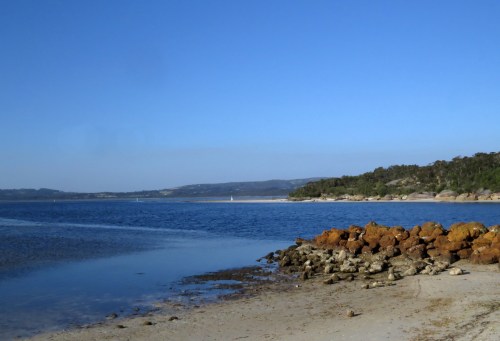
Overlooking the bay we saw a number of terns, gulls and waders as well as some Bottle-nosed Dolphins.

Overhead we saw an Osprey, recently the Ospreys east of Wallace’s Line have been separated off as a separate species based on their smaller size and different face pattern. They are named, somewhat unimaginatively – Eastern Osprey.

Australian Pelicans gave good views but most of the other birds seen here were too distant for photography.

Lawns and other grassy areas invariably held Australian Magpies ….
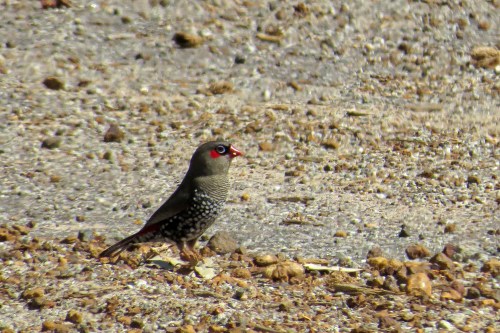
…. whilst a path by a nearby lake gave us views of another SW endemic, Red-eared Firetail.

We made an early departure to get to Cheyne’s Beach for dawn. This site, about an hour’s drive east of Albany is famed as the location to see three of SW Australia’s most difficult birds. One the Whipbird we had already seen (although the birds here are a different race) the other two are Western Bristlebird and Noisy Scrub-bird. This short dirt road to the beach is considered to be the best spot to see the mega-elusive Scrub-bird which seldom flies, but rather runs from cover to cover like a rodent on performance enhancing drugs. We had quite a long wait with just some Western Grey Kangaroos as company, then on a couple of occasions the Scrub-bird shot across the path. It was a real ‘blink and you’ll miss it’ experience and I have to admit on a couple of occasions I did just that.

Fortunately we returned later in the morning and one was seen skulking in the grass by the path. Then it shot across the road like a bullet and incredibly Rainer Ertel was able to fire off about half a dozen shots. one of which was actually in focus. Perhaps the fastest reaction to a birds appearance that I have ever seen from a photographer. There are only two species in the scrub-bird family, the other one, Rufous Scrub-bird of the Queensland rainforests is possibly even more elusive and my views in 1999 were brief to say the least, although I did hear it well. It was therefore a great relief to get satisfactory views of a member of this tricky family. Photograph by trip participant Rainer Ertel.
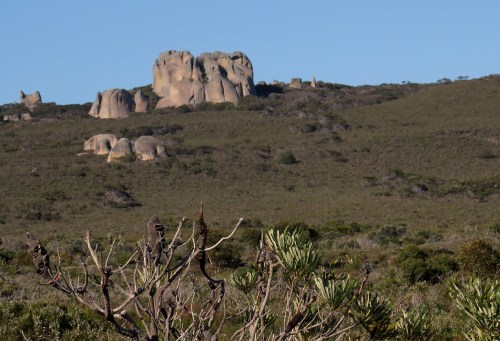
With one mega under the belt it was time to look for the other two so we headed for the adjacent heathland. The Western Whipbird showed briefly but wasn’t photographed (see last post for a shot of this species) but a little persistence resulted in ….
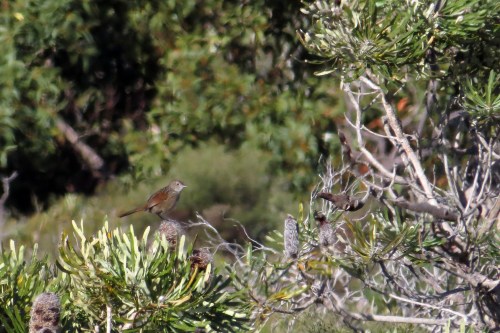
…. views and photographs of skulker number three – Western Bristlebird. Bristlebirds are another of those ancient relict families that can be found in Australasia. Remember that the whole passerine order probably originated in Australasia and there are many ancient families with just a handful of species each peppered across Australia, New Guinea and New Zealand. There are three species of bristlebird, the other two occur in eastern NSW and southern Victoria.

So with the targets sorted it was time to ‘relax’ on the beach. Of course when a birder goes to the beach they don’t put a towel out and reach for the sunscreen they grab scopes and check the gulls and terns and look for pelagic seabirds!

In the dunes we saw a couple of Australian Pipits, a bird with a checkered history, once lumped in with Richard’s Pipit of Siberia, then split off with the New Zealand birds as Australasian Pipit they now are a species in their own right.
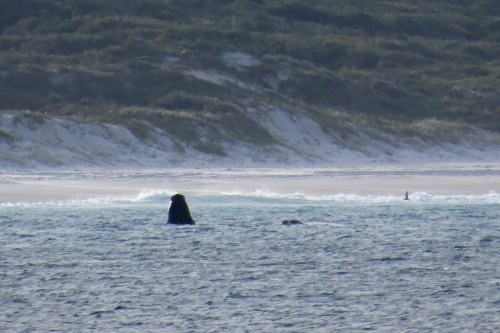
Far away in the bay a Southern Right Whale and her calf frolicked in the shallow water ….
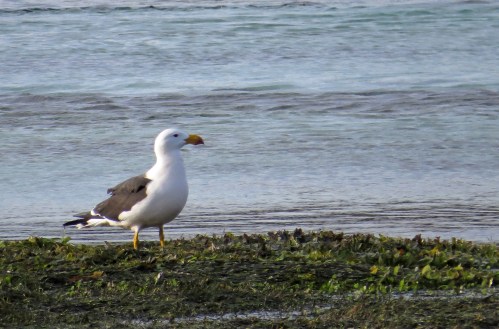
…. whilst on the beach the huge-billed Pacific Gull was seen.

We retreated to some shade for our lunch and were able to photograph Brush Bronzewing ….
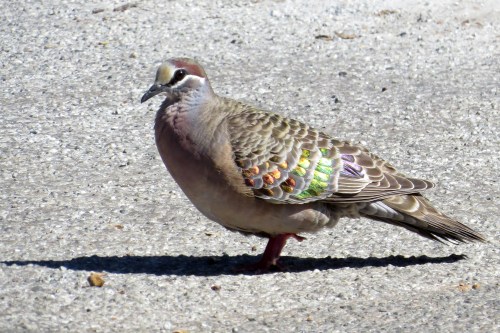
…. Common Bronzewing ….
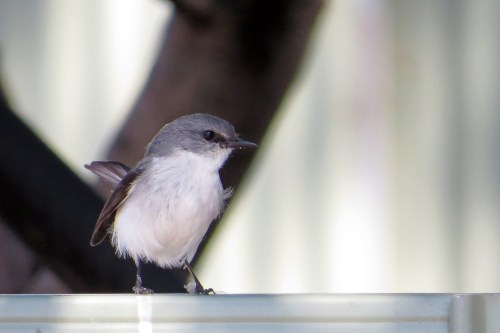
…. and the SW endemic White-breasted Robin.

Later in the day we headed back to Albany ….
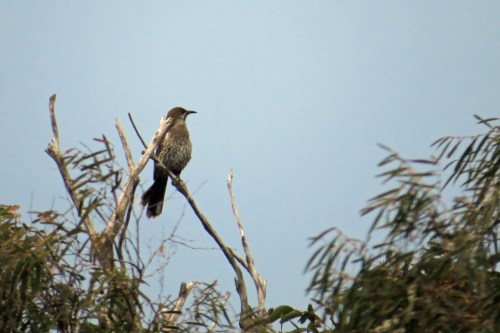
…. stopping on route to see another SW endemic, Western Wattlebird.
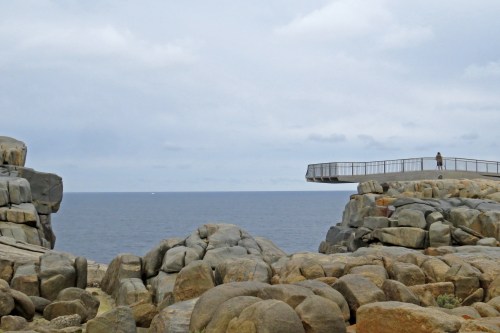
On our second full day around Albany we visited Middleton Beach early morning and in the afternoon and also drove to The Gap, a lookout that faces the open ocean.

From the platform you could peer down to the raging surf below.
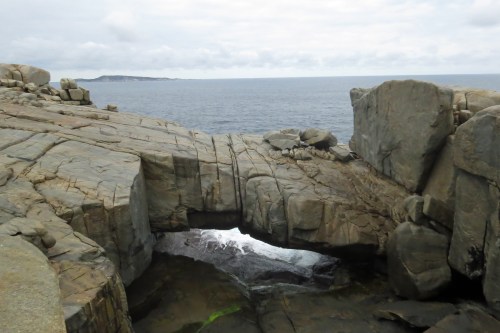
From the platform and from near this natural bridge we did some seawatching and were able to add Black-browed and Indian Yellow-nosed Albatross, some very distant shearwaters and a Brown Skua to our lists.

A few distant whales were seen, both Southern Right and Humpback. This somewhat confusing image shows a distant Humpback breaching the moment before it hits the water. It is coming down on its back with the huge pectoral flippers extended on either side of the body.
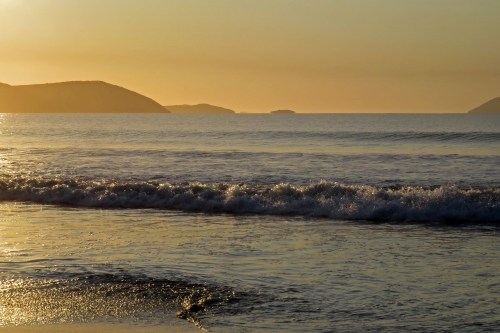
We had most of the endemics sorted but one eluded us, Rock Parrot. We tried numerous locations and the most reliable site, Middleton beach, was visited three times. We walked the dunes at dawn wandered around the golf course and scanned the hinterland, all to no avail.

But in spite of the fact that we had a long drive ahead of us we tried yet again for Rock Parrot on our final morning. Arriving at sunrise we saw three flying over the car park. Never has a minibus decamped so quickly.

Along the tide line we watched a number of Red-capped Plovers ….
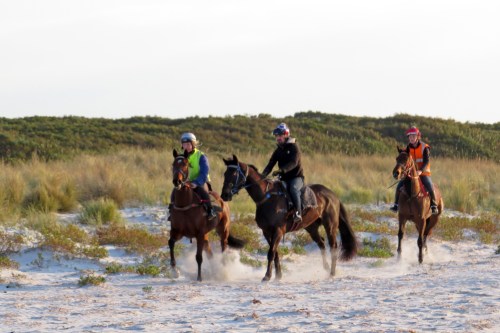
…. before the horse riders and dog walkers booted them.

Well we never photographed Rock Parrots but there were plenty of gorgeous (yet widespread) Galahs in the area …

…. indeed whilst walking the dunes we were accompanied by a blizzard of pink.

The commonest bird in the coastal scrub was New Holland Honeyeater, a bird that we soon tired of, as every movement in a bush or distant perched bird proved to be this species.
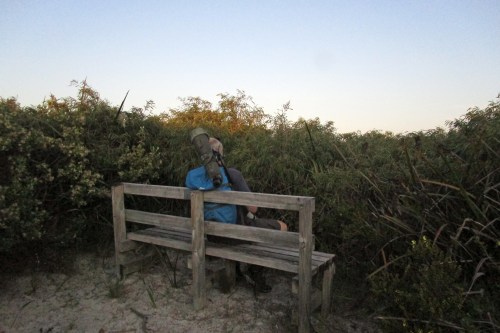
I’m sure whoever put this bench in place so walkers could enjoy the wonderful view over Frenchman Bay was well-meaning, but a little maintenance is required to keep it that way!
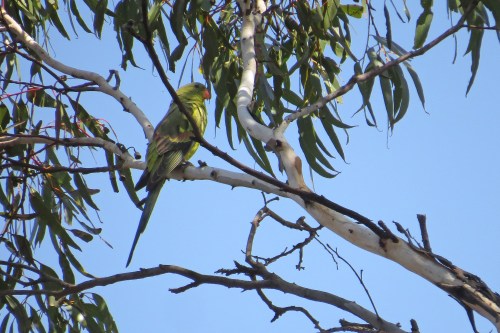
As soon as we had finished at Middleton Beach we left Albany. We had a long drive ahead of us as we were heading north-east towards Hyden and the famous Wave Rock. We had a pit-stop back in the Sterling Range where we had good views of Regent Parrot, certainly an improvement on the flight views we had on our way south.

We also encountered the flock of ‘white-tailed cockatoos’ again. Judging by the upper mandible this one is a Baudin’s. The books say that the two species don’t form mixed flocks but although the majority appeared to be Baudin’s there were a few undoubted Carnaby’s in there.
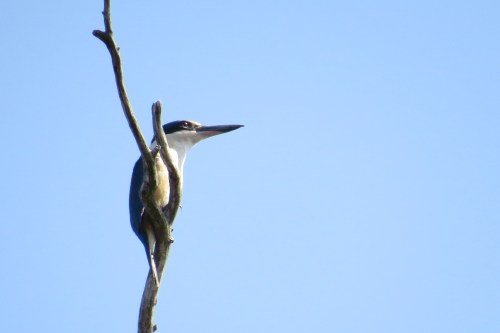
We also had great views of Sacred Kingfisher in the Sterling Ranges. We subsequently stopped a number of times as we drove north but although the birding was good there was little of real note.

However in the late afternoon we reached the stunning Wave Rock near Hyden ….
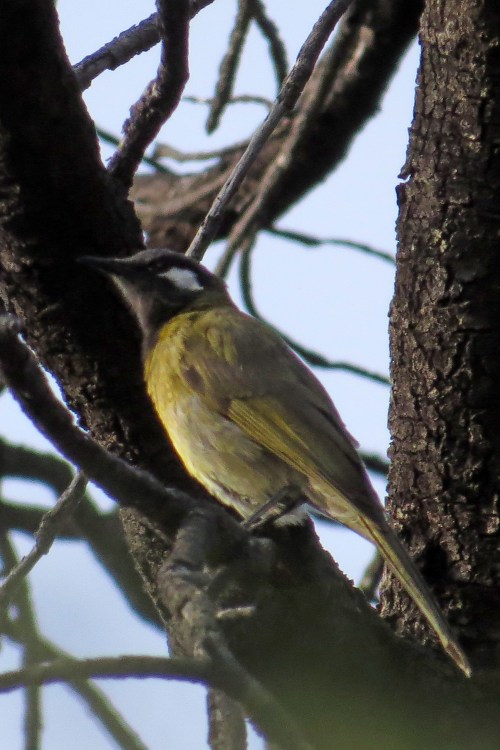
…. and added a number of new birds to our list such as this White-eared Honeyeater.

The following morning we headed well off the beaten track. Signs like this are a reminder that you need to be well prepared when travelling in outback Australia.

From now on most travel would be on dirt roads. This part of the trip was added to the trip itinerary for the first time in 2017 and it was well worth it as produced many new species to the list (even if we had to drive over 1000km to see them). Most notable were two species of quail-thrush both of which we were to see today. We would be travelling through the Great Western Woodland, the largest intact area of deciduous woodland in the world, at 16 million hectares it is larger than England.

I love that there are four categories of alert greater than HIGH!
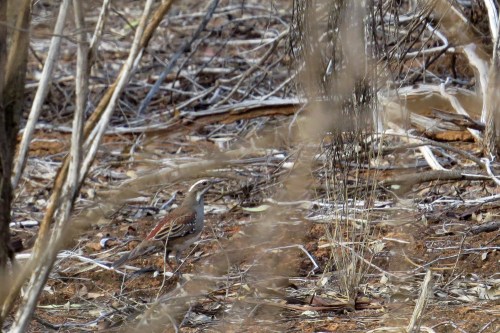
We arrived at McDermid Rock soon after dawn and soon found the amazing Copper-backed Quail-thrush skulking in the dry scrub. A recent split from Chestnut Quail-thrush, this is a member of the Psophidae, a family that includes the quail-thrushes, whipbirds and New Guinea jewel-thrushes. I have a long-standing ambition to see/hear 50% of all of the world’s bird families and this I had done with the exception of the owlet-nightjars and the Psophidae. With the addition of the Western Whipbird and the two quail-thrushes then its just the owlet-nightjars left.

There is relatively little sexual dimorphism in this species, this female is just a slightly washed out version of the male.

We also saw the pretty little Redthroat, a member of the Australian Warbler family.

The long drive took us further north-west, past the mining town of Kalgoolie and away from the deciduous forest and into semi-desert scrub or mulga ….
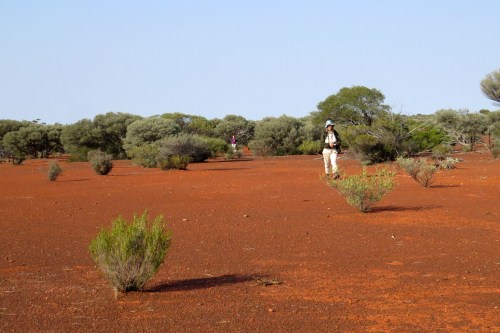
…. often characterised by the red earth that gives the ‘Red Centre’ its name.

We were approaching our destination, the former town of Kookynie, when the leader Andy spotted something at the side of the road, once again we all piled out in seconds flat and there was quail-thrush number two ….

…. the seldom seen Western Quail-thrush, which showed even better than the Copper-backed had.
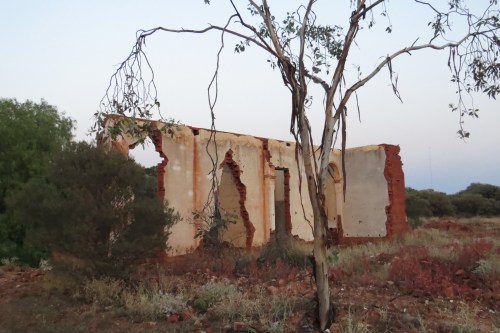
There wasn’t much left of Kookynie. Once a prosperous mining town, just a few ruined buildings, the odd static caravan and ….

…. the Grand Hotel, situated beside the long disused railway station, remained. It was quite literally a ‘one-horse town’.

The interior spoke of past glories and events never to be repeated, a quaint if rather sad situation.
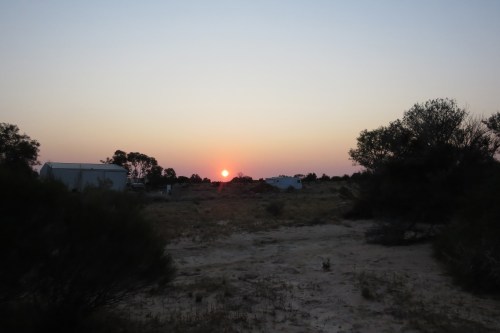
We were up at dawn (of course) and exploring what was left of the town.

We saw a Western Bowerbird, here at the extreme edge of its considerable range. Pics of the bird were not useable but the rather more static bower was easier to photograph. It needs emphasising that this is not a nest but a display ground, carefully constructed, maintained and decorated with shells by the male in order to impress a female.

Other birds seen in Kookynie or the quail-thrush area included Red-backed Kingfisher ….

…. the wonderful little Red-capped Robin ….

…. Little Woodswallow ….

…. a close up view of a pair of Wedge-tailed Eagles and many more birds typical of the interior of the continent. I wish we had a second night in this area as there was much to see but the tour was already quite long. It’s a shame we couldn’t swap the extra day on Christmas Island where we were just marking time for another day here.
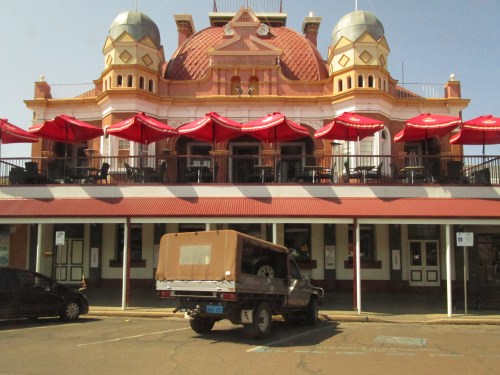
On the way north we had skirted the mining town of Kalgoorlie and just seen the spoil tips and massive excavations. On the way back we stopped in the town for fuel and were able to admire the 19th century architecture of the town centre.
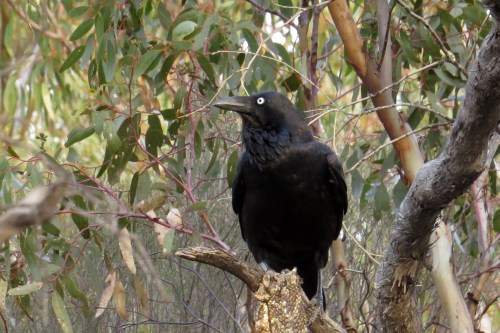
Australia has five regularly occurring corvids and they are all pretty similar. In the south-west the regularly occurring species is Australian Raven (above) but in the Kalgoorlie area we did see (and hear, as voice is one of the best ways to tell them apart) the very similar Little Crow.

And so we continued the mega-drive back to Perth, nearly 700km in total. First we passed through desert scrub or mulga, then the deciduous forest and finally through the wheat-belt and intensive cultivation. We arrived back in Perth at 1830 for an overnight stay.
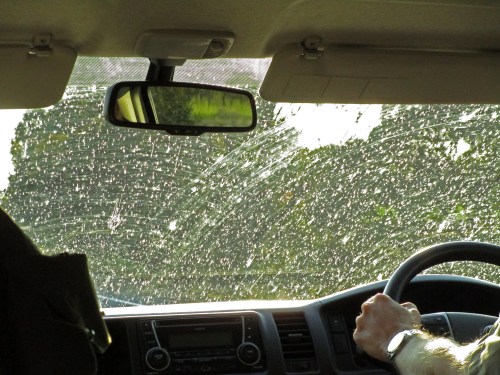
Do readers remember when if you drove a fair distance in the UK then your windscreen would be covered with bugs? Well now pesticides have killed all the insects so your windscreen remains clear but the birds have nothing to eat. Fortunately bugs and birds still exist in good numbers in Australia and long may it remain so.

So I’ll finish this post with another shot of the magical Western Quail-thrush. The south-western part of the trip was over with all the endemics seen (except of course the mythical Night Parrot) The following day we were to fly to Broome in the north-west for the next chapter of this extraordinary tour.
This is the second post about my trip to Western Australia. The first post detailed the pre-tour extension to Christmas Island, this post covers our journey from Perth to Albany.
I have made two previous private trips to Australia, concentrating on the east, north and centre of the country. On this occasion I decided to travel with Birdquest due to their comprehensive coverage of the state of Western Australia.

After the tranquility of Christmas Island, Perth’s freeways, traffic, high-rise buildings ….

…. and multi-lane underpasses came as a bit of a shock. Two more clients, Alison and Brian (who had accompanied me on two previous trips) joined us for the main tour.

Our first stop was Herdman’s Lake, a lovely wetland reserve within the city limits. we arrived just as the sun was rising ….

….. silhouetting the Great Cormorants hanging their wings out to dry.

There were plenty of waterfowl on the lake, the common Pacific Black Duck ….
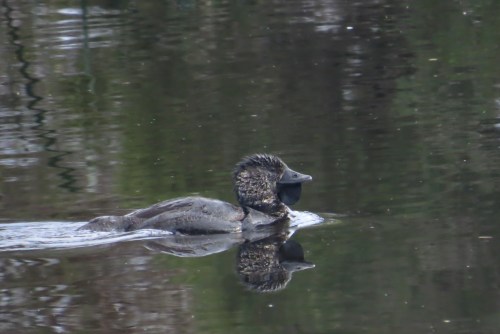
…. the bizarre Musk Duck, the male of which has a huge black dewlap under the bill ….
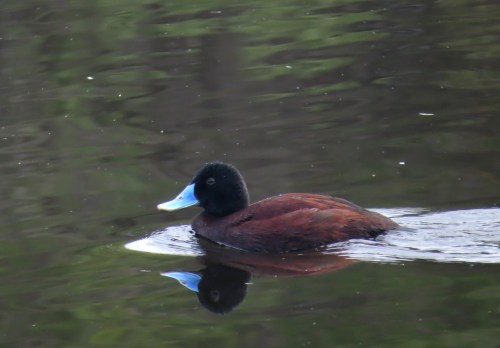
…. the aptly named Blue-billed Duck ….

…. the rather shy Pink-eared Duck …..

….. and the inevitable Black Swans and cygnets.
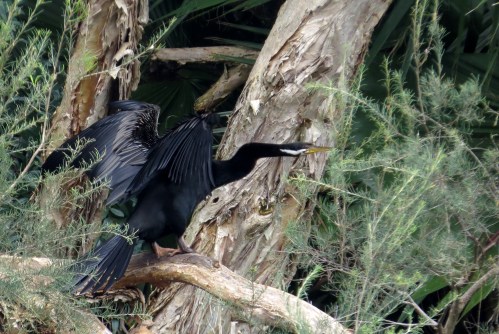
Other waterbirds included Australian Darter ….
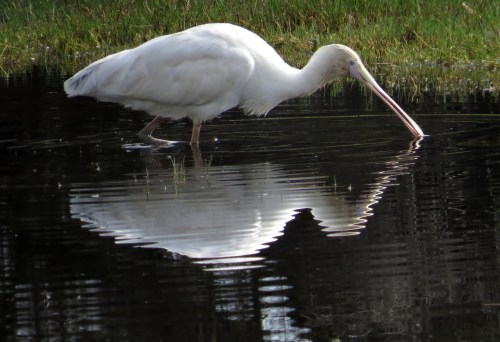
…. Yellow-billed Spoonbill ….
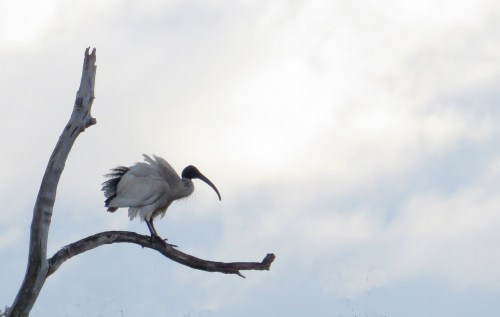
…. White Ibis ….
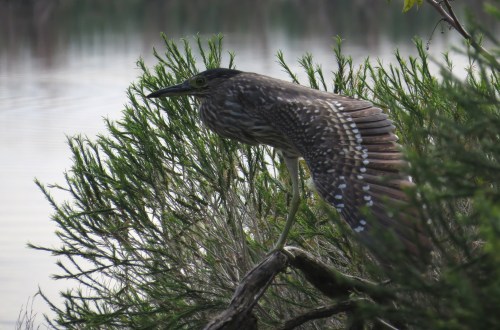
…. and a juvenile Nankeen Night Heron nicely showing off its spots.

Australian Purple Swamphens fed on the verges completely oblivious to the joggers and cyclists passing by.

Buff-banded Rails are far more retiring but high water levels had forced them out of the reeds allowing good views.
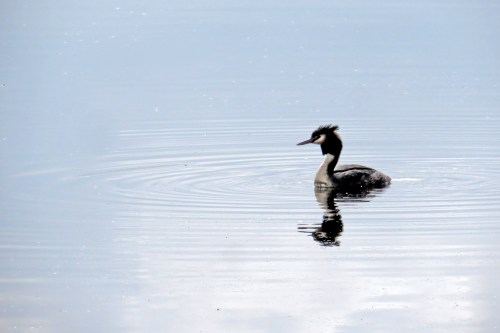
Great Crested Grebes looked quite like the ones back home, if a little darker, however they do not go into winter plumage leading some to consider that they may represent a separate species.
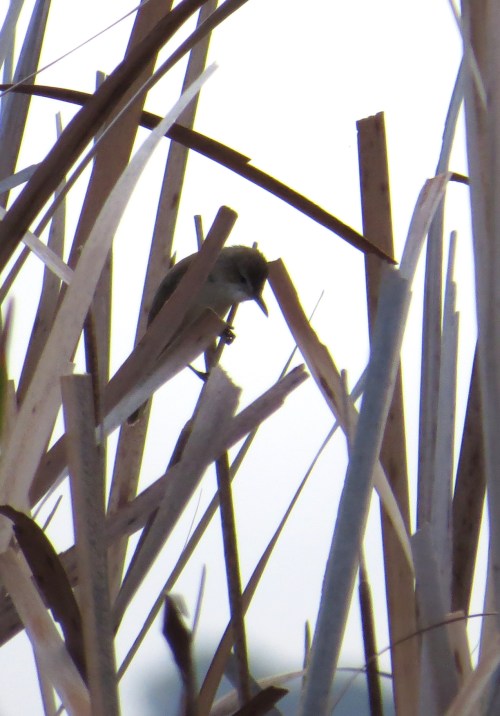
The lakeside reeds held Australian Reed-warbler, formerly considered a race of Clamorous Reed-warbler, now split as a separate species.
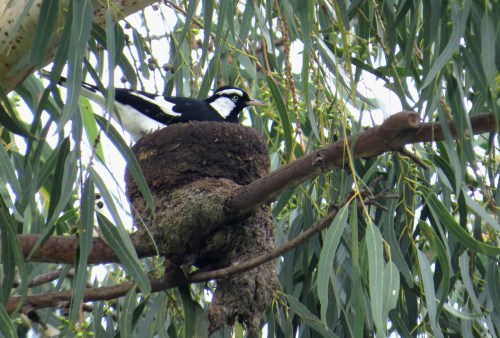
In the eucalyptus we found a Magpie-lark on the nest

As well as a nesting Tawny Frogmouth. Frogmouths are a nocturnal essentially SE Asian family that have spread to Australia where three species occur. Tawny Frogmouth is by far the commonest and most widespread of the three.

With plenty more places to visit we left the lakeside and returned to where we had left the minibus ….

…. but we found to our dismay that the window of the sliding door had been smashed (see the broken glass in the doorway). Fortunately no suitcases had been taken but some of the other clients lost hand luggage containing cameras, clothes, credit cards etc. Reporting this to the police, getting a replacement minibus and all the associated paperwork took us the rest of the morning. This is only the second time that such a break in has occurred in Birdquest’s history so we were pretty unlucky to have it happen to us.

We set off for the Dryandra Forest on route we saw a few Laughing Kookaburras. This is such a well know Aussie bird that it came as a bit of a shock to find out that they are an introduced species in Western Australia.

Other additions to the list included this Grey Currawong ….

…. and Ringnecked Parrot of the so-called ’28’ race.

We had a bit of time in Dryandra Forest before dusk ….
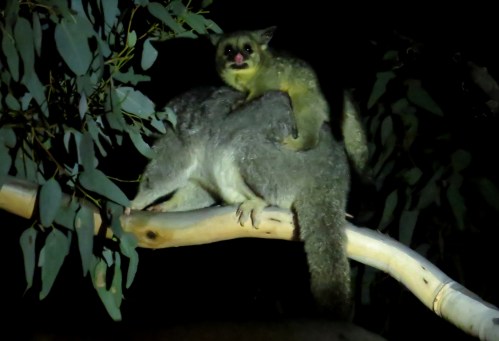
…. and after dinner we returned for a bit of spotlighting. It was quite windy and surprisingly cold, not the best conditions for night birds. and the only species seen was Tawny Frogmouth (which we had seen so well in daylight that morning). Of the mammals, we had hoped to see the rare Numbat but drew a blank, I had a brief view of a Southern Brown Bandicoot but the only mammal that stuck around was this Common Brushtail Possum with a baby clinging to its back.
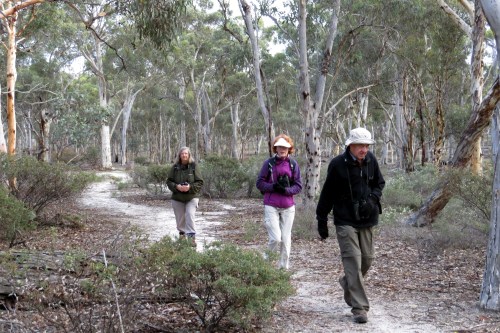
We were back in a chilly Dryandra Forest early the next morning.

Yellow-plumed Honeyeaters were abundant ….

….cute Dusky Woodswallows were seen in the trees or in flight ….
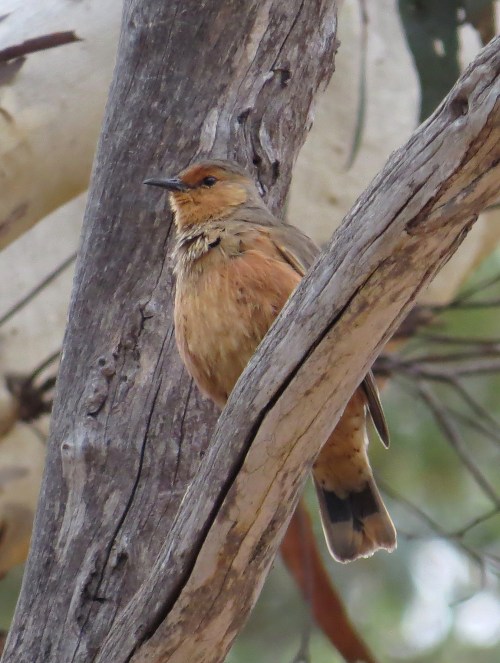
…. and we had great views of Rufous Treecreepers. This species is perhaps the least arboreal of all the Australian treecreepers and is often seen foraging in the leaf litter.
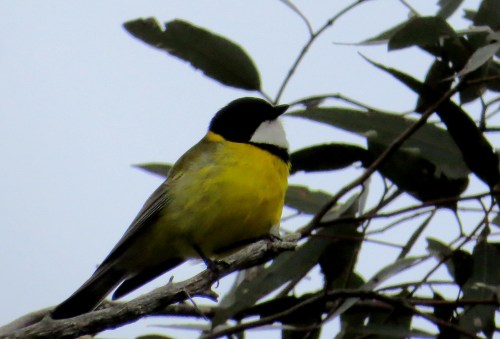
We also saw Western Whistler, a recent split from the widespread Golden Whistler.

Mammal interest was provided by a few Western Grey Kangaroos.

We moved on to the Sterling Ranges ….

…. stopping on route at a lagoon where we had great views of the range restricted Hooded Plover, a bird I have only previously seen in Tasmania.
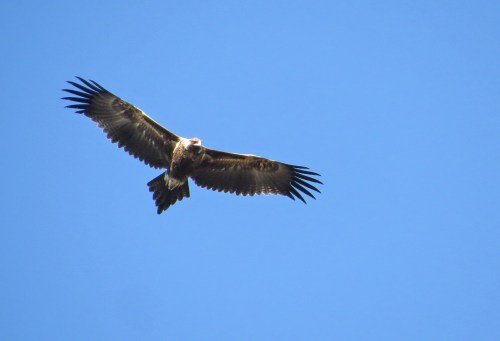
And here we saw our first Wedge-tailed Eagles of the trip.

We arrived at our accommodation in the Sterling Ranges in the afternoon and soon tracked down some goodies like ….

…. the aptly named Splendid Fairy-wren ….

…. and another bird which lived up to its name, Little Eagle ….

…. being little bigger than a Buzzard. There was a pair nesting nearby and we were to see them regularly whilst in the area. Whilst I have never had problems in seeing Little Eagle the same cannot be said for its New Guinea counterpart Pygmy Eagle (with which it was formerly lumped), even after three visit to New Guinea I drew a blank on that one.

The following morning was bitterly cold, just above freezing and with a strong wind. I realised that I hadn’t brought enough warm clothing when the others started donning down jackets and ski gloves. Our target on the road to Mount Trio ….

…. was the mega-skulking Western Whipbird. Although easy to hear they can be a devil to see and I was delighted when one popped into view and I was even more delighted once I had thawed out.
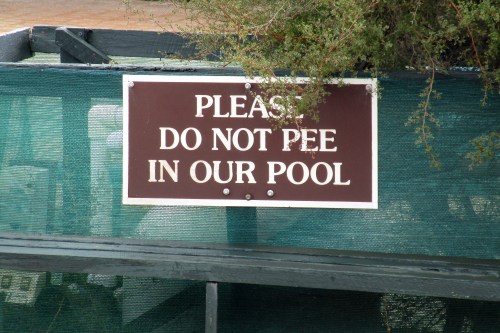
Around the swimming pool at our accommodation we found a Southern Scrub-robin, a species that was completely off my radar as it had never been seen on this tour before. Only in Australia would you expect to see a sign like this ….

…. or a product with this name in the local shop!
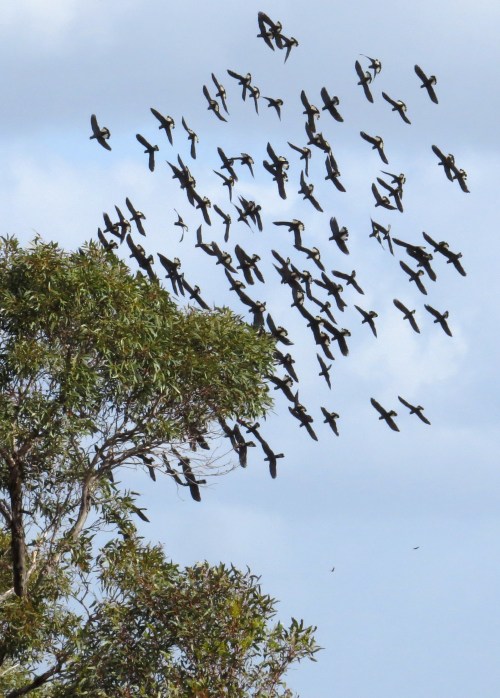
The following morning was even colder and we had to scrape ice off the minibus before we could leave, however there was no wind and it soon warmed up. Not far from the Sterling Ranges we came across a large flock of hundreds of ‘white-tailed cockatoos’ (this is just part of a much larger gathering).

Closer examination showed that the flock consisted of two species, Baudin’s and Carnaby’s Cockatoos ….

Although very similar, differing only in the length of the bill, they are undoubtedly good species, feeding on different fruits and invariably pairing with their own kind. This pair (the dusky-billed bird on the left is a male) are the longer-billed Baudin’s)
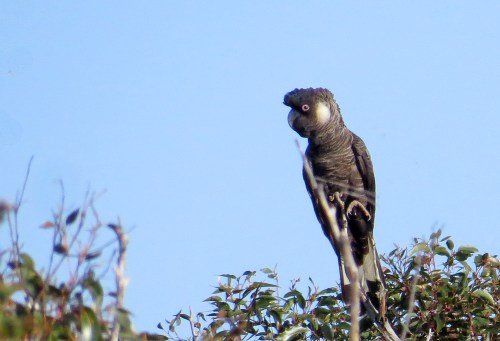
Whilst this is most likely the short-billed Carnaby’s but unless the bill is open it is hard to be sure.

Later on as we drove ever further south towards Albany we found the localized Western Rosella.
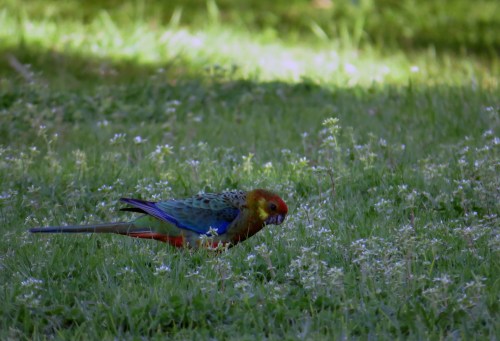
On arrival at our motel in Albany we saw another south-western speciality, Western Rosella feeding in the grounds, this is a female ….

…. and here is the brighter male.
The next post will cover the rest of our birding in the Albany area and then our journey inland to the Outback before returning to Perth.
With 2017 fast receding and the New Year well underway I’d better post something about our time leading up to and during the ‘festive period’ before its too late.
This post deals mainly with social events. I’ll upload another with an account of my winter birding/ringing activities shortly.

Christmas: the time of the year when it’s perfectly acceptable to fill a balloon with your virus and bacteria infected breath and then release it via a nozzle that emits long fart-like noises over the heads of fellow diners!

As neither of us have a work ‘do’ to go to we joined members of the Phoenix organisation at a Christmas dinner-dance at a Bournemouth hotel. I wasn’t very impressed with it this year. The hotel had packed so many tables in the room it was hard move away from your seat and it was very noisy. The food was ok but quite a few people didn’t get what they ordered. We found that other rooms already had their tables cleared and folks were dancing before our dessert was served. With no sign of any imminent dancing by 10.30 we made our apologies and left. Oh well, better luck next year.
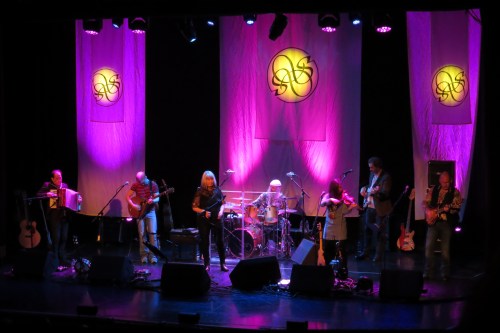
Just before Christmas we went to see the folk-rock band Steeleye Span at the Tivoli Theatre in Wimborne. I first saw the band in Leeds in 1970 when the admission fee was a mere two shillings (10p). I became a firm fan and have seen the band many times since. This is the third time Margaret and I have seen them in the last eleven years.
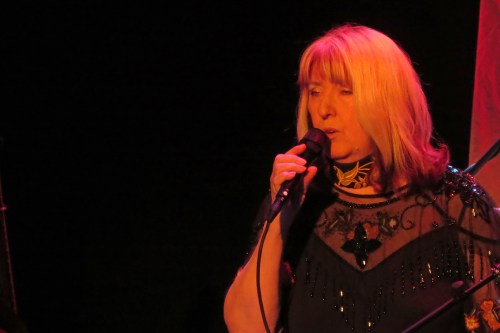
The only band member who has been with them for most of the last 38 years is vocalist Maddy Prior (she left for a few years in the 90s) although several of the current line up have been with them for a very long time ….

…. such as drummer Liam Genockey, whilst violinist Jessie May Smart has only been with the band since 2013. I love their versions of traditional folk material played mainly on electric instruments and feel they have made a massive contribution to folk music revival.
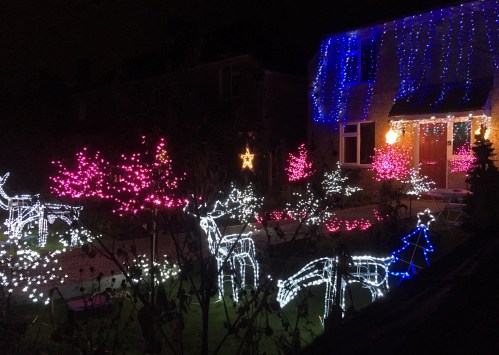
And so to Christmas. As with the last few years we spent it at Margaret’s daughter Anita’s place in Maldon, Essex. This year there was a big difference, many of Anita’s husband John’s family were arriving from South Africa, London or other parts of the UK. With our Dorset contingent as well there would be 25 for Christmas dinner! Obviously that created problems with accommodation, some slept at John’s sister Lois’ place nearby, all rooms in the house were filled with inflatable mattresses whilst we slept in a caravan in the front garden. That would have been ok except for the fact that the next door neighbour’s Christmas lights flashed off and on all night. By night two when found a way to block out the light with towels we slept soundly and kept quite warm in spite of the cold wind.

If finding beds for everyone was an issue, finding a place to eat wasn’t thanks to John’s spacious man-cave (aka double garage). Rather than expect everyone to bring a present for everyone else, Anita instructed us all to buy a single present and add it to the mix. Gifts were then exchanged by a complex series of exchanges at the end of which I found I had received a large supply of biltong that Margaret had purchased!

Then of course there was the issue of catering for 25. Being mainly South Africans the traditional braai (BBQ) was called for. John and his brother and brother-in-law spent all Christmas Day morning constructing this apparatus …

…. made from an old bike, a length of rubber tubing and an old washing machine motor. In the cold and windy conditions it took four hours to cook the meat but it was absolutely delicious. Fortunately our fears that the motor might switch to fast spin mode and send the meat into orbit were not realised.
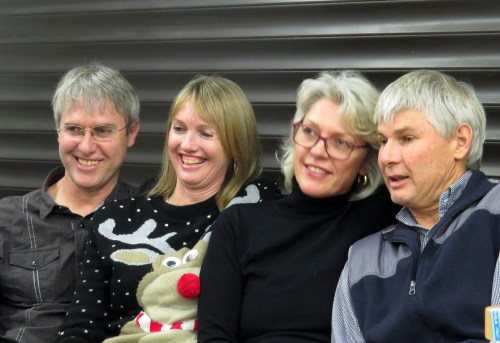
Between the food and the many party games there was time for photos. Here John (left) is joined by sister Lois, sister Heather and brother Paul. The first three live in Maldon but Paul flew over from South Africa. The fifth sibling, Andrea stayed in South Africa with their elderly father.
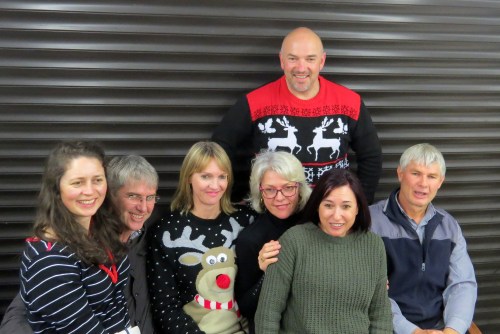
In this shot the four siblings are joined by Anita (on John’s lap), friend Angela and (standing) Lois’ husband Gavin.
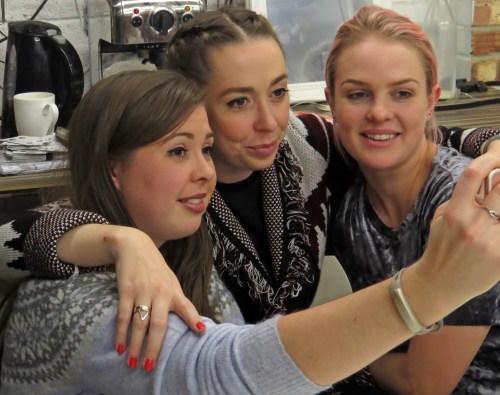
Many of the younger generation were there – Heather’s three daughters (L-R) Erin, Lana and Sheena.
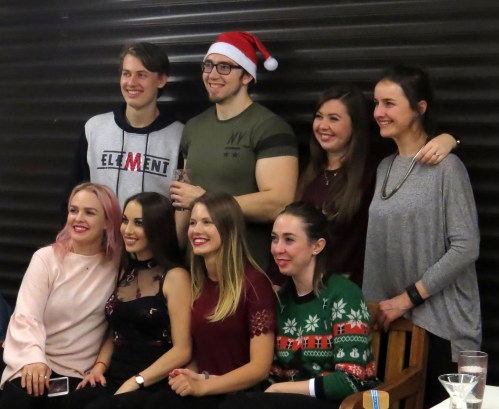
The three sisters were joined by (standing L-R) Paul’s son Alex, Lois’ son Lyle and far right, distant cousin Kim. Sitting between Sheena and Lana are Lois’ daughter Shan and Paul’s daughter Elisha.
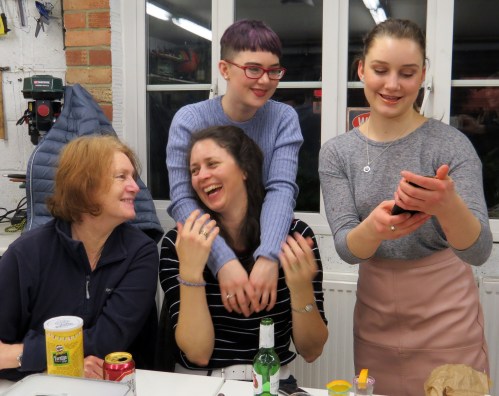
With Anita and Margaret are granddaughters Amber and Kara …
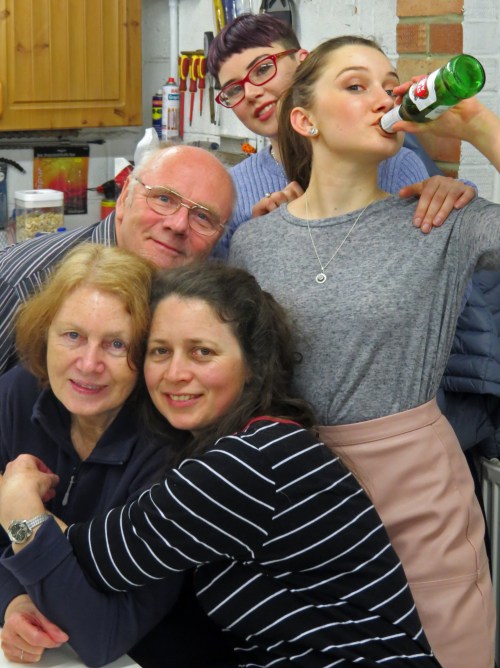
…. whilst I couldn’t resist photobombing this shot. Janis, Margaret’s other daughter (and mother to Amber and Kara) was present but had a bad cold and retired after the meal.
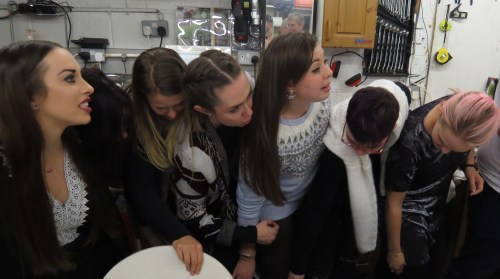
Among the many games played was one where we divided into lines and each line to rearrange itself in order of say, height, shoe size etc. Here Shan (L) tries to organise the line of girls (presumably by shoe size judging by their gaze).

Boxing Day was much quieter and I went out for some birding accompanied by Heather. Like her father, Heather knows the birds of South Africa well, but has having just arrived little idea about identifying British species. Over the period she accompanied me to Abberton Reservoir and the Blackwater Estuary where we saw a wide range of waders and wildfowl.

We left early on the 27th to drive to my brother’s place near Derby. It was raining when we left Maldon but that soon turned to snow. By the time we reached the M11 it was affecting the traffic flow and by the time we were on the A14 it had slowed to a crawl. Fortunately we turned north on the A1, not the parallel M1, as we had to pick a friend up at Nottingham, The section of the A14 between the A1 and M1 was blocked by a jack-knifed lorry and snow. If had gone the other way we wouldn’t have arrived until the evening.

We met our friend Nigel in the centre of Nottingham about an hour later than planned. Down from Leeds, he had been visiting his sister over Christmas. We drove the short distance to Breedon-on-the-Hill to visit Di and Steve (seating far end of the table). I have known Di since the early 70s as I shared a house (and later a profession) with her first husband Clive who tragically died in a motorbike accident in 2001. When ever I see their daughter Hannah (front left) I am struck by how much she looks her father, my dear departed friend. Also in the picture, Hannah’s husband Karl (standing,) daughter Mai, Nigel (between Hannah and Steve) and of course Margaret.
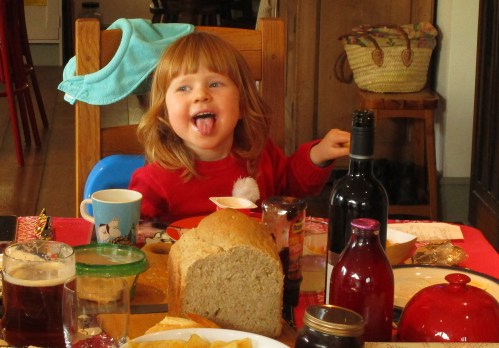
Di’s granddaughter Mai is almost three years old and of course is a bundle of fun. Her sister Rosa is only born a few weeks ago and slept through most of our visit.

We spent a couple of nights at my brothers just north of Derby and visited friends that I have known since school days. We also went to the picturesque Carsington Reservoir for a bit of birding on a beautiful, sunny yet bitterly cold day.
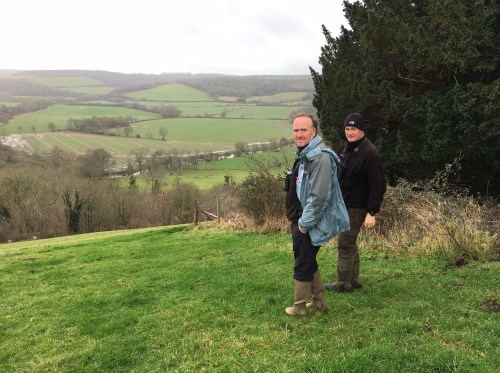
Back in Dorset, on the 30th I joined friend and fellow ringer Ian Alexander (left) and my friend from Shetland Paul Harvey (back in the south to visit his family) for some Dorset birding. There has been a substantial arrival of Hawfinches this winter and we were able to watch a series of flocks that numbered somewhere between 80 and 120 individuals (hard to sure when the flocks kept moving, merging and splitting apart.) More about that in the next post.

We just stayed in and watched the TV on New Year’s Eve but on New Year’s Day we joined the New Year Bird Boat that Mark Constantine kindly puts on for volunteer Webs (wetland bird survey) counters. This year a smaller boat was required as we cruised up the Wareham Channel and Frome River almost to Wareham. The number and variety of birds seen was staggering and the final total from everyone’s sightings combined amounted to 95 species.
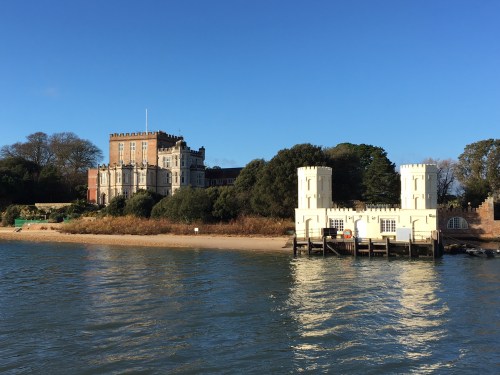
Here we pass Brownsea Island Castle on our way to view the lagoon. Many agreed that it was the best New Year bird boat ever.
More on birding and ringing during the winter will be posted shortly.
In September this year I went on a Birdquest tour to Western Australia. I am only now getting round to sorting and editing the photos.
In addition to the tour of the state of Western Australia there was an optional pre-tour extension to Christmas Island and it seems appropriate that rather than posting photos of family stuffing themselves, I upload an account of Christmas Island at Christmas time.
Christmas Island, although an Australia external territory lies a full 1550 km from the nearest point of the mainland but only 350 km from Java. Ornithologically it is known as the sole breeding site of two seabirds, Christmas Island Frigatebird and Abbott’s Booby plus the ‘golden’ form of White-tailed Tropicbird and has four endemic land birds (plus two more endemic subspecies that are likely to be promoted to species status in the future).
I have seen Christmas Island Frigatebird and a golden White-tailed Tropicbird off Java and remarkably saw a vagrant Abbott’s Booby in Micronesia. After that I declared that I would save my money and not ‘do’ Christmas Island. I’m very glad that I changed my mind as I really enjoyed the place (although due to changes in flight schedules we were there longer than was needed). It was an expensive few days (it’s no longer practical to fly from Jakarta so we had to fly all the way to Perth first and then back north) but the fact that I was asked to drive the second vehicle helped reduce the cost somewhat.

The flight from the UK was predictably lengthy and boring. On arrival at Perth I stayed for what remained of the night in a nearby hotel before returning to the airport the following morning for the flight to Christmas Island. Economically the island is known for phosphate mining and several of these mines could be seen as we came into land. The island is 135 sq km in extent and home to 2000 people, a mixture of white Australians and those of mainly Chinese Malay descent. Although first noted by navigators in 1615 it wasn’t named until 1643 when Captain William Mynors sailed past on Christmas Day. It wasn’t settled until the mid 19th century.

We had hardly left the airport when our leader Andy Jensen pulled to a halt. There perched in full view was a Christmas Island Goshawk, a bird that many birders have failed to see during their stay. We only saw two more and they were just a brief flight views. It’s taxonomic position is controversial. Currently considered a subspecies of Brown Goshawk, it has also been considered a subspecies of Variable Goshawk. Either way, it lies well to the west of the range of either Brown or Variable Goshawk. Most people agree that the most sensible thing is to consider it a species in its own right, something that has been done in the most recent Australian field guide.

There is universal agreement on the species status of Christmas Island White-eye however.
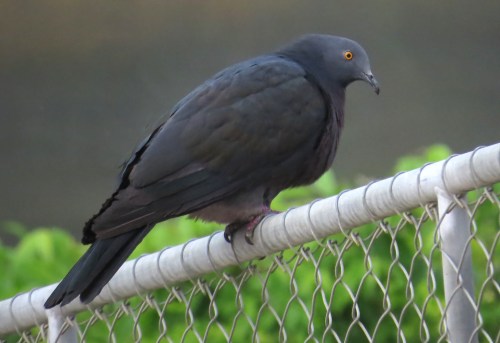
Christmas Island Imperial Pigeons were large and quite conspicuous.
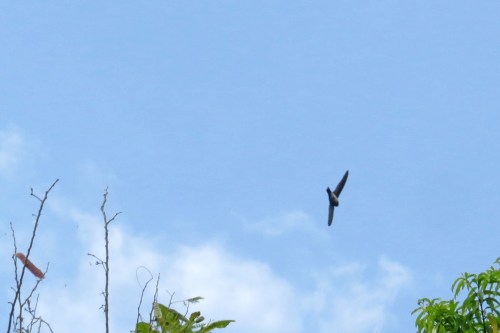
Christmas Island Swiftlet was considered a subspecies of Edible-nest Swiftlet until a few weeks before the tour commenced. Identifying these small swiftlets in flight is nigh on impossible unless you can get near-perfect photos. Some are best identified by the composition of their nests: Edible-nest Swiftlet – only saliva, Black-nest Swiftlet – breast feathers and saliva, Mossy-nest Swiftlet – moss and saliva. It goes without saying that Edible-nest Swiftlet nest are the most valuable and sought after for the manufacture of bird nest soup.

Island Thrush was common and tame all over the island including in the towns. The Island Thrush complex involves some 50 or so races spread across the islands of Wallacea and the western Pacific. Many of the subspecies look very different from each other, some are black,some are brown, others have white heads, most occur on remote mountain tops and are very timid and elusive. Again the general consensus is that this tame species, which occurs to sea level should be split as Christmas Island Thrush.

The other endemic landbird is Christmas Island Boobook which showed so very well in a small park in Settlement on our first night.

The following morning we visited this viewpoint overlooking Flying Fish Cove and the conurbation known as Settlement. All of the above photos except the goshawk and owl were taken near here.

In addition we saw the endemic Christmas island Flying Fox ….

…. and also Common Emerald Dove which is considered a different species from Pacific Emerald Dove that occurs in eastern Australia.

Breakfast time, indeed many meal times, were enlivened by Island Thrushes begging for scraps.
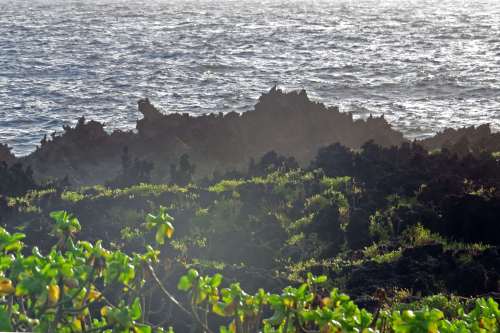
By breakfast time on our first morning we had seen all the endemic land birds so we set off to explore the rocky coasts. With three and a half days in front of us we had plenty of time to concentrate on the seabirds. Unfortunately flight schedules meant we could only spend two nights or four on the island. If we chose the former and there was bad weather or the flights were routed via Cocos Island we could have well dipped on the goshawk or the owl. Of course an extra day in such a lovely place was no hardship but we really could have done with an extra day at some locations on the mainland.
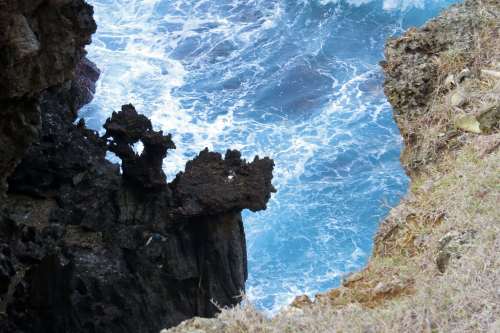
The coastal scenery was characterised by jagged volcanic rocks …
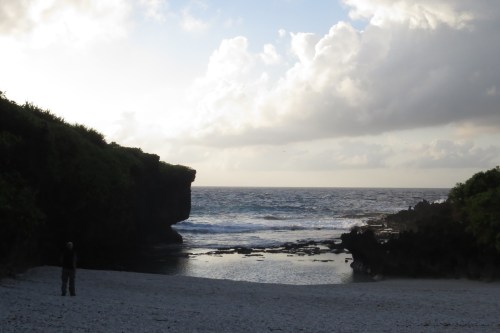
…. quiet coves ….
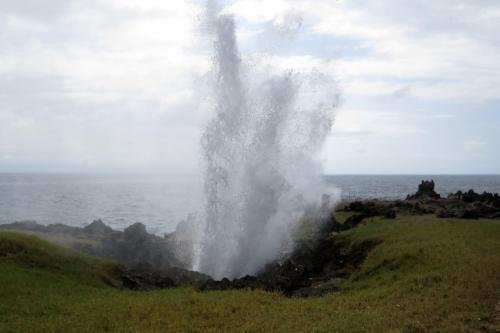
…. and dramatic blowholes.

Nankeen Kestrels were regular if not exactly common ….
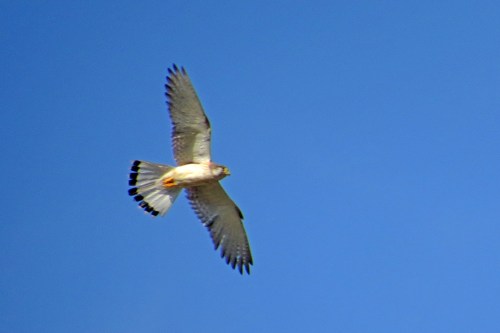
…. it’s interesting that this species, widespread in mainland Australia has colonised rather than Spotted Kestrel which can be found in Indonesia, including Java, only a quarter of the distance away.

Unlike the Red-footed Boobies, which nest in trees, Brown Boobies were seen along the rocky shores.
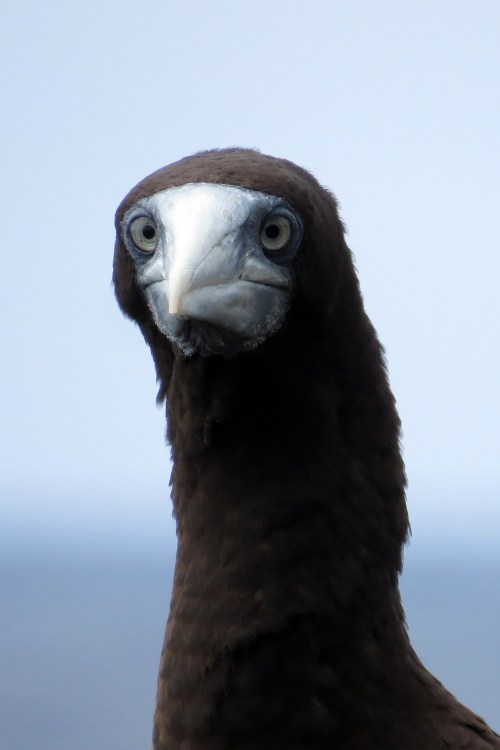
So we got great close-ups of their long gangly necks.
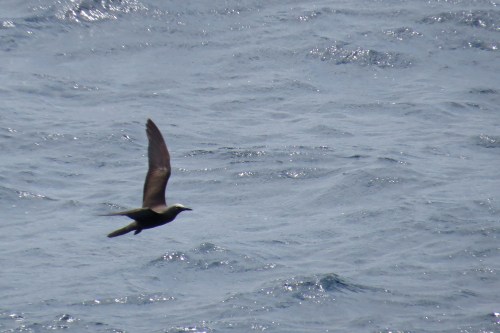
For an hour or so after dawn large numbers of Brown Noddies passed close inshore.
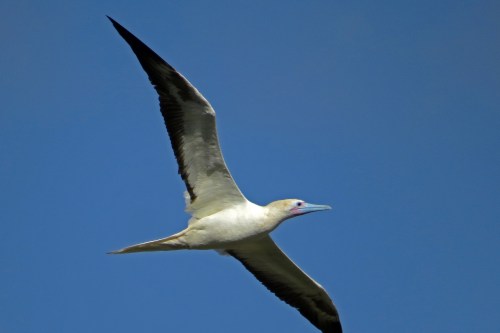
Red-footed Boobies gave wonderful views ….
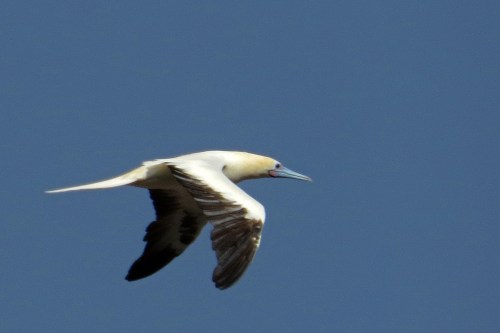
…. Red-footed Booby is one of the most widespread of the Sulidae, the family that comprised the ten species of Boobies and Gannets, being found in the tropical Atlantic, Indian and Pacific Oceans.
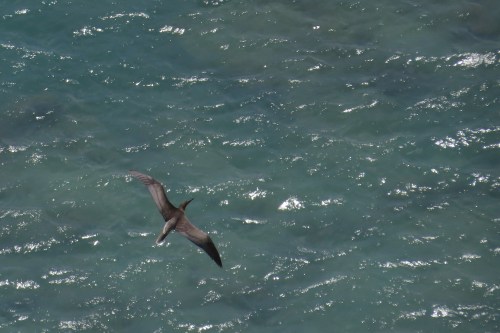
A brown phase also occurs which is a pale brown all over unlike the dark brown upperparts and white belly of Brown Booby.
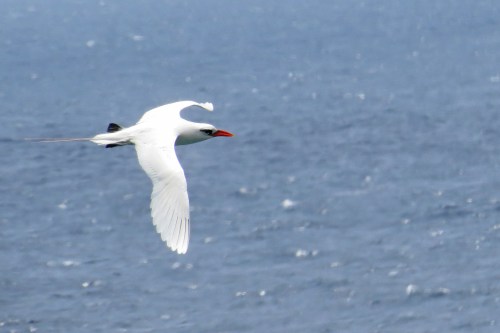
Some of the delights of Christmas Island were the excellent views of Red-tailed Tropicbirds that we saw all along the coast.
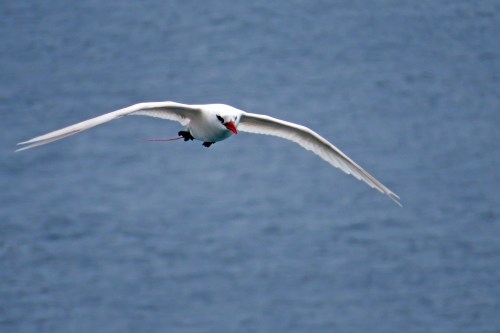
Pairs would perform their ‘rowing backwards’ aerial display, but as the pair keep some distance from each other whilst doing this it didn’t result in great photos, but as they drifted past on the updrafts from the cliffs they posed nicely for the camera.
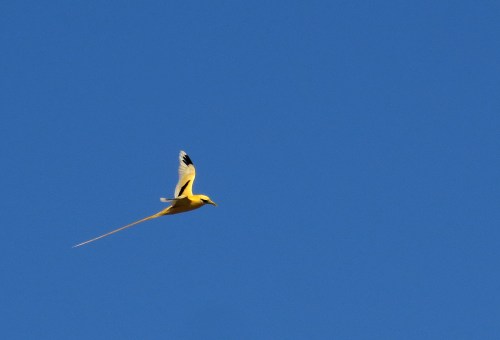
But the highlight was the ‘Golden Bosunbird’, currently classified as the race fulvus of White-tailed Tropicbird. Bosunbird or Boatswain Bird was the name given to Tropicbirds in the days of sailing boats (for reasons I can’t establish).

There are those who consider that this form should be split as a separate species, but whilst this is an attractive proposition, I think they don’t even warrant subspecies status and they are no more than a colour morph. The bird in these two pictures represents the extreme of golden colouration, most are much paler ….
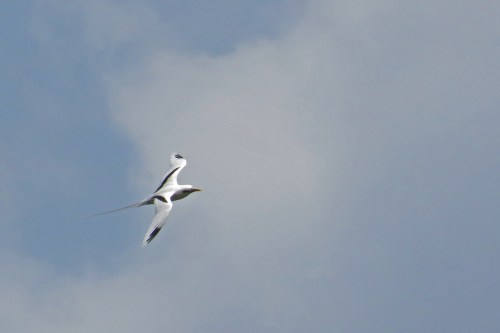
…. and white morph individuals, looking just like the White-tailed Tropicbirds that are seen elsewhere, are not uncommon.

Once when driving past the golf course someone in the group saw an Intermediate Egret. We turned round and went back to investigate …
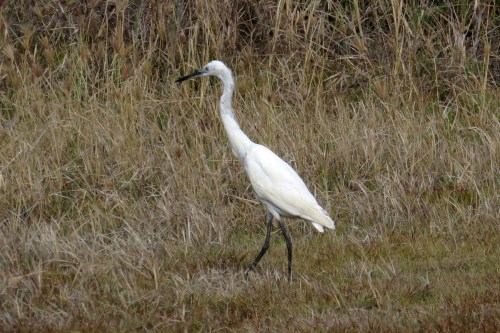
…. but only found a white-morph Pacific Reef Egret.

However the next day we saw an undoubted Intermediate Egret in the same place. Talk about the ‘two bird theory’.
–
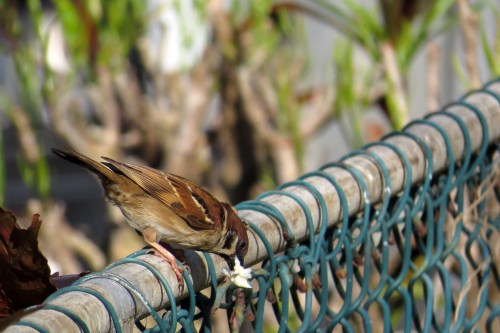
Tree Sparrows, introduced to Christmas Island from Asia, could be easily seen around habitation ….

…. but the introduced Java Sparrow (which isn’t a sparrow at all but a member of the Estrildidae) was much harder to find. Fortunately we heard that a resident put out food for them at 4pm every day on the roof of her garage so we had great views along with a few Tree Sparrows. I missed Java Sparrow when I went to Java but have seen introduced population in places as far-flung as Hawaii, St Helena and here. Java Sparrow is one of just two or three species which I have only seen as introduced individuals rather than in their native range.

One of the most bizarre experiences of the trip, indeed in all of my 40+ years of birding occurred when we visited the part of the town by Flying Fish Cove, immediately under the viewpoint that I illustrated at the start of this account. About half an hour after sunset a strange call was heard offshore and we followed it round until it turned and came directly towards us up the street.
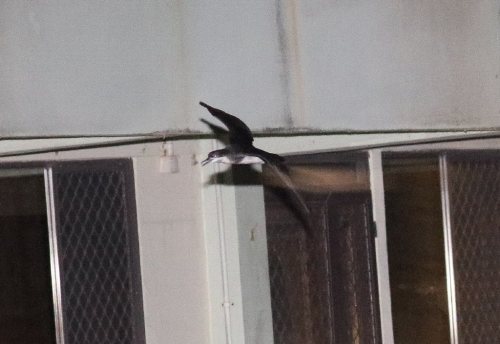
It was a Tropical Shearwater, possibly only the third or fourth record for all of Australia. The bird continued up the street, dodging traffic, calling all the time, before it swung back out to sea. It repeated this performance twice more before flying up the hill. I didn’t get any photos worth publishing so have used this photo from one of the local birders, Hickson Ferguson.

Imagine a small shearwater zooming up this street at shoulder height as you were driving down it! What made the experience even more bizarre was that this was a Muslim part of town and whilst we were listening to the shearwater’s calls an Iman from the local mosque was preaching in (I presume) Arabic and his sermon was being relayed over the loudspeakers.
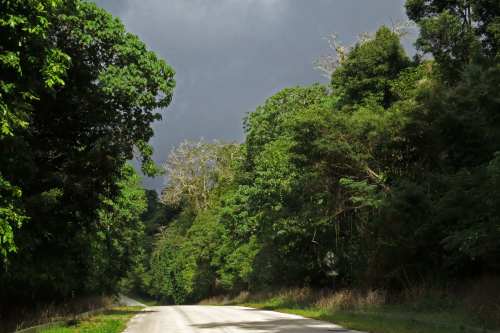
We also spent time in the forested interior of the island.
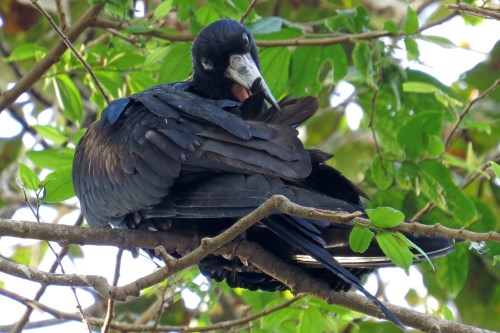
In some areas there were colonies of Frigatebirds ….
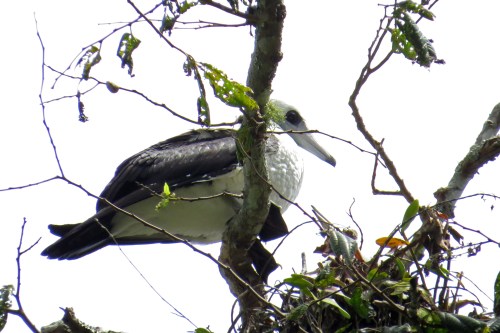
…. but the main attraction was Abbott’s Booby.

Undoubtedly the rarest and most range restricted of all the ten members of the Sulidae, this species is restricted to Christmas Island where it nests in tall trees. I was lucky to see one in a Red-footed Booby colony on Rota in Micronesia (the bird was probably ship assisted) but seeing them and their chicks in the breeding colonies on Christmas Island was a superb experience.

With their fluffy plumage and black surround to the eyes, the chicks looked almost owl-like as the gazed down from their tree top nests.

With its drooping neck and thin, elongated wings held in strangely pushed forwards manner, Abbott’s Booby’s flight has been likened to that of a Pterodactyl, which is a bit strange as we all missed adding Pterodactyl to our list by at least 66,000,000 years so how does anyone know?
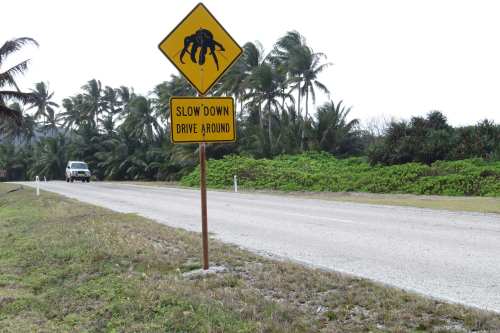
Although Christmas Island has some great bird spectacles, most people know it as the site of the world’s largest crab migration. This occurs later in the year at the onset of the monsoon so we didn’t get to see it.

However there were plenty of the giant Robber Crabs about …
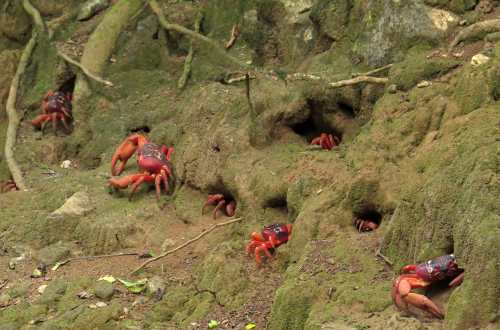
…. but far more Christmas Island Red Crabs. The population is estimated at 40 million or 20 thousand for each human inhabitant.
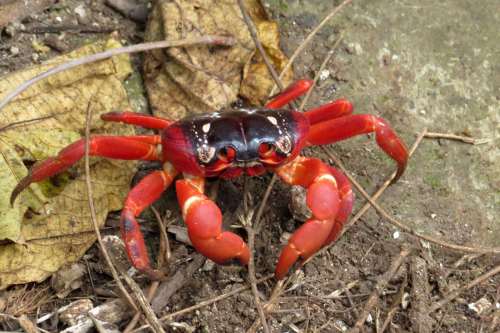
In order to reproduce the crabs must migrate to the coast and lay their eggs in the sea so the males can fertilise them. With 40 million crabs on the move all at once island life does get disrupted but this is what the island is famous for and it brings in tourist dollars. Judging by what was on sale at the gift shop, the islanders were proud of their unique wildlife spectacle.

We were initially puzzled by these apparent ‘cattle grids’. There was no stock to contain and the grids weren’t for water drainage as they were usually situated at the top of a rise rather than in the dips …

… closer examination showed guide rails on each side – they were to protect the migrant crabs from traffic by channelling them under the road.
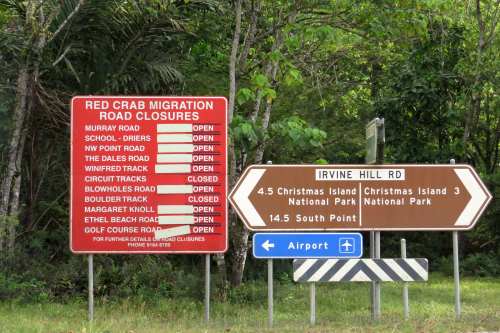
Where else in the world would roads be closed due to crab migration? As we were a month or two too early I think Circuit Tracks and Boulder Track are closed for reasons other than crabs.
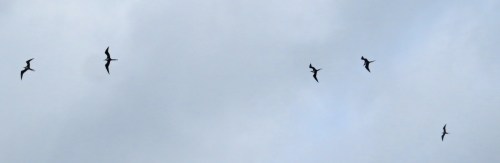
I haven’t mentioned the frigatebirds. Christmas Island is probably the only location in the world where three species (out of a total of five) frigatebirds breed in sympatry. Telling them apart was a different matter though.

It’s not that the different species don’t have a distinct plumage, they do at least in adult male or adult female plumages. This is an adult male Christmas Island Frigatebird.

…. and here is an adult female.

Juveniles however (like albatrosses and large gulls) go through a complex series of plumages before they are adult. The youngest have brown heads like this immature male Christmas.

This particularly ragged looking bird is an immature female Christmas with a partial pale collar and limited and poorly defined white spurs in the axillaries. I have seen Christmas Island Frigates off southern Thailand and Java but Christmas Island is their only breeding site.

Adult male Great Frigatebirds are relatively easy as they are all black. This one is having a quick preen in flight. This species is the commonest frigate on Christmas Island but bizarrely I took far more photos of the eponymous species.

The pale backward-pointing horseshoe on the adult female Great Frigatebird makes it fairly easy to identify.
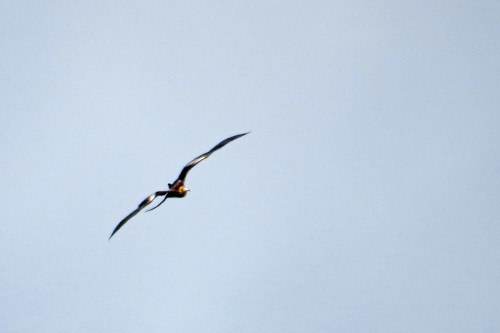
The brown head of this bird marks it as an immature but I’ve not been able to identify it conclusively to species.
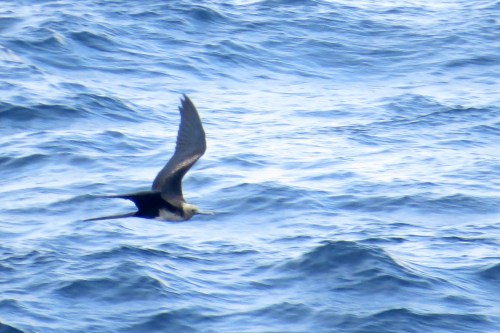
The pale head and breast without spurs in the underwing indicate that this an immature Great Frigatebird .

One of the easiest to identify is the much rarer Lesser Frigatebird, especially the male which is all black except for the narrow white spurs in the axillaries.

Christmas Island has a superb National park covering some two-thirds of the island. Large areas were destroyed by phosphate mining but this has largely ceased. However there are plans to renew the mining, it is critically important that these activities don’t impact on the only nesting grounds of Abbott’s Booby or Christmas island Frigatebird. The above photo shows the loading facility for the phosphate at Settlement.

Well that was it for Christmas Island, a fairly relaxing destination by bird tour standards.

Our four-hour flight to Perth took us down the west coast of Western Australia where the huge expanses of arid wilderness could be seen. the route to and from Perth is a triangular one with flights visiting the even more remote Cocos Island either before or after visiting Christmas Island. Unfortunately on both our flights we were on the direct route. That did save several hours in the air but I would have liked to see Cocos Island, even if it was just briefly from the plane or departure lounge.

I’ll end with a sunset taken from our hotel on Christmas Island. This island is never going to get a lot of visitors from far-away Europe but it is an enchanting destination with some wonderful wildlife.
Previous posts have detailed our visits to Rosslyn Chapel, Fife, Aberdeen and Speyside. From Speyside we continued on to the Kintyre Peninsula in south-west Scotland and arrived at the port of Tarbert late in the day.

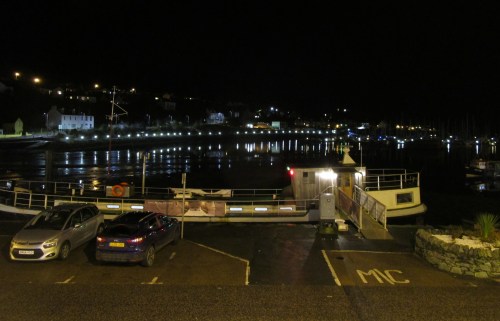
Tarbert from our hotel room.
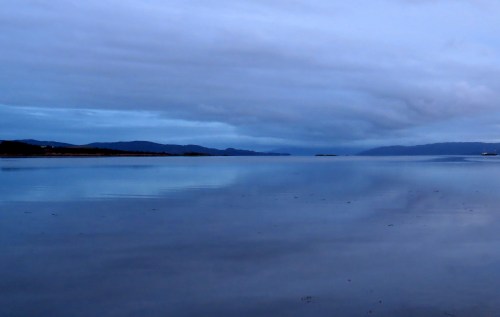
Early the next morning we sailed for Islay from Kennacraig on Loch Fyle on the western side of the peninsula . The loch almost divides the Kintyre in two, there being just two km of land between the head of the loch and Tarbert. It was raining and conditions were very gloomy, although quite still.

As we emerged from Loch Fyle and into the open sea we left the rain clouds behind,

There was still some cloud cover as we arrived at Islay with a sprinkling of snow on the hills.

As we drove north from our disembarkation point of Port Ellen we encountered ….
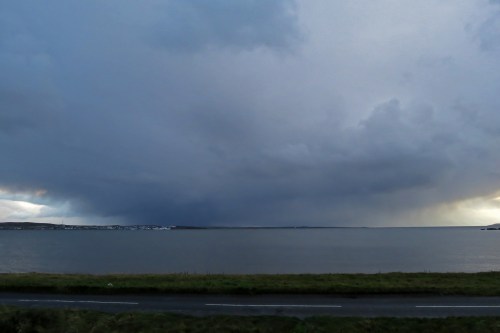
…. heavy showers ….
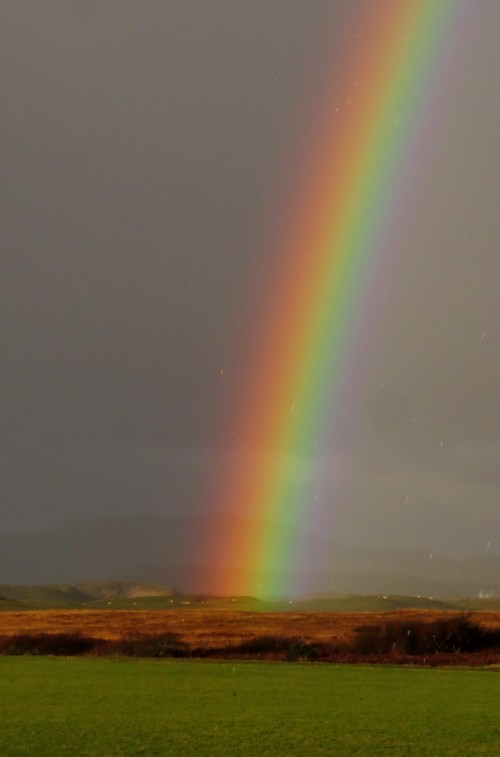
…. which resulted the most intense rainbows.

Quite a number of seabirds were seen, Great Northern Divers. Red-breasted Mergansers, Eiders and this flock of Scaup.
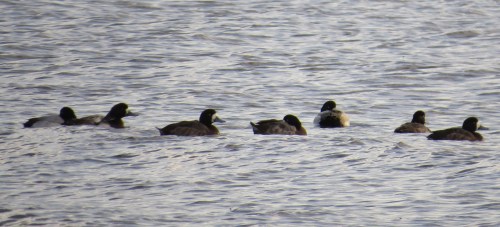
Scaup, more correctly called Greater Scaup, were once a regular wintering bird in Dorset but now we seldom see any, so a flock of 50 just offshore was a real treat. The grey flanks and backs of the males and white crescent on the faces of the females were clearly visible.

Our main reason for going to Islay was to see geese and there were geese aplenty. As many as 45,000 Barnacles winter on Islay and surrounding areas.
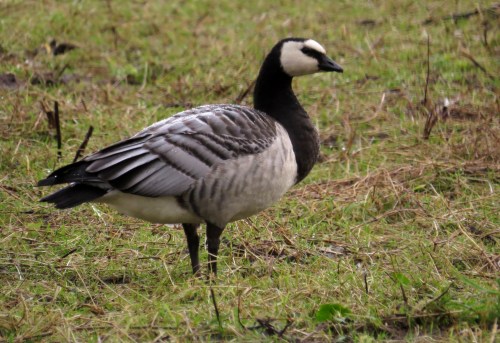
Most were Barnacle Geese, the population that winters on Islay has been shown to breed in Greenland whilst the population that winters on the Solway Firth breeds in Svalbard

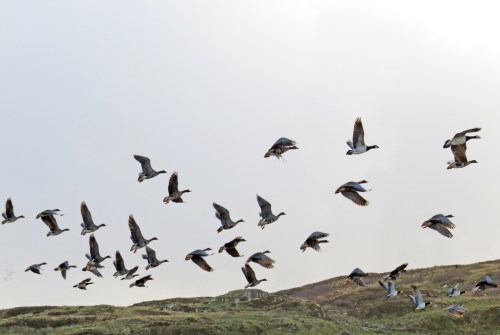
Flocks of geese were seen in flight both against pastel blue skies ….

…. and against stormy ones.

Barnacles weren’t the only geese species present, many Greenland White-fronted Geese were seen too. Islay holds about 5,000 of the estimated 19,000 world population of this threatened taxon. The other main wintering sites are in Ireland.
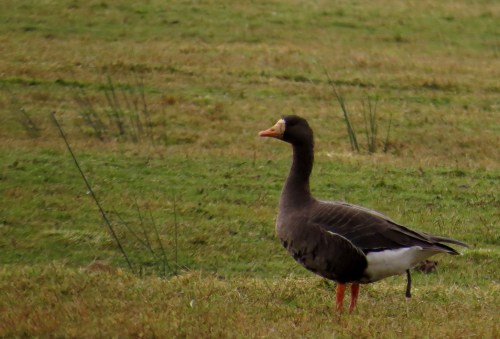
Larger and longer-necked with an orange bill and more strongly marked belly, the threatened Greenland Whitefront is sometimes considered a different species from the (Russian) White-fronts that winter in England.

Greenland Whitefronts and Barnacle Geese. Generally Whitefronts are larger and stockier but the frontmost Barnacle in this picture seems to buck the trend.

Almost all Barnacles seen in the south of the UK are from feral stock so it was a delight to see these birds that have flown all the way from Greenland against the backdrop of snow-covered mountains.

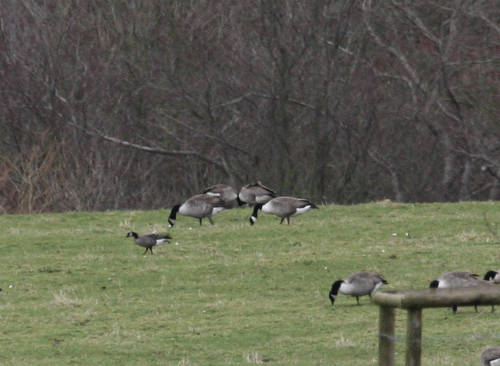
Good as these geese were there was one species I particularly wanted to see – Cackling Goose. The RSPB information centre at Loch Gruinart was not manned but you were invited to phone the local office with enquiries. The warden I spoke to confirmed that there had been no sightings of Cackling Goose for a couple of weeks but then said he had some unopened emails in his inbox. A minute or so later he announced that a Cackling Goose had been seen yesterday at Loch Kinnabus in the far south of the island. We returned to Port Ellen and continued on minor roads to the loch. Highland Cattle were there to greet us ….
…. but so too were flocks of Barnacles and Greenland Whitefronts.

It took a bit of scanning through the somewhat distant flocks before the Cackling Goose was found. Photography was attempted but the bird only showed as a brown blur in the pics. I have included a photo from http://www.lloydspitalnikphotos.com taken in the USA. This photo is quite informative as it shows a Cackling (left) alongside a wild Canada Goose. For a long time the Canada Goose complex was a conundrum, the many subspecies covering the largest size range of any bird. Subsequently the four smallest Canadian/Alaskan tundra breeding races were split off as Cackling Goose. Of these four only the nominate race hutchinsii, the so-called Richardson’s Cackling Goose, is a potential vagrant to Europe, the others being short distant migrants from Alaska to the USA and Canadian west coasts. However it is likely that the last word in Canada Goose (senso lato) taxonomy has been written and they may be further splits or they could even be lumped back together again.
My experience with Cackling Goose has been checkered. One was seen by others when I was on Islay in 1984 with a large flock of Barnacles, but I failed to get onto it before it disappeared behind a rise, I saw one on Wrangel Island, Arctic Siberia with a flock of Snow Geese in 1996, undoubtedly an overshoot from Alaska, I saw two so-called Cackling Geese, one in Norfolk in 1999 and another in Suffolk in 2002 but further research showed they were wild Canadas of the smallest race parvipes which approaches Cackling in size, I have seen two undoubted Cackling Geese in the UK but one was clearly of captive origin and the other (seen above) may have been, I have also seen a small wild flock in Nebraska. Until this trip I hadn’t seen a definite Cackling that was definitely wild anywhere in the UK. The photo shows the Cackling Goose that I saw with feral Canadas in Somerset in 2012.
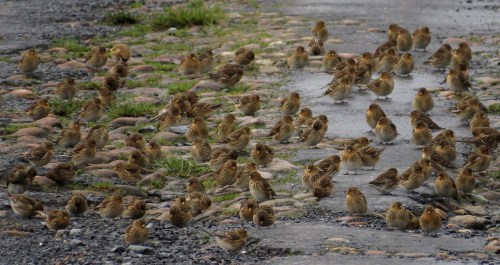
Further along the track to the loch was this large flock of Twite involving perhaps 100 birds.
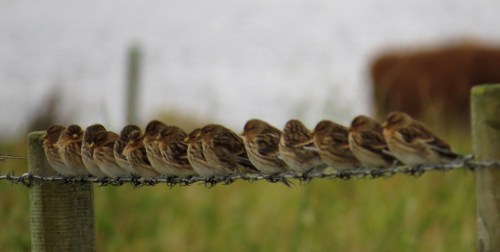
Although these lovely relatives of Linnets and Redpoll are common in the Northern and Western Islands the population that used to breed on the moors of northern England seems to have declined and it is this population that used to winter on the east coast. As a result few are seen away from the Hebrides, Orkney or Shetland these days.
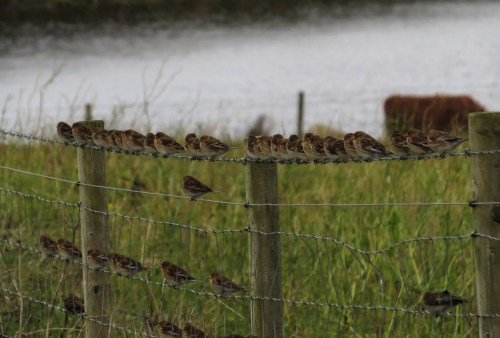
Twite are particularly rare in Dorset, but I was lucky to catch one in November 84 when I was ringing Pied Wagtails at roost. A small flock used to occur at Dibden in Hampshire but in recent years I have only seen them in Scotland.

We were now on the RSPB’s reserve on the Oa (pronounced ‘O’) so it made sense to drive down to the Mull of Oa and look for Choughs and Golden Eagles.
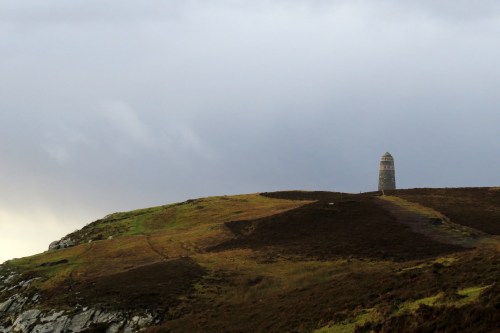
My plan was to walk around the headland to the American Memorial which commemorates a number of American servicemen who were killed here during the war.

From the coastal footpath the shoreline of Antrim in Northern Ireland could be seen in the distance.

From the cliffs you could also get good views of the south-west peninsula of Islay.
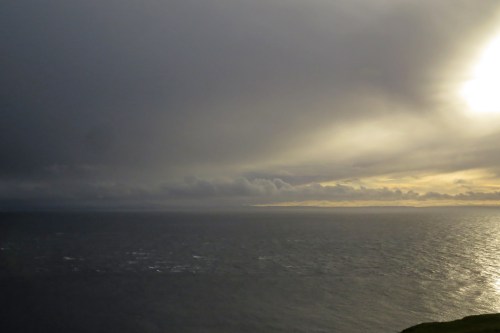
Unfortunately the plan to walk to the American Monument had to be abandoned for two reasons, the sky turned very black and it was clear that another downpour was on its way and I slipped and fell on the rain-soaked grass and landed on top of my camera bruising my ribs which are still painful over two weeks later.

I just got back to the car just as the heavens opened. A few Chough were seen briefly from the car park but no eagles.
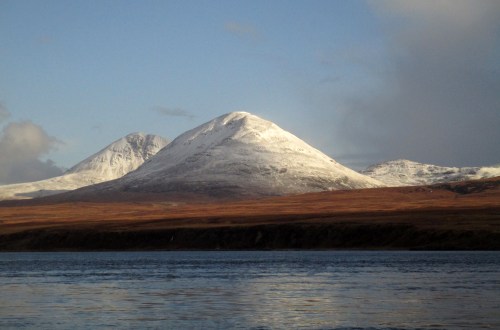
The following morning we drove to Port Askaig on the north-west shore of Islay. Here you get a good view of the island of Jura. The two most prominent mountains are known as ‘the Paps of Jura’ for obvious reasons.
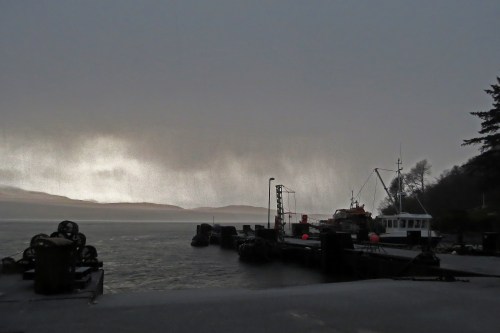
Once again the sunshine was short-lived and whilst we waited for the ferry to Jura the heavens opened ….

…. but at least we had the shelter of the car.

The ferry was very small and there was only room for two cars and this lorry.

We really hoped that he wouldn’t roll back when we docked. Note the layer of hail on the car.
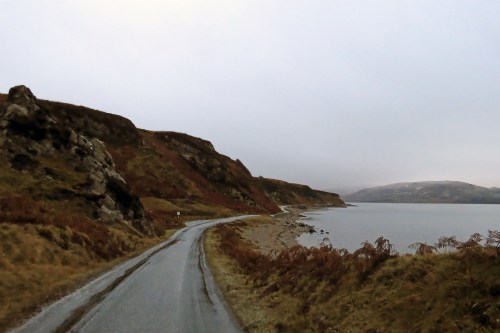
Jura is about 50km long but it only has one road and only 150 inhabitants.

Red Deer were common along the roadside.

We soon reached the little town of Craighouse.

There was still a lot of Jura ahead of us but we still had somethings we wanted to see on Islay and we had to be back at Port Askaig at 2pm for the ferry to the mainland so we backtracked to the inter-island ferry at Feolin.

We had hoped to see White-tailed Eagle, which we did, but it was quite distant and the photos were poor. Here is one I photographed on Skye in 2012.
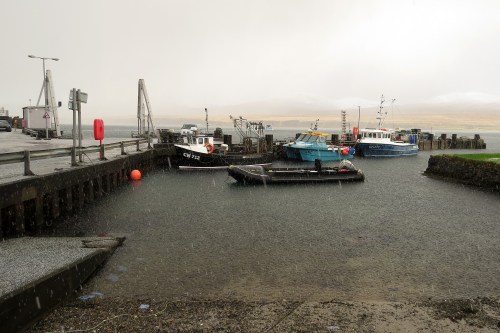
Our return to Islay was as dramatic as our departure with another hail storm …

…. but at least this time we had a nice hostelry opposite ….
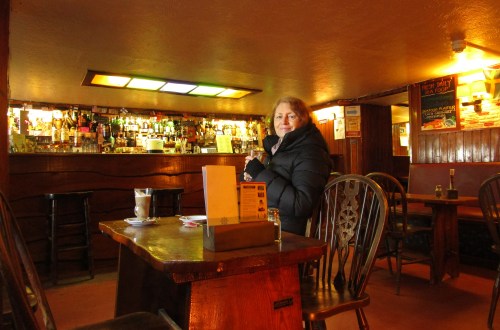
…. where we could warm up with a nice cup of coffee.
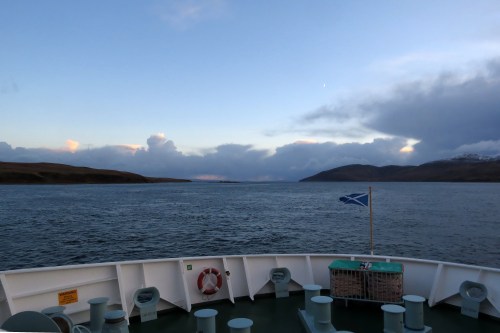
So it was farewell to Islay. We departed that afternoon with Jura on our left and Islay on our right ….
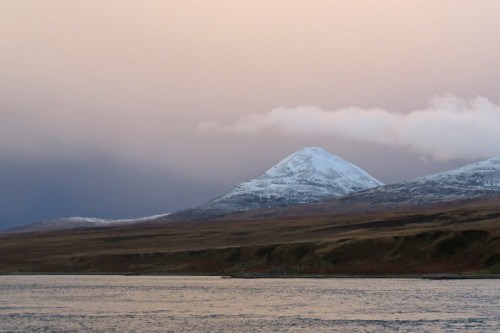
…. leaving the snow-covered Paps behind ….

…. perhaps Eccentrica Gallumbits once visited Jura!
After docking at Kennacraig we spent the night back in the hotel in Tarbert.

We now had to make our way south, we had the choice of driving all the way north to Loch Lomond and then south via Glasgow or catching the ferry from Tarbert to the Isle of Arran and then on to Ardrossan on the Dumfries and Galloway coast. The former involved a lot of driving, much of the time backtracking on the route we took to get here, so we opted for the latter. This gave us much of the morning to further explore the Kintyre Peninsula, but not enough to get to the Mull of Kintyre and back. First we drove down Loch Fyle past where we had boarded the ferry to Islay two days earlier ….

…. and we carried on southwards for about an hour seeing the wonderful scenery of the islands of Islay, Jura and Gigha to one side and the Mull of Kintyre and the Antrim coast in front of us.
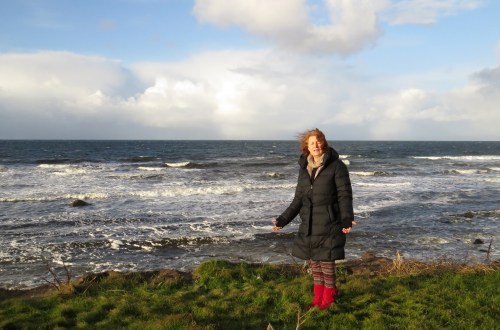
The weather was predictably cold and windy but at least we had no rain, hail or snow.

About lunchtime we boarded the small ferry to Lochranza on Arran.
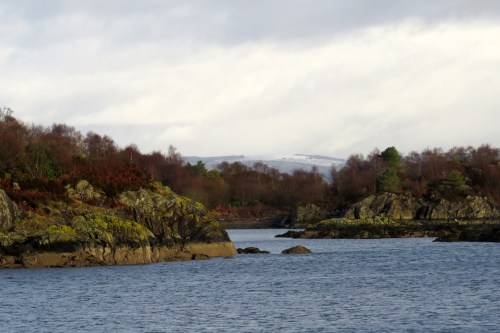
We had a beautiful journey across to Arran and even managed to add a few birds like Black Guillemot to the trip list.
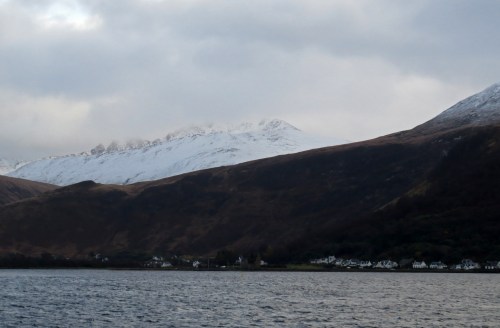
On arrival we had about two and a half hours before our next ferry so we decided to take the minor road along the west shore of Arran.
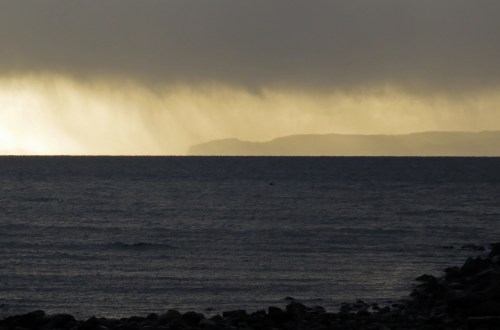
As well as passing through many quaint villages we also had views of the southern Kintyre peninsula. We took a minor road over the centre of the island but it was snowing and we didn’t stop for photos. Late afternoon we caught the ferry to Ardrossan and arrived about 6.30 pm.

We stayed at a rather charming but cold guest house near Kirkconnel north of Dumfries and with a lack restaurants nearby we visited a typical Scottish small town pub for drinks.
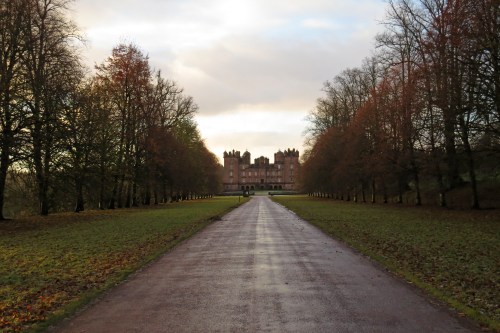
Our final destination of the trip was Drumlanrig Castle. Margaret particularly wanted to visit as her grandfather had been brought up here. Unfortunately although the grounds were open, the castle itself was closed for the winter.
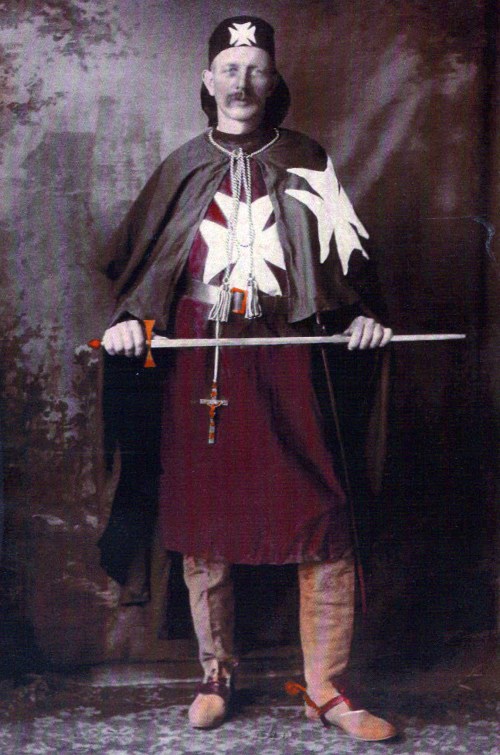
The story is that her paternal grandfather James Wright was born in South Africa, but at a very young age was taken back to the UK by his mother in 1869. His father intended to follow on a few weeks later but tragically died from a heart attack before he embarked. Weakened by recurrent malaria, his mother never recovered from the shock and died soon after. His siblings were sent to boarding school, but the infant James was raised by his aunt who owned the Drumlanrig estate. After he left school he returned to South Africa where later made a living transporting goods by ox wagon through the wilderness. His memoirs were later collected into a book which was privately published. Here he is seen in a hand coloured photo in the uniform of the Knights of Saint John. Date of photo unknown, photographer unknown.

We couldn’t visit the castle on this trip but one day we will return.

We both had developed chest infections and my bruised side was giving me some grief, so although we had another couple of days available (which we were going to use to visit the Lake District) we decided to cut the trip short and return home.
The return trip from north of Dumfries to Poole went quite smoothly and we were home by late afternoon. It had been a very interesting trip with good birds and great scenery, the weather was against us but there again it was late November. I’m glad we didn’t leave the trip until later as the area has received considerable amount of snow recently and indeed we just avoided heavy snow ourselves by leaving Speyside when we did.
Previous posts have detailed our stops at Martin Mere in Lancashire and the Rosslyn Chapel in Midlothian that we took on the way to visit Margaret’s brother Duncan in Aberdeen.
This post covers our time in Fife along the north coast of the Forth Estuary, our visit to Aberdeen and our stay in Aviemore in Speyside.
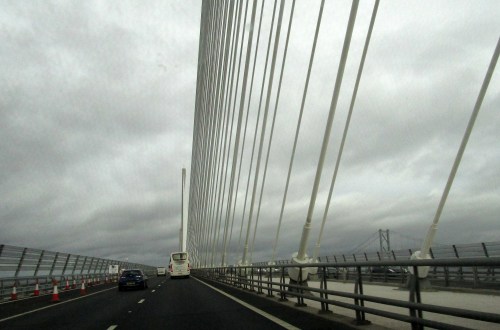
We left Roslin and skirted Edinburg on the ring road and crossed the Firth of Forth on the new Queensferry Crossing. Only opened this August at a cost of £1bn it is already (as of early December) undergoing closures for resurfacing. Of course it was Margaret who took this photo and not the driver.

The weather improved as we drove along the north shore of the Forth estuary. In the distance is the now uninhabited island of Inchkeith.
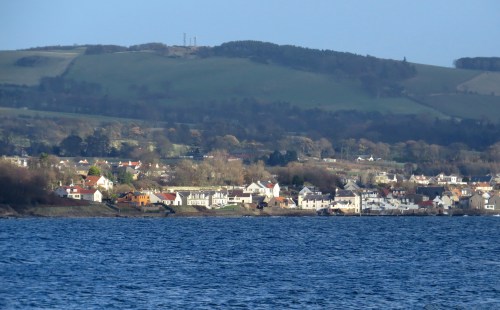
We skirted the large bay between Leven and Earlsferry on the lookout for flocks of seaduck.

A few Ringed Plover, Dunlin and Redshank were seen on the rocky shores ….

…. and we encountered a number of distant flocks of Long-tailed Ducks, Eider and Common Scoter. Velvet Scoter showed well and I was able to capture this passing flock. However we didn’t find seaducks in the numbers I encountered on a visit to the same area in April 2000, where a single flock contained 2000 Common Scoter and 500 Eiders.
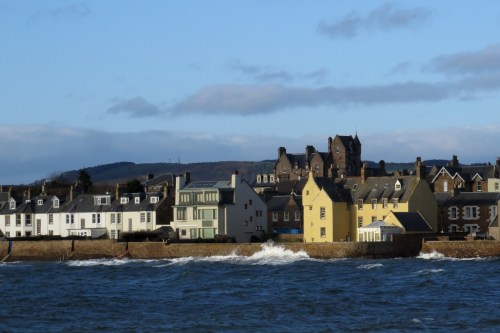
We drove to Elie Ness lighthouse and looked back towards the pretty town of Elie.

We stopped in Anstruther ….

…. had lunch in this cafe ….

…. and in spite of the bitter wind that had sprung up, went for a walk around the harbour.

This proved to very worthwhile with stonking views of a Grey Seal ….

…. and a few hundred (Common) Eider.

We had great close up views of the dapper males ….
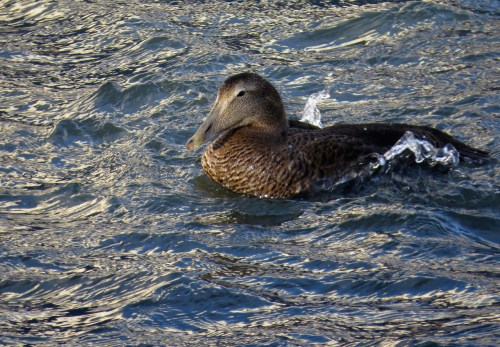
…. the well camouflaged females (female Eiders of course pluck their breast feathers to line and insulate their nests, the original eiderdown) ….
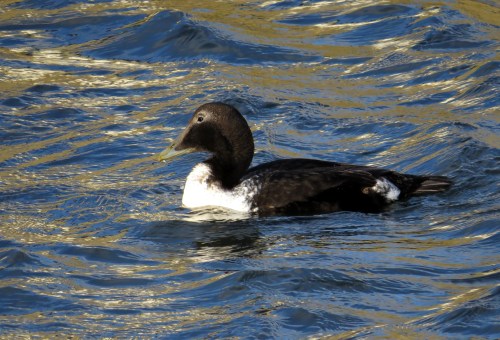
…. and the variable and somewhat scruffy first-winter males.
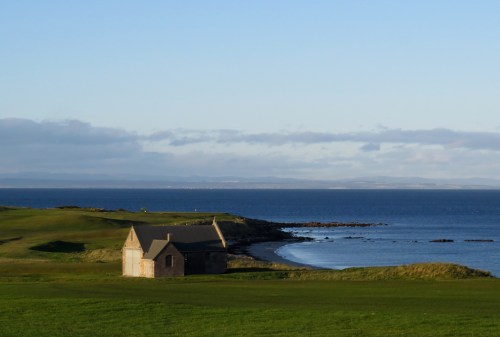
We continued on to the easternmost point of Fife, Fife Ness. From here you could look northwards to Arbroath and Montrose or south to East Lothian. We continued northwards through St Andrews and Dundee but arrived at Aberdeen at rush hour on a Friday. In a set of extensive and very poorly signed road works to the south of the city we took the wrong turn and ended up in the city centre. Frustratingly it took an hour before we emerged and carried on to our destination.

Margaret’s brother Duncan and his wife Wendy moved from South Africa to the UK about 10 years ago, first to Edinburgh and then to Aberdeen. The climate must be a bit of a shock after living in Durban. We haven’t seen them since 2012 so it was good to meet up. This photo was taken in 2008 when their sons Darren and Sean were still living at home. L-R Darren, Margaret, Sean, Wendy, Duncan.

Early in the morning I popped down to Blackdog a coastal site to the north of Aberdeen and close to where Duncan and Wendy live. Offshore were many anchored ships from the oil industry. Whether they are moored up because of the downturn in the oil business or due to a lull in the need to supply the rigs is anyone’s guess. Blackdog is famous for its huge flocks of summering scoters and eiders, with several rare species often being present. I enjoyed this spectacle in 2012 but found out on this trip that this gathering doesn’t occur in the winter.

A little bit to the north of Blackdog lies the Trump Golf Course. The Scottish Government let his empire destroy a nationally valuable, wild and totally protected stretch of unspoilt coastal dunes when he promised a multi-million pound investment, thousands of jobs and a huge leisure complex. He has reneged on all of this except for the building of the course, which now operates at a loss. So now we have the destruction of a precious ecosystem, hardly any new jobs and just a bit of manicured grass.

We hoped to pick up one or two rare birds during our stay so having heard of a Snow Goose at Loch of Skeen a few miles east of Aberdeen, we headed out there one afternoon. It’s not that difficult to see Snow Geese in the UK but most are feral or direct escapes. Seeing one in the company of wild Barnacle or Pink-footed Geese or Whooper Swans greatly increases the chance that the bird has really come from Arctic Canada. We arrived at the lake before dark and carefully scanned the few hundred Pink-feet on the loch without sucess. As darkness fell thousands, well probably tens of thousands, of Pink-feet flew in a long skeins until the entire surface of the lake looked black. It was too dark to see when we left yet still you could hear them flying in. We never saw a white one though.
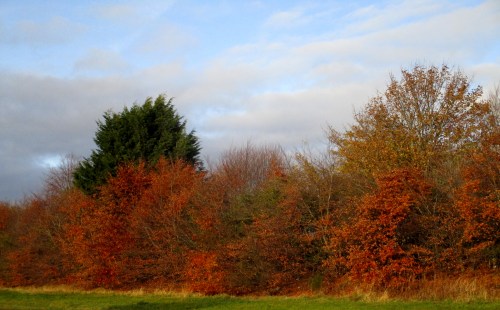
After a final morning with Duncan and Wendy we headed inland for Speyside. It was a lovely day, if rather cold and the sun lit up the autumn colours a treat. The route from Aberdeen to Aviemore is not straightforward but we negotiated the many changes of highway with ease ….

…. and arrived at the quaint village of Carrbridge just as it was getting dark (hence the lacklustre look of the photo). We continued onto Aviemore where we had booked an apartment (it was actually bigger than our house) for the next three nights.

The Aviemore/Cairngorms area (or Speyside as it sits on the banks of the river Spey) is one of the most outstanding areas for birding in the UK and one that all British birders should visit at some time. Most notable are the stands of ancient Caledonian forest, which has in places remained unchanged since the end of the Ice Age. Mature forest is made up of Scots Pine with birch and oak in places with an understory of juniper, rowan, blaeberry and heather.

Birdwise this area is famous for both Red and Black Grouse, Capercaillie, Ptarmigan, three species of crossbill, Crested Tit, and in summer Dotterel. Other goodies (in season) include Snow Bunting, Long-eared Owl, Osprey, Golden Eagle, Dipper and a multitude of other more widespread birds. We first headed to the RSPB reserve at Loch Garten but the visitor centre is shut at this time of year. This lady was feeding birds in the car park and they were tame enough to feed from her hand. They were mainly Coal Tits but we did also see ….

…. a few Crested Tits. These forests are the only place in the UK where this species can be found. I have made many excuses for not using my own photographs in the past but this time it was a good one, I’d left my camera behind in the apartment! So here is a photo of Crested Tit from highlandphotography.co.uk

It had rained all morning but suddenly the skies cleared, I glanced up from the car and saw this bizarre upside down rainbow directly above us. By the time I had got my pocket camera out the 3/4 full circle had shrunk to a crescent but it still looked remarkable. This phenomenon is known as a circumzenithal arc or an upper tangent arc (‘upper’ as it is above the sun) and is caused by light refraction through ice crystals.

It was perfectly still and nearby Loch Garten was like a mirror.

Summer visits have revealed lots of breeding Goldeneye on this lake but today it was birdless.
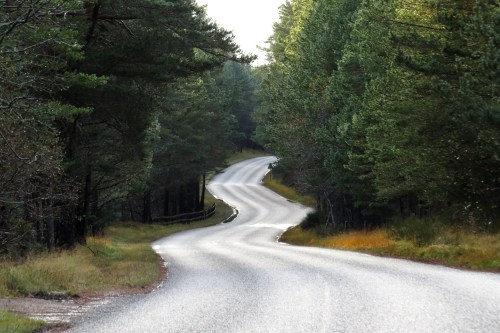
We also took a drive to the Cairngorm Mountains 13 miles south of Aviemore. The road goes straight to the ski centre car park and the funicular railway which takes you up to 3600ft asl.

You pass through beautiful areas of heathland studded with areas of natural Caledonian Forest and modern plantations.

Way in the distance to tops of the 4000ft (1200m) high Cairngorms peek through the clouds. Whilst not very high by the standards of the Alps, Rockies or Andes, at the latitude of Scotland the Cairngorm plateau is a true alpine-arctic wilderness home to many species of flora and fauna found nowhere else in the UK. The Cairngorm National Park is the largest wilderness area in the UK and the largest National Park.

By the time we reached the car park cloud had descended and we saw no point in going up the funicular railway to the Ptarmigan Restaurant. To prevent those unprepared for hiking in arctic conditions from wandering about the plateau and getting lost you are not allowed to leave the restaurant at the top and if you want to explore you need to walk up. I did hike to the neighbouring peak of Cain Lochan (left in the photo) in June 2012 and saw Ptarmigan (see below) and Dotterel but I have never seen breeding plumaged Snow Bunting in the UK.
In spite of the weather we saw other good birds during our stay, a flock of crossbills, most likely the endemic Scottish Crossbill, plus Dipper and genuinely wild Greylag Geese, but pride of place goes to this distant male Black Grouse seen on the climb up to the Cairngorm car park. It might have distant but it looked really good in the scope.

At least the Red Grouse (a endemic British subspecies of the Holarctic Willow Ptarmigan or Willow Grouse, which doesn’t change to white in winter) showed well. This is a female ….

…. and here a male.

As we returned to Aviemore we stopped at Loch Morlich where the mountains formed a perfect reflection on the water ….

I have camped by this lake a number of times in past; in the early 70s with two friends (I well remember having to walk back from Aviemore at dawn after a very memorable night on the town) and in the late 70s with Janet when we tried to go sailing and I realised far to late that I couldn’t remember what I learnt on sailing holidays ten or more years earlier!
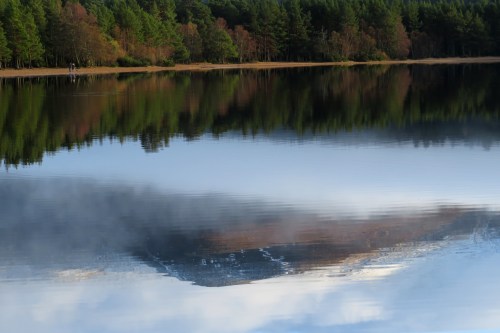
All in all I’ve made about 18 trips to Scotland and most of them have brought me here. These days I just enjoy the magnificent scenery and wildlife and avoid adventure activities and all-night parties!
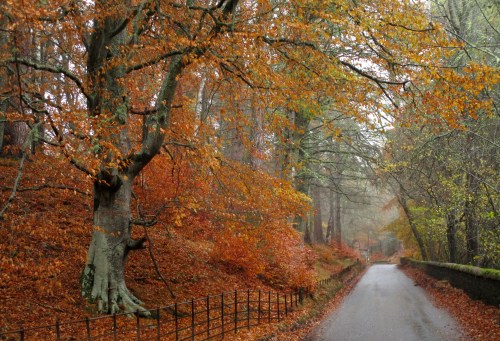
So that was it for Speyside and we drove from the rich autumn colours around Loch an Eilein ….
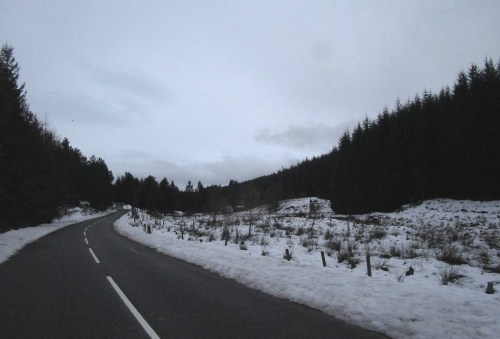
…. straight into winter. We had heard that heavy snow was on its way and it was time to leave anyway, so we planned an early departure and only met a small amount of snow on route. We drove south over the eastern Cairngorms and onto Braemar on Royal Deeside, favoured by the royal family since 1852.

We then climbed another pass at Glenshee in the hope of seeing the Ptarmigan that we missed on Cairngorm. I had seen Ptarmigan at Glenshee in April 2000 but had to climb quite a bit to see them. It was cold and windy and I didn’t fancy the climb so we scanned the slopes from the car park. Initial attempts drew a blank but after warming up in the cafe we had another go and found a flock of 11 white winter plumaged birds high above us. Yes, the six white blobs in the photo are Ptarmigan, its a dreadful photo but they were a considerable distance away and it was starting to snow.
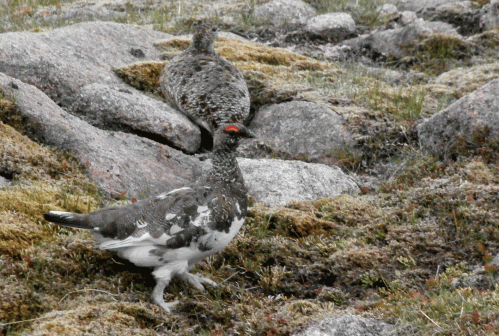
Here’s a lot closer pic of a pair of Ptarmigan in grey and white summer plumage taken in Cairngorm in 2012. Remember they are ‘P’tarmigan, a bird with a silent P (like in ‘swimming pool’).

From Glenshee we headed south and then west via Loch Tay on the long drive to the west coast. We arrived at our hotel at Tarbert on the Kintyre Peninsula just before dark. On route we passed these falls and paused briefly for photos.

…. but I’ll conclude the post with another couple of views of Loch Morlich.
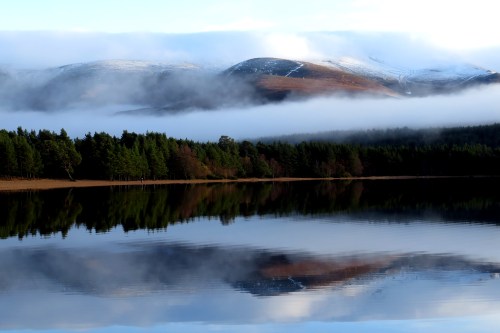
By leaving Speyside when we did we managed to avoid the worst of the snow but there was plenty more wintry weather waiting for us at our next destination, the west coast islands of Islay, Jura and Arran, which will be the subject of the next post.
Like many people I have to admit that I had never heard of the beautiful Rosslyn Chapel until I read Dan Brown’s ‘The Da Vinci Code’.
Margaret and I paid a visit to the Chapel in April 2010. We had a planned trip to Portugal cancelled at the last-minute due to the infamous Icelandic ash cloud, so we set off in the car on an impromptu trip visiting old friends and tourist sites all across northern England and southern Scotland and Rosslyn Chapel was one of many historic sites we stopped at.
Unfortunately then the Chapel was undergoing a much-needed renovation and Margaret said ‘we must come back when all this scaffolding comes down’ – so this year we did.
Dan Brown falsely claims that the names Roslin/Rosslyn originate because the Chapel sits on the ancient Paris Meridian, a French alternative to The Greenwich Meridian (which it doesn’t), which he names ‘the Rose Line’ and then (again falsely) associates it with the Rosicrucians and the supposed bloodline of Mary Magdalene.

The Chapel is situated on a rise above the town of Roslin. Behind is a wooded gully and even in mid-November many of the trees were still sporting their autumnal colours.
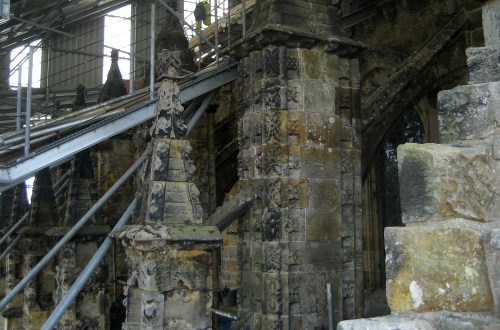
This is what the exterior of the Chapel looked like when we visited in 2010, there was also scaffolding inside the Chapel.
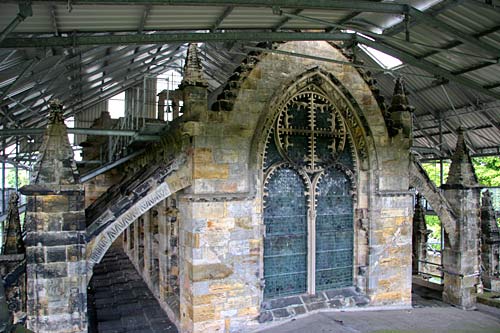
Here is an elevated view (taken from Wikipedia) of the chapel during the restoration process.

The Rosslyn Chapel was commissioned in 1446 by William St Clair (the family now know as Sinclair). It is thought that it might have been planned as part of a much larger building, but work ceased after William’s death in 1484. The endowments for Rosslyn Chapel were seized as the effects of the Reformation began (this was the time of Henry VIII’s dissolution of the monasteries). The Chapel’s provost and prebendaries were forced to resign as a result and in 1592 Oliver St Clair was ordered to destroy the altars of Rosslyn, it being described as a ‘house and monument of idolatrie’. After the altars were destroyed, the Chapel ceased to be used as a house of prayer and subsequently fell into disrepair.
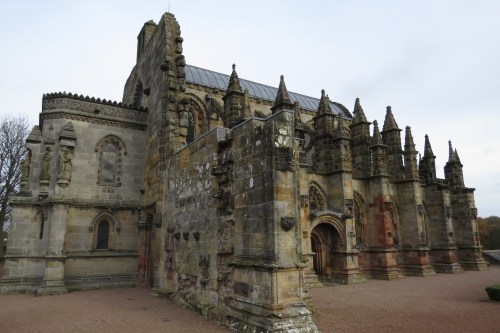
In 1630 (another!) William St Clair was pronounced Grand Master of the Masons in Scotland. In 1650 Oliver Cromwell’s troops sack Rosslyn Castle. The Chapel was spared, although it was used for stabling the troop’s horses. In the same year, Sir William Sinclair of Rosslyn died at the Battle of Dunbar. He is believed to be the last knight buried in full armour in the vault below the Chapel, said to be the family custom. The chapel falls into serious disrepair for 150 years until limited restoration occurred in 1736. Between 1780 and 1850 visits by the likes of Robbie Burns, Dorothy Wordsworth and Queen Victoria brought the chapel to the nation’s attention as a place of romantic association and mystery, something that was enhanced by the enigmatic nature of the carvings. In the 1950s a major restoration was carried out but cladding the stonework with a concrete like material (which gave the interior its current grey colouration) but it sealed the moisture in and the chapel continued to deteriorate badly. It’s inclusion in the 2003 novel ‘The Da Vinci Code’ and the 2006 film brought worldwide attention and visitor numbers increased ten-fold. This along with a £4.9m lottery grant has allowed a full-scale restoration.
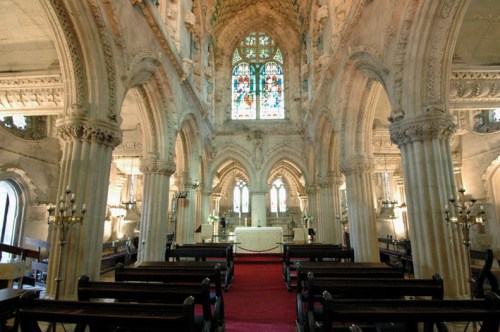
Photography inside the Chapel is no longer allowed. This and the following photos have been taken from the internet either from the Rosslyn Chapel website or via Wikipedia. Those photos that were credited were taken by either ‘Guinnog’, J McInnis, Joe Ellis, Jeremy Atherton or ‘the Lothians’. Although this photo makes it look quite spacious the chapel is quite small inside ….

…. but is very high. Of course the stained glass windows are a later addition.
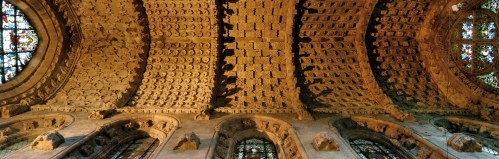
A wide angle view of the fantastically ornate roof.

The chapel is covered in ornate carvings, many of which would have had deep meaning at the time when the chapel was built. Of note are the many ‘Green Men’, about 100 carvings of a pagan symbol of fertility and regrowth that seems curiously out-of-place in a Christian place of worship.

This image of the fallen angel Lucifer bound by ropes is said to be a motif of the Masons. Both the Masons and Knight’s Templar are said to have historic associations with Rosslyn. Legends associated with the chapel include that it is the final resting place of the head of John the Baptist or that of the Holy Grail.

The chapel was commissioned in 1446, building started in 1456 and ended in 1484, so how then were maize and aloe vera (North American plants that supposedly couldn’t have been discovered by Europeans until after Columbus’ voyage in 1492) depicted in the carvings? I don’t believe any of the superstitions associated with Rosslyn but I do believe that Columbus wasn’t the first European to land in the New World!

Many embossed carvings are to be found, some depicting scenes from the Bible, others life after death and still others whose meaning is greatly debated by both scholars and by those with a ‘mystical orientation’.

…. these include the 213 cubes carved into buttresses and architraves that have a variable number of dots on them. Some have interpreted this as a secret code, others as a musical score.
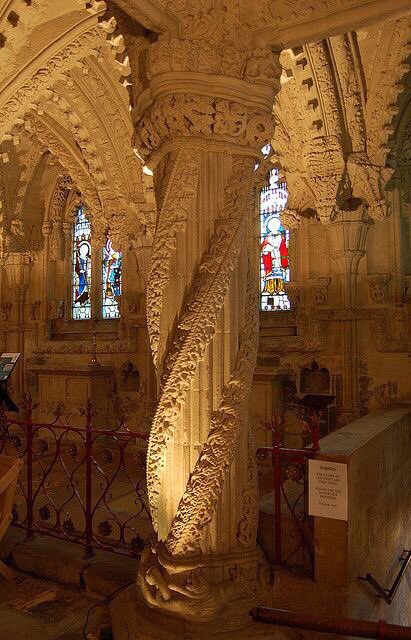
Perhaps the most spectacular carvings are to be found on the so-called Apprentice Pillar. The following is taken from Wikipedia: ‘One of the more notable architectural features of the Chapel is the “Apprentice Pillar. Originally called the “Prince’s Pillar” (in the 1778 document An Account of the Chapel of Roslin) the name morphed over time due to a legend dating from the 18th century, involving the master mason in charge of the stonework in the chapel and his young apprentice mason. According to the legend, the master mason did not believe that the apprentice could perform the complicated task of carving the column without seeing the original which formed the inspiration for the design. The master mason travelled to see the original himself, but upon his return was enraged to find that the upstart apprentice had completed the column by himself. In a fit of jealous anger, the master mason took his mallet and struck the apprentice on the head, killing him. The legend concludes that as punishment for his crime, the master mason’s face was carved into the opposite corner to forever gaze upon his apprentice’s pillar. On the architrave joining the pillar there is an inscription, Forte est vinum fortior est rex fortiores sunt mulieres super omnia vincit veritas: “Wine is strong, a king is stronger, women are stronger still, but truth conquers all”. The author Henning Klovekorn has proposed that the pillar is representative of one of the roots of the Nordic Yggdrasil tree, prominent in Germanic and Norse mythology. He compares the dragons at the base of the pillar to the dragons found eating away at the base of the Yggdrasil root and, pointing out that at the top of the pillar is carved tree foliage, argues that the Nordic/Viking association is plausible considering the many auxiliary references in the chapel to Celtic and Norse mythology. There are those who claim the Holy Grail is buried under the Apprentice’s Pillar! Of course I don’t believe any of these fairy tales but its fun relating them!

As I said before, although not know so widely before the publication of The Da Vinci Code, the chapel has always been a source of mysticism and wonder, as a drawing from ‘Heath’s Picturesque Manual’ from 1835 shows. Here on the left the Mason’s Pillar and the far superior Apprentice’s Pillar can be seen.

Near the chapel is Rosslyn Castle once the home of the Saint Clair family.

The castle dates from the late 14th or early 15th century and so predates the chapel. The castle suffered from a domestic fire and attacks in the ‘War of Rough Wooing’ in 1544, and by Cromwell’s troops in the Civil War.
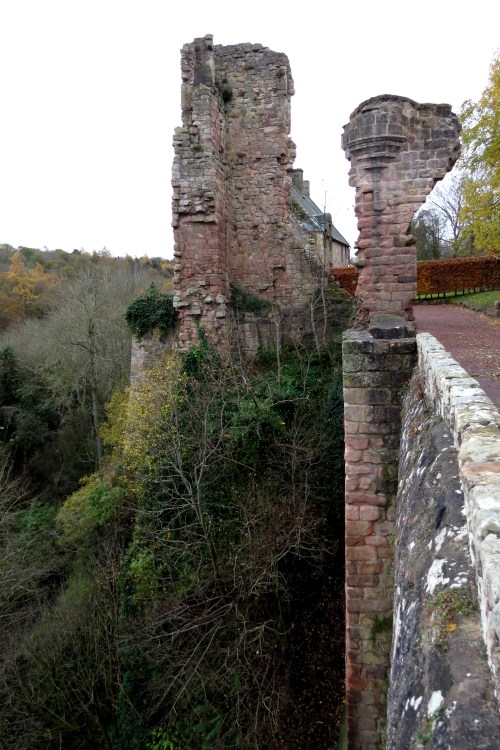
The castle once contained a scriptorium containing many valuable documents some of which (including the earliest example of Scots prose) are in the National Library of Scotland. In a fire in 1452 valuable documents were said to have been lowered from the castle by a rope. Questions of the nature and current whereabouts of these documents adds to the mystery surrounding the Rosslyn (Roslin) area.
Needing to be in Aberdeen that evening we had to leave by late morning. We crossed the Firth of Forth and did some birding/sightseeing along the Fife coast. This and more will be the subject of the next post.
We recently have spent some time in Scotland, the main purpose of our visit has been to visit Margaret’s brother and sister-in-law who lives in Aberdeen.
To break the long drive north we spent a few hours at the Wildfowl and Wetlands Trust reserve at Martin Mere in Lancashire.

Like many WWT reserves Martin Mere has an extensive collection of captive wildfowl, but interesting as they can be time was at a premium, so we concentrated solely on the lagoons where the wild birds are found.

Martin Mere has a large wintering population of Shelducks.

These are quite independent of the Shelduck population that winters in nearby Morecambe Bay.

There were good numbers of other duck species, Gadwall, Teal, Mallard and (above) Pintail.

Wigeon were also present in good numbers and could be seen grazing along the margins of the mere.

Martin Mere is a famous site for the Whooper Swans that fly to the UK from Iceland for the winter. Around a thousand roost here, but only a few were seen close to the hides ….

…. but many more were on a lagoon in the distance.
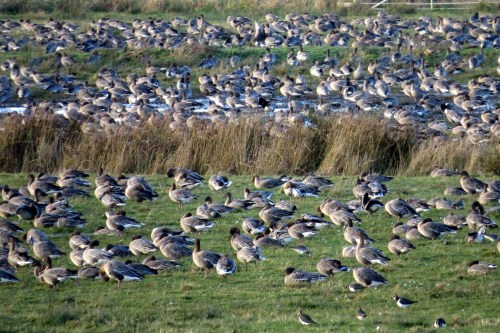
Even more impressive were the flocks of Pink-footed Geese that winter here.

About 25,000 were present in the area in mid November but larger numbers occur in October.
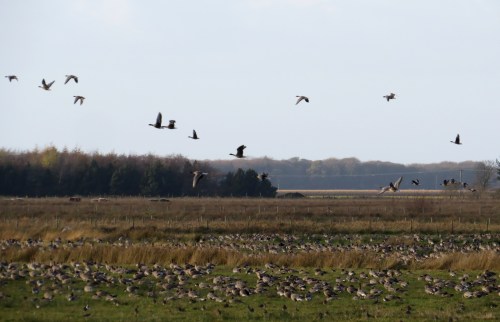
When Pink-feet first arrive from Iceland and Greenland they stop off at Martin Mere to refuel, some stay for the winter but around 70,000 continuing on to Norfolk. Other populations winter in Scotland. The reverse migration occurs in spring. We have noticed these movements between Lancashire and Norfolk whilst birding in Derbyshire.
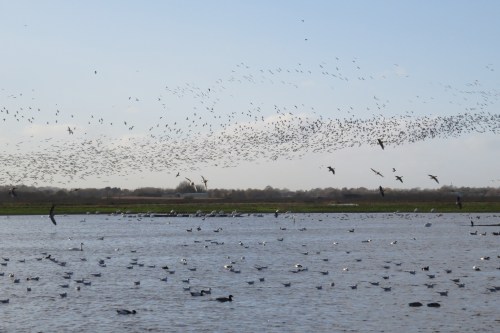
The site of thousands of geese in the air was spectacular.

A view that I couldn’t resist photographing over and over again.

Pink-feet are quite rare in southern Britain, indeed the one that made it to the lakes near Ringwood, just over the border from Dorset became a bit of a local celebrity.

In mid afternoon the wildfowl are fed just in front of the main hide. At the time we were some distance away and took this photo from another hide ….

…. however we had the sun behind us, the photographers in the pictures might have been close but the light for them would have been dreadful.
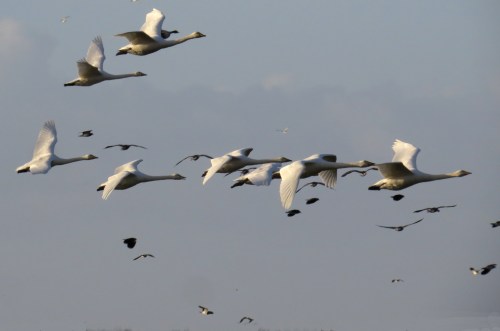
As the afternoon wore on more Whooper Swans flew in from the surrounding fields to roost ….
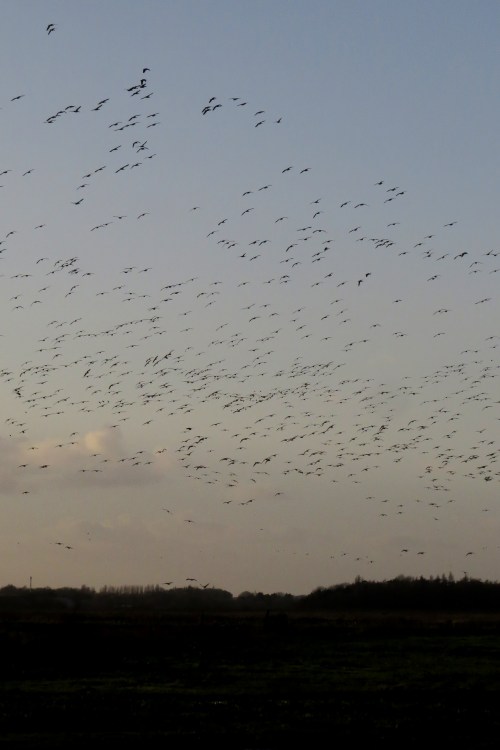
….accompanied by even larger number of Pink-feet. Martin Mere is also famous for hosting a spectacular Starling murmuration but time was pressing, we still had a three-hour drive to reach our B&B near Edinburg so that had to be left for another time.

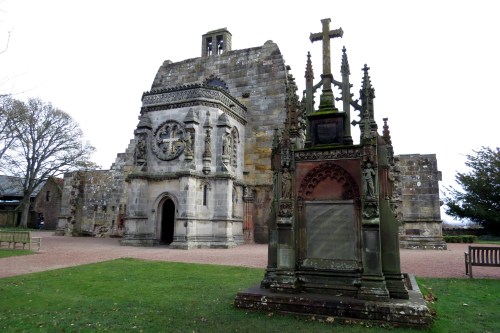
 gryllosblog