Archive for the ‘Uncategorized’ Category
This post covers our final destination on the Lesser Antilles and Trinidad tour, the area around the small town of Grande Riviere on the north-east coast of Trinidad.
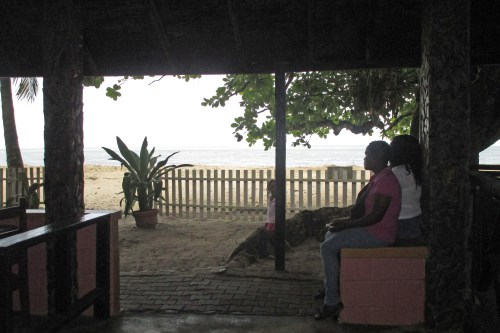
As I described in the last post in late in the afternoon when we arrived at our lodge at Grande Riviere we found there was no electricity due to the previous nights cyclone and therefore no aircon and little water supply. Power was restored about lunchtime the following day.

There was just enough time before it got dark to admire the sunset ….
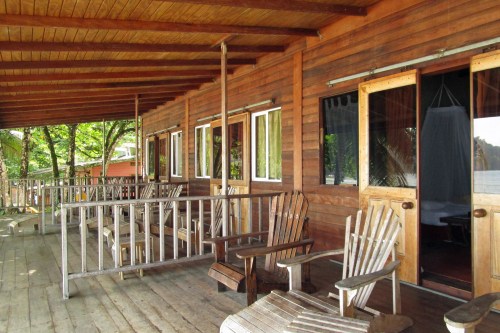
…. as the lodge was situated right next to the beach and you had a great view from the balcony.

Apart from a few Frigatebirds, vultures and a single Osprey there wasn’t much to see on the beach during the day although that would change big time when we ventured out first thing in the morning or at night.

A White-tiped Dove was seen near the lodge but our main ornithological interest lay ….
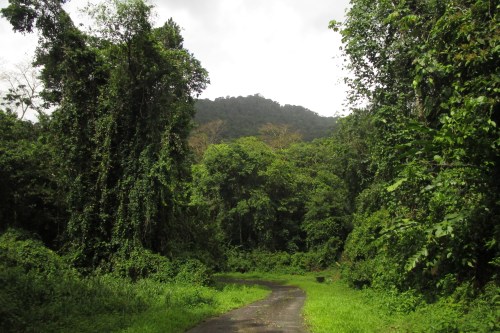
…. in the hills behind the town.

Our main reason for coming to Grande Riviere was to see Trinidad’s other endemic bird, Trinidad Piping Guan.
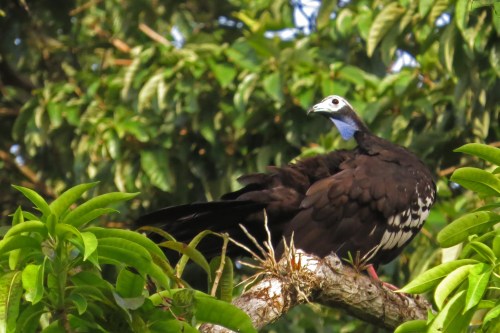
A large garden above the town held a small group of these impressive cracids and we all had excellent views.

Other birds seen in the area included Fork-tailed Flycatcher, this bird has a shorter tail than most, either the feathers are old and have broken off or are new and are still growing!

Skulking deep in cover we located this White-bellied Antbird.
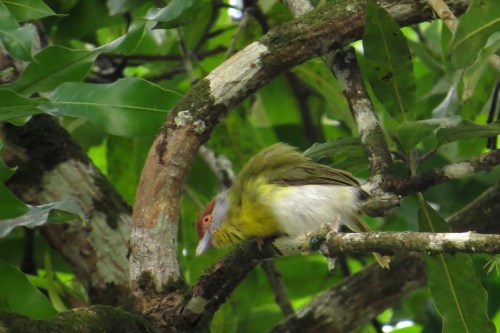
Overhead was a Rufous-browed Peppershrike, which isn’t a shrike at all but a vireo.

It looks like a kiskidee but has a stonking bill, the appropriately name Boat-billed Flycatcher.

The largely diurnal Ferruginous Pygmy-owl, which has a range that extends from Arizona and Texas all the way south to Argentina.
Short-tailed Swifts shot by overhead ….

…. and skywatching revealed the presence of the lovely White Hawk ….
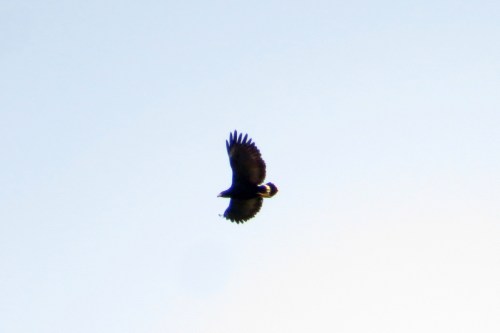
…. and several Common Black Hawks.

They must have been displaying or driving off an intruder as one would often sweep low with its undercarriage down but yet made no attempt to land.
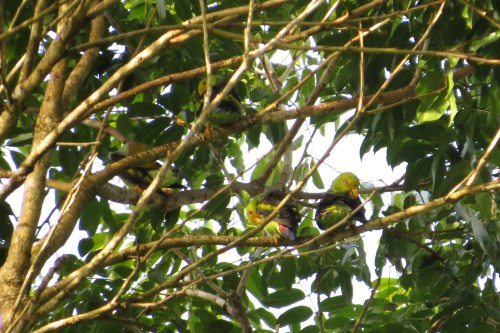
Whilst we were watching all these birds up the hill our local man Kenny returned to the lodge and tried to locate where the rare and elusive Lilac-tailed Parrotlets were coming to roost. After a while he returned with a smile on his face and we all bundled into the minibus and got back in time to see these gorgeous little parrots. They were high up in a tree and photography was difficult but you can see the lilac tail on one of the four birds illustrated. A great find Kenny. Along with the two endemics plus Tufted Coquette and Green-throated Mango this meant I had five life birds on Trinidad – plus one very good mammal.

However good the birds were I’m afraid they were overshadowed by a reptile, and what a reptile, the fourth largest in the world (and the only one in the top ten largest reptiles that isn’t a crocodilian). On both morning at Grande Riviere we left the accommodation just before dawn ….

…. and searched the beach for evidence of these giants.
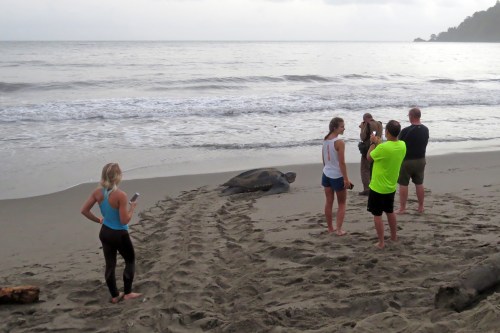
It didn’t take long, along with a group of students from the USA we soon located the last of the previous night’s Leatherback Turtle females crawling back to the sea after laying eggs in the sand.

Although sometimes the crawl was a bit erratic.
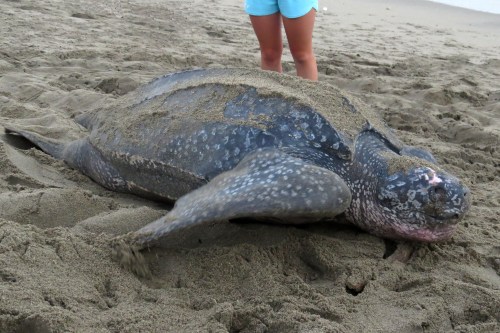
They seemed completely oblivious to us, although I think this young lady might be approaching a bit too close.
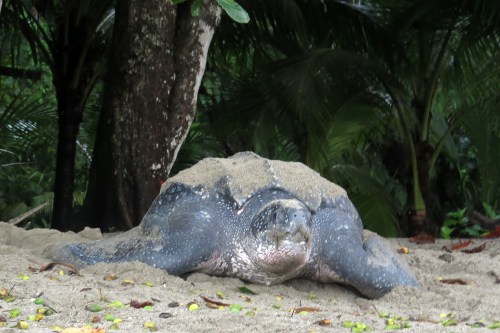
As I said above they are considered the fourth largest reptile in the world after Saltwater, Nile and Orinoco Crocodiles. Males are considerably bigger than females weighing as much as 650kg (heavier ones have been claimed but not verified). Females (of course all the adult individuals we saw were females) may be about half that weight. Although nesting occurs or has occurred in the Caribbean/Central America, Africa and the Far East the majority of important nesting sites are now in the Caribbean, indeed the largest nesting site in the world in Malaysia has been totally destroyed because all the eggs were harvested for food.

The beach was covered in Black Vultures looking for late emerging hatchlings and unearthed eggs.

Although it may seem like the vultures are digging up the eggs the majority of eggs on the surface are due to turtles accidentally uncovering previously laid eggs as they dig pits in which to deposit their own.
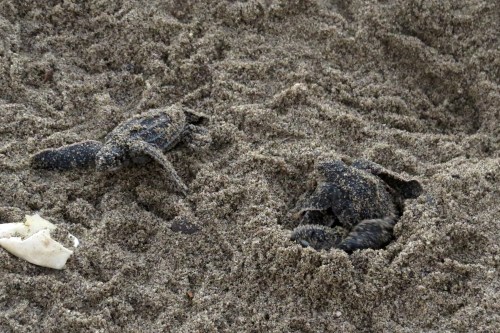
Whilst we were watching the adults, hatchlings from earlier layings were erupting out of the sand at our feet,
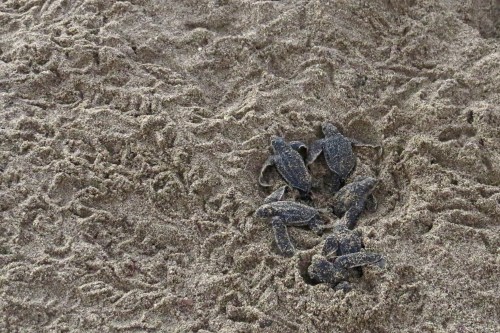
It was strange to see a patch of sand suddenly quiver and and then see tiny turtles appear ….

…. and immediately head off to the sea.

Many fall prey to the Black Vultures and the local dogs ….
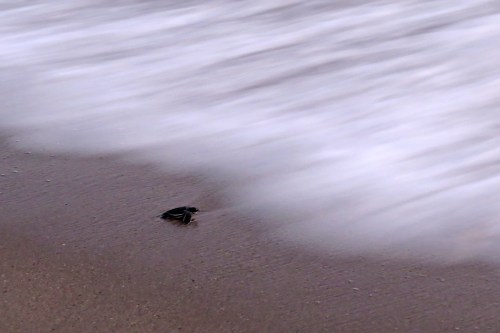
…. but at least this little fella made it ….
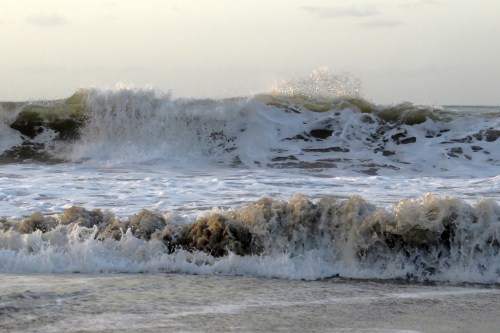
…. but then of course it had to navigate the pounding surf and the Frigatebirds. Its estimated that less than one in a thousand hatchlings will reach maturity.
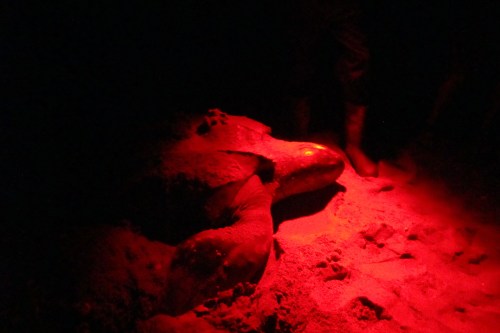
You were not allowed (quite understandably) to wander the beach at night looking for laying turtles. However for a small fee a ranger equipped with a red torch would take groups out to see these leviathans laying. They appeared to be completely unaware of us and seemed to be in a trance.

The pit is dug with the hind flippers and then the female lays a clutch of about 100 eggs.

The best time for the hatchlings to emerge is at night when predators aren’t present, but there is one major disadvantage to this. The hatchlings have evolved to head towards the any light source as the sea is usually brighter than the land at night. This doesn’t account however for man-made light pollution, clearly not a problem when turtles first evolved in the Cretaceous period, 110 million years ago. On our second night (but not our first as we had no electricity then) we were suddenly aware that the dining area was being invaded by hatchlings. Several children present and the staff collected three boxes of hatchlings which were then taken to the sea by one of the rangers. At least this boxful will avoid the vultures and the dogs.
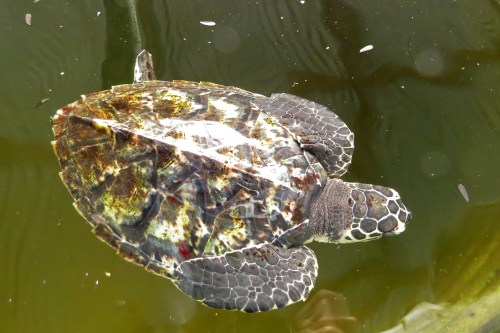
One afternoon we visited a headstarting’ facility. Here Leatherback and Green Turtle hatchlings (above) are raised in tanks until they are a few months old when they are far less vulnerable to predators and then released in the sea.

A member of staff gave us a close up view of a Green Turtle (this species breeds earlier in the year than Leatherbacks and the adults had already departed the beaches). Great as this program is you cannot get away from the key problem. Turtles and predators have co-existed for over 100 million years, its the lack of secure breeding sites for them, free from those who collect eggs for food and free from light pollution that is the underlying problem. And I know that by visiting these areas and staying at the beach side lodge I’m adding to the light pollution problem but at least the locals have a reason to protect the turtle beach if it brings in tourist’s money.

So I’ll end this saga with a couple of Caribbean sunset shots. It had been a great trip, almost every life bird seen and a great mammal (Silky Anteater) and a great (literally) reptile too. We asked if for this part of the trip we could vote for Leatherback Turtle in the ‘bird of the Trinidad’ competition. The leader agreed and it won hands down.

We had some additional birding the following morning then it was a drive to the airport and the flight home. The trip around the Lesser Antilles and Trinidad was a bit whistle-stop tour, but it was very, very worthwhile. There are still a few birds I haven’t seen in the Caribbean, I missed quite a few on Hispaniola and Puerto Rico in the 90s and I’ve never been to the Bahamas so I expect I’ll be back one day.
I had intended to do just two posts on Trinidad, but as always there were too many I photos that I wanted to share. So this second post covers our final hours based at Asa Wright and a place we stopped at on route to Grande Riviere on the north coast.

No wildlife holiday to Trinidad would be complete without a visit to the Caroni Swamp and its stunning Scarlet Ibis roost. So we headed back west and then south of the capital, Port of Spain ….
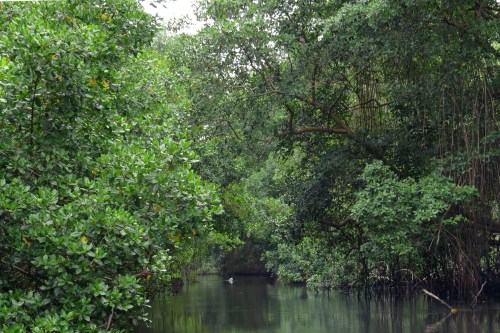
…. and took an afternoon cruise down the creeks and channels of the swamp.
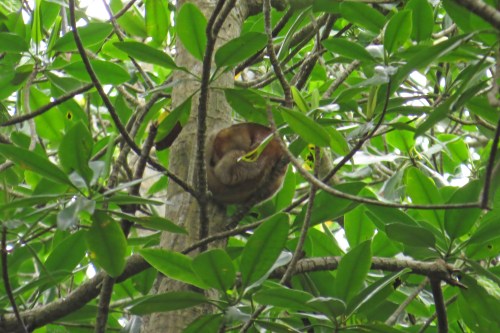
By far the best sighting was this diminutive Silky Anteater which was curled up in the mangroves like a furry football. I now have seen all four species of anteater, another one off the bucket list.

Eventually we emerged from the mangroves into the main lagoon.
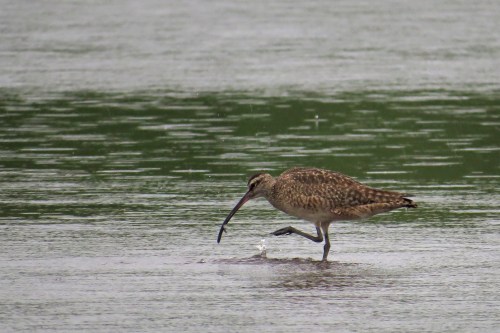
We saw a few waders like this Hudsonian Whimbrel. UK birders have only about six weeks left to enjoy having this Nearctic form of Whimbrel on their lists because as of 1/1/18 the BOU will adopt the IOC checklist as a basis for the British List and Hudsonian Whimbrel and Eurasian Whimbrel will be relumped.
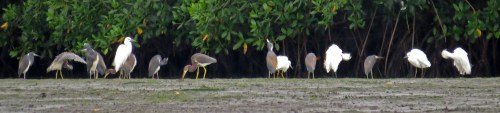
Along the edge of the mangroves was a large collection of egrets and herons.
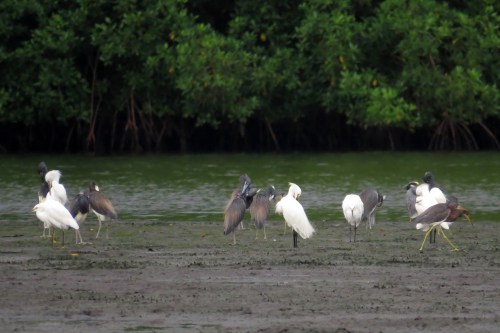
Those we could get close to were revealed as Snowy Egrets, Little Blue and Tricoloured Herons ….
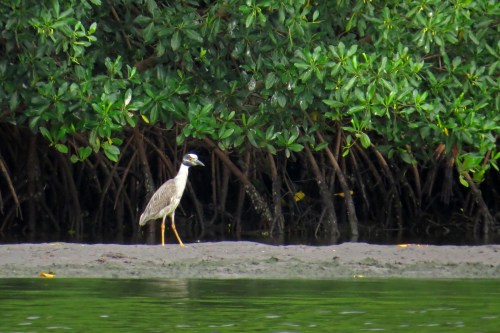
…. with the occasional Yellow-crowned Night Heron.
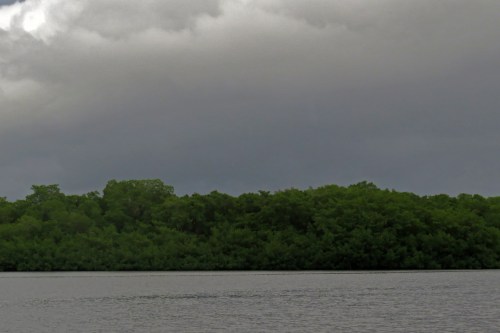
However just as the first Scarlet Ibises were starting to fly over it turned ominously dark. We had heard that bad weather, well a cyclone actually, was on its way but hadn’t expected it to arrive until after dark.

…. what we got was this!
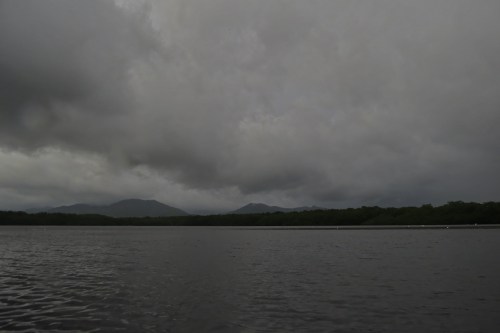
It was now raining very hard and we had no option but to head back, arriving back at the bus completely soaked (in spite of ‘waterproofs).

Through the night the wind howled and the rain was torrential, beating down on the metal roofs of our rooms with great intensity. The following morning the lodge was wreathed in cloud and it was still raining hard. Several dead nestlings were seen on the paths washed out of their nests ….

…. but the baby Spectacled Thrushes outside reception had survived! (photo taken before the storm).

One of the large trees outside the verandah had its top broken off ….

…. and Black Mastiff Bats were found taking shelter inside the building.

We thought that this presumed (it was hard to know when it was soaking wet) Copper-rumped Hummingbird was dead, as it hung motionless upside down for a long time but a researcher rescued it and fed it sugar-water from a dropper and it soon perked up and flew off.
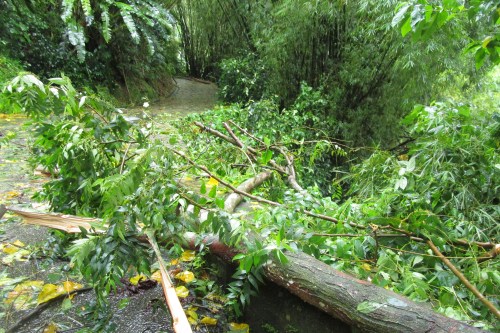
Then the bad news; our bus was at the bottom of the mountain and couldn’t get to us because of fallen trees, mind you there are worst places in the world to be trapped than Asa Wright.

After about three and a half hours of hanging about two 4x4s belonging to the lodge appeared. The road had been cleared enough for them to get down the hillside but not for the larger bus to get up. It was a case of creeping under the fallen trees rather than going around them.
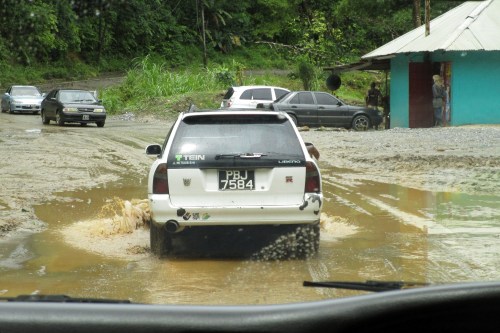
Reunited with our minibus we headed off through flooded roads ….
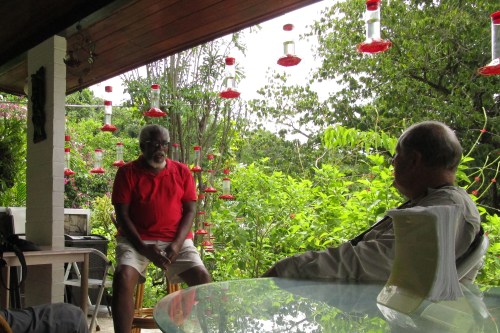
…. to a place called Yerette, a private garden turned into a hummingbird spectacular.

Keith, its above you!

We could wander around the garden looking at the various feeders. I counted 37 and I’m sure I missed some.
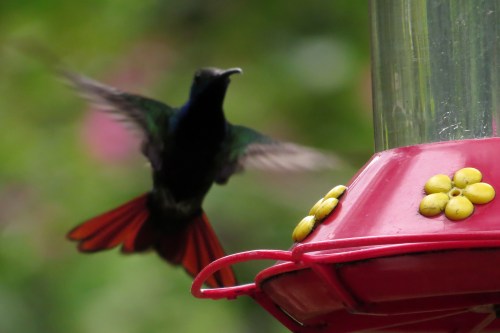
Although not in focus, I quite like this image of an incoming Black-breasted Mango.

We saw eleven species of hummer at Yerette, including this Little Hermit ….
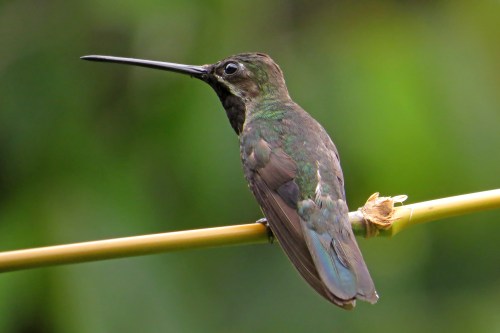
…. Long-billed Starthroat ….

…. Blue-chinned Sapphire ….

… a female Amythyst Woodstar
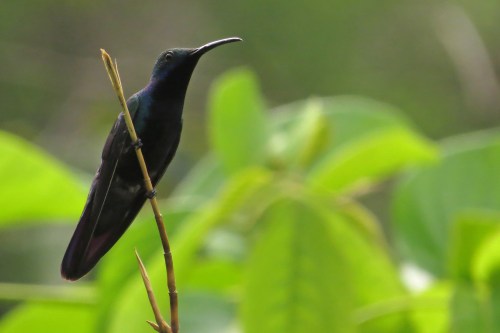
…. and yet another male Black-throated Mango. There was also a single Green-throated Mango around which was lifer for me, it looked much the same but was slightly bulkier with a green throat.

But the best hummer of the bunch was this Ruby Topaz.
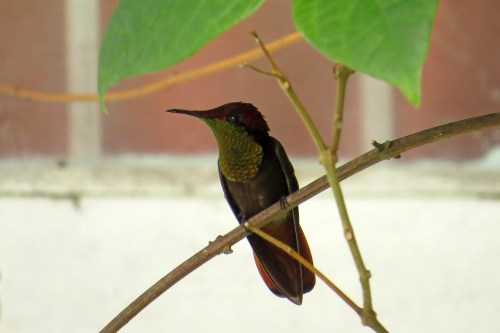
As with all hummers Ruby Topaz’s colour changed in intensity with the direction the bird was facing.
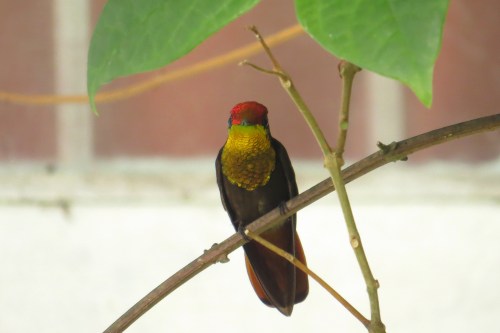
See what I mean! In many species all of the iridescent colours, so carefully illustrated in a field guide, can’t ever be seen at once.
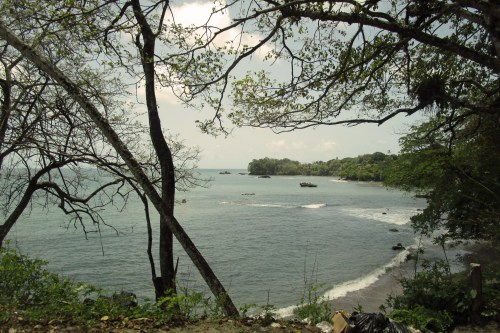
We were now well behind schedule so we headed off for the north-eastern point of the island, from here we headed back west along the north shore (there is no short cut across the mountains). Although the way was clear the road would have been impassible due to flooding if we had left Asa Wright on time as there was a lot of mud on the road, especially when we crossed the streams. The flooding had been less severe in forested areas as forest uplands hold back the water and let it flow gently to the lowlands and in these areas the streams were already running clear. In deforested areas it runs off the hills like the proverbial water off a duck’s back and is full of mud and debris. Deforesters in northern England and near the Somerset Levels please take note.
We arrived at our lodge at Grande Riviere before dark but we found they had no power due to the storm and that meant no air-con and no water supply either as the pumps wouldn’t work. They managed to cook us a meal which we ate by candlelight and we squeezed just enough water out of the pipes to wash our hands and face. The power came back on at lunchtime the following day.
The next post will cover the birds we saw in this scenic area, including Trinidad’s other endemic and a very close encounter with the world’s fourth largest reptile.
Following on from my very successful trip to the Lesser Antilles (see earlier posts) most of the group continued on to the island of Trinidad for an optional five-day extension. Three didn’t take this option and one joined for the extension only. The tour didn’t visit Tobago, the island that forms a nation-state with Trinidad, as it only has one bird species that cannot be seen in Trinidad and that can be seen in Venezuela.
Although the island of Trinidad may be considered to be in the Caribbean, it certainly doesn’t have a Caribbean avifauna. In fact it’s avifauna is a watered down version of that found on the adjacent South American mainland (which is not surprising as they were connected during prehistory).
The island of Trinidad was a Spanish colony from the arrival of Christopher Columbus in 1498 until Spanish governor Don José María Chacón surrendered the island to a British fleet under the command of Sir Ralph Abercromby in 1797. During the same period, the island of Tobago changed hands among Spanish, British, French, Dutch and Courlander colonisers more times than any other island in the Caribbean. Trinidad and Tobago were ceded to Britain in 1802 under the Treaty of Amiens as separate states and unified in 1889. Trinidad and Tobago obtained independence in 1962 and became a republic in 1976 (copied from Wikipedia).
Although I have never been to Trinidad before, I have an emotional connection with the island as Margaret lived here during her yachting days, as did her daughter Janis, and the two granddaughters were either born here or lived here from when they were a babies for a period of up to four years.
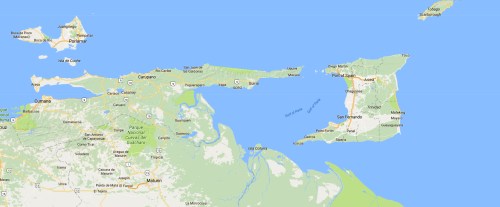
The island of Trinidad lies just 11km off the Paria Peninsula of Venezuela (and indeed I could see it from there when I visited northern Venezuela in the 90s). We couldn’t see the South American mainland as our explorations were limited to the central and eastern part of the northern mountain range. The northern mountain ranges of Venezuela are contiguous with the Andes and as they were once joined with Trinidad ….

…. the easternmost point, where Trinidad’s northern range runs into the sea, can be considered the furthermost reach of the mighty Andes.

On arrival we were met by our cheery local guide and driver Kenny. Our drive to the mountains was mainly though large areas of cultivation but fortunately some areas of forest have been protected around our destination ….
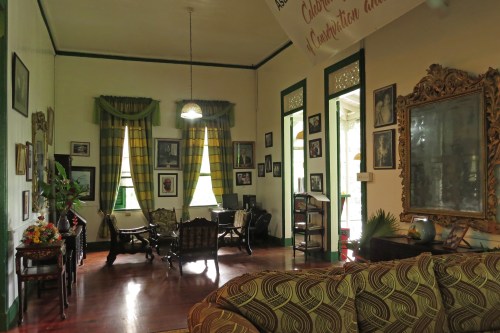
…. the world-famous Asa Wright Centre. Like many of these lodges it had a very ‘olde worldly’ feel to it, from the furnishing …..

…. to the old photos on show in the corridor.

Wildlife interest was immediately apparent as a Green Hermit had suspended its nest from the light fittings ….
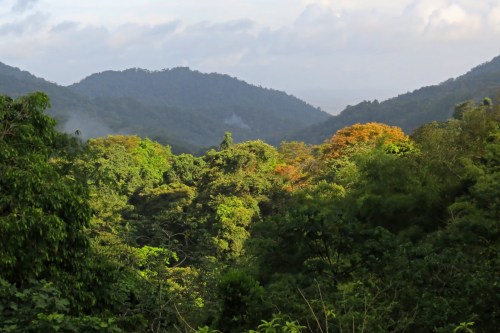
…. but it was this scenic view and the birds on show from the elevated verandah that grabbed our attention.
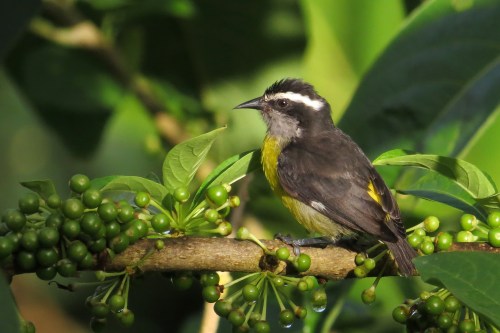
Common species included our old friend the Bananaquit (note this race has a shorter bill and lacks the fleshy red gape of the birds we saw in the Lesser Antilles) ….

…. Spectacled Thrush (formerly called Bare-eyed Thrush but renamed to avoid confusion with the African species of the same name) ….

…. the striking male Barred Antthrush ….
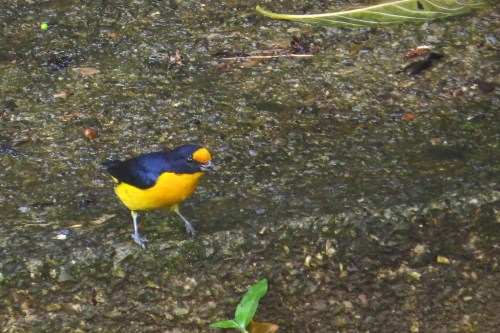
…. Violaceous Euphonia ….
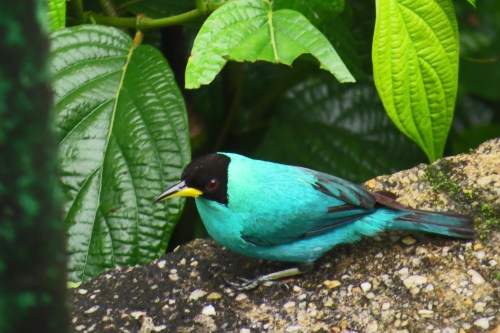
…. Green Honeycreeper ….

…. and the beautiful Purple Honeycreeper. All these species are widespread in northern South America (at least) but the great thing about Trinidad in general and Aza Wright in particular is the ease with which these birds can be seen and photographed. As such Trinidad makes a wonderful introduction to the Neotropics, clearly I’m not a Neotropical neophyte having visited some 25 times, but I still greatly valued getting such good views of these avian gems.

The many feeders were full of hummingbirds like this White-necked Jacobin, showing off its white neck and tail ….
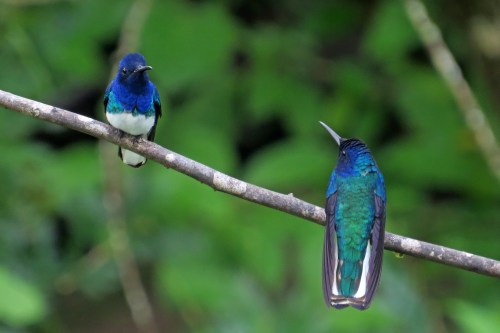
…. however when they are at rest neither the white neck or white tail are particularly visible.

The star of the show was the diminutive (and very fast) Tufted Coquette. The exquisite male never visited the feeders but shot from flower to flower at such speed that I never got a sharp photo. Picture from Wikipedia Commons taken by Steve Garvie.
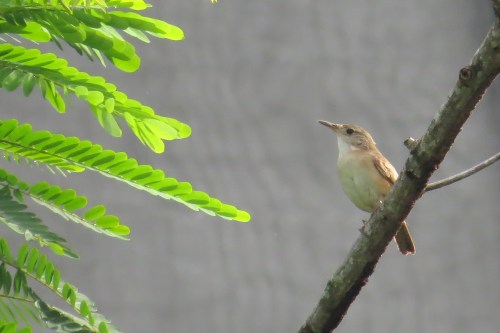
In the Lesser Antilles we saw four different subspecies of House Wren that looked and sounded different enough to be elevated to species status, but none posed for photos. The only one that did pose was in Trinidad and that was a bog standard House Wren just like you can see anywhere in the Neotropics.

The Red-rumped Agoutis walked around like they owned the place ….
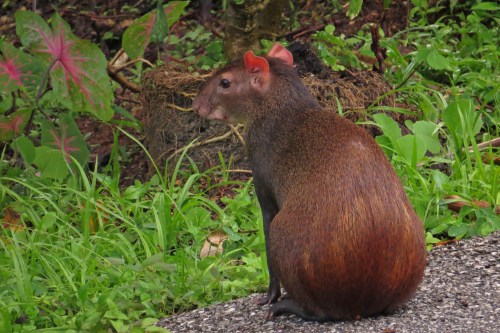
…. and seemed quite unafraid of people.

We also saw the little Red-tailed Squirrel from the verandah.
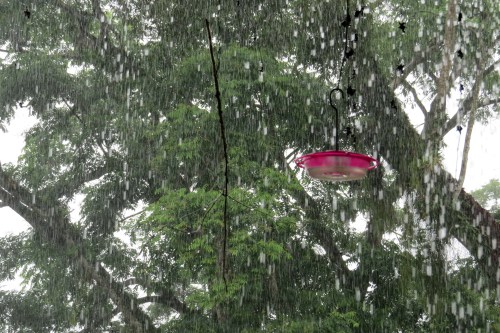
Unfortunately it rained regularly, often heavily. As soon as a downpour started all the birds would disappear immediately ….
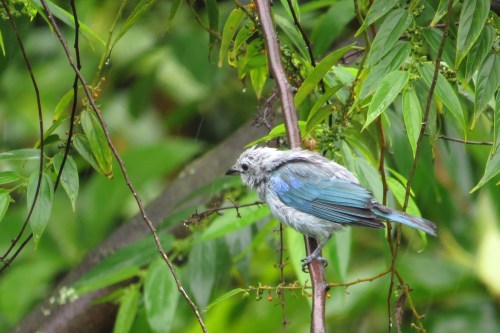
…. and re-emerge to dry out once it had eased off. Here are three species of common tanagers doing just that – Blue-grey ….
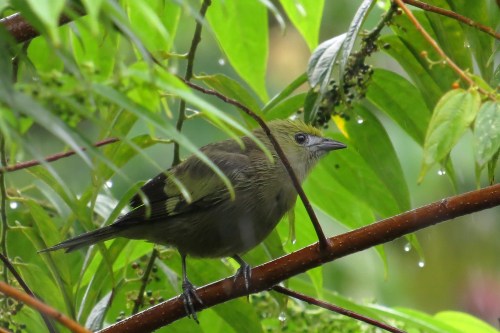
…. Palm ….

…. and a male Silver-beaked.
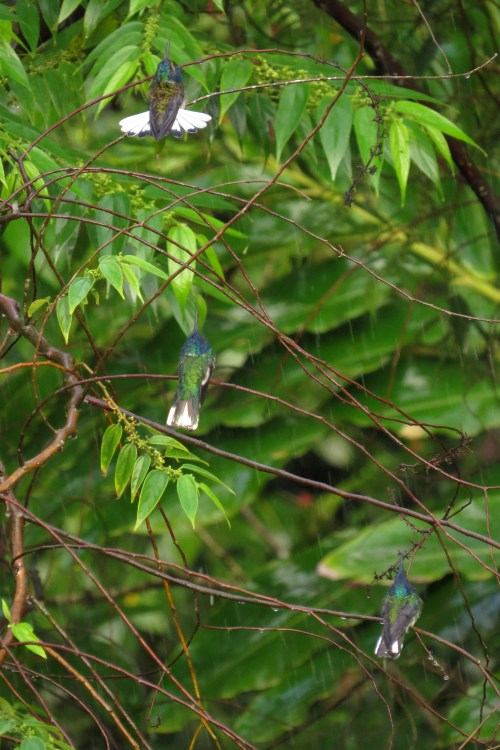
These White-necked Jacobins lined up on a bush in the rain ….

…. with tails spread, presumably enjoying a shower.
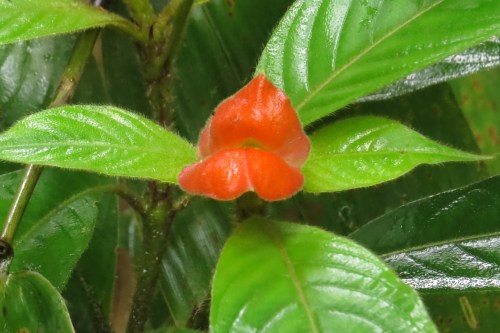
We also spent time on the forest trails (admiring the Cupid Lips bushes) as well as birding.
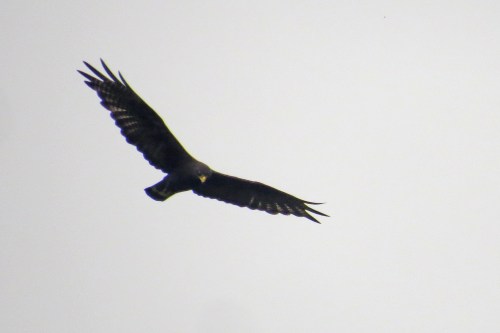
Overhead we saw a Zone-tailed Hawk, a bird that is thought to have evolved to sneak up on its prey by imitating the harmless Turkey Vulture.

One of our goals was seeing a displaying male Bearded Bellbird. The strange ‘growths’ on its throat are wattles which it shakes as it emits its ear-shattering bell-like call.

A couple of species of manakins were lekking as well. In well-defined display grounds we could see calling and dancing White-bearded ….
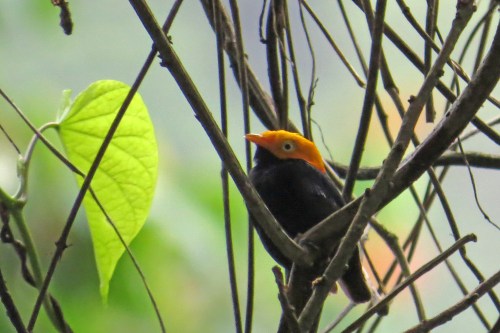
…. and Golden-crowned Manakins. As with all the species shown (except Tufted Coquette, which was a lifer) I was familiar with them from previous trips, but I have never seen them so well or been able to photograph them before. This, more than seeing a couple of endemics, makes a visit to Trinidad so special.
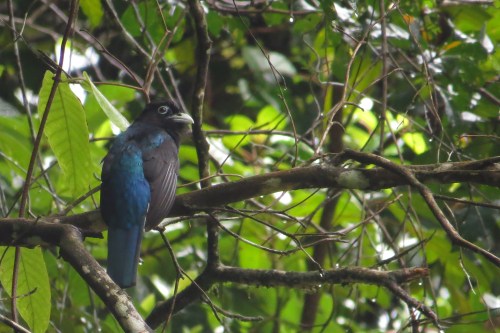
Other goodies included this Green-backed Trogon (back looks a little blue in this shot) ….
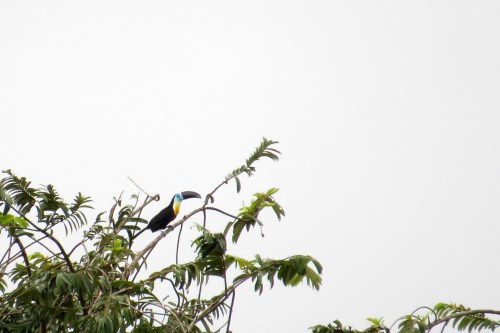
…. a distant Keel-billed Toucan …
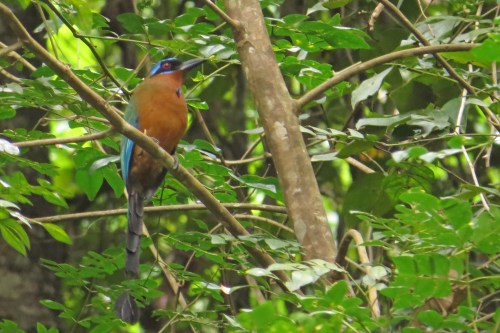
…. and of particular importance, the endemic Trinidad Motmot, a recent split from Blue-crowned Motmot.

Also on the Aza Wright property is this cleft in the rock (so it’s not really a cave) where there are a number of nesting Oilbirds.

These bizarre birds, distantly related to Nightjars but in their own family, nest in caves. They are nocturnal frugivores and find their way about at night or in the darkness of a cave by echo-location. Conditions inside the fissure were wet (it was raining heavily outside and it was dripping down from above) and dark, my camera misted up and my photos didn’t amount to much.
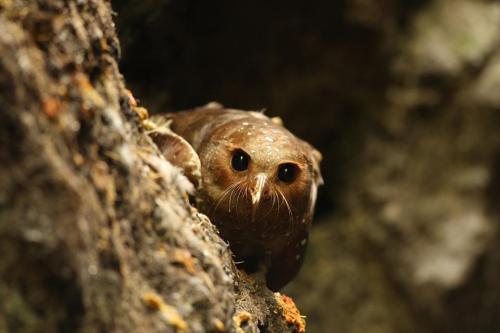
Here is an excellent photo of an Oilbird from the Internet Bird Collection by Tony Palliser see here

Away from Asa Wright we visited a number of sites in the lowlands, we had to peer through the fence to see the birds at this water treatment works.

New birds for the trip included this Yellow-headed Blackbird ….
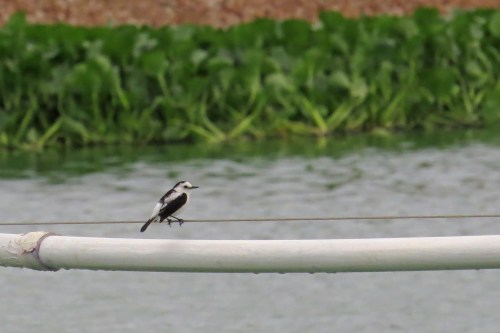
…. a Pied Water Tyrant ….

…. a pair of the amazing Black Skimmers ‘unzipping the pond’ ….

…. and best of all the bizarre Large-billed Tern which has a wing pattern reminiscent of a Sabine’s Gull.
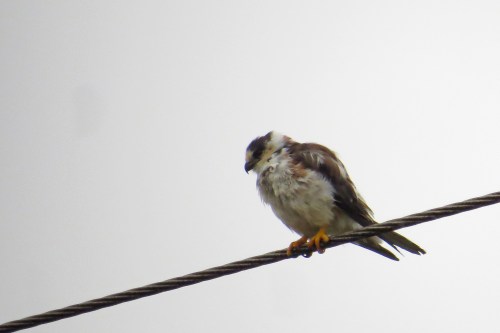
Nearby a Peal Kite surveyed the scene from an overhead wire.
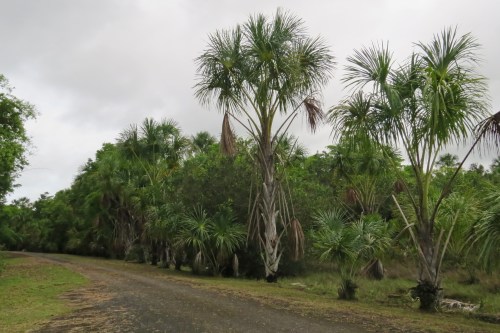
Also in the lowlands we visited an area of Moriche Palms near a disused airfield.

We found plenty of White-winged Swallows ….
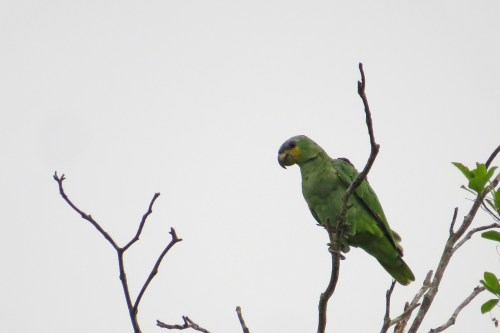
…. a few Orange-winged Parrots ….
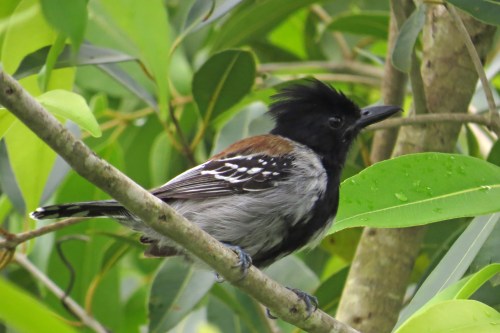
…. and a Black-crested Antshrike.

But the highlight were this flock of Red-bellied Macaws feeding on figs.

One of the smaller macaws, this species has a wide range from Trinidad in the north to Bolivia in the south. As is so often the case with bird-names the eponymous red-belly isn’t very striking.
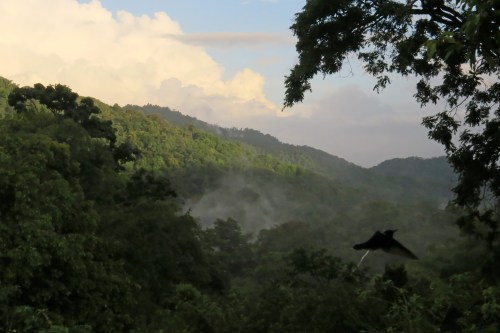
So it was back to Asa Wright where a ‘crappy little chappy’ photobombed my shot.
Our visit to the Caroni Swamp a hummingbird mega-fest and the arrival of a cyclone will all be covered in the next post.
This is the final part of the Lesser Antilles saga, covering the islands of Barbados and Grenada, although I have still to report on the optional extension to Trinidad.
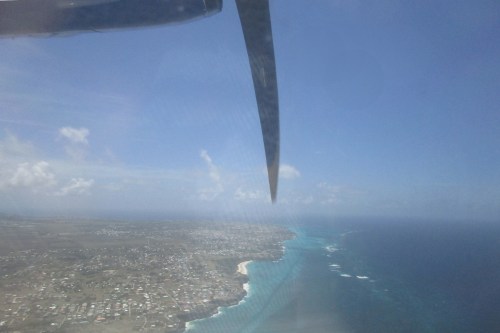
Contrary to St Vincent, our time in Barbados was marked by sunshine and warm weather, however what little we saw of it looked flat, built up and uninteresting, far from the tropical paradise that is usually portrayed as. Barbados was claimed by Spain in late 1400s but was first European settlement was in the early 17th century by the British. Barbados gained independence in 1966.
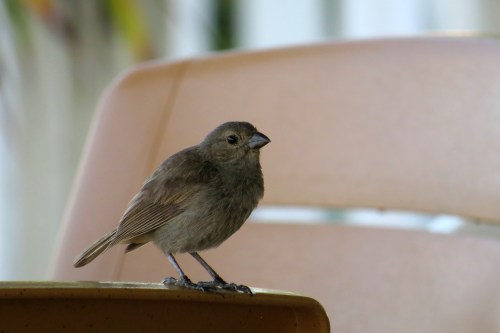
We had a really bizarre reason for coming here and a reason that would only appeal to the dedicated world lister. All over the Lesser Antilles the Lesser Antillean Bullfinch is a common and easily seen bird, however on Barbados both sexes show a female-like plumage. Recent research has demonstrated that this form is a full species, so as we were on a endemics clean up we had to go, even though it looked just like the female Lesser Antillean Bullfinches that we had previously seen on every day of the tour! So common were they that we saw one or two just outside the airport, we could have run back inside and got back on the plane before it departed!

But of course we had to stay on the island overnight just in case and we were taken to this hotel by the sea.

It was a perfectly nice hotel but it lacked any form of garden and given that all we had time for was garden birding it seemed to be a strange choice.
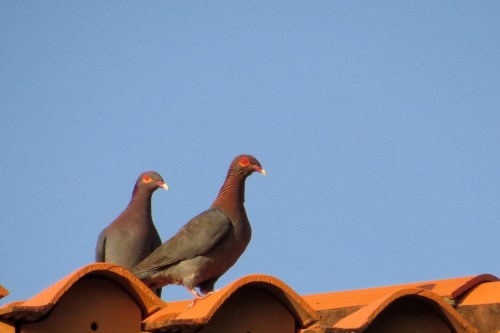
Even so, in spite of the lack of cover I was able to photograph several species in our short time there such as these Scaly-naped Pigeons, a species with a wide distribution throughout the Caribbean.
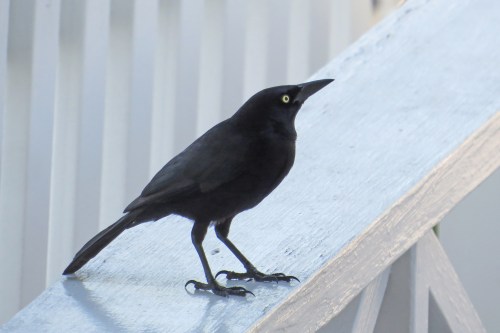
I had been puzzling why the Carib Grackles on Grenada and St Vincent looked like the one we saw in the northernmost island of Antigua and Barbuda but quite unlike the ones in the central Lesser Antilles (see earlier post). The reason is simple, if not immediately obvious, birds from Grenada have been introduced to the northernmost islands (why I cannot imagine).
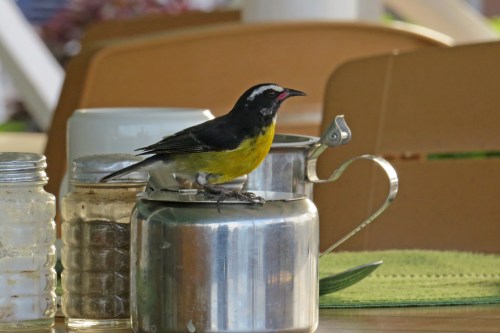
Another bird that shows some variation throughout its very large Neotropical range is the Bananaquit. Birds here show the red gape that is absent on many other islands and some of the islands we visited have an all dark morph. Bananaquits have often been described as ‘trash birds’ which is surprising as they have been considered to be in a monotypic family, however even that honour has been removed and they are now (as of August 17) lumped in with the Thraupidae tanagers.

It was clear why the Bananaquits were hanging around the breakfast table, they were using their long beaks to winkle grains of sugar out of the sugar bowls.
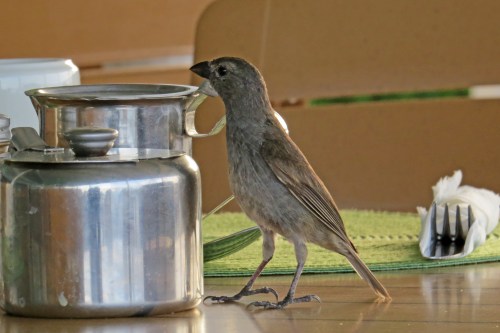
And guess what, the Barbados Bullfinches were on the scrounge too.
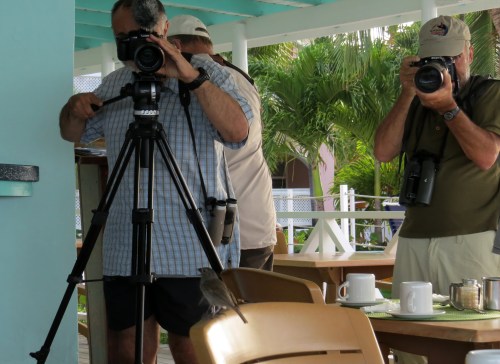
Other guests at breakfast must have wondered why this drab ‘sparrow’ was getting so much attention.
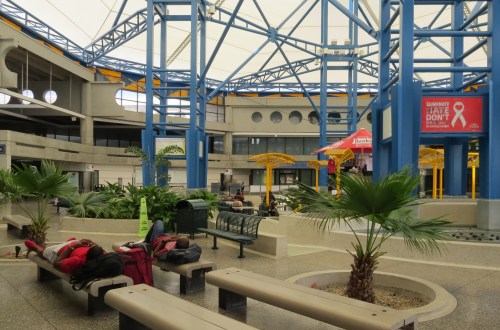
And so having only spent about four daylight hours on the island we returned to Barbados’ open-air airport, with just a canopy protecting the check-in area.

Then it was yet another LIAT flight to our final Lesser Antilles destination, Grenada. Although claimed for Spain by Christopher Columbus in 1498 there is no evidence Spanish colonists ever landed there. The island changed hands several times between Britain and France but was ceded to Britain in 1763. Independence was obtained in 1974. Our very pleasant hotel was quite near the airport ….

…. and proved to be a good place to photograph the mainly South American Eared Dove, here an adult ….
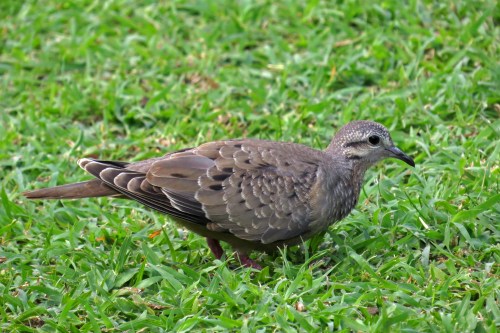
….and here an immature.

But it was soon time to head off to a nearby shopping centre for lunch ….

…. and then drive to the Hartman Reserve for our main quest, the endemic Grenada Dove.

From the observation tower we had good views of Broad-winged Hawks ….

…. seeing one being repeatedly mobbed by a Grey Kingbird (this aggressive behaviour is what gave the Kingbirds their name and also the name of the entire family – Tyrant-flycatchers).

Our main quarry remained elusive however, but on our second visit the following morning we all had brief views in a tree and somewhat better views in flight. This photo was taken by Pete Morris of Birdquest on a previous tour. Grenada Dove is endemic to the island and is one of the most critically endangered pigeon/doves of the world, with perhaps as few as 100 individuals remaining mainly due to the the destruction of its xerophytic scrub habitat.

We also had great views of Grenada Flycatcher, which despite its name is found on St Vincent as well. However the light was so much better on Grenada that I have only posted images I took here.

I know light levels can be a bit low in some restaurants but this tour member is taking the matter to extremes!

We had a nice evening meal at the hotel but service was slow, which was a shame as we were all itching to get out for one of the very few owling excursions of the trip. Our target was this very dark ‘barn owl’ which we saw well even if I didn’t get any photos. This form is currently classified as a subspecies of American Barn Owl, however it looks just like Ashy-faced Owl of Hispaniola and the HBW Illustrated Checklist treats it as such. On Hispaniola Ashy-faced Owl is sympatric with American Barn Owl and so must be a separate species. What is more likely; a) that Ashy-faced Owl evolved in Hispaniola from a barn-owl-like ancestor and then spread down the Lesser Antillean chain only to die out in the northern and central islands or b) that American Barn Owl colonised Grenada and the southern Lesser Antilles from either North or South America and then, in this location only, evolved to look just like Ashy-faced Owl? I’ll go for the former option! Photo from the Internet Bird Collection by Mikko Payhala see here

So that was it, (almost) the end of a lovely tour and goodbye to the Lesser Antilles. However there was still the optional extension to Trinidad which I will report on in the next post.
This is the fourth blog post from my island hopping tour of the Lesser Antilles in the Caribbean. I had intended to include the four remaining islands St Lucia, St Vincent, Barbados and Grenada in this post but inevitably there were too many photos so I have just written about the first two of these islands.

The first European power to settle St Lucia were the French who signed a treaty with the local Carib Indians in 1660. From then until 1814 the island changed hands many times between the French and British. In 1979 it was granted independence as a member of the Commonwealth. In the case of St Vincent the Carib Indians and escaped African slaves vigorously opposed European settlement and it was not colonised until 1719, first by the French then by the British. Like St Lucia power switched between these countries several times. Attempts by the British to affiliate St Vincent and the Grenadines with other nearby islands failed, but in October 1979 they became the last Caribbean Island to gain independence.

Apart from our flight to and from Montserrat and between Guadeloupe and Martinique, all the remaining eight ‘internal’ flights on this trip were with the local carrier LIAT. This stands for Leeward Island Air Transport, but it has also been interpreted as ‘Leaves Island Any Time’ or Luggage In Another Terminal’. That said we had no trouble with LIAT at all, they always left on time, sometimes early and never lost a single bag.

We stayed at a lovely hotel in St Lucia right by the harbour.

There was an egret colony in the grounds and I was lucky to get a room on the 1st floor with a grandstand view. I was able to observe the Cattle and Snowy Egrets from the balcony on several occasions, even as here whilst sheltering from heavy downpours.

There were a few Snowy Egrets in the colony ….
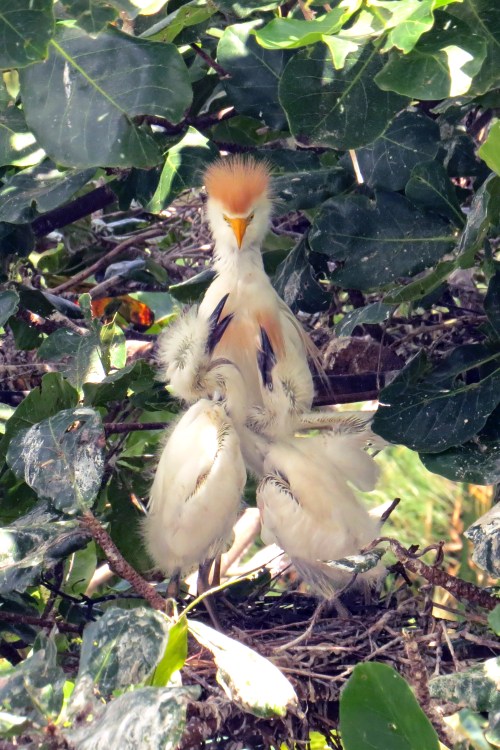
…. but by far the majority were Cattle Egrets.
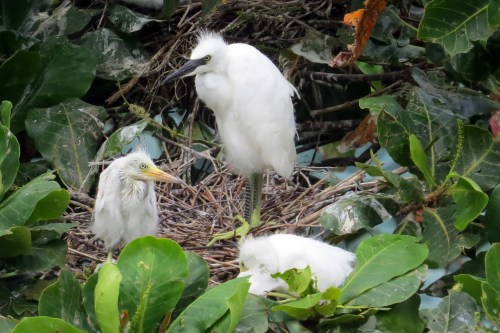
There even appeared to be Cattle and Snowy Egret chicks in the same nest, presumably the older and more mobile Snowy Egret chick had gone ‘walkabout’ from its own nest.

There was a puzzling degree of variation in the Cattle Egrets, some like this one were in bog standard breeding plumage ….
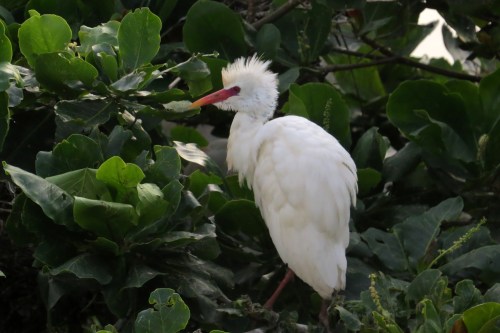
…. others had bright red bills and/or had no chestnut in the plumage at all (even though they were breeding) and the bill colour of the chicks seemed to vary from yellow to black almost at random.
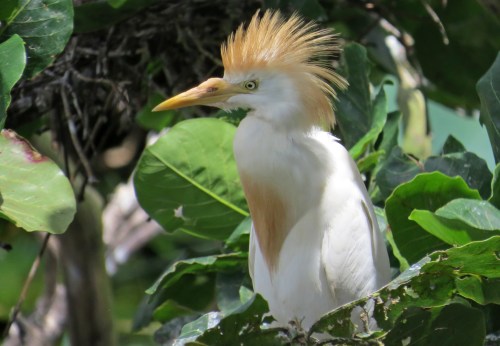
This individual, who had one of the closest nests to my balcony, sported and strangely swollen and elongated bill.

I don’t know if any Black-crowned Night Herons were nesting deep in the colony but one or two could be seen skulking around on the ground at the base of the tree.

A Green Heron quietly stalked its prey from the giant lily pads

Among the lily pads was a pair of Common Gallinules, recently split from the Old World Common Moorhen. Interestingly, here we can see a juvenile from an earlier brood feeding its younger sibling along with one of the parents.
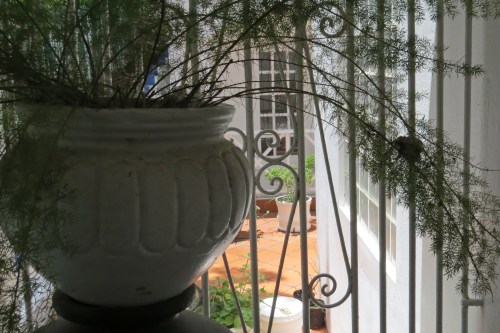
Just outside my room was this large ornamental plant, if you look at the right hand fronds you will see ….
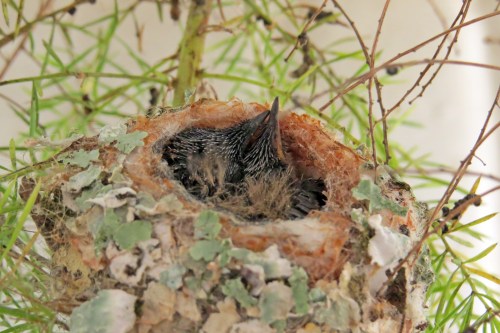
…. an Antillean Crested Hummingbird’s nest with two tiny chicks. Joseph waited in the corridor (and even skipped some outings for endemic birds) in order to get video of the parents coming to the nest.

Most of our time in St Lucia was spent in the interior searching for the four endemic species. There used to be five but Semper’s Warbler has not been seen since for certain since 1961, it was probably driven to extinction by introduced mongooses.

The endemic St Lucia Amazon was seen several times, but only in flight, St Lucia Oriole was seen but not well enough for photos ….

…. but the beautiful St Lucia Warbler put on a great show, We also saw two endemic subspecies that could be split in the future, St Lucia House Wren and St Lucia Pewee

We saw Grey Trembler on Martinique, but not well enough for photos, so it was great to get good views here, the only other island where it occurs.

As we are now in the southern Lesser Antilles there is a greater influence from South America. Examples include this Short-tailed Swift ….
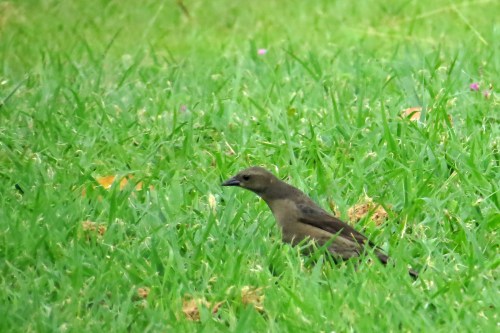
…. and this female Shiny Cowbird.
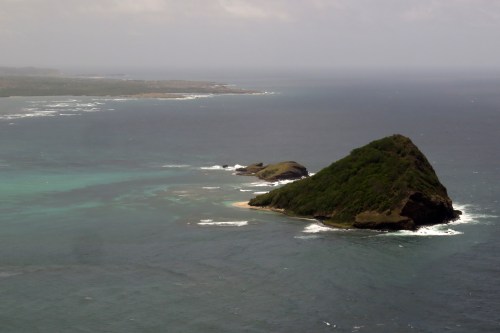
In the afternoon of our first full day we headed for the southern most point of the island

…. and the lighthouse at Moule de Pique.
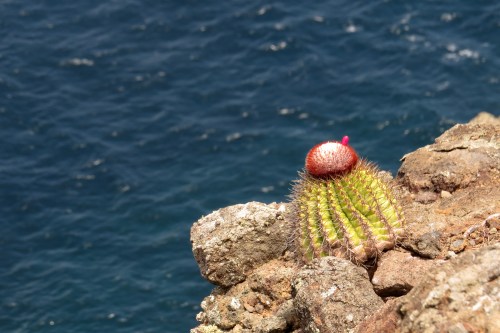
Strange barrel cacti grew on the precipitous cliffs.

In spite of the strong wind Keith, Mark and I tried some seawatching and added a few distant Bridled and Sooty Terns to the trip list, but Joseph had the right idea ….
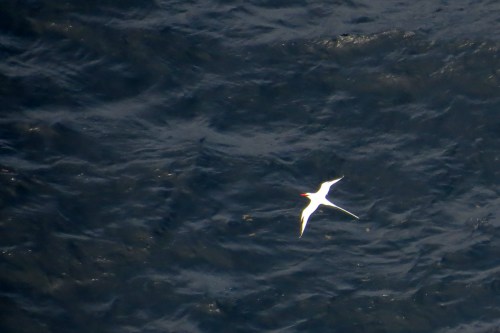
…. he was videoing Red-billed Tropicbirds just below us.

St Lucia was also pretty good for other forms of wildlife, I don’t know the name of this butterfly ….
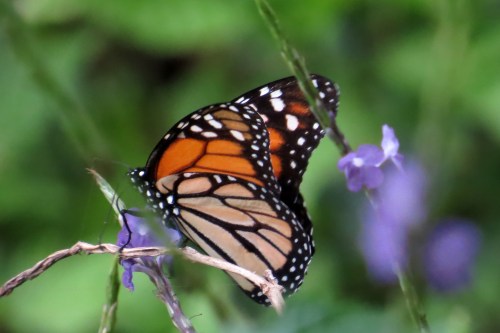
…. but this is the highly migratory Monarch (migratory in North America at least) which is capable of crossing the Atlantic and which I have seen on Scilly and Portland in the UK.

Bizarre caterpillars and ….
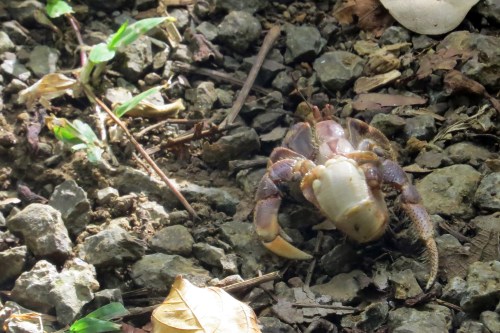
…. bizarre crabs were the order of the day. One of our group (perhaps unadvisedly) picked up a Hermit Crab in its borrowed seashell. It probably climbed out of the shell and scuttled away ‘butt naked’.
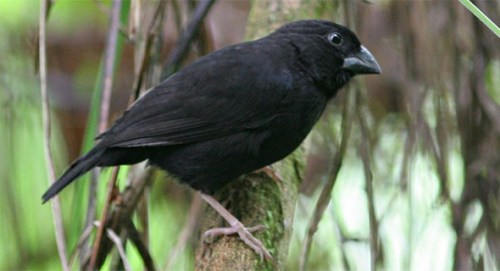
Well three endemics had fallen easy enough but the fourth remained a problem. However on our last morning we connected with the St Lucia Black Finch on a trail where forest meets farmland. Views were quite brief, light was poor and so were my photos. Here’s pic of the little fella from the Cornell Lab of Ornithology website taken by Marcel Holyoak see https://neotropical.birds.cornell.edu/Species-Account/nb/species/slbfin1/overview
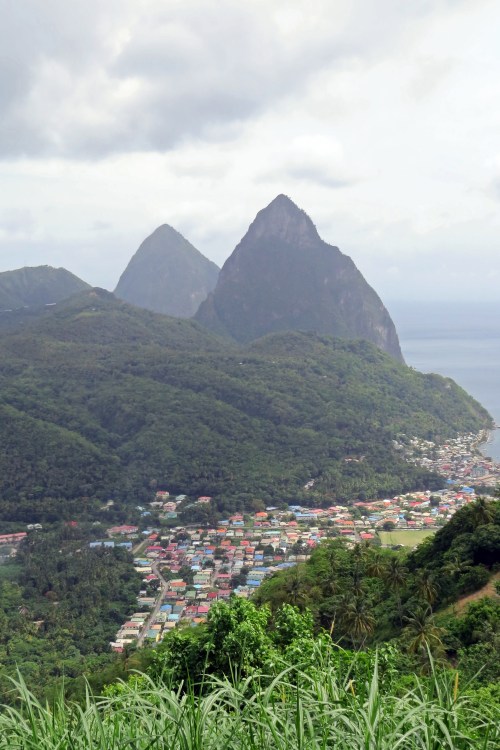
We were staying at the capital Castries in the northwest but on the final afternoon some of us persuaded Mark to drive us down to the viewpoint overlooking the town of Soufriere to see the St Lucia’s most famous landmark, the Grand Pitons.

So it was ‘job done’ for St Lucia with all the endemics ‘under the belt’ ….

…. and time to fly on to St Vincent. Our journey time was quite long as we had to fly all the way west to Barbados before flying back east to St Vincent.

Our hotel in the capital Kingstown was fine ….

… and boasted one of the tallest cheese plants I have ever seen ….

…. but the streets in the town outside lacked a certain sparkle ….
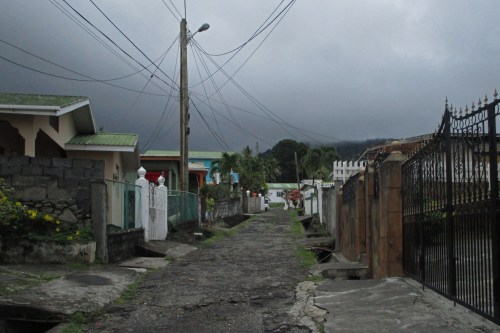
…. and the same could be said for the residential areas.

Mind you the weather didn’t help. It had been dry on Antigua, Barbuda, Montserrat and Guadeloupe, cloudy with some rain in Martinique and St Lucia but on St Vincent it rained most of the time.
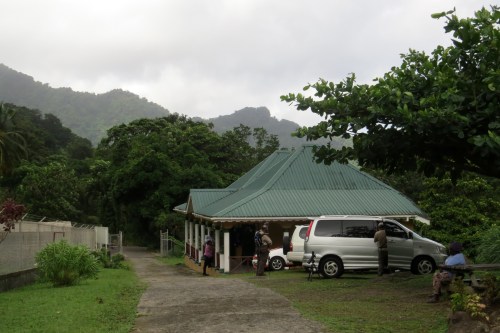
Nearly all our birding was done on the Vermont trail ….

…. but we had to shelter by the water works building during the worst of the rain.

There was a good forest trail alongside a stream ….

…. with some impressive mature fig trees, but with the poor weather we struggled with the birding. We did see Lesser Antillean Tanager, the local race of House Wren (like all the other island forms of House Wren it deserves to be split) and Grenada Flycatcher (found only here and on Grenada) but the delightful Whistling Warbler was a ‘heard only’. This undoubtedly the disappointment of the trip as it looks a stunner in the field guide.
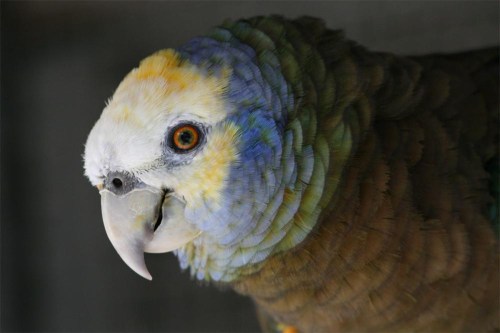
On the positive side we had good prolonged scope views of a flock of the endangered St Vincent Amazon but as with the other parrots they were too distant for photos so again I have used a pic of a captive individual from the Internet Bird Collection taken by Mikka Pyhala. https://www.hbw.com/ibc/species/st-vincent-amazon-amazona-guildingii
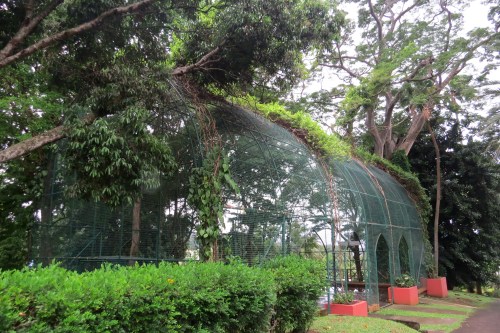
One afternoon we birded the Botanical Gardens in Kingstown but again we were thwarted by rain.

A juvenile Broad-winged Hawk called noisily from a nearby tree ….
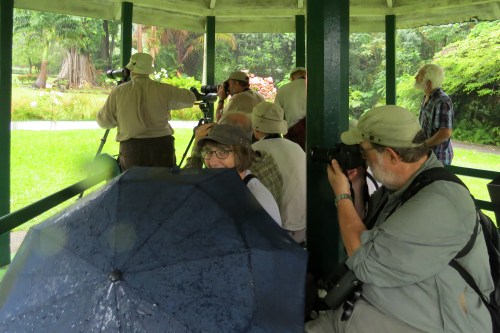
…. and whilst sheltering from the heaviest rain under this shelter ….
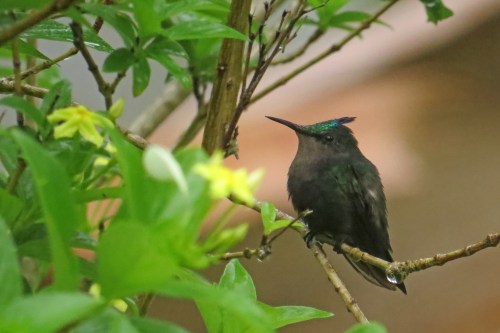
…. we had great views of the endemic race of Antillean Crested Hummingbird.
So that was it for St Vincent. We flew east the following morning to Barbados (we were getting heartily sick of emigration and immigration forms and airport security checks by this stage) which will be the subject of the next post.
This post, the third covering my island hopping Lesser Antilles tour, concentrates on the islands of Guadeloupe and Martinique, both overseas departments of France.
As I mentioned in the last post, from Dominica we had to overfly Guadeloupe to Antigua then return to Guadeloupe hours later. Similarly on our onwards flight to Martinique we had to overfly Dominica!

Guadeloupe is a department of France and hence has all the benefits of belong to the EU, something we are carelessly discarding in Britain. It consists of two island Basse Terre (seen in the distance) and Grande Terre joined by an isthmus and a series of bridges.

The capital Pointe-a-Pietre straddles the isthmus leading to the major traffic jams at rush hour.

Our birding at Guadeloupe was on the slopes of the mountains in the south-west of Basse-Terre. In fact all of our birding took place at this single picnic site beside the river.
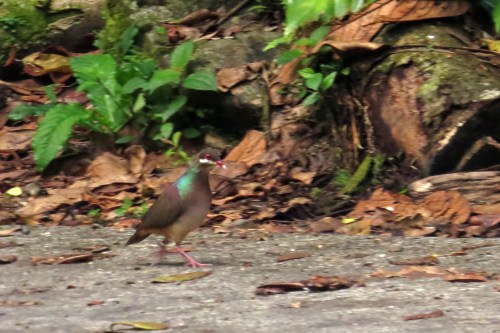
Just on dawn several Bridled Quail-doves walked around the clearing. We had seen one before on Montserrat but the views here were so much better ….

…. however the light was poor that early in the morning, so these pics aren’t very sharp.
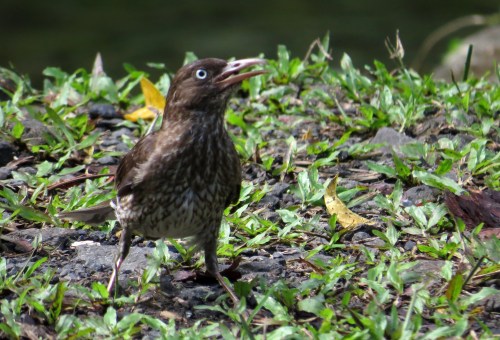
Other species we saw included Pearly-eyed Thrasher ….

…. and we had multiple views of the usually skulking Forest Thrush.

We had seen Plumbeous Warbler on Dominica but here one posed for photos.
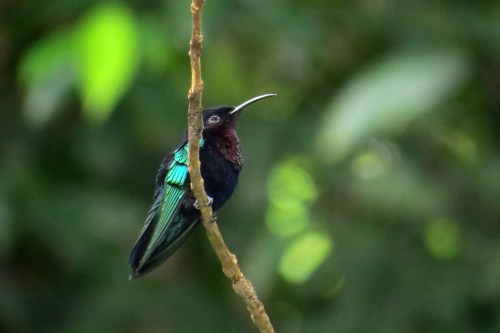
We also saw our first Purple-throated Caribs.
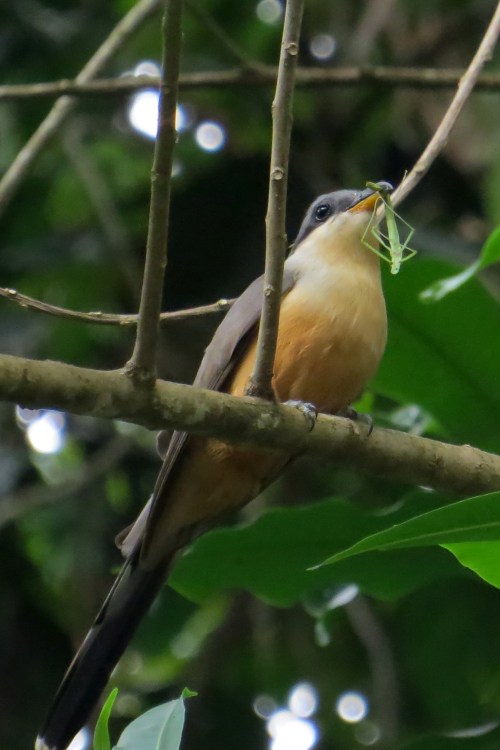
We were surprised when this Mangrove Cuckoo appeared carrying a cricket ….

…. presented the cricket to a nearby female, copulated ….

…. and then perched on a branch with a smug look on his face.

The bird of the morning was Guadeloupe’s only endemic bird, Guadeloupe Woodpecker.

On an earlier post I uploaded images of birds that I have seen on my birthday, well it was my birthday today and this bird was a fantastic birthday present.
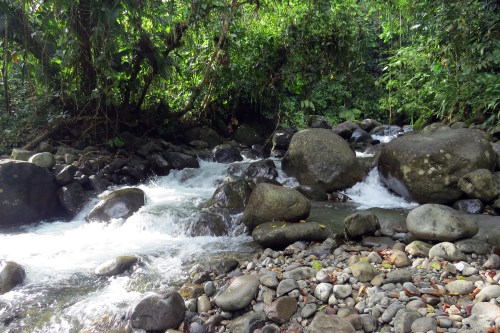
So it was goodbye to the glade by the river and goodbye to Guadeloupe as well, we returned to the airport and flew to Martinique.
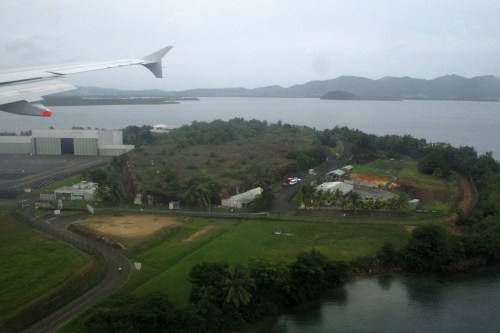
Our flight from Guadeloupe to Martinique wasn’t on the local island carrier LIAT but on an Air France Jumbo, direct from Paris and on route to French Guiana.
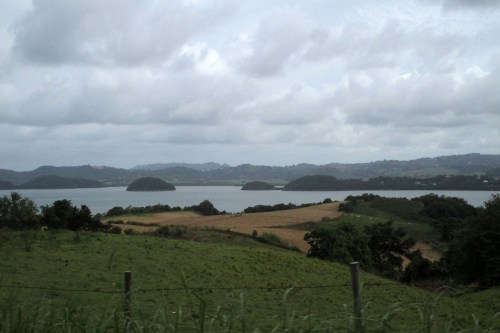
Martinique, like Guadeloupe was like a slice of France transported into the Caribbean, but a rather dull, hot and sticky slice at that. We drove to a peninsula on the east coast of the island and checked into our hotel.

Situated on the side of a steep hill, the multiple steps caused consternation for some of the group members.

It was getting late in the day so a quick look around the immediate vicinity and a chance to photograph Zendaida Dove was about all there was time for.

The following morning we took a short drive down the pLa Caravelle Peninsula
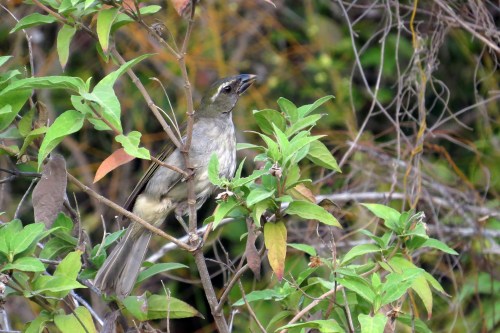
…. where Lesser Antillean Saltator showed well. It is found on several of the central Lesser Antilles but we only saw it here and on St Lucia.
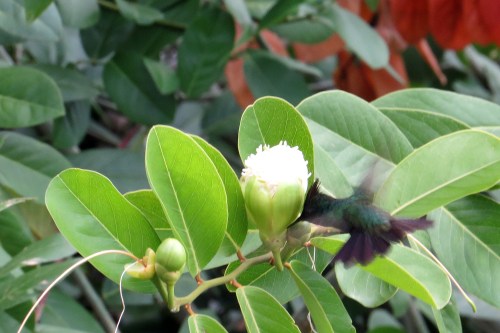
More widespread was Antillean Crested Hummingbird which we saw on most of the islands.
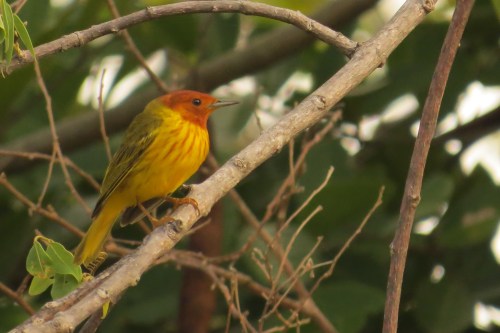
Golden/Mangrove Warblers are a bit of a conundrum. Taken together with Yellow Warbler (the species that turned up at Portland in August) they fall into three groups, the migratory Yellow Warbler from North America, in which the male has a chestnut streaked breast and a yellow head, the sedentary Mangrove Warbler of the coastal mangroves of Central America and northern South America, which has an entirely chestnut head and Golden Warbler of the islands of the Caribbean where the male shows a little chestnut cap. OK you say, clearly they are three separate species, the trouble is in the Lesser Antilles the Golden Warblers look just like Mangrove Warblers with a complete chestnut head but aren’t associated with mangroves. As a result, despite the morphological differences the two resident forms are considered one species and only the migratory Yellow Warbler is split off.
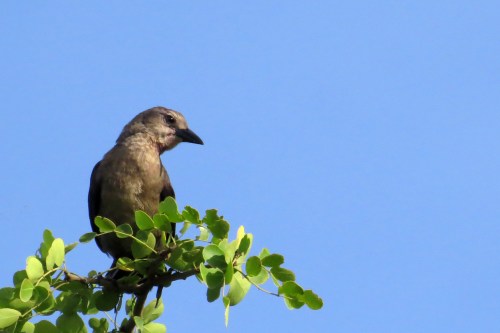
Carib Grackles are a bit of a puzzle as well. Birds in the Lesser Antilles look different from those of northern South America and the females in the central Lesser Antilles are much paler than those in the more northerly islands. Nice as they were the bird we really wanted to see was ….

…. White-breasted Thrasher, a species known only from Martinique and St Lucia. Our views were reasonable but the birds remained partially hidden so I have used a photo from the Internet Bird Collection taken by Mikko Pyhla http://www.hbw.com/ibc/u/3849
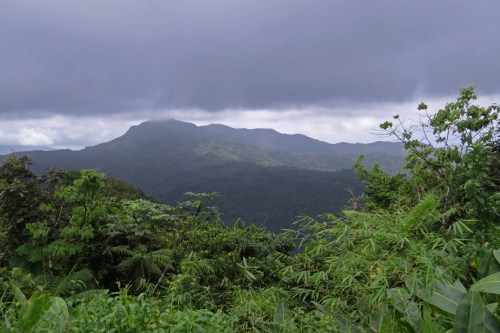
To see the remaining Martinique goodies we had to leave the coast and head for the misty mountainous interior.

Unfortunately we had heard that the road from the east coast to the interior had been blocked by a major landslide, sufficiently large that it was marked on the maps, so we had no alternative but to drive back south and head inland from a different direction, a detour that must have taken about an hour. At least the roads were good and unlike Guadeloupe, not congested.
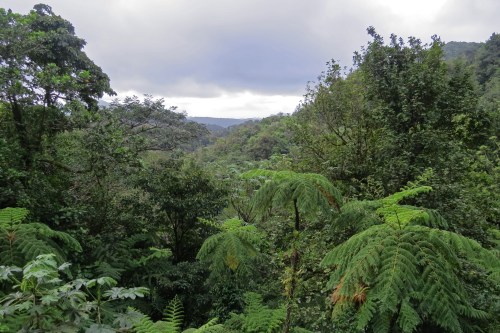
In due course we reached the mountains and it didn’t take us long to find the goodies ….
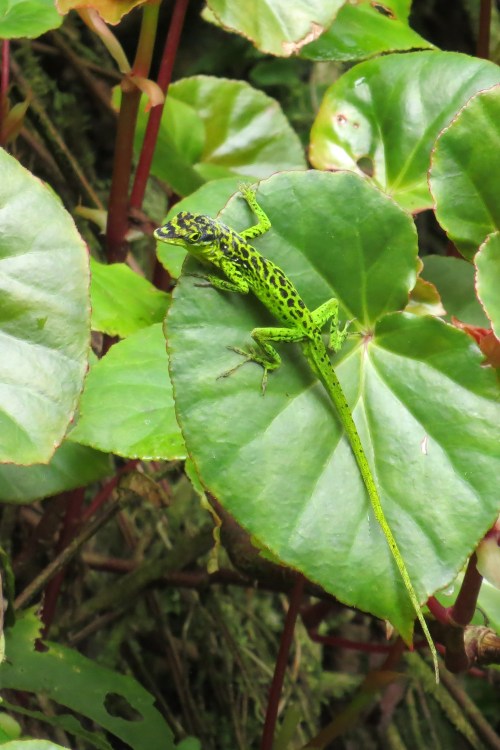
Whilst walking the mountain road we found Martinique’s endemic lizard, the Martinique Spotted Anole.
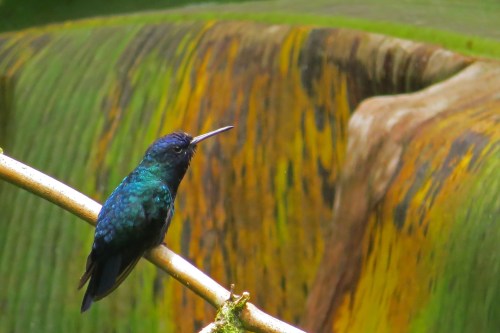
We spent quite a time watching this lovely Blue-headed Hummingbird ….

It stayed perched motionless on the same branch for ages and because the branch was situated by a hairpin bend we could watch it from many different angles
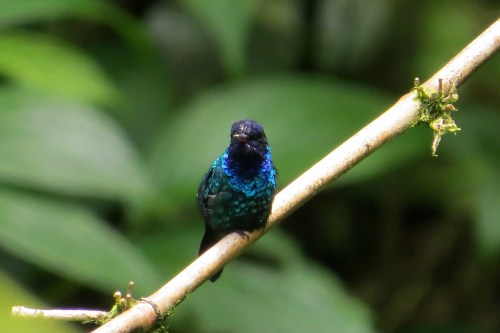
As always with hummingbirds, their colours are only revealed when the light strikes them at a certain angle, so in this pose the blue head becomes black and the gorget lit up like a police car’s strobe lights.

Joseph shows his video of the hummer to Mark and Keith.

In due course we found our main target, the endemic Martinique Oriole. Initially our view was of a bird directly overhead ….

…. but later we got a view that placed less of a strain on the neck ….

…. and we could watch it as it preened.
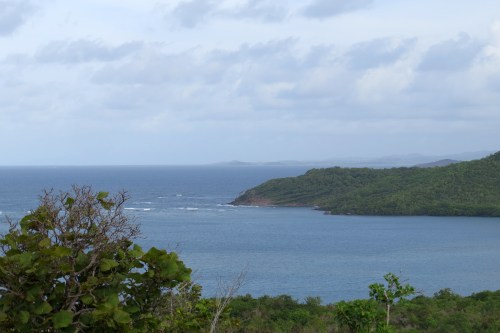
Before we left we returned to the La Caravelle peninsula ….

…. but we didn’t get to see anything new, just a chance to photograph the widespread Tropical Mockingbird.

Then it was time to move on again, this time to the island of St Lucia, which will feature in the next post.
This post covers my visit to the island of Dominica (pronounced Dom-in-ee-ka) as part of my tour of the Lesser Antilles.
I had intended to post photos from Dominica, Guadeloupe and Martinique but I had more decent photos of Dominica than I though, so the two French islands will appear in the next post.
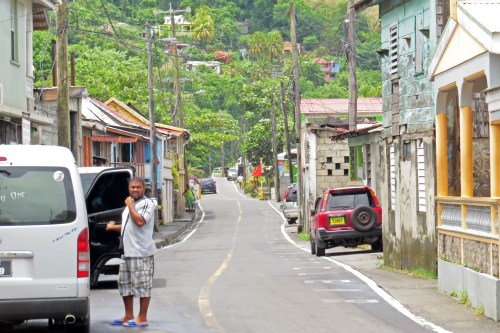
Compared to Antigua and in particular to the two French islands (which are part of the EU), Dominica is somewhat impoverished, although car ownership seems quite high. It is a mountainous and verdant volcanic island quite unlike Antigua and Barbuda. A former British colony, taken from the French in 1763 and gaining independence in 1978, it gained its name because Christopher Columbus first sailed past it on a Sunday.
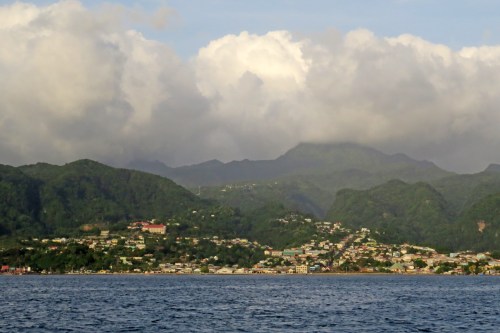
Our flight from Antigua arrived after dark and we had to cross the island from north-east to south-west to arrive at the island’s capital Roseau, seen here from a boat trip that we took later in the trip.
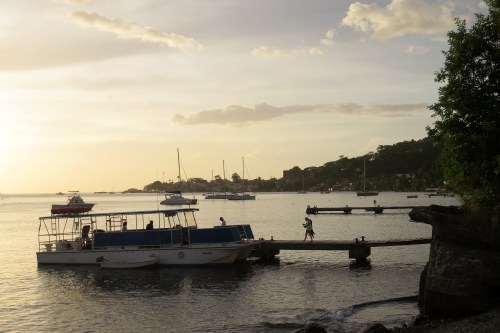
Our hotel was situated on the coast just south of Roseau, it was a long way from the best birding site but decent accommodation is in short supply.

Much of our time on the island was spent at or near this viewpoint in Morne Diablotin NP, named after local breeding petrels or diablotins, (their name in turn deriving from their devilish sounding vocalisations). Unfortunately the weather was against us and it rained for much of the time. On the right is our tour leader Mark van Beirs from Belgium. Mark has led more tours than any other Birdquest leader and is capable of leading trips to any part of the world. Indeed I’ve been on no less than 18 tours with him from 1989 onwards. One of the joys of always travelling with the same tour company is that on any given tour there will be several people you already know. Keith, the guy with his back to the camera, was on our Atlantic Odyssey in 2016, although I know Keith from UK birding and we first met in 1980.

The main targets were two species of parrot. The smaller Red-necked Parrot was easy to find and perched up on the far side of the valley. However its ‘red-neck’ was harder to see ….

…. but can just be seen as a red dot on this photo. Another example of a bird that is named after its least obvious field characteristic.
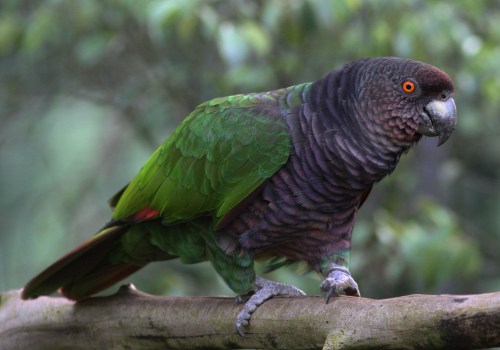
The other species, the larger Imperial Parrot, known locally as the Sisserou, was much harder and it took two morning visits to the view-point before we had tickable flight views. An internet search failed to produce any pics of wild birds but I did find a photo of this captive individual taken by Mikko Pyhala http://www.hbw.com/ibc/u/3849
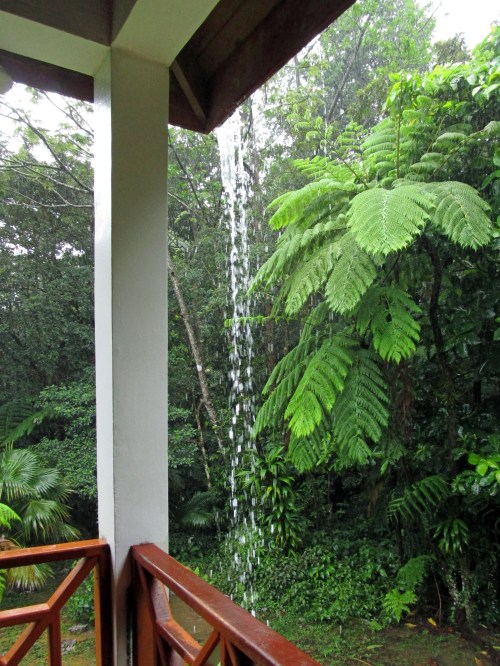
By now the weather on the mountain had turned really bad and we retreated to the visitor centre for shelter.

The now familiar Lesser Antillean Bullfinch also sought shelter from the storm.
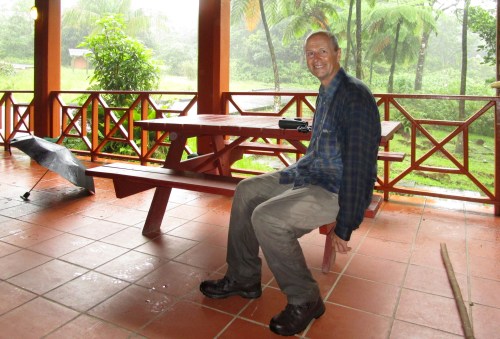
In spite of the weather Keith seems pretty pleased with the outcome.

On the return we noticed some Caribbean Martins on wires in this village and stopped for photos, but may have caused a bit of a traffic jam in the process.

These chunky hirundines gave excellent views. ….
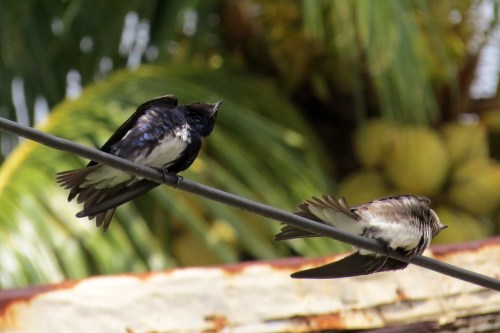
…. but then they exhibited a most bizarre behaviour, stretching out along the wire, presumably drying themselves after the heavy rain. They certainly seemed to be enjoying sunbathing!
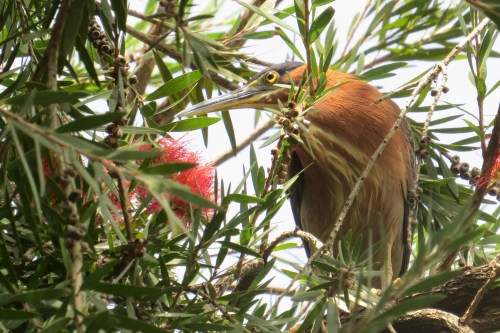
Around our hotel we found nesting Green Herons. This species is found throughout north and central America but in South America (and Trinidad) it is replaced by the similar Striated Heron.

On our second morning we returned to the mountains and in spite of the continuing rain managed flight views of the Imperial Parrot and our first view of Plumbeous Warbler and the Dominica race of House Wren. All of the races of House Wren in the Lesser Antilles deserve to be split as a series of single island endemics as they look and sound different and inhabit forests not human conurbations.
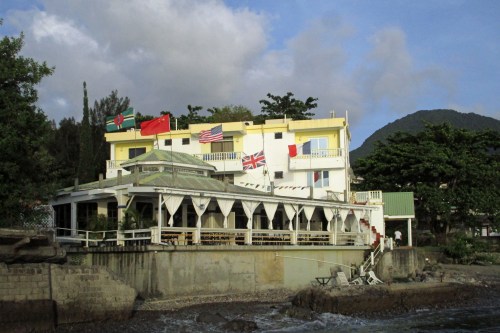
We returned to the hotel late morning and in the afternoon took a boat from the adjacent dock.
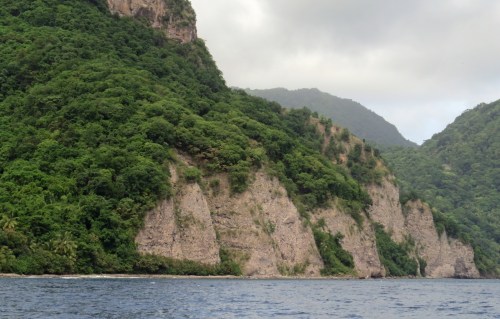
We headed south towards the southernmost tip of the island in search of seabirds and cetaceans.

On route we found an American Oystercatcher, a rare migrant from North America and one that even resident birders haven’t seen.
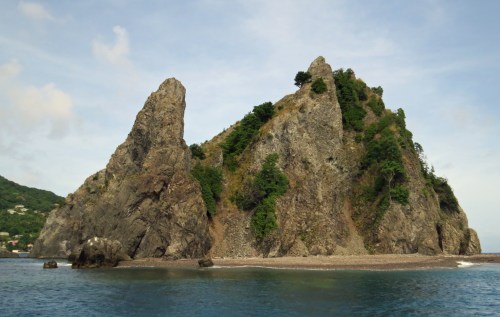
Soon we reached Scott’s Head at the most south-westerly tip of Dominica.

There were a lot of Magnificent Frigate birds fishing and we soon saw why, a shoal of tuna were pushing small fish up to the surface.

Amongst the leaping tuna was a small dark tern (LHS of the photo).

It proved to be an American Black Tern. Many in the UK (if not in North America) treat this race of Black Tern as a separate species based on a few morphological differences, but to my knowledge there has been so study of genetics, voice etc and until there is I think they should be considered conspecific.

We continued up the west coast until we were level with misty (and wet) Morne Diablotin, the highest point of the island, where we had been birding earlier in the day.

Our aim was to find the Sperm Whales that are regularly seen off Dominica and we located two, presumably a mother and well-grown calf. Note the laterally offset blow hole which gives this whale its characteristic blow.

They put on a good show before finally diving into the deep underwater trench that lies just offshore.

So it was back to the hotel and an early departure the next morning for the airport. I was expecting our flight would take us on to Guadeloupe but no, things weren’t that simple ….
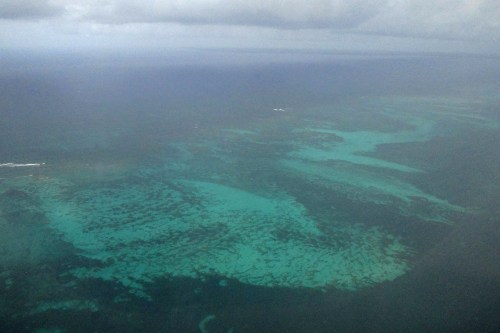
…. first we had to fly north, over flying Guadeloupe in the process, spend many hours sitting around in Antigua airport (again) before taking the short hop back to Guadeloupe.

No wonder Mark was knackered.
Arriving in Guadeloupe was like arriving in France (and technically it was France) French signs, three lane highways and traffic jams. What a shock after the rural simplicity of Dominica.
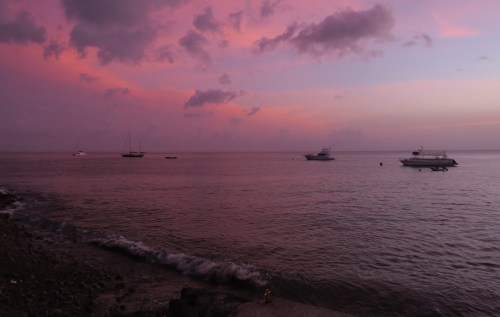
Rather than end this post with a photo of traffic congestion instead let’s enjoy a wonderful sunset from our Dominica hotel at the conclusion of our boat trip.

The islands of the Caribbean hold a multitude of birds, many of them endemic. The islands fall into two main groups, the Greater Antilles (the four large islands of Cuba, Jamaica, Hispaniola and Puerto Rico) and the Lesser Antilles, a chain of 30+ islands that stretch southwards from Puerto Rico towards the Venezuelan cost. For the purpose of this blog and birding in general, the islands off the Venezuelan coast and Trinidad and Tobago are not considered part of the Lesser Antilles. Map of the Caribbean from Google Maps.
The Lesser Antilles comprise of eight nation states and seven overseas dependencies. Our tour took us all the islands that had endemic birds namely (in order of arrival) Antigua, Barbuda, Montserrat, Dominica, Guadeloupe, Martinique, St Lucia, St Vincent, Barbados and Grenada. We also visited Trinidad. This post deals with Antigua, Barbuda and Montserrat. Barbuda is the unmarked island just north of the A of Antigua. Map of the Lesser Antilles from Google Maps.
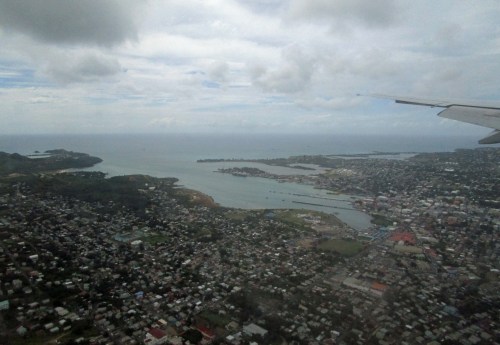
After a long flight from the UK I landed at St John’s on the island of Antigua on a rather cloudy afternoon and met the rest of the tour group at the airport.

Although we were tired after the long flight, after dropping the bags off at our hotel we headed out to a nearby beach.
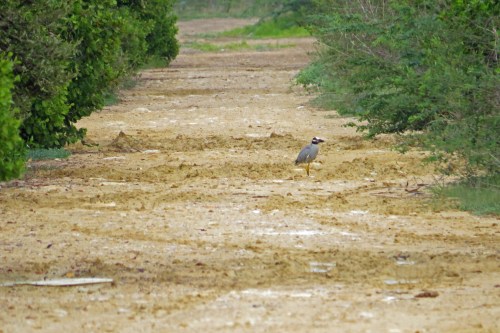
It wasn’t the beach we came to see but a lagoon just inland. Access was via this dirt track, there must have been a sewage works near the start as the smell was awful. However we were soon away from that and came across some good birds like this Yellow-crowned Night Heron.

As you would expect from a freshwater lagoon, there were many Black-necked Stilts. This is the New World equivalent of our familiar Black-winged Stilt and some authorities treat them as conspecific.
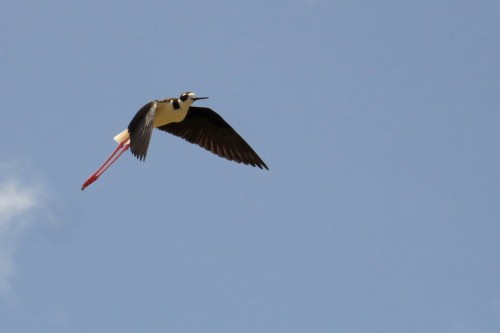
All stilts noisily defend their nests against potential intruders, indeed their piping call is a familiar sound at wetlands over much of the world’s temperate and tropical regions.
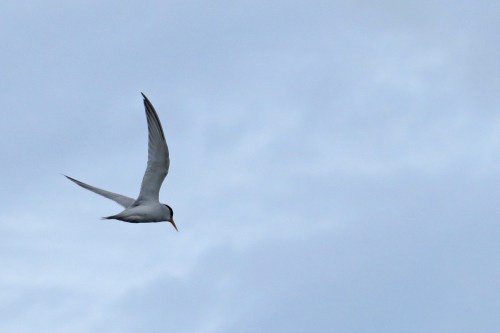
There were several species of tern on the lagoon, by far the commonest was Least Tern.
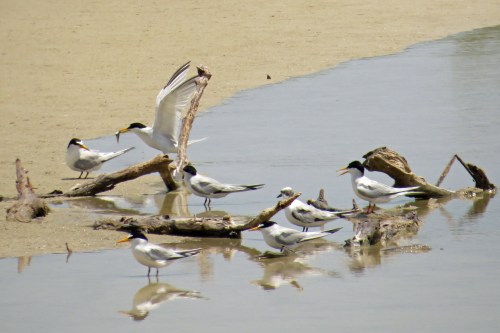
Least Tern is the New World equivalent of our Little Tern. Although very similar in plumage it differs vocally. A Least Tern visited a Little Tern colony in Sussex for several years in the 90s but it was several years before it was conclusively identified by which time it was less reliable. I twitched it but dipped.

There were several species of wildfowl on the lake, most notable were a few West Indian Whistling Ducks but they remained in cover at the back of the lagoon. These White-cheeked (or Bahama) Pintails were more co-operative.
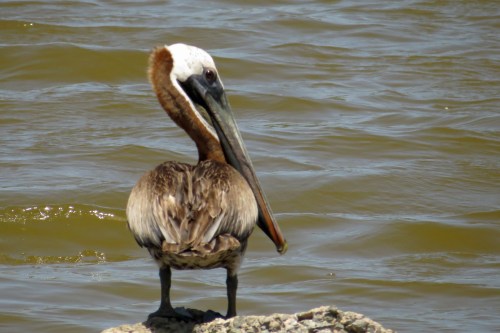
Brown Pelicans were common on the lagoon and along the shore.

Magnificent Frigatebirds were seen on all eleven islands that we visited and were common on Antigua.

After a much-needed sleep we set off by boat the next day to Barbuda. The islands of Antigua and Barbuda were British colonies but achieved independence as a single country in 1968.

Barbuda is a small low-lying island of about 160 sq km, about a third the size of Antigua, largely covered with scrub vegetation. Tragically three months after our visit the island was flattened by Hurricane Irma and all inhabitants were evacuated to Antigua. After disembarking we headed on foot to a nearby wooded area

We soon started seeing birds like the widespread American Kestrel ….
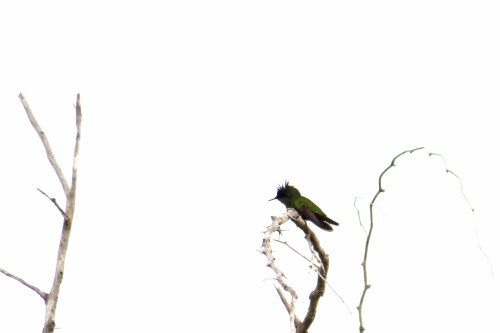
…. and the tiny Antillean Crested Hummingbird, a species that occurs in Puerto Rico as well as the Lesser Antilles and one we saw on every island except Antigua.
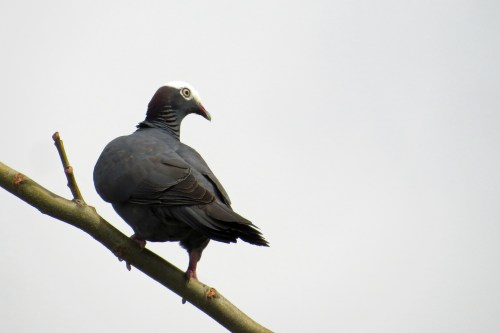
White-crowned Pigeon is a bird of the northern Caribbean, occurring from the Florida Keys south to Antigua, Barbuda and Montserrat.
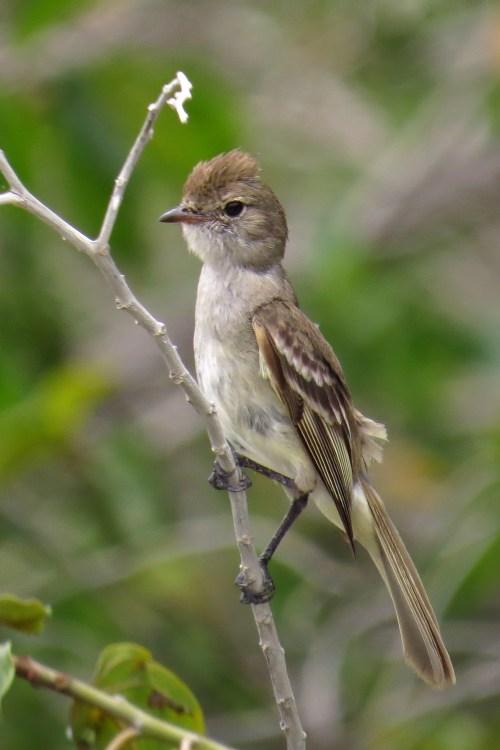
There are twenty-eight species named Elaenia, mot of them nondescript and hard to identify. Caribbean Elaenia occurs in Puerto Rico and islands off Central America as well as the Lesser Antilles.

The semi-concealed erectile white crest is typical of many species of Elaenia.

The common and ubiquitous Lesser Antillean Bullfinch was seen on all the Lesser Antillean islands except Grenada (more about that later). This was my first life bird of the trip, being seen in the car park of the airport at Antigua on arrival.
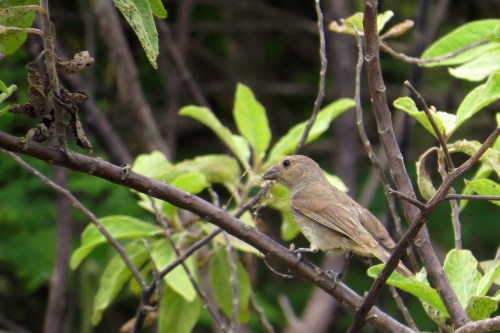
The female is much drabber (again more about this later).

Lesser Antillean Flycatcher belongs in a genus known as Myiarchus With their lemon yellow bellies and grey breasts and brown upper parts members of this genus are most distinctive even if it is hard to tell one from another. Rather than using the non-specific name ‘flycatcher’ I wish they would all have the english name of Myiarchus. With over 430 species of tyrant flycatcher in the New World, then anything that makes a genus easier to remember is to be welcomed. We were only to see this species on Barbuda and Dominica.

Black-whiskered Vireo is widespread in the Caribbean especially in low-lying coastal regions. Its distinctive voice forms the backdrop to a lot of Caribbean birding.

The main reason we had come to Barbuda was to see the beautiful little Barbuda Warbler, which of course is endemic to the island. They seemed quite common and it didn’t take us long to locate some.

Fears had been expressed for their continual survival after Hurricane Irma but recent surveys have proved that at least some remain.
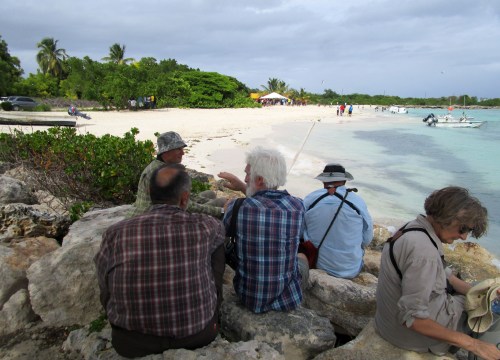
With our targets under the belt and with the temperature rising we returned to the dock. Today was a festival and there was very loud music playing from a beach party, most of the group kept well away ….

…. but I braved the deafening beat and had a wander around.

As we returned to the boat there were many Frigatebirds about ….

…. we realised why when we saw fisherman landing their catch.

A Brown Pelican was feeding on some discarded fish offal but this Frigatebird was hanging around nearby ….

….. and it quickly grabbed and stole the fish guts from the pelican’s beak!

Soon it was time to return to Antigua and to our hotel.
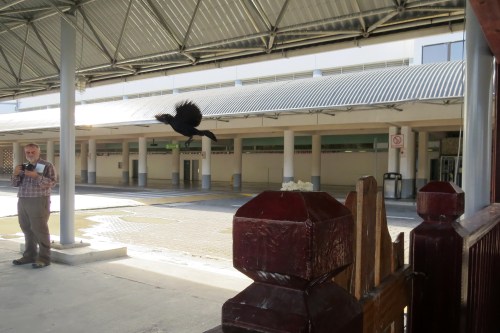
Early following morning we were back at Antigua airport waiting for our flight to Montserrat. One of the tour participants was Joseph del Hoyo editor of the Handbook of Birds of the World series. Joseph is keen on videoing birds and much of his work can be seen on the Internet Bird Collection/HBW Alive at https://www.hbw.com/ibc Here Joseph is videoing a Carib Grackle that was hanging around our breakfast venue at the airport.
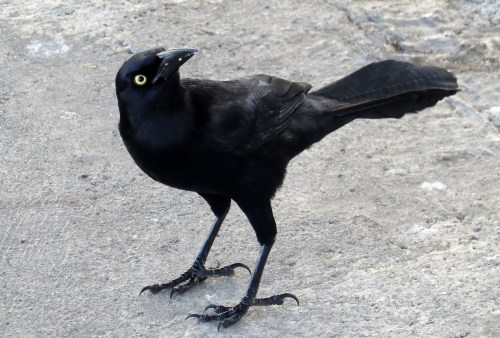
Some discarded toast would soon bring the grackle within photo range.
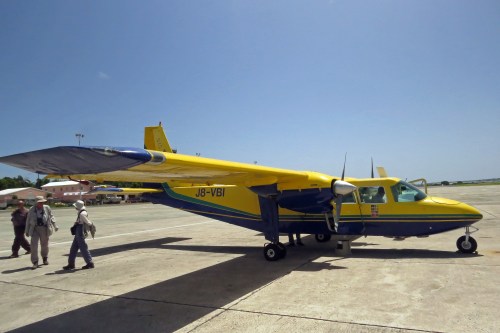
Our flight to Montserrat (a UK Overseas Territory) was in this light aircraft.

I have to say it was a bit of a squash inside.
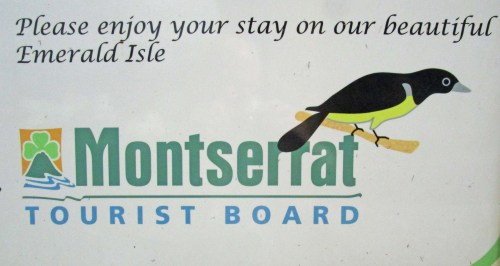
The board outside Montserrat’s airport illustrated our reason for coming to Montserrat, the endemic Montserrat Oriole. Although we were to see the species, the most views were of females so this was our best view of the a male! When the immigration officer asked my reason for coming to Montserrat I replied ‘I’ve come to see the oriole’, his eyes lit up, they are obviously proud of their national bird.
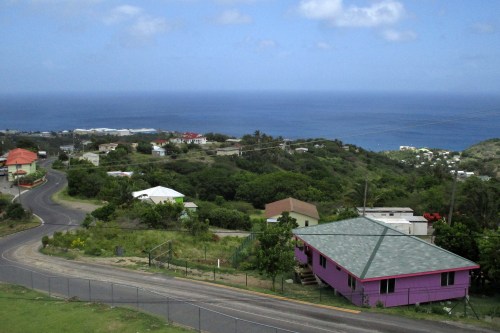
Due to the flight schedule our time on Montserrat was brief. We arrived mid morning and dropped our gear off at our hotel (which had a lovely view from the rooms) and immediately went birding.

The so-called ‘oriole walkway’ was our best chance to connect with the island’s special birds and we spent the rest of the day there.
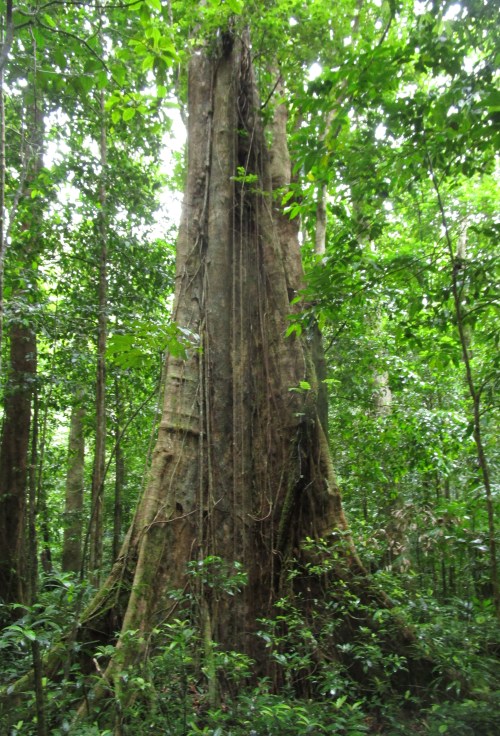
It was good quality forest growing on volcanic soil, not the sand of Antigua and Barbuda (which reduces the height of their forest cover to that of low scrub on those islands).

The first good bird was Pearly-eyed Thrasher, a mimid, that is a member of the family that includes mockingbirds, catbirds, tremblers as well as the thrashers.

We had brief views of a Bridled Quail-dove in the gloom of the forest.

Eventually we saw our prize, Montserrat Oriole, but only this female perched for photos. I had a brief look at a male but many of the group only saw females.
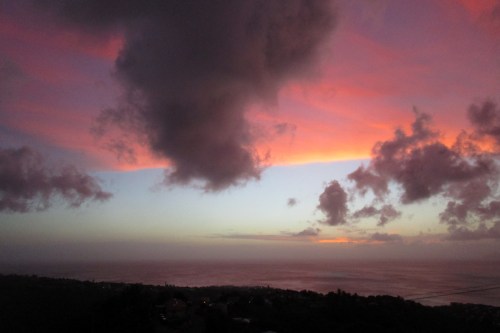
It was nearly dark by the time we were back at the hotel.
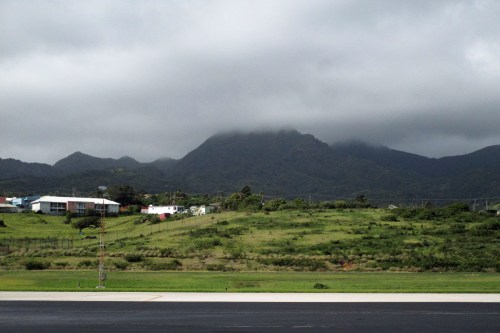
The following morning it was straight to the airport for the return flight to Antigua. Although I knew that this would be a whistle-stop tour of the islands I was a bit disappointed that we couldn’t see more of Montserrat. In particular I’d have like to see some of the lava flows that formed after the 1995 eruption and whatever remains of the capital Plymouth. Although the southern third of the island is an exclusion zone, apparently there is a public viewpoint that overlooks Plymouth.

The eruption of the Soufriere Hills Volcano in 1995 destroyed much of the southern part of Montserrat and buried Plymouth, the docks and the airport under pyroclastic flows and lava. The whole southern part of the island was evacuated (about two-thirds of the population) mainly to the UK and the economy was destroyed. The new airport was built in 2005 but the island economy has yet to recover. Although the volcano destroyed much of the Montserrat Oriole’s habitat, some remained in the north and it has recently been downgraded from Critically Endangered. Margaret lived on a yacht and sailed though the Caribbean in the mid 90s and has described to me the wonderful experience of passing Montserrat by night and seeing views like this (from www.sciencedaily.com).

It was back to Antigua in the small plane ….

…. we had time before our onward flight to visit the lagoon once more, go into St John’s for lunch (this is St John’s cathedral) and visit a new site a bit to the south.

Getting the lake by the Cocos Hotel took longer than expected so it was a quick scan, a few photos and then on to the airport.
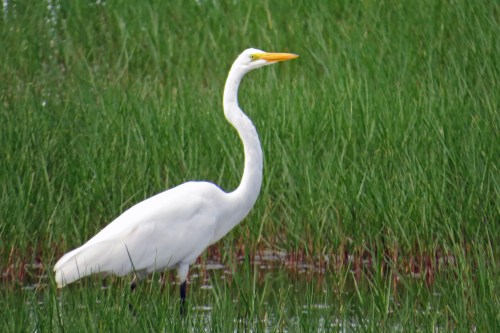
There were a few new species like American Coot and Pied-billed Grebe plus a chance to photograph Great Egret ….

…. and Tricoloured Heron.
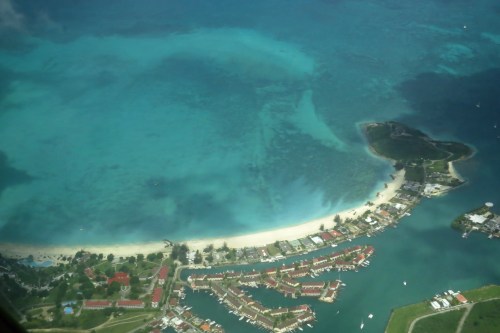
So for the third time we said farewell to Antigua and headed off in the late afternoon to Dominica.
The next post will cover Dominica and the French islands of Guadeloupe and Martinique.
This post covers a few of the ringing and birding activities during the summer of 2017 plus a post script about a Dorset Mega in October.

Most of the birds we ring at Durlston and beyond are small passerines so I felt it would be useful for my trainees to get some experience in handling larger birds such as geese or swans. Fortunately we were all free to join the annual Canada Goose ringing session at Chew Valley Lake in Somerset.
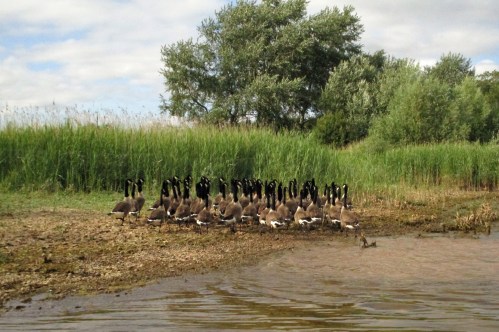
Margaret, my trainees Ginny and Chris, Olly, another ringer from our group and I drove up to Chew Valley. Most of us went out on the boats to round the geese up. Unfortunately for the ringing program many of the geese were feeding in a shallow, weed filled area where the boats couldn’t get so the total number ringed/processed was smaller than usual.

As they moult most of their flight feathers simultaneously the geese are flightless in early July so using some well-practiced boat maneuvers, the flock was shepherded ashore and into a corral.
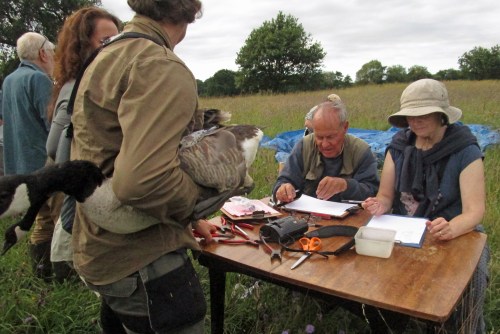
Each of us was handed a goose and we proceeded to the a table where the ‘scribe’, ably assisted by Margaret, handed out the rings and recorded the details.
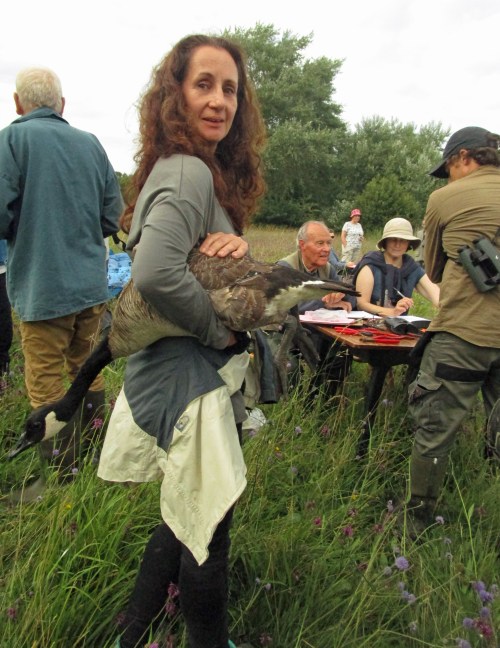
Although they had never held such a large bird before Ginny and Chris managed very well and were able to close the large ‘L’ rings around the goose’s tarsus.
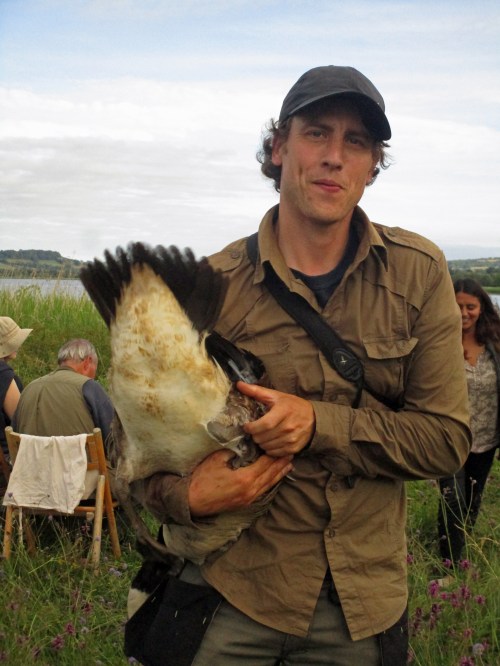
Chris enjoying his visit to Chew Valley. This may be a rather inelegant view of a Canada Goose but it is the safest and easiest way to carry one.

Closing a large ring on a large bird involves a very different technique to say ringing warblers or garden birds. Although an introduced bird, the monitoring the movement and population growth of alien species like Canada Geese is very important, so ringing these birds is so much more than just an outing for trainees.
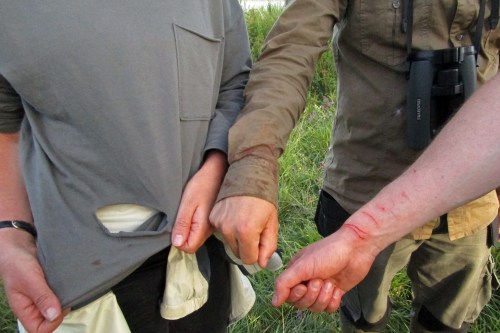
In the end the ringers compared their ‘war wounds’, a torn t-shirt, a few scratches and a bit of (human) blood on your sleeve.

A Collared Dove was an unusual bird ringed in my garden this summer. This species naturally colonised the UK from the 1950s onwards and now is an established breeder throughout the country. However they were introduced to the Caribbean from where they have spread to the USA and in a very short period colonised much of North America.
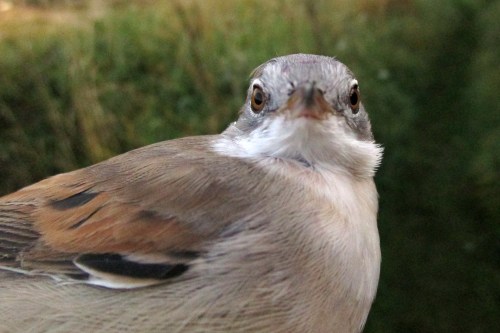
Our ringing at Durlston commenced on the 19th July with local breeders like this Common Whitethroat (note the grey head and pale eye of an adult) ….

…. but the highlight was this 1st year Nightingale. As we also trapped an adult in the spring it is likely that the species has bred locally. Like many woodland birds Nightingales have declined markedly. Our ringing group had ringed 99 Nightingales prior to 2017 but none of those were after 1994 showing the scale of the decline.
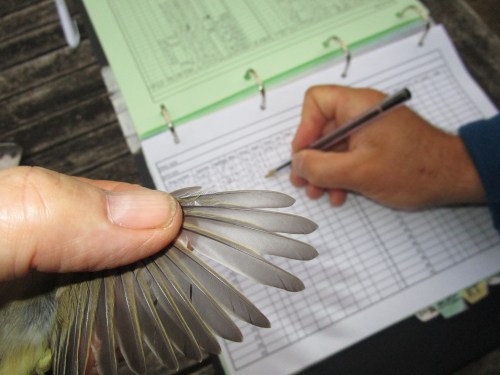
Details of wing length, weight and moult status are recorded. This year a few Willow Warblers must have bred near or at Durlston as we trapped a few adults in moult as well as juveniles. Willow Warblers used to be common breeders but with climate change their range has shifted northwards. This bird is missing its 6th primary, a little tricky, as the exact shape of this feather is what proves categorically that it not a Chiffchaff. However there were enough other features to prove its identity beyond doubt.

One feature that is sometimes seen on young birds is ‘growth bars’. As a bird is growing its remiges and retrices (primaries, secondaries and tail feathers) in the nest, the quantity and quality of food delivered to it will vary depending on the weather. This can affect the growth of the feathers and as the feathers are grown simultaneously appear as a bar across the tail. Growth bars across the primaries and secondaries are usually much less obvious than across the tail. This Reed Warbler is notable because of the strength of the growth bars across all the flight feathers. It must pointed out that this is not a plumage characteristic of the species but an anomaly in this particular bird.

Of the more unusual captures, this Northern Wheatear was notable.

One of the features of ringing this summer/autumn was the capture of nine Nightjars, seven in August and two in September . All were juveniles and presumably were on migration, or at least undergoing making postnatal dispersal prior to migration as the species is not known to breed on the limestone grasslands and scrub at Durlston. Most likely we only discovered their occurrence in the park because this year we took to arriving on site that bit earlier, typically about 0430 in August.
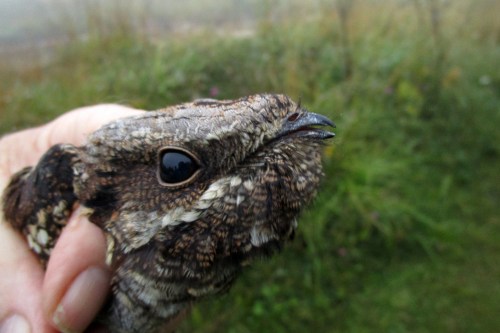
On one occasion a Nightjar was trapped just on dawn so we were able to photograph it in what appears to be daylight. In fact it was still quite gloomy, I was just using a very slow shutter speed!
=
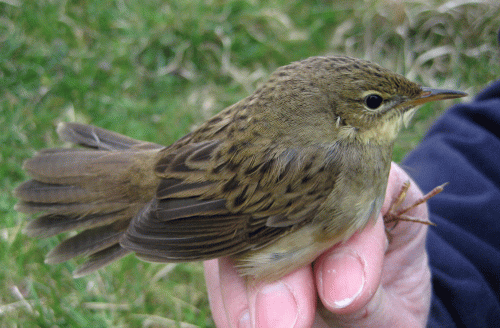
Another benefit of getting the nets up before dawn has been the capture of a record number of Grasshopper Warblers. Most years we ringed 10-30 of these skulky little warblers, last year that rose to over 100, this year to over 200 with 65 on a single day. This huge increase cannot just be attributed to earlier starts, the species must have had a very good breeding season. We also had our first Grasshopper Warbler ‘control’, a bird ringed last autumn in Hampshire. We also ‘controlled’ a Tree Pipit, a Willow Warbler and two Reed Warblers, all ringed in various parts of the UK but our only Bullfinch recovery was a bird we ringed in the spring that was found killed by a Sparrowhawk in a garden less than a mile away.
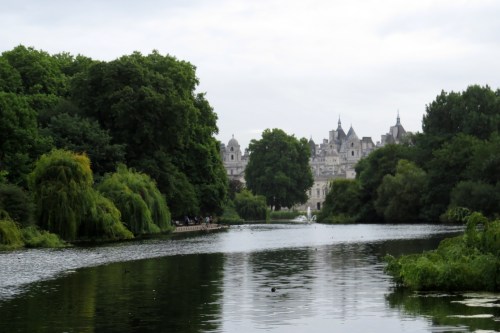
I mentioned in my previous st that we visited London for the day. On our way from Victoria coach station to Trafalgar Square we passed through St Jame’s Park.
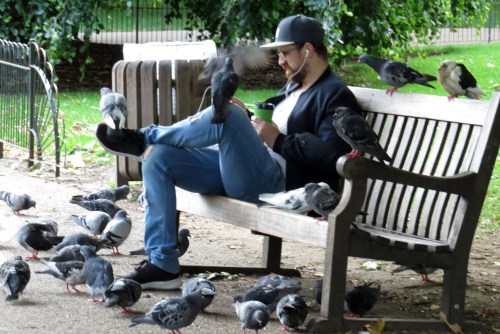
Many people think the only ‘wildlife’ in London parks are the pigeons but in fact a lot of wildlife lives there.

That said many of the wildfowl are introduced, if this female Smew had been seen on a reservoir in the east of the UK in winter it would unhesitatingly be treated as wild but in St Jame’s Park in July – no way.

The existence of free flying birds like this White-headed Duck (WHD) in ornamental collections confuses the true status of any potential vagrants to the UK. Before Ruddy Ducks escaped from captivity and became established in the UK, WHDs (away from collections) were very rare. The commoner Ruddy Ducks became the more vagrant WHDs were seen. Logic was that British Ruddy Ducks wintering in Spain were pairing up with WHDs and returning to the UK with them in tow. Of course it was this interbreeding with Spanish native WHDs that forced the UK authorities to eliminate the Ruddy Duck, but guess what once the UK Ruddy Ducks were gone then so were apparently wild WHDs as well. Clear evidence that those WHDs away from collections in parks etc were genuine vagrants from Spain.
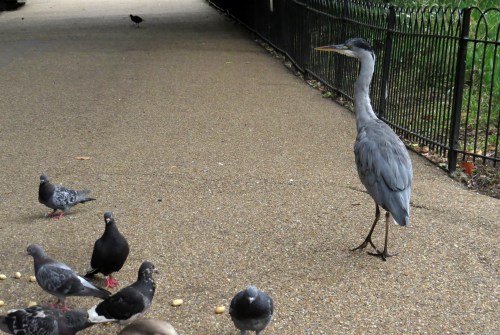
Whatever you think of the status of wildfowl, there is no doubt that this Grey Heron was wild even if it was walking around on well used public footpaths.
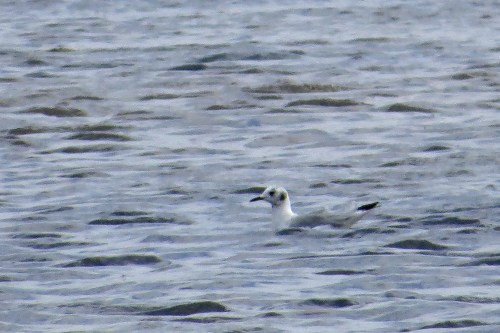
Although I continued my ‘New Year Resolution’ to go ringing or birding every day, July wasn’t a great time for rare birds. A few nice waders were seen at Lytchett Bay but a highlight of early August was this American Bonaparte’s Gull that pitched up on Brownsea Island. Bonaparte’s Gull was not named after Emperor Napoleon but after his ornithologist nephew Charles.
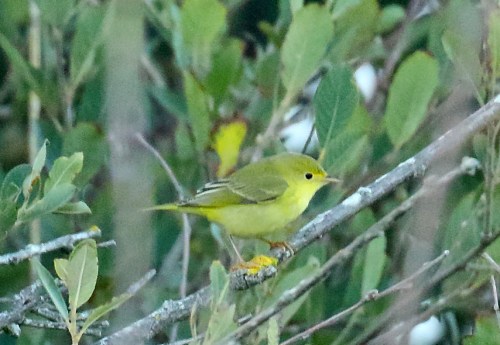
Several weeks later, on 22nd August to be precise, we had a most unexpected treat when an another American bird, a Yellow Warbler turned up on Portland. This is migrates relatively early in North America and so seldom gets caught up in the severe weather systems that propel migrant New World warblers all the way across the Atlantic. However the remnants of a hurricane reached the UK just the day before and was undoubtedly the reason why the lovely bird graced our shores. Photo by Chris Minvalla.
POST SCRIPT
Nothing to do with summer 2017 but yesterday (17/10/17), only minutes after I had returned from a very busy morning’s ringing at Durlston I heard that a warbler first seen two days ago at St Aldhelm’s Head had been identified as a Two-barred Warbler (formerly known as Two-barred Greenish Warbler). So it was an immediate turn round and a quick return to Purbeck, the site is just 4 miles west of Durlston. The weather by this time had deteriorated, but in spite of the rain I had nice views but got no photographs. I left about 4pm by which time less than 20 birders had seen the bird. Along with the Yellow Warbler above this was a new species for my British and of course Dorset, Lists. Fortunately for twitchers across the UK it remained overnight and was seen by hundreds today. Fortunately my ringing colleague Chris and his father Tony saw the bird well and Tony has given me permission to use his excellent photo.
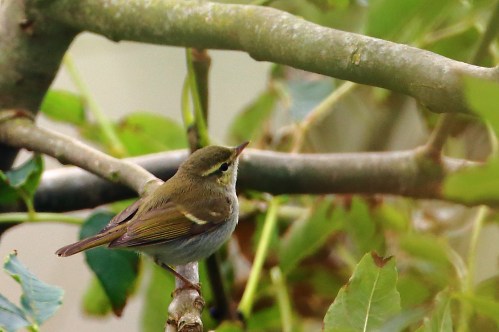
Two-barred (Greenish) Warbler – formerly treated as a race of Greenish Warbler, hence the inclusion of ‘greenish’ in its former name, breeds no closer than central Siberia from the upper Tungusta/Lower Yenisey rivers east to Sakhalin, northern China and North Korea. Although formerly lumped with the more westerly cousin it has been shown to act as a separate species in the area of overlap. This is about the 6th record for the UK but the first for Dorset. This ends a 30 year bugbear, I ignored reports of a ‘funny Yellow-browed Warbler’ on the island of Gugh, Scilly in 1987 only to find the day after I returned home that it was the UK’s first Two-barred! So it wasn’t just hurricane strength winds that occurred in mid-October 1987 and mid-October 2017. Photo by Tony Minvalla.
As in 2016 I haven’t posted much to my blog during the summer and early autumn.
As I mentioned earlier I have lost all my edited photos from the Caribbean trip so haven’t been able to upload any of those, I spent much of July and August ringing and September was spent on a wonderful tour of Western Australia.
With my ringing paperwork up to date I’ll now attempt to edit the thousands of outstanding photos (outstanding in the sense that I haven’t touched them rather than that they particularly good) that I have accumulated and get the blog up to date.
This post deals with a few non-birdy activities this summer (or rather should I say ‘less-birdy as birds creep in a bit) and the next with the more birdy ones.

In early July we went up to Derby to see my brother and his family and then from there on to Leeds. The purpose of the visit was to meet up with my old friend Nigel (left) whom I have known since school and Uni days. Another friend from University is Dave (right) who lives in County Durham and caught the train to Leeds to meet up with us.
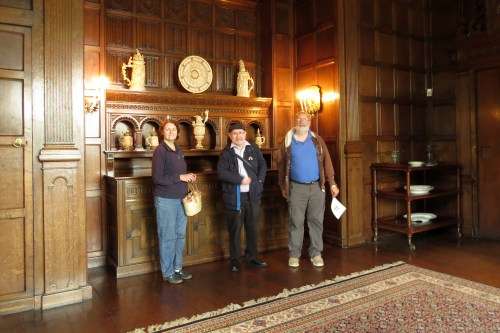
Nigel has a strong interest in art and as we all like a good stately home, we visited Temple Newsam House in Leeds which was quite near where I lived in 1976-78.

Temple Newsam is a Tudor-Jacobean house with grounds landscaped by Capability Brown. The estate was mentioned in the Doomsday Book, was once owned by the Knights Templar (hence the name), was seized by the crown and given as a present by Henry VIII to his niece Margaret. Today it is owned by Leeds City Council.

One of the most outstanding features of this grade 1 listed building is this highly decorative staircase.
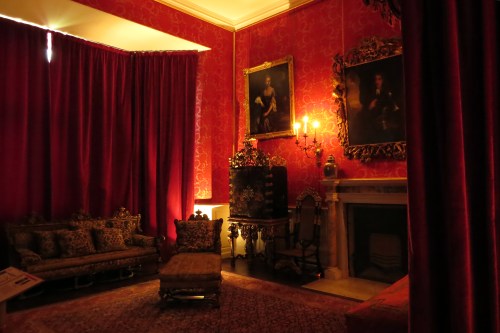
The ornate rooms, carefully shielded from the rays of the sun are what you would expect from a house of this antiquity.
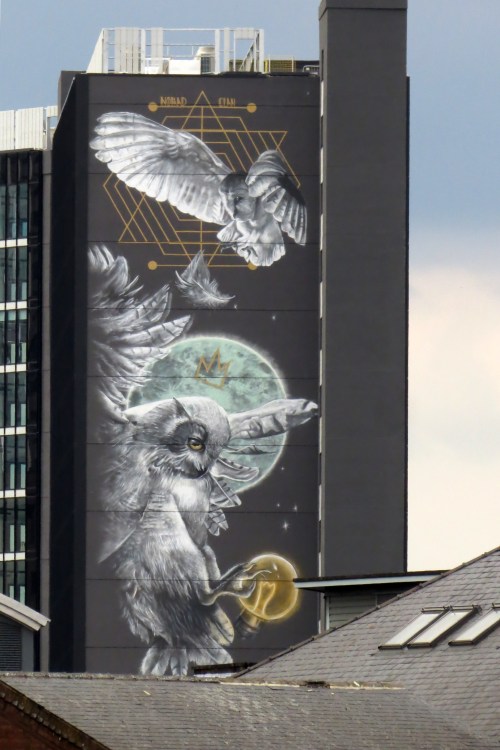
Later we all returned to Leeds for a spot of lunch. When I lived there in the 70s Leeds was a drab northern town (although still full of character). Today it is lively, modern and beautifully decorated (for example by these owls on the side of high-rise building).
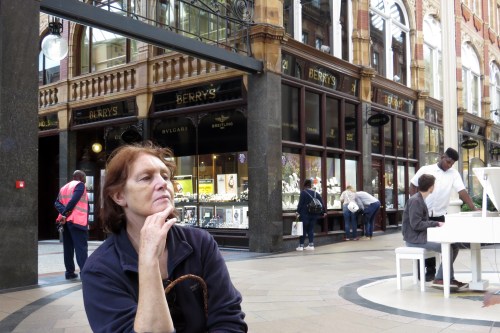
However the old arcades have been preserved and in many case improved.
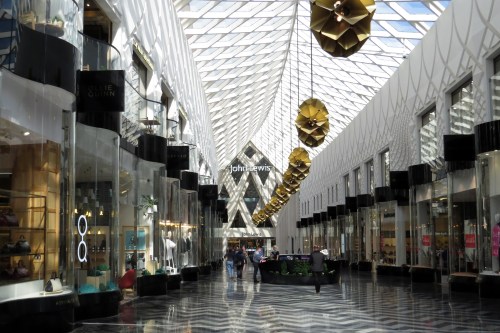
Dingy back streets have been covered over and turned into beautiful shopping malls. I lived in Leeds from late 69 to early 78 and am amazed at its transformation.
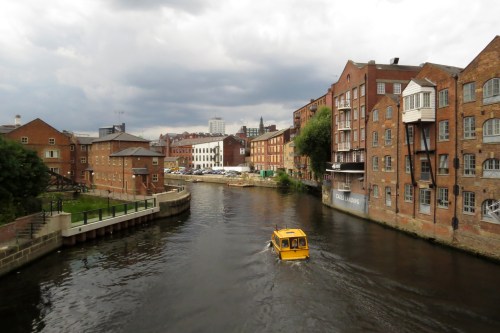
A particularly dingy area was along the banks of the River Aire but now decaying warehouses have been turned into luxury flats and pedestrian access along the old tow-paths allows for a pleasant stroll by the waterside.
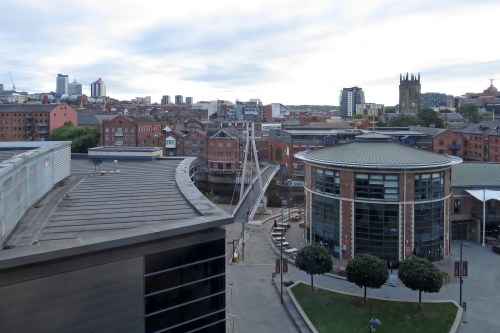
As with our last visit we stayed at a hotel just south of the river. The following morning we set off on a long drive to Essex. We stopped for a bit of birding in Cambridgeshire and then visited Margaret’s friends in Suffolk before arriving at her daughter Anita’s house in Maldon that evening.
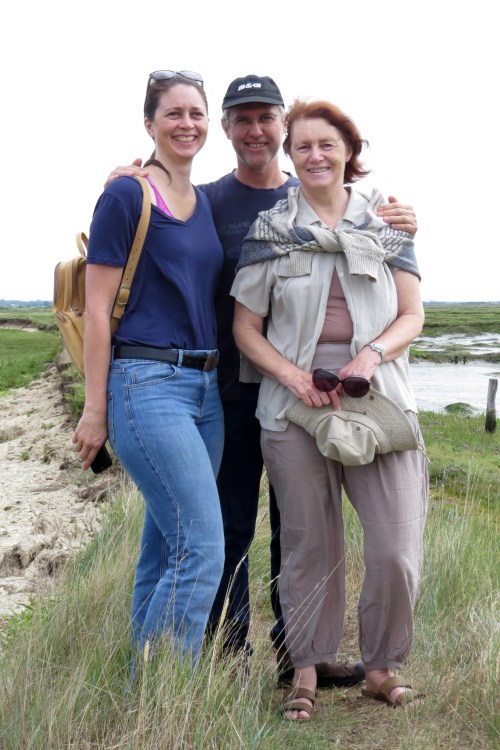
Anita, her husband John and Margaret on a coastal footpath in Essex.

At the park in Maldon is the statue of Byrthnoth, a Saxon Earl who rejected King Ethelred’s policy of appeasement towards the Vikings. He fought and was defeated by the Vikings at the Battle of Maldon in 991.

The only bird photo in this post! Along the shore there were many Black-tailed Godwits. Nearly all the UK’s Black-tailed Godwits breed in Iceland, a few non-breeding birds spend the summer in the UK and in July these are joined by the first of the returning birds. At this time many are in their resplendent brick-red and grey summer plumage.

John and Anita had some business to attend to near Southend, so we went with them and took a walk along the seafront. Off shore several large sailing barges could be seen. In the distance is the Kent coast on the south side of the Thames Estuary.

The tide was out exposing a huge expanse of intertidal mud. This is an important area for wading birds but in early July relatively few had returned from their breeding grounds.
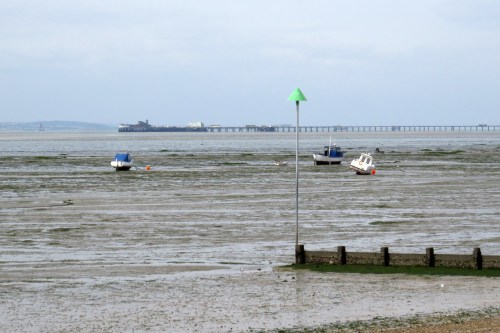
In the distance we could see Southend Pier, the longest pier in the world. On a previous visit we walked to the end of the pier and I posted photos of and from the pier on this blog.

Rows of beach huts, he stereotypical image of an English seaside resort.
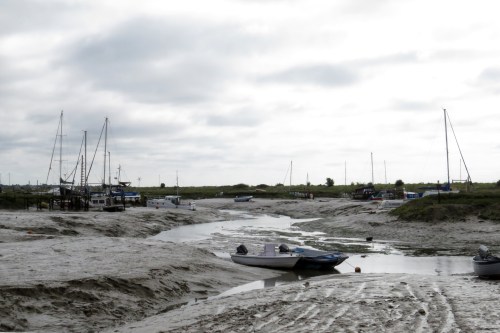
On another day we visited the area around Tollesbury, which lie to the north of Maldon on the Blackwater estuary. Unlike Suffolk and Norfolk to the north the Essex coastline is dissected by multiple estuaries. These have created a large area of saltmarsh (much of which has been converted into grazing pasture) but fortunately some remains, as seen here . I don’t like the phrase ‘reclaimed land’ as this indicates that farmland was once ‘lost’ giving farmers the right to ‘reclaim’ it, which is far from the truth.
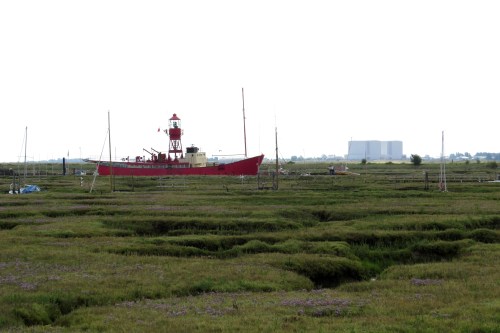
An old lightship and Bradwell power station (on the south shore of the Blackwater) are seen above the expanse of salt marsh.

The many creeks are enlivened by some pretty villages.

Two days after our return from Essex I undertook a far less successful trip, this time to western Cornwall. Earlier in the year news had broken of an Amur Falcon in Cornwall, but it disappeared long before I had a chance to go and see it. On 17th July it was rediscovered at St Buryan to the west of Penzance and was even seen to go to roost. Two of my friends joined me for the 200 mile overnight drive. We arrived about 0400 and waited from dawn until late morning at this vantage point but there was no sign of the falcon. This is the second time that this highly migratory east Asian raptor has been recorded in the UK It was a real shame that we dipped, partially because of the wasted effort but mainly because unlike the first UK record in the north-east it was in an easily identified plumage and had shown very well the day before. Also there was no ‘back-up’ rarities in the area to allow us to claw back some value from the twitch.

Later in July we had a day in London, Margaret needs to renew her South African passport and this required a trip to the South African consulate.
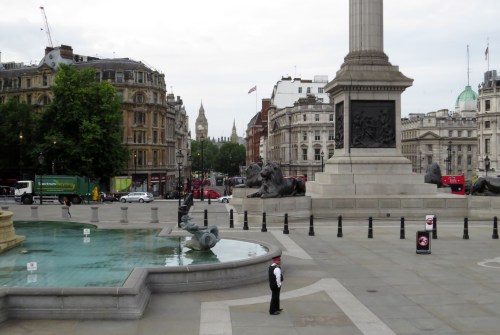
Situated near to Trafalgar Square this involved an early morning bus ride from Poole and a lot of queuing and form filling. Even now this simple matter is not fully resolved.
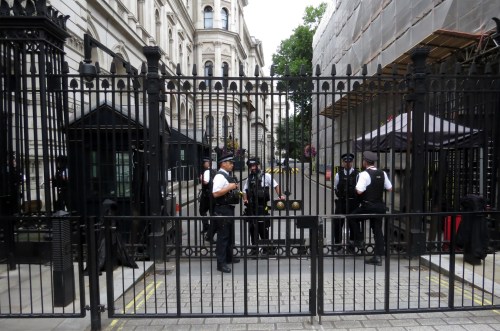
We later walked past the fortress that is Downing Street. On a visit to London as a child I remember you could walk up Downing Street and take a photo of Number 10, how things have changed.

We spent the afternoon in the impressive Victoria and Albert museum (usually known as the V&A).

Even the cafe is a historical exhibit in its own right ….
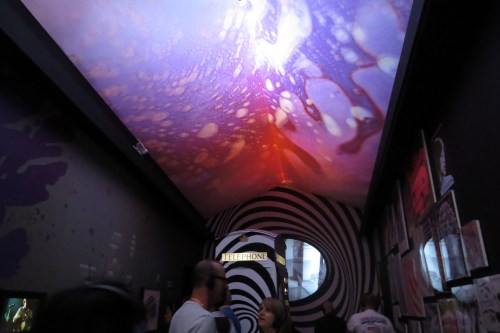
…. but the reason we had come was to see the Pink Floyd exhibition which charted the 50 year history of the band from its psychedelic beginnings ….

…. to the bitterness and remorse of ‘The Wall’ ….
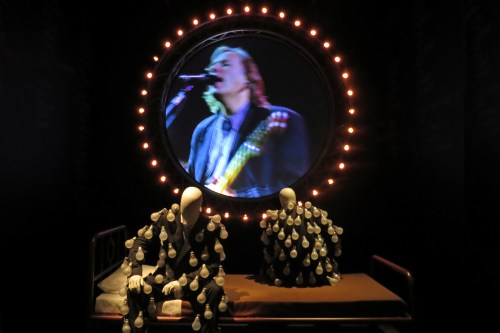
…. to the post Roger Waters period.

I first heard ‘Piper from the Gates of Dawn’ in 1967, saw Pink Floyd three times between 1970 and 1974 and have seen Pink Floyd tribute bands many times recently. I have all of their albums. I can honestly say that few bands have given me so much enjoyment or given me so much food for thought. In particular I have come to love the interplay between Waters’ acerbic lyrics and Gilmour’s angry guitar playing on ‘The ‘Wall and ‘The Final Cut’ albums. I never saw them perform ‘The Wall’ live and I will always regret that, but I’m glad I saw them when I did and delighted that 50 years on a three-month long exhibition about their timeline can draw tens of thousands of fans.

After the exhibition there was only an hour or so available to enjoy all of the other exhibits at the V&A. These beautiful medieval triptychs are but an example of the countless treasures in this wonderful museum. We must return and spend the whole day here.
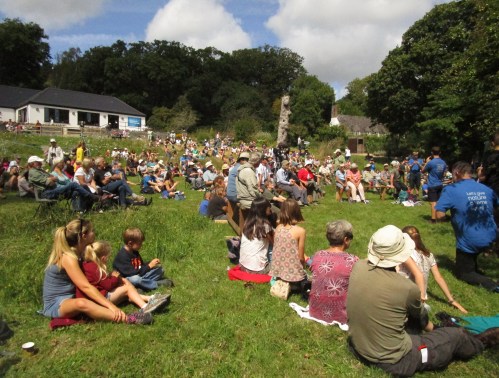
In early August, planned to coincide with the so-called ‘glorious twelfth’ I attended Hen Harrier Day at Arne RSPB. The purpose is clear, opposition to illegal killing of our birds of prey. Year after year shooting interests openly flaunt the law (and in most cases get away with it) and slaughter birds of prey just in to prevent them predating their precious game birds. This is most acute on moorlands where whole estates have been turned over to ‘Red Grouse factories’, with every predator exterminated, wet areas drained (so increasing erosion and flooding downstream) and birds even fed with medicated grit to avoid infections that result from overcrowding. The result is a hundred-fold increase in grouse numbers all to the detriment to all other species – just so people can blast the grouse out of the sky!
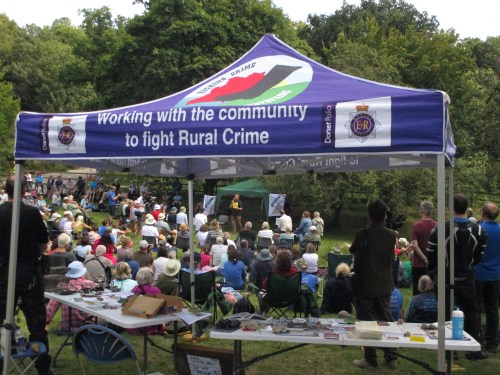
This raptor persecution is wholly against the law as the Police Wildlife Crime Officer reminded us, yet it still goes on seemingly unpunished. Although Peregrines, Goshawks, Buzzards and even Golden Eagles are targeted it is the beautiful Hen Harrier that comes off worse. Most years only 3 or 4 pairs in England raise young whilst enough habitat exists for 300 pairs.

Every year a few stalwarts like Chris Packham (above) and Mark Avery speak at Hen Harrier events but I’m beginning to think they are preaching to the converted and a new plan is needed to bring this iniquity to a wider audience. Over 100,000 people signed a petition to call for a ban on driven grouse shooting but the parliamentary committee that looked into it swept the facts under the carpet.

Our final trip away during the summer was our (almost) annual trip to the Bird Fair at Rutland Water. This time we went up to Derby prior to the Fair to see my brother and his family. As well as meeting up with many people who I know, the main aim of the visit was to look into getting a new telescope. In the event I didn’t buy one but at least I know which one I want.
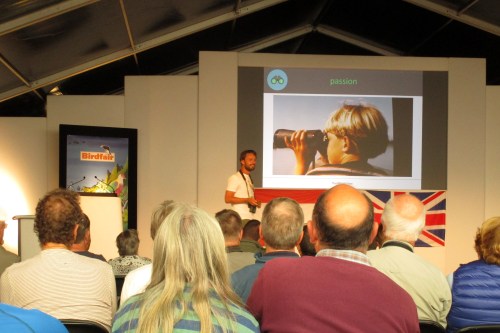
As well as visiting many of the stands and chatting to old friends we went to a number of talks. Perhaps the most interesting was from Dutch birder Arjan Dwarshuis who set a record for the most birds seen worldwide in a single year, an incredible 6,833 and gave an account of his non-stop race around the world.
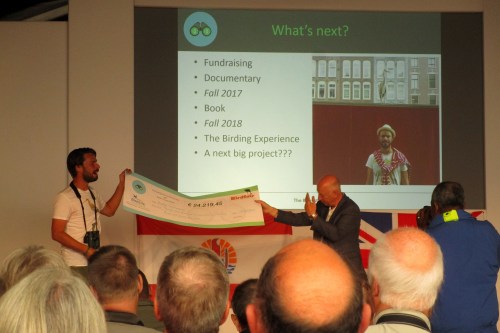
Arjan got a lot of sponsorship for his record-breaking and was able to present a cheque to BirdLife International’s preventing extinction program of (I think) 24,000 Euros.
 gryllosblog