This post covers five-day spent visiting my friend Patty Scott who lives in Wilton, Connecticut. During that time we did some birding or banding as it is known in the New World and a little birding.
I have recently completed a 23 day birding trip to Costa Rica. On the way back I broke the journey in the USA in order to see Patty. I have over two and a half thousand photos from Costa Rica to sort, edit and label so I thought I would post a few from Connecticut first.
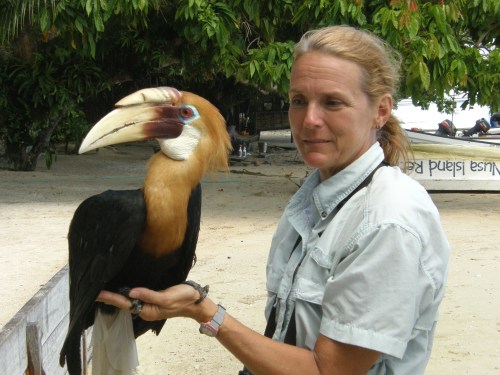
I first met Patty in 2012 when we both participated in a Birdquest trip to some of the remoter parts of Papua New Guinea. Sharing a number of interests, including ringing/banding birds we have made kept in touch since and Patty has visited me at least twice in the UK and we have also met up in New York and on the 2016 Birdquest reunion in Mallorca. Here Patty is holding a tame Blyth’s Hornbill in a PNG village.

Patty picked me up from the airport at Newark, NJ in the afternoon of the 23rd. We hit heavy traffic crossing the George Washington Bridge into Manhattan but once clear of New York we had an easy ride north to Wilton.
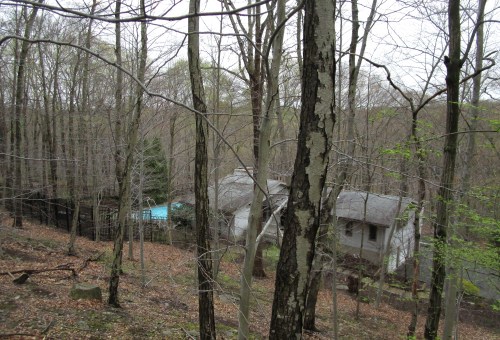
Patty has a beautiful house in dense woodland in Wilton. Even though Wilton lies some 600 miles or 9 degrees south of Dorset the season is about a month behind and the trees were only just beginning to come into leaf.

From the picture windows we could look over the pool to the woodland beyond were such goodies as Wild Turkey and Pileated Woodpecker occur. Patty has even seen a Black Bear from her house.

The feeders were topped up ….

…. and we sat on the deck and enjoyed the show.

By far the commonest bird in the garden was American Goldfinch with up to 15 on the feeders at any one time. There was a bewildering variety of plumages, with adult males and females in both winter and breeding dress and a fair few first year birds as well.
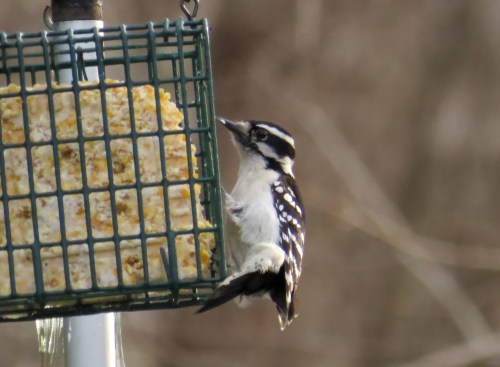
Downey Woodpeckers would appear to be the ecological equivalent of our Lesser Spotted Woodpecker but are about a thousand times commoner and far more approachable. At least two pairs, maybe more, were coming to the feeders.

When seen climbing a tree the name Red-bellied Woodpecker seems a complete misnomer as the red is not visible. Seen here at the feeder a red smudge on the belly can be made out (just).

Of course the main reason for visiting Connecticut in spring was to take part in some ringing (or banding). Whilst me ringing a few birds in the USA or Patty ringing a few in the UK won’t make much difference to our respective scientific programs, this sort of exchange of personnel improves a ringer’s knowledge and experience and can only benefit the ringing schemes in the long run. Patty bands at the Birdcraft Museum which is housed at the Fairfield Audubon Sanctuary near the coast some 30 minutes drive from Wilton.
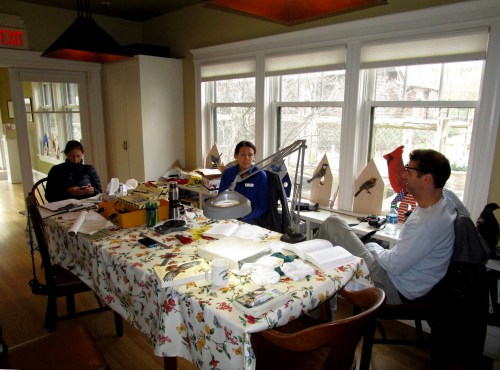
Where as we usually have to base ourselves around an outdoor picnic table when ringing, they have a comfortable ‘lab’ with heating and a coffee machine!

The sanctuary is in an urban setting with the I-95 running along side and is open to the public. Much of the reserve is taken up by a lake that has breeding Tree Swallows and Red-winged Blackbirds along its shores.

Unfortunately I arrived just a few days too early. The spring migration hadn’t really reached Connecticut and a huge blocking low pressure over the Carolinas meant that very few spring migrants arrived during my stay. Most of the birds handled, like this gorgeous Northern Cardinal (which has a very powerful bite) were retraps. In the USA, as at home, collecting data by retrapping already ringed birds is as important (if not more so) than ringing them in the first place. I was to handle eleven species during my stay, six of them newly ringed and five of them retraps. All but one, an American Robin, are illustrated in this post.

Another retrap was this Carolina Wren. Whilst we have only one species of wren in the entire Old World the New World has 87, with 10 in the USA alone

Our Eurasian Wren is one of the smallest of all the wrens so my reaction of ‘Wow, just look at the size of that!’ when I took the Carolina Wren out of the bag greatly amused the other ringers.

I haven’t seen a Cardinal or a Carolina Wren in the UK but I have seen a White-throated Sparrow, once in Lincolnshire on New Year’s Eve 1992. They are common in winter throughout much of eastern USA and breed mainly in NE USA and Canada.

New World Sparrows are not related to Old World ones like the familiar House Sparrow but are included in the family Emberizidae that contains the New World Sparrows, Brushfinches and the Old World Buntings (181 species in total). About 45 species of this family occur regularly in the USA, but few are as widely distributed as White-throated Sparrow.

A familiar bird through much of the New World is the House Wren, because it ‘does what it says on the tin’ and lives near human habitation.

A smart male Mourning Dove (named after its mournful vocalisations not the time of day it appears) was a surprise. Common to abundant in North America it is a very rare vagrant to Europe and one I have never seen in the UK.

A larger version of the familiar tits and chickadees, this Tufted Titmouse is essentially sedentary.

Of the four mornings I spent in Connecticut I was able to go ringing three times, the other day it rained and rain also cut short our second attempt. The last morning was by far the best, as we caught several new species including this handsome Blue Jay.

Although of a similar size to our Eurasian Jay, the bird was nowhere near as aggressive. Although the crow family overall originated in Australia and has a mainly Old World distribution, there are 39 species of jay in the New World compared to just 8 in the Old.

This Blue Jay can be aged as a second calendar year bird (age code 5) by the contrast between the blue greater coverts and the grey juvenile primary coverts.
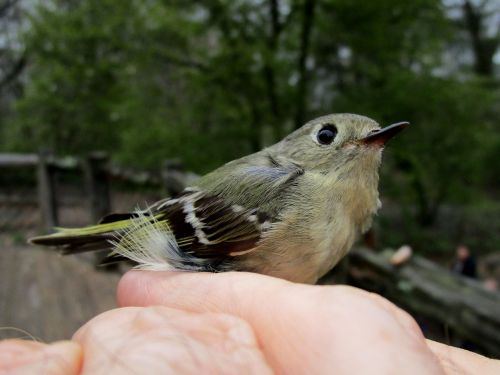
Another highlight of the final day was a Ruby-crowned Kinglet. This very small migrant in the same genus as our Goldcrest and Firecrest and from this angle looks not unlike our familiar ‘crests’ ….
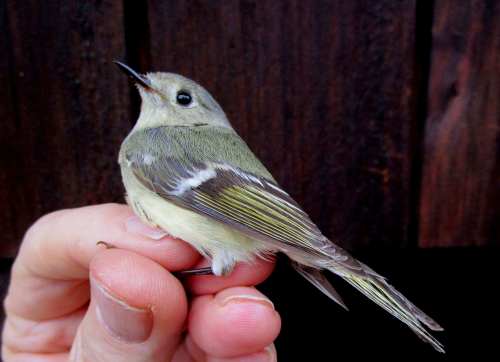
…. but side on it shows unexpectedly long wings and tail giving it more the appearance of a Phylloscopus warbler. The almond-shaped bare area around the eyes and the wing bars are reminiscent of some of the tyrannulets I’ve seen in the Neotropics.
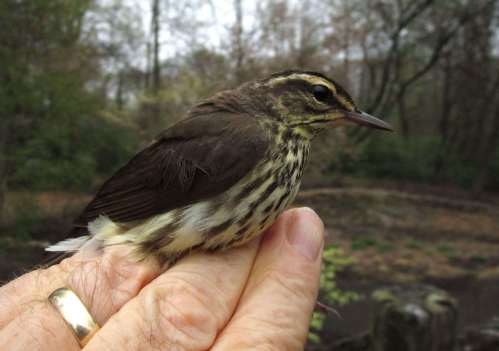
Of course what everyone wants to see in North America on spring migration are the New World warblers. Some come in a riot of colour, but even the plainer ones like this Northern Waterthrush are much sought after. Most of the eastern North American warblers have strayed across the Atlantic at some time or another and at least a dozen have occurred in the UK. I have even seen a Northern Waterthrush in Dorset

The similar Louisiana Waterthrush can be excluded by the leg colour, supercilium shape, flank colour, spots on the chin and markings on the undertail coverts.

The best bird of my trip to Connecticut was this gorgeous adult male Black and White Warbler.

We were able to do a bit of birding when ringing wasn’t possible. At Sherford Island we saw a flock of Brent Geese (or Brant as they are called in North America). Brent Geese are a regular wintering species in Poole Harbour but have just about all gone by the end of March. Our wintering birds are of the nominate race known as Dark-bellied Brent which breeds in NW Siberia but here the Pale-bellied Brent from the Canadian Arctic is found.
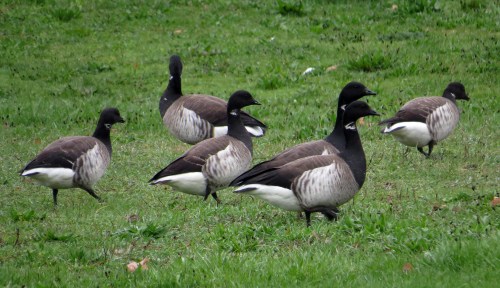
Some advocate splitting Brent Goose into three species, Dark-bellied, Pale-bellied and the east Siberian Black Brant, but the situation is more complicated, with at least two separate populations of Pale-bellied and the yet undescribed ‘Grey-bellied Brent’ needing to be taken into consideration.

Offshore we saw Long-tailed Ducks and Red-breasted Mergansers, birds typical of mid-winter at home not late April. That said, Great Northern Divers (above) can be seen in Dorset (usually flying past headlands on their way to breed in Iceland or Canada in early May). In North America this species is called Common Loon; surprisingly ‘loon’ predates ‘diver’ in British usage, originating from Old Norse lomr meaning to moan, a description of its evocative wail. This diver might be ‘greater’ than Black-throated or Red-throated, but its breeding range is more southerly! I’m ambivalent as to which name should be used, but when in North America I try to use their names (if I remember).
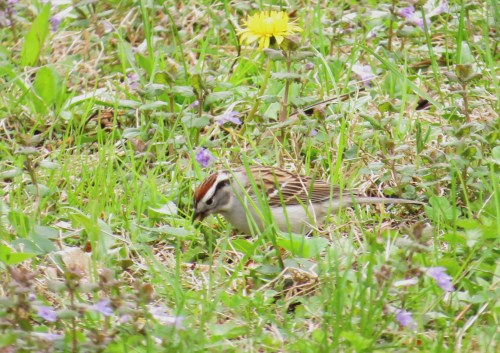
A walk around the fields and woods in Wilton brought a few more birds but the only one I managed to photograph in the dull and often wet conditions was this Chipping Sparrow.

Patty took me to some nice restaurants in Wilton, which unlike most fast food joints in the States served some excellent food. Instead of giving you a couple of mints or chocolates after you paid your bill, this one delivered a glass of candy floss instead.

Soon it was time for Patty to take me back over the Hudson and the George Washington Bridge to Newark airport for the overnight flight home. I arrived very jet lagged early on the 28th and was home by mid-morning. Many thanks to Patty for hospitality, good company and taking be ringing and birding, I hope to go back some time in the future, but this time at the peak of migration in mid-May.

POSTSCRIPT. No sooner had I got home then I was out again to Longham Lakes, a 20 minute drive away, where a first winter Bonaparte’s Gull had been recently found. Named after ornithologist Charles Bonaparte, nephew of Napoleon, this was one American bird that I didn’t see in America, having to wait until I was back home to connect. Superficially it is like a Black-headed Gull, but smaller with a black bill and a white underwing that does not highlight the white wedge in the outer primaries the way that the dusky underwing of a Black-headed Gull does. Although I have seen Bonaparte’s Gull occasionally in the south-west of the UK over the years, the last time I saw one in Dorset was in 1981! This photograph was taken by Paul Morton.









 gryllosblog