This post updates what I have been up to over the last couple of weeks since I returned from the Madagascar / Comoros.
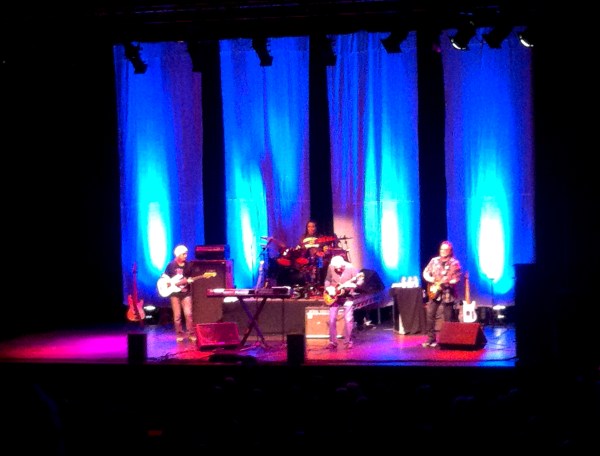
On the 23rd we went to see John Mayall’s Blues Breakers at Salisbury. This legendary blues player has played a pivotal role in the development of modern blues and rock music. Although he is now 80, he still plays harmonica, piano and guitar, although perhaps his keyboard skills aren’t what they used to be. The backing band, mainly from Chicago were excellent. I have enjoyed his music since I was at school. I last saw John Mayall in 1972 during an amazing week when we saw Led Zeppelin, The Rolling Stones and John Mayall at Leeds University during a eight day period. I forgot my camera so this blurry shot was taken on my phone.

The picture is from the cover of the classic 1965 album: L-R John Mayall, Eric Clapton, John McVie (later of Fleetwood Mac) and Hughie Flint. The album might be nearly 40 years old but its still one I play regularly today. The number of musicians who came to prominence by playing with John Mayall reads like at who-who of modern blues and rock: Eric Clapton (Cream), Peter Green (Fleetwood Mac), Jack Bruce (Cream), John McVie (Fleetwood Mac), Mick Fleetwood (Fleetwood Mac), Mick Taylor (The Rolling Stones), Don “Sugarcane” Harris (played with Frank Zappa), Harvey Mandel (Canned Heat), Larry Taylor (Canned Heat), Aynsley Dunbar, Hughie Flint, Jon Hiseman (Colosseum), Dick Heckstall-Smith (Colosseum), Andy Fraser (Free) and Johnny Almond just to name a few from the period 1965 – 1973

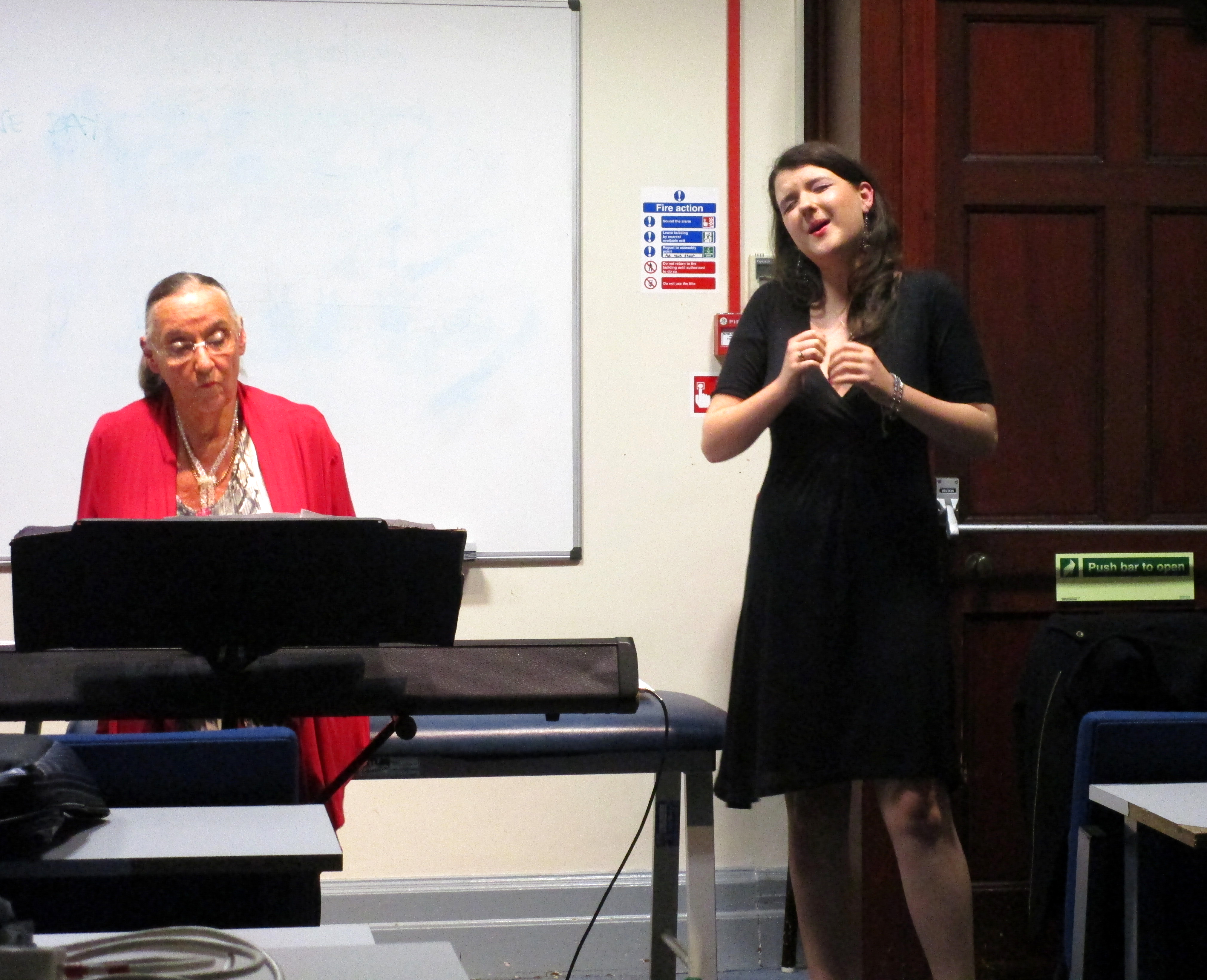
Now for something completely different. My friend Giovanni runs the Anglo-Italian Society. On the 28th they hosted a musical event where Patricia Bonelli (piano), Rachael Mathews (centre) and Elizabeth Senior (right) played and sang a history of Italian Opera. They performed many lovely songs and arias but i have to admit I had only heard of one piece and two composers before. Here Rachael and Elizabeth sing a piece by Rossini comprising entirely of the word ‘meow’.

What is really remarkable is that Rachael is only 17 and has had no formal training. The Anglo-Italian Society meets in the rather ancient Chiropractic College in Bournemouth. It seems strange listening to such lovely music in such a old fashioned and cluttered lecture theatre.

On the 2nd we went to Bournemouth’s Folk Club to hear Gigspanner, the new folk trio led by Peter Knight who has been the fiddle player for Steeleye Span for over 45 years. I first saw him play in Leeds in 1969 when the entrance fee was a mere 2 shillings (10p). Gigspanner have left behind the traditional folk jigs and reels and play some beautiful, thoughtful and highly entertaining music.

One morning whilst at Durlston I went down to Durlston Castle to see ‘Life, Light and Landscape’ an wildlife art exhibition by Bruce Pearson and Anne Shingleton. Here Bruce Pearson chats to Tasie Russell and Mo Constantine. Bruce and Anne were brought to our ringing station by one of the wardens earlier that day but unfortunately we had no birds to show them at that moment.

Of course 31st October brough ‘trick and treat’ and the local kids hit the street.

We are asked to do a number of public ringing demonstrations over the course of the year. This allows us to explain the purpose of our research and hopefully will convince the public to report any ringed bird that they might discover and show that that ringing can be carried out without harming the birds. Here Paul Morton is showing the public a Great Tit at the Arne Forage Festival on 25th October.

Know how to tell the age of a Blue Tit? Paul will explain.

We are still ringing at Durlston whenever the wind and rain allows it. Migration of grounded migrants has tailed off considerably but vis mig continue apace with large numbers of Woodpigeons, Goldfinches and Linnets overhead.
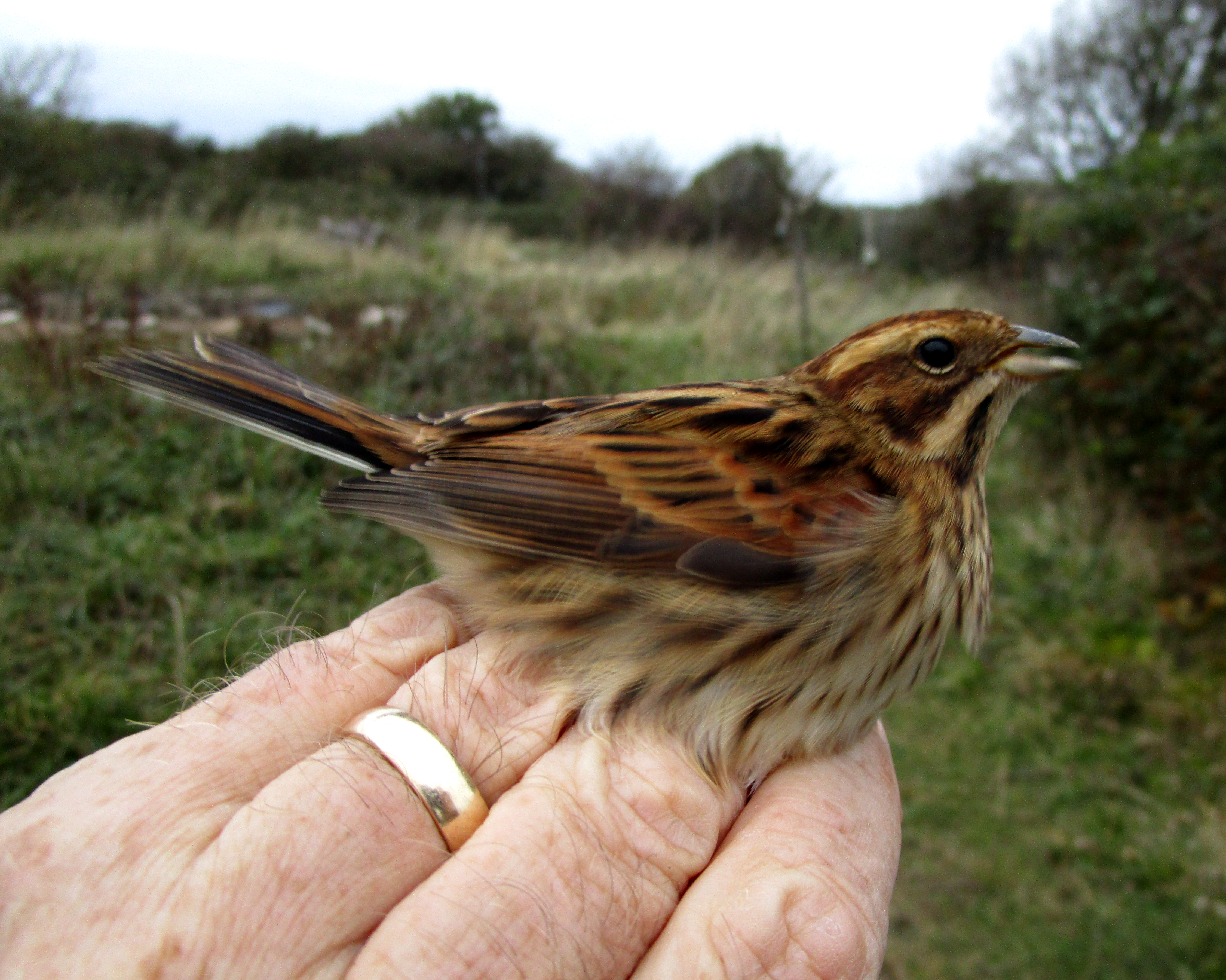
Common enough at Lytchett Bay, Reed Buntings are a bit of rarity at Durlston, at least in the hand.

This adult Linnet is much cleaner in appearance with well marked wings and tail and broad tail tips compared to a first-winter bird.
The mild conditions that persisted until recently haven’t been conducive to big thrush movements but we did trap this Redwing on 30th October.
I have been assisting with the training of ringers for many years but I haven’t had any trainees registered in my own name. However in the last few weeks I have taken on two trainees who are currently learning the basics of how to hold, measure, weigh and age birds in the hand.

Rik McCoy

Ginny Carvisiglia

Rik was lucky on only his third outings to ring a Firecrest ….
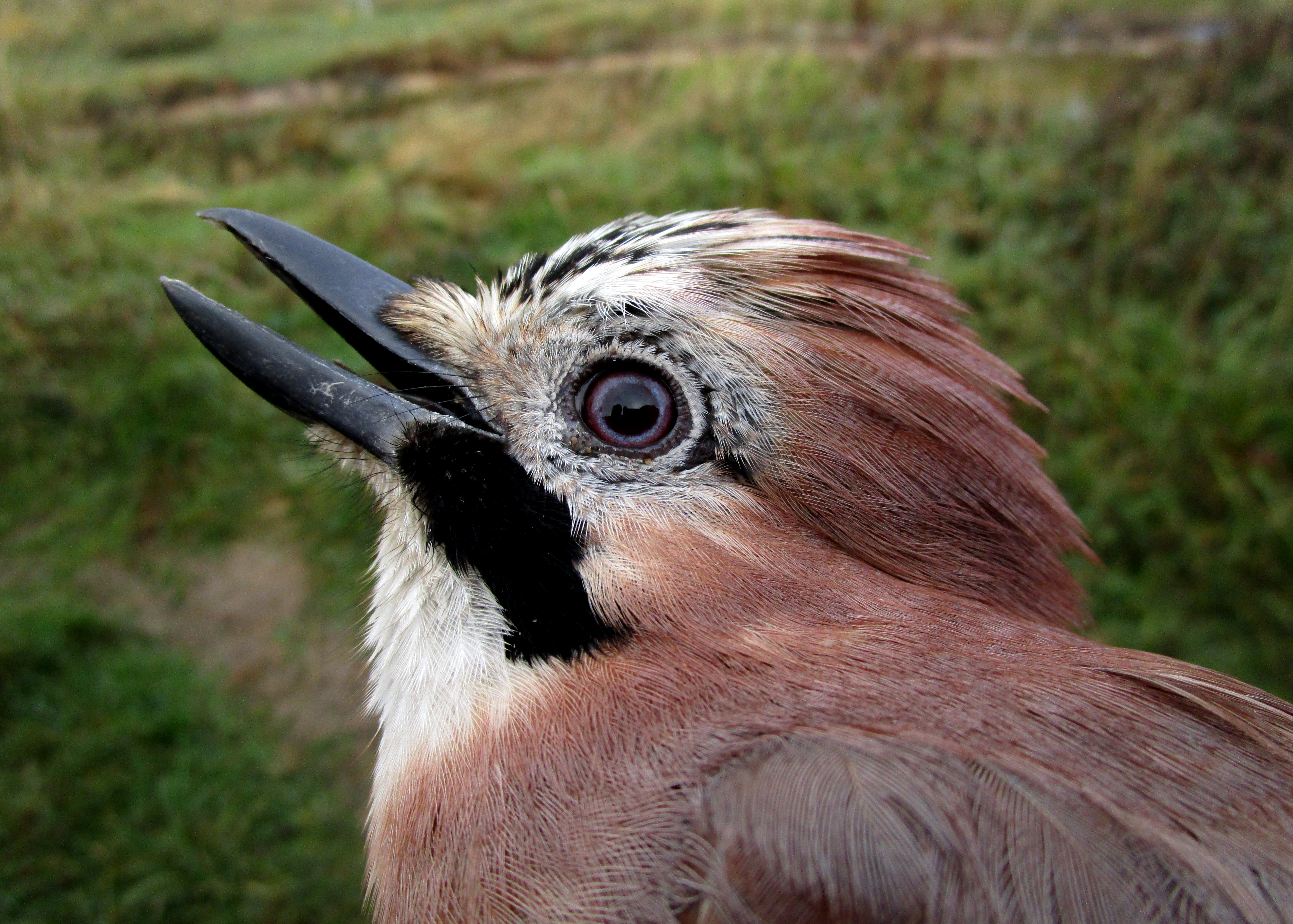
.. and this Jay, although great care had to given to make sure that the Jay didn’t sink its vicious bill into his fingers.

Whilst Ginny ringed the increasingly rare Marsh Tit at Holton Lee, a bird a lot of experienced ringers seldom see in the hand, at least in Dorset.

The glossy cap, lack of pale wing panel and less muscular neck all help separate Marsh Tit from Willow (which no longer occurs regularly in Dorset). However the best field characters undoubtedly are vocalisations.
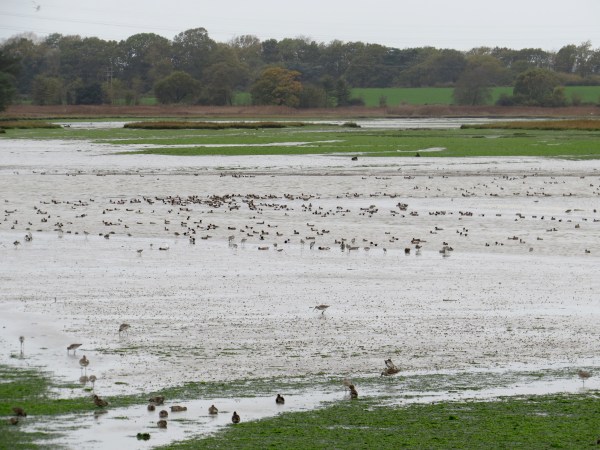
On the 2nd I did the monthly WeBS (wetland birds survey) count in Holes Bay. Numbers of common species have really built up in recent weeks with over 600 Wigeon in the NE sector of the Bay alone.

Holes Bay is one of the few places in Poole Harbour where Mute Swans congregate. it is not the most pleasant part of the Harbour to go birding, bounded as it is on two sides by dual carriageways and on one other by a railway line, but it does hold a lot of birds.
Attempts to make accurate counts were not helped by the Coastguards simulating a rescue of someone trapped in the mud!






 gryllosblog