The last post covered our trip as far as Rancho Naturalista on the Caribbean slope of the central mountain range. From here we joined the Pan-American highway and climbed back into the mountains at Cerro de la Muerta, literally ‘the road of death’ as many travellers, unaware of the cold condition that can occur at 3600m, died as they made their way to the central valley where San Jose is situated.
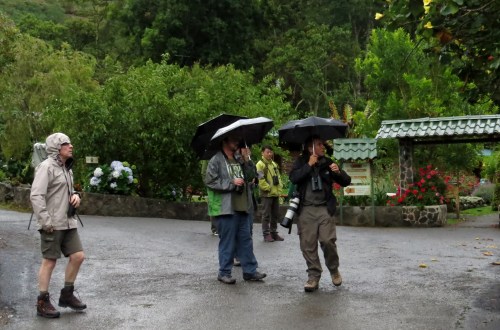
We arrived at Savegre Lodge on the mountain massif of Cerro de la Muerta on a very wet afternoon.

In spite of the rain and low light levels we still got to see birds like this Ruddy-capped Nightingale Thrush ….

…. and Flame-coloured Tanager (this is a female, only the males are the vivid orange that the name suggests) ….
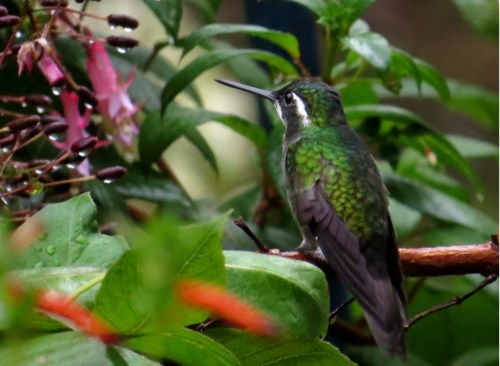
…. and Grey-tailed (or White-throated) Mountain-gem which was a life bird for me.

The following morning we searched for the elusive Spotted Wood Partridge, we were successful but my photos were useless. However we did chance upon this suitably named Resplendent Quetzal, one of the key birds of the Cerro de la Muerta area.

After breakfast we were taken by jeep to the forest above the lodge and slowly walked down via a network of trails. We found these Sulphur-winged Parakeets at their nest hole.
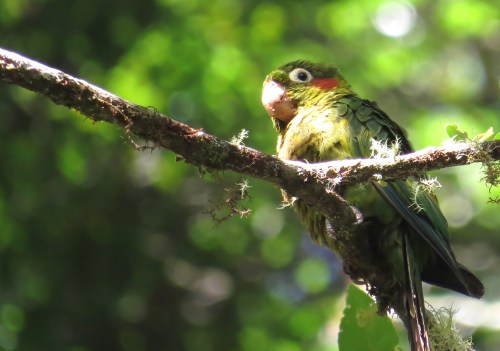
We also saw them perched nearby. The sulphur colouration is mainly visible on the spread wing.

Yellowish Flycatchers were relatively common. This is a resident member of the genus Empidonax aka ’empids’. The migratory species from North America are particularly difficult to identify and many get logged as just ’empid sp’.

A particularly cute warbler was the Collared Whitestart. When British settlers colonised in North America they found a bird with a reddish-orange tail and called it American Redstart after the European Redstart they were familiar with from home, in spite of the fact that they weren’t closely related. Later other tropical members of the same genus were name ‘xyz’ redstart. Of course redstart is derived from the Old English for tail steort (which is also the origin of the word ‘startle’) so these tropical warblers were named for red tails when their tails were largely white! Recently it has been proposed that their names are changed to the more appropriate ‘whitestart’ and I’m glad to say this is catching on.

Another montane speciality was Blue-throated Toucanet, a member of the ever shifting Emerald Toucanet complex.
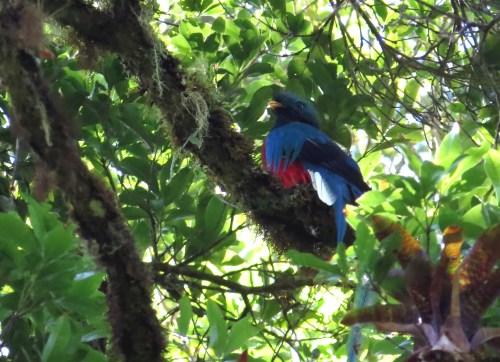
We also came across another male Resplendent Quetzal, this time the red belly was on show. None of the birds we saw had particularly long tails, whether they were all immatures or still growing their long plumes I don’t know, but this subspecies generally has a shorter tail than the one in southern Mexico.

But the best bird of the morning was the Wrenthrush also known as Zeledonia (a name I prefer as it neither a wren nor a thrush). Originally considered to be in its own family it was then moved to the New World Warblers, recent evidence has shown they were right in the first place and it really does deserve to be in its own family. Hardly surprisingly this was one of my top targets and I rated it number two bird of the trip. This skulking bird is hard to see let alone photograph and I have used this image taken by Juan Pablo Solano and the Asociación Ornitológica de Costa Rica. Our views today were brief but we had much better views the following day near Quetzal Lodge.

Back at the lodge, now in good light conditions there was time to search the flower beds and bird feeders for species like ….
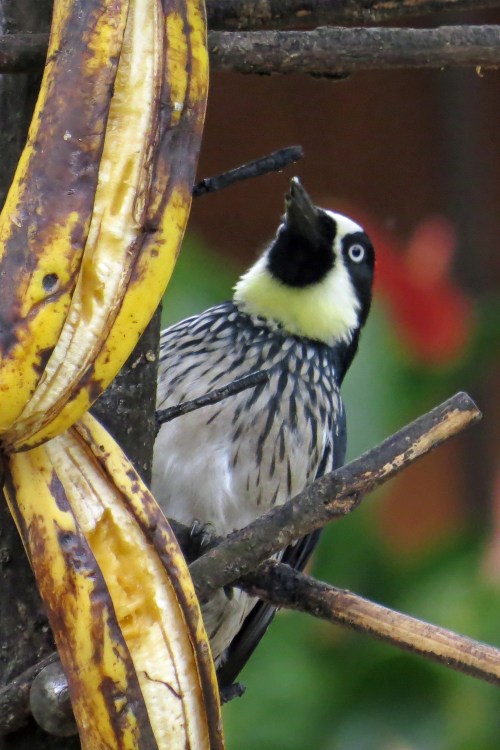
.. Acorn Woodpecker (this species stores acorns in holes drilled in a tree trunk) ..
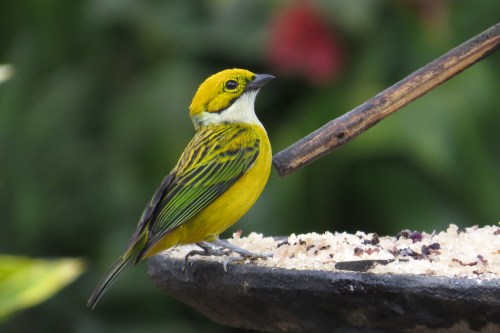
…. the beautiful Silver-throated Tanager ….
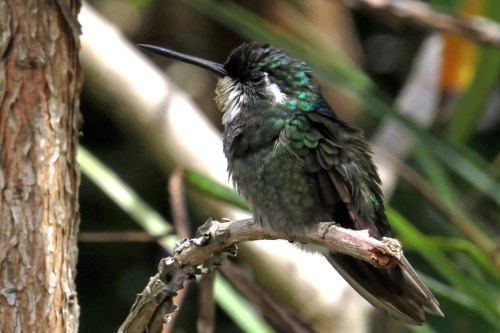
…. and more views of Grey-tailed Mountain-gem.
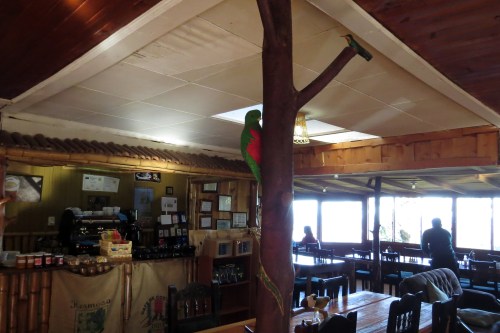
Later we transferred to the Quetzal Lodge which is just off the Pan American Highway at an altitude of 3265m asl. On the balcony just outside the windows is a set of hummingbird feeders.
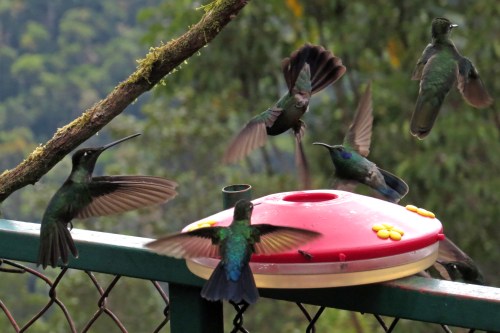
As usual the hummers were completely oblivious to onlookers and you could stand nearby and admire or photograph them for as long as you liked. Most are Lesser Violetears (formerly Green Violetear) but the one on the left is an Admirable Hummer.

Here three out of the four are Admirable Hummers. At this angle the right hand bird shows the ‘admirable’ colours of the head and throat well. Colours on hummers are produced by refraction and are only seen from a certain angles. Thus a field guide may show a kaleidoscope of colour but all cannot be seen at once, as you cannot view the bird from all angles at once.
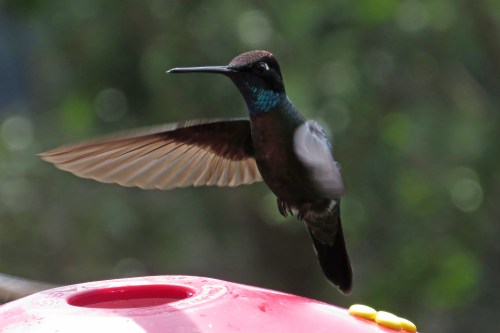
Formerly known as Magnificent Hummer, the species has been recently split into two; Rivoli’s in Mexico and southernmost USA and Admirable further south. There is a convention, mainly applied in the New World, that if a species is split then all the ‘daughter’ species get a new English name, so you can tell whether an English name has been applied pre or post split. That said, it means yet more names to learn and more potential confusion for the unwary.

The other common hummer at the feeders was the pretty Fiery-throated Hummingbird, which lived up to it name.

The afternoon and much of the following morning was spent walking side roads through some excellent montane forest. It was quite cold overnight and in the early morning.
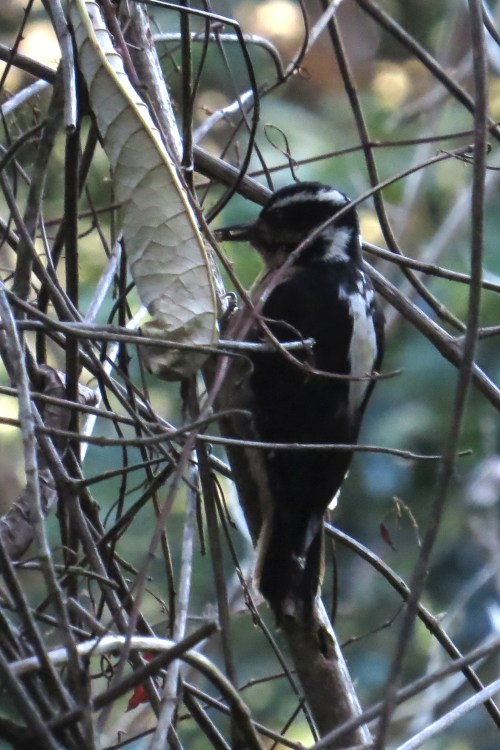
A chilly pre-breakfast walk produced Hairy Woodpecker, a widespread North American species whose breeding range extends from Alaska to Costa Rica and western Panama ….

…. the rare and initially confusing Ochraceous Pewee ….
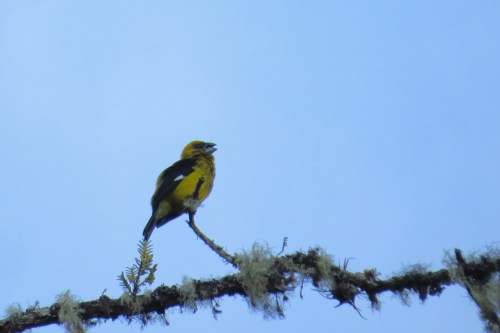
…. and Black-thighed Grosbeak, confined to the mountains of Costa Rica and western Panama.

As you can see the weather gods were kind to us. Of the many birds we saw one of the best was the Long-tailed Silky Flycatcher ….

…. a member of an unusual family comprising just four species most closely related to the Waxwings.

The Empids were with us again, this time another resident species, Black-capped Flycatcher.

We had been having very little luck owling. The first morning of the trip had been a complete failure and the night at Quetzal Lodge had produced good views of Dusky Nightjar, but no owls what so ever in spite of hours of searching. So it was a great relief when we came across the diurnal Costa Rican Pygmy Owl.

Before we left this mountain massif we stopped at the highest point where the forest gives way to paramo. Our target was the rare and irruptive Peg-billed Finch which we failed to find (although the lookalike Slaty Flowerpiercer caused a false alarm) ….

…. but we did get excellent views of the high altitude Volcano Junco.
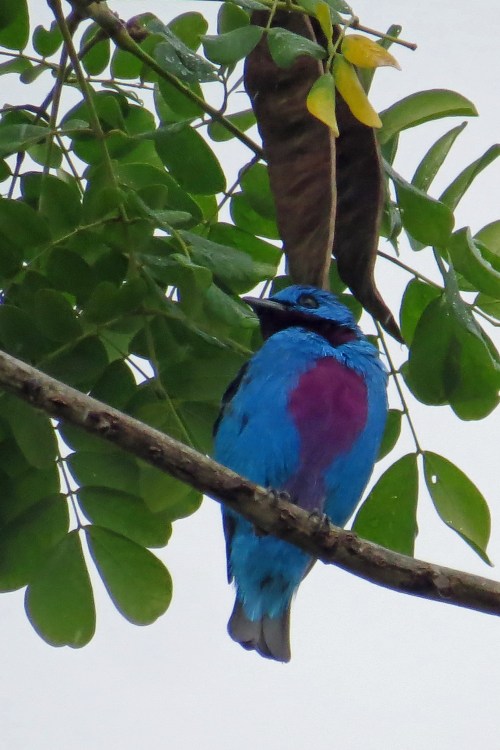
Leaving the cool (and now rather wet) highlands behind we dropped down to the steamy Pacific slope lowlands and the town of San Isidro. On route we stopped at a location where the beautiful and declining Turquoise Cotinga can be found.

Nearby in a stand of flowering eucalyptus we strained to see several diminutive hummers at the very tops of the tall trees.
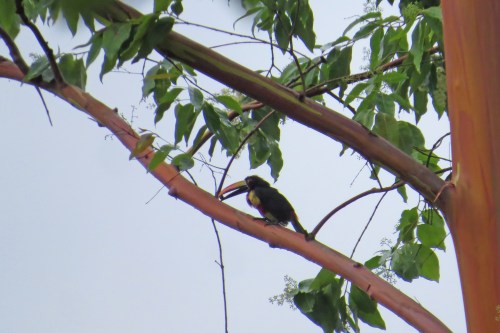
Rather more visible was this Fiery-billed Aracari.
We overnighted near San Isidro and over the next few days explored a number of locations in the south-western corner of the country. This will be the subject of the next post.
Forty years ago today I picked up my very own binoculars for the first time, saw a bird I didn’t immediately recognise and looked it up in my very own field guide for the first time and wrote a note of it in my very own birding note-book for the first time.
I had made the transition from being merely interested in birds to being a birder.
It was one of the best decisions in my life and I never looked back. Around 8200 species worldwide and 500 the UK, about 130 foreign trips looking for birds and countless hours in Britain and a very large part of my income later, I can honestly say that I’ve never regretted it.
Sure I’ve regretted individual decisions, but that has usually been because I’ve missed a (the) bird(s) but I’ve never regretted taking up birding. It has made me what I am and glad I’m I stuck with it and committed so much of my time and money to it.
Perhaps the only regret is that I didn’t start earlier so that I would now be celebrating 50 or even 60 years of birding.
I’d like to do an full blog post on my early birding history but I’m trying to get all my Costa Rica photos sorted and uploaded before my next birding trip in June and haven’t really got the time.
So here is a photo the species that I saw in my back garden in Leeds on 20/05/77 – one that any birder in Europe will be very familiar with, but one that a non-birder could easily dismiss as a sparrow.
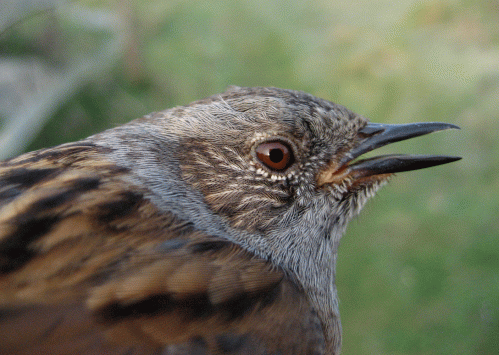
Dunnock
This post is the first of several covering my recent trip to Costa Rica. Marketed by Birdquest as the ‘Ultimate Costa Rica tour’ it lived up to its name as I saw all but a handful of the life-birds that occur in this bird-rich country.
In 1981 I had made arrangements to visit the Middle East in late March but just a month or so before I found that the trip had been cancelled. With the leave already booked I looked around for an alternative. I found a tour to Costa Rica that went on the same dates, a little more expensive, but I raised the money by selling some of my photography gear. I didn’t even know where Costa Rica was, I had to look it up in the atlas, but that tour changed my life and opened my eyes to the wonders of tropical birding and as soon as I was earning enough to do so I went to the tropics every year.
With a previous visit to the country, three tours of Mexico and two each to Venezuela and Colombia you would think that I wouldn’t get many life birds on a return visit. However birding in the country has developed so well in the past 36 years that nearly all of the ‘goodies’ are staked out and I saw an astonishing 87 lifers. In fact Costa Rica, a tiny country little bigger than Ireland, has the best ecotourism industry in the world and is leader in the use of sustainable energy and resources. (as well as having the biggest bird list for any country of its size).
It was a highly enjoyable trip and I intend to share some of my many photos on the blog over the next few weeks.

I arrived in the capital San Jose just before midnight on 30th March and transferred to the hotel getting to bed by 0200. I spent much of the morning birding in the extensive gardens.

There were plenty of birds typical of the Central Valley in the gardens, such as these Rufous-backed Wrens.

The ubiquitous Tropical Flycatcher ….
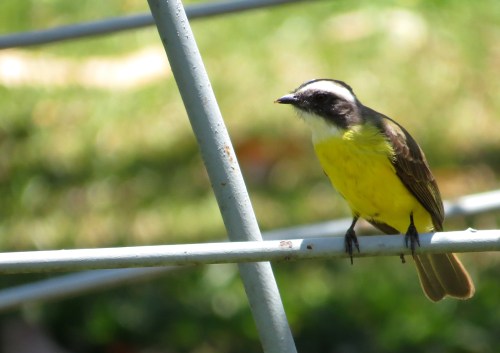
…. Social Flycatcher ….

…. and Great Kiskadee.
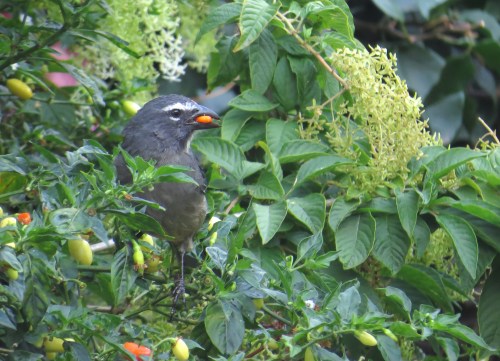
Along with Greyish Saltator ….

…. and the beautiful and much scarcer Lesson’s Motmot.
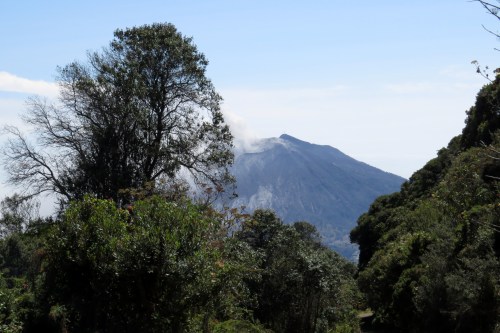
The group gathered in the evening but had an early night as it was a 0300 departure the next day for the slopes of Irazu Volcano. Once there we had about an hour pre-dawn to try for nightbirds which proved to be most unsuccessful with nothing but a distant song of Dusky Nightjar to show for our efforts. However once it was light we had great views of ….
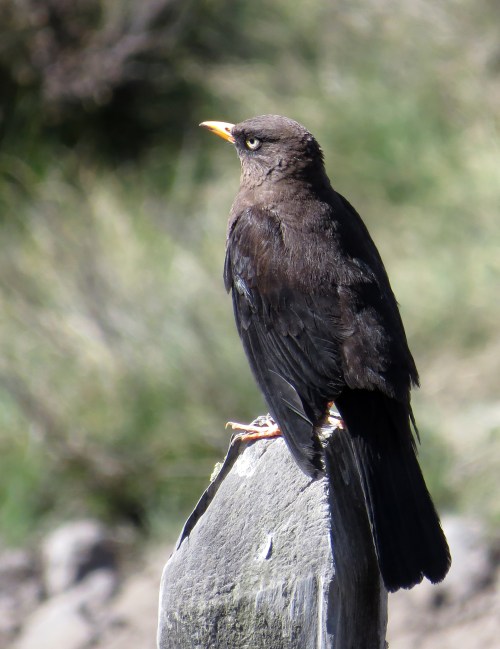
…. Sooty Thrush ….

… the perky Sooty-capped Chlorospingus (formerly Sooty-capped Bush-tanager) ….

…. and my first life bird of the trip – the exquisite Flame-throated Warbler.

The range of this beautiful bird is restricted to the mountains of central Costa Rica and Western Panama.
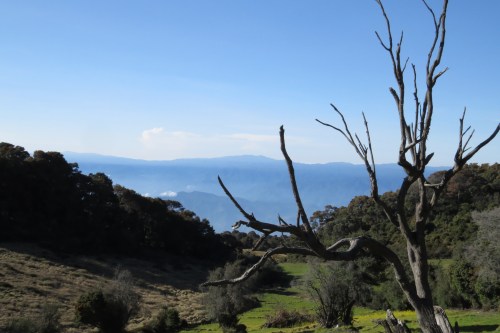
A hike down this slope failed to get us views of the rare and seldom seen Buffy-crowned Wood Partridge, but we continued to score with other montane goodies. We reached an altitude of 3600m that morning, it was cold at dawn but soon warmed up. Later we commenced our descent into the eastern flanks of the central mountain chain.

A short detour gave us wonderful views of Cabanis’s Ground Sparrow, a recent split from Mexico’s Prevost’s Ground Sparrow, but time was short and we couldn’t linger.

I keep wanting to call this beautiful bird Cannabis Ground Sparrow, but of course it is named after German ornithologist Jean Louis Cabanis and not some entry-level recreational drug.

The reason for our leader’s haste soon became clear, we arrived at our next destination, the pleasant Rancho Naturalista with about an hour of daylight remaining. We hurried to a lookout above some pools where a series of hummingbirds, including the exquisite (a word that I am in danger of over-using in this post) Snowcap. Of course in the gathering gloom I couldn’t get photos of rapidly moving hummers but I did capture a bathing Tawny-throated Leaftosser – a bird that is likely to be split in multiple species in the near future.
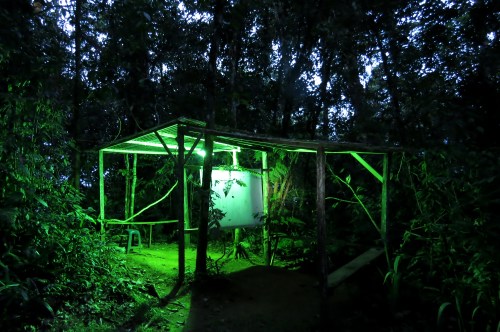
The following morning just before before dawn we had a look at the moth trap.
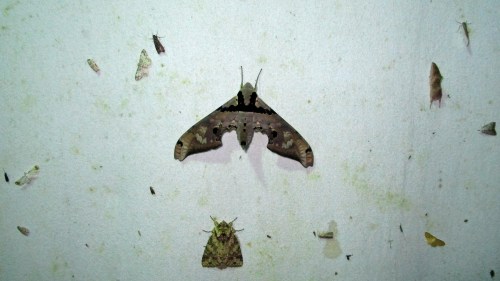
A stunning array of moths had been drawn to the light, including this huge hawk-moth in the centre of the photo.
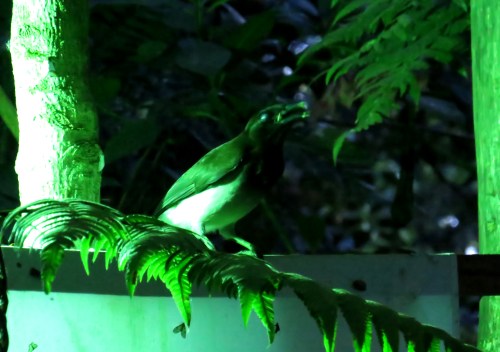
Even whilst it was dark birds such as this Brown Jay (looking green not brown as the trap’s UV light has tinted my photos) came in snatch moths from the sheet.

This might have been rather unfortunate for the moths but it allowed us to see a range of species including the rare Tawny-chested Flycatcher.

Our time at Rancho Naturalista was all too short and after several hours on the trails and several life birds later we were on our way again. We paused on route for the tricky White-throated Flycatcher (my photos of this ’empid’ were rather poor) and the above Grey-crowned Yellowthroat in an area of rank grassland.

Now away from the high mountains and at mid altitude on the Caribbean slope we saw a number common open country birds such as this Groove-billed Ani ….

…. and the ubiquitous and rather ugly Turkey Vulture.
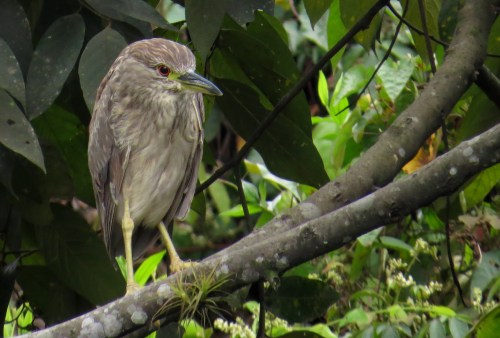
At a nearby river bed the first bird we laid eyes on was this immature Black-crowned Night Heron, but this wasn’t the reason for our visit.
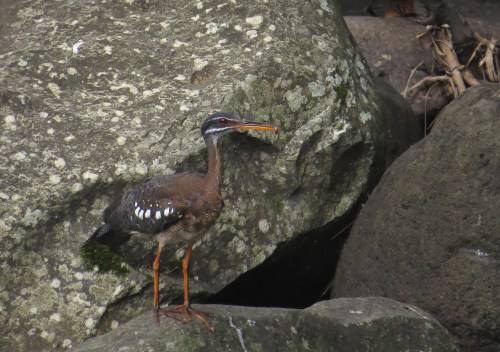
Our local man had a pair of the wonderful Sunbittern staked out. Although I have seen this species on five previous trips, I don’t think I’ve ever seen it so well or for so long.

The reason they were sticking around was that they had a nest with two well-grown young overhanging the river.

Also along the river were several Black Phoebes ….

One of the Sunbitterns seemed to take exception to the Phoebes occupying its bit of the river and opened its wings in a threat display. Pete, our tour leader, was better positioned to capture this moment and has an absolutely stunning photo of this event. If I can get a copy and with his consent I’ll post it here in due course.
From here we climbed back up the mountainous ridge that forms the backbone of Costa Rica and in deteriorating weather conditions headed for Cerro de la Muerta, literally the ‘road of death’. This will be the subject of the next post (when I’ve edited the photos that is).
This short post covers a Bob Dylan concert that Margaret and I attended in Bournemouth on May 4th.
 Of all of the famous artists of the 60’s there few who have had a greater impact on modern music than Bob Dylan. His amazing songs with their wonderful lyrics were the soundtrack to my youth. Having said that after Nashville Skyline in 1969 I didn’t actively follow Dylan’s career. Although I have obtained a number of his later albums, if I wish to listen to Dylan I always turn to Nashville Skyline, Blonde on Blonde, one of the many ‘Best Of’ albums or to my favourite – Highway 61 Revisited.
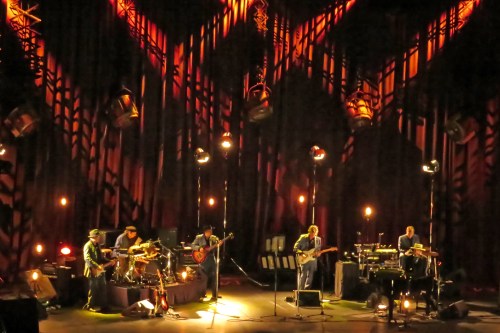
I have always wanted to see Bob Dylan in concert. I wanted to go the 1971 Isle of Wight festival but was working at the time and couldn’t go. Several work colleagues saw him in Bournemouth in 2006 but I was away when tickets went on sale and they had sold out when I returned, so when I heard that he was playing in Bournemouth again this May we jumped at the chance.

Unfortunately by the time we got tickets only one from the back of the upper terrace were available. From this distance it was hard to even make out which one was Dylan, especially as he was seated at the piano for much of the time and his features were hidden by a wide-brimmed hat. Fortunately I had brought my camera and took some (not especially sharp) telephoto shots.
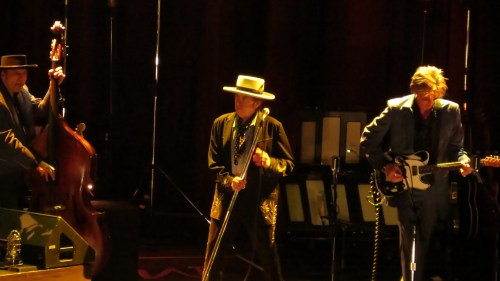
So what of the performance itself? Dylan never played the guitar or harmonica, never even spoke to the audience, introduced a number or the band or even said farewell. Most of his lyrics couldn’t be heard and apart from some covers of songs by Sinatra, I only recognised three numbers (although that’s my fault for not getting to know his post 1970 work better) ….

…. that said, the band were awesome and played very well and it was great to see a true musical legend ….
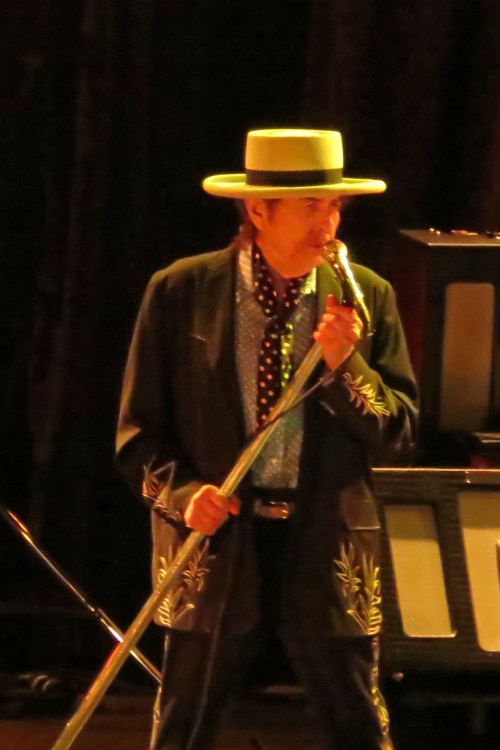
…. but perhaps it would have been better if I had seen him in 1971.
By the way this post is my 500th since I started the blog on my retirement in June 2011.
This post covers five-day spent visiting my friend Patty Scott who lives in Wilton, Connecticut. During that time we did some birding or banding as it is known in the New World and a little birding.
I have recently completed a 23 day birding trip to Costa Rica. On the way back I broke the journey in the USA in order to see Patty. I have over two and a half thousand photos from Costa Rica to sort, edit and label so I thought I would post a few from Connecticut first.
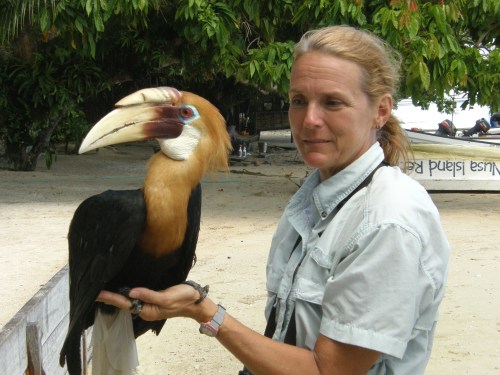
I first met Patty in 2012 when we both participated in a Birdquest trip to some of the remoter parts of Papua New Guinea. Sharing a number of interests, including ringing/banding birds we have made kept in touch since and Patty has visited me at least twice in the UK and we have also met up in New York and on the 2016 Birdquest reunion in Mallorca. Here Patty is holding a tame Blyth’s Hornbill in a PNG village.
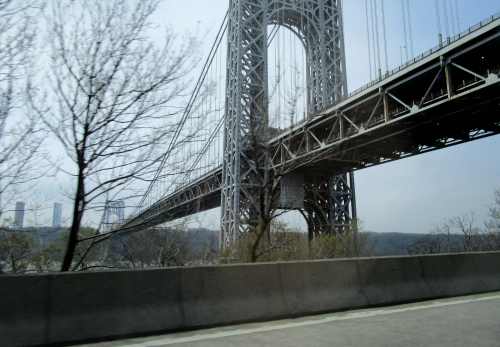
Patty picked me up from the airport at Newark, NJ in the afternoon of the 23rd. We hit heavy traffic crossing the George Washington Bridge into Manhattan but once clear of New York we had an easy ride north to Wilton.
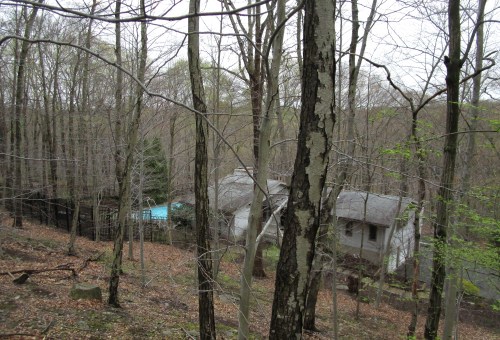
Patty has a beautiful house in dense woodland in Wilton. Even though Wilton lies some 600 miles or 9 degrees south of Dorset the season is about a month behind and the trees were only just beginning to come into leaf.
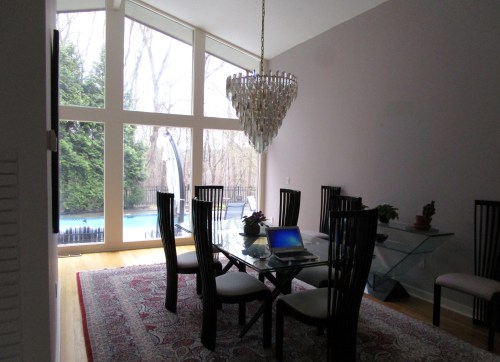
From the picture windows we could look over the pool to the woodland beyond were such goodies as Wild Turkey and Pileated Woodpecker occur. Patty has even seen a Black Bear from her house.

The feeders were topped up ….

…. and we sat on the deck and enjoyed the show.

By far the commonest bird in the garden was American Goldfinch with up to 15 on the feeders at any one time. There was a bewildering variety of plumages, with adult males and females in both winter and breeding dress and a fair few first year birds as well.
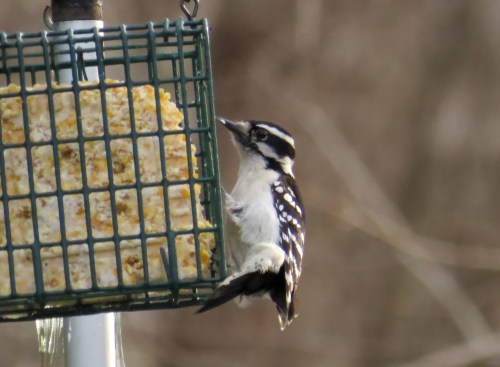
Downey Woodpeckers would appear to be the ecological equivalent of our Lesser Spotted Woodpecker but are about a thousand times commoner and far more approachable. At least two pairs, maybe more, were coming to the feeders.

When seen climbing a tree the name Red-bellied Woodpecker seems a complete misnomer as the red is not visible. Seen here at the feeder a red smudge on the belly can be made out (just).

Of course the main reason for visiting Connecticut in spring was to take part in some ringing (or banding). Whilst me ringing a few birds in the USA or Patty ringing a few in the UK won’t make much difference to our respective scientific programs, this sort of exchange of personnel improves a ringer’s knowledge and experience and can only benefit the ringing schemes in the long run. Patty bands at the Birdcraft Museum which is housed at the Fairfield Audubon Sanctuary near the coast some 30 minutes drive from Wilton.
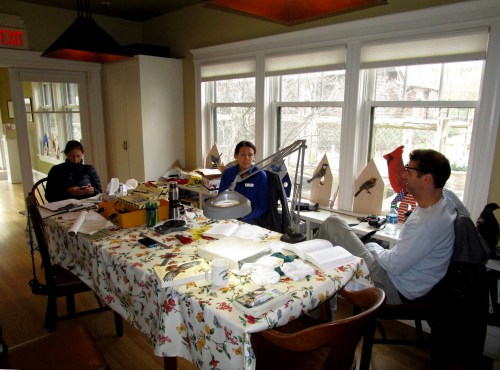
Where as we usually have to base ourselves around an outdoor picnic table when ringing, they have a comfortable ‘lab’ with heating and a coffee machine!

The sanctuary is in an urban setting with the I-95 running along side and is open to the public. Much of the reserve is taken up by a lake that has breeding Tree Swallows and Red-winged Blackbirds along its shores.

Unfortunately I arrived just a few days too early. The spring migration hadn’t really reached Connecticut and a huge blocking low pressure over the Carolinas meant that very few spring migrants arrived during my stay. Most of the birds handled, like this gorgeous Northern Cardinal (which has a very powerful bite) were retraps. In the USA, as at home, collecting data by retrapping already ringed birds is as important (if not more so) than ringing them in the first place. I was to handle eleven species during my stay, six of them newly ringed and five of them retraps. All but one, an American Robin, are illustrated in this post.

Another retrap was this Carolina Wren. Whilst we have only one species of wren in the entire Old World the New World has 87, with 10 in the USA alone

Our Eurasian Wren is one of the smallest of all the wrens so my reaction of ‘Wow, just look at the size of that!’ when I took the Carolina Wren out of the bag greatly amused the other ringers.

I haven’t seen a Cardinal or a Carolina Wren in the UK but I have seen a White-throated Sparrow, once in Lincolnshire on New Year’s Eve 1992. They are common in winter throughout much of eastern USA and breed mainly in NE USA and Canada.

New World Sparrows are not related to Old World ones like the familiar House Sparrow but are included in the family Emberizidae that contains the New World Sparrows, Brushfinches and the Old World Buntings (181 species in total). About 45 species of this family occur regularly in the USA, but few are as widely distributed as White-throated Sparrow.

A familiar bird through much of the New World is the House Wren, because it ‘does what it says on the tin’ and lives near human habitation.

A smart male Mourning Dove (named after its mournful vocalisations not the time of day it appears) was a surprise. Common to abundant in North America it is a very rare vagrant to Europe and one I have never seen in the UK.

A larger version of the familiar tits and chickadees, this Tufted Titmouse is essentially sedentary.

Of the four mornings I spent in Connecticut I was able to go ringing three times, the other day it rained and rain also cut short our second attempt. The last morning was by far the best, as we caught several new species including this handsome Blue Jay.

Although of a similar size to our Eurasian Jay, the bird was nowhere near as aggressive. Although the crow family overall originated in Australia and has a mainly Old World distribution, there are 39 species of jay in the New World compared to just 8 in the Old.

This Blue Jay can be aged as a second calendar year bird (age code 5) by the contrast between the blue greater coverts and the grey juvenile primary coverts.
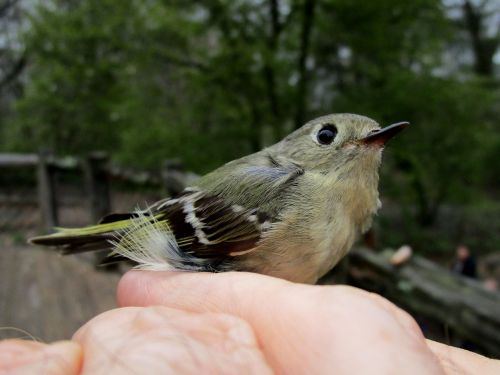
Another highlight of the final day was a Ruby-crowned Kinglet. This very small migrant in the same genus as our Goldcrest and Firecrest and from this angle looks not unlike our familiar ‘crests’ ….
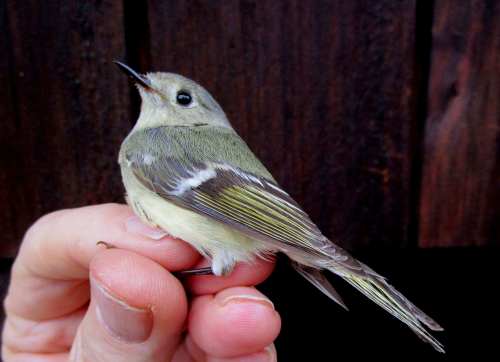
…. but side on it shows unexpectedly long wings and tail giving it more the appearance of a Phylloscopus warbler. The almond-shaped bare area around the eyes and the wing bars are reminiscent of some of the tyrannulets I’ve seen in the Neotropics.
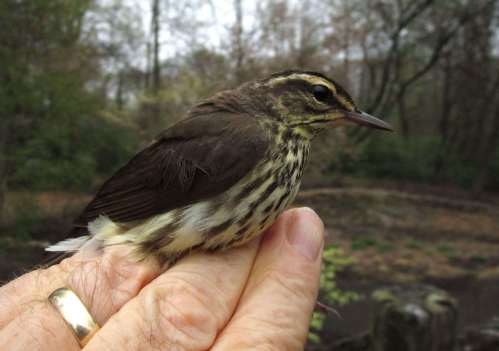
Of course what everyone wants to see in North America on spring migration are the New World warblers. Some come in a riot of colour, but even the plainer ones like this Northern Waterthrush are much sought after. Most of the eastern North American warblers have strayed across the Atlantic at some time or another and at least a dozen have occurred in the UK. I have even seen a Northern Waterthrush in Dorset

The similar Louisiana Waterthrush can be excluded by the leg colour, supercilium shape, flank colour, spots on the chin and markings on the undertail coverts.

The best bird of my trip to Connecticut was this gorgeous adult male Black and White Warbler.

We were able to do a bit of birding when ringing wasn’t possible. At Sherford Island we saw a flock of Brent Geese (or Brant as they are called in North America). Brent Geese are a regular wintering species in Poole Harbour but have just about all gone by the end of March. Our wintering birds are of the nominate race known as Dark-bellied Brent which breeds in NW Siberia but here the Pale-bellied Brent from the Canadian Arctic is found.
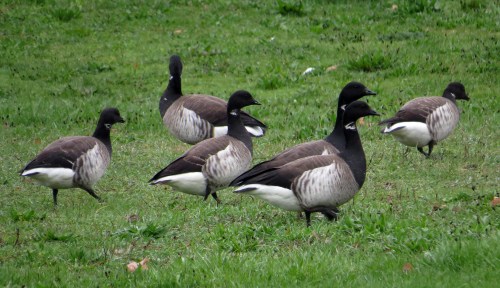
Some advocate splitting Brent Goose into three species, Dark-bellied, Pale-bellied and the east Siberian Black Brant, but the situation is more complicated, with at least two separate populations of Pale-bellied and the yet undescribed ‘Grey-bellied Brent’ needing to be taken into consideration.

Offshore we saw Long-tailed Ducks and Red-breasted Mergansers, birds typical of mid-winter at home not late April. That said, Great Northern Divers (above) can be seen in Dorset (usually flying past headlands on their way to breed in Iceland or Canada in early May). In North America this species is called Common Loon; surprisingly ‘loon’ predates ‘diver’ in British usage, originating from Old Norse lomr meaning to moan, a description of its evocative wail. This diver might be ‘greater’ than Black-throated or Red-throated, but its breeding range is more southerly! I’m ambivalent as to which name should be used, but when in North America I try to use their names (if I remember).
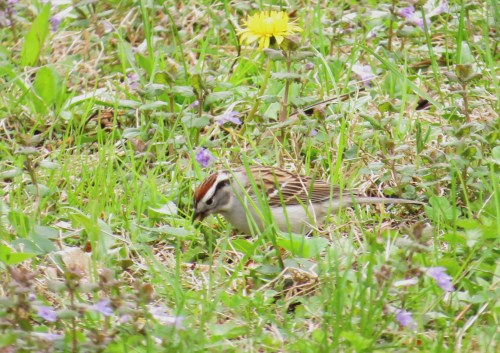
A walk around the fields and woods in Wilton brought a few more birds but the only one I managed to photograph in the dull and often wet conditions was this Chipping Sparrow.
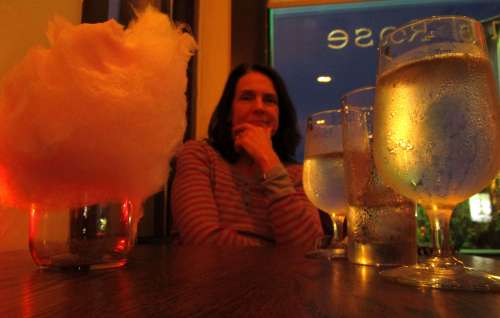
Patty took me to some nice restaurants in Wilton, which unlike most fast food joints in the States served some excellent food. Instead of giving you a couple of mints or chocolates after you paid your bill, this one delivered a glass of candy floss instead.
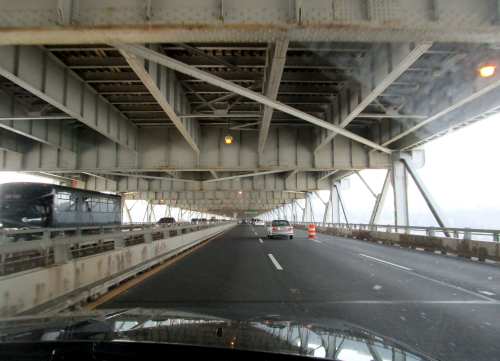
Soon it was time for Patty to take me back over the Hudson and the George Washington Bridge to Newark airport for the overnight flight home. I arrived very jet lagged early on the 28th and was home by mid-morning. Many thanks to Patty for hospitality, good company and taking be ringing and birding, I hope to go back some time in the future, but this time at the peak of migration in mid-May.

POSTSCRIPT. No sooner had I got home then I was out again to Longham Lakes, a 20 minute drive away, where a first winter Bonaparte’s Gull had been recently found. Named after ornithologist Charles Bonaparte, nephew of Napoleon, this was one American bird that I didn’t see in America, having to wait until I was back home to connect. Superficially it is like a Black-headed Gull, but smaller with a black bill and a white underwing that does not highlight the white wedge in the outer primaries the way that the dusky underwing of a Black-headed Gull does. Although I have seen Bonaparte’s Gull occasionally in the south-west of the UK over the years, the last time I saw one in Dorset was in 1981! This photograph was taken by Paul Morton.
This post covers a number of (mainly) bird related activities during January, February and March.
Apart from our week in France we’ve been having a relatively quiet time during the first three months of the year. I made a New Year’s Resolution to do some birding every single day and so far I have stuck to that, but I haven’t travelled outside of Dorset and West Hampshire (except to travel to Paris) but have done a fair bit of local birding within that area and a lot of bird ringing at our regular sites.
Also I haven’t taken many photos, often deliberately leaving my camera at home. This is because I still have photos to edit and reports to complete on trips I did in 2016, so it seemed pointless adding even more to the ‘to do’ pile.

A sunset is usually placed at the end of set of slides not at the start, but early this winter these has been a sizeable roost of Starlings near Shell Bay at the entrance to Poole Harbour and so the sunset has to come first.

Many thousands of birds have come into roost, often performing the wonderful aerial acrobatics known as a ‘murmuration’. On this occasion the wind was rather strong and the flocks just flew in to roost.
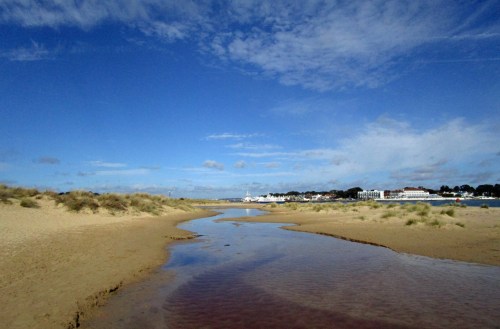
I have birded many places in Dorset, mostly around Poole but sometimes going as far as Weymouth, Abbotsbury or the New Forest. On one particularly sunny day Margaret and I went back to Shell Bay.

For those who have never visited this is a particularly beautiful part of the Dorset coast. On the other side of the Bay is Sandbanks, one of the most expensive areas of the UK. The Haven Hotel and the chain ferry that permits vehicular access to the Studland peninsula can be seen.
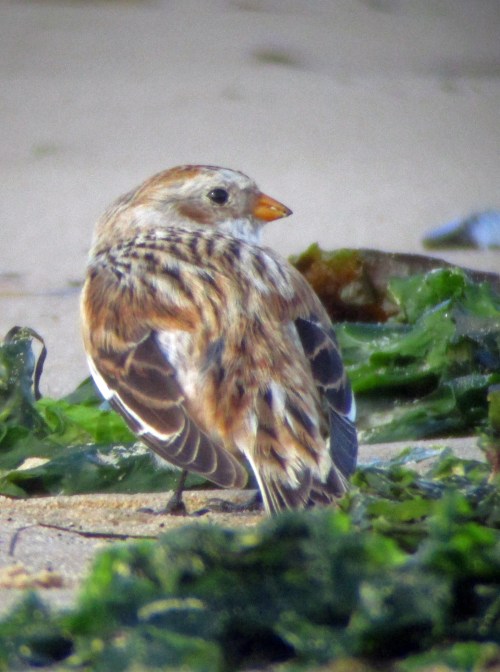
Our target was this Snow Bunting which was feeding on the beach where Shell Bay meets Studland Bay. Although a regular wintering bird in reasonable numbers on the east coast, I have only seen this species seven times in Dorset, all singles except in early ’82 when a flock of 6-7 occurred in the Studland area.
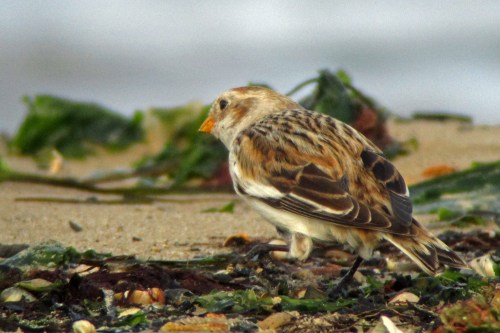
As I said earlier I haven’t been taking my camera with me very much this year and these photos were hand-held digiscoped, hence the lack of quality.

Two races of Snow Bunting occur in Britain, nominate nivalis (from northern Europe and northern Canada) and the Icelandic insulae. All the evidence points to this being the nominate race.

The area around Mordon Bog and Sherford Bridge can be very good for birds but if you want to explore the area around Mordon Park Lake you need to cross this very dodgy ‘bridge’.

A distant Great Grey Shrike was the best bird I saw in Wareham Forest this year.

Leaving the birding scene behind for a moment, on one clear night I visited my friend and former work colleague Tim to look through his astronomical telescope. Unfortunately living in the middle of Poole, ambient lighting rather spoilt the images. No planets were in view but we did look at some star clusters and nebulae ….

…. but my favourite object that Tim was able to show me was galaxy M82, one of the Messier objects, 110 diffuse nebulae, planetary nebulae, open clusters, globular clusters and galaxies that were catalogued by Charles Messier as he searched the heavens for comets. Our view of galaxy M82 was nowhere near as good as this one (taken from Wikipedia) but it becomes the furthest object I have ever seen. At 12 million light years (or just over 100,000,000,000,000,000,000 km) the light would have left this galaxy in the Miocene era, even before human’s ape-like ancestors walked the earth.

I have done many trips in the UK and a few abroad with my friend Roger (here seen on a pelagic trip in the Azores) ….

…. so it was very pleasing to be able to attend his 60th birthday party. This unusual cake (made by his wife Sue) is complete with a model of Roger birding from a park bench.
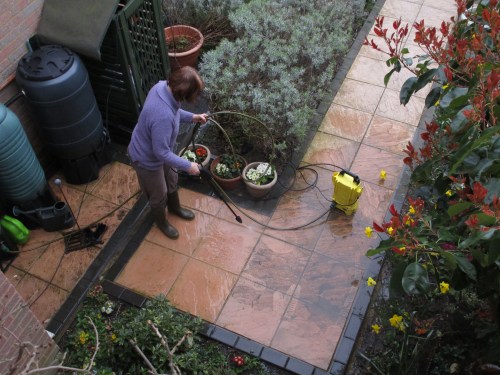
Although I have I have little or no interest in gardening it’s probably Margaret’s favourite occupation. Deciding the front path was getting a bit grubby she bought a power washer and before I was even aware what was going on she had cleaned the lot.

Though she looked like she had a bad case of measles when she had finished.

Most of my activities during this period have involved bird ringing which I have been keen to continue through the winter period. This winter we have started ringing at a new site on heathland to the north of Poole which has proved very productive, especially for finches. This is the view on a frosty morning from our ringing site.

Here are a few photos of birds in the hand: I don’t think I’ve ever seen a Blackbird with such incredibly rich colour to the bill and eye-ring before.

Understanding and recognising moult is key to telling the age of a bird and telling the age of a bird is key to understanding population dynamics. But there are always exceptions to the rule. This Robin has just moulted its three innermost primaries but not the rest. This is not a usual moult strategy and might have occurred after the feathers were lost after an attack by a predator.

Goldcrests can be aged by the shape of the tail feather, pointed in first years, rounded in adults. This first year Goldcrest has lost the three outer tail feathers on the right-hand side and although obviously it is still in its first year it has regrown the feathers with an adult shape. Thus if the bird was to loose all its tail feathers and regrow them in the shape of an adult, it would be incorrectly aged.
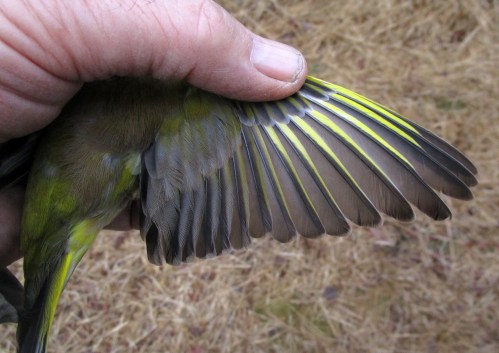
Some birds can be easily sexed in the field (for example Chaffinch or Bullfinch), other can only be reliably sexed in the hand such as this Greenfinch. The diagonal shape of the yellow on the outer webs of the inner primaries shows that this is a male. On a female the yellow would run parallel to the shaft leaving a black streak between the yellow and the shaft for the entire length of the feather.

Goldfinches can be only aged on the combination of a number of features and then only reliably in adult birds. The red extending behind the eye, more extensive red chin and longer bill indicate that the bird in the foreground is a male. Although on average, the male is slightly larger than the female, this is exaggerated in this photo as it is being held nearer to the camera.
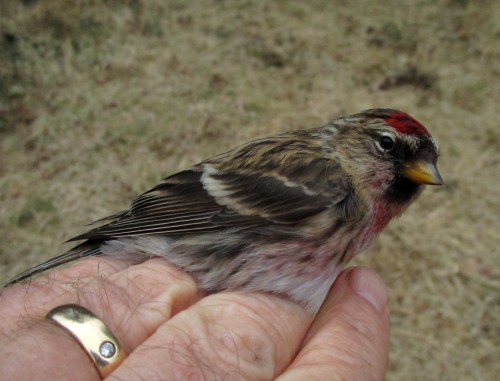
We usually catch a few Redpolls in the autumn on migration at Durlston but its a long time since I’ve ringed one in it’s its breeding finery. We have caught a Redpoll that was ringed elsewhere and look forwards to learning where it came from and when it was ringed.
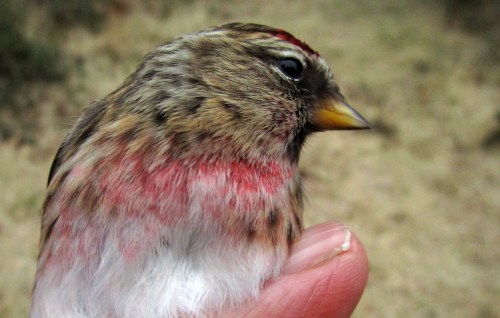
Redpolls are comprised of 5 or 6 subspecies divided into 3 (BOU list) or two (IOC list) species. The BOU has stated that as from the start of 2018 it will follow the IOC checklist, so we will loose our breeding form Lesser Redpoll as a separate species as it will be lumped with Common Redpoll. This however is just the start of the story, recent genetic research has shown that all the races of Redpoll are genetically identical and a proposal is being considered to lump the lot, so we will go from having three species on the British list to just one.

Another bird that we usually only ring in the autumn is Pied Wagtail when the majority are in drab first-year plumage. This smart male was ringed in one of our group member’s garden close to Lytchett Bay.

Another species we only ring occasionally is Jay, an aggressive and noisy bird in the hand and one that will leave deep marks on your fingers if they get anywhere near its bill. We have ringed four recently at our new site, it would be nice to get a recovery.

One of the ongoing puzzles that ringing may solve is the issue of ‘Siberian’ Chiffchaffs. This bird seen and ringed at one of our sites in Poole calls and sings like a Siberian (race tristis) has the whitish belly and green fringes to the flight feathers, yet in certain lights shows greenish tones in the upperparts. Body feathers accidentally shed in the ringing process have been sent for DNA analysis but as only mitochondrial DNA markers are available this will merely tell us what its mother was! Tristis is increasingly being touted as a full species, based mainly on its unique vocalisations, so robust identification criteria are needed.

Over the last few months I have been ringing with a young lady named Fenja. She recently returned from a voluntary research expedition to the lowland rainforest of south-east Peru where she assisted in wildlife censuses and ringing. During her stay they trapped 32 species of rainforest birds, all but one have been seen by me in one place or another, but I am quite envious of the photos of her holding a Hairy-crested Antbird, a species I have never even seen.

Towards the end of March our ringing group held its AGM, this time in a more professional looking location than my conservatory. As always it took ages to work through the agenda because we kept getting side-tracked (but some of us expected that and brought some beer along). L-R: Shaun Robson, Andy Welch, Olly Slessor, Ginny Carvisiglia, me, Chris Minvalla, Mike Gould, Daniel Whitelegg, Paul Morton, Carol Greig, Sean Walls, Bob Gifford and Brian Cresswell. Out of shot are Ian Alexander, Kath Clay and Terry Elborn. We thank Brian and Sean for allowing us to use the Biotrack offices for the meeting.

At the end of every AGM Bob awards the so-called ‘Stoate Award’ for the worst data submission in the last year. This time he performed it in the manner of the Oscars, calling on Shaun to open the envelope and read out the ‘winner’, then declaring a mistake had been made and then having it read out again. As expected I was the recipient, but I pointed out that I entered 64% of all the data submitted last year and therefore more mistakes were to be expected. The actual award is an unidentifiable ornamental bird, I’d rather it was the stuffed Eagle Owl in corner of the photo.
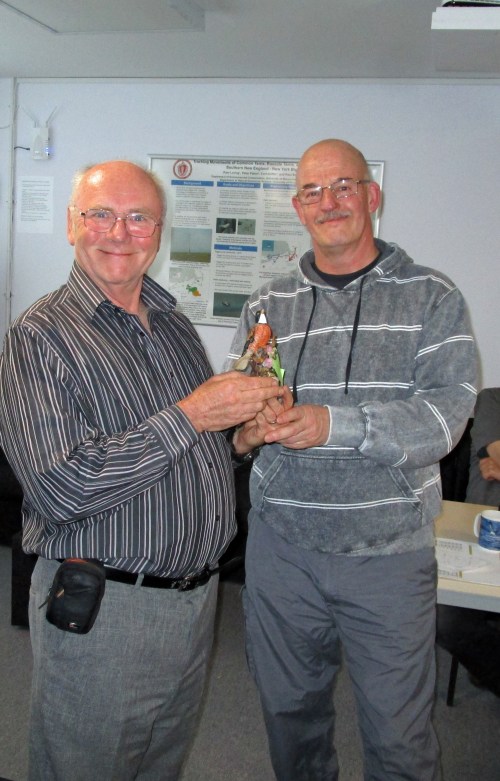
However the worse sin was that occasionally, when the program rejected a bird’s biometrics on the basis of it being too heavy, I would type ‘fat bastard’ or ‘who ate all the pies’ in the comments box. Judging from the photo above I think that’s a case of ‘the pot calling the kettle black’!
In the last post I described the first three days of our trip to Paris which involved both sightseeing and a visit to my friend John at nearby L’Isle Adam, whom I have known since 1969.
This post covers the remaining three days with more visits to Paris and to the Palace of Versailles.

On 1st March John drove us to the Palace of Versailles about an hour’s drive to the south-west of L’Isle Adam. These golden gates were torn down during the French Revolution and have only recently been restored.
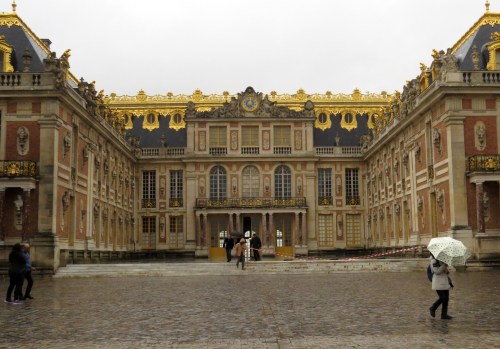
Once past the golden gates we could clearly see imposing facade of Louis XIV’s famous palace. From Wikipedia: The Palace of Versailles, Château de Versailles, or simply Versailles is a royal château in Versailles in the Île-de-France region of France. When the château was built, Versailles was a small village dating from the 11th century; today, however, it is a wealthy suburb of Paris, some 20 kilometres (12 miles) southwest of the centre of the French capital (point zero at square in front of Notre Dame). Versailles was the seat of political power in the Kingdom of France from 1682, when Louis XIV moved the royal court from Paris, until the royal family was forced to return to the capital in October 1789, within three months after the beginning of the French Revolution. Versailles is therefore famous not only as a building, but as a symbol of the system of absolute monarchy of the Ancien Régime.
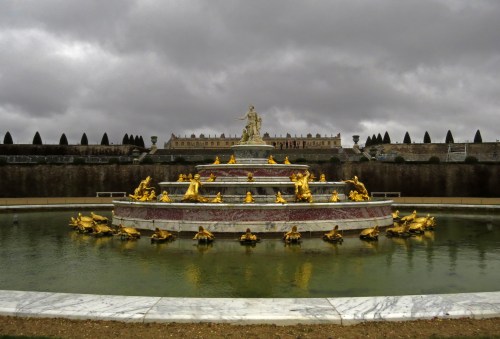
We expected rain to arrive in the afternoon so planned to visit the extensive gardens first. However the rain had already started by the time we got there so our time in the gardens was fairly short.
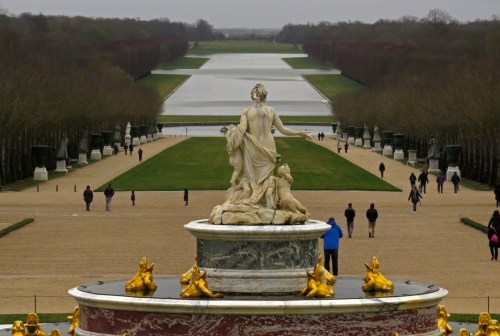
Not only was cold and wet with very low light levels but as it was still winter little was in leaf or in bloom ….
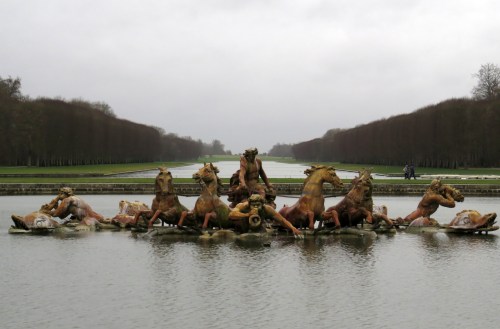
…. even so the statues, lakes and ornamental gardens exuded grandeur.
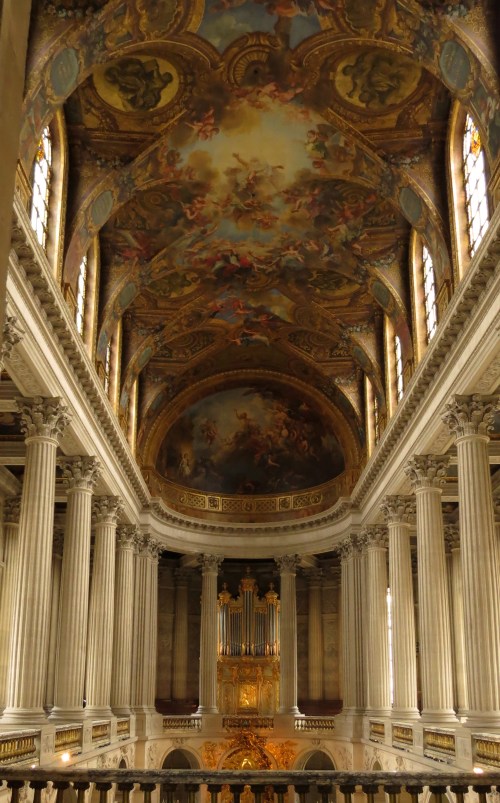
However grandeur takes on a whole new meaning once you enter the Château and see the chapel ….

…. and that theme continues when you enter the state rooms with their majestic murals and ….
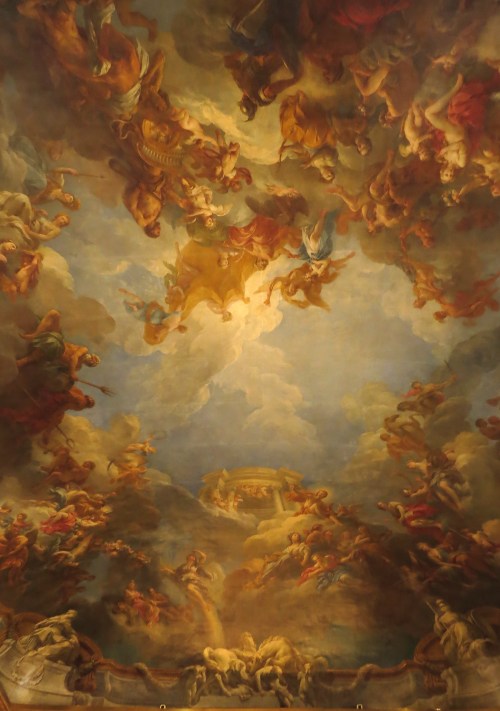
…. wonderfully decorative ceilings.
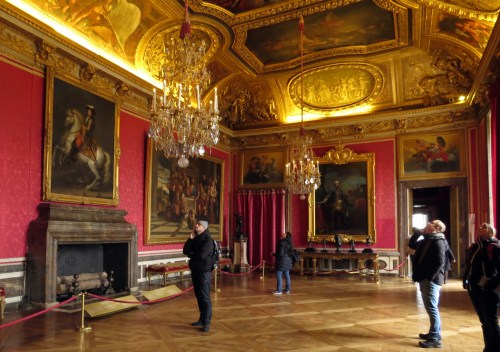
I took so many pictures of these extraordinary rooms that it is difficult to know which to use.

One of the most celebrated rooms is the King’s bedchamber. In the highly stylised ceremonial traditions of the Ancien Régime’s absolute monarchy, Louis XIV just about ran the country from his bedroom.

Imagine waking up to this on your ceiling!
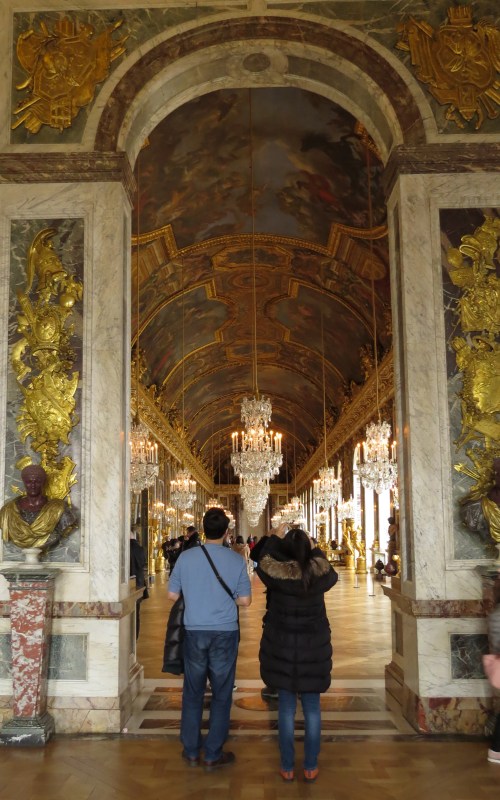
But the most famous room of all, perhaps the most famous room in any palace anywhere in the world, is the Hall of Mirrors.
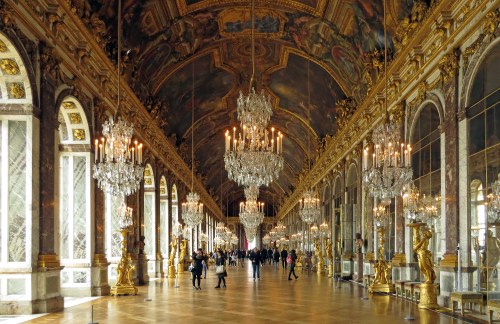
From Wikipedia: the principal feature of this hall is the seventeen mirror-clad arches that reflect the seventeen arcaded windows that overlook the gardens. Each arch contains twenty-one mirrors with a total complement of 357 used in the decoration of the galerie des glaces. The arches themselves are fixed between marble pilasters whose capitals depict the symbols of France. These gilded bronze capitals include the fleur-de-lys and the Gallic cockerel or rooster. Many of the other attributes of the Hall of Mirrors were lost to war for financial purposes, such as the silver table pieces and guéridons, which were melted by order of Louis XIV in 1689 to finance the War of the League of Augsburg.

Used mainly for ceremonial reasons this hall is simply stunning.
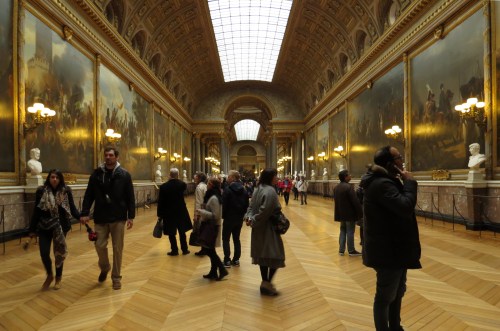
Another impressive room was the 120m long Gallery of Battles intended to glorify French military history from the Battle of Tolbiac c496 to the Battle of Wagram in 1809.Gallery of Battles, with its 30+ panels (but no panels depicting Waterloo or WW1 or WW2!).

From Wikipedia: The Battle of Wagram (5–6 July 1809) was a military engagement of the Napoleonic Wars that ended in a decisive victory for Emperor Napoleon I’s French and allied army against the Austrian army under the command of Archduke Charles of Austria-Teschen. Try as I might, it is very difficult to photograph a painting when other members of the public are milling around it and get all the angles perfectly straight.

After three days of rather wet weather, Thursday 2nd was warm and sunny and we took the opportunity to see the obligatory tourist highlights. We took the Metro to the Trocadero but low sun spoilt the view of the Eiffel Tower.
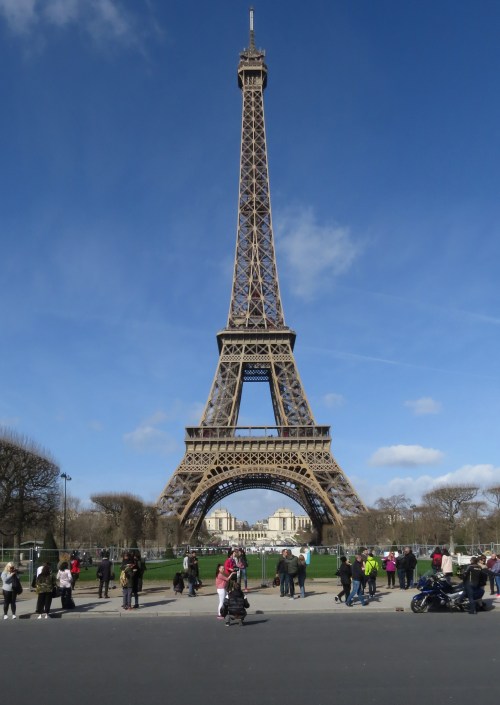
However by crossing the Seine to the Champ de Mars we had great views. However Margaret, who suffers from vertigo, didn’t fancy a trip to the top (or even to the first stage) and as I’ve been to the top several times we gave it a miss.

From Wikipedia: The Eiffel Tower is a wrought iron lattice tower on the Champ de Mars in Paris, France. It is named after the engineer Gustave Eiffel, whose company designed and built the tower. Constructed from 1887–89 as the entrance to the 1889 World’s Fair, it was initially criticized by some of France’s leading artists and intellectuals for its design, but it has become a global cultural icon of France and one of the most recognisable structures in the world. The Eiffel Tower is the most-visited paid monument in the world; 6.91 million people ascended it in 2015. The tower is 324 metres tall, about the same height as an 81-storey building, and the tallest structure in Paris. Its base is square, measuring 125 metres on each side. During its construction, the Eiffel Tower surpassed the Washington Monument to become the tallest man-made structure in the world, a title it held for 41 years until the Chrysler Building in New York City was finished in 1930. Due to the addition of a broadcasting aerial at the top of the tower in 1957, it is now taller than the Chrysler Building by 5.2 metres. Excluding transmitters, the Eiffel Tower is the second-tallest structure in France after the Millau Viaduct. The tower has three levels for visitors, with restaurants on the first and second levels. The top level’s upper platform is 276 m above the ground – the highest observation deck accessible to the public in the European Union. Tickets can be purchased to ascend by stairs or lift to the first and second levels. The climb from ground level to the first level is over 300 steps, as is the climb from the first level to the second. Although there is a staircase to the top level, it is usually only accessible by lift.
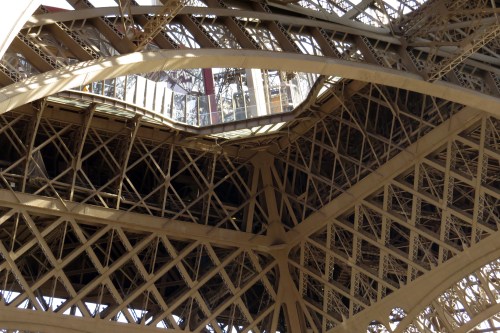
From underneath, looking up at the restaurant on the first stage.
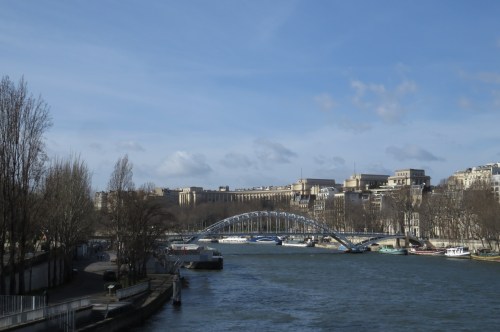
From the Champ de Mars we crossed the Seine and could look back at the museums of the Trocadero.

Soon we reached the Avenue des Champs-Élysées. This is the view to the east looking towards the Place de la Concorde and the Louvre ….
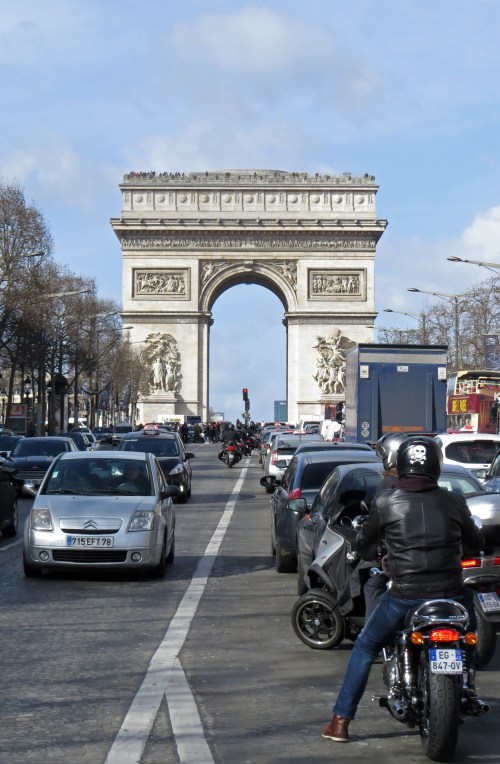
And this is the view to the west towards the Arc du Triomphe.
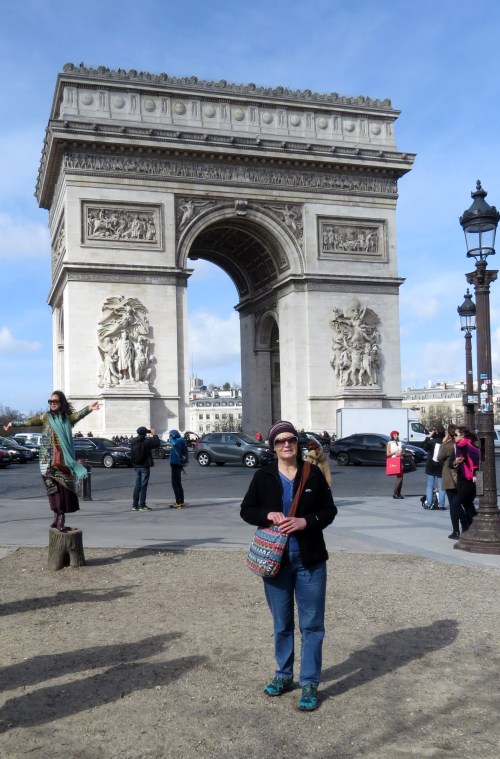
TheArc du Triomphe stands in the centre of Place Charles de Gaule and commemorates those who fought and died in the French Revolutionary and Napoleonic Wars. Twelve avenues radiate out from the Place, however again Margaret didn’t want to go to the top to see the view.
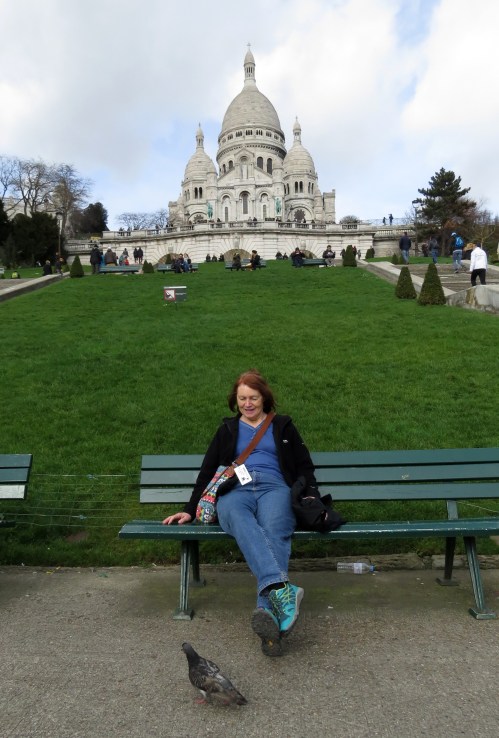
We caught the Metro to the Sacré-Cœur Basilica in Montmartre. By now we were pretty foot sore, here Margaret stops to rest her feet and admire a pigeon.
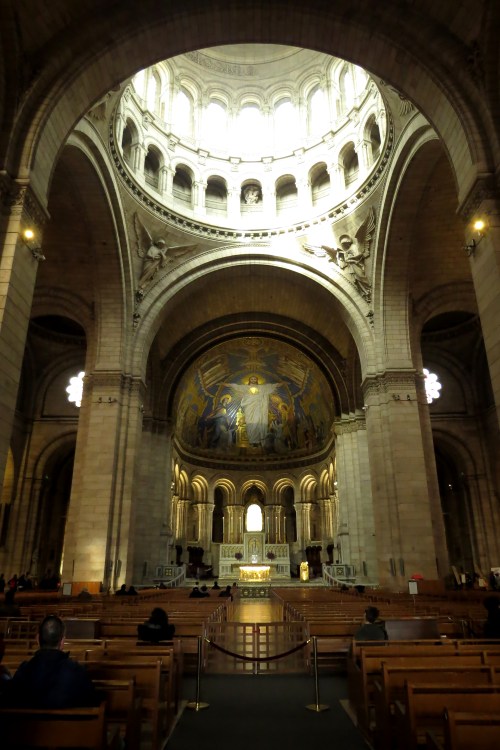
From Wikipedia: The Basilica of the Sacred Heart of Paris commonly known as simply Sacré-Cœur is a Roman Catholic church and minor basilica, dedicated to the Sacred Heart of Jesus, in Paris. A popular landmark, the basilica is located at the summit of the butte Montmartre, the highest point in the city. Sacré-Cœur is a double monument, political and cultural, both a national penance for the defeat of France in the 1871 Franco-Prussian War and the socialist Paris Commune of 1871 crowning its most rebellious neighbourhood, and an embodiment of conservative moral order, publicly dedicated to the Sacred Heart of Jesus, which was an increasingly popular vision of a loving and sympathetic Christ. The Sacré-Cœur Basilica was designed by Paul Abadie. Construction began in 1875 and was finished in 1914. It was consecrated after the end of World War I in 1919.

The church is on the highest point of the City of Paris and the view is excellent.
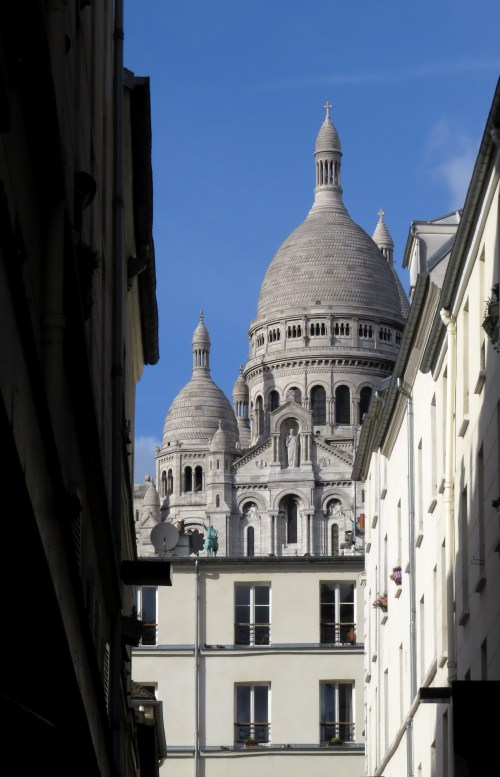
The narrow streets and courtyards of Montmartre are well known for their quaint shops and picturesque appearance ….

…. none more so than the Place du Tertre which is packed with artists trying sell their wares to the tourists.
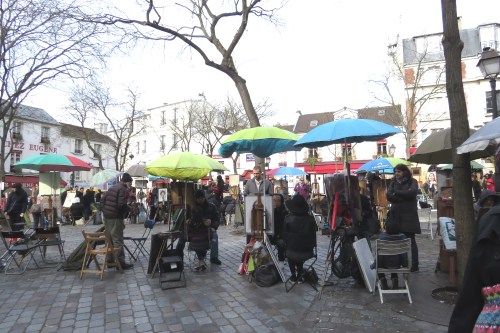
Once the centre of Paris’s modern art movement, now you are accosted at every step by an artist who wants to paint your portrait or caricature. One told Margaret he could make her look like the Mona Lisa.

Descending the hill we arrived at Place Pigale, famous for its many nightclubs, none more so than the Moulin Rouge ….
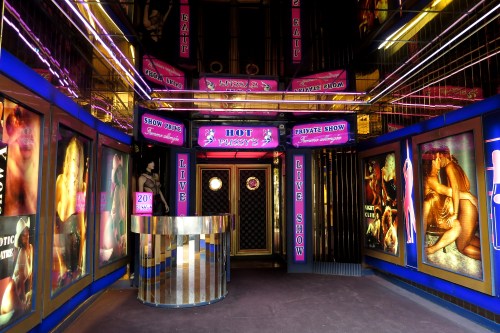
…. although some of the clubs we passed looked rather more seedy.
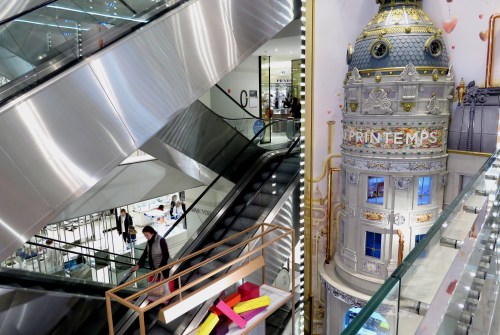
John had agreed to meet up with a couple of his old friends from work and had come into Paris to meet them. we met up with him at the Gare du Lyons and from there he showed us another part of Paris where he once lived (and where I twice visited him in the 70s). We entered the enormous Printemps store, not because we wanted to buy anything ….

…. but because John wanted to show us the wonderful stain glass dome on the top floor.

We met up with John’s friends Quan (centre right) and Lily (right) in an Irish bar and then went to another place to eat, it was a very pleasant evening with most enjoyable company.

On the way back we passed the Opera House and La Madeleine (above), a church built to celebrate the glory of Napoleon’s Army. Unfortunately one side was covered for renovation.
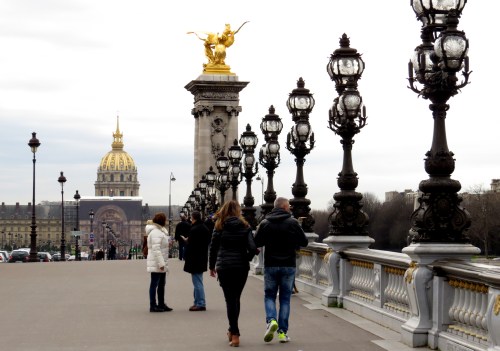
On Friday 3rd we caught the Metro to the east end of the CH and walked across the Seine to Les Invalides.

From Wikipedia: Les Invalides commonly known as Hôtel national des Invalides, is a complex of buildings containing museums and monuments, all relating to the military history of France, as well as a hospital and a retirement home for war veterans, the building’s original purpose. The buildings house the Musée de l’Armée, the military museum of the Army of France, the Musée des Plans-Reliefs, and the Musée d’Histoire Contemporaine, as well as the Dôme des Invalides, a large church with the burial site for some of France’s war heroes, most notably Napoleon Bonaparte.
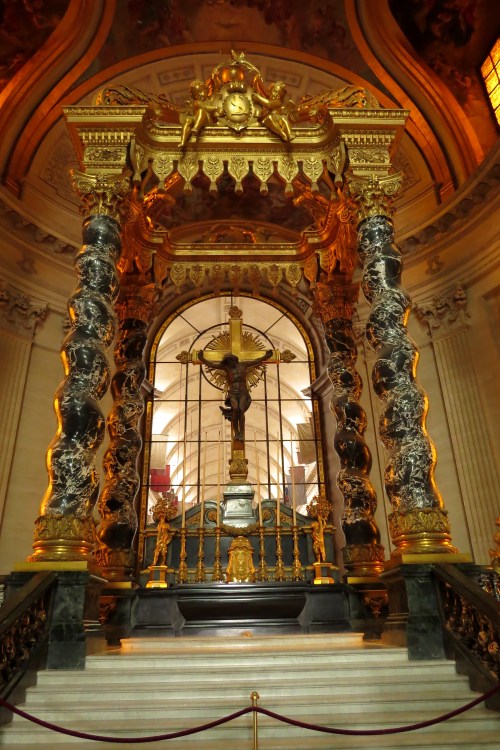
Louis XIV had this royal chapel with its beautiful dome built in 1708. Beyond the crucifix and the glass panel is the much plainer chapel (as apparently ‘fits their status’) built for the war veterans.
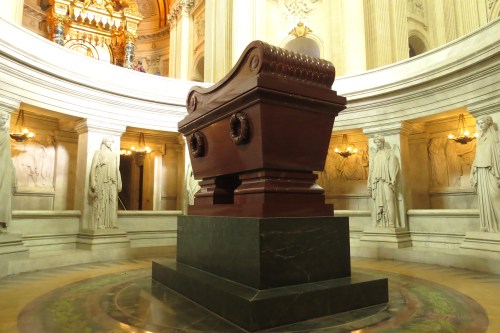
Below the dome now rests the tomb of Napoleon Bonaparte. Napoleon died and was buried on St Helena in 1821 where he had been exiled by the British. In 1840 permission was granted for his remains to be returned to Paris where a state funeral was held.

We visited Napoleon’s original burial site on St Helena as part of our Atlantic Odyssey in April 2016. There can’t be that many people who have been to both of his burial-places within 12 months! Interesting this site along with Longwood House where Napoleon lived have been declared French sovereign territory meaning that there has to be an honorary French consul on the islands to administer them!

We didn’t have enough time to look at all the French military museums so waked across the imposing courtyard and back to the north bank of the Seine. Interestingly one facade was covered for renovation but the coverings were a fabric printed with an image of the original building, so from a distance the grandeur of the place was maintained.

Place de La Concorde is the largest public square in Paris. Constructed in 1755 to honour Louis XV it was renamed Place de la Révolution in the French Revolution. The new revolutionary government erected the guillotine in the square, and it was here that King Louis XVI and many others were executed.

We also paid a visit to the nearby Musée de l’Orangerie to see more impressionist and post impressionist paintings. This is Renoir’s ‘Portrait de deux fillettes’.

But the main attraction and the reason we had come was to see the eight panels of water lilies painted by Monet. These are housed in two oval shaped rooms each containing two long and shorter panels. Here art students practice their Monet technique with varying degrees of success.

Close to the painting just look a mess of colour but seen from a distance they are a delight.
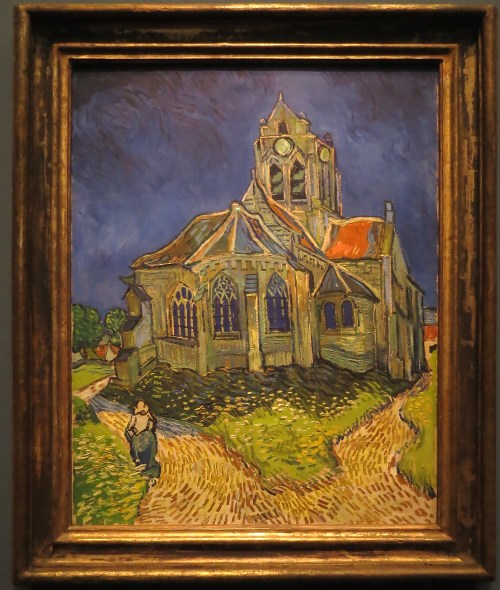
Another painting we saw, not that day but earlier in the week at the Musee d’Orsay was van Gogh’s wonderful ‘The Church at Auvers’ ….

…. after we returned from Paris John picked us up and took us to the nearby village of Auvers where we saw the church the painting was based on. Using a wide-angle setting has meant that the verticals in my photo as are almost as wobbly as in van Gogh’s rendition.
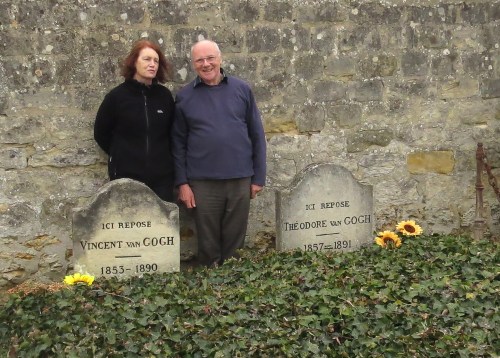
In the village we visited the simple grave site where Vincent van Gogh and his brother Theodore are buried. Surprisingly no ornate tomb in Cimetière du Père Lachaise for one of the world’s best ever artists.
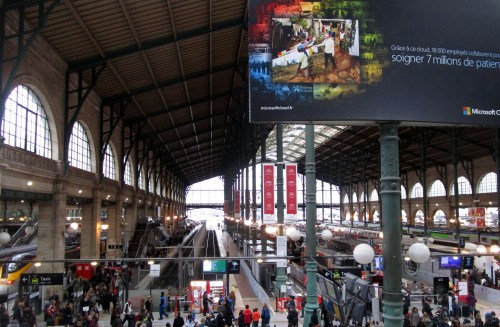
All that was left to do on the 4th was to get the train back to Gare du Nord and get the Eurostar to London and the bus home to Poole.
.
It had been a very enjoyable week and quite a change from the usual birdwatching trips. Margaret very much enjoyed her first visit to Paris and I was able to visit a few places for the first time and see many wonderful sites once more. It was also great to meet up with John and Florence once again and we thank them for their hospitality.
I have visited Paris at least five times, the first on a school exchange visit the remainder to see my friend John who has lived near there for much of the past forty years, but Margaret has never been, so a week staying with John whilst we ‘did the sights’.
Rather than fly, we travelled to Paris on the Eurostar and John met us at Gare du Nord.
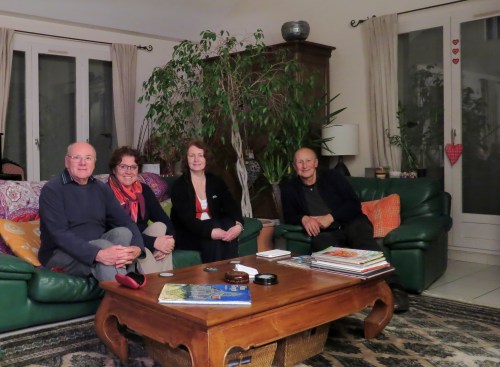
Here we are with John and his wife Florence at their home in L’Isle Adam. I first met John in 1969, we shared accommodation for four years at University in Leeds. After graduating he moved to Paris, after a spell back in the UK he returned to France and eventually settled in L’Isle Adam, a pretty town on the banks of the River Oise some 40km north of Paris.

That evening we went into L’Ise Adam and had a meal at a restaurant by the River Oise.

The following morning John took for a walk around the town that has been his home for the last twenty years. This is the town hall.

he local market was full of delicious cheeses, sausages and fruit. Margaret was quite taken by the wide choice and was keen to sample what was on offer.

Being a Sunday John was able to drive us into the centre of Paris – although we got caught up with a Mardis Gras festival.
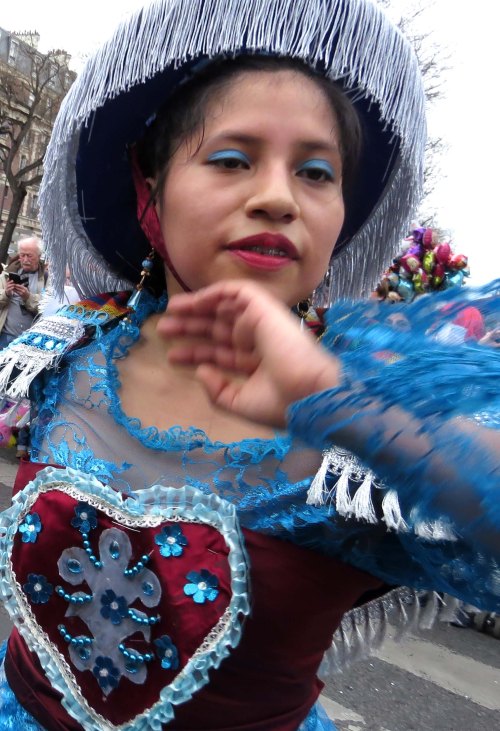
Not the cultural experience you would expect in the capital of France.
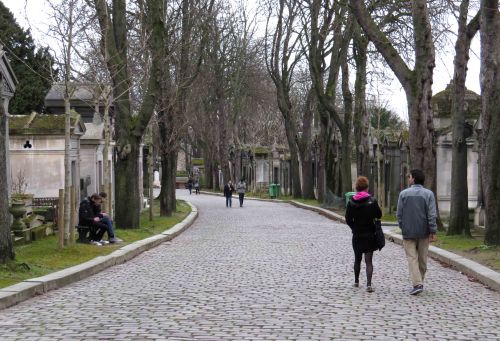
We visited the famous Cimetière du Père Lachaise to the east of the city centre, the world’s most visited cemetery.

The cemetery holds a remarkable number of tombs of famous French artists, musicians and politicians plus some foreigners who have died in the city. We didn’t have time to seek out graves of the twenty or so famous people who I was familiar with but we did locate the final resting place of Oscar Wilde (traditionally female fans of his works kissed the enormous headstone wearing bright red lipstick, but due to the fear of damage the headstone has been encased in glass).

We passed the tomb of Frédéric Chopin (John tells a wonderful story of an old school friend of his whose life’s ambition was to play Chopin’s ‘Revolutionary’ in the middle of a pub brawl and he actually succeeded in doing so).
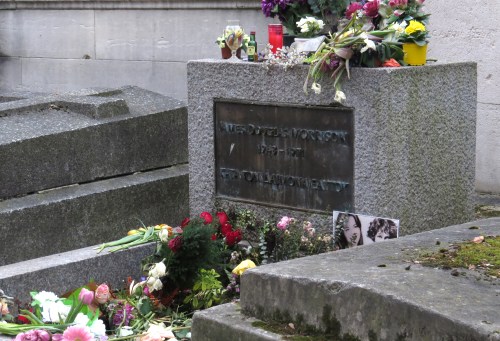
But the tomb we wanted most to see was that of rock star and poet Jim Morrison, lead singer of the Doors who died in Paris in 1971 at the age of 27. The original tomb was covered in graffiti by fans and the stone bust of the singer was stolen in 1988. The entire tomb was replaced in 1990 and fenced off from the public. The Greek inscription translates as translated as ‘faithful to his spirit’ or ‘against the devil within’.
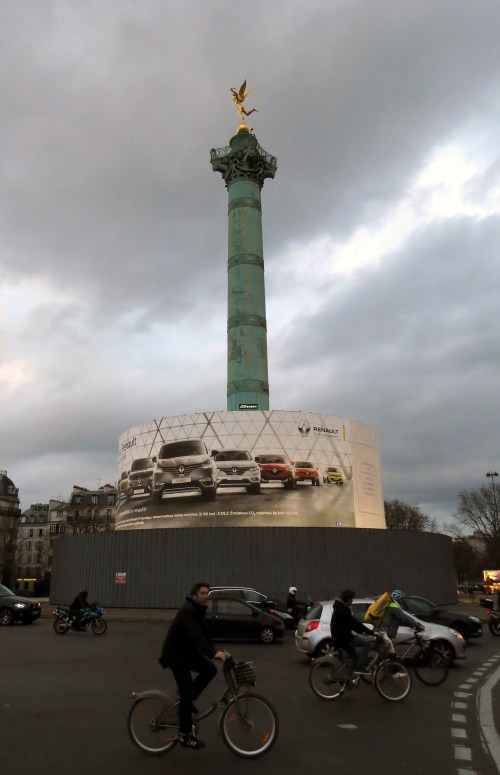
Later we headed to the Place de la Bastille, the site of the former prison which was stormed at the start of the French Revolution on the 14th July 1789. The monument was unfortunately partially hidden by hoardings, presumably for renovation.
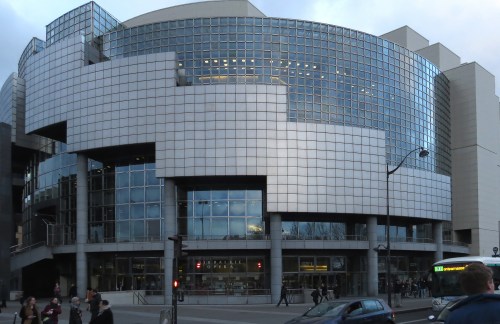
Nearby is the new Bastille Opera House.

We took a wander around the area where John first lives when he worked in Paris in the mid 70s and passed his old (somewhat basic) flat that I stayed at in 1974. The area has had a major facelift in the intervening 43 years.

This bottle store looked quite enticing (because its attractively backlit – not because it full of booze!)
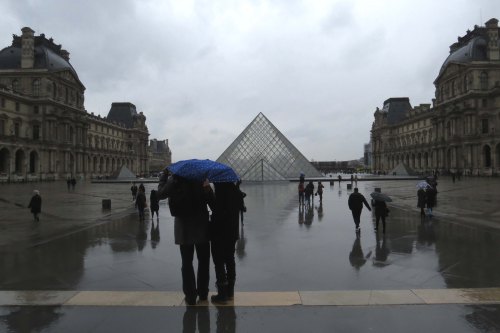
On the Monday Margaret and I headed into Paris on the train and visited the Louvre. It was a very wet but at least we would be inside ….

…. however we hadn’t bargained for the hour long wait in the rain to get in. Paris is still on a heightened security alert and all bags are searched before entering historic buildings.
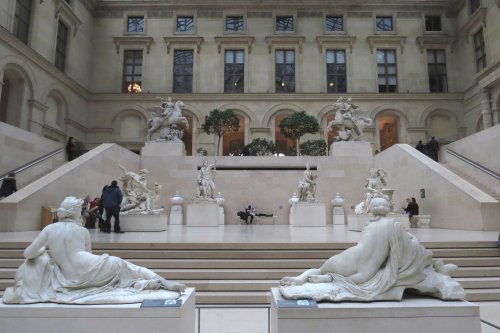
The Louvre is one of the most important (and one of the most rambling) museums in the world and is packed to the brim with countless priceless works of art including this gallery of French sculptures ….

…. these bronze statues known as ‘the Four Captives’ are by Dutch sculptor Martin Van Den Bogaert and represent four nations: Spain, the Holy Roman Empire, Brandenburg and the Dutch Republic defeated by the armies of Louis XIV. Originally in one of Louis XIV’s palaces the statue was brought to Les Invalides and then to the Louvre. Each of the four statues is supposed to portray a different aspect of defeat.

…. and mosaics.

There are also galleries of wonderful Assyrian (above), Greek and Roman sculptures …

Not forgetting, of course, the iconic Venus de Milo. The following is from Wikipedia: an ancient Greek statue and one of the most famous works of ancient Greek sculpture. Created sometime between 130 and 100 BCE, it is believed to depict Aphrodite, the Greek goddess of love and beauty (Venus to the Romans). It is a marble sculpture, slightly larger than life size at 203 cm (6 ft 8 in) high. Part of an arm and the original plinth were lost following its discovery. From an inscription that was on its plinth, it is thought to be the work of Alexandros of Antioch; earlier, it was mistakenly attributed to the master sculptor Praxiteles. It is currently on permanent display at the Louvre Museum in Paris. The statue is named after the Greek island of Milos, where it was discovered.

Of course the Louvre is better known for its vast collection of paintings, none more famous that the Mona Lisa, a portrait of Lisa Gherardini by Leonardo de Vinci, painted between 1503 and 1506. Considered the most famous and most valuable (estimated at $880,000,000) painting in the world, it has been in the Louvre since 1797 (apart for a time in the early 20th century when it was stolen by an employee).
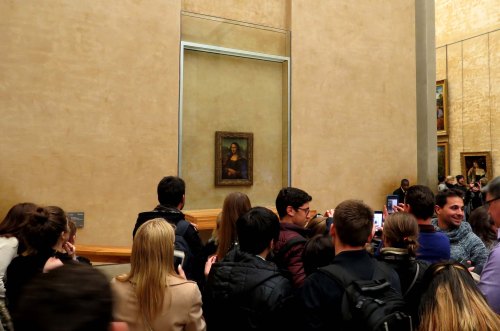
Due to a number of attempts to damage the painting over the years it is now enclosed in a climate controlled chamber behind bullet proof glass. Just getting to see this masterpiece is tricky due to the huge crowds that throng the Louvre. Of course people want a photo but why do they have to use a selfie stick to get themselves in the picture!
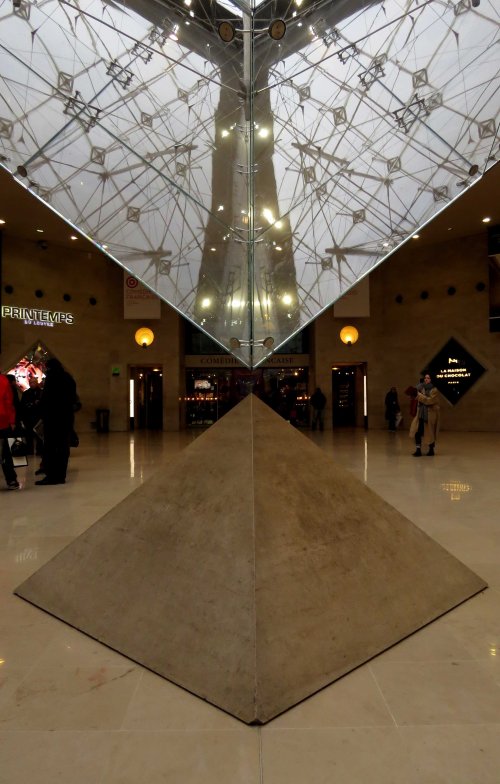
We could have spent several hours more looking at these treasures but after a few hours you get museum-fatigue and your brain can take in no more. If I lived in Paris I would go regularly and do one section thoroughly each time. Rather than leave via the main entrance we descended to the shopping mall below which led directly to the Metro. If we had known about this initially we could have avoided the long queue or at least if there had been a long queue, stood in it out of the rain.
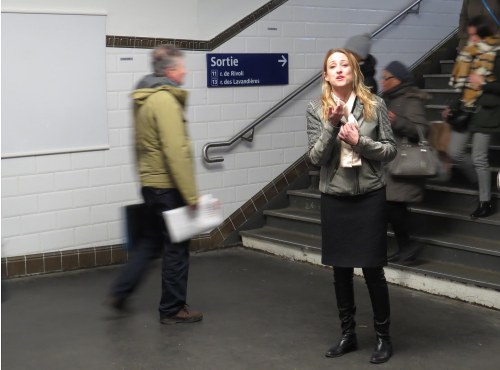
All underground systems have their buskers, most of which are totally ignored by people rushing to or from their place of work, but the standard of musicianship in the Metro was outstanding, particularly this opera singer who was giving a rendition worthy of a concert hall (yes, we did give her a tip).
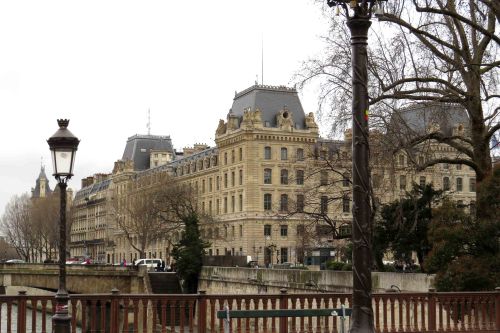
Although still wet, the weather wasn’t as bad the following day so we headed for the Île de la Cité ….

… and the Palais du Justice.
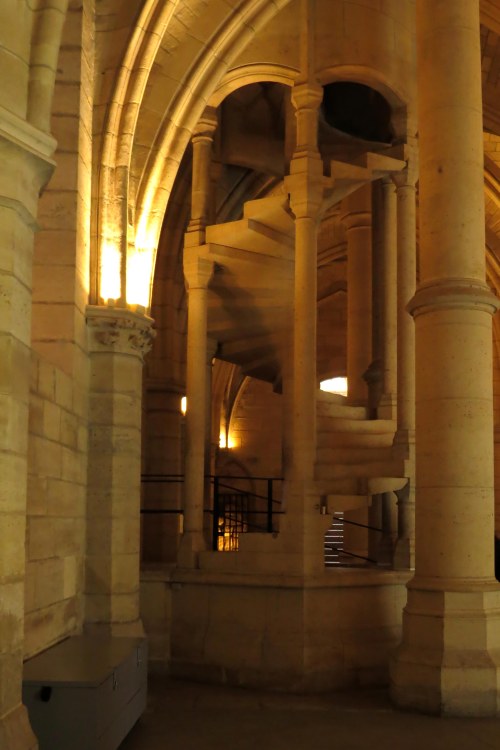
Within its grounds is the Concergerie, which was used as a prison during the Revolution to hold those awaiting the guillotine, and preserves the cell that held Marie Antoinette.

We also visited one of the best churches in Paris, indeed in the world – Sainte Chapelle. The lower chapel where you enter is pleasant enough ….
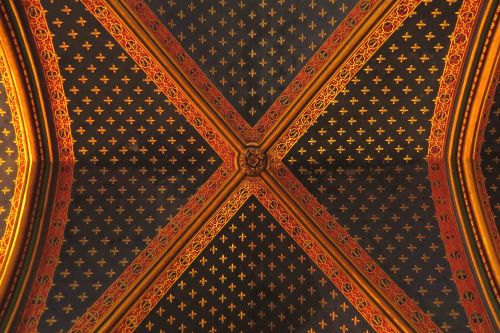
…. and has a highly decorated ceiling ….
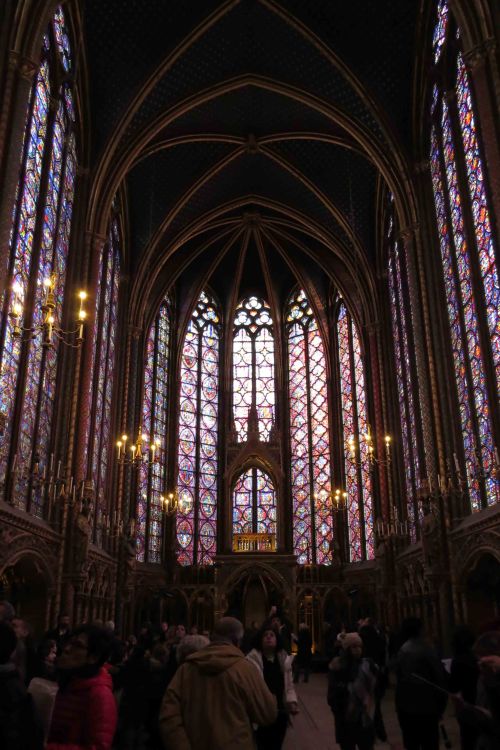
…. but when you ascend the narrow spiral staircase to the upper chapel your breath is taken away. This was on a dull day, imagine it in full sunshine with the light streaming through the windows.

From Wikipedia: The Sainte-Chapelle is a royal chapel in the Gothic style, within the medieval Palais de la Cité, the residence of the Kings of France until the 14th century, on the Île de la Cité in the heart of Paris, France. Begun some time after 1238 and consecrated on 26 April 1248, the Sainte-Chapelle is considered among the highest achievements of the Rayonnant period of Gothic architecture. It was commissioned by King Louis IX of France to house his collection of Passion relics, including Christ’s Crown of Thorns—one of the most important relics in medieval Christendom. Along with the Conciergerie, the Sainte-Chapelle is one of the earliest surviving buildings of the Capetian royal palace on the Île de la Cité. Although damaged during the French Revolution, and restored in the 19th century, it has one of the most extensive 13th-century stained glass collection anywhere in the world.

We still had one more architectural wonder to see, the beautiful Notre Dame cathedral. The queue to the mainland stretched across the bridge to the south bank of the Seine so we could watch the tourist boats pass by as we waited.
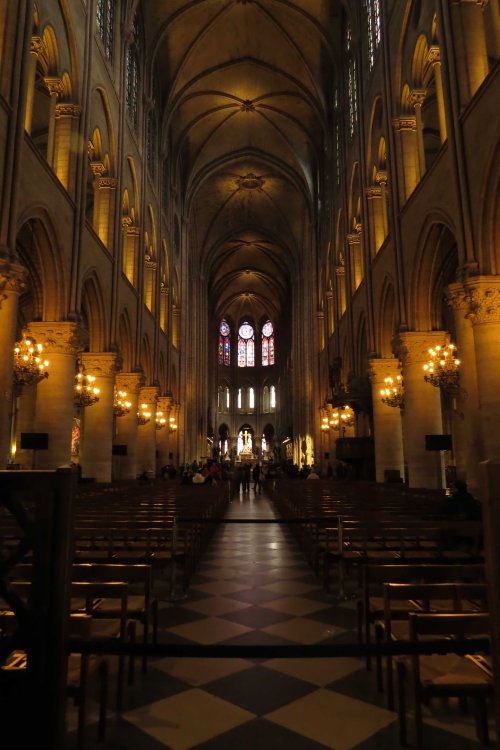
Notre Dame de Paris built between 1162 and 1345 ‘is widely considered to be one of the finest examples of French Gothic architecture, and is among the largest and most well-known church buildings in the world’ (Wikipedia).
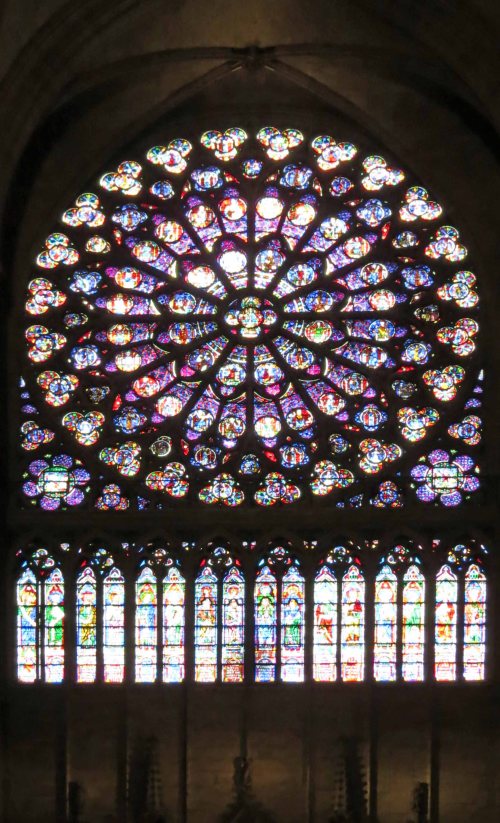
The beautiful rose window.
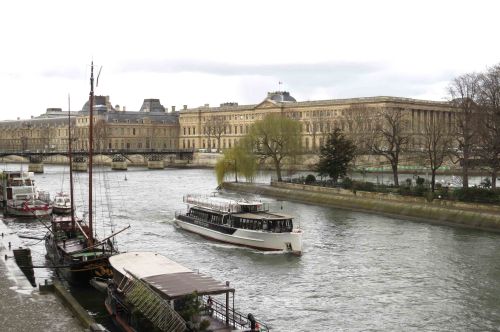
As we left we got caught in a torrential downpour and sought shelter in a restaurant adjacent to the cathedral. Not the cheapest of places to have lunch. With the weather improving we walked along the south left (south) bank of the Seine to the Musée d’Orsay.

The museum was originally a railway station and by 1970 it was due for demolition. However following a campaign it was saved as a historic building and turned into museum designed to bridge the gap between the Louvre and the National Museum of Modern Art at the Georges Pompidou Centre.
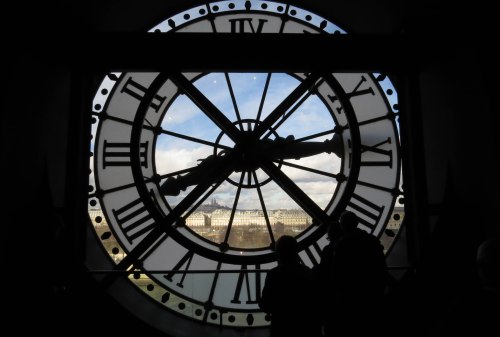
A former clock is now an ornamental window giving views out over the city …

… towards Montmartre and the Sacré-Cœur.

The museum holds many impressionist paintings including works by Monet, Manet, Van Gogh, Cezanne and Gaugin. Here is Claude Monet’s ‘London, Houses of Parliament. The Sun Shining through the Fog’, painted in 1904
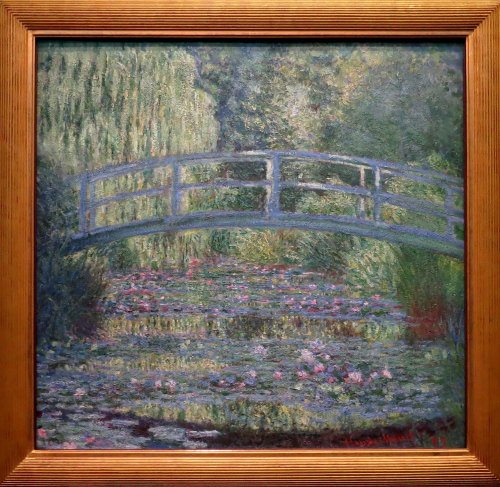
And here his famous ‘The Water Lily Pond’.
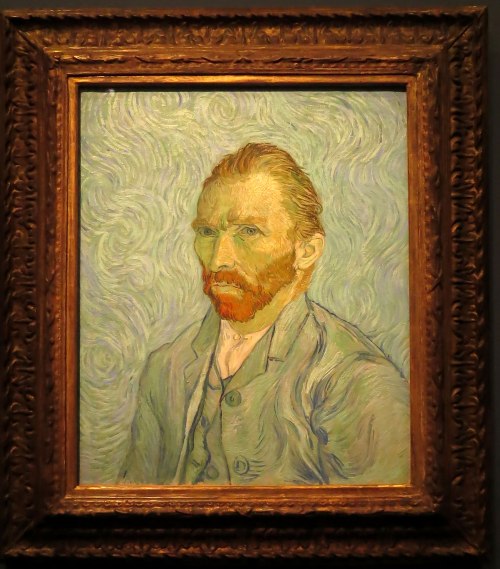
But if I had to chose my favourite artist it would be a toss-up between Salvador Dali and Vincent van Gogh. This is Van Gogh’s famous self-portrait.
As with the Louvre the day before we could have spent longer had time allowed but as well as getting museum-fatigue we were both feeling the effects of all that walking. we returned to L’Isle Adam and had a restful evening.
Part 2 of my account will deal with our visits to the Palais de Versailles, Eifel Tower, Arc du Triumph, Montmartre, Les Invalides and Place de la Corncorde.

 After the very hot and sunny conditions in the Chaco we encountered dull conditions and a 20c degree drop in temperature for the next few days. Before we left the capital we made a short visit to an area known as ‘the bay’ a marsh on the banks of the Paraguay river, unfortunately the best…
 gryllosblog
