Archive for the ‘Uncategorized’ Category
This is the final post about the Central Peru tour I did in November 2016 and deals with the pelagic boat trip on the final day.

Over the last 17 days we had followed this route clockwise from Lima. Now we were back at the capital for a final day of birding – not onshore but at sea on a pelagic trip 35 nautical miles (65 km) offshore.

So early on the final day it was down to the docks ….

…. to set off on our little open boat past the Peruvian Navy’s submarine ….
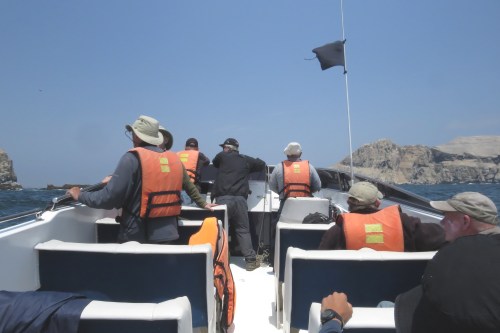
and head out to sea ….
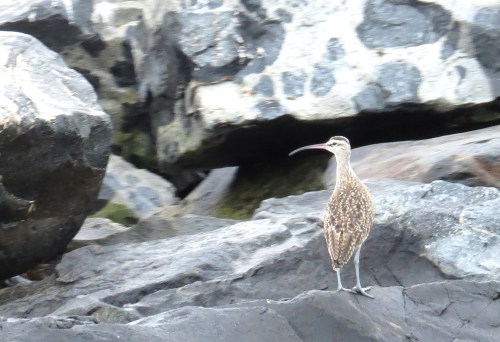
As we passed the breakwater we saw a Hudsonian Whimbrel ….

…. as well as several Surfbirds, a bird with one of the strangest non-breeding distributions on the planet, after leaving their Alaska/Yukon breeding grounds the entire population occupies a narrow intertidal band a few metres wide and 17,500 km long from Alaska to the Straits of Magellan. I wasn’t quick enough to get a photo as the boat sped by so I used this shot by Marlin Harms from Wikipedia.

Leaving the coast behind we headed towards the Islas Palominas ….
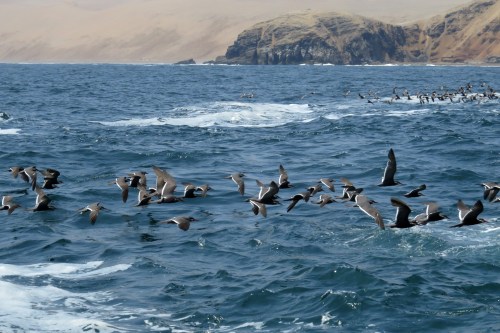
…. passing sizeable flocks of Inca terns …

…. and rocks covered with Peruvian Boobies.
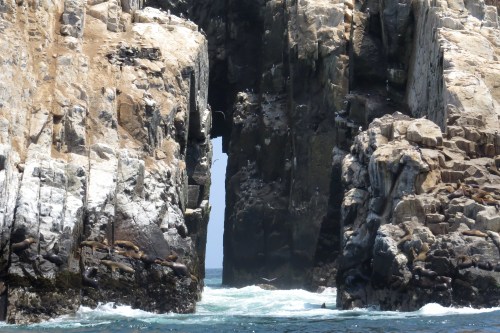
We spent some time at the Islas Palominas ….
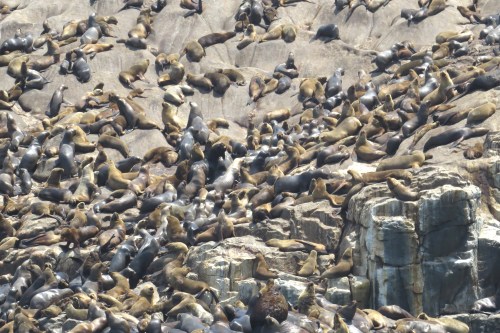
…. that held truly impressive numbers of South American Sea Lions.
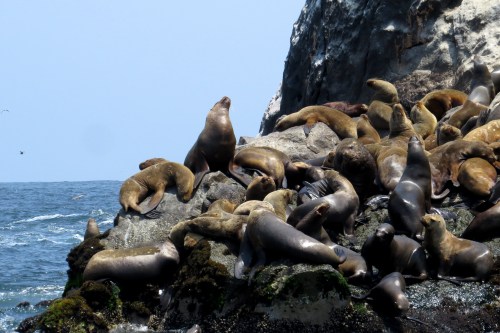
Many were hauled out on the rocks. The darker ones are still wet from their last swim.
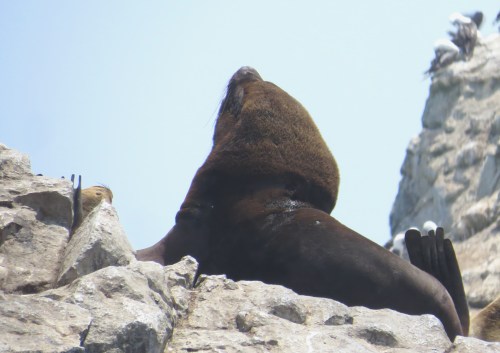
A small number of impressive bull sea lions were present.

A boat load of people were in the water …

…. swimming with the sea lions ….
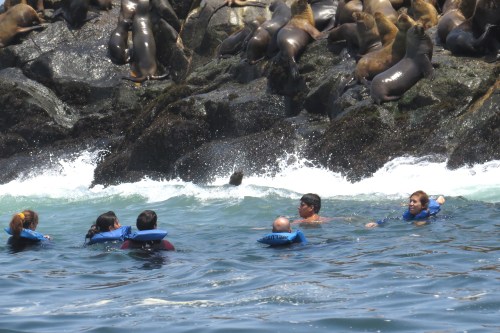
…. whilst undoubtedly a great experience for the swimmers, I’m sure it disturbs the sea lions, all the individuals on shore are alert and moving up the rocks (our boat is much further away and the photo was taken with a 1000mm telephoto setting) ….

…. in addition taking swimmers into such heavy surf close to the rocks is the height of folly (I was H&S man at work and can’t help doing ‘risk assessments’, even now).

Many other birds were seen including Peruvian Boobies, now much reduced in numbers compared to 30 years ago ….

…. although still providing a spectacle as they fly back to the rocks …

Once very common the boobies, like several other birds of the Humboldt Current, have seen catastrophic declines due to over fishing and climate change have all had an impact.

Three species of cormorant were seen, the elegant Red-legged ….
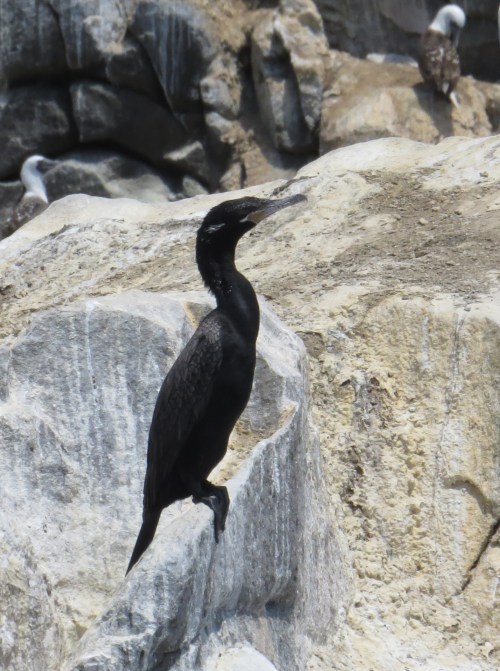
….Neotropic, which is more usually seen on freshwater lakes and the Guanay Cormorant, which although the commonest, was never seen close enough to photograph.
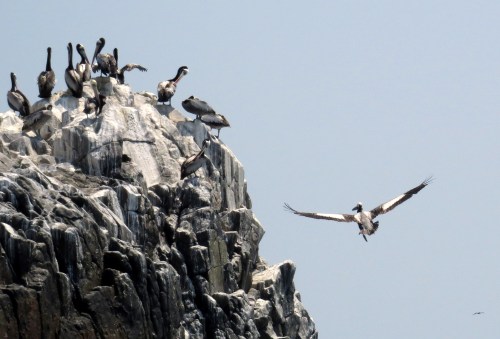
Another ‘guanay’ bird is the Peruvian Pelican, a larger version of the more familiar Brown Pelican.

For a centuries the droppings (guano) of all those cormorants and boobies was harvested for fertiliser apparently without harmful effects. However recently these ‘guanay’ birds particularly Guanay Cormorant have dropped markedly. On a similar trip in 1989 I recorded over 6000 Guanay Cormorants, this time we saw less than 1000. The major factors driving this decline seem to be the El Nino phenomena, climate change and overfishing. Here the loading platform and associated warehouses of the guano collectors can be seen.
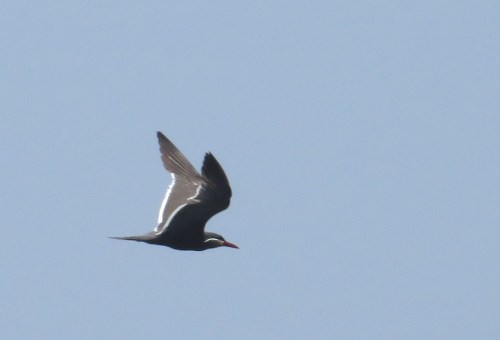
Other birds seen included the elegant Inca Tern ….

… often seen in large tightly knit flocks.

This lovely shot was taken by my friend and room-mate Steve Lowe.

The cold waters of the Humboldt Current which flows up from the Antarctic has allowed a separate species of penguin to evolve off the coast of central South America, named (perhaps unsurprisingly) Humboldt Penguin.

On the rocks were a number of Blackish Oystercatchers ….

…. and the only passerine of the boat trip, Peruvian Seaside Cinclodes.

Leaving the islands we headed out to deeper waters.

On an earlier post I described Belcher’s Gull as being ‘inappropriately’ named. A friend pointed out that it wasn’t inappropriate as the species was named after an Mr Belcher, so perhaps I should have said ‘unfortunately’ named. The original Band-tailed Gull was split into two – the Atlantic Olrog’s Gull and the Pacific Belcher’s Gull. I suppose we should be grateful the Atlantic species wasn’t named after any other bodily function!
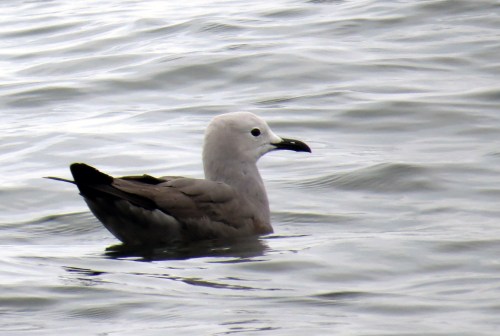
We only saw a pair of the delicately plumaged and ‘appropriately’ named Grey Gull.
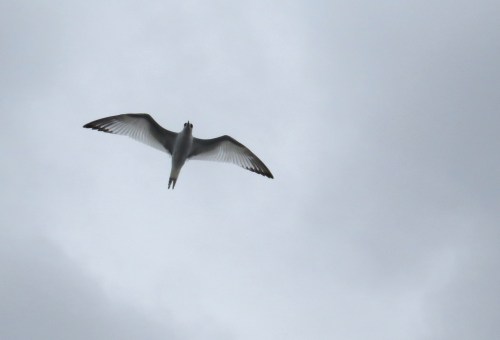
Further out under the persistent grey clouds we saw our first Swallow-tailed Gulls.

Swallow-tailed Gull breeds only on the Galapagos Islands (a location I have never visited). There are just two species of gull breeding on the Galapagos, the other – Lava Gull is one just of two gull species worldwide that I have never seen. The unusually large eyes must mean that it is adapted to foraging at night.
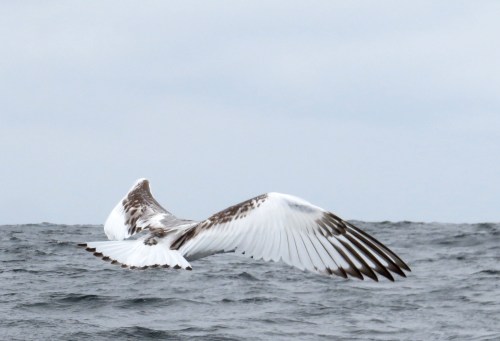
The upper-winged pattern makes Swallow-tailed look like a large version of Sabine’s Gull (an Arctic breeding species that also winters in the Humboldt current). We also saw Sabine’s on the pelagic but due to the rocking motion of the boat the photos were too poor to use.

Another gull we saw was Franklin’s Gull, named after legendary Arctic explorer Sir John Franklin whose expedition to discover the North-west Passage ended in such tragedy. The species breeds in the prairies of North America and winters in the Humboldt Current.
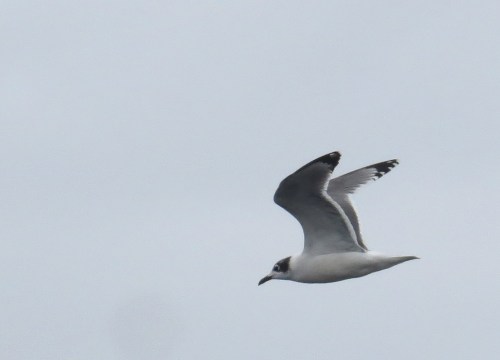
The species occasionally turns up in the UK as a vagrant and I have seen it six times at home, all in Dorset or neighbouring Devon and Hampshire.
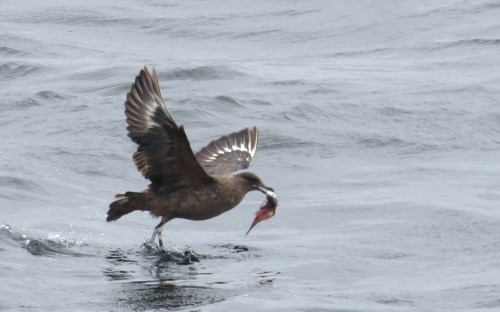
A migrant from the opposite direction was this Chilean Skua which breeds in the far south of South America.

Another migrant from the south was this White-chinned Petrel, the nearest breeding colonies are in the Falklands and South Georgia. Possibly not the best name for the species as the ‘white chin’ can be as little as a single white feather and can even be absent.

But one of the highlights of this pelagic was the storm-petrels. We saw no fewer than six species, four of which were life birds for me. These are Elliots (or White-vented Storm Petrels). The only known breeding grounds of this bird are the Galapagos and some islets off north Chile.

The diagnostic white vent and lower belly can be seen here, the pale panel in the underwing secondaries is best seen in the top photo.
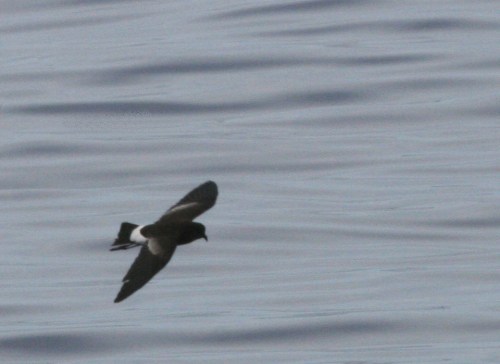
Wilson’s Storm-petrel is similar but much more widespread (the commonest seabird and possibly the commonest wild bird in the entire world, but we saw very few on this trip). It differs from Elliot’s by the lack of a white vent and a different flight action. I took this photo in the subantarctic in April 2016.

I’ve been unable to conclusively identify the storm-petrel in this picture. It is in moult which the Elliot’s weren’t. I suppose it is a Wilson’s but I have never seen them looking this long-winged. The other four species we saw can be easily excluded by rump colouration/shape.

From the small and crowded boat, and not having my DSLR with me, I found photographing fast-moving stormies to be very hard. The following three pictures (all of life birds) have been taken from external sources. Wedge-rumped Storm-petrel breeds mainly on the Galapagos but also along the coasts of Peru and Chile. Photo (taken from Wikipedia) by Brian Gratwicke

Another life bird was Markham’s Storm-petrel, a large and dark stormie. Until recently its breeding grounds were unknown but colonies (underground burrows) have been found several Km inland in the Atacama Desert of Peru and Chile. This photo by Cock Reijnders was taken from Internet Bird Collection. I also saw the northern hemisphere Black Storm-petrel which is very like Markham’s but is smaller with a different flight action.

The most striking stormie was Hornby’s (or Ringed Storm-petrel). Its breeding grounds have never been discovered but are thought to be in the Atacama Desert. Photo by Cock Reijnders taken from Internet Bird Collection.

But the best bird of the day and one of the top five birds of the trip was this Waved Albatross ….
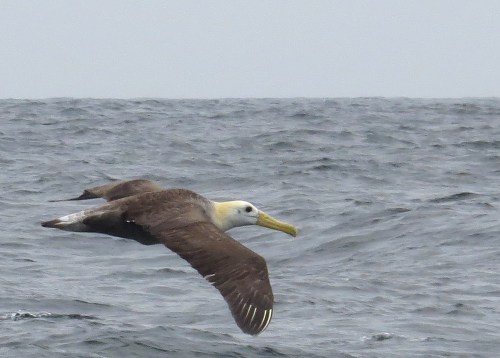
This magnificent bird breeds only on the Galapagos and is one of four albatross species confined to the northern and central Pacific.
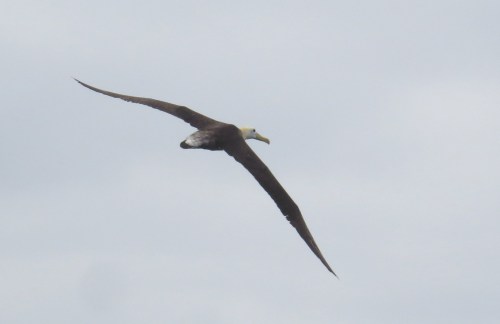
Waved Albatross is the new last albatross species that I will ever see. I hope to do a blog post on my observations of the world’s albatrosses soon but I need to assemble the photos, some of which are on 35mm slides.

After our return to Lima we had a quick look at this lagoon near the port.
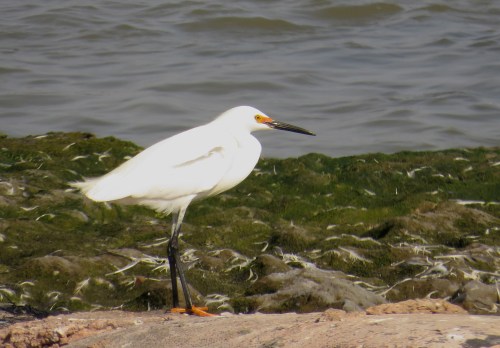
As well as expected species like this Snowy Egret ….
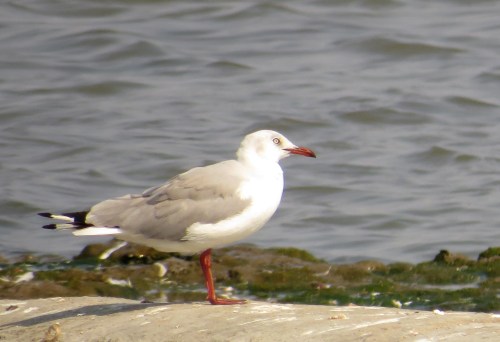
…. Grey-hooded Gull….
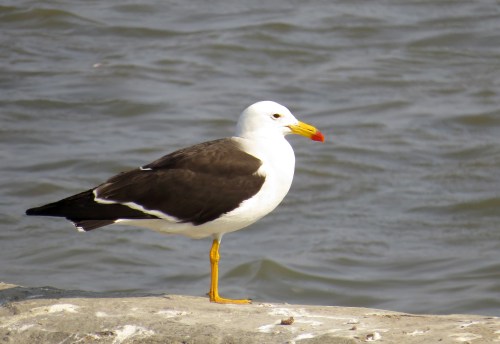
…. and this adult Belcher’s Gull ….
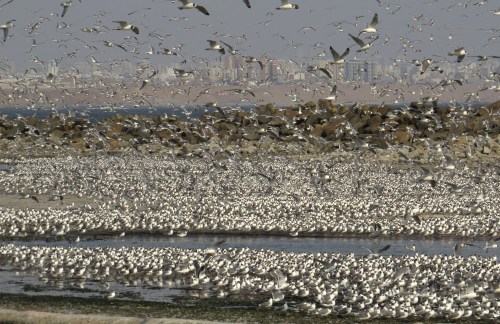
…. there were thousands upon thousands of Franklin’s Gulls. Our estimates varied from 20,000 to 100,000 but I made do with the lower estimate.
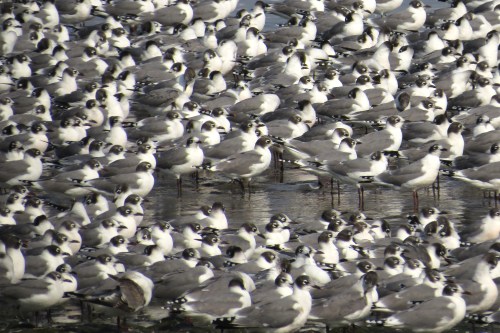
Franklin’s Gull can be distinguished from the similar but larger Laughing Gull in winter by the partial black hood and prominent eye crescents.
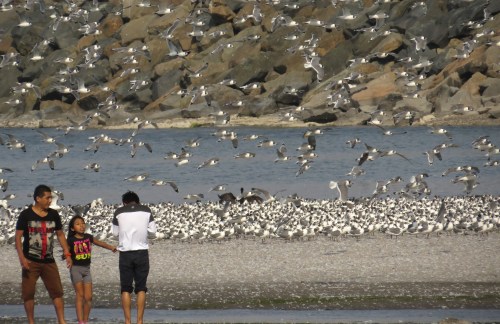
The gulls were easily spooked by people getting to close ….

…. but the resultant clouds were quite spectacular.

Franklin’s Gulls are unusual in that they have a complete moult after breeding ( as most gulls do ) and then again in the wintering grounds (a moult strategy shared as far as I know only by Willow Warbler). That said most of these individuals don’t seem to have started the moult yet.

This lad seems oblivious to spectacle behind him.
–
From here is was just a short drive to a hotel for a wash and brush up and then to the airport for the flight home. All my foreign trips are interesting and rewarding experiences but this trip was exceptional in many respects. Peru is one of the most interesting of all Neotropical countries and I hope to return for a fourth visit sometime in the future.
This post covers our final leg of the trip, back westwards to the continental divide and the descent to San Mateo with birding over the following two days at Marcapomacocha and the Santa Eulania Valley.
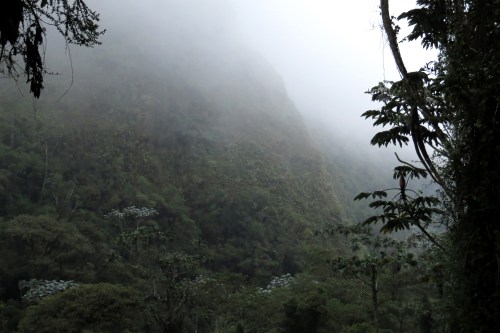
Following on from the last post we climbed out of the humid subtropics and headed westwards towards the high Andes.

Soon we were out of the cloud and back in puna grassland.

Domesticated llamas replace sheep at these altitudes.
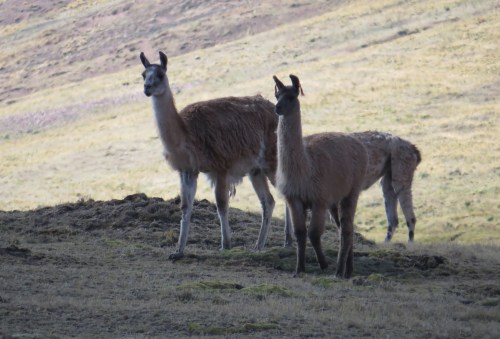
Llamas were almost certainly domesticated from the Guanaco, whilst the wool bearing Alpaca originated from the Vicuña.

A Variable Hawk watched us from a nearby ridge. Formerly treated as two species the lower elevation Red-backed Hawk and high elevation Puna Hawk; it was shown a decade or so ago that there were no consistent differences between the two and they were lumped under the name Variable Hawk. Back in 1989 as we climbed the Andes on my first visit to Peru, I asked the leader how you separated the two. ‘Easy’ was his reply, they are Red-backed before the lunch stop and Puna afterwards!
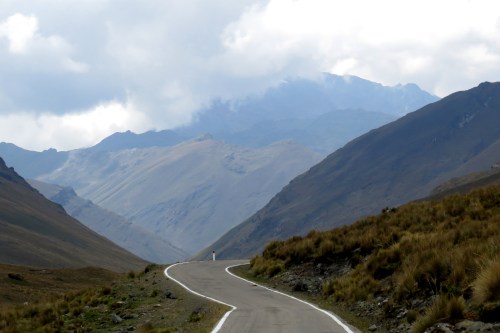
It was a long, but scenic drive punctuated with birding stops but became easier as the latter part was on tarmac. However we did meet some serious congestion when we reached the Central Highway.
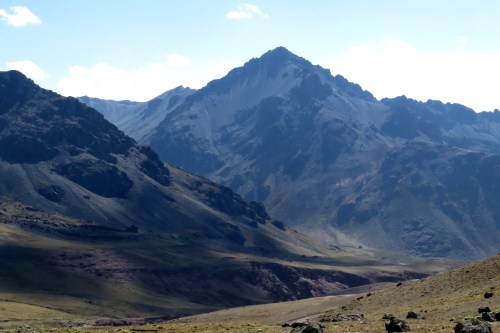
We were running short of daylight when we reached the continental divide at Ticlio Pass at an altitude of 4828m but we did have a short stop at Ticlio Bog.

In spite of the late hour we had good views of White-bellied Cinclodes, a critically endangered species restricted to a few high altitude bogs in Central Peru. (Photo taken the following day in good light). The world population may be as low as 50 pairs as the bogs are suffering from overgrazing, drying out – in the long term due to climate change (all are fed from glacial meltwater from glaciers that will eventually disappear) and in the short term, the effects of La Niña.

We had to descend for about an hour to San Mateo for the night. The next morning we retraced our steps back up to the pass and along a side road. At least we didn’t have to be there for dawn as there is virtually no bird activity that early on at these altitudes.

We soon started seeing cracking new birds like this Junin Canastero …
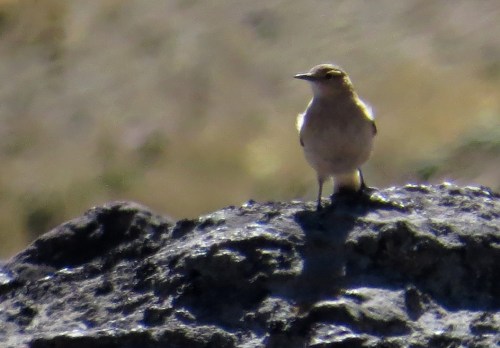
… Dark-winged Miner …

… and at the highest of the bogs – Andean Snipe …

… and another couple of pairs of White-bellied Cinclodes. For a critically endangered bird they were remarkably easy to see.

Dave, one of the participants, using a GPS to track our journey, declared that we were at 4898m asl. This was the highest I have ever been. However I realised that if I climbed two metres up this rock I could reach a nice round 4900m. I have often wished I could reach 5000m but there is no way I could climb a further 100m vertically. That said I had acclimatised and could walk about without the extreme shortage of breath and headaches that occurred at the start of the trip.

The acclimatisation was to be put to good use as our next stop was the bog at Marcapomacocha.

Whilst it was a couple of hundred metres lower than the Andean Snipe site we were to spend several hours jumping from one tussock to the next as we searched for our target species.
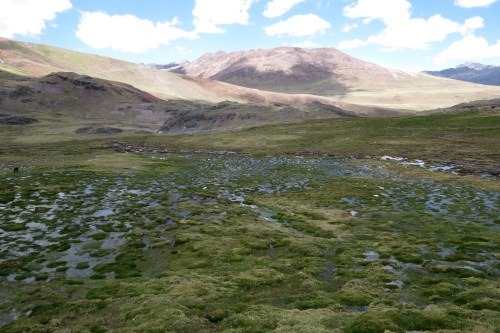
The meltwater from the glacier spreads out forming this hillside of shallow puddles interspersed with tussocks and cushion plants.

Of course there were common Andean wetland species like Andean Goose ….

… and Puna Ibis …

… whilst a Variable Hawk soared overhead.

With all dark underparts this was a very different bird than the one we saw the yesterday (hence the name). With so much variation in all populations it is understandable that the two former species were lumped, but on altitude alone this one would certainly qualify as a ‘puna’ hawk.

White-winged Duica Finches were common.

Although the epithets ‘white-winged’ and ‘finch’ are self-explanatory, no-one seems to know the origin of the world ‘duica’.

In the drier areas around the bog we saw several small groups of Rufous-bellied Seedsnipe, the third sneedsnipe species of the trip (the only other one White-bellied, is only found in the far south of South America).
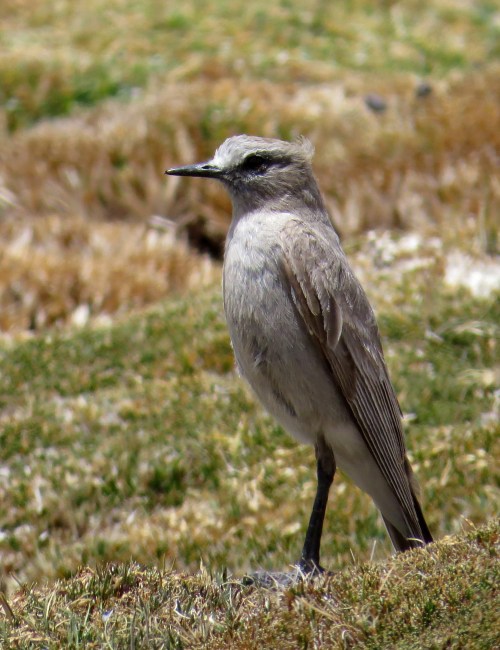
There were several species of ground-tyrant on the bog, the neotropical equivalent of the wheatears, this is a Cinereous Ground-tyrant. Had we come in the austral winter then the place would have been stacked with various ground-tyrant species as many migrate north from Patagonia seeking the comparatively mild conditions of the central Andes.
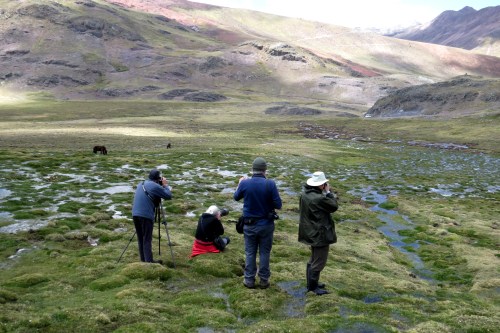
After some searching we eventually found the main prize …
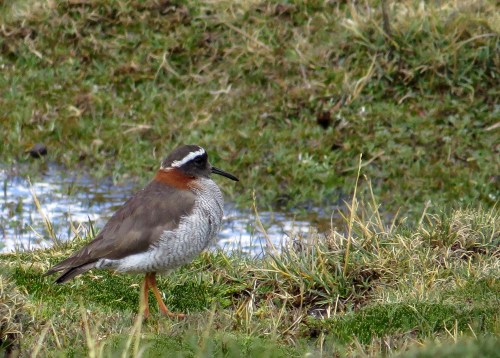
… the exquisite Diademed Sandpiper Plover …

… one of the most beautiful waders in the world. It has a wide range from Peru to Chile but occurs only sparsely in high altitude bogs. For me it tied with Junin Grebe as ‘bird of the trip’ but it only came fourth in the group-wide poll.

With this gem securely under the belt we slowly descended to the Santa Eulania valley. On this dirt road it took several hours before we reached our next destination …

…. there were many distractions both avian and scenic.

Our driver Julio (L) and tour guide Eustace.
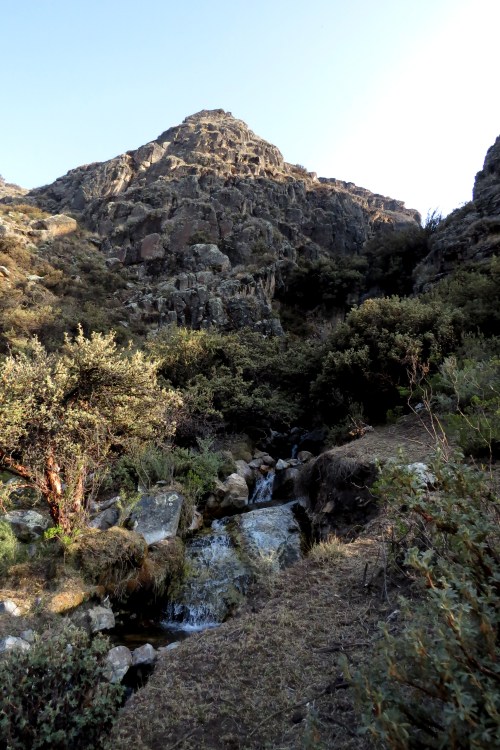
In the late afternoon we slogged up this gully at an altitude of about 4000m into the dwarf scrub (we are now of course on the dry side of the Andes so there is no temperate forest here).

As well as common and familiar species like this House Wren ….
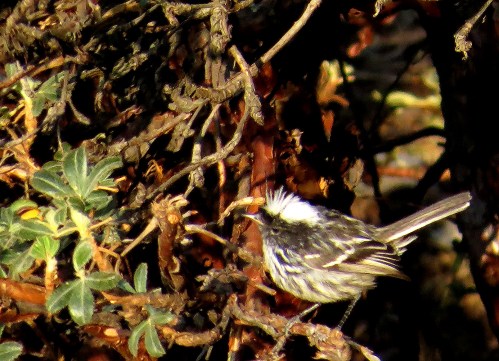
…. we found the beautiful Pied-crested Tit-tyrant …

… surely one of the cutest of the 436 strong tyrant-flycatcher family.
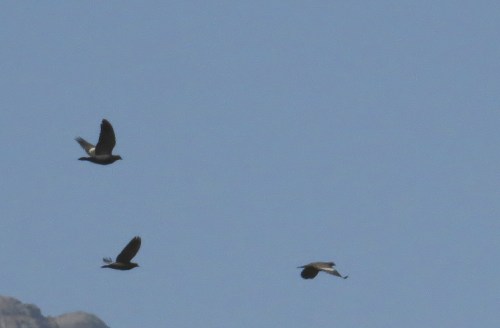
A small flock of Spot-winged Pigeons was a surprise as they are mainly confined to the east slope of the Andes.

Our main target was this Rusty-bellied Brushfinch which was a life bird for me.
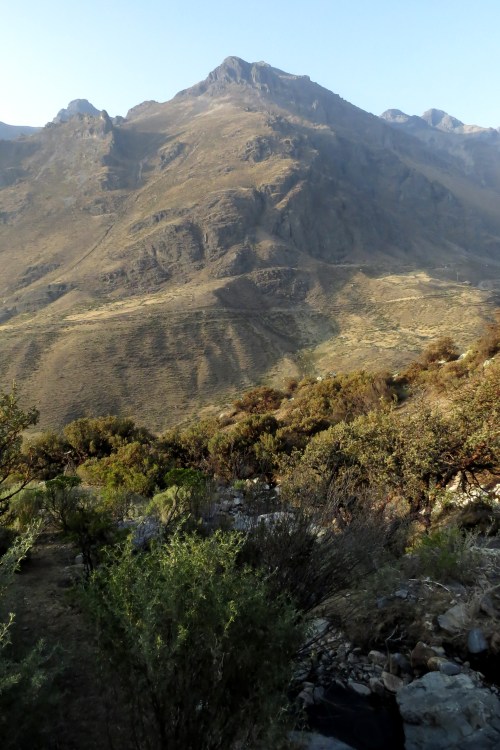
With the day drawing on it was time to head down to the town of Santa Eulania which at an altitude of a mere 1000m was a long way below.

Driving down these narrow dirt roads in the dark was quite scary (these photos were taken of the same area the following day).
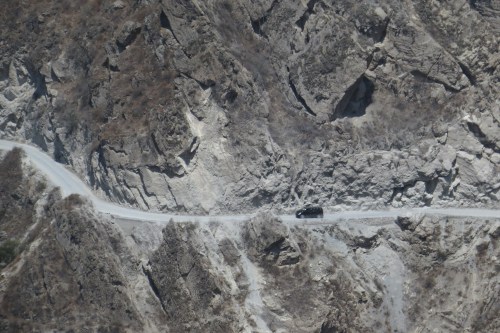
I was at the back of the minibus and on the left so I could see directly down a 1000m or so to the river glinting in the moonlight.
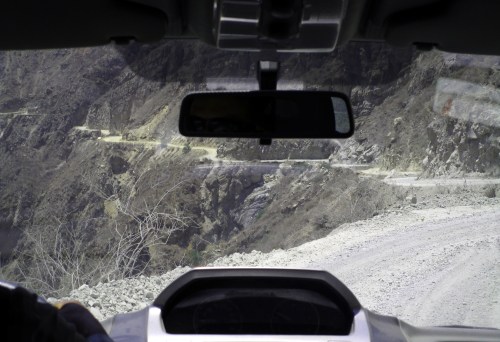
We also had a puncture but fortunately not on of the perilous hairpin bends. All of the staff seemed to have left the hotel leaving only a night-watchman so it was a bit of a Fawlty Towers situation. We ordered in pizza for our evening meal and ate it out on the lawn.

The following morning we returned up the Santa Eulania road and took a side road to reach the other side of the valley.

We spent a few hours birding an altitude of about 3000m.

This Bronze-tailed Comet was a new bird for me as was the pretty, yet elusive Rufous-breasted Warbling Finch (but I didn’t get any photos of that one).
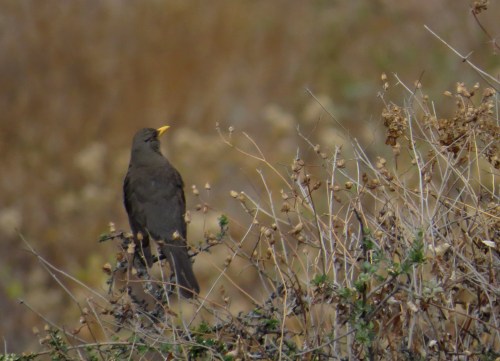
Again there were plenty of common species around such as this Chiguanco Thrush.
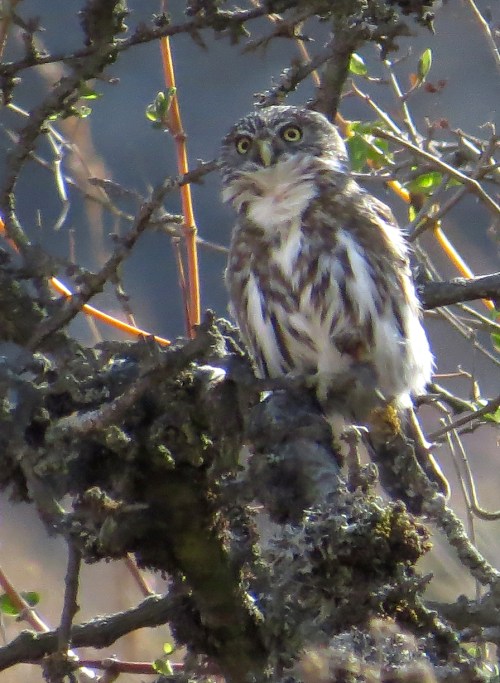
Lower down see saw this Pacific (aka Peruvian) Screech Owl.
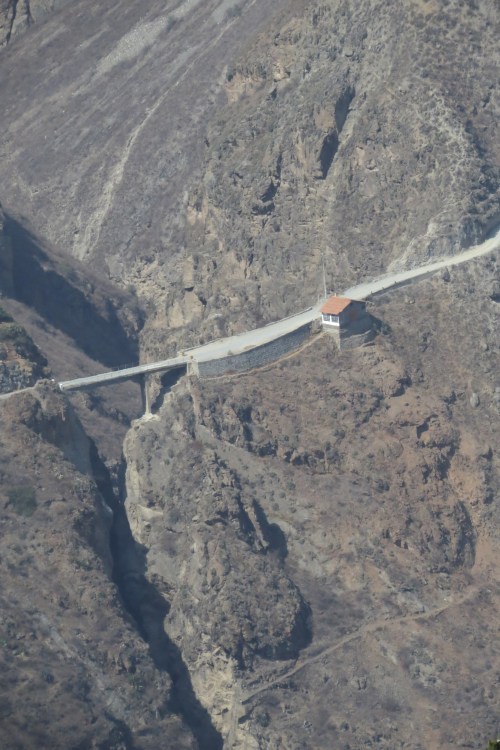
We descended still further and crossed the valley via this bridge.

Views from the bridge in both directions were quite spectacular.

From here we joined up with the road that we used last night and returned to the hotel. We packed up and had a leisurely lunch before heading off to Lima for our final night in Peru.

….. but just before we left we had views of this female Peruvian Sheartail in the hotel garden – our last ‘quality’ land bird of the trip. Photo by tour participant Steve Lowe.

The drive back into Lima was, as expected slow and tedious but we arrived at the hotel with plenty of time for a clean up and a repack.
The trip wasn’t quite over, as although our land birding was over we had another day before our evening flight home and that would involve a pelagic out on the Pacific Ocean. The subject (of course) of the next post.
This post covers our journey from Lake Junin across the puna and the descent (again) into the more humid eastern flank of the Andes, visiting several different valleys before heading back west towards the continental divide.

To reach our next destination at Villa Rica we took a short-cut through the mountains, that way we hoped to avoid all the lorries crawling along the main road.
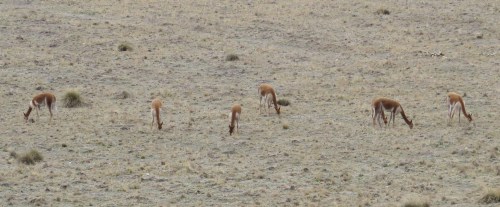
It was well worth it as we had great views of these Vicuña, wild camelids of the puna grasslands.

Vicuña wool is said to be the softest in the world and they were once almost hunted to extinction. Vicuñas are now well protected and have been reintroduced to parts of their native range.

The short cut was going well until after an hour or more we found the road ahead was closed. There was a diversion but it was on more of a mule track than a road. In spite of some scary moments we made it through.
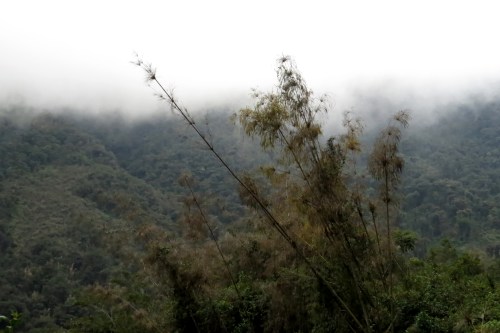
The following day as we descended into the cloud forest again we realised that the bamboo had flowered recently and now was in seed. Various seedeaters were common and we even saw the nomadic Slaty Finch, although the equally nomadic Maroon-chested Ground Dove was a ‘heard only’.

By lunch time we arrived at Ulcumana Lodge, a beautiful location in some charming subtropical forest. The forest here was similar to that at the Carpish Tunnel but was more extensive and less degraded.
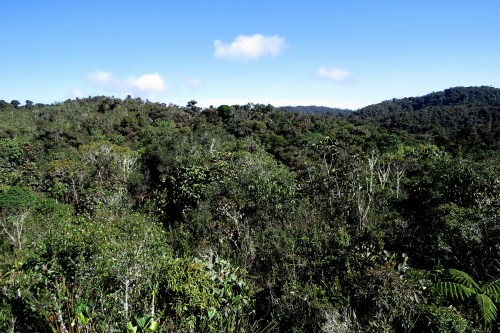
It would be worth the tour operators spending less time at the Carpish Tunnel and more here, but I would have hated to go home without the Orange-breasted Falcon under the belt that we only saw at Carpish.

We saw many birds here but few were photographed, at least by me. Here is the diminutive Peruvian Tyrannulet ….
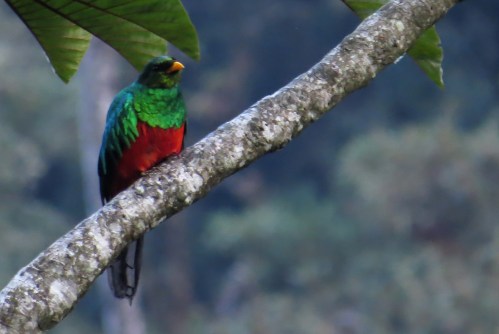
…. and here the rather more impressive Golden-headed Quetzal. The best birds by far were seen at night, a magnificent Swallow-tailed Nightjar and also Cloud Forest Screech-owl a species new to the Birdquest Life List (which now must be approaching 10,100) Photos of both will be available on the Birdquest tour report once it has been uploaded to their web-site.
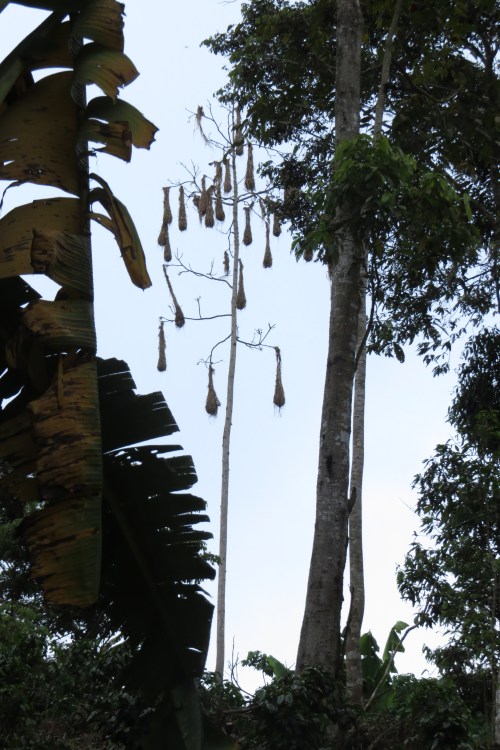
We didn’t have enough time at the lodge as the next day we had to move on, on route we saw a whole new range of birds resulting in multiple ‘write-ins’ and I managed to photograph these oropendola nests if not the oropendolas themselves.
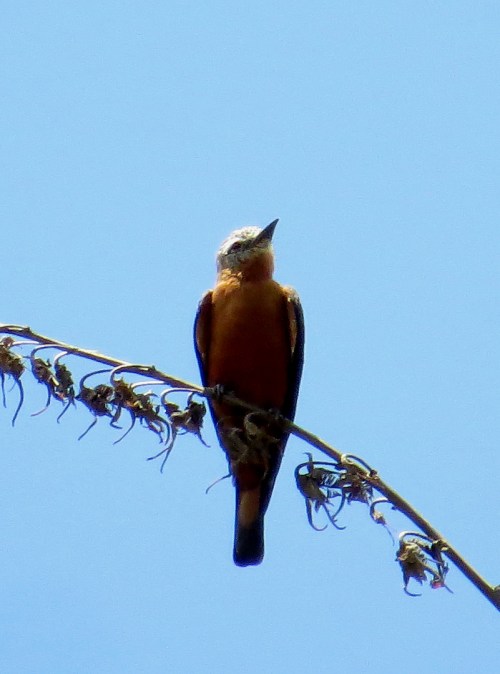
On route we saw this Cliff Flycatcher ….
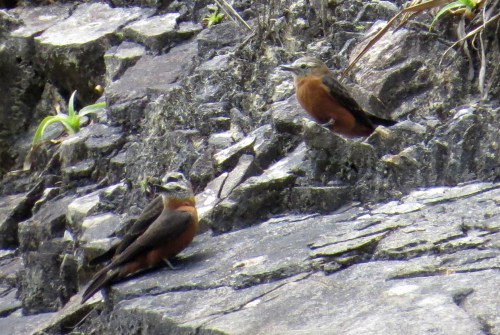
The two adults were feeding a juvenile.
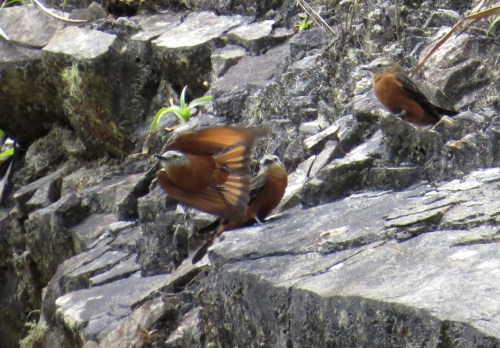
The Cliff Flycatcher’s rufous flight feathers shows nicely in this shot.

We descended further into the lowlands where even more ‘write-ins’ were added to our ever-growing list ….
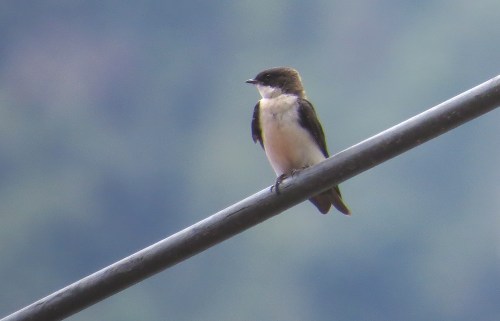
Blue-and-White Swallows were a familiar site although this young bird is neither very blue nor very white
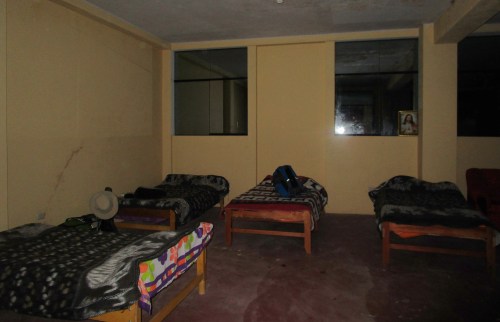
There are few hotels in this remote area and we spent the night in this basic accommodation, but as our evening meal was prepared by our helpful drivers and they had a stock of cold beers in for us, it was no great hardship.
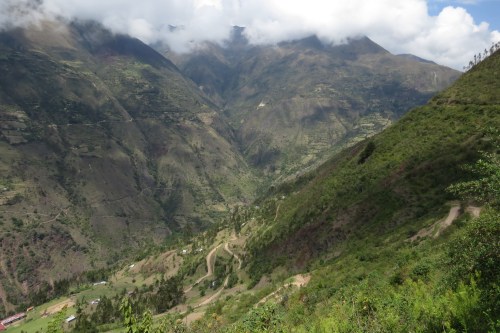
The following day we headed for the nearby Upper Mantaro Valley, an area that has been neglected by birders yet has recently be shown to harbour several endemic species.

Some of the first birds we saw were the widespread Andean Guan ….

…. and Spectacled Whitestart

The recently described Black-spectacled Brush Finch is a much more restricted ranged bird ….

…. although I prefer the alternative name of Black-goggled Brush Finch.
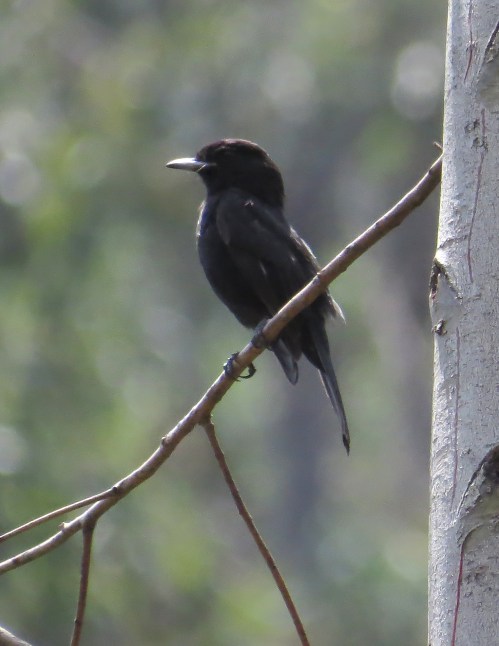
White-winged Black Tyrant is quite widespread ….
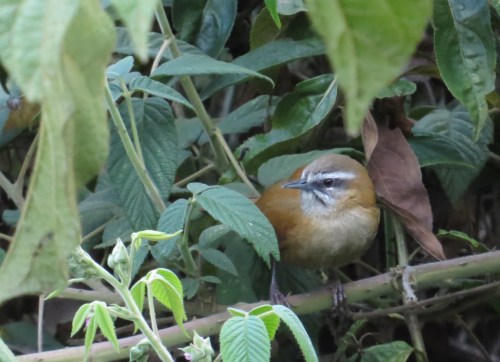
….. but the ‘Mantaro’ Wren is a newly discovered (and possibly still undescribed) form of Plain-tailed Wren that almost certainly deserves specific status ….
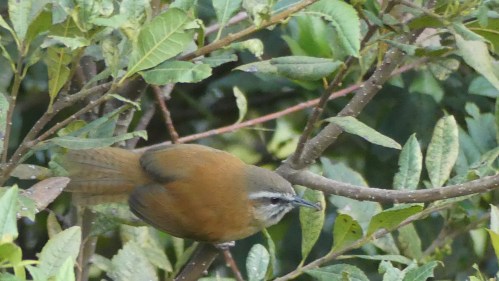
…. the lightly barred tail and paler grey head are some of the features that distinguish ‘Mantaro’ Wren from the highly disjunct Plain-tailed Wren. Photo by fellow tour participant Steve Lowe.

Other goodies in the Mantaro drainage included Eye-ringed Thistletail.

One problem of using a bridge camera is that it is impossible to get a sharp focus if there is vegetation between you and the bird, but at least I got a record shot of this Creamy-crested Spinetail.

We had good views of this Violet-fronted Starfrontlet (don’t hummers have the most marvellous names) ….
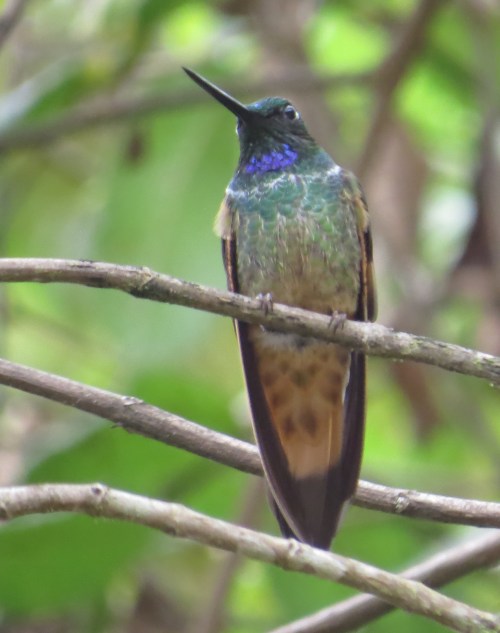
The Peruvian form of this species may be split as Huanaco Starfrontlet (and indeed already has been by the Lynx/BLI Illustrated Checklist) the remaining population would the become a Bolivian endemic and be known as Bolivian Starfrontlet.

In due course we left the Mantaro drainage and headed towards our stop for the night ….

…. more basic accommodation, but the single bright light by the outside wash basin attracted a multitude of moths and I took many photos to send to moth-er friends back home (the hyphen is essential otherwise moth enthusiasts become ‘mothers’).

The next morning we had a field breakfast just as the sun was touching the high peaks.
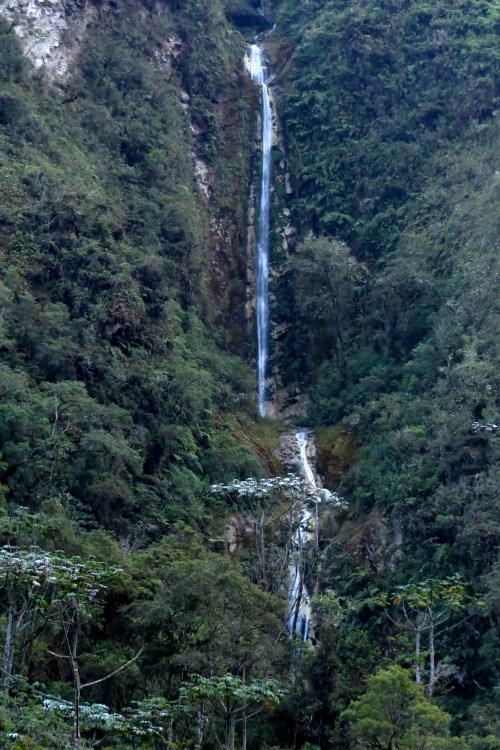
It certainly was a breakfast table with a view.

These cecropia trees are typical of the subtropics, the low cloud and poor visibility is typical of the subtropics as well!

A Broad-winged Hawk, a winter visitor from North America watched from a nearby branch.
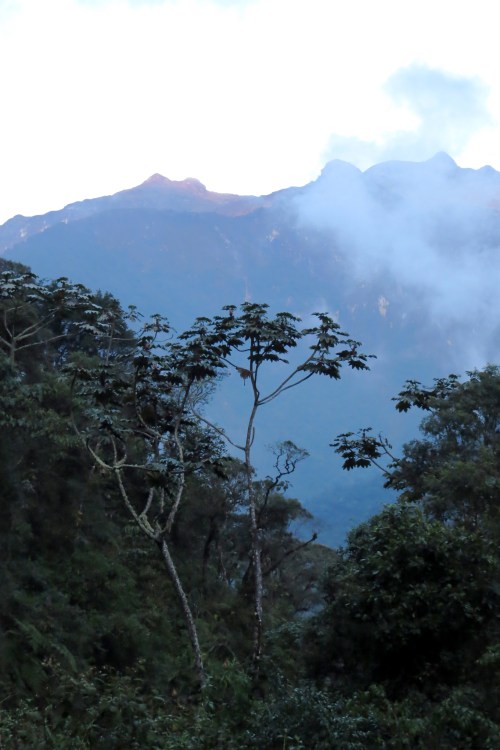
During the morning we slowly gained altitude and left the subtropical zone and the humid eastern slope of the Andes behind. From here we would cross the continental divide and descend towards Lima. That will be the subject of the next post.
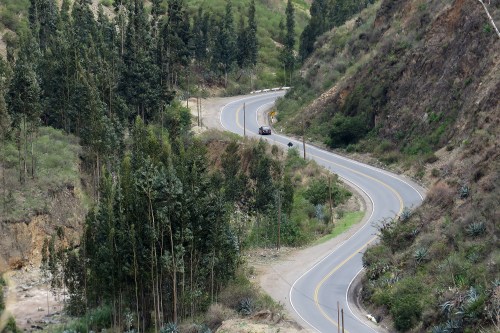
After leaving the Huanaco we explored areas near Huariaca, notably this steep-sided canyon.

It was a bit of a slog climbing up the steep sides but we were getting used to the altitude.

Meanwhile our ever helpful drivers prepared lunch. Note how the use of a telephoto lens has altered perspective, the front of the bus appearing wider than the back. This ‘size illusion’ can be critical if you are comparing the size of one bird in a photo (say a peep) with another species (say a Dunlin) that is a little way behind it.
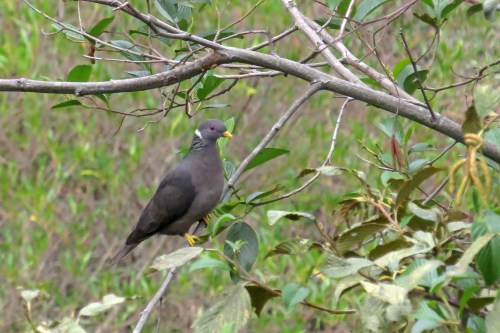
Some of the species we encountered well familiar to us like Band-tailed Pigeon ….
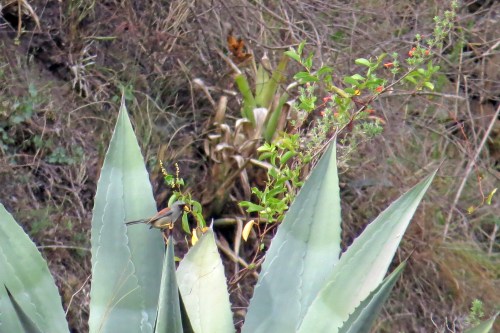
…. but eventually we found our target, the rare Rufous-backed Inca-finch.
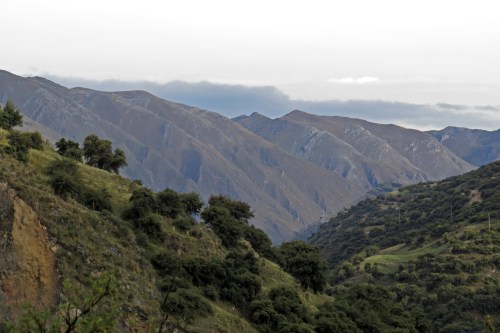
The following morning we stopped at an area of polylepis forest in the upper Huariaca valley.
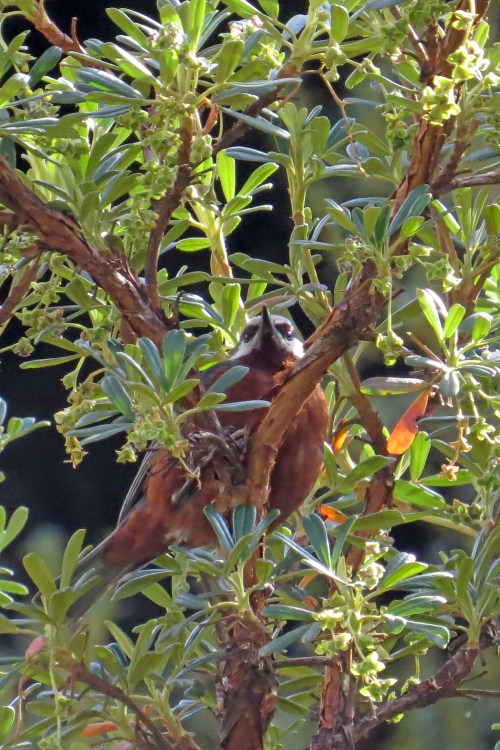
We encountered a number of localised species such as this Giant Conebill ….

…. as well as widespread ones like Cream-winged Cinclodes.

One of our main targets was Stripe-headed Antpitta which had eluded us up to now. We eventually caught up with it in this grove of gnarled polylepis trees.

Much of the polylepis forest has been felled, either for firewood or to replace it with alien and wildlife unfriendly eucalyptus which is preferred as its fast growing straight trunks can be used in construction and as windbreaks. However as this photo shows if coppiced polylepis can grow straight and quite quickly.
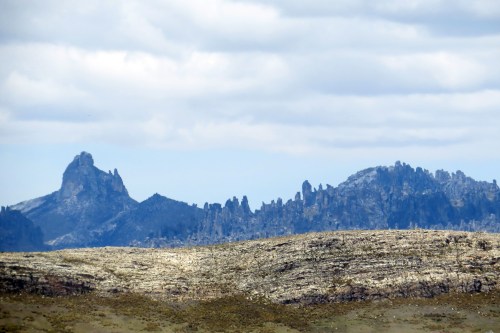
By the afternoon we arrived in rocky basin that holds the enormous Lake Junin, the second largest lake in Peru (after Lake Titicaca)

Surrounding areas held a good range of species including Burrowing Owl ….

…. Puna Ibis ….
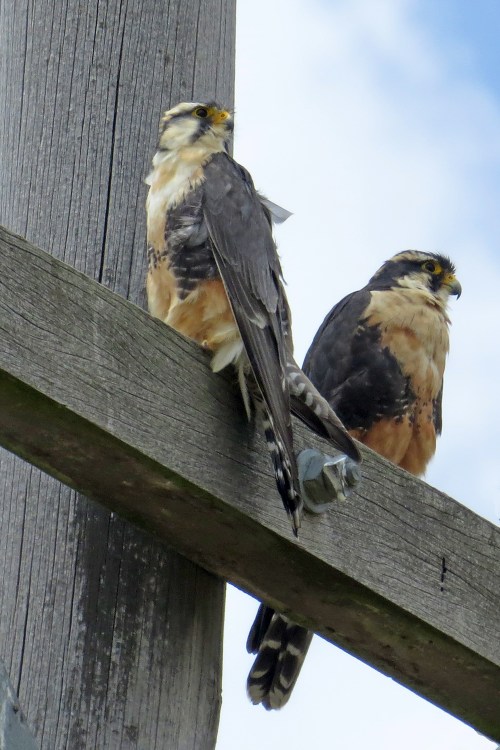
…. this lovely pair of Aplomado Falcons ….
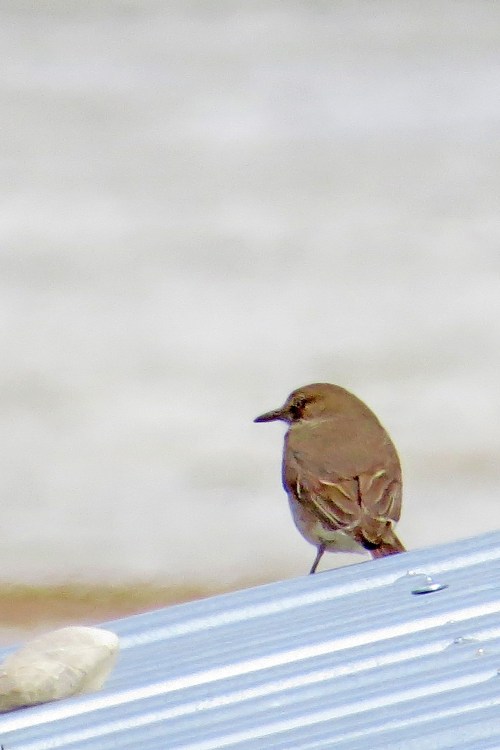
…. the now familiar Black-billed Shrike Tyrant ….

…. Ornate Tinamou (photo by my friend and trip participant Steve Lowe)

Buff-breasted Earthcreepers showed nicely.

In general there is less variation in English from one field guide/checklist to another the Neotropics than in any faunal region yet the field guide confusingly calls this Plain-breasted Earthcreeper.
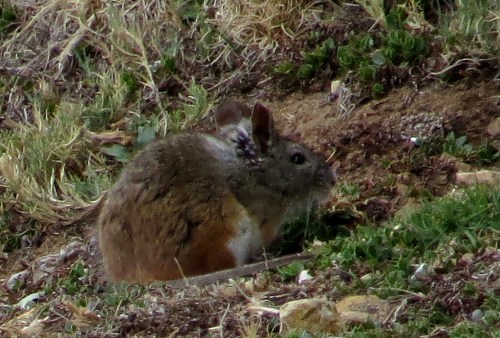
This rodent was eventually identified as an Ashy Chinchilla Rat

We could look out on the expansive waters of Lake Junin ….

…. and the many lagoons that fringed its shores.

Photography (for example of this Andean Avocet) was difficult as we would have flushed the birds if we had disembarked, so it had to be done through the single opening window which resulted in several of the group performing strange contortions.

One of the stars of the show were these Chilean Flamingos ….

…. but although Chileans were common we didn’t see James’ or Andean Flamingos, species that mainly occur on the salt flats further south.

One of the highlight of this trip was seeing the normally invisible Black Rail. Although I have heard this species in the USA it is very rarely seen. Patiently waiting with our eyes fixed on this gap in the reeds we waited for one to respond to a tape, in the end we saw a pair but they was too quick for photos. The Lake Junin form differs vocally from other populations and probably should be split as Junin Rail.
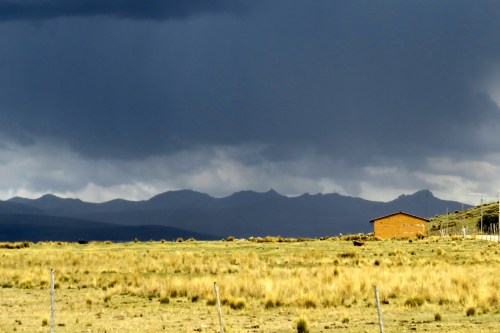
With storm clouds gathering ….

…. it was time to head to the town of Junin for our overnight stop

There was time for some birding on the outskirts of the town …,
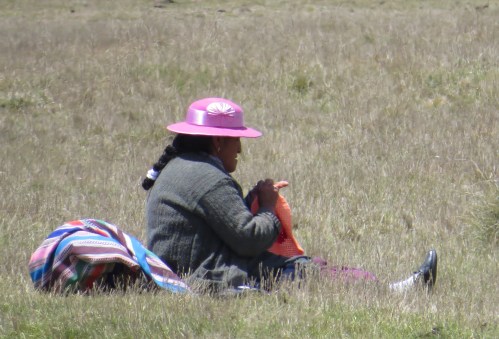
…. avoiding the gaze of a local knitter ….

…. we searched for species like D’Orbigny’s Chat-tyrant and ….

…. Andean Flicker

The following morning we met up with a boatman who took us along a channel and out into the middle of the lake.
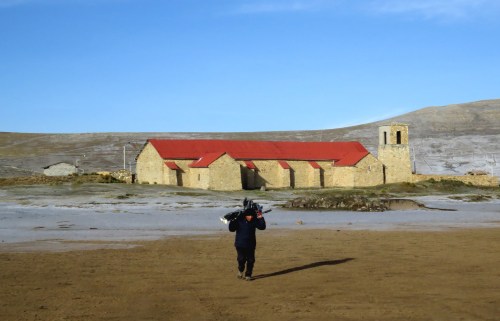
The boat was at its mooring but the outboard was safely stowed elsewhere. The boatman slung the 80kg engine over his shoulder and ran towards us; all this at an altitude of 4100m !
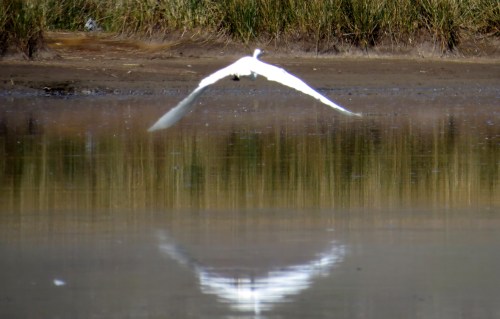
Many birds were seen on our way out such as this Great Egret
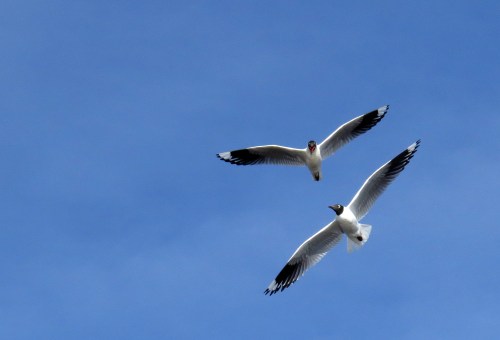
Andean Gulls were breeding on the margins of the lake ….

…. and were are constant companions until we were far from shore.

The many ducks included Yellow-billed Teal ….

…. Puna Teal ….
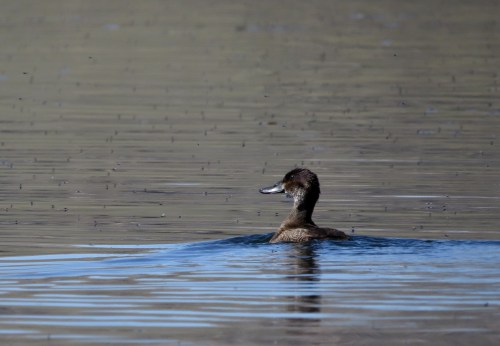
…. and Andean Duck, a species that is sometimes lumped with the North American Ruddy Duck

White-tufted Grebes were easy to find but they were not our main target ….

Far out in the middle of the lake we came across four Junin Grebes, a flightless species endemic to this one lake. Official estimates give a population size of over 400, but our boatman, a local warden and others who know the area well think it could be as low as 40. The species is threatened by pollution from local mines and the introduction of Rainbow Trout.
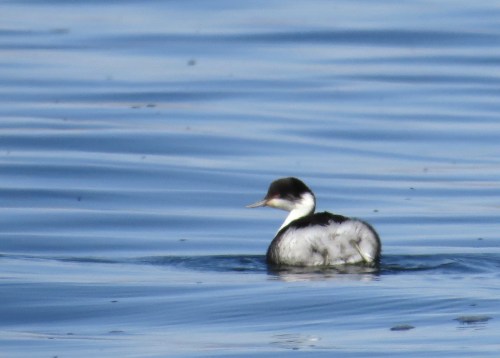
Until the 70s there were 23 species of grebe in the world but in a short space of time three went extinct, one each in Madagascar, Guatamala and Colombia. In each case it was due to a change in water use, usually the introduction of predatory fish which ate all their food or the pollution from agriculture. It now looks like two more species will join them in the near future, Junin Grebe and the Hooded Grebe of Patagonia. Junin Grebe was the last of the 20 extant grebes for my world list but my joy in seeing it was tempered by the thought that we could be some of the last birders to do so.
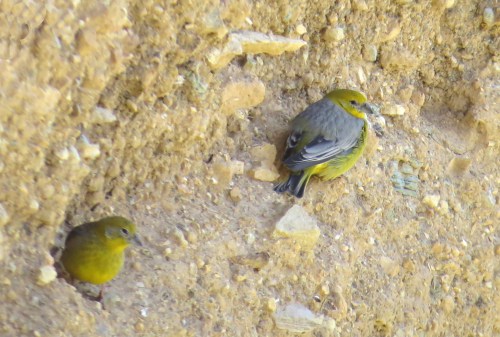
Whilst the outboard and boatman were delivered to their rightful destinations we birded around the nearby buildings seeing many Bright-rumped Yellow-finches
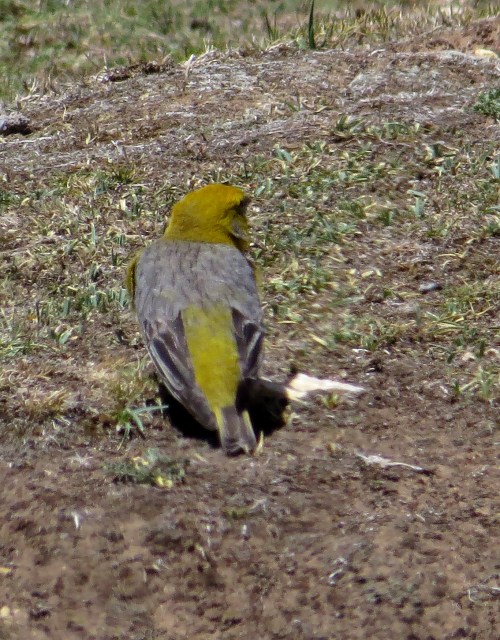
…. some living up to their name.

Also there were good numbers of the beautiful Black Siskin.

The male Black Siskin in particular is quite a stunner.
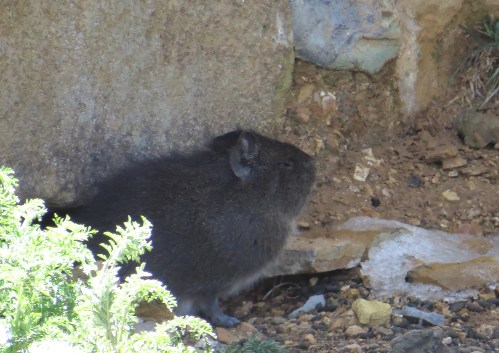
We had good views of this Andean Cavy, the wild ancestor of the Guinea Pig.
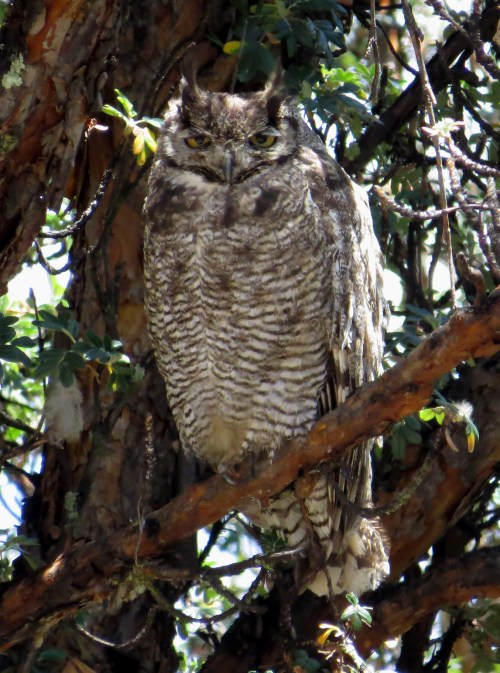
Our time at Lake Junin ended with a search for a hummer called Black-breasted Hillstar, whilst we did see it well, it was nesting inside a barn and the photos were poor. However this Magellanic Horned Owl that was found nearby posed nicely.
We spent four nights in the comfortable yet very noisy hotel in Huanaco. During this time we explored two areas, the partially degraded forests around the Carpish Tunnel and Paty Trail and the cloud forests of Bosque Unchog. We spent two and a half days at the former and two days at the latter.

Rising out of Huanaco the road climbs through a mainly dry habitat now largely deforested to grow crops of decorative flowers.

As the road emerges from the tunnel under the Carpish Pass onto the eastern side of ridge the habitat changes markedly to humid cloud forest. Once the inevitable jokes about the ‘Carpish Tunnel syndrome’ were complete we set about exploring this wonderful area.

Birding in cloud forest can be tricky. If the cloud lifts the birds tend to be inactive and silent, however too much fog and you can’t see the birds in the murk.

The locals are used to it, these kids seem to have no problem playing football in 30m visibility.

But when it’s clear enough to see the birds the cloud forest can deliver some real crackers, like this Grey-breasted Mountain Toucan.

Most of our time was spent on the Paty Trail which descends from about 2700m near the tunnel to the main road far below. This local man told us he had been down to the town at the start of the track and it had taken him seven hours to climb back up (we met him at about 0900 so most of that was in the dark). A long way to go if you run out of milk!

Many consider the birding in the cloud forests of the eastern slope of the Andes to be the finest in the world. Certainly there is little that can match the flocks of dazzling multi-hued tanagers that appear and disappear out of the gloom, full of gems such as this Flame-faced Tanager ….
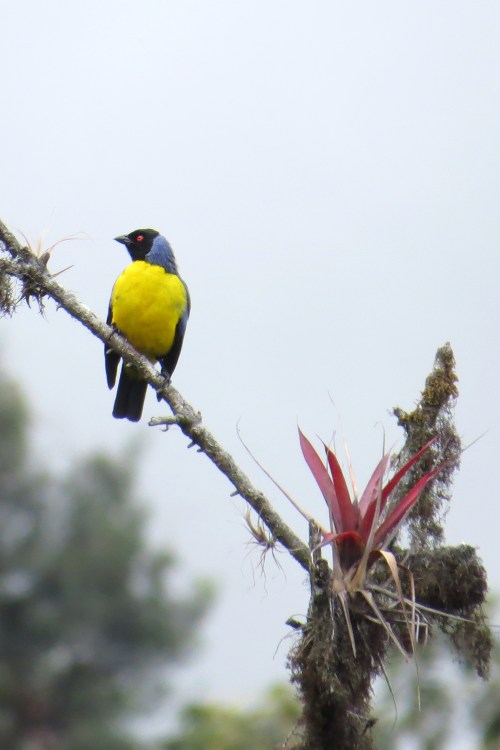
…. or this Hooded Mountain Tanager
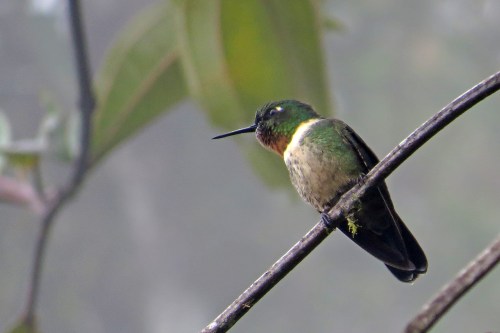
…. Hummingbirds were represented by Amethyst-throated Sunangel ….

…. and Collared Inca.
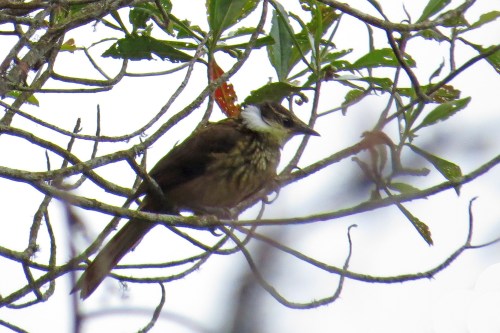
We didn’t see as many furnarids here as in the open puna habitats on this tour, but Streaked Tuftedcheek was seen quite regularly in the cloud forest.
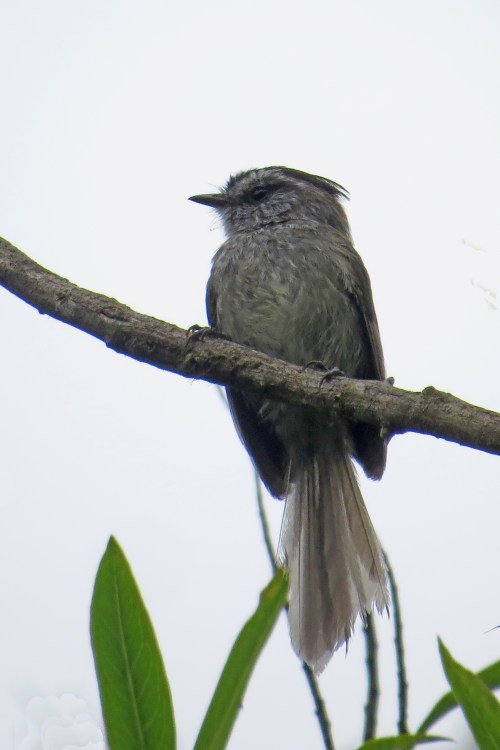
No Neotropical forest would be complete without its quota of tyrant flycatchers – here an Unstreaked Tit-tyrant ….
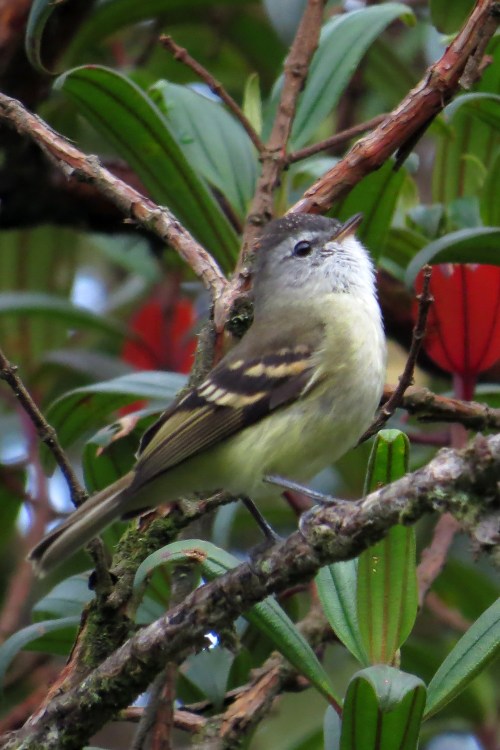
…. and here a lovely little Tawny-rumped Tyrannulet. Many UK birders if told this little bird with its wing bars, insectivorous bill and yellow, grey and brown plumage was a Phylloscopus warbler would go all dewy-eyed, however if told it was a tyrannulet they would diss it as ‘list fodder’.
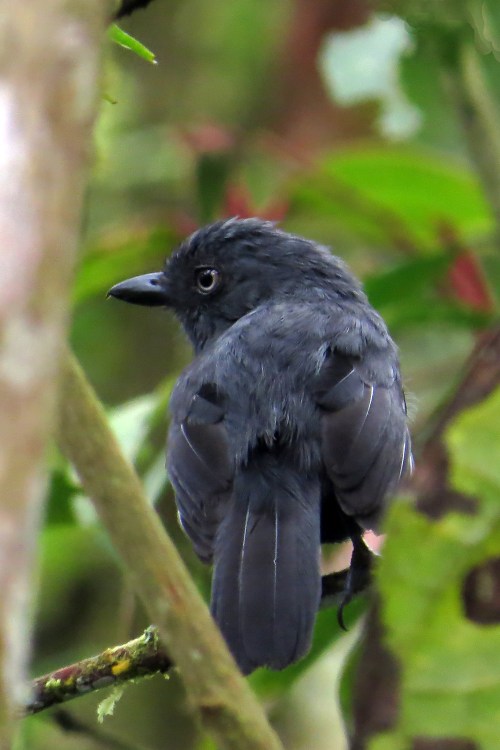
Antbirds tend to be more characteristic of lowland habitats, although a few reach mid-elevation. This Uniform Antshrike was one of them.
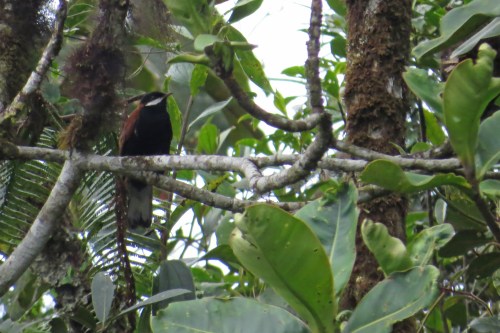
This forest held a high concentration of White-eared Solitaires and their single high bell-like note, sounding like an alert on a mobile phone, was regularly heard.

Of all of the neotropical passerines, the cotingas are some of the most spectacular. We may have dipped on White-cheeked Cotinga earlier on in the trip but here we scored with Band-tailed Fruiteater ….
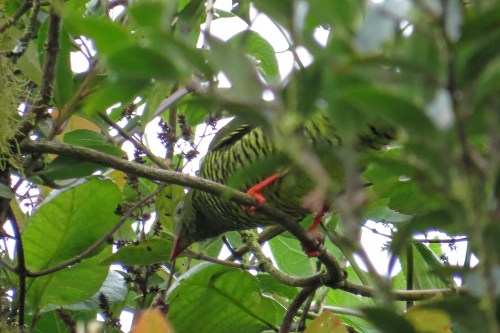
…. and Barred Fruiteater.
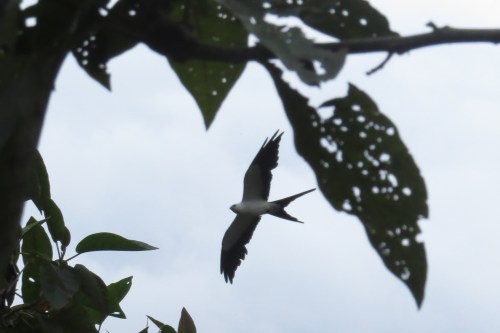
Overhead we caught a glimpse of the elegant Swallow-tailed Kite through the foliage ….

…. but it was much further down, below the level of the clouds, that we had distant views of one of the top birds of the trip ….
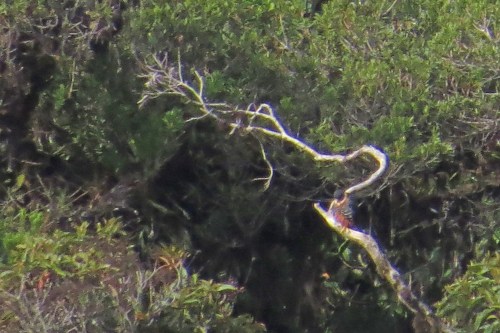
…. the widespread but rare and totally stunning Orange-breasted Falcon. I have made multiple trips to areas within this bird’s range which extends from Belize to Argentina, but have always dipped. We could hear it calling for ages before sharp-eyed Ken picked it up in flight and was able to follow it back to a perch. It was possibly over 1Km away but such is the power of digital photography that I was able to get a record shot.

Another group of neotropical passerines that always generate a lot of excitement are the tapaculos. In the south, in Chile and Argentina there are some large tapaculos that inhabit open areas but the cloud forests and puna are inhabited by the Scytalopus tapaculos. All Scytalopus are similar (there are 43 of them) and many can only be told apart by their vocalisations. This photo might not be in focus but it captures the jizz of these charming little birds perfectly. With their short wings and tail they seldom fly and skulk around invisibly on the ground. When responding to a tape they have been known to pass unseen between an observers legs. The dry La Nina conditions meant that many of the tapaculos and antpittas weren’t responding, although in the end we did see a full suit of seven tapaculos but only four out of the seven possible antpittas – and we had to do a lot of work to see those.
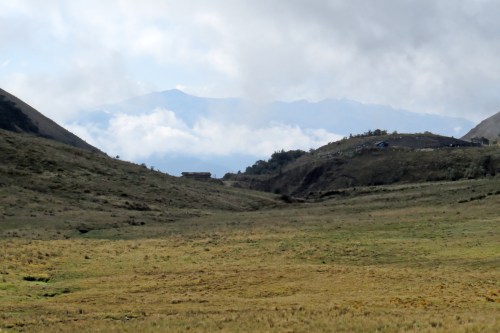
The other site we visited during our stay at in this area was Bosque Unchog. In the past you have had to camp at this rather wet and cold location but road improvements have made it possible to day-trip it from Huanaco

The only birds we saw in the boggy areas were Andean Lapwings ….

…. but our goal was the cloud forest below this escarpment.
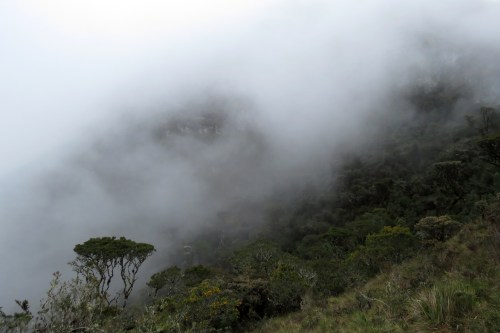
These cloud wreathed trees are home to a range of very special birds but finding them in the fog can be problematic.

In the 1970s researchers from Louisiana State University discovered three new species to science at this site. In this high area of elfin forest they found a new mountain-tanager (Golden-backed Mountain-Tanager, one of the largest tanagers of all) a cotinga in a totally new genus (the Bay-vented Cotinga), and a very odd little tanager, the Pardusco. We were able to see all three of these wonderful birds.
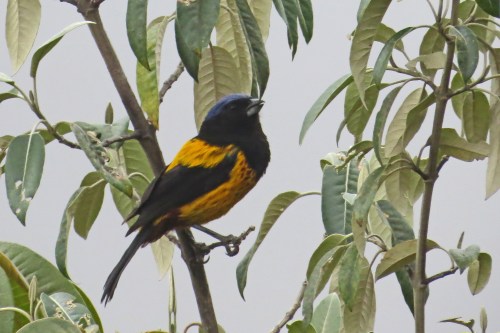
Firstly the beautiful Golden-backed Mountain Tanager ….
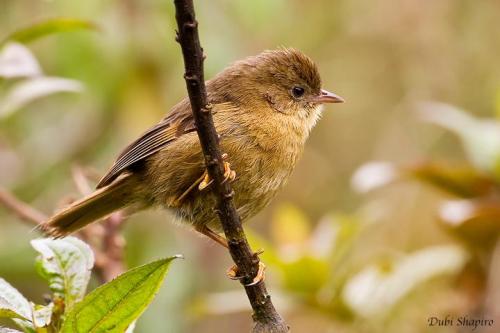
The second of the LSU’s discoveries was the Pardusco, a dull coloured gregarious tanager. Photographing these fast moving specialities in foggy conditions was tricky, so I have used a picture from the Internet Bird Collection taken by Dubi Shapiro at Bosque Unchog.

It took some time to find this Bay-vented Cotinga in the mist but we were eventually rewarded with great views.

Another speciality was Rufous-browed Hemispingus, another species of tanager. This photo was also taken at Bosque Unchog by my friend Martin Reid. Martin used to live in Dorset and we went on a series of twitches together and even did a trip to Morocco. He now lives in Texas and I haven’t seen him for over 20 years, but thanks to social media its easy to stay in touch.

Another target species was this Golden-collared Tanager. I was the only one to see this gem at Bosque Unchog but fortunately everybody else connected later in the tour. This second bird (above) was photographed by tour participant and my roommate Steve Lowe.
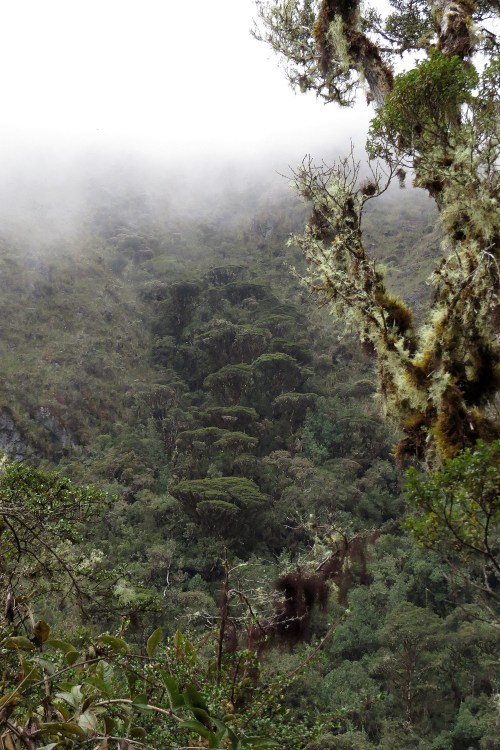
It was time to say goodbye to these beautiful moss-covered forests …..
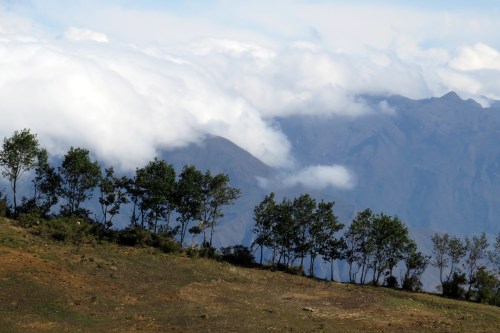
On the way back we stopped to explore the dry side of the mountain. As happens regularly in the Andes cloud builds up on the eastern slope during the day and overspills onto the drier western flank where it rapidly evaporates.

We were able to investigate this drier habitat more fully on our second visit to Bosque Unchog and get good views of Brown-flanked Tanager and few other species that had eluded us on our first visit.

Much of the habitat in this area has been degraded for agriculture – although many farmers are leaving for work in the cities as the many abandoned buildings attests.
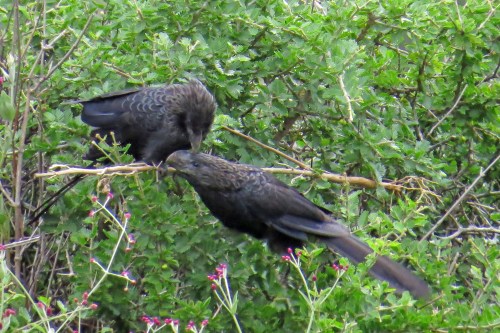
As well as seeing a some of the specialities of this region we also saw many widespread birds such as these Groove-billed Anis, a type of cuckoo.
The following day we left Huanaco and after some final birding on the Paty Trail drove to Huariaca for the night. The day after we reached the wonderful Lake Junin and that will be the subject of the next post.
This post covers a day out on the 11th from Caraz to the Huascaran NP and back and the journey from Caraz to Huanoco on the 12th.

We left very early in the morning and were already climbing high into the Sierra Blanca by the time the sun had fully risen.
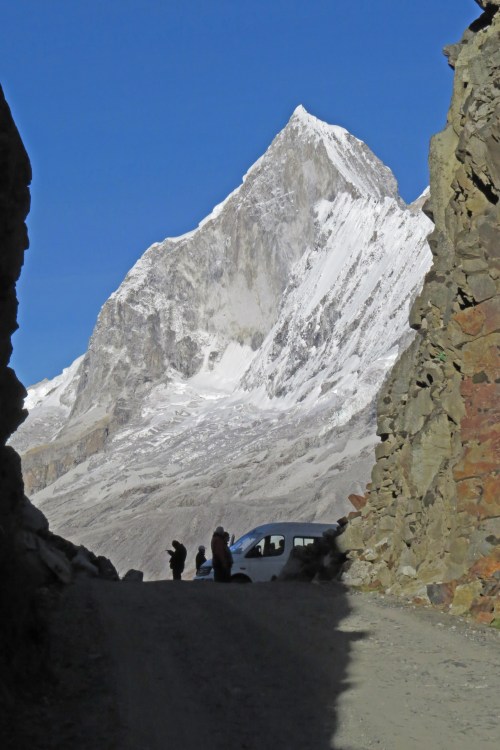
We had a short stop at the pass of Abra Portuchela to admire the stunning scenery.
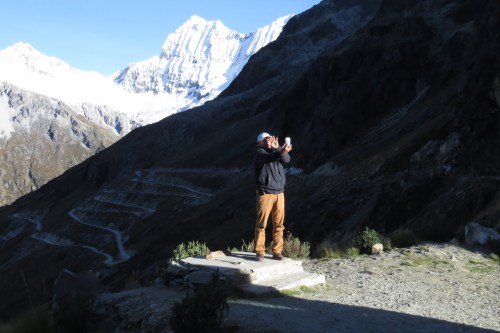
Early morning light was giving our driver selfie problems.

6500m peaks were all around us, five on one side of the road, three on the other.

At 4750m it was hard to walk around without becoming breathless, it was very cold and few birds were around so we descended to the forest below ….
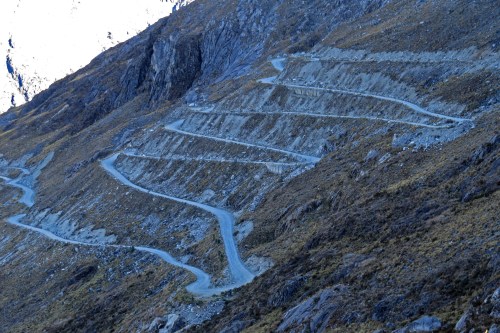
…. by a series of hairpin bends.

I was pleased that I managed to capture the reflection of the mountain in this high altitude lake as this photo was taken through the window of a moving bus.
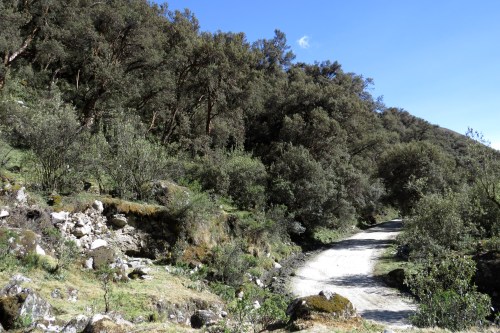
Our main birding was along the edge of this extensive polylepis forest on the far side of the pass. Sorry about this horizontal line. I added it by mistake and can’t find an easy way to remove it!

Our main target was the rare White-cheeked Cotinga, endemic to Central Peru which in spite of searching for most of the day, we failed to find. The forest is extremely dry, after last year’s El Nino event, the Andes comes under the influence of ‘La Nina’ as the currents of the Pacific return to normal and this is associated with unusual dry conditions, which was nice in that we had good weather but had a profound effect on the local breeding birds.

Polylepis trees are noted for their gnarled appearance and flaking paper-like bark. We may have missed the cotinga but we did find the delightful Rufous-eared Brushfinch.

Polylepis forest is effectively impenetrable and we could only see the brushfinches when they strayed to the edge.
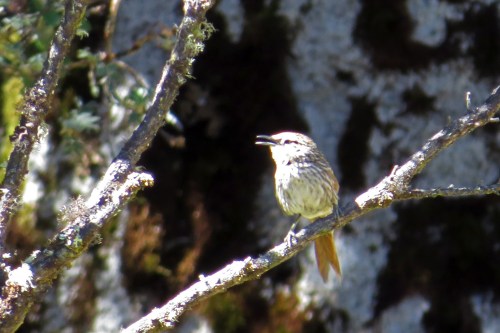
Baron’s Spinetail, a split from Line-cheeked Spinetail performed well ….

…. as did this female Ashy-breasted Sierra Finch.

Although this Rufous-webbed Tyrant posed nicely I failed to photograph the rufous webs to the flight feathers that gives it it’s name.

In the afternoon a stop by a lake gave us views of ….
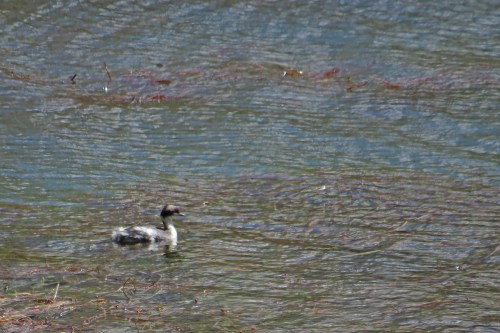
…. ‘northern’ Silvery Grebe (a bird that really should be split from the golden-eared, brown-headed population of Patagonia) but we only heard our main target, Ash-breasted Tit-spinetail, in the nearby forest.

Heading back we only paused briefly at the top of Abra Portuchela, which was now in a less flattering light.

We descended to the lake far below.

Now in the shadow of the mountains the light was fading fast but I managed to see my lifer Jelski’s Chat-tyrant ….

…. as well as this much commoner Chiguanco Thrush.

The following day we made a dawn visit to an area of cactus scrub near our hotel in Caraz and saw my first and only Pale-tailed Canastero ….
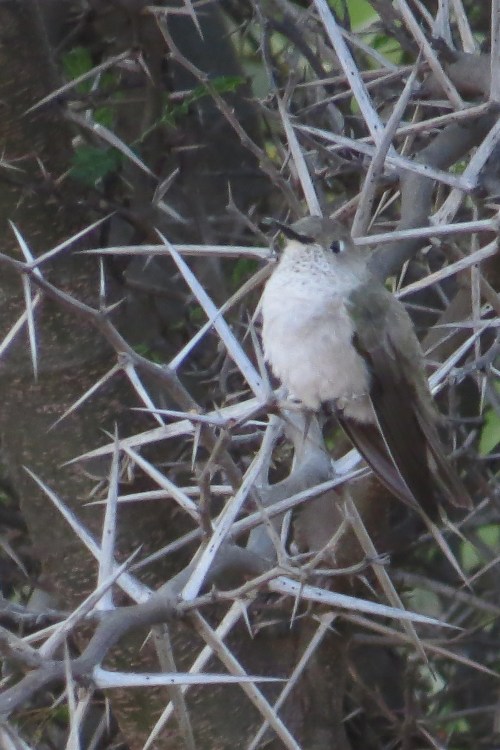
…. and the poorly spotted Spot-throated Hummingbird.
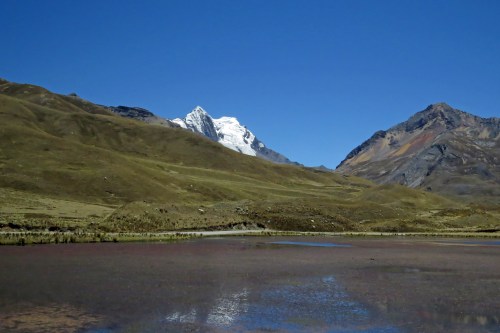
The rest of the day was taken up in the 13 hour drive to the town of Huanaco.

The early part of the trip took us back through the Huascara NP with its spectacular scenery ….

…. and ice capped mountains.
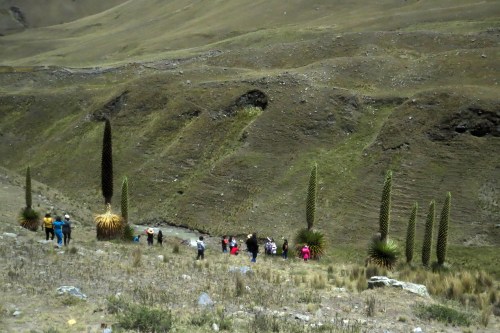
Along with other travellers we stopped to admire this stand of puya plants.
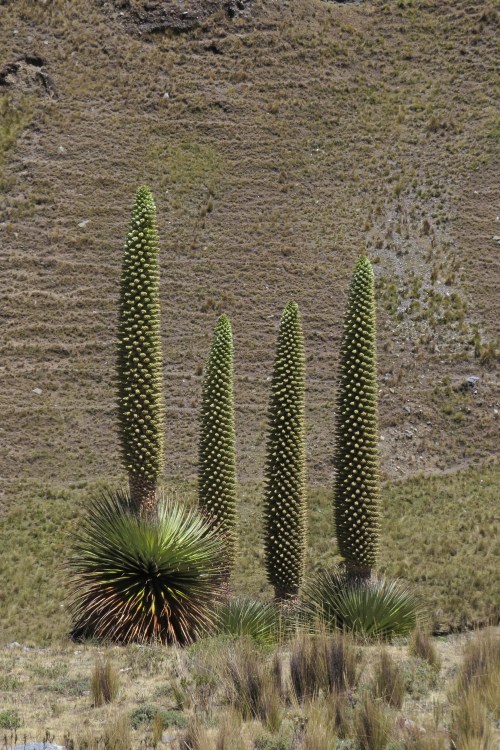
Puya raimondii known also as the ‘the queen of the Andes’ is the largest of the puya species and is related to the bromeiliads. The flowering spikes can grow to 10m tall. The plant only flowers once after it is about 40 years old and then dies. The spike can contain 3,000 flowers and produce 3,000,000 seeds.
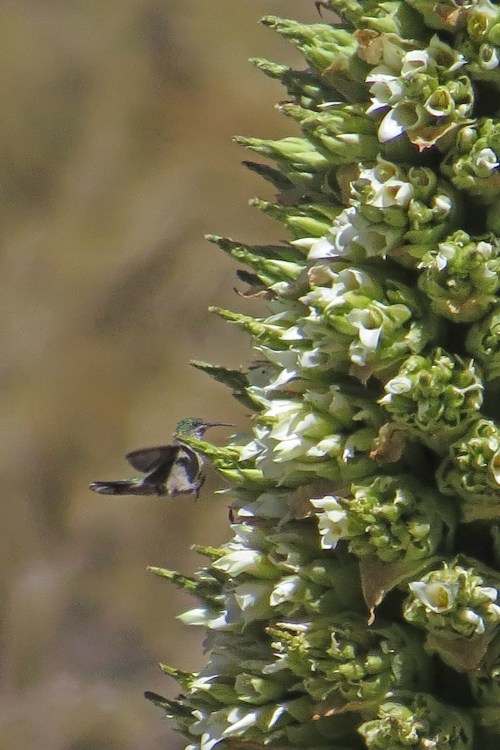
Andean Hillstars were busy feeding on the flowers.

Although looking quite like the Rufous-webbed Bush Tyrant I photographed in the polylepis, this Black-billed Shrike Tyrant can be easily distinguished by its all dark wings and the extensive white in the tail.

Further on we saw a flock of the lovely Andean Ibis ….

…. although it was difficult to get close for photos when they landed.
We eventually reached a pass at 4880m but the scenery wasn’t on a par with Abra Portuchela. It was already getting dark as we descended the enormous Magdelena canyon and we still had several hours to go. We arrived in a very noisy Huanaco to find that a soccer match between Peru and Brazil was being relayed on giant screen in a establishment immediately under our hotel room. Not the best night’s sleep!
From the 8th – 26th November 2016 I took part in a very enjoyable Birdquest tour of Central Peru with Eustace Barnes as the leader. I knew most of the other participants from previous trips, the tour ran smoothly and we saw more birds and had more lifers than we ever expected. As the photos will show the scenery was out of this world and the birding wasn’t bad either!
Map of Peru showing (approximately) the route we took. It might not look that we covered any real distance at this scale, but progress was slow as we were often driving on mountainous dirt roads and had very slow lorry traffic on the better roads.

Early in the morning of the 9th we left a dreary fog-bound Lima and headed along the coast and then climbed up to the scenic Lomas des Chey just as the sun was breaking through the coastal gloom.
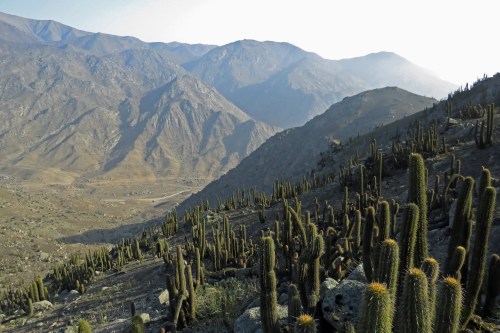
Here in the Atacama Desert it hardly ever rains but the fog, visible here on the upper left of the photo, persists at sea level for 10 months of the year.
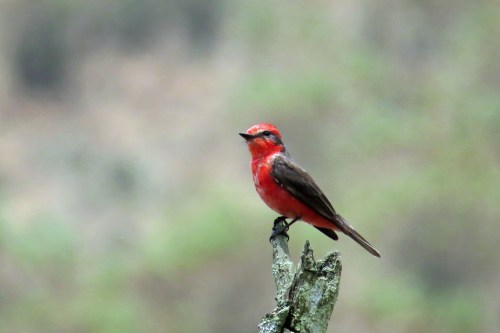
One of the first birds we saw was the delightful Vermillion Flycatcher. With a range from the southern USA to Argentina this is a bird I have come across many times. Since my return I have learned that southernmost populations have been split as a separate species, Scarlet Flycatcher, but I don’t know if these birds are the southernmost breeding Vermillion Flycatchers, or wintering Scarlets from the south. At this time of year the former seems more likely.

Nice as the flycatchers were it was a species of furnarid that was our main target, the perky little Cactus Canastero.
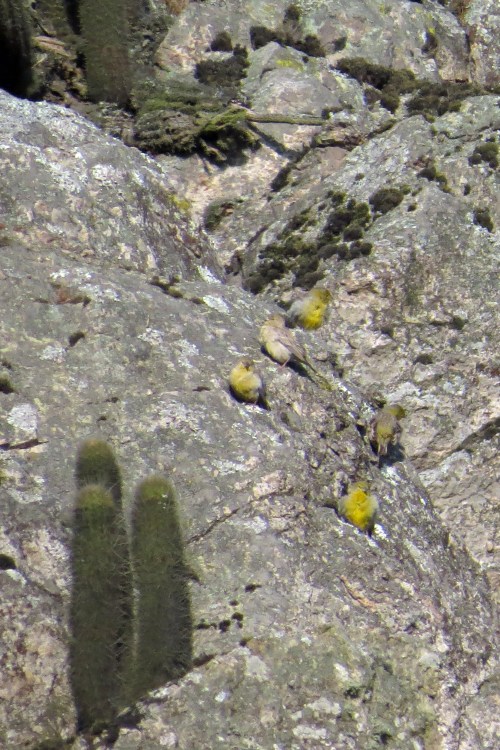
I was delighted to see a flock of this rare finch, Raimondi’s Yellow-finch, although the views were quiet distant and the image quality poor.

Later we headed back to the fog-bound coat and to another area of lomas (woodland where the only moisture comes from fog).

There are four species of seedsnipe, aberrant waders adapted mainly to barren areas. Three occur only at high altitudes but Least Seedsnipe is found in the coastal desert. The male is on the left, the female on the right.

Although I know they have a cosmopolitan distribution, it was still a surprise to see the familiar Peregrine posing for photos in this barren habitat.

Another widespread species in dry habitats throughout the Americas is the Burrowing Owl.

Oasis Hummingbirds occurs in the dry woodland and scrub to the west of the Andes.

Another bird of the dry coastal deserts is this Coastal Miner.
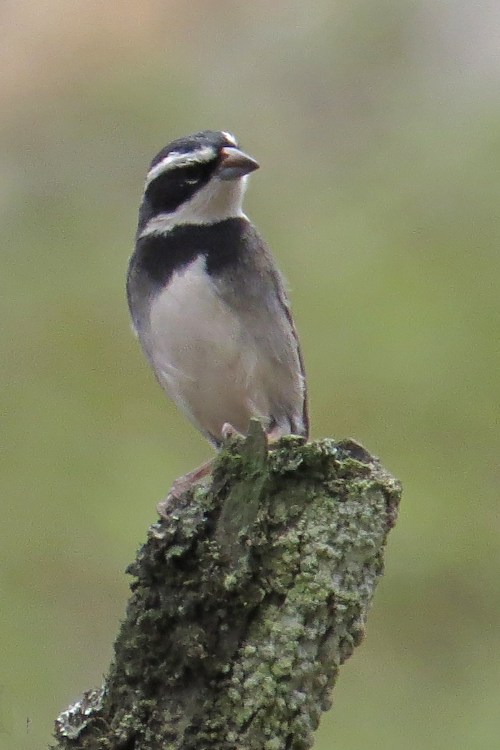
A bird of similar distribution to the last two is the little Collared Warbling-finch,

In the afternoon we moved to the coast to Bahia Paradiso, fortunately the mist had cleared.

This tour used to be run in reverse, this meant that there was very little time to spend along the coast as it was necessary to get to Lima that evening. That was a shame as there was plenty to see on route as this mixture of Black Skimmer, Slate-coloured Coots, Common Gallinules, White-cheeked Pintails and Kelp, Grey-headed and Franklin’s Gulls shows.

There were more gulls on the beach where Kelp, Grey-hooded and Franklin’s were joined by the inappropriately named Blecher’s Gulls. They were all first years and were easily recognised by their long bill, brown plumage and dark hoods.

Here two 1st year Belcher’s Gulls say goodbye to the three Snowy Egrets

Nearby on the rocks this Hudsonian Whimbrel stood sentinel. The UK and Holland seem to be the only countries recognising the New World form of Whimbrel as a separate species, based on its dark rump and more strongly marked underwing pattern. I think the head pattern is more striking as well. However the vocalisations of the two forms are identical and no other Old World/New World wader species pair fails to show distinct vocal differences.
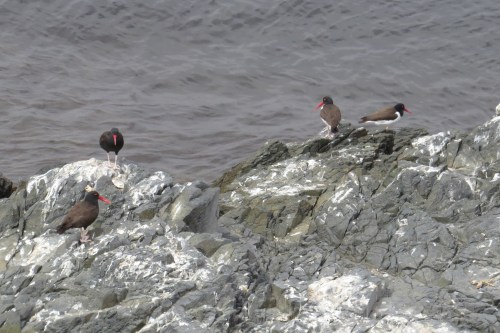
An interesting comparison between Blackish Oystercatchers (L) and American Oystercatchers (R).

An elegant Great Grebe sailed by offshore.

We stayed overnight in the town of Barranca. The following morning we explored an area of cultivation and scrub where we saw many species such as these Chalk-browed Mockingbirds ….

…. a moulting Blue-black Grassquit ….
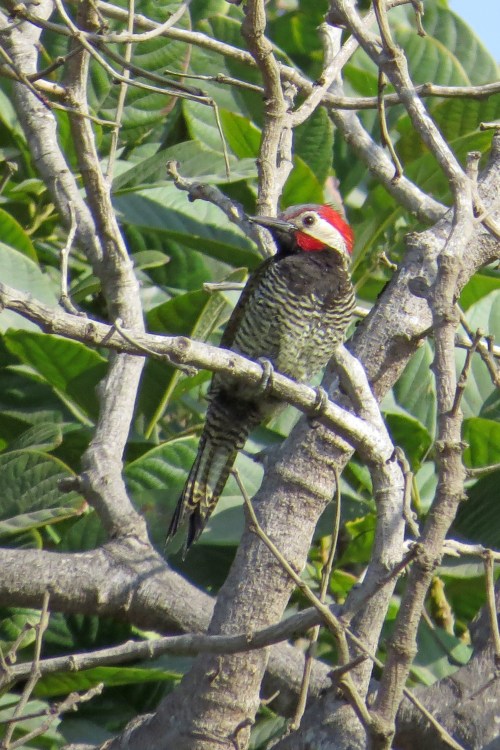
…. Black-necked Woodpecker ….
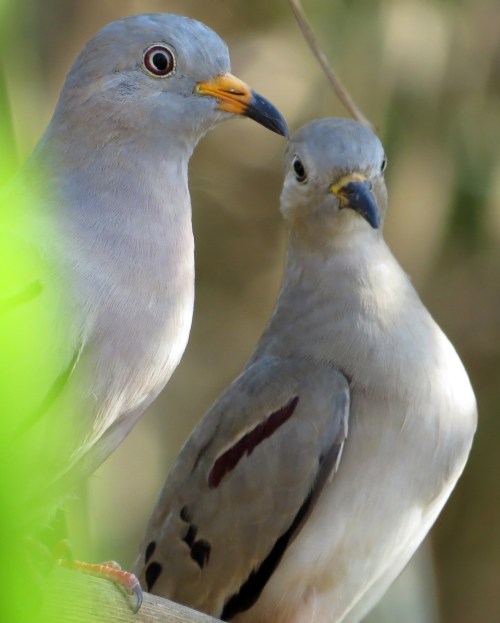
…. this charming pair of Croaking Ground Doves ….
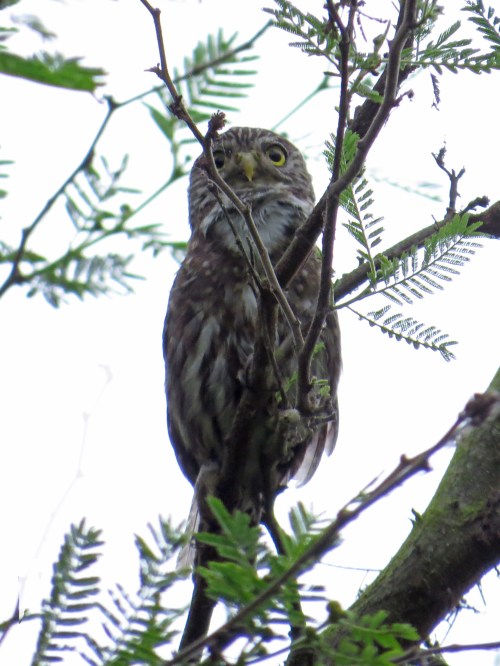
…. the diminutive Pacific Pygmy-owl ….

…. a Green Kingfisher posed for photos along the river ….

…. and Black Vultures roosted on nearby rocks
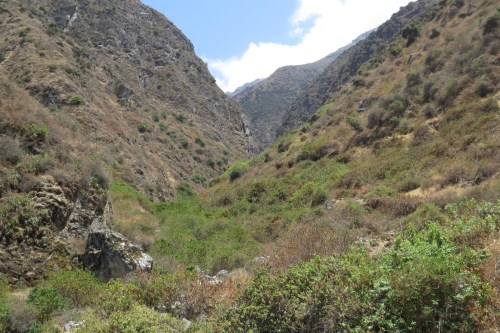
We started to climb up into the Andes and took a side road up the Fortaleza Valley.

The best birds in this side valley were Great Inca Finch (which I managed to photograph) and the rare Russet-bellied Spinetail (which I only managed rubbish shots of).

We continued to ascend the west flank of the Andes eventually coming out the puna grasslands at an altitude of over 4000m.

We made a stop at Lake Conocha. Even walking slowly along the road was exhausting, my head throbbed, my chest ached and my legs felt as weak as jelly. On the original itinerary today we would have birded at a site even higher than this and would have needed to scramble around high altitude bogs for several hours to get our targets. Fortunately the reversed itinerary meant we would be acclimatised well before then.
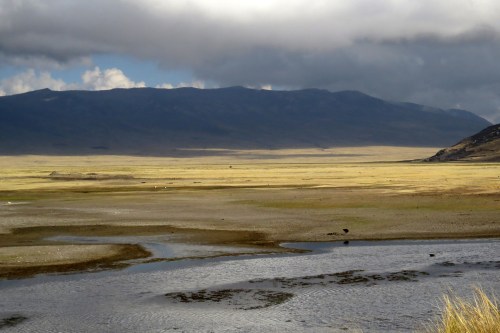
We took a few minutes to take in this awesome panorama (and get our breath back). This mountain range is known as the Cordillera Negra, as being on the dry side of the Andes it seldom snows.
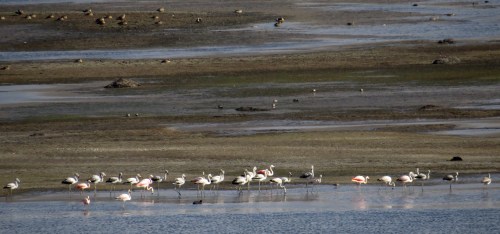
In the distance flocks of Chilean Flamingos and Crested Duck could be seen.
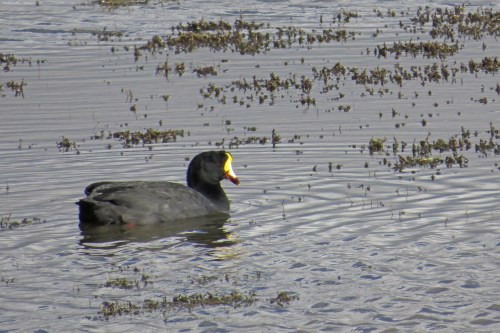
The most wanted species on this lake was the shelduck-sized Giant Coot.

Giant Coots are known only from a few high altitude lakes of the Andes. Here a pair are constructing their floating nest.

Cream-winged Cinclodes (formerly known as Bar-winged Cinclodes prior to a three way split) were common in these high altitude areas.
We continued on to the town of Caraz where we stopped for the night. Fortunately this was at a much lower altitude in an inter-montane valley, so we had no difficulty sleeping.
It’s a bit late in the New Year to be reminiscing about Christmas but as usual I’m running late with blog updates, so here is a short account of our activities over the ‘Festive Season’.

Don’t we scrub up well! The first and only formal Christmas party we attended this year was on the 17th in Bournemouth with the Phoenix Organisation (formerly Nexus), the organisation through which Margaret and I met. I had been ill for about a week beforehand so we did little more than enjoy the meal, have a token dance and leave.

For Christmas we all went to Margaret’s daughter Anita and her husband John’s place in Maldon, Essex. Kara was already there, we arrived on the 22nd and Janis and Amber arrived on the 23rd. On Christmas Eve we all went for a rather chilly walk near Bradwell-on-Sea at the mouth of the Blackwater Estuary. L-R Kara, Amber, John, Margaret, Janis and Anita.

Birding-wise it wasn’t too exciting with just this flock of Brent Geese near the car park and a few common waders along the shore ….
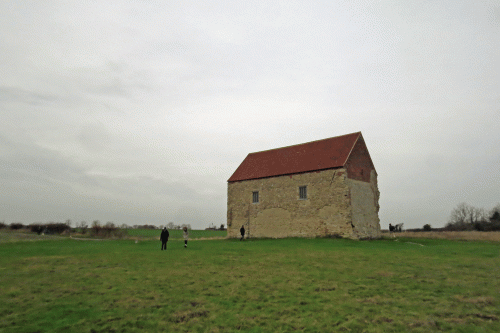
…. but there was an interesting chapel built in 654 AD by Cedd a bishop from Lindisfarne in Northumbria using stone from an earlier Roman fort.

The rather sparse interior is still used for regular services.

Many houses and gardens near Anita and John’s house in Maldon were suitably (over) illuminated for Christmas ….

…. but we had to laugh at this illuminated snowman that appeared to be about to jump to its death …..

…. compounded by fact that the inflatable Santa below had already hung himself.

On Christmas morning it was time for the grand present opening ceremony. Janis looks particularly delighted with hers.

Amber was given some goggles that convert your mobile phone into a VR experience. Kara is clearly enjoying her sister’s present ….

…. and so for that matter, was her grandmother.

Having turned his double garage into a ‘man cave’, John was most pleased to receive this sign for Christmas.
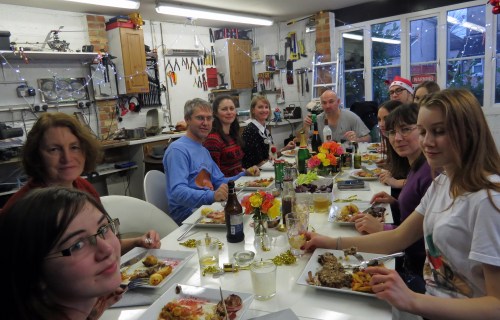
For Christmas dinner we were joined by John’s sister Lois and her family for a slap-up feast in the ‘man-cave’. Clockwise from the left: Amber, Margaret, John, Anita, Lois, her husband Gavin, their son Lyle, Lyle’s girlfriend Heather, their daughter Shan, Janis and Kara. This must be the first year when I haven’t eaten any turkey over the whole Christmas period.

As they were almost hidden in the last photo here is a better shot of Lyle and Heather.

And here Shan assisting Janis’ with a selfie.

Usually after a large Christmas dinner everyone falls asleep during the Queen’s speech, but Anita kept us busy with a series of party games such as this ‘card blowing’ contest where the object was to get the card to balance on the edge of the table without falling to the floor – much harder than it sounds.

…. but one of the funniest games was the ‘twerking contest’. Small baubles were placed in a box with a hole and tied to your waist. The aim was to knock out as many baubles as possible just by hip action.

On Boxing Day morning I went to nearby Abberton Reservoir to see a drake Ring-necked Duck (on the left), a rare visitor from America.
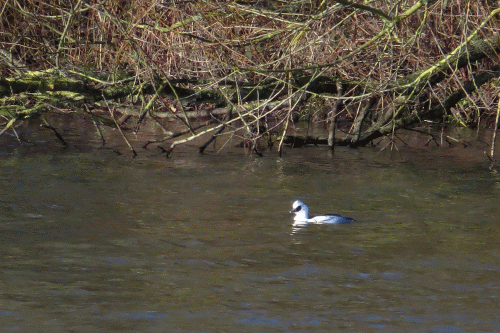
I was pleased to see four Smew on the reservoir including this stunning drake. They occur occasionally as far west as Dorset but the majority of wintering Smew are found in the south-east of the UK.

This Ring-necked Duck probably hatched in Canada or the northern USA, the Smew in Scandinavia or Siberia and the Pochard from eastern Europe or western Russia yet all come together in one photo in Essex.

On the 27th we headed north to my brother’s in Derbyshire, an early start helped us to avoid the traffic. We stopped at my University friend Di’s place in Breedon-on-the Hill (centre of the photo with her husband Steve). Her daughter Hannah, husband Karl and daughter Mai were staying and it was great to see Hannah who I haven’t had a chance to speak to for many years and meet Karl and Mai for the first time.
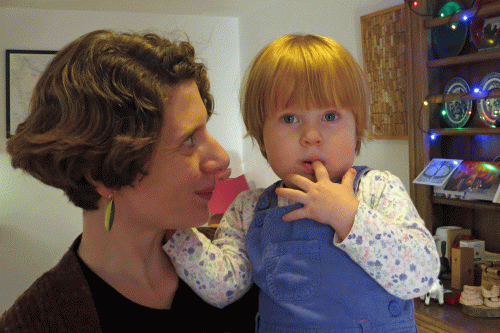
Over five year’s ago Hannah’s dad, my University housemate Clive was tragically killed in a motorbike crash. I was surprised how like her father she now looks, which of course brought back how much I miss Clive.
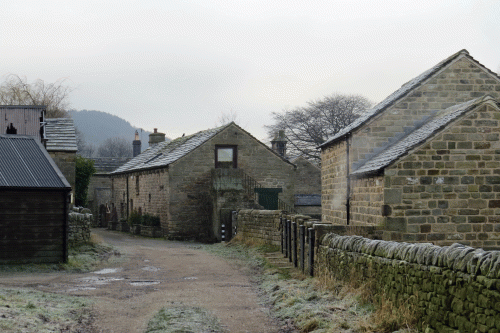
I came to Beeley, a small village in the Peak District, in early December to see a Dusky Thrush, a very rare vagrant from eastern Siberia. The thrush was still there on so I took Margaret to see it.

The residents of Beeley have been praised by birders for their warm welcome, something that doesn’t always happen when a rarity is found in a residential area. The bird is now showing just outside the village and the number of birders arriving is much reduced but even so residents will probably be glad when it migrates in the spring.
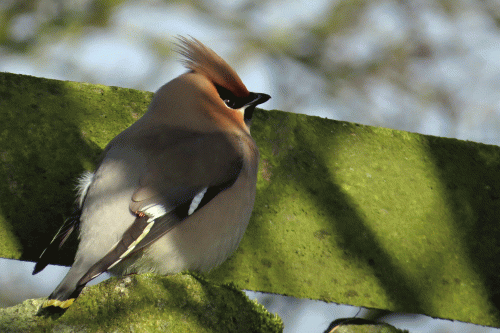
There have been a reasonable number of Waxwings turning up this year, but very few have reached the south. We managed to catch up with one some ten miles to the north of Beeley but if we had got there five minutes earlier we would have seen a flock of 40!

On the way back to Poole on the 29th we detoured to see another vagrant thrush – a Blue Rock Thrush, a bird with a wide distribution from the Mediterranean to the far East. This beautiful bird has taken up residence in a housing estate at Stow-on-the-Wold in Gloucestershire and is using roof tops as a substitute for its usual rocky mountain or coastal cliff habitat.
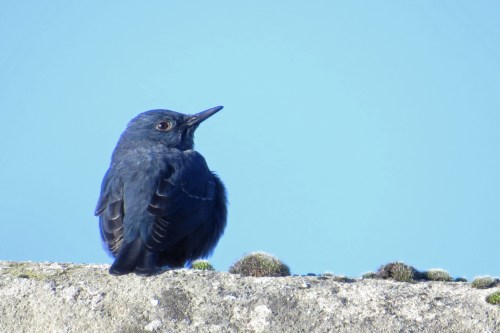
A few birders are denigrating this bird, considering it an adult and therefore less likely to be a true vagrant, and saying wintering in the middle of the UK rather than the coast points to captive origin. These critics seem to mainly be twitchers who saw the Blue Rock Thrush on Scilly some 20 years ago and don’t want all these newbies catching them up – ie they are doing a bit of list protection. There is debate about its age, some consider it a first winter, and vagrancy can occur in adult birds and nobody criticised the Dusky Thrush because it was found in the middle of the country!

When the Blue Rock Thrush was seen from certain angles its lovely blue hue faded to a dark grey. As I said before twitching rarities in urban areas can be difficult, photographing a bird on someone’s roof is one thing but on their bedroom windowsill is a different matter entirely.
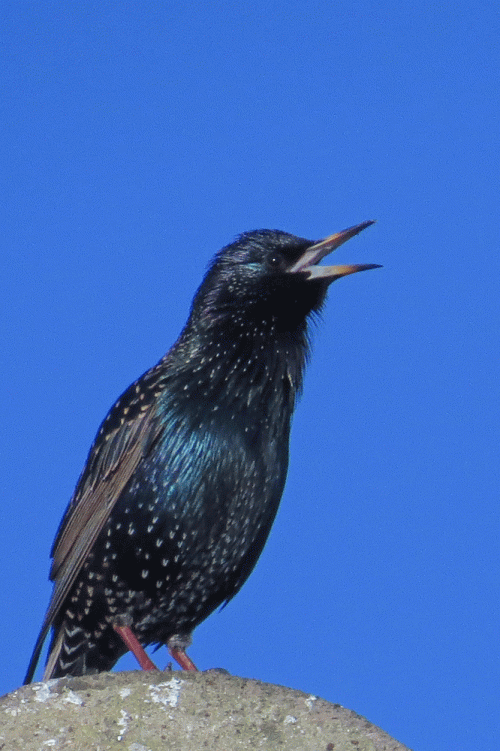
Now if Starlings were rare vagrants from Siberia then birders would go crazy for them, just look that blue sheen. But they were just considered something to photograph whilst we waited for the thrush to appear.

We did nothing more exciting than watch TV on New Year’s Eve. The planned boat trip around Poole Harbour on New Year’s Day was postponed to the 2nd so we paid a visit to Longham Lakes before the rain set in. The first quality bird of the year was this Great White Egret, one of three that are wintering at Longham. Once a true rarity, there has been a huge increase in numbers in the last few years and now they even breed in Somerset.

The 2nd was a much better day for our boat trip, kindly put on by our friends Mark and Mo Constantine, but compared to previous years there were relatively few quality birds in the harbour.

There was one last event that fits in with the broad definition of the ‘Festive Season’, the annual bird race. This year I opted to do the race with my three ringing trainees L-R Daniel, Ginny and Chris. I think it would be fair to say that my team has had less birding experience than the members of the other teams, but they did extremely well and we ended up with 117 birds seen/heard during the 12 hours of the race and actually came second out of the four teams participating.
2016 earned the reputation as the year when everything went wrong – the awful Brexit result which will have adverse consequences for the rest of my life, the shock American presidential election which may have ramifications far beyond the borders of the USA, the ongoing slaughter in Syria and the threat of terrorism and the death of many much-loved celebrities; but on a personal level 2016 has been both a great success and very enjoyable with much travel at home and abroad and lots of quality birding and bird ringing.
This post summarises what we have been up to this year, most of the photos have been uploaded before and more details can be found by reading the original posts.

In January I spent three weeks in western India, mainly visiting the states of Punjab, Rajasthan and Gujarat. The tour started with a visit to the wonderful Golden Temple at Amritsar.
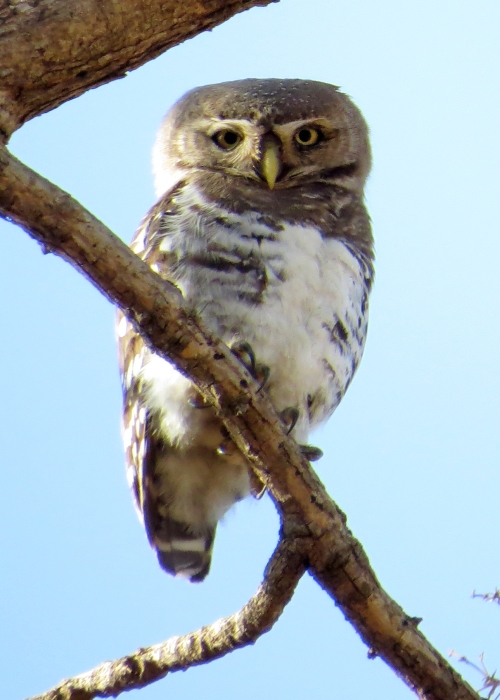
The final few days of the trip were spent in the state of Maharashtra where we searched for the recently rediscovered Forest Owlet. The bizarre story of the discovery, loss, presumed extinction and rediscovery of this enigmatic species is explained in an entry posted on the 18th March. The tour was well covered on this blog with seven separate posts uploaded in February and March.

A post in March tells of our trip to Essex and from there to London. As well as sorting out my Russian visa for a subsequent trip we also visited St Paul’s cathedral from where I took this shot of the Millennium Bridge.
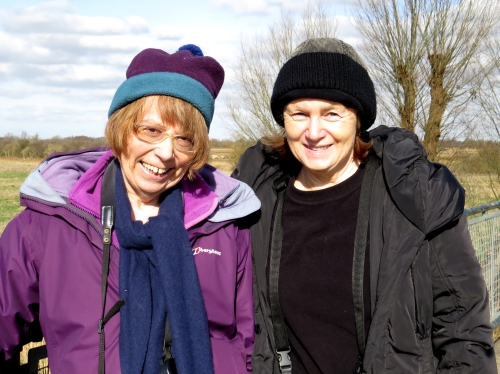
From Essex we moved on to Cambridge to stay with my old University friend Jenny.

The longest and most remarkable trip of the year was the Atlantic Odyssey which ran from late March to early May. Starting at Ushuaia in southernmost Argentina we sailed on the Plancius to South Georgia, Tristan da Cunha, St Helena, Ascension and Cabo Verde.
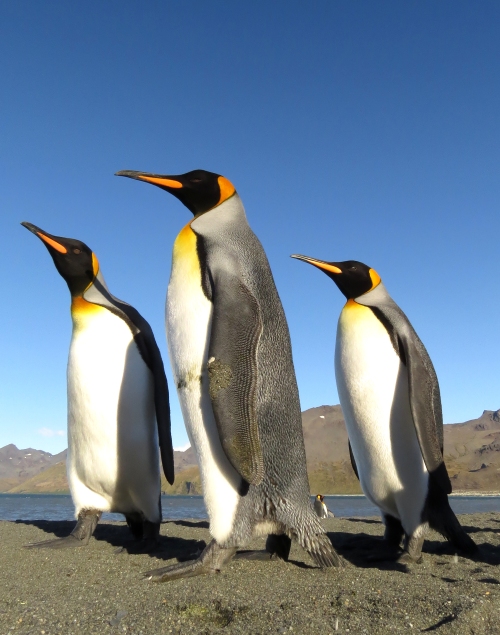
South Georgia was a delight with stunning views of King Penguins ….
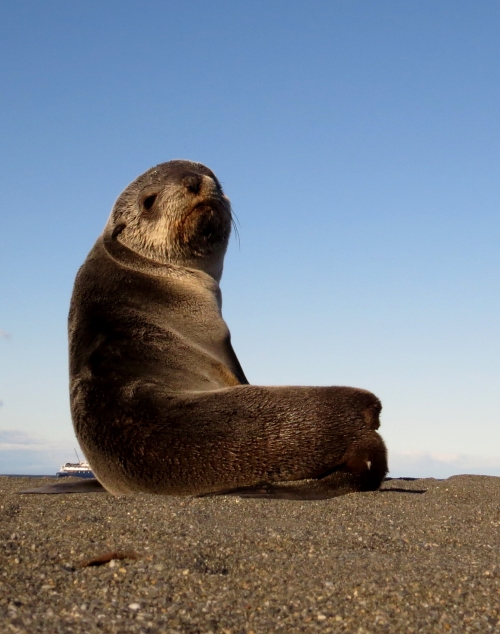
….cute Fur Seal pups plus several species of albatross and many other seabirds.
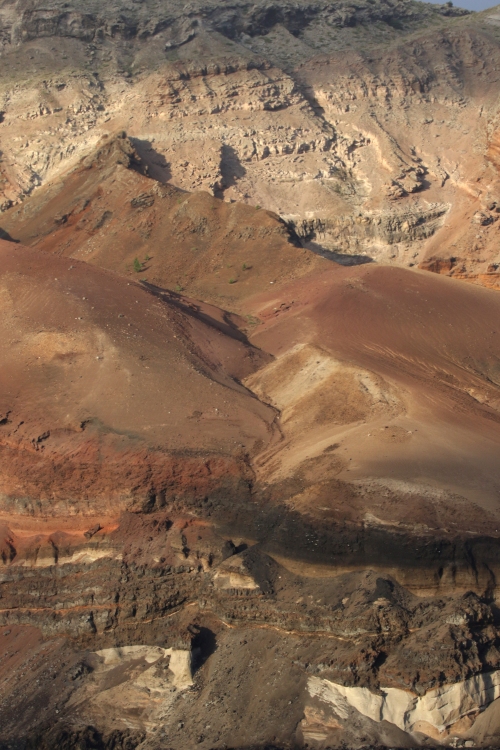
In complete contrast we encountered desert like conditions on the island of Ascension and a range of tropical seabirds ….
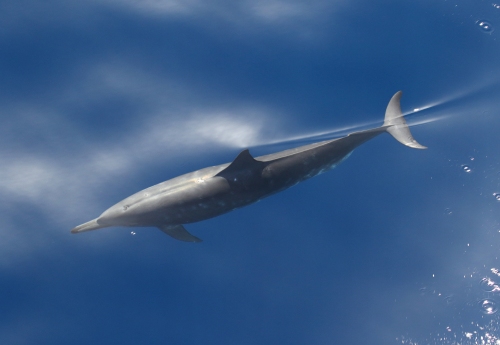
…. and tropical cetaceans like this Clymene Dolphin.
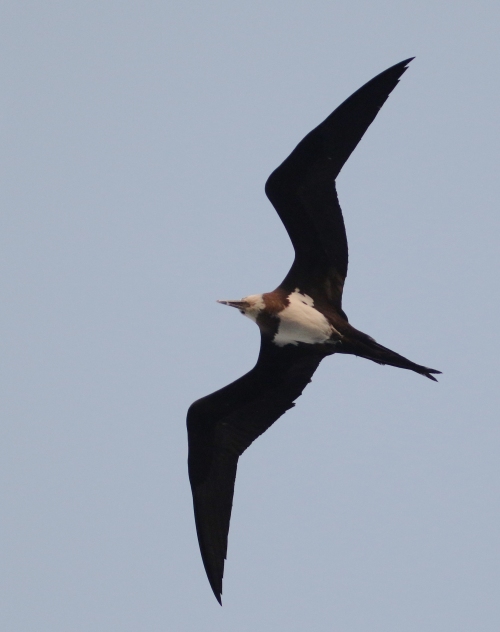
But the star of the show was the breeding endemic Ascension Frigatebird that only breeds on a single half hectare offshore rock stack. Although the trip was over five weeks long and we sailed from the subantarctic to borders of the Western Palearctic I only had 13 life birds – but most of them were very sought after indeed.
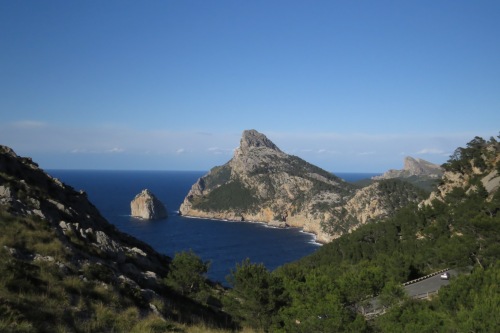
After landing at Cabo Verde we flew to Mallorca to join Birdquest’s 35th anniversary reunion. We had a very enjoyable time meeting up with old friends and making new ones amongst great scenery and great birds.
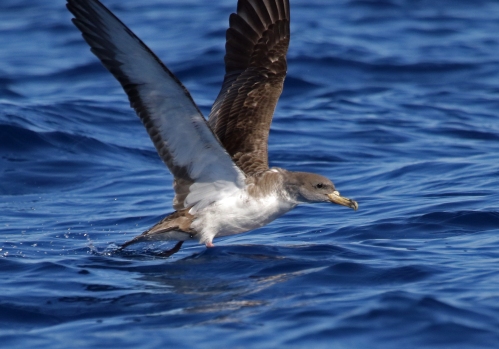
Birding highlights were my first views of Moltoni’s Warbler, and first proper views of the endemic Balearic Warbler and the newly split Mediterranean Flycatcher. On a boat crossing to the island of Cabrera we had the best ever views of Scopoli’s and Balearic Shearwaters. Unfortunately these two wonderful trips have not been covered well on the blog with just a single extended post uploaded on 18th May covering the entire six weeks. It has always been my intention to give a more detailed coverage but other things have got in the way!
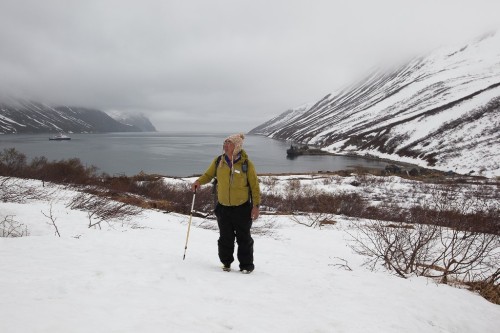
I was only home for a couple of weeks before it time to join another cruise, the so-called ‘Russian Ring of Fire’ to the Russian Far East. Cancelled at short notice in 2015 due to the Russia authorities intransigence, the cruise from Kamchatka to the Commander and Kuril Islands and on to Sakhalin was absolutely outstanding, even if we did get snow at sea level in early June.
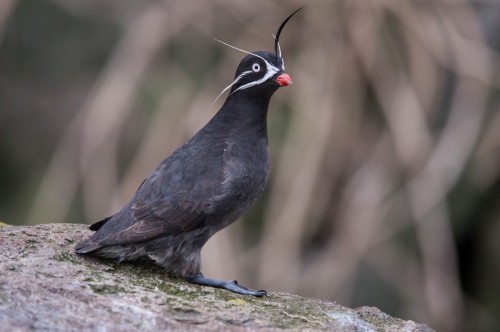
I saw something like 17 life birds on the trip, perhaps the most beautiful and most desired was the wonderful Whiskered Auklet. As with the previous cruise, other commitments prevented me from doing it justice on this blog, but a summary was posted on 25th June.
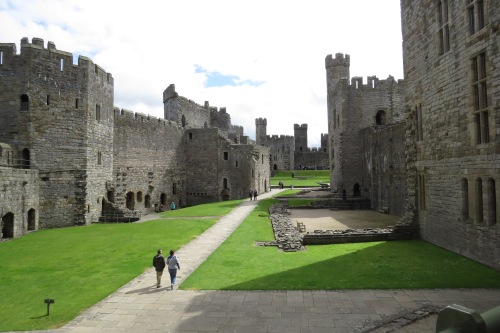
In late June and early July Margaret and I had a two week trip around Wales, parts of northern England and ended with a visit to Essex. As well as visiting friends and family we enjoyed many sights from castles in north Wales ….

…. to a wet and dreary Blackpool. I uploaded two posts on this trip in late July/early August.
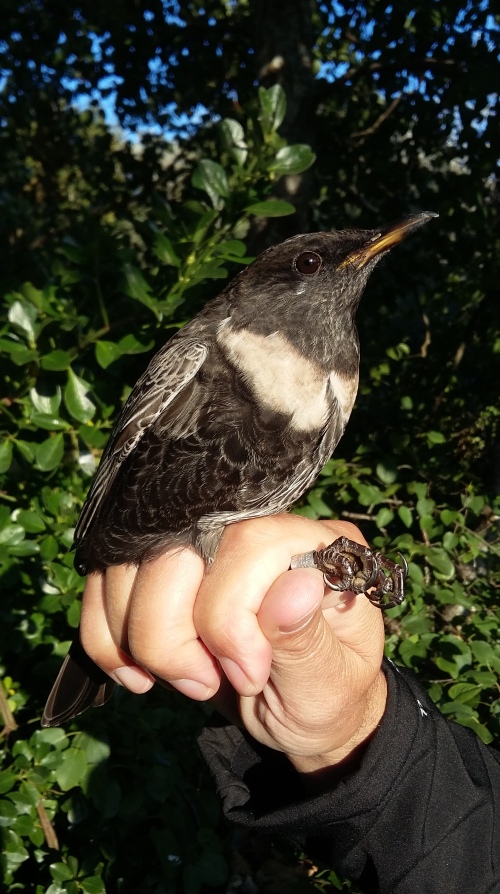
From mid July to early November my time was taken up with ringing. Covering the entire autumn migration I paid 60 visits to Durlston Country Park as well as ringing at several other sites. We ringed over 4700 birds adding greatly to our knowledge of bird migration at Durlston. Autumn 2016 will be long remembered for the remarkable influx of birds from Siberia, caused by a strong easterly airflow that persisted for weeks. Although we didn’t catch any real rarities, there was much larger than usual number of Ring Ouzels passing though ….
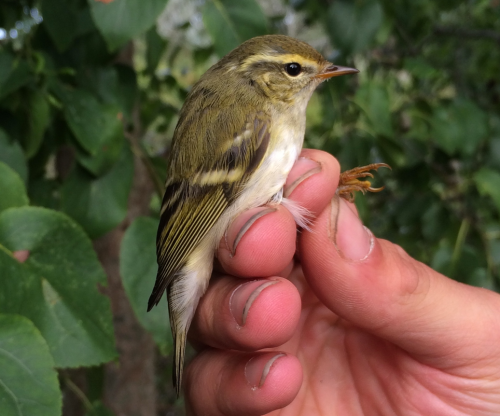
…. and as a group we ringed at least 16 Yellow-browed Warblers, a species that breeds no nearer than the Urals. The only ringing I did away from Dorset was when my friend Chris and I spent several days at Spurn Bird Observatory in early September. I have uploaded a number of posts on my ringing and UK birding activities throughout the year.

In November I went on an excellent three-week trip to central Peru. The scenery on almost every day was outstanding ….
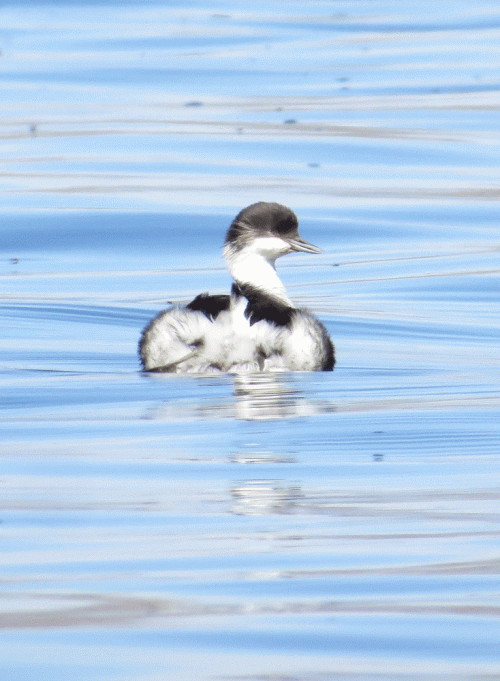
…. as was the birding, with much wanted gems such as the flightless Junin Grebe (my last grebe) ….
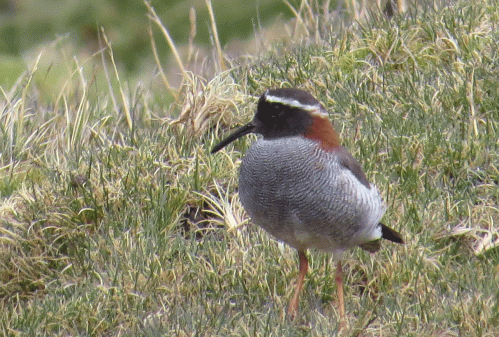
…. and the enigmatic Diademed Sandpiper-plover, a rare inhabitant of high altitude bogs, which took a lot of stomping around at a breath-taking 4500m to find. This was by far the most productive trip of the year for both species and lifers and I accumulated some 57 new birds and bringing my life list (with the help of a few armchair ticks) to 8122. I am still editing the many photos from this tour but hope to upload some to the blog in a week or so.

Whilst I was in Peru Margaret had the opportunity to travel to New York with members of her choir to join a massed choir of over 200 singing Howard Goodall’s composition ‘Eternal Light’. There is more on her adventure in a blog post uploaded on 4th December.

2016 has become infamous as the year when many much loved celebrities passed away. Whilst not unexpected, he was 82 and in poor health, the death of singer/songwriter Leonard Cohen saddened me the most. A fan since I first heard ‘The Sisters of Mercy’ back in 1968 I have all of his CDs and love his deep, poignant and moving lyrics. I am pleased to have had the privilege of seeing him in concert three times, once when I was a student and twice in recent years. I bought his 14th and final studio album ‘You Want It Darker’ just days before his death on 7th November.

We have only been to a few music events this year, a fantastic gig by the Afro Celt Sound System and a visit to the opera to see Don Giovanni. I even missed both of Margaret’s UK choral concerts, one by being in Russia, the other through ill health. However, although not a musical event, a trip to the BIC to see the funniest man in the world, Billy Connolly in late November, was a hilarious night out.
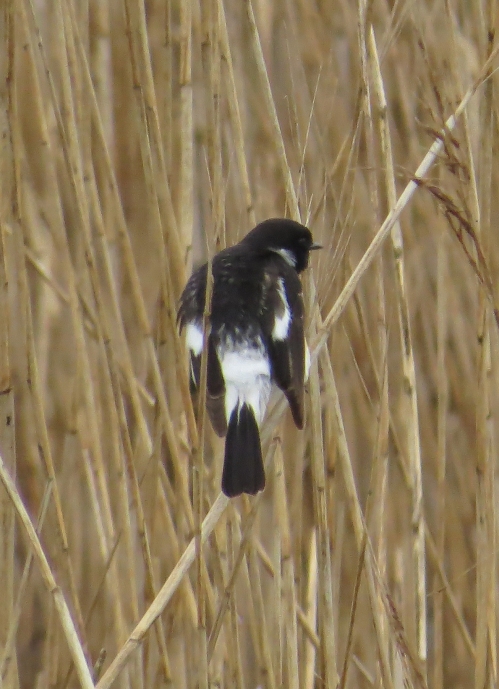
Although UK birding has taken a bit of a back seat with a large amount of time being devoted to ringing and the subsequent paper work, but I have mamaged to see a number of great species this year. In the spring my friend Roger and I twitched a ‘Caspian’ Stonechat in Hampshire. Although currently considered a race of Siberian Stonechat this white-rumped form from the southern borders of the Caspian Sea could well warrant specific status.
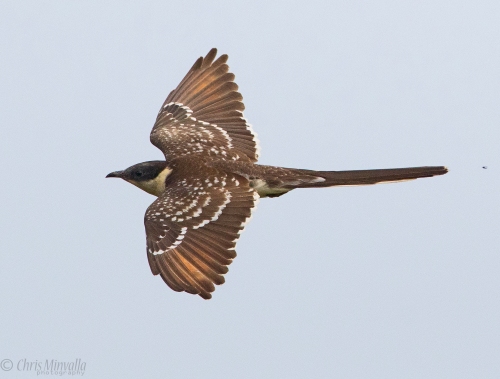
Although I have seen two in the UK before, this beautiful Great Spotted Cuckoo at Portland was a much appreciated addition to my Dorset List. Other local goodies in May included Red-footed Falcon, Glossy Ibis, Black-winged Stilt and Honey Buzzard. Photo by my friend Chris Minvalla.
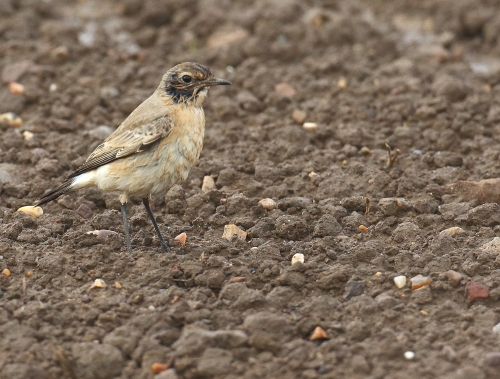
In recent years I have shied away from long distance twitches due to the effort and cost involved and because I am often familiar with the species concerned from birding abroad. However in mid October, as the remarkable influx of Siberian and Central Asian goodies continued I was tempted back to Spurn once more. This Isabelline Wheatear in a muddy field by the coast (here with a head stained from the dark soil) was reason enough for the long journey ….
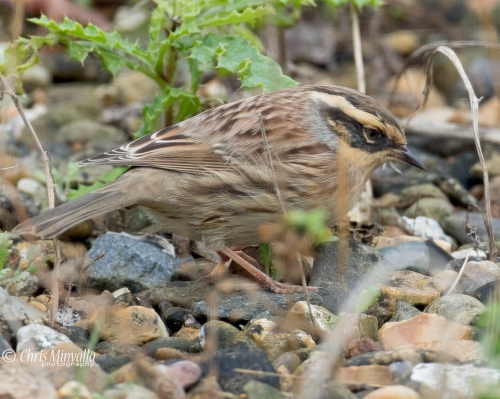
…. but the real prize was this superb Siberian Accentor just a few hundred yards away in the grounds of the gas terminal. This species had never been seen in the UK before 2016 but this autumn there were 12, with close to 300 found in western Europe. As far as my UK birding is concerned this was ‘bird of the year’. Photo by Chris Minvalla.

There was another Siberian mega to twitch before the year was out. Just north of where my brother lives in Derbyshire a Dusky Thrush was found in early December. With only a dozen UK records (and most of those from antiquity) this was a much wanted UK tick. I was prevented from going for a Dusky Thrush in Kent a few years ago by earlier commitment, so a trip to the Derbyshire Peak District became essential. I needn’t have fretted as it was still these when I visited my brother over the Christmas period and we went to see it again. Photo by my friend Roger Howell.
Another mega-rare thrush, a Blue Rock Thrush was seen towards the end of the year on my way home from Derbyshire (giving me 4 new birds for my British List in 2016 and bringing it to 493 by the BOU list). I will upload photos of this plus an account of our activities over Christmas and New Year will be in the next post.
Happy New Year to all readers of this blog.
I have recently been in Peru and will post about that in due course, but whilst I was away Margaret had a trip to New York to sing in Carnegie Hall with some members of the Barclays House Choir (apparently I mustn’t forget the ‘s’ in Barclays but I can forget the apostrophe in Barclays’). DCINY were putting on the American debut of Howard Goodall’s ‘Eternal Light’ and invited choirs from the UK and beyond who had already performed this piece to perform. In the event there were 210 in the choir and the composer was in attendance.


Margaret was there for a couple of days before the performance, time to sightsee ….
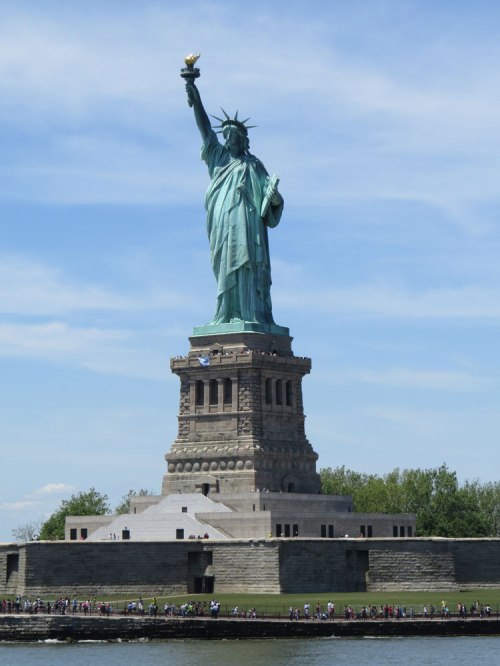
…. the Statue of Liberty and ….

…. the 9/11 memorial ….
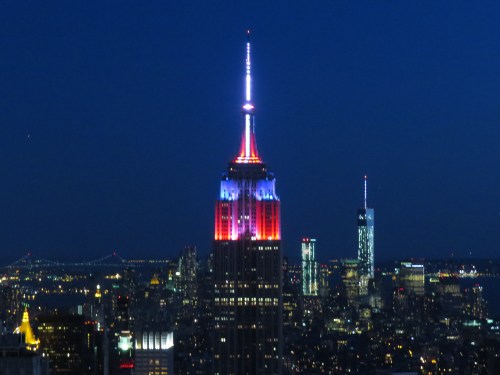
…. and the glorious New York skyline at night. The above three photos were taken on our visit to New York in June 2014, the following (except the shot of the concert) were taken on Margaret’s phone.

Margaret travelled to New York with her friend Ann, a fellow choir member and my former work colleague. The late autumn was rather colder than they expected.

Walking around the city they came across these strange statues ….

…. and a tunnel of Christmas lights

Passing the Trump Tower Margaret’s way was blocked by an anti-Trump protest. She asked a photographer how long the protest was going on for and was told ‘the next four years’ !

Times Square at night.

DCINY presents UK composer Howard Goodall’s Eternal Light: A Requiem led by Maestro Jonathan Griffith. Solo singers: Sarah Joy Miller – soprano, Scott Joiner – tenor, Steven Eddy – Baritone. The official photograph of the concert. Hard to see at this scale but Margaret is 5th row back and second from the left.

After rehearsals the choir had their music sheets signed by Howard Goodall.
 gryllosblog