At the end of August my friend and trainee ringer Chris and I went to the Bird Observatory at Spurn in East Yorkshire. I had hoped that Chris would get to ring a lot of new species and learn some new ringing techniques and I hoped I would have a chance to do some wader and tern trapping and see how ringing is performed at one of Britain’s best migration hot spots.
In the event, for a number of reasons, it wasn’t as good as I expected but it was still well worthwhile.

In East Yorkshire the north shore of the enormous Humber estuary turns southwards at its mouth and forms the Spurn Peninsular. Recent erosion has cut the road to the lighthouse and it is now a three-mile walk or cycle to the point. In this photo the lighthouse is at the tip of the peninsula whilst the shoreline to the right of the lighthouse is the south side of the estuary and is in Lincolnshire.

Setting off at 0600 and with an hour-long stop at my brother’s in Derbyshire, we arrived at Spurn Bird Observatory about 1300. As ringing was over for the day we immediately went to the nearby ‘canal’, an area of reeds growing near an overgrown ditch in search of a Barred Warbler that had been there for several days.

The Barred Warbler was distant and only showed intermittently. My photos weren’t worth reproducing so I have taken this one from Wikipedia. Virtually all British records of the central European species are of first years which lack the barred plumage and pale eye of an adult and look rather like a large Garden Warbler (with the addition of pale fringes to the wing coverts, flight feathers and tail tips). A regular, if scarce migrant mainly to the east coat of the UK, this was one of the species I had hoped to see in the hand at Spurn. I have seen the species 19 times in the UK but this was a first for Chris.

The North Sea off Spurn used to be a migration stopover for thousands of migrating Arctic, Common and Sandwich Terns and I had hoped we might be able to ring a few of these at night on the beach. Local birders told me that the number of terns has reduced drastically since the building of this massive offshore wind-farm.
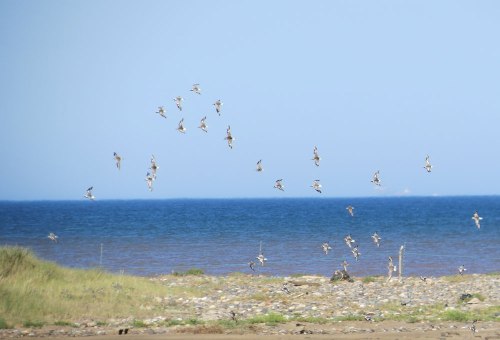
Gravel pits between the Humber estuary and the North Sea provided a high tide roost for thousands of waders, mainly Dunlin, Knot and Ringed Plover but also included flocks of Grey Plover (above) and a few Turnstone, Sanderling, Little Stints and Curlew Sandpipers.

Most Grey Plovers we see in Dorset are in their drab grey winter plumage but here we saw flocks fresh in from Arctic Siberia still in their beautiful silver and black breeding plumage. Americans call this species Black-bellied Plover based on the summer plumage, but I like the French Pluvier argenté which translates as Silver Plover, a perfect counterpart to its cousin the Golden Plover.

During our time at Spurn we worked at two different locations ringing a small number of migrant and resident birds. It was clear we hadn’t coincided with a large migratory movement and with a freshening wind on the second day we trapped relatively few birds. One thing we tried on the first afternoon of the course was the spring trapping of small waders such as this Little Stint, but although the stints walked up to and around the trap they refused to trigger the spring mechanism. We did catch a Yellow Wagtail by the same method though.

Returning from the unsuccessful wader ringing trip we were told that a surprise awaited us at the Observatory. It proved to be an immature Gannet that a villager had found trapped in some netting in his garden. One of the wardens is keeping hold of its dagger like bill, which could course some damage if it was not restrained.
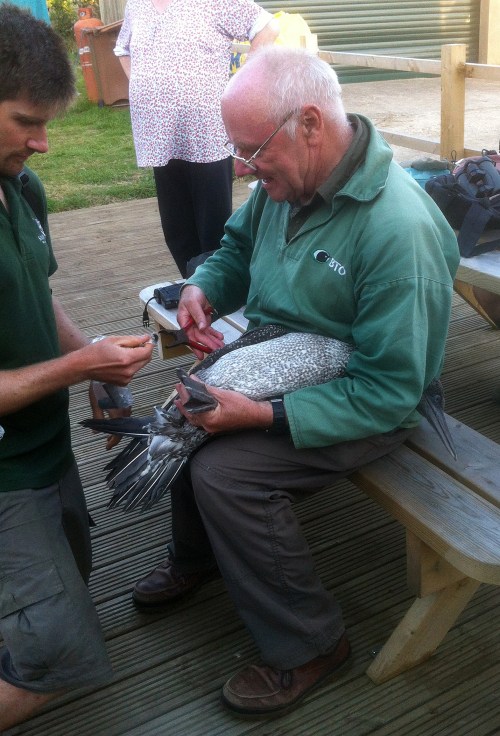
Having not ringed a single bird at this stage I quickly volunteered to ring this monster of a bird. However the ring didn’t fit well and it appeared that one leg was swollen. In case the bird was unwell (which indeed could be why it crash landed in someone’s garden) the ring was removed and the bird taken to the shore and released. Photo by Chris Minvalla.
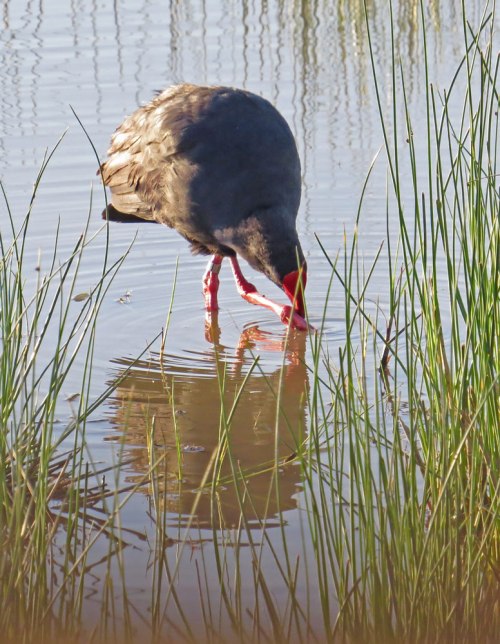
It was whilst attempting and failing to catch stints that we heard that on the other side of the Humber, at Alkborough Flats in Lincolnshire, there was a Western Swamphen (not ‘Purple Gallinule’ as some people call it, that is an unrelated American species) about an hour and a half’s drive away. This species has been seen once before in the UK, earlier this year in Minsmere, Suffolk. Earlier records refer to the closely related Grey-headed and African Swamphens which are undoubted escapes from captivity but the two records in 2016 appear to be part of an influx from the western Med into northern Europe. Chris and I were very interested in twitching it, but the following day it wasn’t seen at all, so we assumed it had gone. I photographed this individual in Mallorca this May.

There was a lovely sunset over the Humber that evening. Very early in the morning (0230) we got up to do some wader ringing on the gravel pits, the early start was needed to coincide with the high tide. We ringed a few Redshanks, Knot and a Curlew and Oystercatcher, eight in total one for each on the course. Photography wasn’t allowed as it would take the birds eyes some time to recover so I have no shots of this activity.
On the second day of the ringing course Chris and I took our turn at the ringing station at the ‘breach’, the neck of the peninsular where the road has been washed away. Using mist nets and spring traps we trapped a few birds but the strong wind prevented us from catching much. An afternoon attempt to spring trap Wheatears also ended in failure. We were able to get a few hours much needed rest in the afternoon.
Back at the Obs we prepared some dinner and got ready to go out in an attempt to trap terns after dark, but then Chris heard the bad news that his father was seriously ill and had been taken to hospital. There was no alternative but to pack up and return immediately to Dorset, arriving about midnight. Fortunately Chris’s father made a total recovery after about a week in hospital, but it could easily have been so much worse.
So the ringing course concluded with me ringing just two birds, a Redshank and that Gannet, and the latter had to have the ring removed. Further frustration ensued when we found the Swamphen was seen again once we were back in Poole and remains there to this day.

Fast forwards about six weeks and Chris and I were back at Spurn, this time with our friend Roger. This time our destination was the unglamorous setting of the nearby Easington Gas Terminal, where the North Sea gas is pumped ashore.

During early October there was a strong easterly airflow arriving all the way from Siberia. This brought with it a whole run of Siberian goodies including thousands of Yellow-browed Warblers. I have published some photos of Yellow-broweds in the hand in my last post. Far rarer was the occurrence of Britain’s first Siberian Accentor (a high latitude cousin of our Dunnock) in Shetland. This was followed by a second one at Easington a few days later and then another five scattered between Shetland and Cleveland. There was a huge twitch at Easington especially over the weekend where the crowd was measured in the thousands and a queuing system was in operation. This is a still from a video that appeared on ‘Penny Clark’s blog http://pennyshotbirdingandlife.blogspot.co.uk/
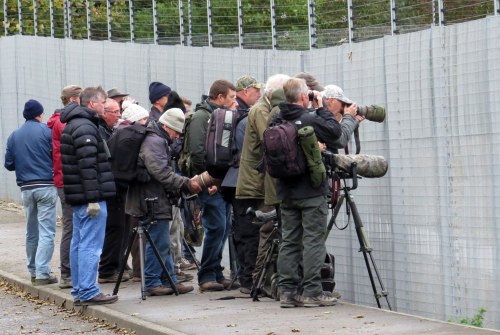
I had seen a pair of Siberian Accentors twenty years ago in Arctic Siberia (otherwise I would have left immediately) and I dithered for several days about making the 600 mile round trip again. It was my friend Roger returning from Scilly on the 18th that made all the difference, he was very keen to go. I’m so pleased we went the following day as the bird wasn’t seen on the 20th. we arrived mid morning to find a modest crowd watching. The bird had moved between two lines of security fencing feeding contentedly on weed seeds. The only problem was that because of the close weave of the fence you could only see when looking at 90 degrees to the fence. It must have been a nightmare at the weekend.
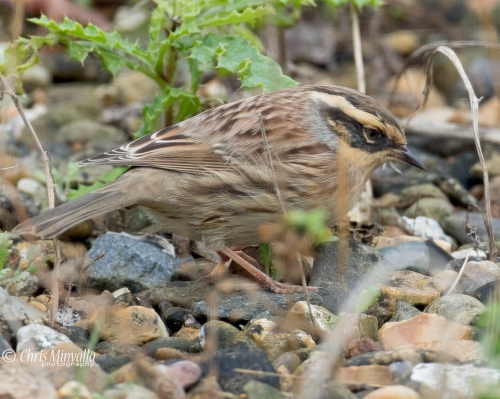
Even so, Chris with his 500mm mega lens was able to get some really nice photos. Breeding in a narrow zone from the northern Urals to Chukotka and wintering in eastern China (a time of year when few birders visit China), this was a once in a lifetime chance for most birders to experience this charming species.
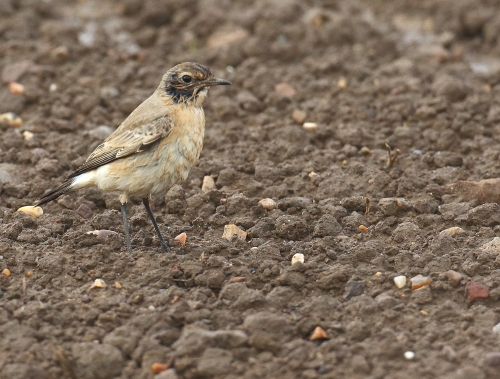
An added bonus was that only a few hundred yards away was an Isabelline Wheatear, a species I have seen on 19 foreign trips to its breeding grounds in Central Asia and wintering grounds in East Africa, but never in the UK. Whilst I wouldn’t have gone all the way to Spurn for this alone, it was a most welcome addition to my British List. Heavy rain and a habit of feeding in a muddy field has stained its face black, but the upright stance, long legs, short tail, the black alula contrasting sharply with the rather plain ear coverts ….
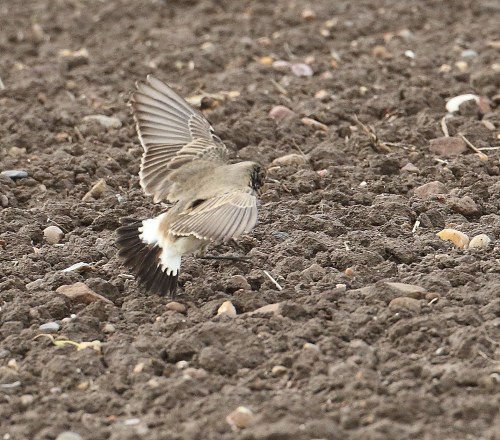
…. and in this photo, the extensive black in the tail with only a short projection of black towards the rump on the central tail feathers all indicate an Isabelline Wheatear. According to Wikipedia the word ‘isabelline’ may derive from Isabella I of Castile and the eight-month siege of Granada by Ferdinand II of Aragon starting in April 1491. She vowed not to change her chemise until the siege was over, which took rather longer than she anticipated (other versions of this legend are available). The name Wheatear of course derives from the Anglo-Saxon ‘white-arse’. Both the photos of the wheatear and the Siberian Accentor were taken by Chris Minvalla and are used with permission.
There had been no news about the Western Swamphen and the three of us headed home in the afternoon well pleased with what we had seen. The next day, of course, we heard that the Swamphen was being seen again in Lincolnshire. Never mind as Meat Loaf once sang ‘two out of three ain’t bad’. Indeed on this occasion it was bloody marvellous!





















 gryllosblog