Archive for the ‘Uncategorized’ Category
This is the 7th post about our wonderful trip to northern India in November 2019. The custom tour was arranged by Jo Thomas of Wild About Travel, who arranged an itinerary, accommodation, transport and guides to our specification, which combined wildlife viewing and cultural highlights.
This post covers our half-day visit to the city of Jodhpur and a visit to some nearby villages belonging to the Bishnoi people.

After visiting Mumbar gardens (see post 6) we entered the city of Jodhpur and stopped at the Clock Tower where there was an extensive market …

… selling a wonderful variety of fruit, vegetables, clothing etc. We were able to buy some spices and masala tea, far better souvenirs than the usual tourist junk.
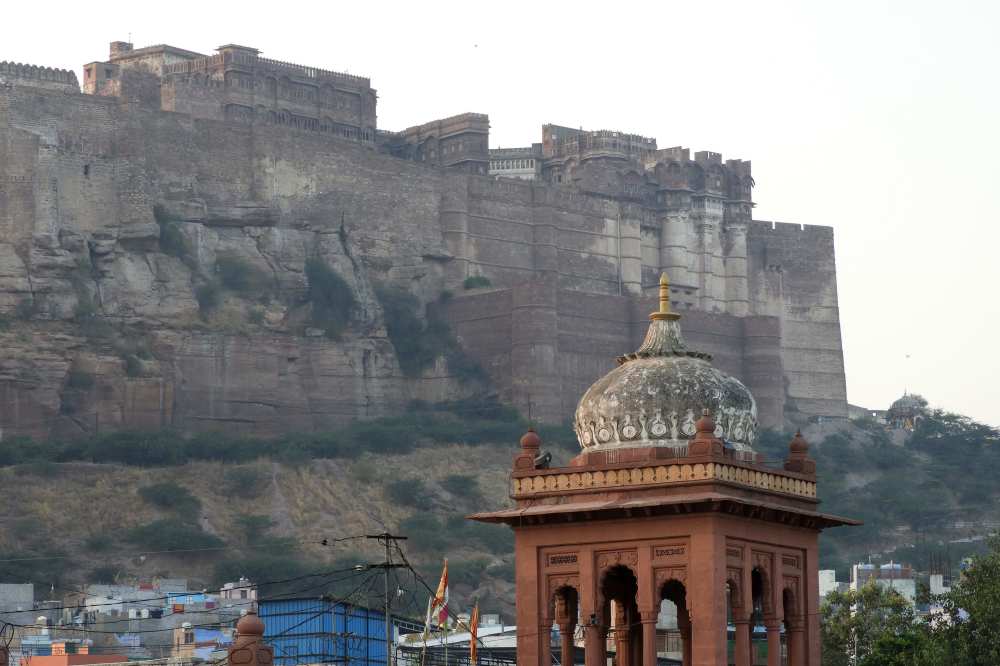
The whole area is overshadowed by the Mehrangarh or Mehran Fort. which dominates the skyline.

Later we were taken to our hotel, the lovely Rattan Villas near the city centre.

No dancers this time, but a musician playing traditional instruments made up for that.
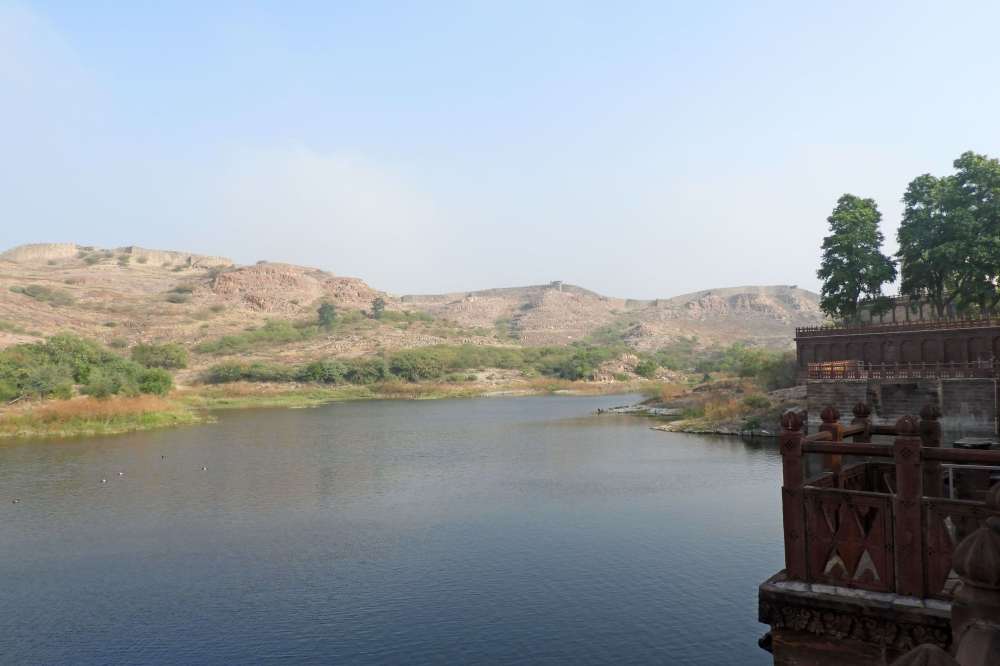
The next morning we drove with a guide to Jaswant Thada, a marble mausoleum overlooking the city. Note the ancient city walls running along the skyline.

An adjacent lake got me my first Ferruginous Ducks for the trip, but the main focus was the beautiful architecture of the mauseleum.
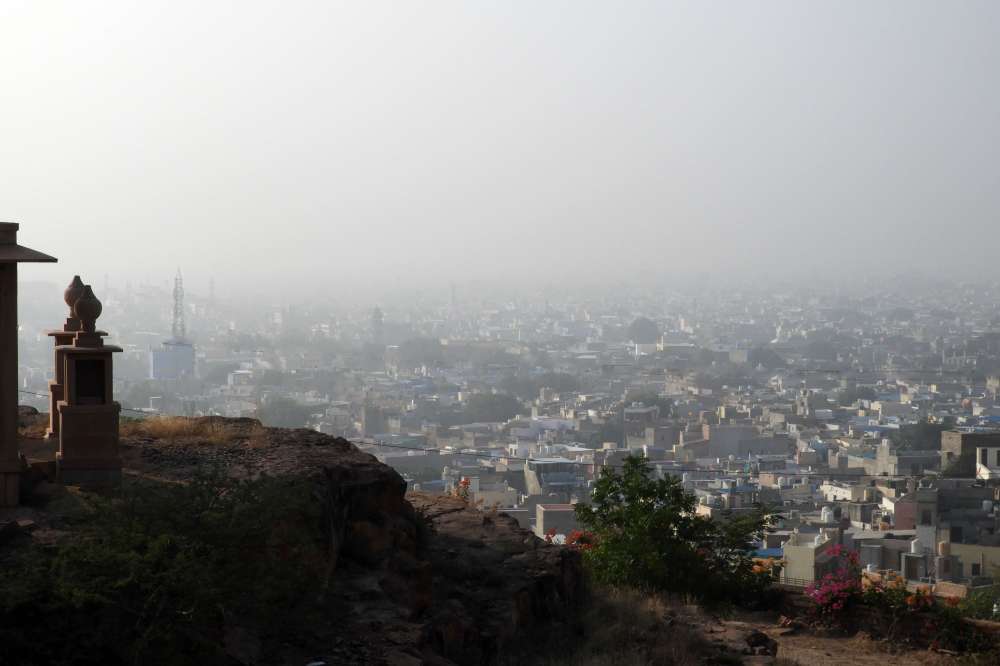
Unfortunately the usual mist and pollution haze hung over the city, but even so the view was spectacular.

Regular readers of this blog will know I’m no fan of the selfie craze, but even so I found this sign quite amusing.
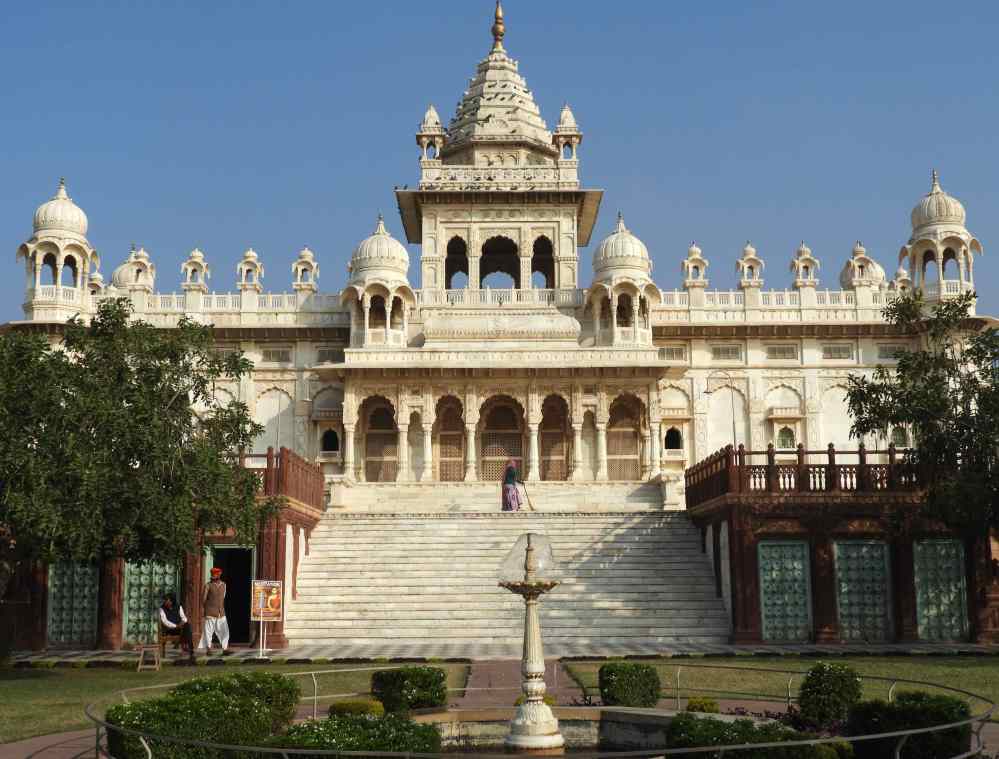
From Wikipedia: The Jaswant Thada is a cenotaph located in Jodhpur, in the Indian state of Rajasthan. It was built by Maharaja Sardar Singh of Jodhpur State in 1899 in memory of his father, Mahara-ja Jaswant Singh II, and serves as the cremation ground for the royal family of Marwar.
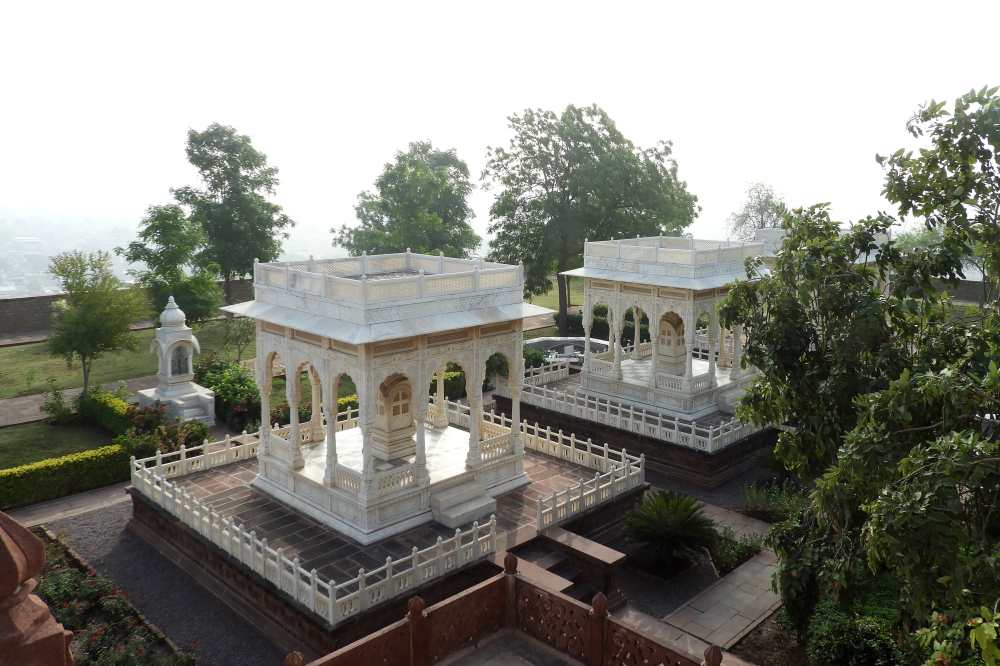
The mausoleum is built out of intricately carved sheets of marble. These sheets are extremely thin and polished so that they emit a warm glow when illuminated by the Sun.

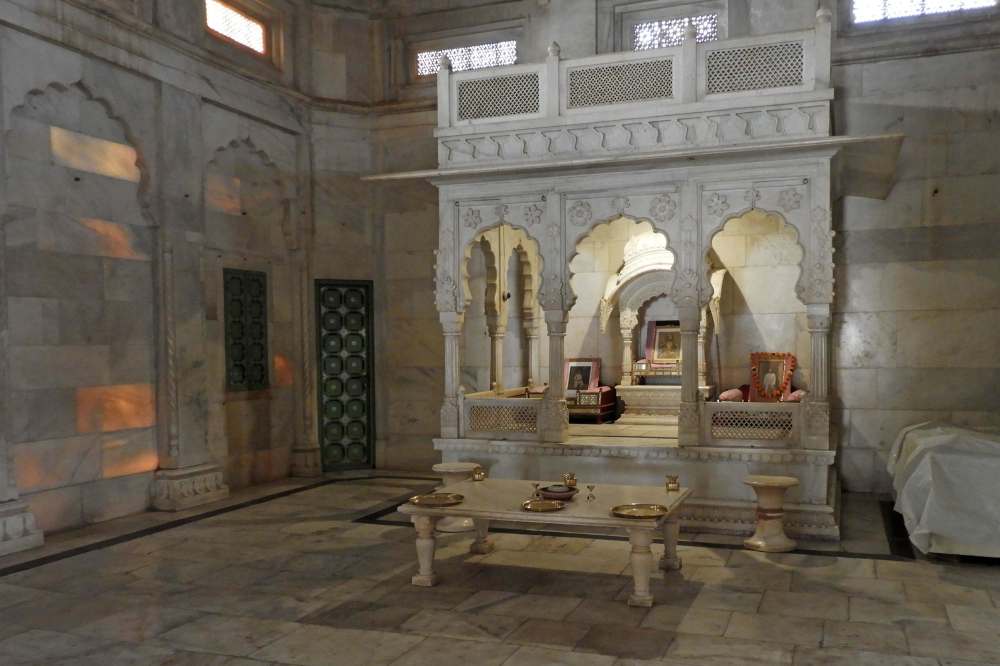
The cenotaph of Maharaja Jaswant Singh displays portraits of the rulers and Maharajas of Jodhpur.
The cenotaph’s grounds feature carved gazebos, a tiered garden, and a small lake. There are three other cenotaphs in the grounds.
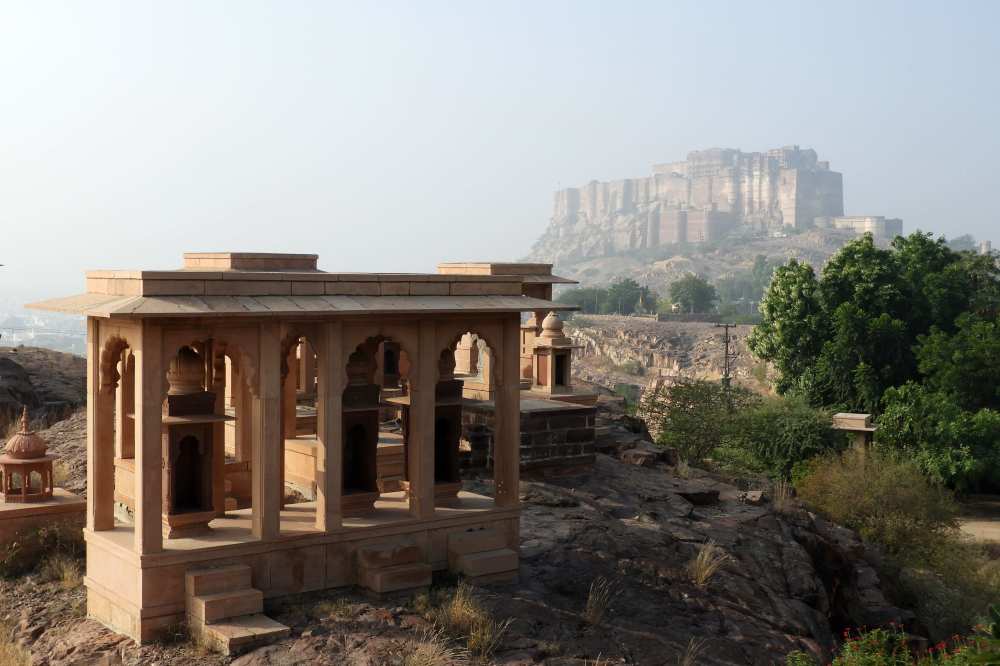
The view from the mausoleum’s gardens were once again dominated by the Mehrangarh Fort, which was to be our next destination.

From Wikipedia says about the Mehrangarh Fort,: There are seven gates, which include Jayapol (meaning ‘victory gate’), built by Maharaja Man Singh to commemorate his victories over Jaipur and Bikaner armies. There is also a Fattehpol (also meaning ‘victory gate’), which commemorates Maharaja Ajit Singhji victory over Mughals.

The fort is truly enormous, said to be one of the largest in India.

If Jaipur is known as the pink city then Jodhpur is the blue city.

From Wikipedia (again): Jodhpur is the second-largest city in the Indian state of Rajasthan and officially the second metropolitan city of the state with a population surpassing 1.5 million. It was formerly the seat of the princely state of Jodhpur State. Jodhpur was historically the capital of the Kingdom of Marwar, which is now part of Rajasthan. Jodhpur is a popular tourist destination, featuring many palaces, forts, and temples, set in the stark landscape of the Thar Desert. It is popularly known as the “Blue City” among people of Rajasthan and all over India. It serves as the administrative headquarters of the Jodhpur district and Jodhpur division.

The old city circles the Mehrangarh Fort and is bounded by a wall with several gates. The city has expanded greatly outside the wall, though, over the past several decades

This bronze model shows the size and scale of the gigantic fort.
These next three photos …

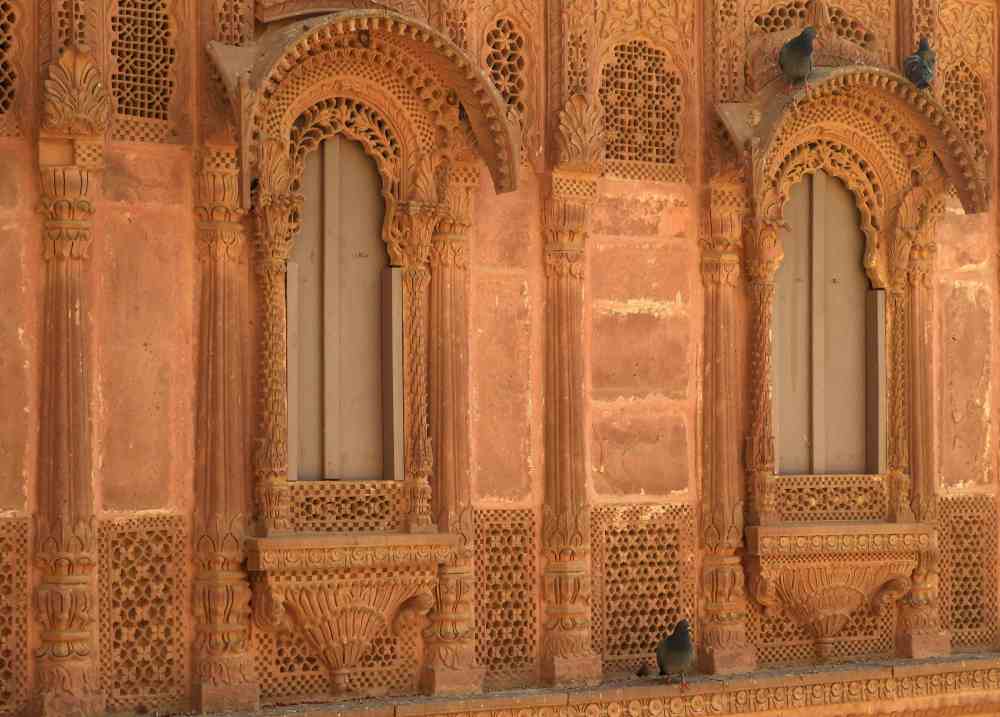
shown the scale and extent of the wonderful architecture …

… and the incredibly intricate stonework seen here …

… and here.

The museum in the Mehrangarh fort is one of the most well-stocked museums in Rajasthan. In one section of the fort museum, there is a selection of old royal palanquins, including the elaborate domed gilt Mahadol palanquin which was won in a battle from the Governor of Gujarat in 1730.

The museum exhibits the heritage of former times …

… in shrines, costumes …

… paintings and decorated tapestries.

A few more photos of the fabulous interior …

… it was so gob-smackingly beautiful …

… that I failed to take in all the details that our guide was providing.
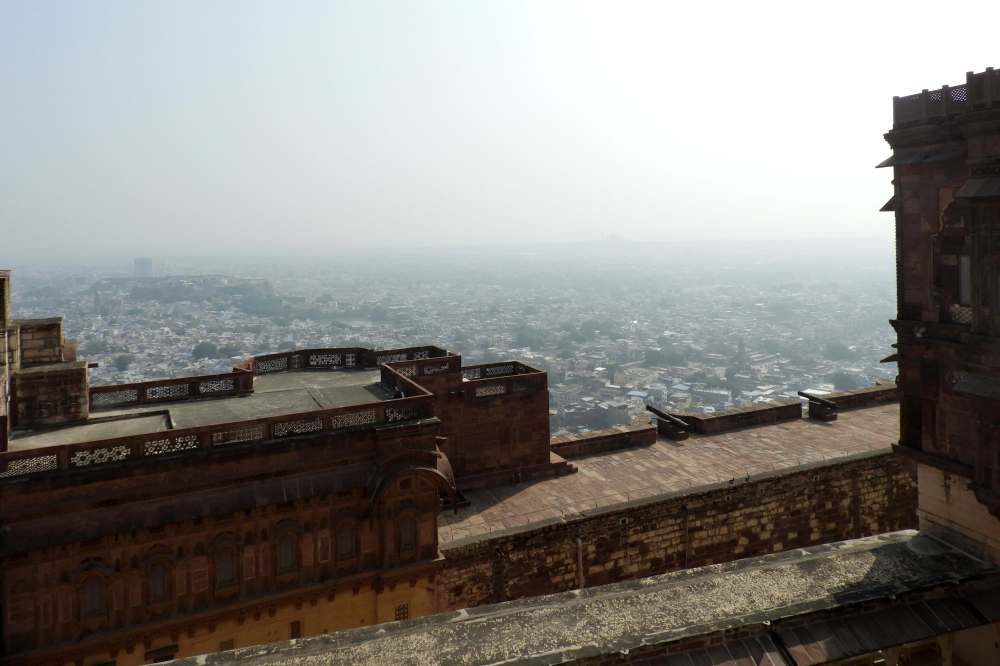
Eventually we emerged outside for another view over the city.

You get the feeling that this passage way was designed for a smaller person!
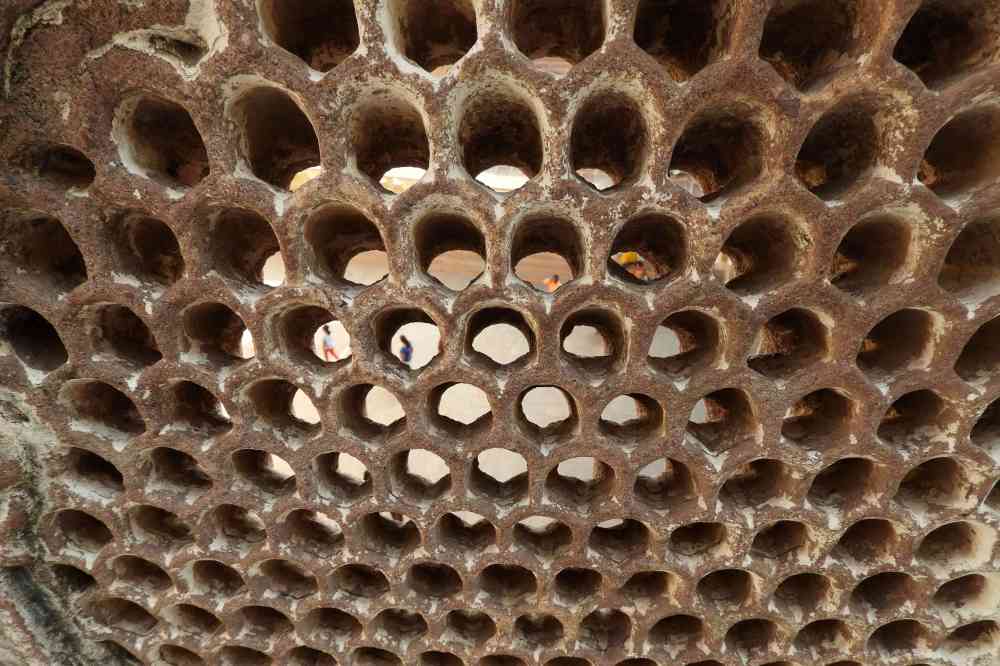
More of the delicate stonework that allows the breeze to enter but allows the women of the court to view the plazas below without being seen themselves.

This time a view complete with Rock Pigeons. The question of what is a truly wild Rock Pigeon and what is a domesticated feral pigeon is a vexed one. Certainly those in European cities and any in the New World are feral but these here on the forts of India showed every characteristic of being wild; no enlarged cere, no variation in plumage and pale grey not white rumps.

More views of the city walls …

… more highly decorated corridors …

… and yet more intricate stone work.

Later on we returned to Jodhpur and after some lunch we headed into the countryside to visit the villages of the Bishnoi people.

After lunch the guide and our driver Mehaz took us to some villages of the Bishnoi people. Apparently Bishnoi means 29 in the local dialect which comes from the 29 commandments given to members of the Bishnoi sect by Guru Jambheshwar (1451-1536). As well as religious instructions and social rules the commandments list a number of environmental considerations and instructions for sustainable living. If only Moses had thought to bring another 19 commandments with him when he descended from Mount Sinai then the world would be a very different place today! Like so many of these village tours it was really just an opportunity to sell artefacts to tourists, but the villagers seemed so much more deserving than their city counterparts (and prices were much lower).

In this rather scruffy yard we were shown how the villages make and fire the large earthenware pots and we bought a ‘terracotta sun face’ to put on our garden fence …

… whilst elsewhere and an old man with a gammy leg offered us some opium – which we politely declined.

Although we usually hate being taken to ‘carpet outlets’ when on a tour we rather stumbled on this one and as he didn’t give us the hard sell, we bought a small rug off him.

Our visit to a group of nomadic ‘snake charmers’ was more impromptu but we were welcomed in once they realised that the guide came from the same village as they did.
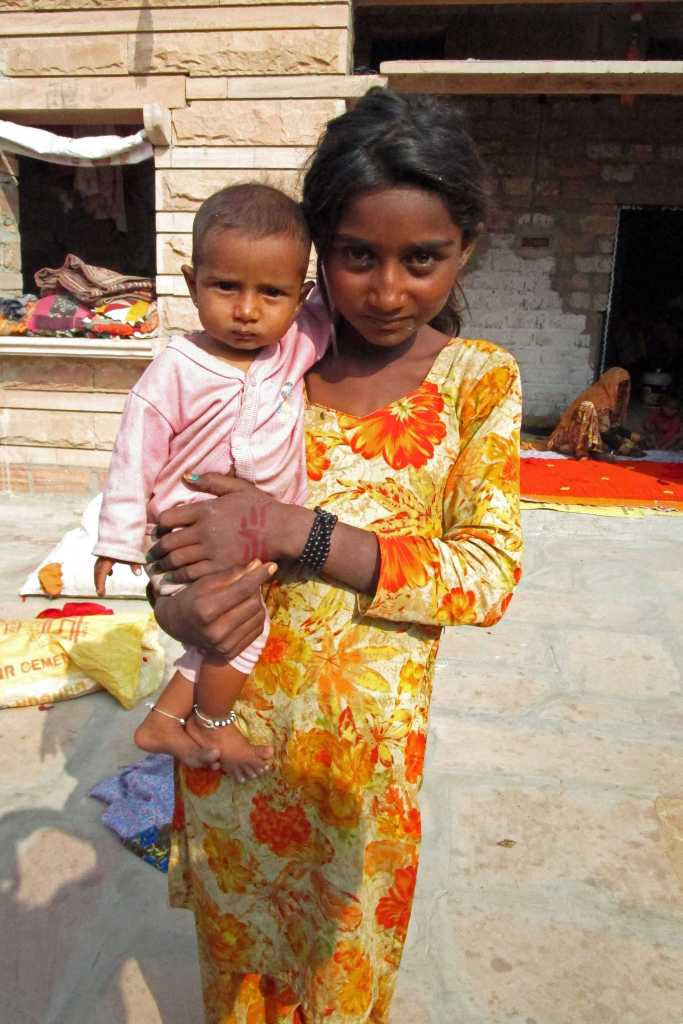
… although a small child ran away screaming in terror when he saw our white faces (he calmed down later for this photo).

These are the cow-turd piles that the villages construct as the fuel store for cooking and heating.
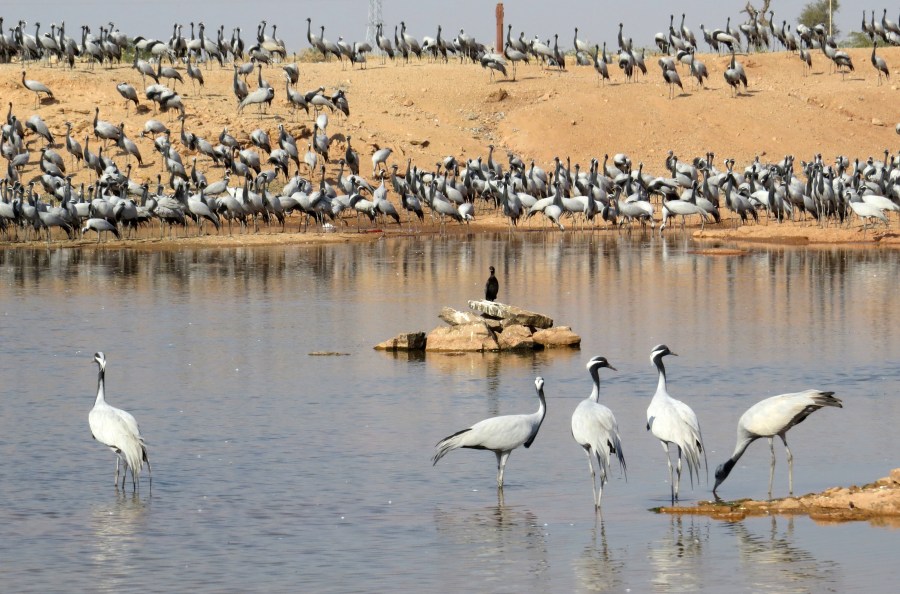
The Bishnoi believe in protecting nature and we were taken to a lake where they feed the Demoiselle Cranes that come from Central Asia for the winter. The birds were rather distant for photos so I’ve included a shot from the similar, but much larger feeding station at Bikiner some distance to the west, where the cranes can be found in their tens of thousands.
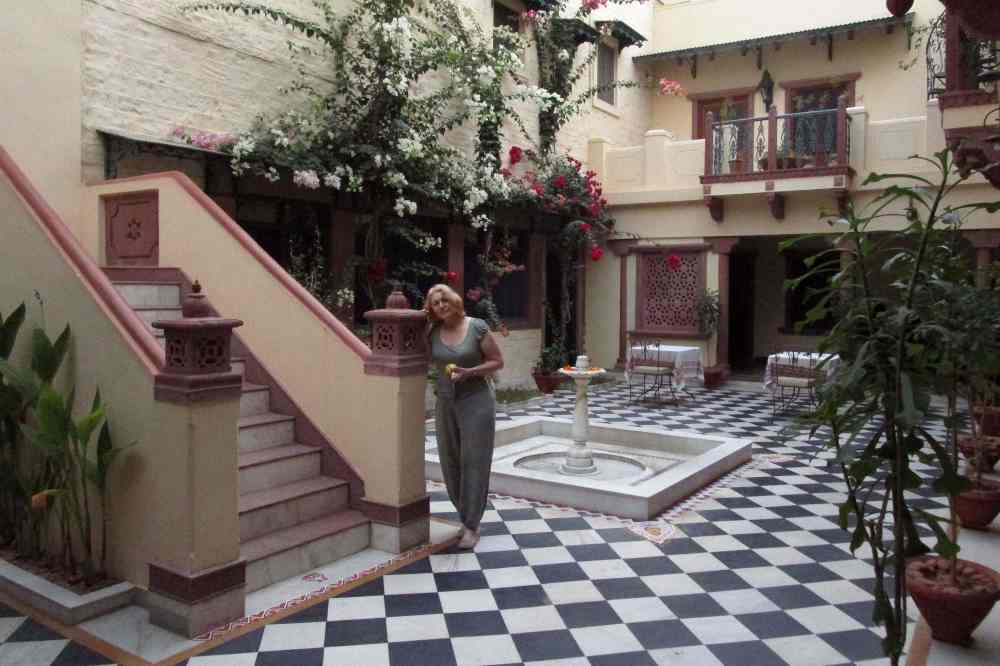
We returned to the hotel that evening but the following day was worst of the trip. The flight to Delhi was in the early afternoon which would have given us time to do some sightseeing on arrival, so in the morning we had a bit of a lie in followed by another visit to the Clock Tower markets (where once again Margaret would be asked to pose for a selfie with the locals). Then we headed to the airport in the late morning and said our goodbyes to the very capable driver Mehaz. Before we left he reminded us of the three requirements for driving in India – a good horn, good brakes and good luck! Once through security we found there was a major delay with the flight and we spent six or more hours in a tiny departure lounge that was hot, crowded and very noisy due to a loud security scanner and lots of babies. We finally arrived at our hotel in Delhi late in the evening where decided to skip dinner and get straight to bed. It was the only hiccup of the trip and completely outside the organiser’s control.
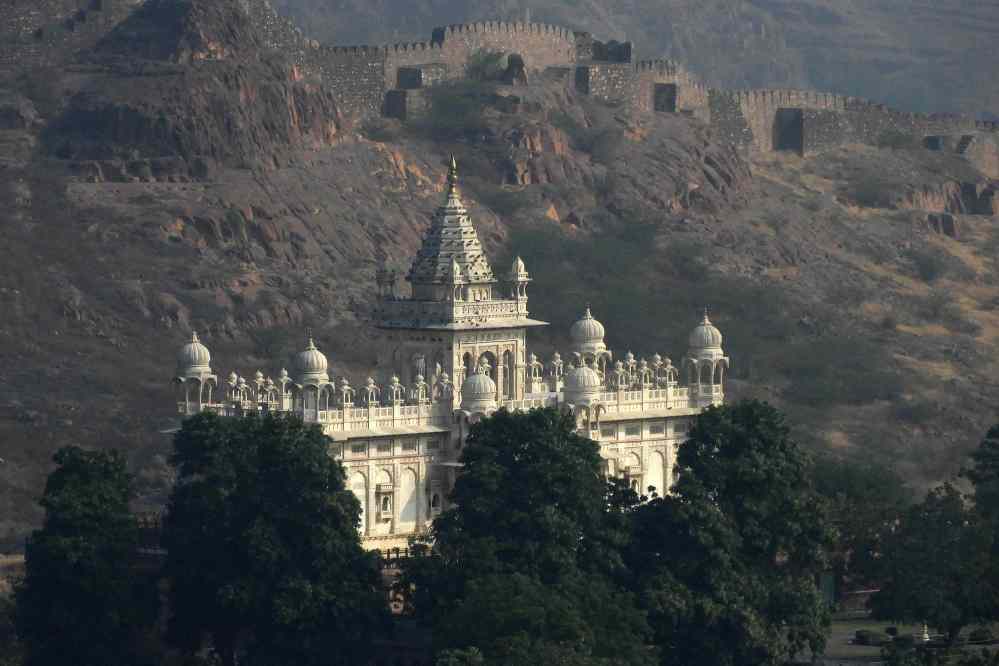
I’ll conclude with a photo of the wonderful Jaswant Thada taken with on a telephoto setting from the fort of Mehrangarh.
The eighth and final post will deal with our time at the wildlife reserve of Sultanpur Jheel near Delhi and some of the monuments within the city itself.
This is the 6th post on our wonderful trip to northern India in November 2019. The custom tour was arranged by Jo Thomas of Wild About Travel who arranged an itinerary, accommodation, transport and guides to our specification that combined wildlife viewing and cultural highlights.
After spending a day touring historic sites in Jaipur it was the turn to do some birding in the reserve of Tal Chhapar (yes that is the correct spelling!) a reserve near the village of Chhapar which is just under half way between Jaipur and the Pakistan border.

We were relatively close to Tal Chhapar on my Birdquest Western India trip in 2016 when we visited Bikaner, (as so often happens it was added to the itinerary the following year). There were two lifers for me here, one mammalian and one avian, the beautiful Blackbuck and the little-known Indian Spotted Creeper.

It was a 215 km drive from Jaipur and took over four hours. The village of Chhapar was quite unremarkable with a single busy main street and a few back streets like this.

We stayed at Raptors Inn, a private guest house run by local bird guide Atul Gurjar and his wife Sunita. They made us very welcome and provided great food. Margaret was very taken by this home stay and had a chance to ask Atul and Sunita about many aspects of Indian life including their cuisine. See more here
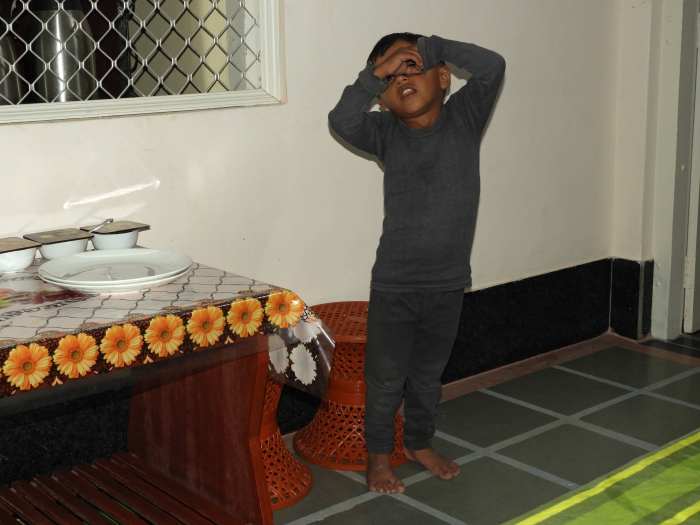
They tried their best to keep their boisterous children away from us but we found them most entertaining.

That afternoon we headed to a ‘gaushala’ a walled off area where the sacred cattle can safely graze. On route we passed this camel and buggy. There is clearly no law about using your phone whilst driving a camel in India! Here we were to search for the ‘semi-mythical’ Indian Spotted Creeper. Now I can’t say that I’ve been waiting to see this species all my life, I didn’t even know about of it until after it was split from its African cousin in the late 90s, but I have been wanting to see the area’s other attraction, the beautiful Blackbuck since I was a small child.

Finding the Indian Spotted Creeper took some time but there was no problem with seeing Blackbuck, up to 50 were on view. The females ,which are smaller, brown and white and have no horns were present but elusive, but the males were in rut and were bold and approachable.

Males would approach each other and then ‘parallel walk’, sizing each other up …

… sometimes disputes were resolved by this but often it ended up with an all out battle.

In due course Atul found a Spotted Creeper but it was in a line of trees by the gaushala wall. After a brief view and one very mediocre photo, it flew to some trees outside the gaushala where it could be seen but not photographed (there was a considerable drop on the other side of the wall so climbing over was impractical).

This was my first bird lifer on the tour and I was pretty pleased at this moment. This species and its African cousin are members of the Sittidae, the Nuthatch Family rather than Certhidae which contains all the (Holarctic/Oriental) treecreepers. Both photos by Prasad Natarajan see here

I think I said in an earlier post, when discussing the catastrophic decline in Indian vultures, that the only vulture we saw on the trip was Egyptian. That’s not quite true as we saw a single wintering Eurasian Griffon Vulture. How ever that doesn’t detract from my earlier statement that because of poisoning, the formerly widespread and abundant Slender-billed, White-rumped and Indian Vultures are now critically endangered.

Other raptors included this Black-winged Kite …

… and a beautiful Long-legged Buzzard.
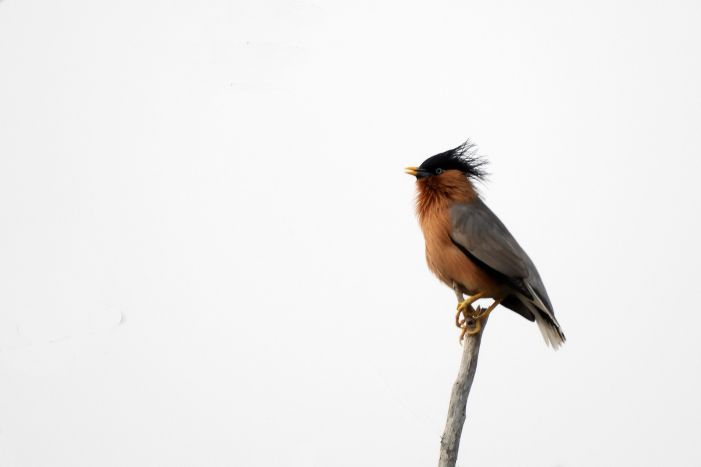
Other birds photographed that afternoon included the punk-crested Brahminy Starling (above) and …

… flocks of Indian Silverbills, small estridid finches, native to India but introduced to many other places.
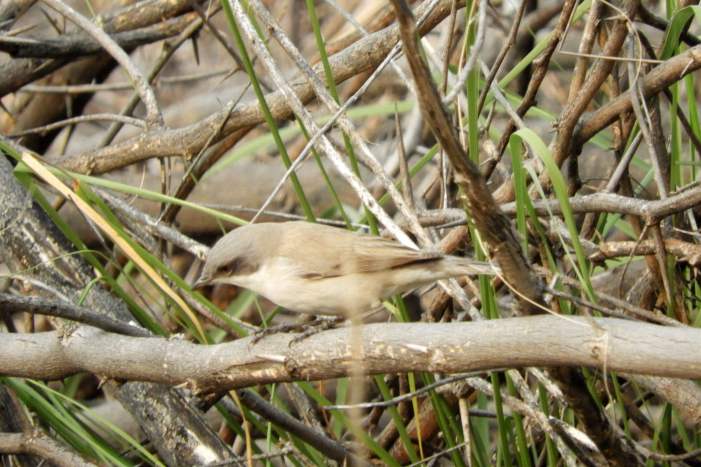
There were a few ‘lesser whitethroats’ wintering. The taxonomy of this group has been controversial with between one and five species accepted at various times and by various authorities. IOC and HBW both now recognise three species, Hume’s Whitethroat which breeds in the mountains of Central Asia and winters in southern Baluchistan and SW India, Lesser Whitethroat which breeds from western Europe to east-central Siberia and winters in Africa and northern India and Desert Whitethroat which breeds in parts of China and Turkestan and winters in the Arabian peninsular and north-west India. This bird is a classic minula, ie a Desert Lesser Whitethroat, small, sandy with reduced grey in the crown.

There were quite a few Lanius shrikes in the area, including this male Bay-backed, which looks like a Penduline Tit on steroids …
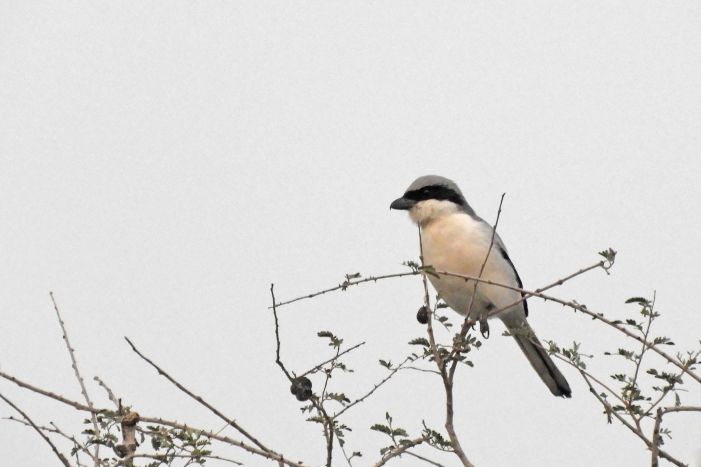
… and the more familiar Great Grey Shrike, although here of the race archeri. The ‘great grey shrike’ group has undergone a lot a changes during the last few decades. Originally one species, then three (Southern, Great Grey and Steppe), its now still three but a different three: Northern Grey occurs in North America and eastern Siberia, Iberian Grey occurs where it’s name suggests and all the rest are re-lumped in Great Grey again. The problem seems to be that genetics and morphology don’t match, maybe eventually more sensitive and innovative genetic methods will be able to divide this group further and so better match DNA to plumage.

Also present were a number of Common Woodshrikes. These are not related to true shrikes of the genus Lanius (see the two photos above) but instead are members of the Vangidae, an unusual Family which includes the vangas of Madagascar, the African helmetshrikes and shrike-flycatchers and Asian philentomas.

After we had our meal that evening we heard very loud music coming down the street. Atul and Sunita said it was a pre-wedding celebration, so we decided to take a look.

Although they had never met us before the villagers were most welcoming. First they brought chairs out into the street so we could watch the dancing in comfort, then they invited us into their house and where the ladies were keen to be photographed with Margaret.
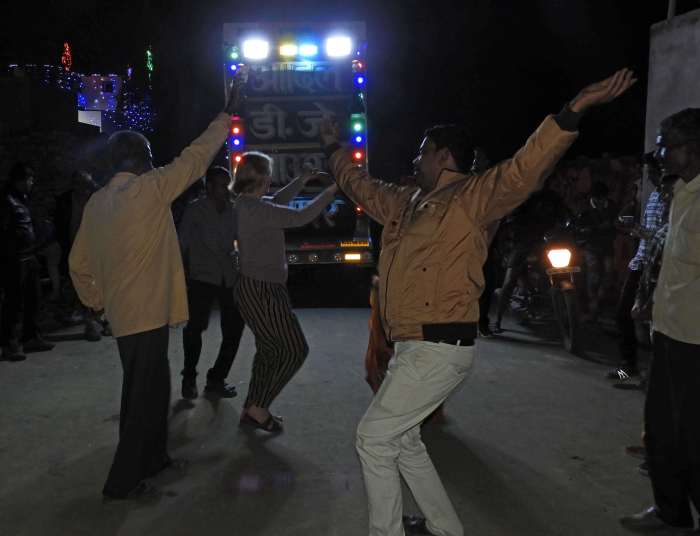
Later we (well mainly Margaret) joined in with the dancing …
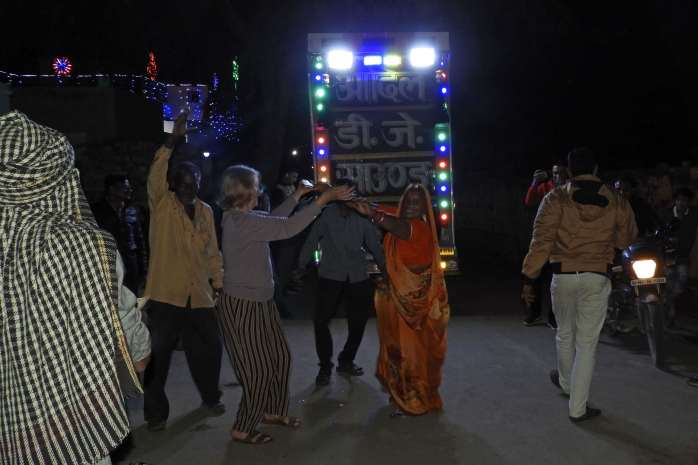
… and we were treated as honoured guests. The bride and groom-to-be had yet to arrive but everyone else seemed to be having a great time on their behalf.

Now I’ve heard of ‘a bull in a china shop’ but its not that often that you come across the ‘cow at the mobile disco’, well not this sort of cow anyway.

Atul was a bit hesitant about visiting the actual Tal Chappar reserve (Tal meaning low-lying land) as heavy rain had made the tracks unsuitable for vehicles. As a result the following morning we first visited a lake near the gaushala.
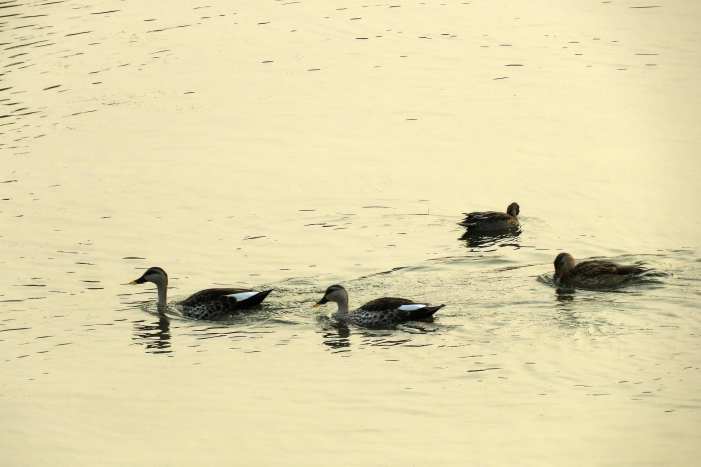
We found a few waterbirds we had seen earlier on like these Indian Spotbills but the River Terns we found were new for the trip.

Spotbill used to be a single species but has since been split into Indian and Chinese varieties. I think it looks rather splendid in the pale-yellow light of dawn

Eventually Atul relented and took us to the nearby Tal Chhapar, but we had to leave the vehicle at the entrance gate. In this low-lying hollow the mist persisted, producing some atmospheric views of the local Blackbuck.

As well as Blackbuck there were quite large numbers of Wild Boar.
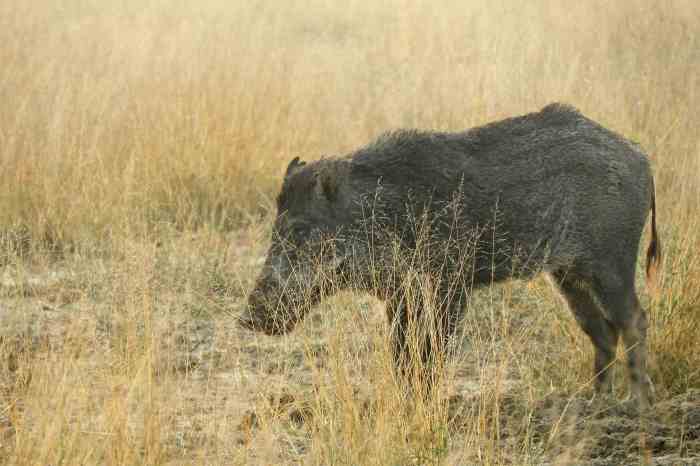
However some of the piglets showed characteristics more typical of domestic pigs so there must be some interbreeding. Also seen were Common Cranes and Western Marsh Harriers, but unfortunately not Monties or Hen Harriers (I dare say we would have seen more if we could have stayed or if the visibility had been better).
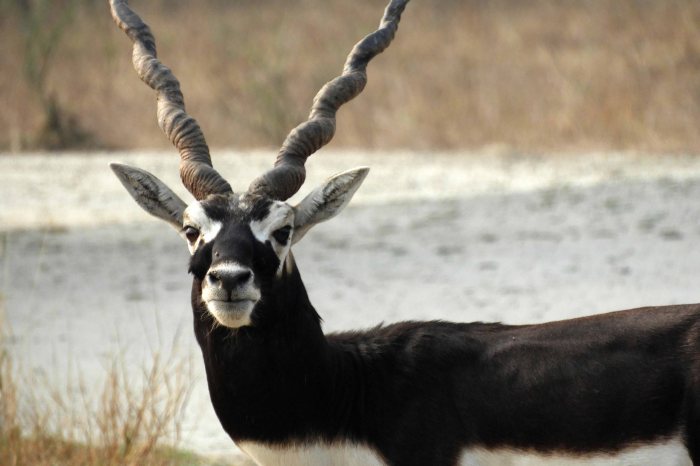
Well we weren’t able to walk very far as we had huge great clods of mud stuck to our boots, making walking rather difficult. Back at vehicle we had a very close encounter with a male Blackbuck. I don’t know if I’ll ever see this magnificent antelope again, but if I don’t I can’t complain about the views we had this time.
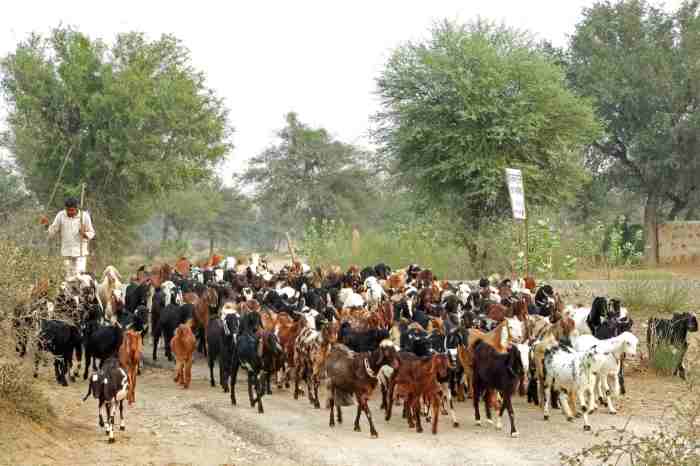
So we returned to the other side of the road and explored another area dodging great herds of goats on route.
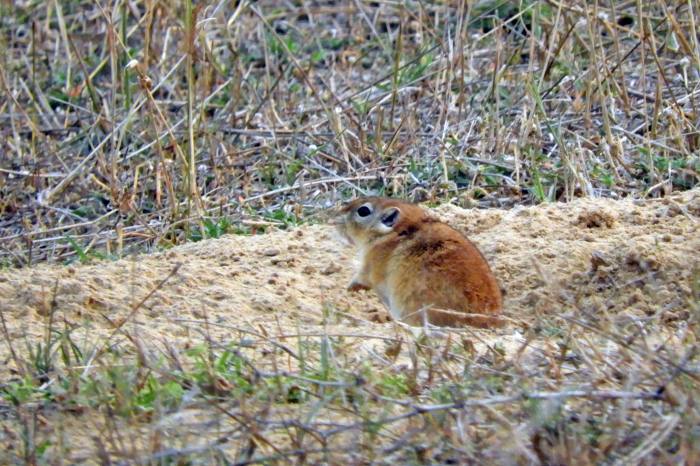
Here we found Indian Desert Jirds. We only saw about ten but their burrows were everywhere.
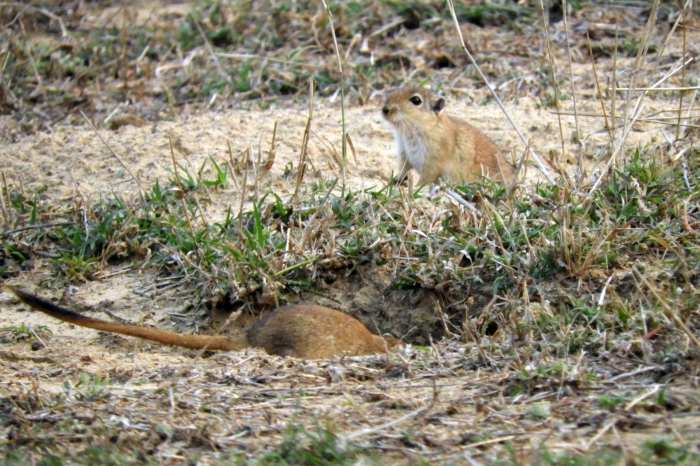
These little rodents are preyed on by many raptors including …

… Booted Eagles (although in Europe rabbits are their favoured mammalian prey) …

… and Long-legged Buzzard.
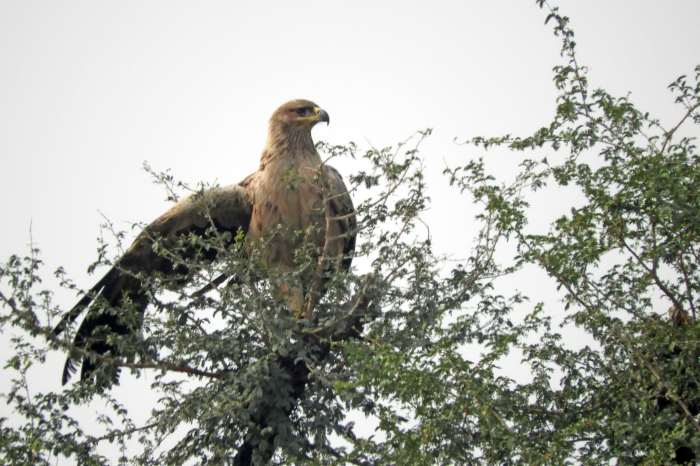
Tawny Eagles are know to be mainly a scavenger and a kleptoparasite but I dare say the odd Jird or two would make a tasty snack, if they were quick enough to catch one.
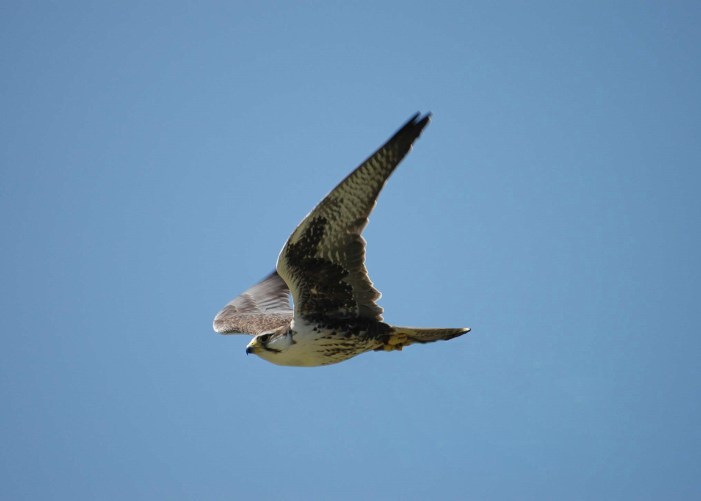
We had spectacular views of a Tawny Eagle being harassed by a pair of Lagger Falcons. Unfortunately in my photos either the eagle or falcon are blurred so I’ve included one from iNaturalist taken by Philippe Boissel see here
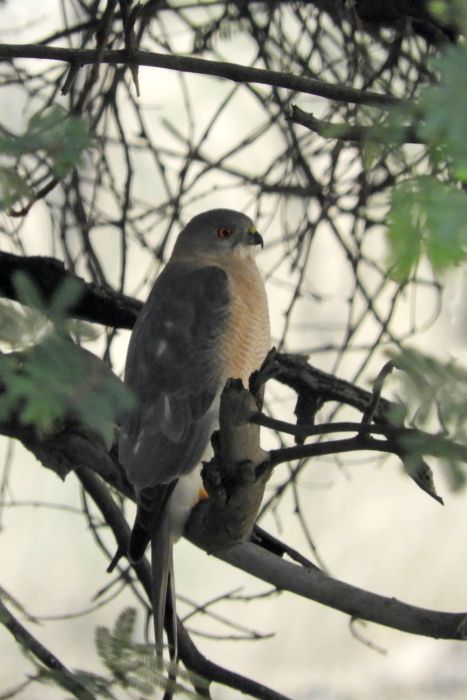
The little Shikra is in the genus Accipiter which feeds mainly on birds rather than rodents.
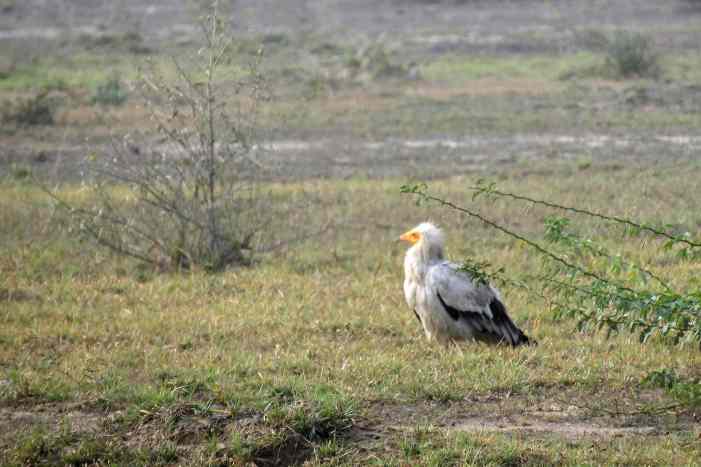
Rather commoner than the larger Gyps vultures but still declining severely is the widespread Egyptian Vultures.

We came across a group of four on our drive around.
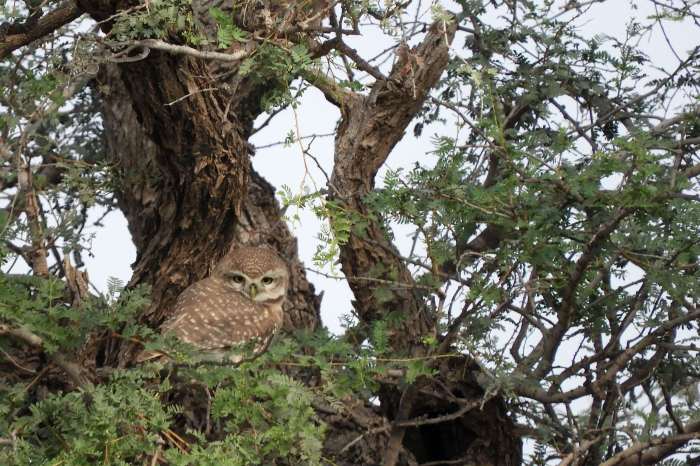
Also seen was (yet another) Spotted Owlet.

Enjoyable as it had been it was time to leave Chhapar and heard to our next destination.
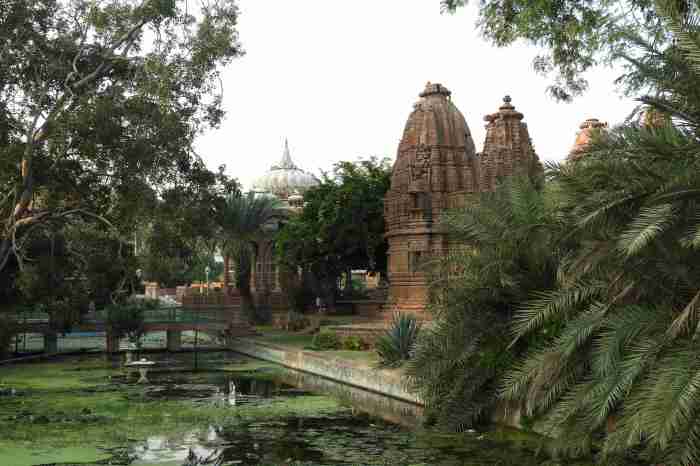
That afternoon we drove to Jodhpur and stopped for a short while at Mumbar Gardens near the city where there was an attractive temple and a wetland area caused by the damming of the local river.

We didn’t learn anything about the temple a this was just a short impromptu stop …
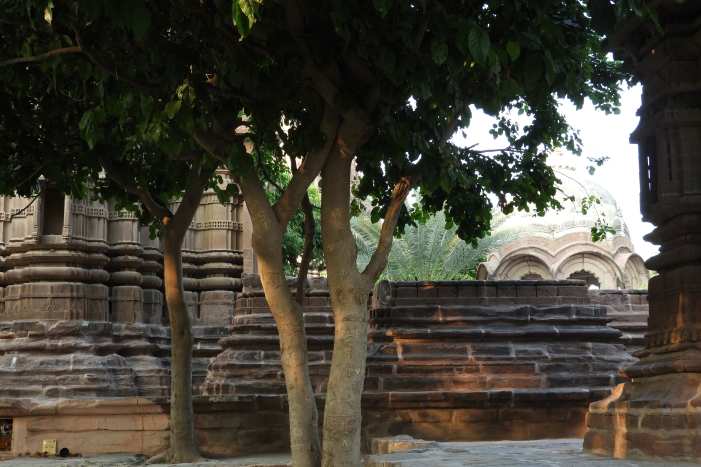
… but like all old Indian architecture it was very beautiful.

There were a few birds in the temple area …

… but most were in the overgrown water channel. These included a ‘water rail’, I hoped that it would be the recently split Eastern Water Rail (or Brown-cheeked Rail), after all the scientific name is Rallus indicus, but it proved to be the same one we get at home.
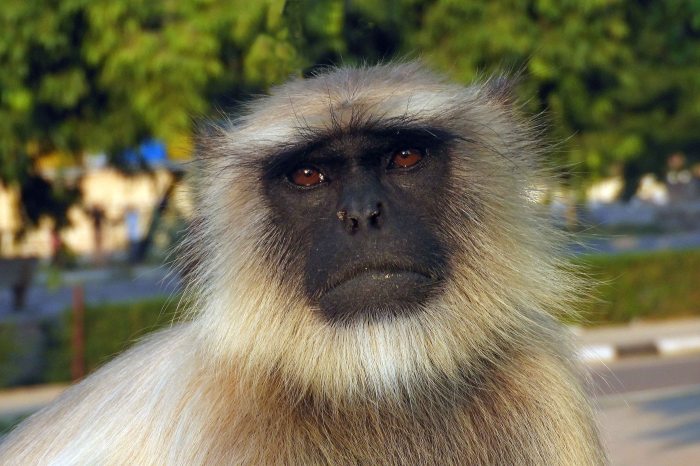
Perhaps the most notable feature of the temple was the very approachable Hanuman Langurs.
The next post will cover our visit to the city of Jodhpur, the nearby Bishnoi villages and a nearby lake where Demoiselle Cranes gather.
This post covers our stay in the city of Jaipur, Rajasthan in northern India. This was part of a custom tour arranged by Jo Thomas of Wild About Travel which combined wildlife viewing and cultural highlights in a way that wouldn’t be possible in standard tour of India.

As I explained in the last post our bird guide at Baratphur came with us to Jaipur on 25th November as there was a site nearby where we might encounter the seldom seen Indian Spotted Creeper, but we weren’t in luck. We dropped the guide off at a bus station to get back to Bharatpur and we were taken to our hotel.
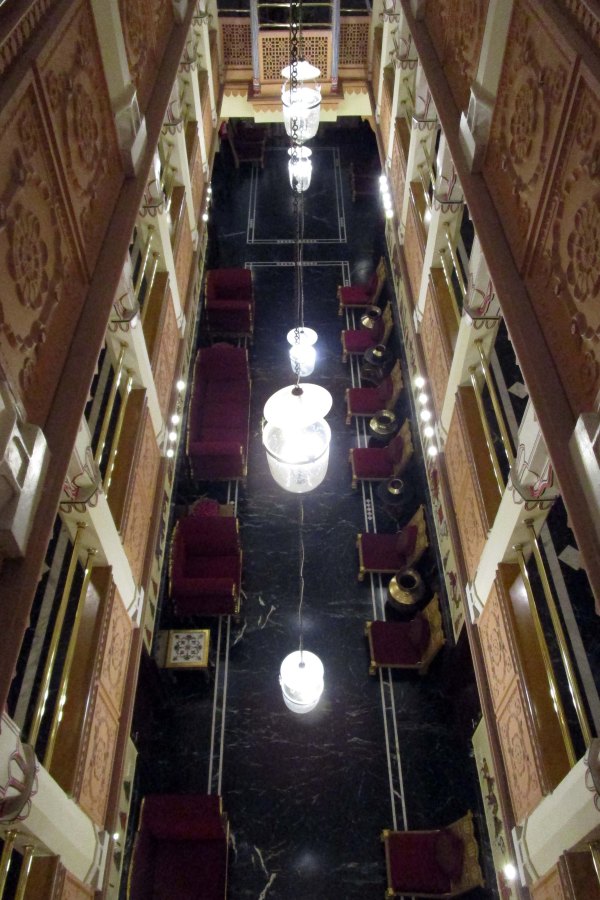
The hotels and lodges we had stayed at so far had been really good but the Umaid Mahal hotel was something special …
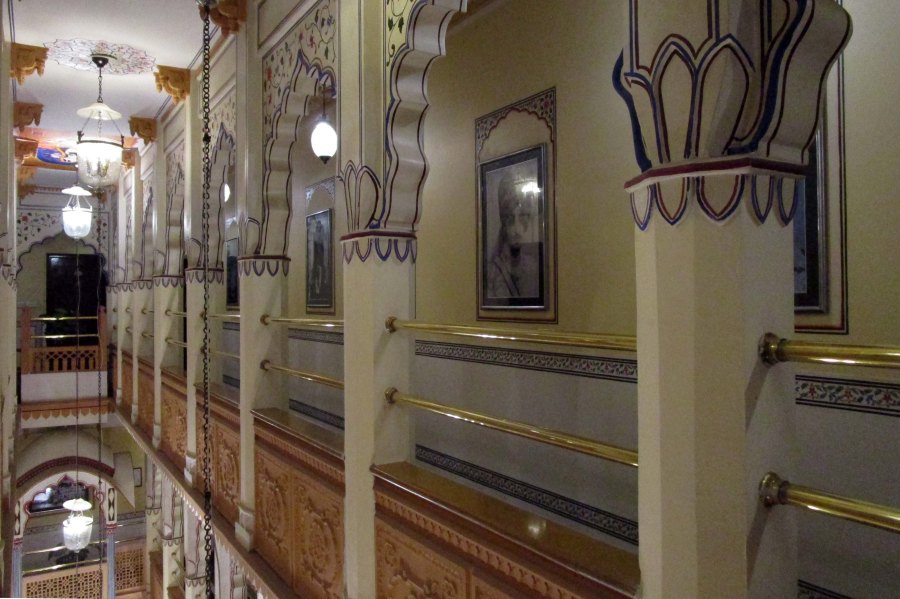
… with it’s highly decorated corridors …

… and a lovely room.

In the dining room we were entertained by some Indian music and dance.

The following morning we picked up our guide and drove into the centre of Jaipur.
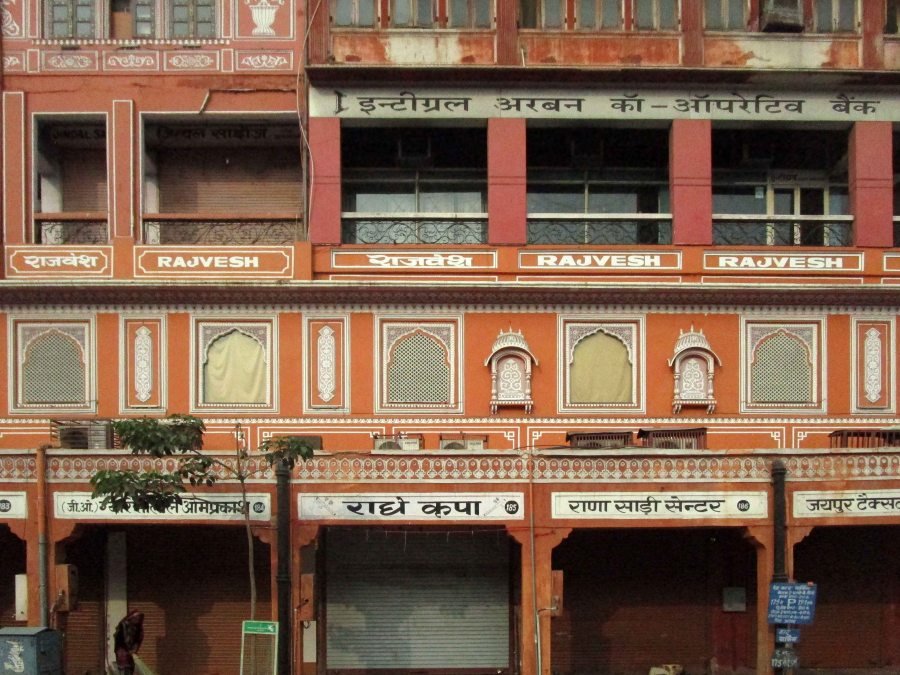
From Wikipedia: Jaipur is the capital and the largest city of the Indian state of Rajasthan. As of 2011, the city had a population of 3.1 million, making it the tenth most populous city in the country. Jaipur is also known as the Pink City, due to the dominant colour scheme of its buildings. It is located 268 km from the national capital New Delhi.

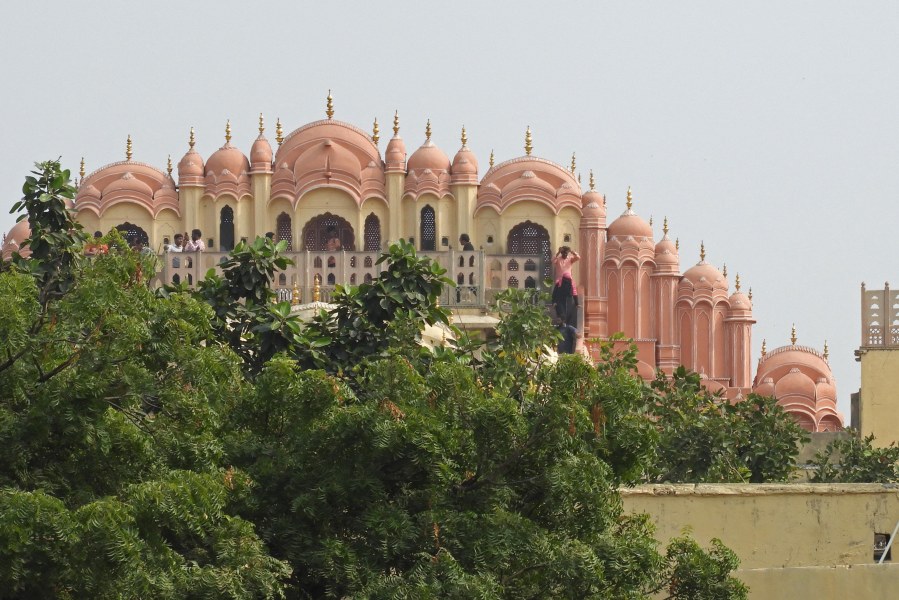
We stopped on a busy road to photograph the Palace of Wind. Unfortunately we couldn’t get further away from the façade to take the photo so the following image shows a bad case of ‘falling over backwards’.

From Wikipedia: Hawa Mahal (English translation: “The Palace of Winds” or “The Palace of Breeze”) is a palace in Jaipur, India approximately 300 kilometres from the capital city of Delhi. Built from red and pink sandstone, the palace sits on the edge of the City Palace, Jaipur, and extends to the Zenana, or women’s chambers. The structure was built in 1799 by Maharaja Sawai Pratap Singh, the grandson of Maharaja Sawai Jai Singh, who was the founder of Jaipur. He was so inspired by the unique structure of Khetri Mahal that he built this grand and historical palace. It was designed by Lal Chand Ustad. Its five floor exterior is akin to honeycomb with its 953 small windows called Jharokhas decorated with intricate latticework. The original intent of the lattice design was to allow royal ladies to observe everyday life and festivals celebrated in the street below without being seen, since they had to obey the strict rules of “purdah”, which forbade them from appearing in public without face coverings. This architectural feature also allowed cool air from the Venturi effect to pass through, thus making the whole area more pleasant during the high temperatures in summer. Many people see the Hawa Mahal from the street view and think it is the front of the palace, but it is the back. In 2006, renovation works on the Mahal were undertaken, after a gap of 50 years, to give a facelift to the monument at an estimated cost of Rs 4.568 million.[6] The corporate sector lent a hand to preserve the historical monuments of Jaipur and the Unit Trust of India has adopted Hawa Mahal to maintain it.[7] The palace is an extended part of a huge complex. The stone-carved screens, small casements, and arched roofs are some of the features of this popular tourist spot. The monument also has delicately modelled hanging cornices.

But our main focus for the day was the huge Amer Fort, which is usually known as the Amber Fort.

We parked and climbed up the access road which gave us views of the modern town and and the ancient walls that enclosed the town and fort. Some of the wall can be seen just to the right of the large cream-coloured buildings in the upper right of the photo.

There was a lot of step climbing involved.
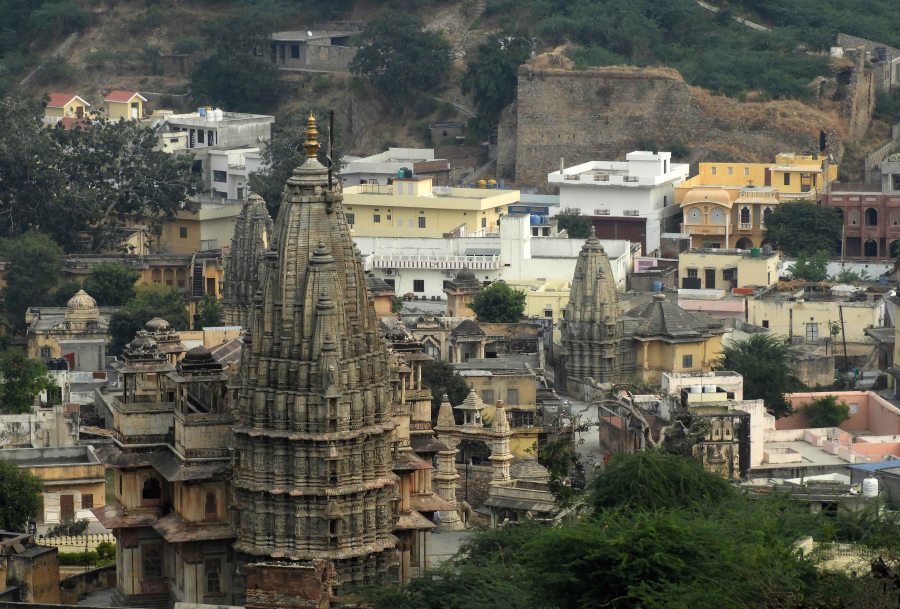
Some views over the town from the fort – here …
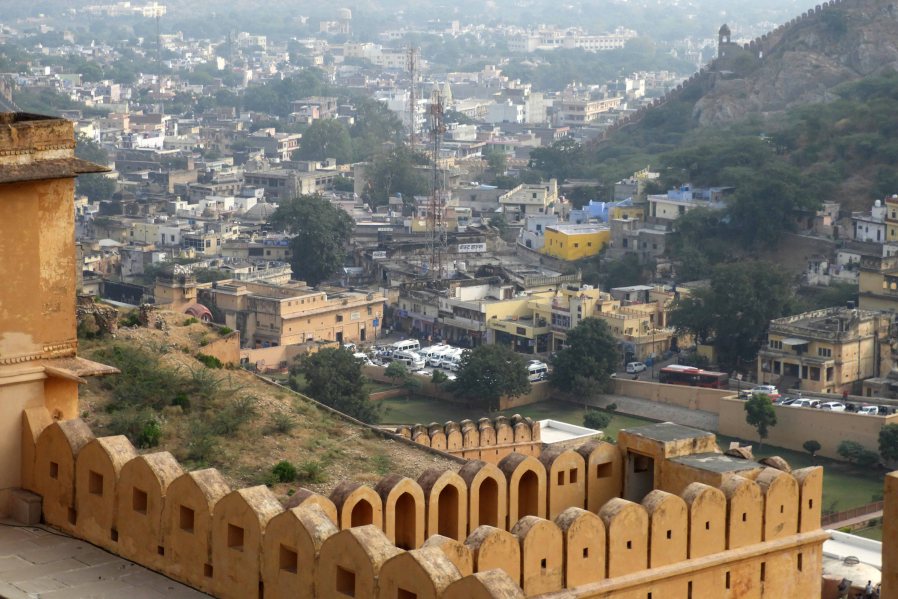
… and also here. More of the wall can be seen in the upper right corner.
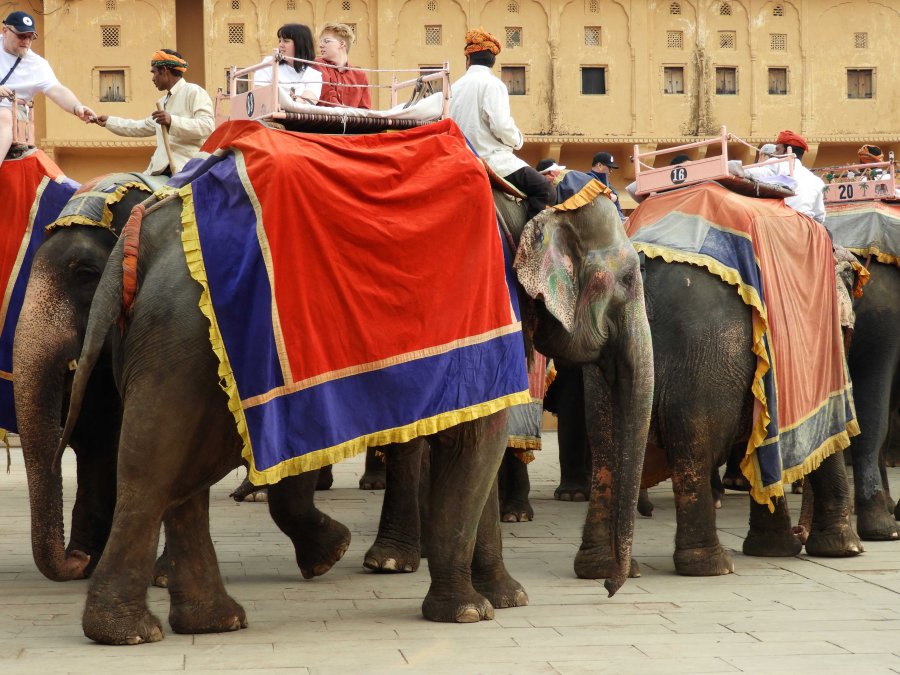
Some people opt for an elephant ride around the lower part of the fort but we didn’t bother.

It was quite spectacular to watch the procession of elephants coming through the arch. Yet more of the ancient wall is visible through the arch …

… and in this photo. Climbing up further we visited the parts that elephants couldn’t reach.

From Wilipedia: Mughal architecture greatly influenced the architectural style of several buildings of the fort. Constructed of red sandstone and marble, the attractive, opulent palace is laid out on four levels, each with a courtyard. It consists of the Diwan-e-Aam, or “Hall of Public Audience”, the Diwan-e-Khas, or “Hall of Private Audience”, the Sheesh Mahal (mirror palace), or Jai Mandir, and the Sukh Niwas where a cool climate is artificially created by winds that blow over a water cascade within the palace. Hence, the Amer Fort is also popularly known as the Amer Pal-ace. The palace was the residence of the Rajput Maharajas and their families. At the entrance to the palace near the fort’s Ganesh Gate, there is a temple dedicated to Shila Devi, a goddess of the Chaitanya cult, which was given to Raja Man Singh when he defeated the Raja of Jessore, Bengal in 1604.
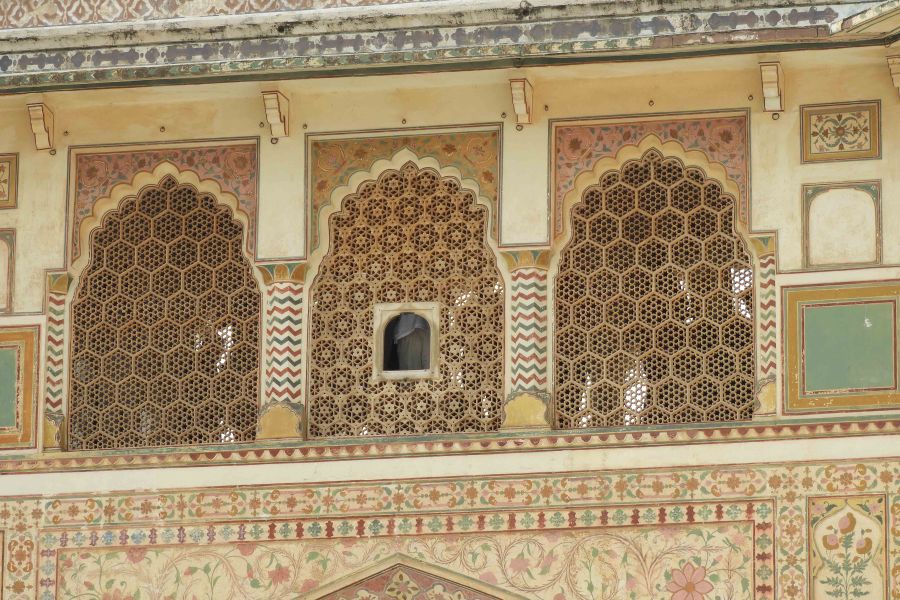
Incredibly fine ‘filigree’ stone work was employed to produce these screens, to allow maximum ventilation whilst providing the women of the court (who were not allowed to mix with outsiders) the opportunity of watching proceedings in the plaza below.

It was hard to take in or remember the function of each of the architectural marvels that we encountered …

… so may of the wonderful buildings will have to remain undescribed.
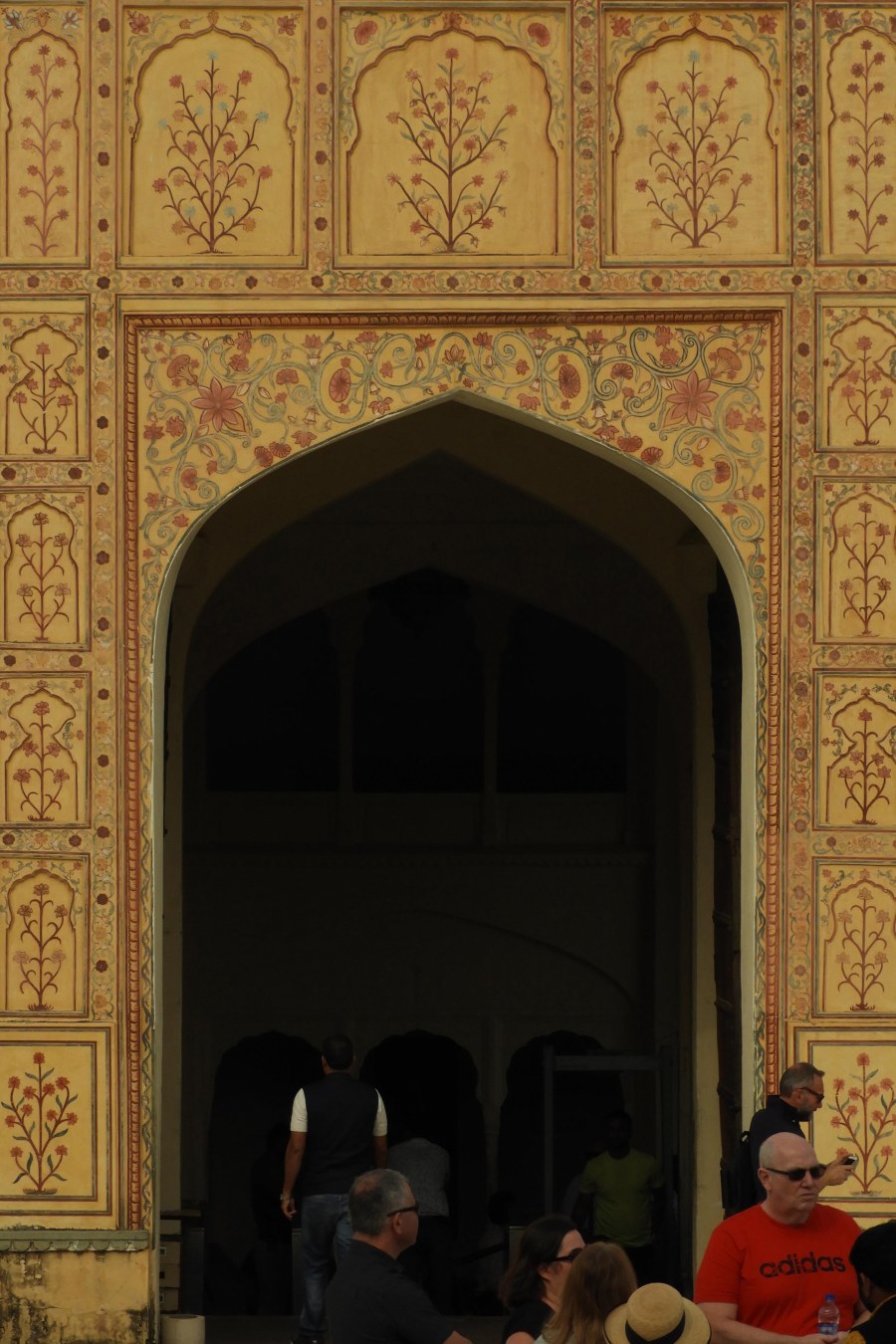
Today was a day for enjoying ancient architecture and Mogul art rather than birding, but I did have my bins with me. A large raptor that I never got to identify and some distant ducks on the lake below was about all I recorded.

More from Wikipedia: Amer Fort is a fort located in Amer, Rajasthan, India. Amer is a town with an area of 4 square kilometres located 11 kilometres from Jaipur, the capital of Rajasthan. Located high on a hill, it is the principal tourist attraction in Jaipur. The town of Amer was originally built by Meenas, and later it was ruled by Raja Man Singh I. Amer Fort is known for its artistic style elements. With its large ramparts and series of gates and cobbled paths, the fort overlooks Maota Lake, which is the main source of water for the Amer Palace.

Even the cleaning staff wear beautiful uniforms!
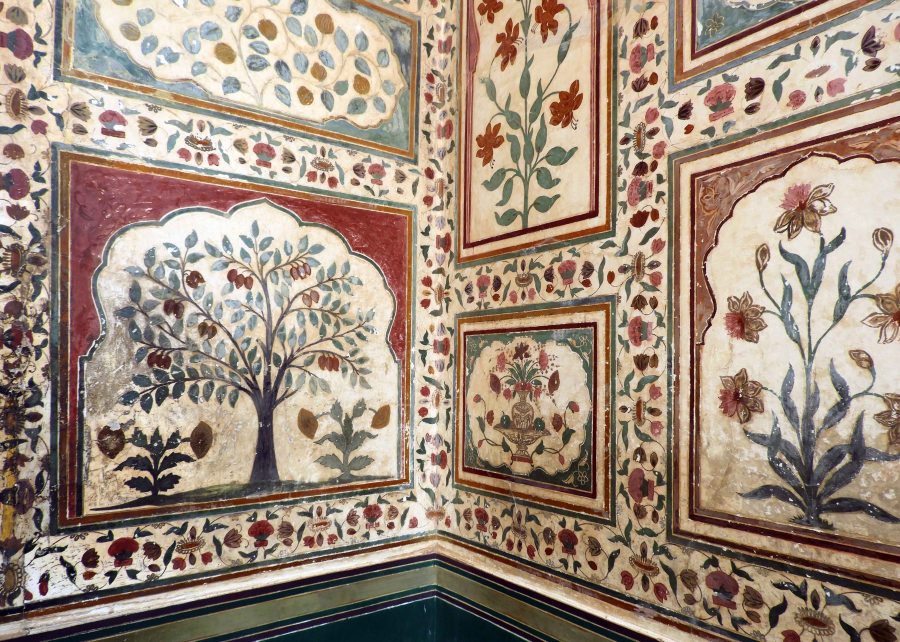
Within the palace were wonderful floral frescos …

… and pretty gardens.

Much of the decoration consisted of intricate patterns on the walls and ceilings. This ceiling has a series of small mirrors set in it …
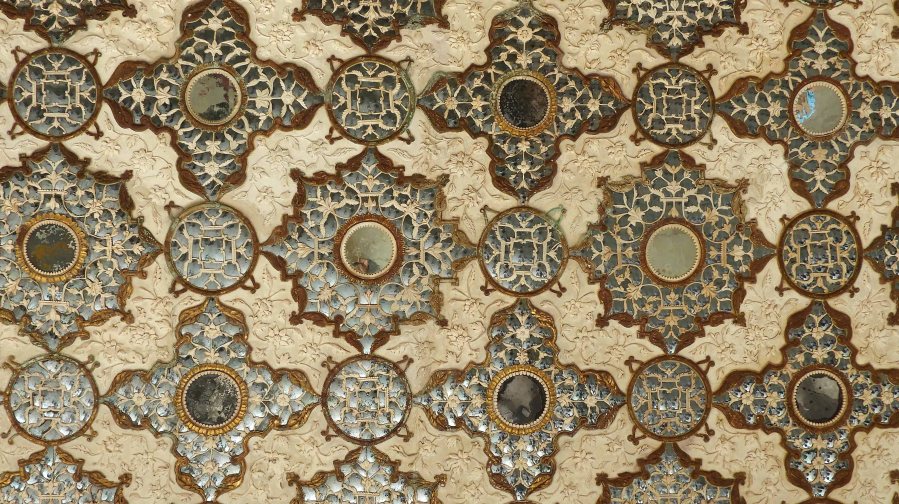
… evidenced by the fact that in the mirror just left of centre, you can see part of my arm and camera!

I was going to include a Mogul painting of a naked man and woman painted above an entrance arch but it was so explicit that looked like an image from the Kama Sutra. However I decided that I didn’t want to get in trouble with the ‘cyber police’ and thought it wise to omit it.
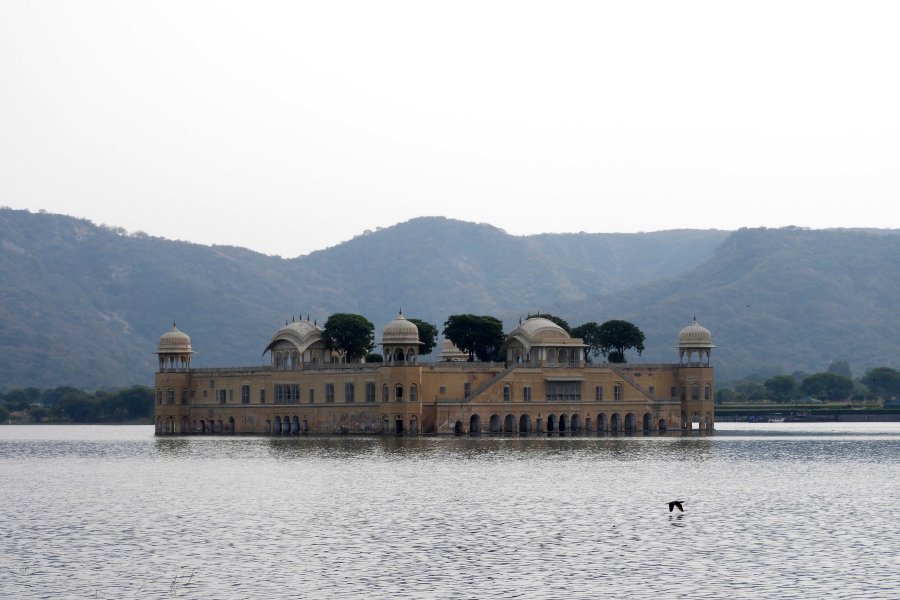
On the way back into Jaipur we stopped briefly at the Water Palace or Jal Mahal. From Wikipedia (again): The Jal Mahal palace is an architectural showcase of the Rajput style of architecture (common in Rajasthan) on a grand scale. The building has a picturesque view of the lake itself but owing to its seclusion from land is equally the focus of a viewpoint from the Man Sagar Dam on the eastern side of the lake in front of the backdrop of the surrounding Nahargarh (“tiger-abode”) hills. The palace, built in red sandstone, is a five-storied building, of which four floors remain underwater when the lake is full and the top floor is exposed. One rectangular Chhatri on the roof is of the Bengal type. The chhatris on the four corners are octagonal. The palace had suffered subsidence in the past and also partial seepage (plasterwork and wall damage equivalent to rising damp) because of waterlogging, which have been repaired under a restoration project of the Government of Rajasthan.
We carried on to Jantar Mantar …
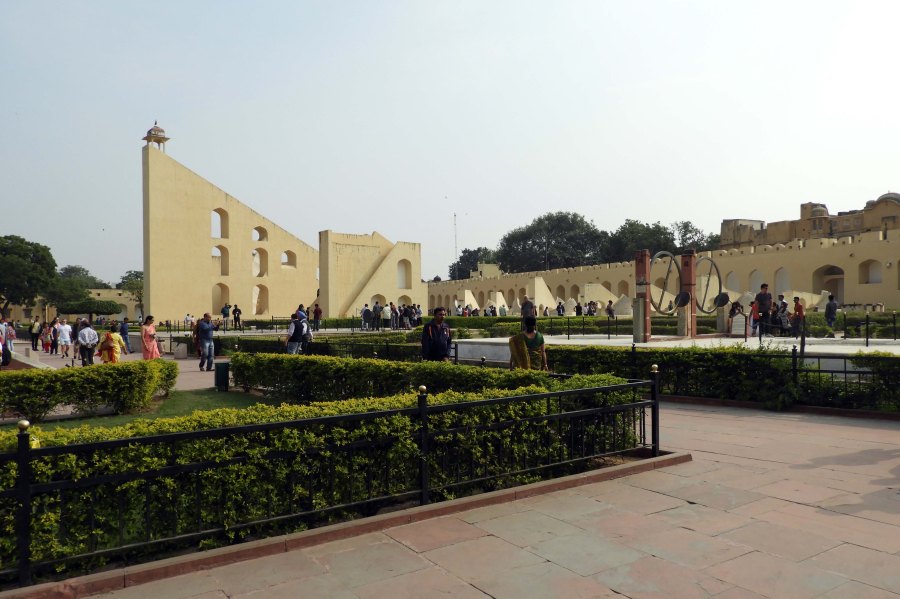
… a sort of astronomical observatory built by the Rajput King Sawai Jai Singh II in 1734.
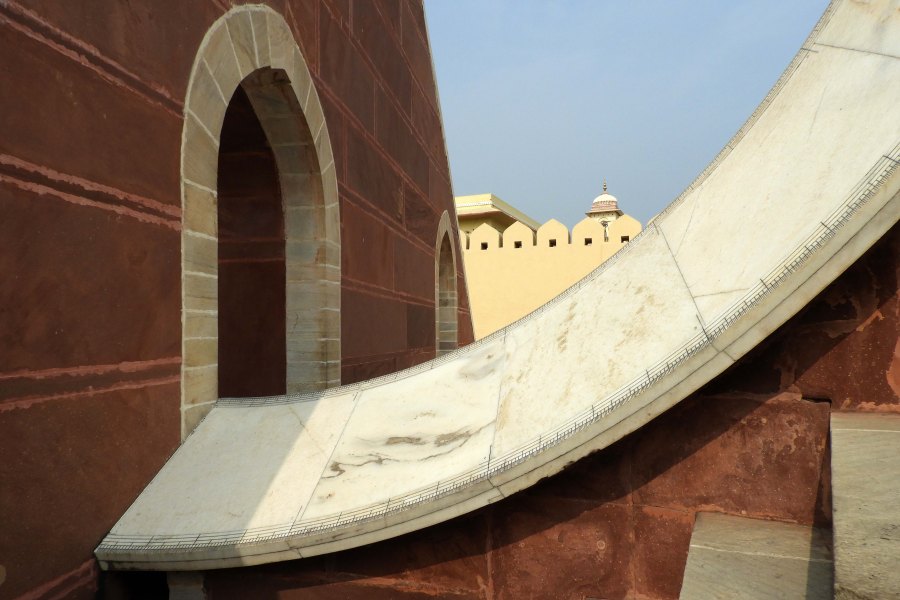
Most of the instruments are designed to tell the time of day from the angle of the sun …
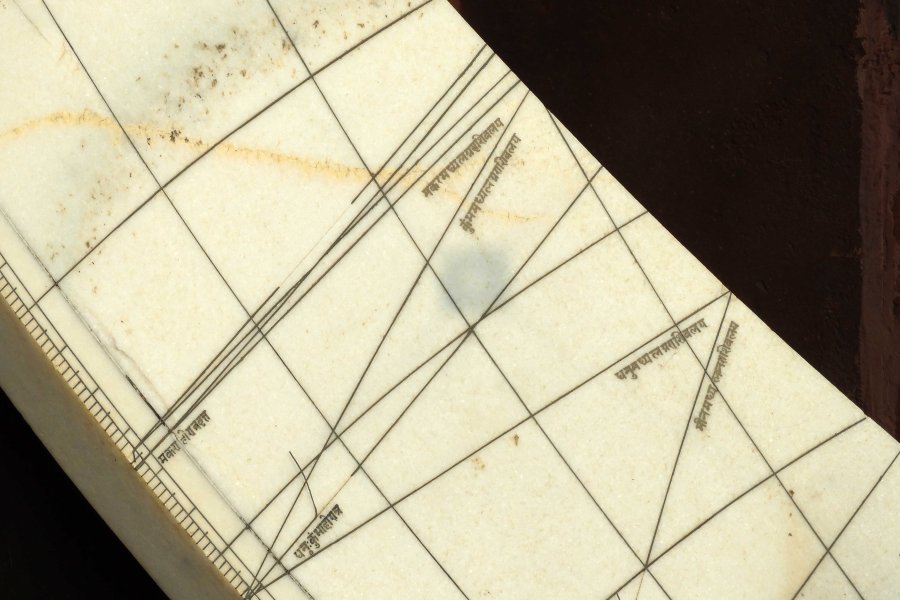
… and considerable effort was made to take account of the sun’s position at various times of the year. With a correction factor for the deviation of Jaipur from the meridian of India’s time zone applied, the result was accurate to a minute or two.

Not content with that Sawai Jai Singh II had a truly stupendous sundial built 27 m tall …
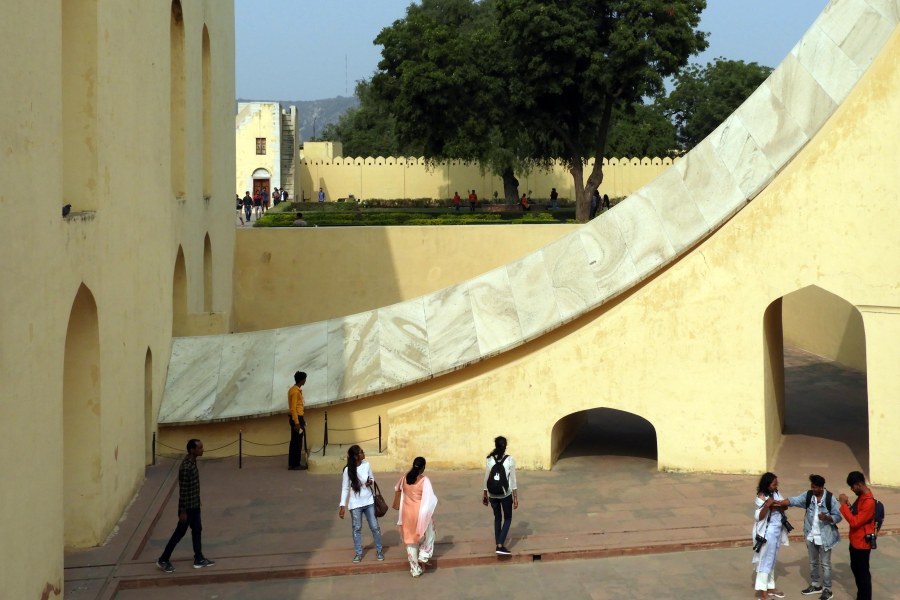
At this scale the sun’s shadow moves along the dial at 1mm per second. These are just two of nineteen instruments in the complex all built on the orders of this most scientifically minded king. As always Wikipedia is my source of information: The observatory consists of nineteen instruments for measuring time, predicting eclipses, tracking location of major stars as the earth orbits around the sun, ascertaining the declinations of planets, and determining the celestial altitudes and related ephemerides. The instruments are (alphabetical) 1. Chakra Yantra (four semicircular arcs on which a gnomon casts a shadow, thereby giving the declination of the Sun at four specified times of the day. This data corresponds to noon at four observatories around the world (Greenwich in UK, Zurich in Switzerland, Notke in Japan and Saitchen in the Pacific); this is equivalent of a wall of clocks registering local times in different parts of the world.) 2. Dakshin Bhitti Yantra (measures meridian, altitude and zenith distances of celestial bodies) 3. Digamsha Yantra (a pillar in the middle of two concentric outer circles, used to measure azimuth of the sun and to calculate the time of sunrise and sunset forecasts) 4. Disha Yantra 5. Dhruva Darshak Pattika (observe and find the location of pole star with respect to other celestial bodies) 6. Jai Prakash Yantra (two hemispherical bowl-based sundials with marked marble slabs that map inverted images of sky and allow the observer to move inside the instrument; measures altitudes, azimuths, hour angles, and declinations) 7. Kapali Yantra (measures coordinates of celestial bodies in azimuth and equatorial systems; any point in sky can be visually transformed from one coordinate system to another) 8. Kanali Yantra 9. Kranti Vritta Yantra (measures longitude and latitude of celestial bodies) 10. Laghu Samrat Yantra (the smaller sundial at the monument, inclined at 27 degrees, to measure time, albeit less accurately than Vrihat Samrat Yantra) 11. Misra Yantra (meaning mixed instrument, it is a compilation of five different instruments) 12. Nadi Valaya Yantra (two sundials on different faces of the instrument, the two faces representing north and south hemispheres; measuring the time to an accuracy of less than a minute) 13. Palbha Yantra 14. Rama Yantra (an upright building used to find the altitude and the azimuth of the sun) 15. Rashi Valaya Yantra (12 gnomon dials that measure ecliptic coordinates of stars, planets and all 12 constellation systems) 16. Shastansh Yantra (next to Vrihat Samrat Yantra) This instrument has a 60-degree arc built in the meridian plane within a dark chamber. At noon, the sun’s pinhole image falls on a scale below enabling the observer to measure the zenith distance, declination, and the diameter of the Sun.) 17. Unnatamsa Yantra (a metal ring divided into four segments by horizontal and vertical lines, with a hole in the middle; the position and orientation of the instrument allows measurement of the altitude of celestial bodies) 18. Vrihat Samrat Yantra (world’s largest gnomon sundial, measures time in intervals of 2 seconds using shadow cast from the sunlight) 19. Yantra Raj Yantra (a 2.43-metre bronze astrolabe, one of the largest in the world, used only once a year, calculates the Hindu calendar) The Vrihat Samrat Yantra, which means the “great king of instruments”, is 88 feet (27 m) high; its shadow tells the time of day. Its face is angled at 27 degrees, the latitude of Jaipur. The Hindu chhatri (small cupola) on top is used as a platform for announcing eclipses and the arrival of monsoons. Jai Prakash Yantra at Jantar Mantar, Jaipur The instruments are in most cases huge structures. The scale to which they have been built has been alleged to increase their accuracy. However, the penumbra of the sun can be as wide as 30 mm, making the 1mm increments of the Samrat Yantra sundial devoid of any practical significance. Additionally, the masons constructing the instruments had insufficient experience with construction of this scale, and subsidence of the foundations has subsequently misaligned them. The samrat yantra, for instance, which is a sundial, can be used to tell the time to an accuracy of about two seconds in Jaipur local time.[13] The Giant Sundial, known as the Samrat Yantra (The Supreme Instrument) is one of the world’s largest sundials, standing 27 metres tall.[14] Its shadow moves visibly at 1 mm per second, or roughly a hand’s breadth (6 cm) every minute, which can be a profound experience to watch.
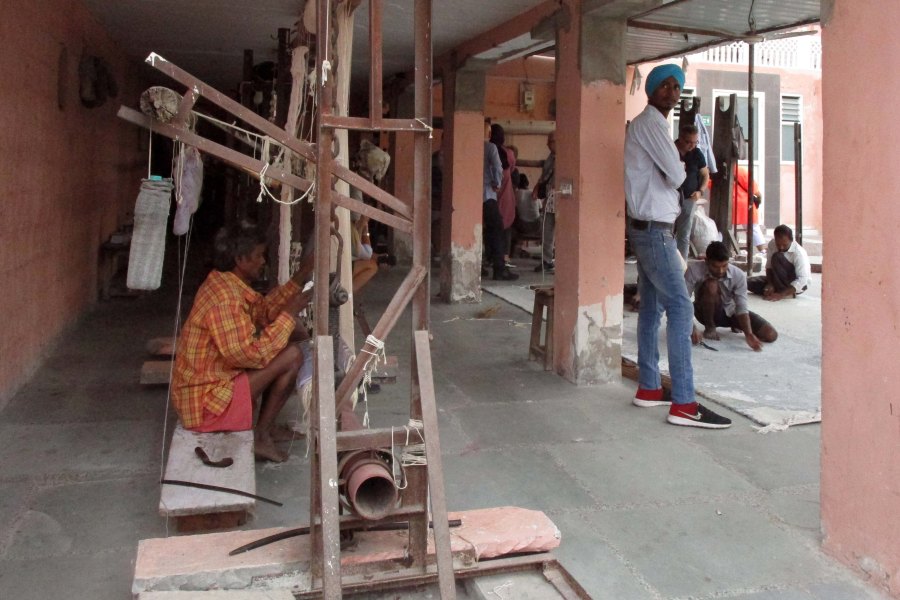
We continued with an obligatory visit to carpet makers, but we convinced our guide we didn’t want to stop long (unlike our experiences in Turkey and UAE).
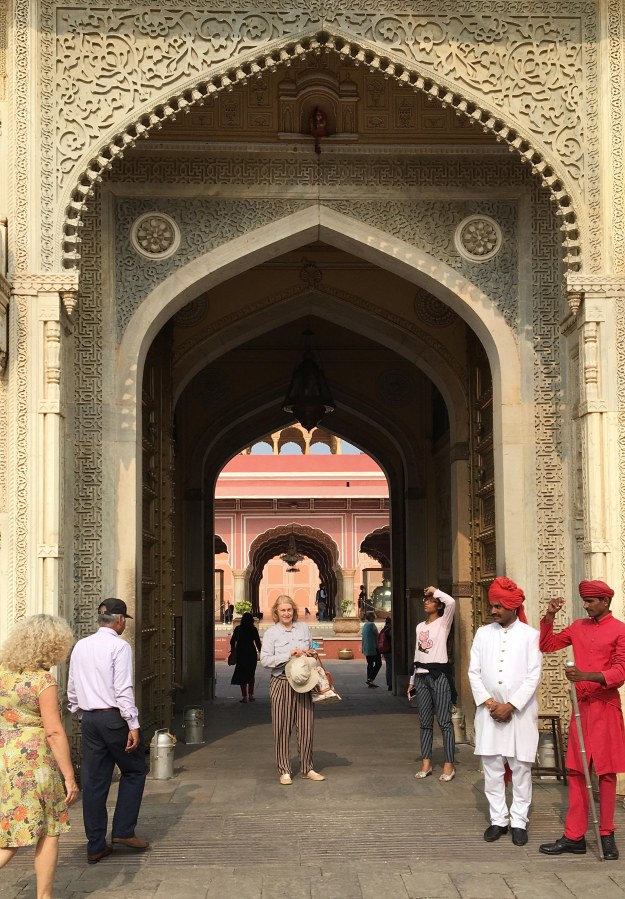
The final stop on our guided tour was the City Palace within the city of Jaipur.

And yet more from Wikipedia:The City Palace, Jaipur was established at the same time as the city of Jaipur, by Maharaja Sawai Jai Singh II, who moved his court to Jaipur from Amber, in 1727. Jaipur is the present-day capital of the state of Rajasthan, and until 1949 the City Palace was the ceremonial and administrative seat of the Maharaja of Jaipur. The Palace was also the location of religious and cultural events, as well as a patron of arts, commerce, and industry. It now houses the Mahara-ja Sawai Man Singh II Museum, and continues to be the home of the Jaipur royal family. The royal family of Jaipur is said to be the descendants of Lord Rama. The palace complex has several buildings, various courtyards, galleries, restaurants, and offices of the Museum Trust. The Maharaja Sawai Man Singh II Museum Trust looks after the Museum, and the royal cenotaphs (known as chhatris).
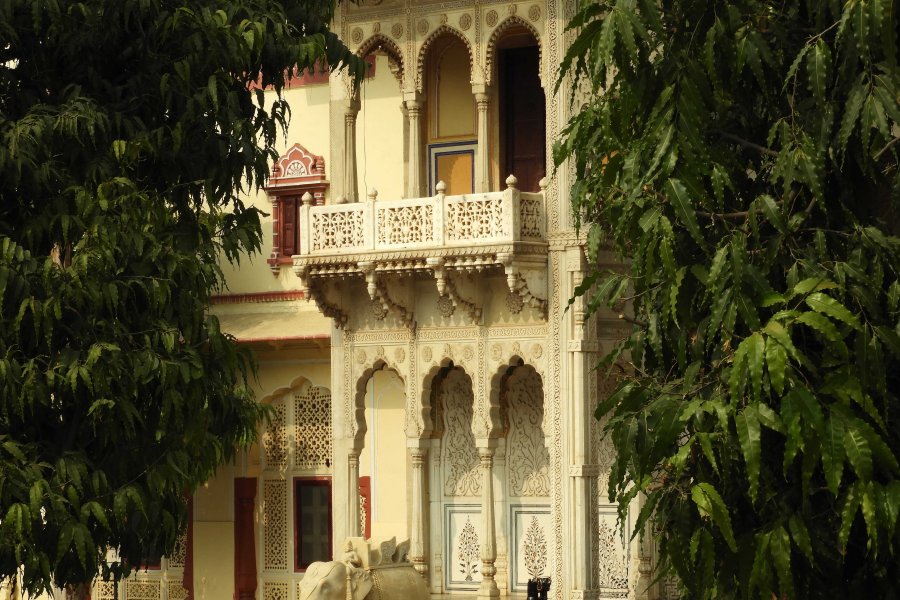
Once more we saw some exquisite architecture …
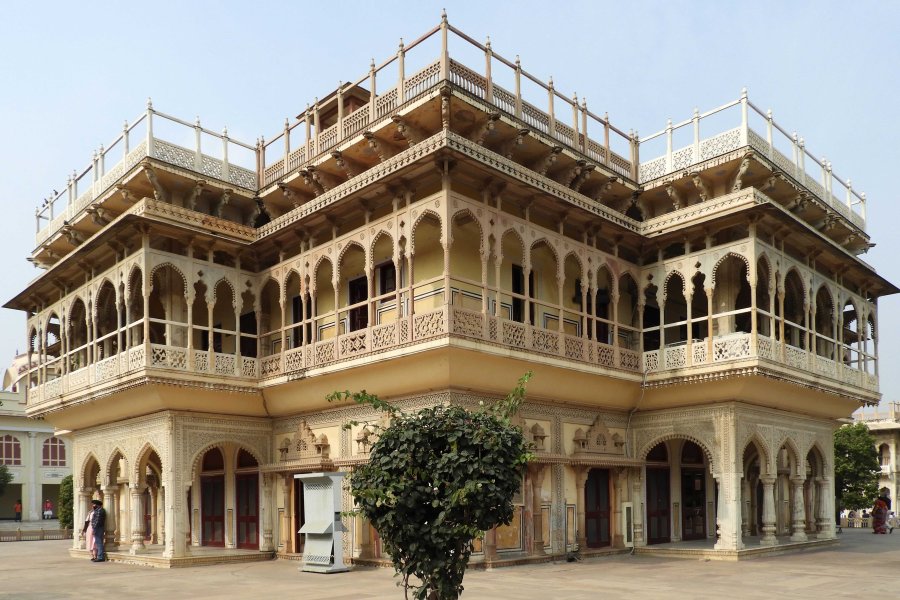
… and beautiful buildings.

Of particular note was a quadrangle with four large ornate doors representing the four seasons.
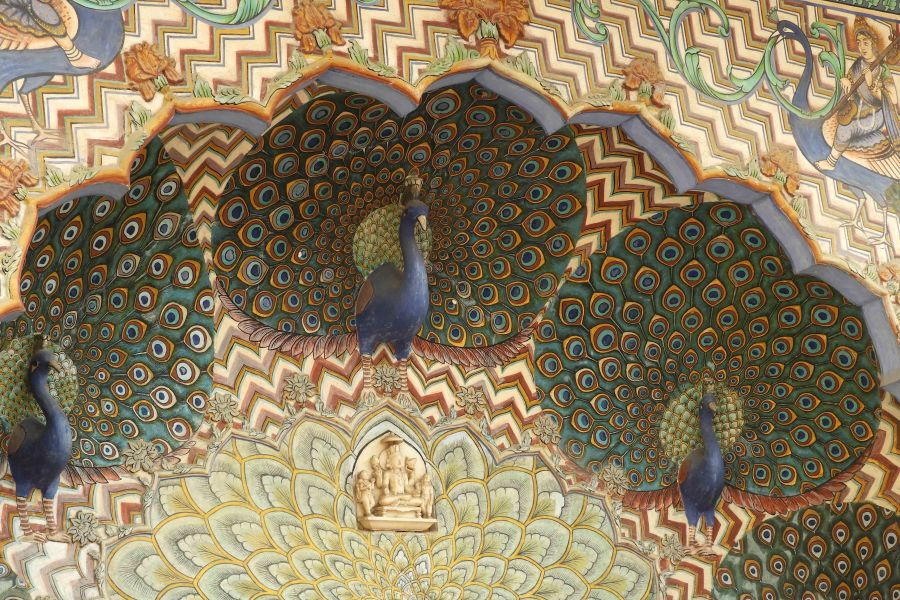
… here are close ups of the arches above the other three doors, although which one represents which season …

…. is rather hard to tell …
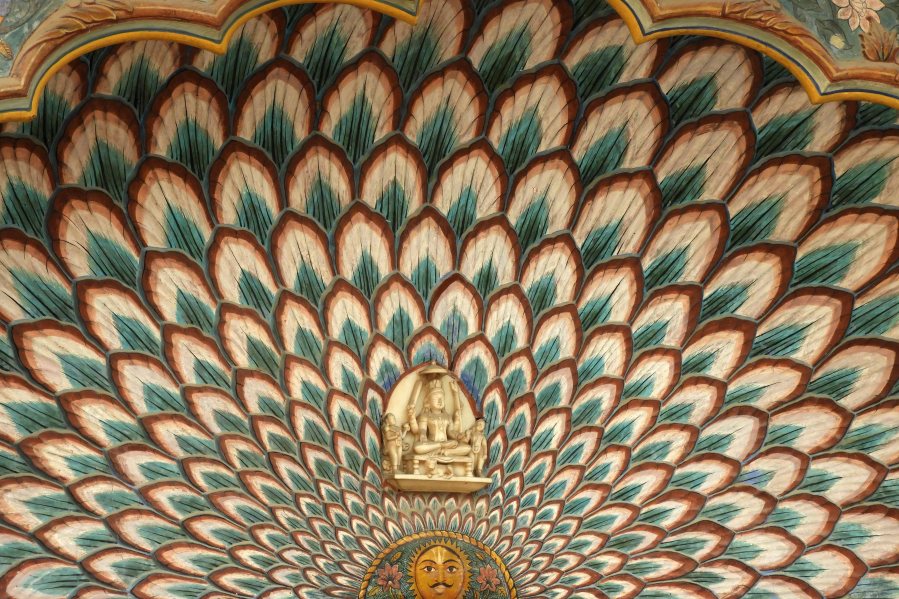
… but that doesn’t detract from their beauty.

A few more images of the City Palace …

… Margaret posed for a photo with these guards …

… before we left to find our vehicle.

Our guide departed and we spent the last hour of the day looking around some shops …

… away from the tourist areas.

Unlike similar places in other parts of Asia or north Africa there was no hassle …

… and you could take your time wandering around. We were able to buy a few Christmas gifts for the family.

The food markets were most colourful …

… and Margaret stocked up on a few goodies for the journey tomorrow.
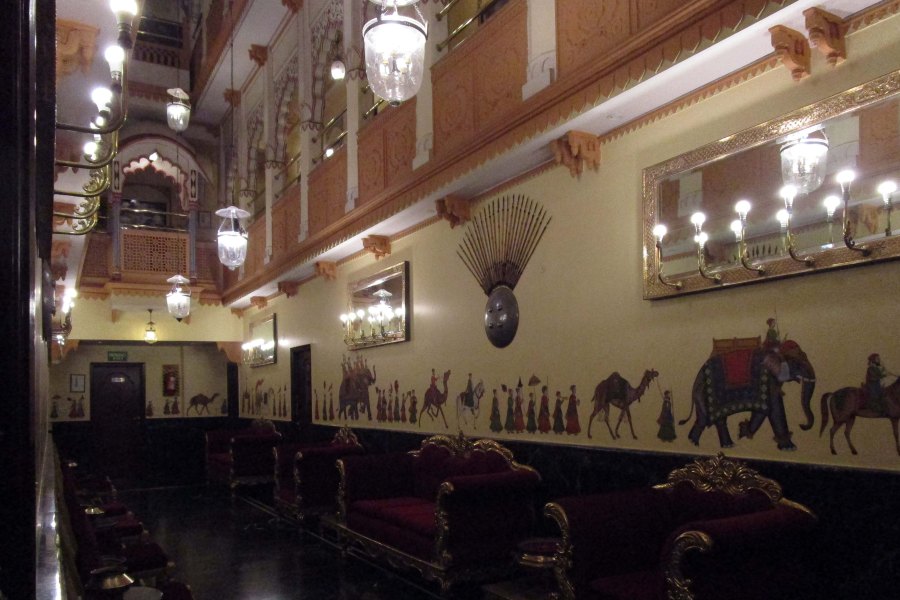
So it was back to our lovely hotel …

… where that evening the dancers played the ‘how many pots can I balance on my head’ game. Later the two dancers got people at tables to get up and dance with them. Margaret of course joined in, I have some video of the event but unfortunately no still photos.
The following day we left the city and headed to the small town of Tal Chhapar. Although I had seen a lifer mammal (Sloth Bear) on the trip I had not added any birds to my life list. But one was waiting, I hoped, in a reserve just outside Tal Chhapar. This will be the subject of the next post.
This is the fourth post on our trip to India in 2019. We wanted a mixture of watching wildlife and cultural sites, a combination that isn’t easy to find on most commercial tour. The trip arranged by Jo Thomas at Wild About Travel was to our specifications and perfectly combined India’s wonderful temples, ancient buildings and unique way of life with watching Tigers, Blackbucks and loads of birds.
This post covers one of the most famous wildlife reserves in the world, officially called the Keoladeo National Park but universally known by the name of the adjacent city – Bharatpur.

To save me typing it here is the description of the reserve from Wikipedia: Keoladeo National Park or Keoladeo Ghana National Park formerly known as the Bharatpur Bird Sanctuary in Bharatpur, Rajasthan, India is a famous avifauna sanctuary that hosts thousands of birds, especially during the winter season. Over 230 species of birds are known to be resident. It is also a major tourist centre with scores of ornithologists arriving here in the winter season. It was declared a protected sanctuary in 1971. It is also a World Heritage Site. Keoladeo Ghana National Park is a man-made and man-managed wetland and one of the national parks of India. The reserve protects Bharatpur from frequent floods, provides grazing grounds for village cattle, and earlier was primarily used as a waterfowl hunting ground. The 29 km2 reserve is locally known as Ghana, and is a mosaic of dry grasslands, woodlands, woodland swamps and wetlands. These diverse habitats are home to 366 bird species, 379 floral species, 50 species of fish, 13 species of snakes, 5 species of lizards, 7 amphibian species, 7 turtle species and a variety of other invertebrates. Every year thousands of migratory waterfowl visit the park for wintering and breeding. The sanctuary is one of the richest bird areas in the world and is known for nesting of resident birds and visiting migratory birds including water birds. The rare Siberian cranes used to winter in this park but this central population is now extinct. According to founder of the World Wildlife Fund Peter Scott, Keoladeo National Park is one of the world’s best bird areas.
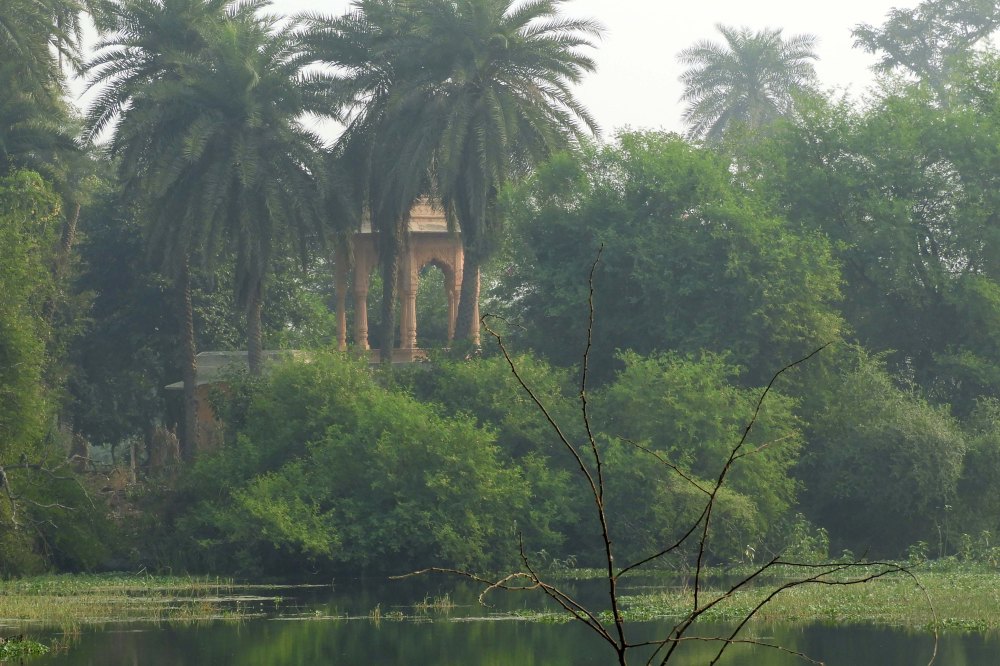
Again from Wikipedia: The sanctuary was created 250 years ago and is named after a Keoladeo (Shiva) temple within its boundaries. (see photo above). Initially, it was a natural depression; and was flooded after the Ajan Bund was constructed by Maharaja Suraj Mal, then the ruler of the princely state of Bharatpur, between 1726–1763. The bund was created at the confluence of two rivers, the Gambhir and Banganga. The park was a hunting ground for the Maharajas of Bharatpur, a tradition dating back to 1850, and duck shoots were organised yearly in honour of the British viceroys. In one shoot alone in 1938, over 4,273 birds such as mallards and teals were killed by Lord Linlithgow, then Viceroy of India.[citation needed] The park was established as a national park on 10 March 1982. Previously the private duck shooting preserve of the Maharaja of Bharatpur since the 1850s, the area was designated as a bird sanctuary on 13 March 1976 and a Ramsar site under the Wetland Convention in October 1981. The last big shoot was held in 1964 but the Maharajah retained shooting rights until 1972. In 1985, the Park was declared a World Heritage Site under the World Heritage Convention. It is a reserve forest under the Rajasthan Forest Act, 1953 and therefore, is the property of the State of Rajasthan of the Indian Union. In 1982, grazing was banned in the park, leading to violent clashes between local farmers and the government.

During the days of the Raj the site was renowned as a great place for shooting wildfowl. Looking at this tally board that’s still on display it was possible to shoot many thousands of birds in a single day. Of course due to the widespread destruction of breeding sites throughout Asia there are nowhere near as many birds visiting as in the past but a visit to ‘Bharaptpur’ still remains one of the world’s top birding experiences. I don’t like the shooting of wildfowl but it would be fair to say that the reserve probably wouldn’t be in its current state without the patronage of shooters in years gone by.

I visited Bharatpur before in 1986 and at that time it was one of the best birding experiences of my life. We were there for nearly three days compared to a day and a half this time and saw a truly awesome number of birds. By the time 2019 had come around it was highly unlikely that I would get any ‘life birds’ at the site but I wanted Margaret to experience it’s avian richness and of course enjoy it myself.
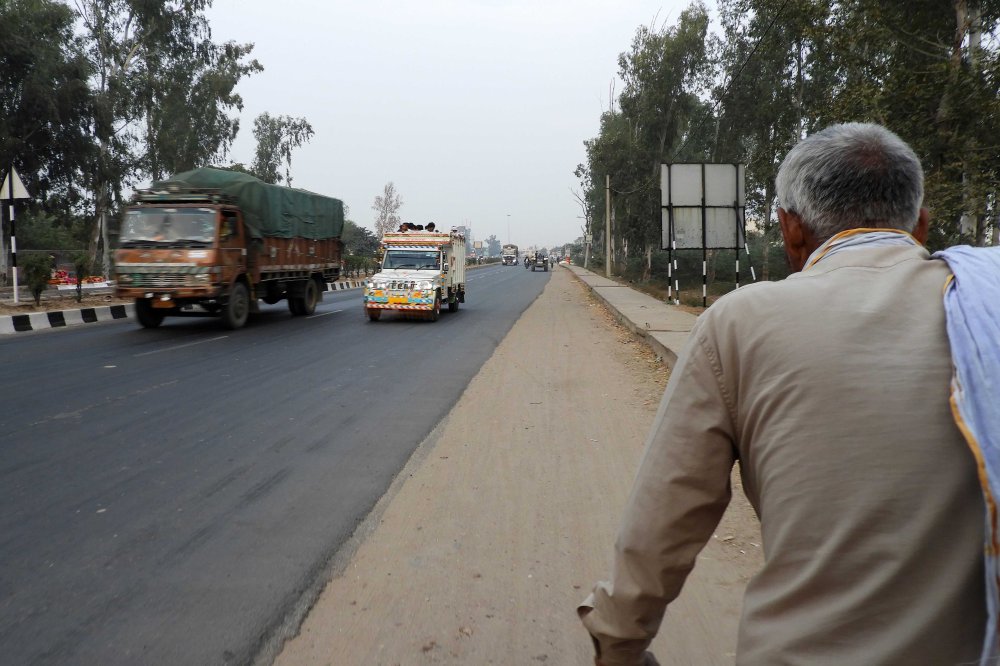
Our journey from the hotel to the park and around the park itself was by bicycle rickshaw with our bird guide cycling along beside. In true Indian fashion we were taken the wrong way down a duel carriageway!
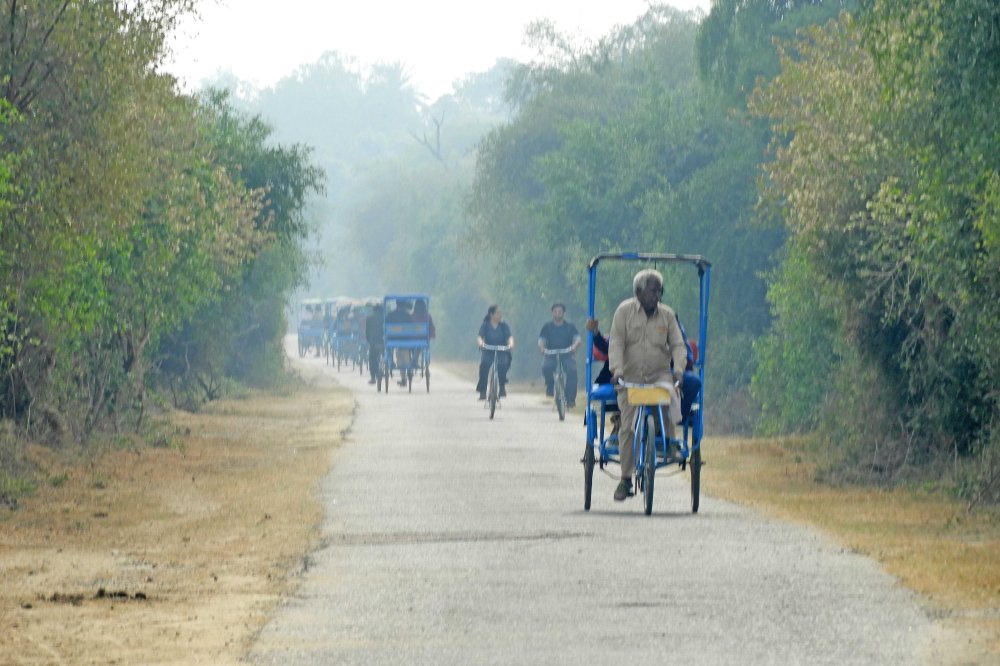
Once in the park you realise that you’re not the only one using a bicycle rickshaw. Most of the rest of this quite extensive post is a collection of bird and other wildlife photos interspersed with a few habitat shots and there is only a limited amount I can say about each.

One of the first species encountered is one I know well from home, indeed it even occurs in my garden. Originally confined to the Orient and Middle East Eurasian Collared Doves expanded its range rapidly in the 20th century spreading across Europe and reaching the UK in the late 50s. It soon became a common bird in towns and gardens. Soon afterwards some Collared Doves either escaped or were released in the Bahamas and rapidly spread to the USA where they are now common (I believe) from coast to coast.
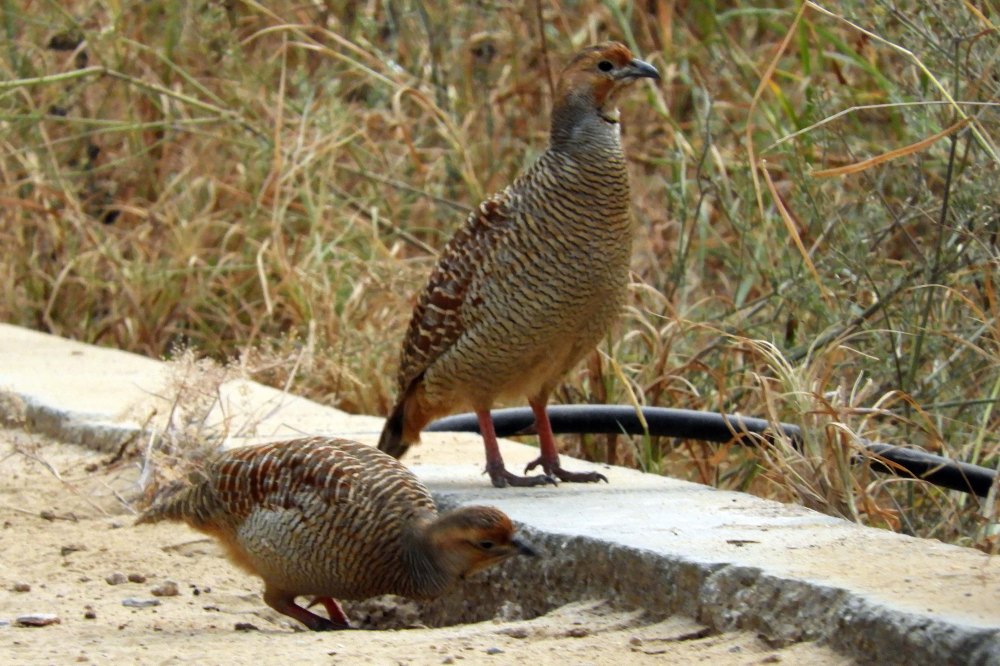
Along the central track we saw these Grey Francolins.
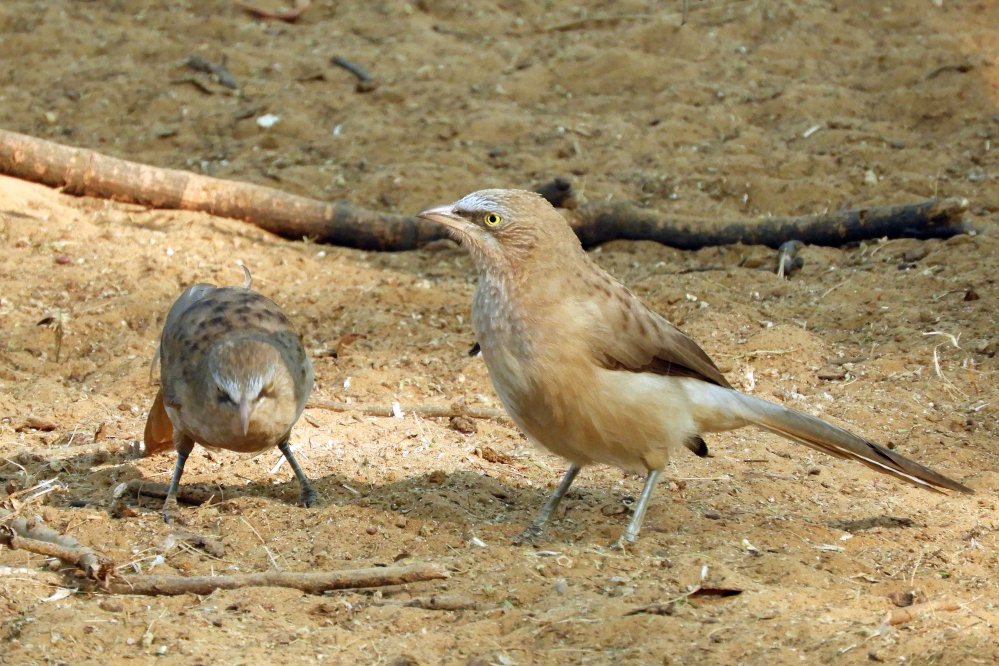
I have shown a few photos of Jungle Babblers on earlier posts, here we saw their cousins Large Grey Babblers …
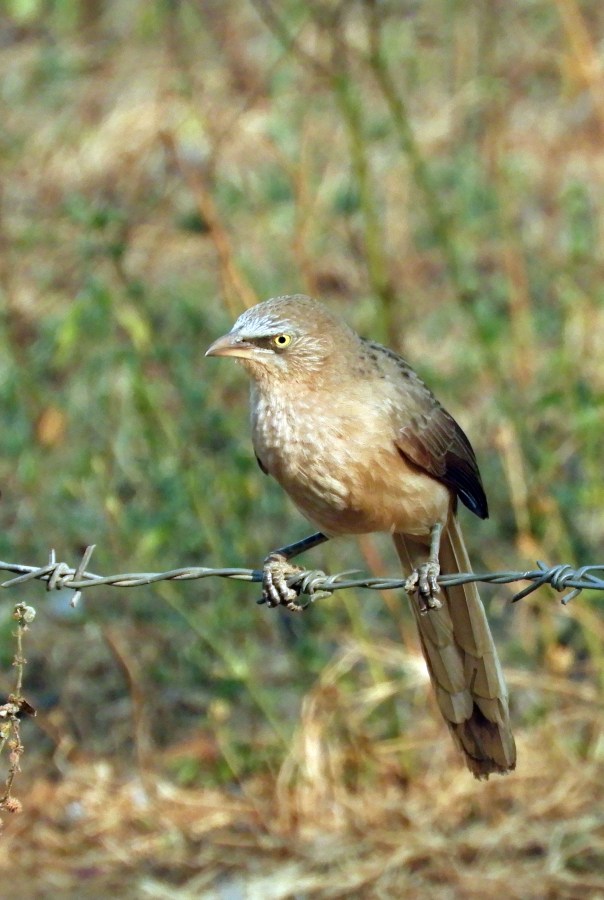
… which as you have probably realised are a bit larger and a bit greyer.
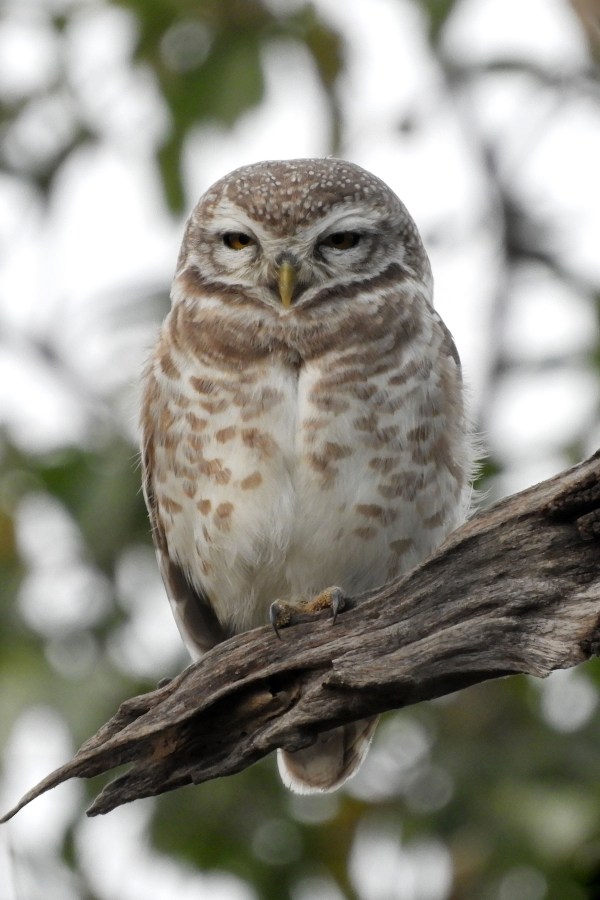
As with several other sites we visited Spotted Owlets were easy to see at their daytime roost.

They could be seen indulging in a bit of mutual preening, so-called allopreening.
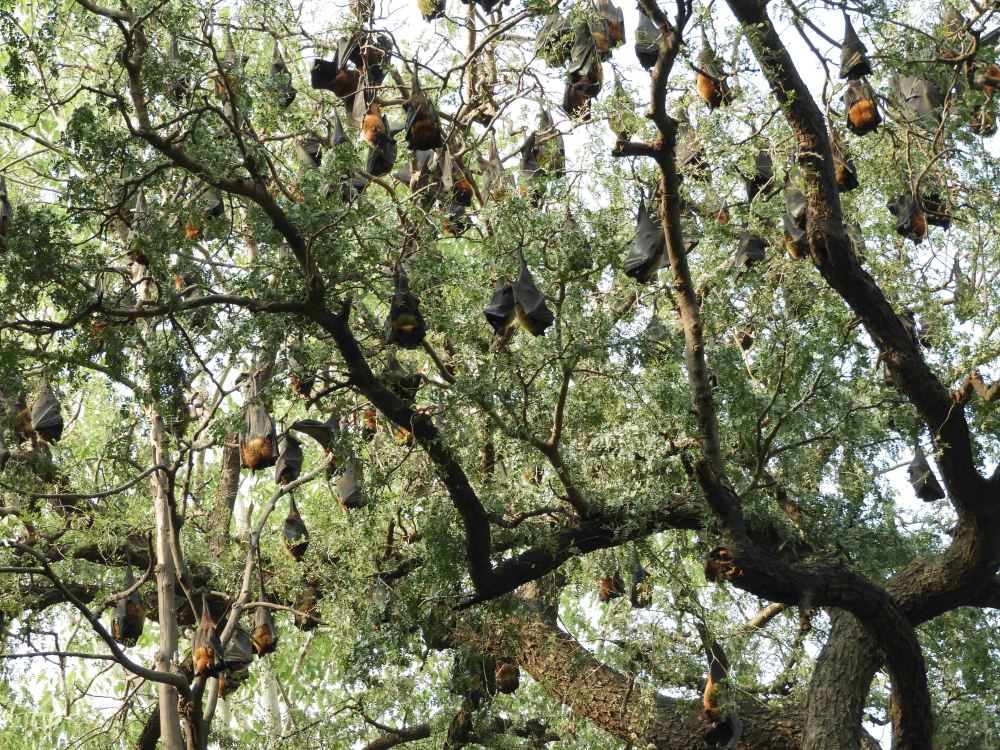
There were several colonies of Indian Fruit Bats.
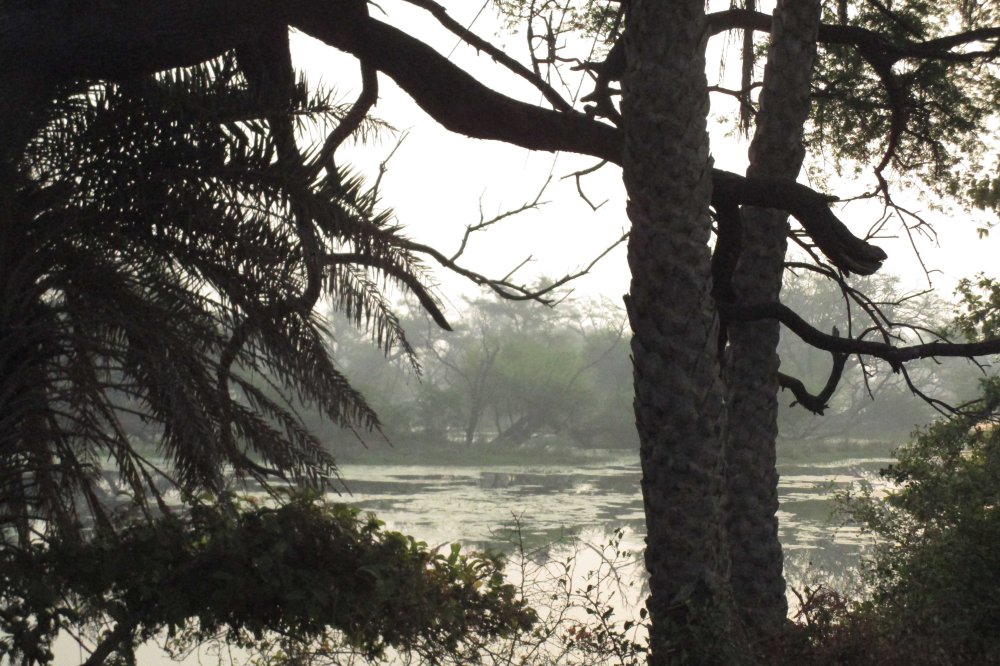
Between the various lagoons, known locally as jheels, were a series of paths were we could see …
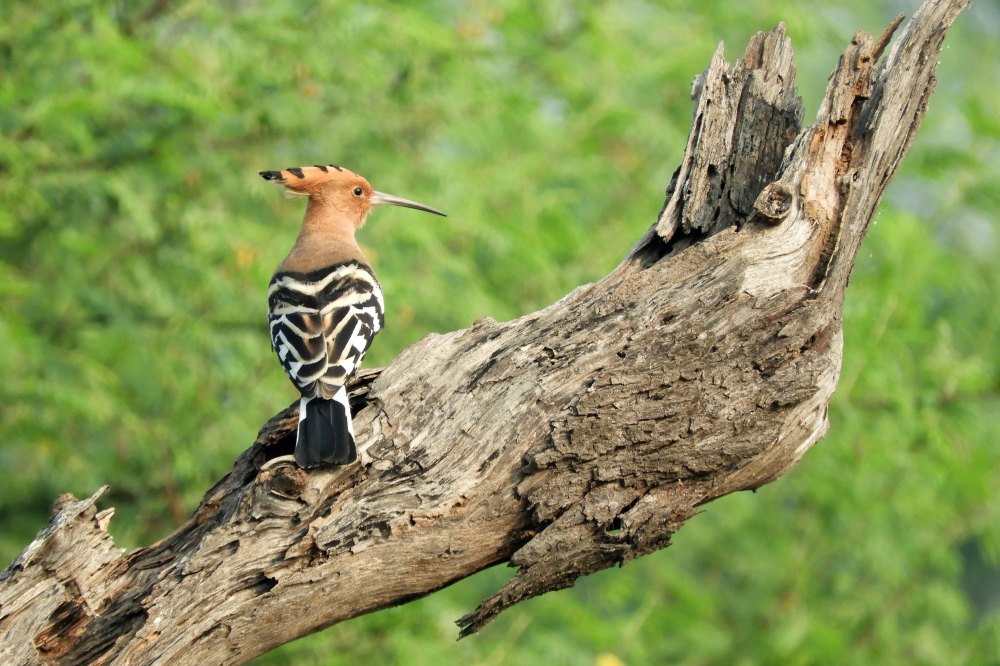
… a variety of species such as Eurasian Hoopoe …
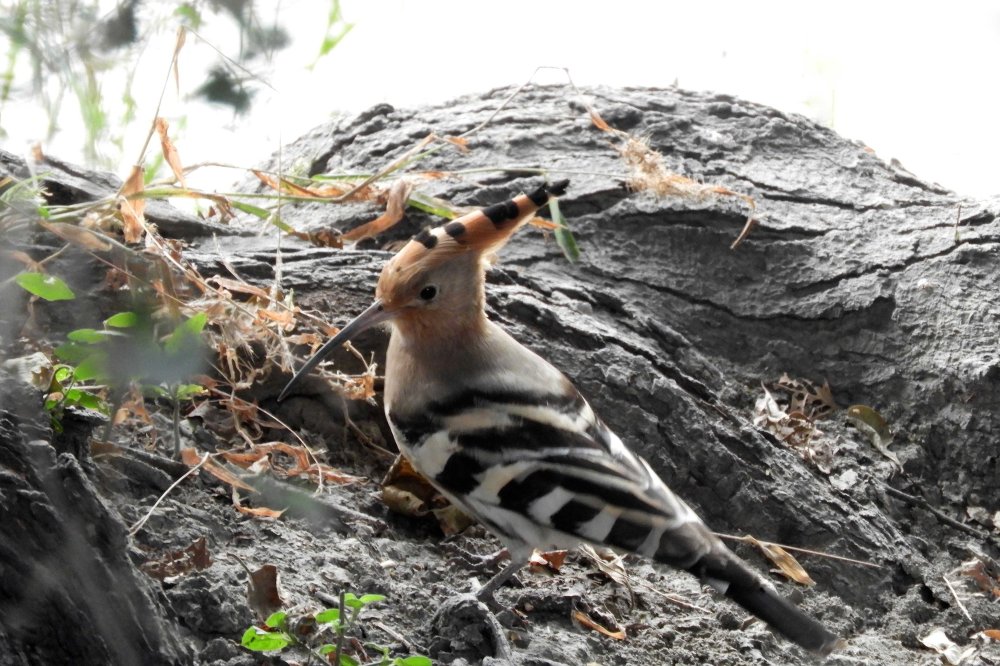
… here of the greyer Asian race saturatus

Also seen were Yellow-footed Green Pigeons and Bank Mynas …
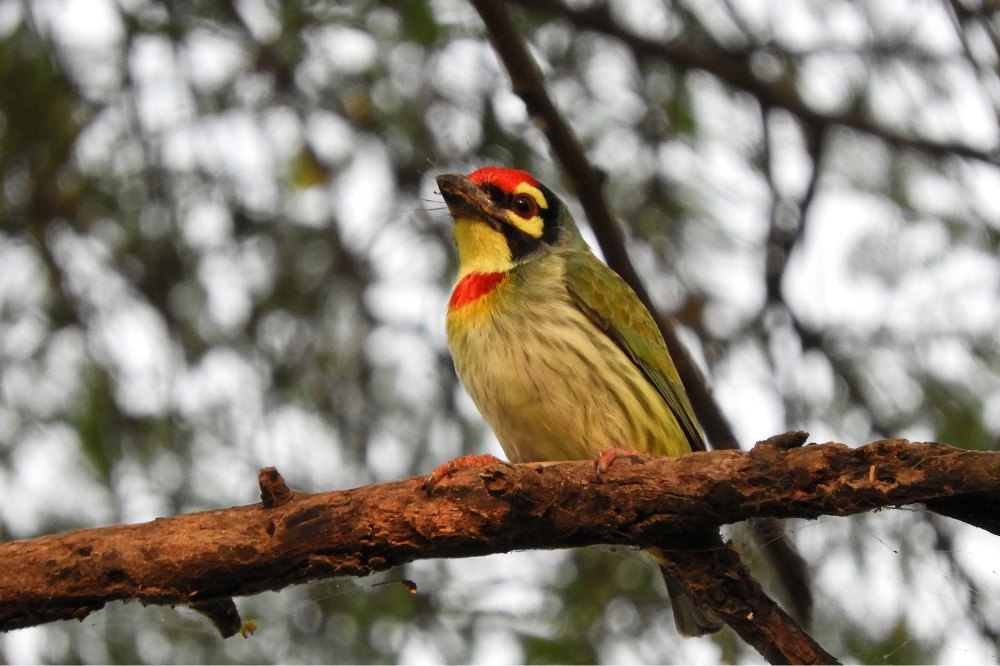
… the inevitable Coppersmith Barbets …

… and the personata race of White Wagtail, sometimes known as Masked Wagtail. These breed in the Tien Shan of Kazakhstan unlike the race leucopsis that we saw on the Chambal River that breeds in China.
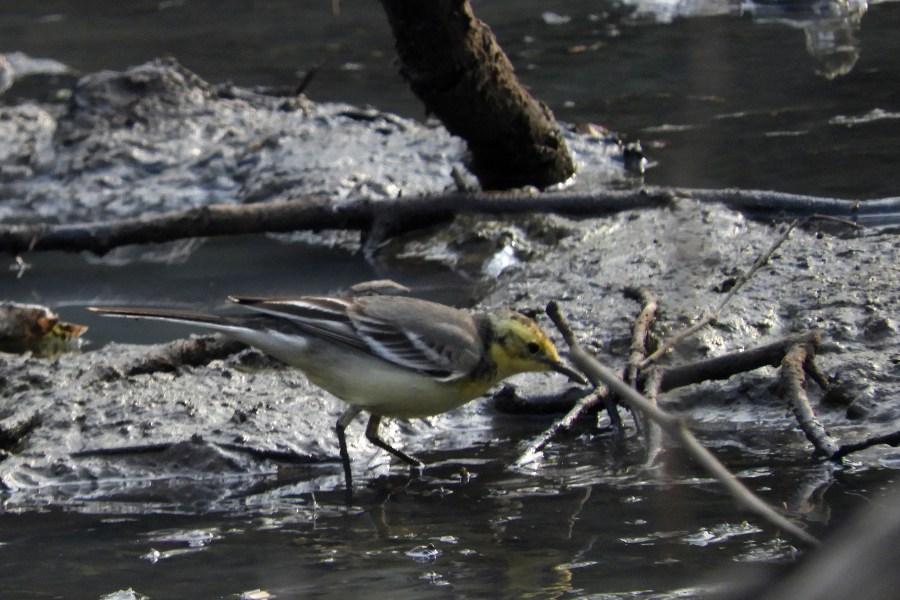
Also present were a few Citrine Wagtails, wintering from further north in Asia. This is probably an adult female as 1st winters lack the yellow tones.

Bharatpur is famous for its pythons and we found this individual in ditch along side the path, but it was nowhere a big as the one I saw on my 1986 visit which must have been 5m long.
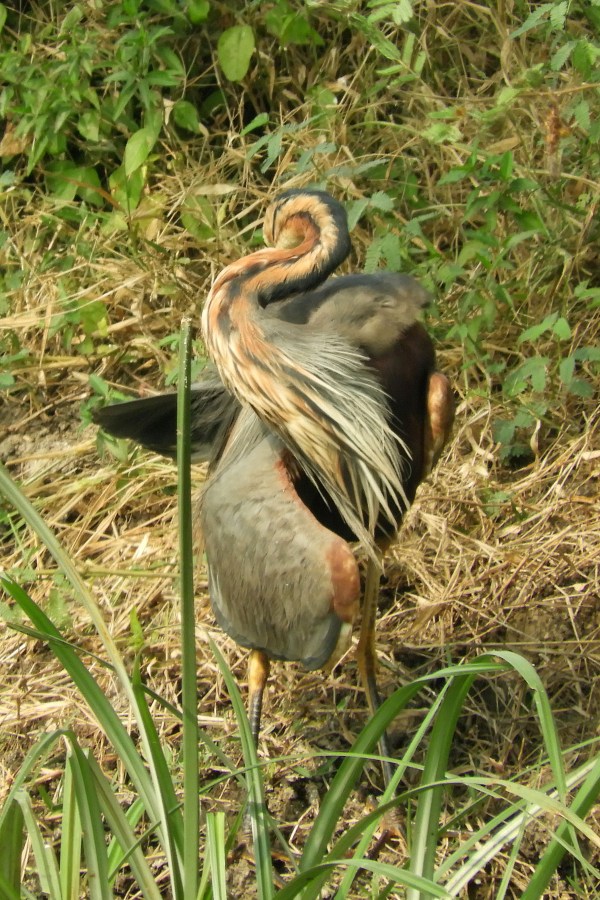
Is this another snake or just a Purple Heron having a preen?
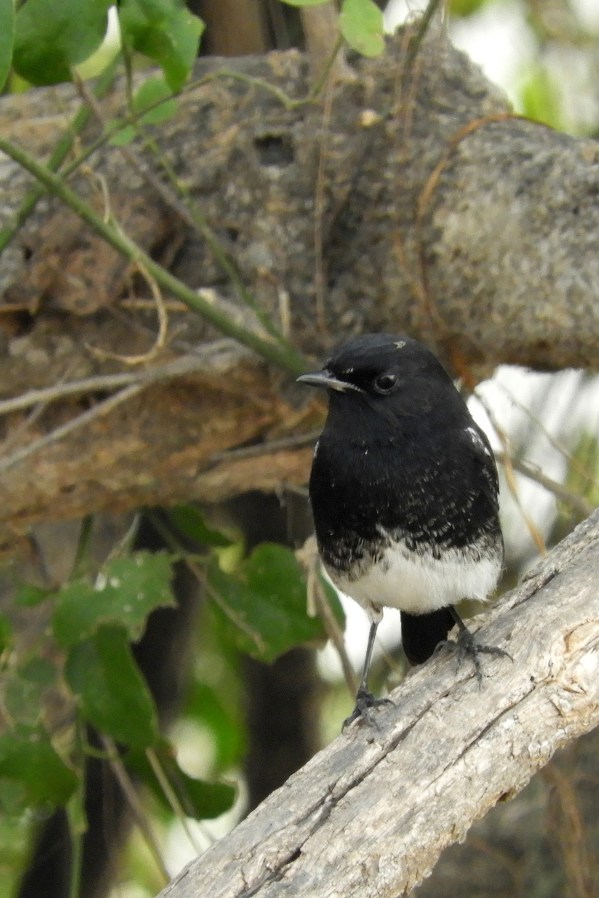
Other species included Pied Stonechat …

… White-cheeked Bulbul …

… Rufous Treepie …
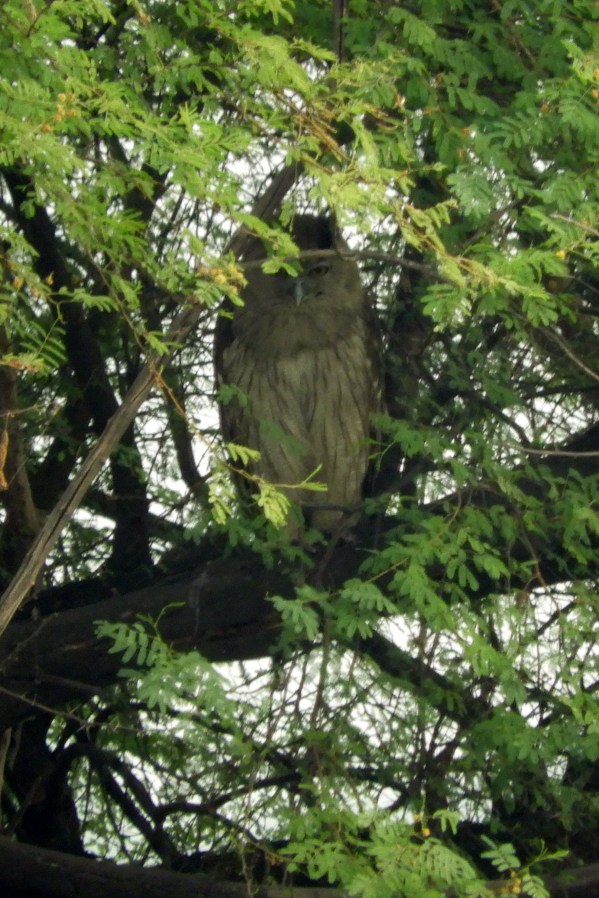
… a roosting Dusky Eagle Owl …
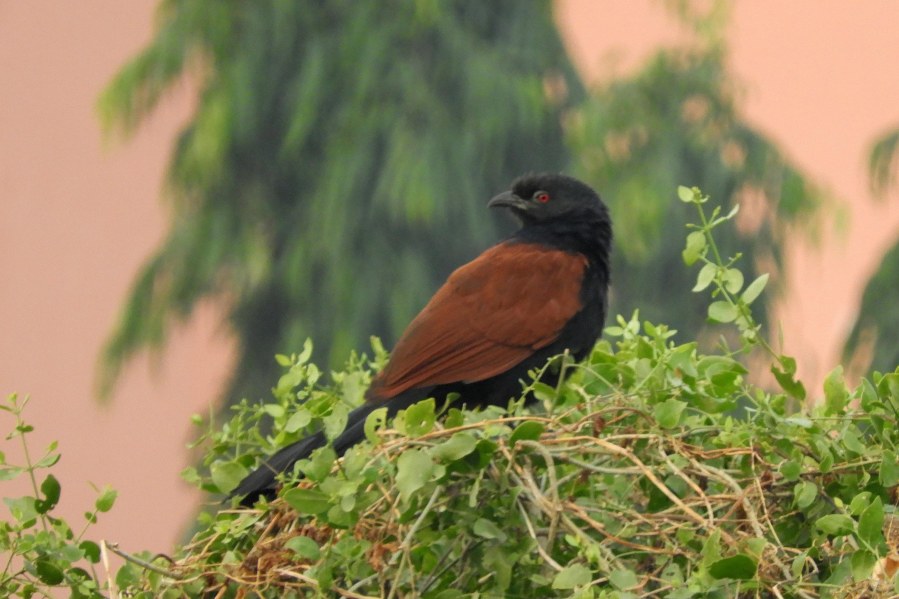
… and a Greater Coucal.
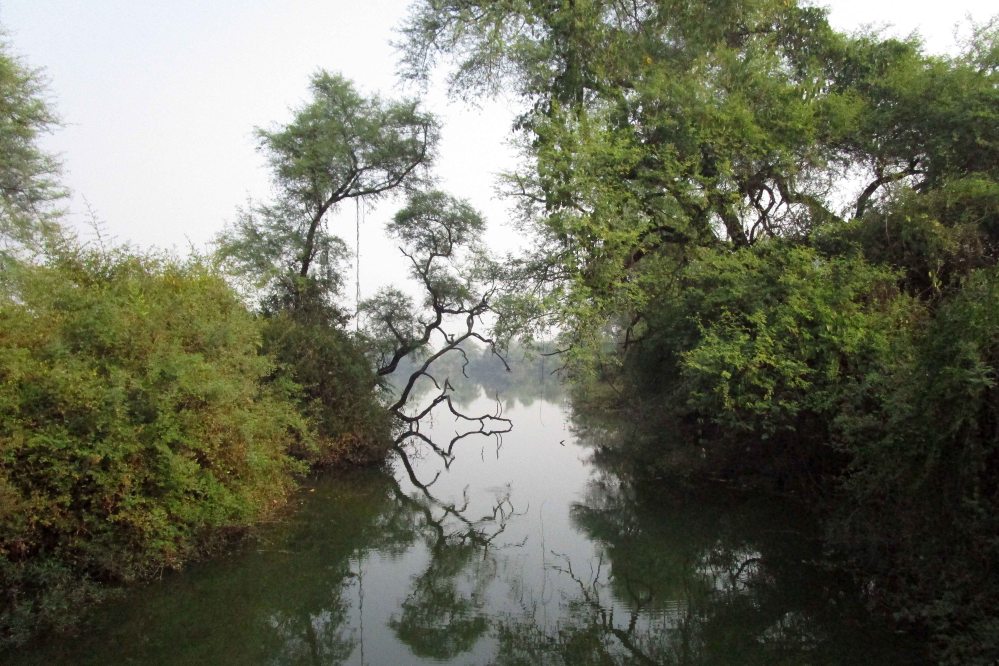
Around the jheels we saw a wide range of waterbirds …
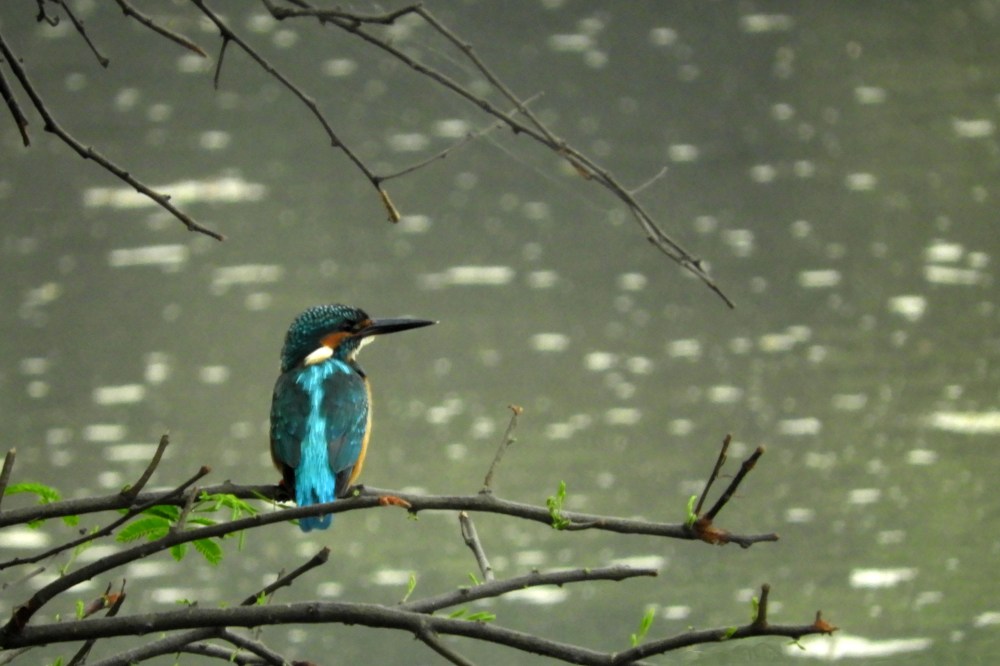
… from familiar ones like Common Kingfisher (the same species that occurs in the UK) …

… to the mush larger White-breasted Kingfisher which has a range from Turkey and the Levant through to SE Asia.. This species used to be known as Smyrna Kingfisher after the ancient city of the same name on the Turkish coast. More recently Symrna has been renamed Izmir.

The species once known as ‘purple gallinule’ has been renamed Swamphen to distinguish it from the bird known as Purple Gallinule in North America. Then it was split into six species with the ones in India becoming Grey-headed Swamphen.
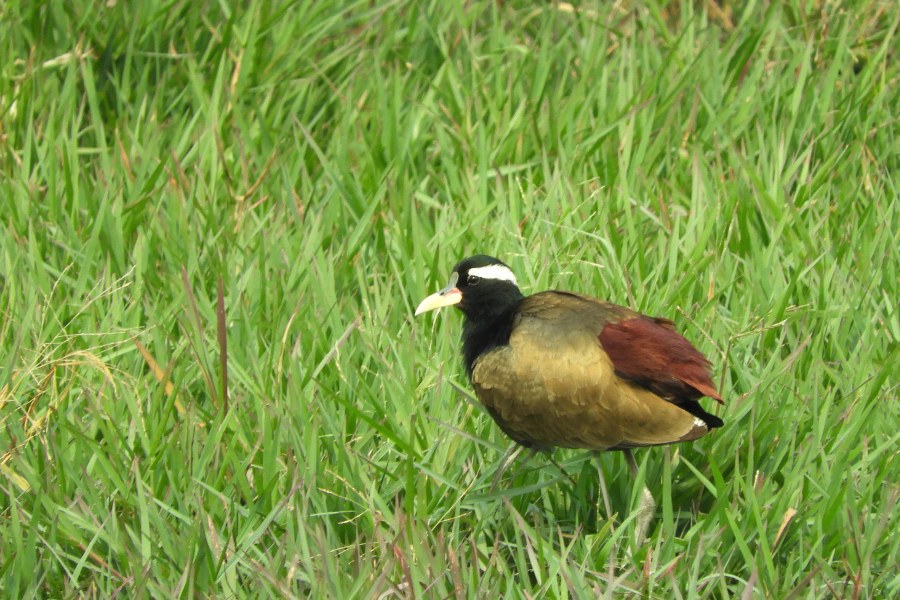
Another inhabitant of these wet grassy meadows was Bronze-winged Jacana, which in spite of appearances is a species of shorebird/wader and not a rail! We only saw a single Pheasant-tailed Jacana which is surprising as they were as common as Bronze-winged on my last visit.
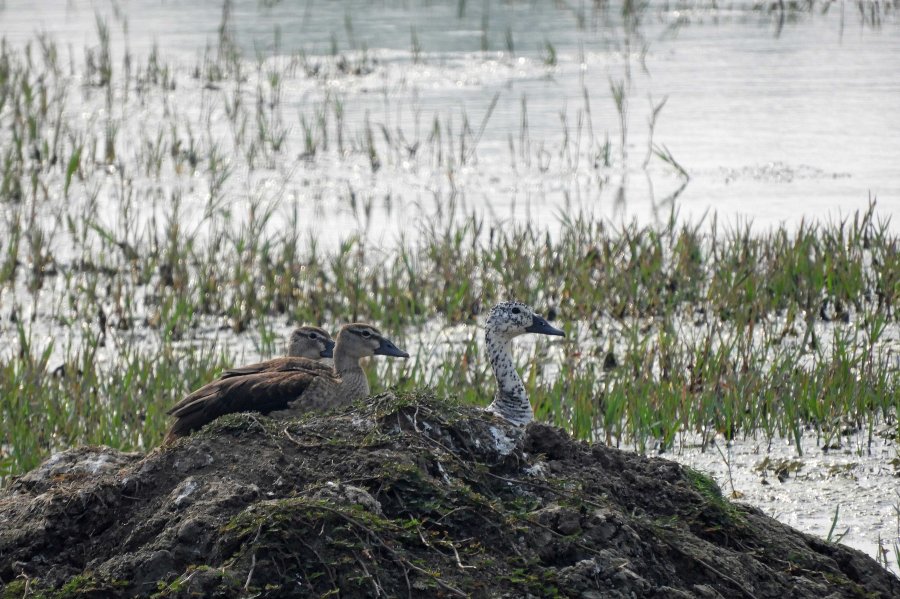
A female and two immature Knob-billed Geese …

… but only the male has the ‘knob bill’. This species has recently been split from the South American version which is now called Comb Duck.

Another species of duck that we saw regularly was the Indian Spot-bill.
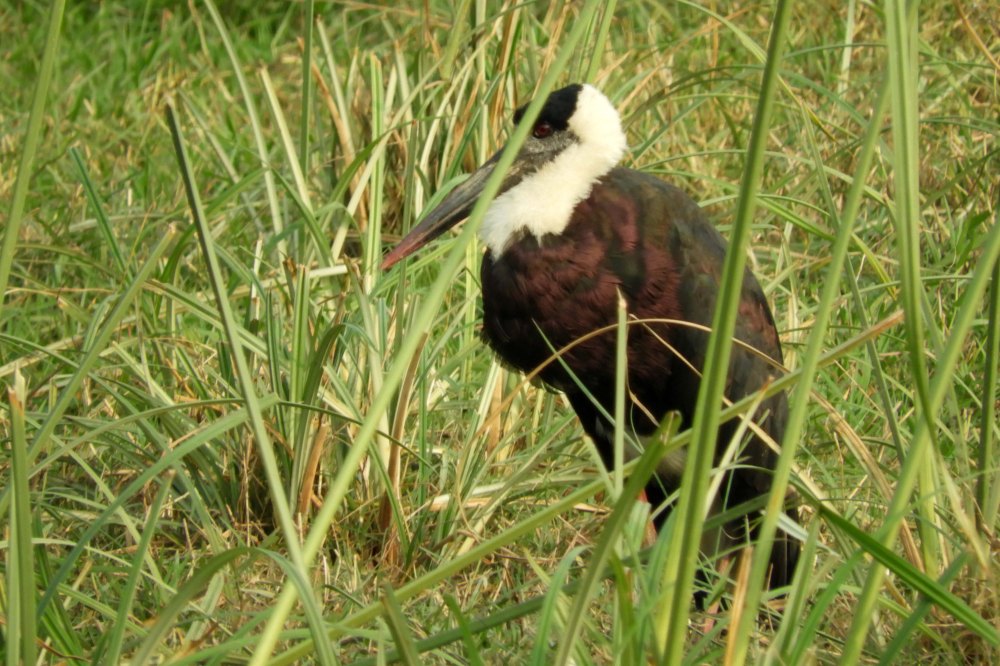
We only saw a few Woolly-necked Storks, the Asian race is sometimes treated as a separate species from the one in Africa on the basis of bronze colouration on the wing coverts and paler face.

We only saw a single Black-necked Stork, this compares to a dozen or more that I saw in 1986. In general big wetland birds; cranes, storks and wetland breeding raptors are doing badly in Asia. In 1986 we saw 37 Siberian Cranes at Bhartapur; now the western population of this species, which used to winter here, is reduced to a single individual which winters in Iran. Pallas’ Fish Eagle is another species that used to occur and we saw regularly in 86 but has now vanished.

The male of this species has a black eye whilst the female has a nice golden colour. In spite of losses in India this species has a wide range and its stronghold is probably the wetlands of northern Australia.
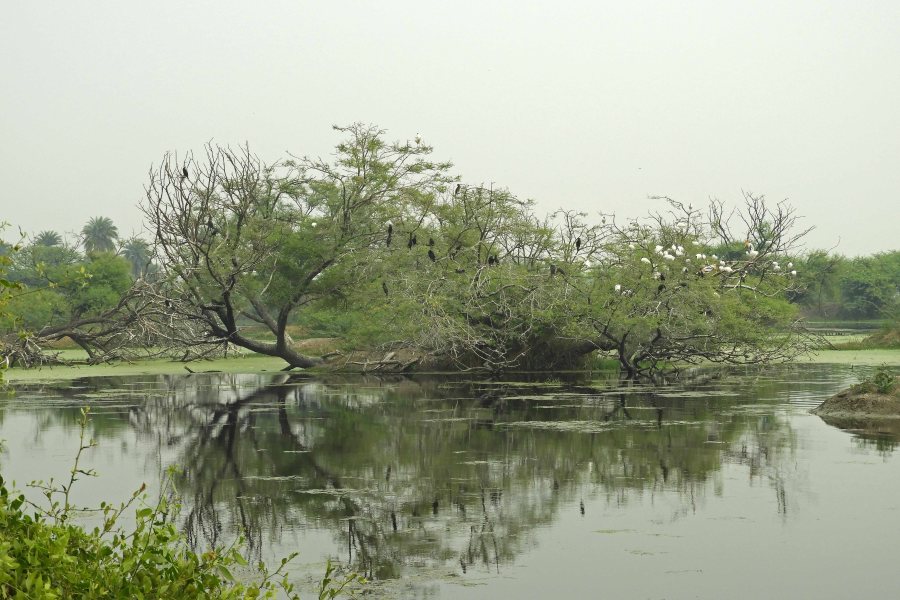
Many waterbirds breed on the jheels but at this time of year most are using the trees as roosting sites. In this photo mainly Great Cormorants, Painted Storks and Black-headed Ibis.
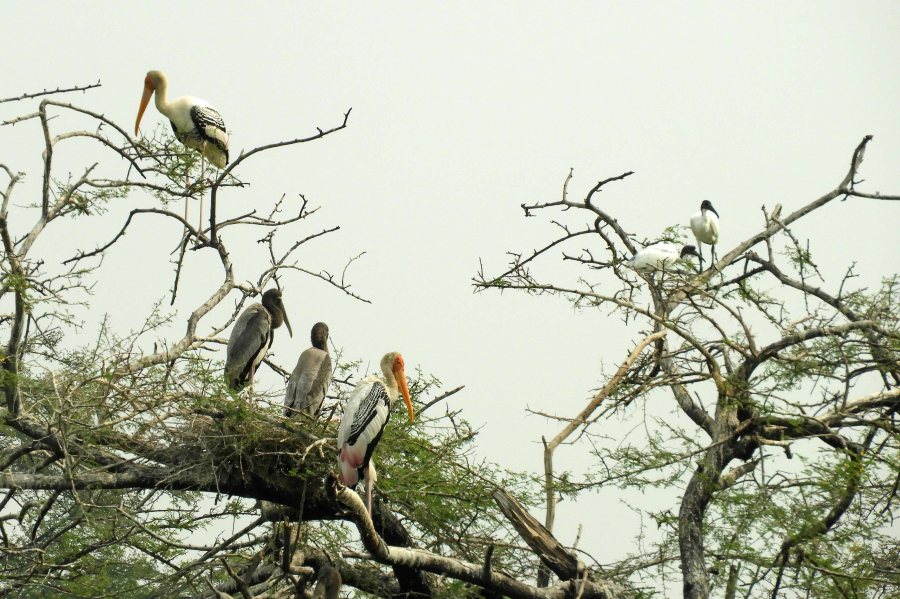
A closer view of a pair of Painted Storks with a couple of immatures and two Black-headed Ibis.

And an even closer view of one of the adults.

Of the most obvious feature of the site was the herons, as well as the expected Great, Little and Cattle Egrets there were good numbers of Purple Herons …

… Black-crowned Night Herons …
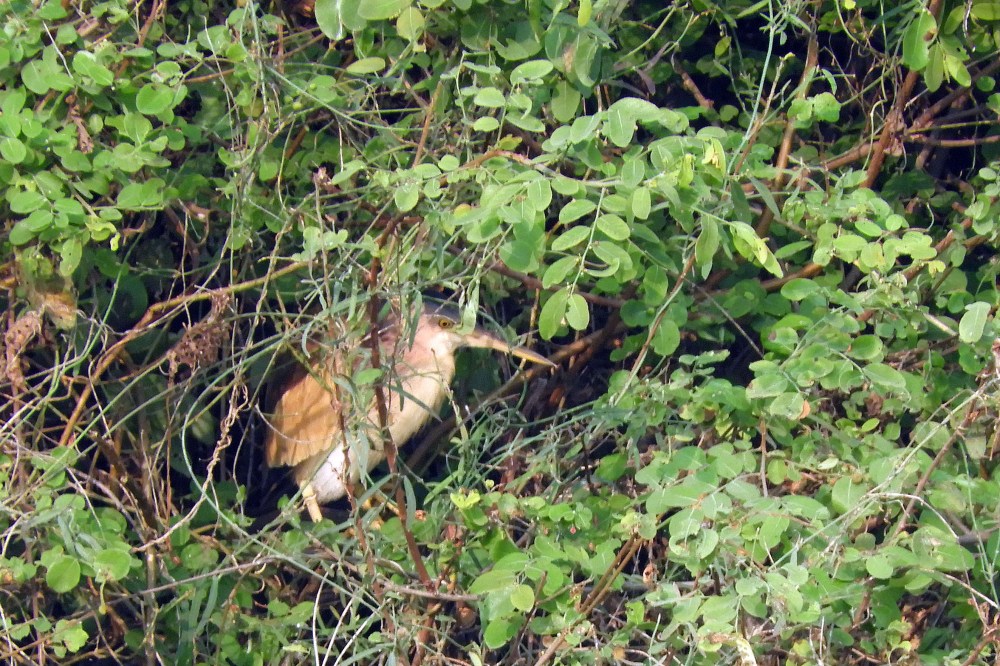
… and even (after a bit of searching) rarer species like Yellow Bittern …
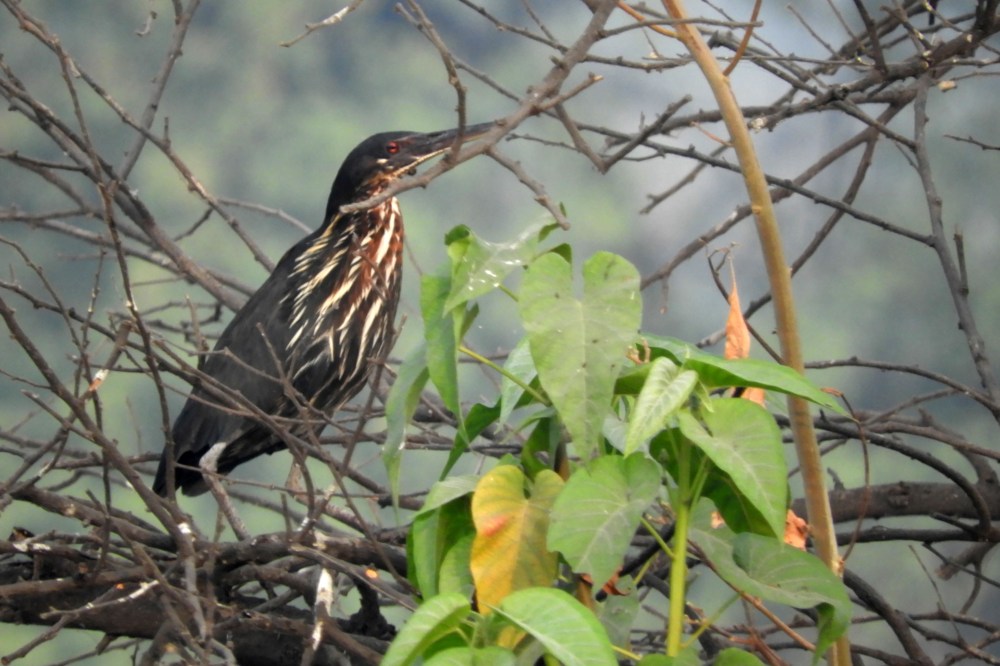
… and Black Bittern.
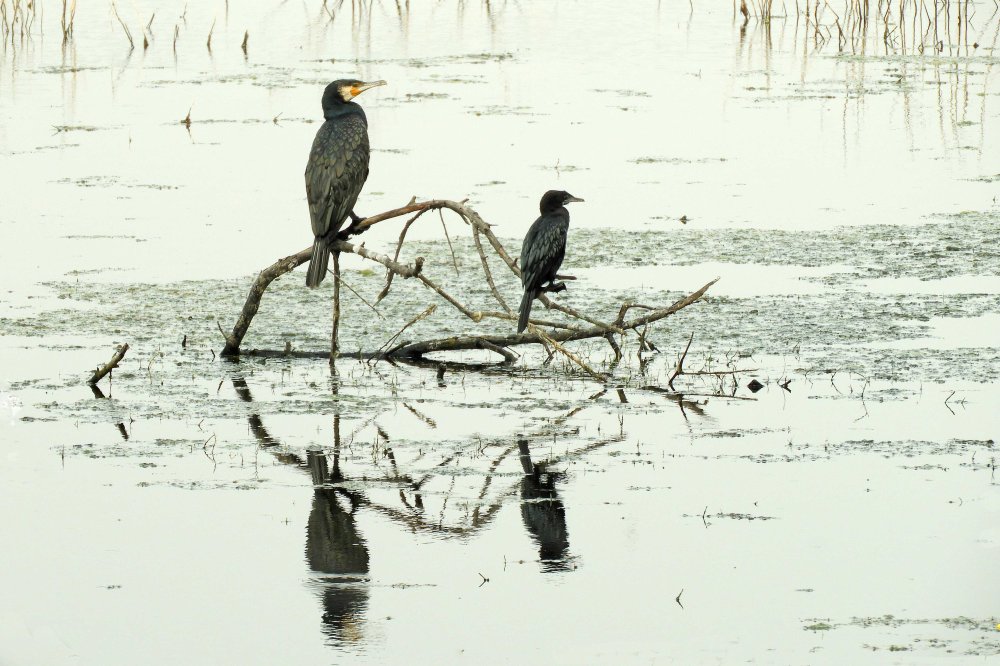
Little and Large: The saw three species of cormorant, here are the eponymous Great Cormorant and Little Cormorant. The third one (not shown) breaks the naming convention and goes by the name of Indian Cormorant.

This is not a cormorant but a darter, a different Family comprising of just four species, sometimes known as ‘snake birds’, with one occurring in each of the Australasian, Afrotropical and Oriental regions and another in the Americas. This is, perhaps unsurprisingly, named Oriental Darter.
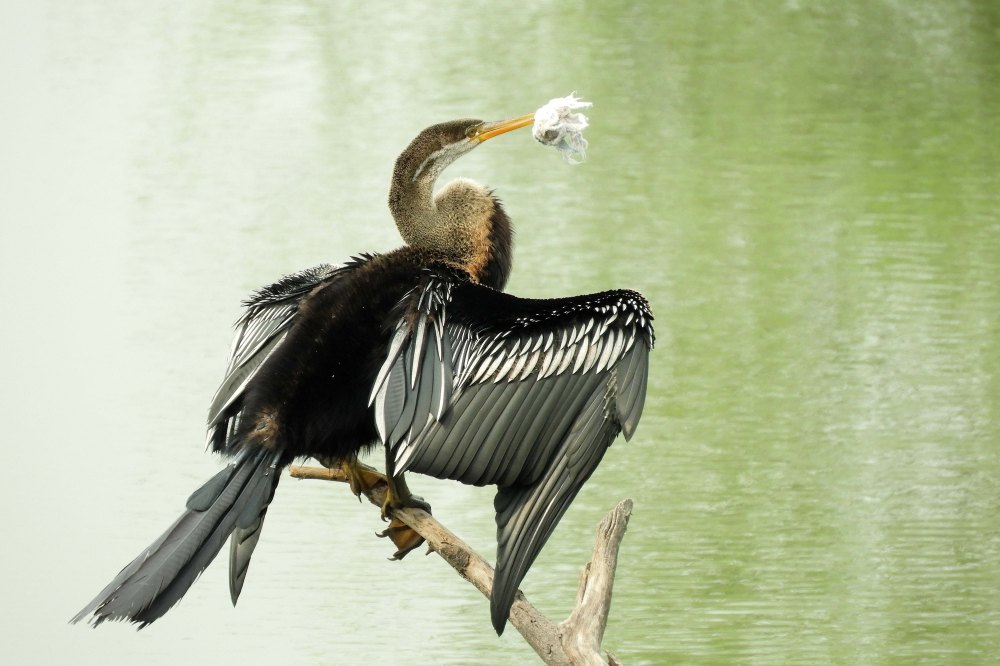
This darter has got some fishing net caught around its bill, presumably obtained outside the park as no fishing occurs within. The staff were attempting to capture it to remove the netting, I hope they succeeded.
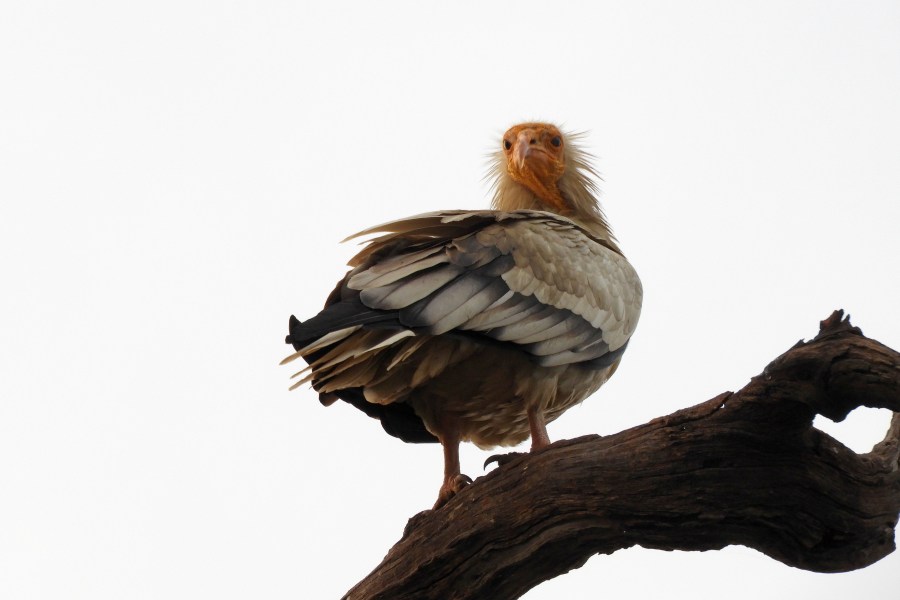
I mentioned in the last post how vulture numbers in India have dropped to <1% of their former numbers due to poisoning with the vetinary drug that we know as Volterol or Diclofenac. One species that has survived better than the others is Egyptian Vulture, whether this is because it can metabolise the drug or feeds less on the poisoned cattle carcasses, I don’t know. This was the only vulture species we saw on the trip.
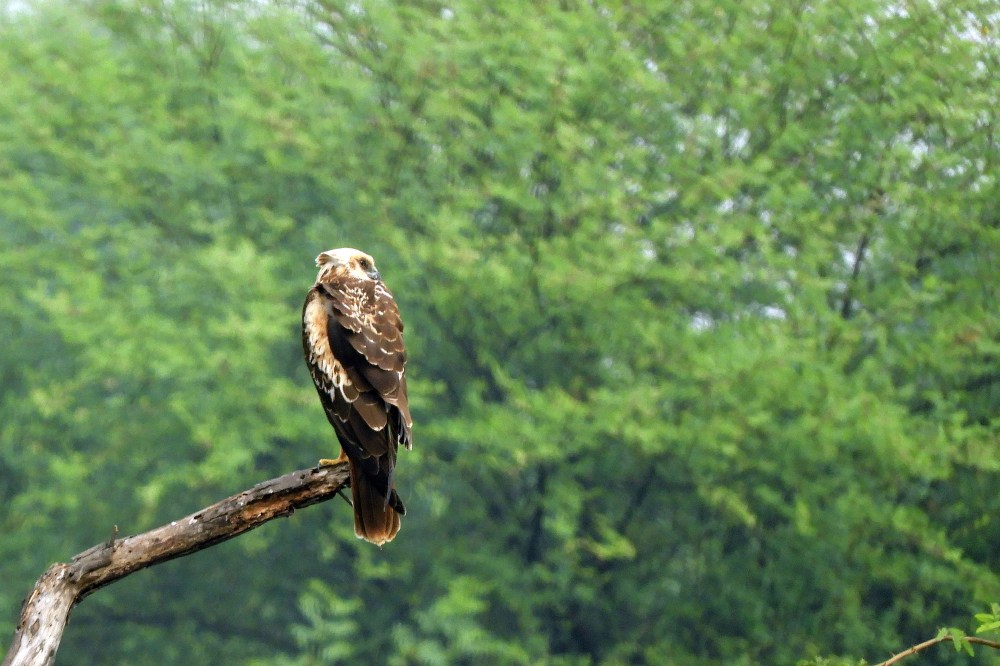
There were many raptors around the site such as this Western Marsh Harrier, a bird we are familiar with from the UK (you have to go a lot further east than India before you encounter Eastern Marsh Harrier).

Less familiar to us was Crested Serpent Eagle, this bird with the pale forehead and supercillium is an immature …
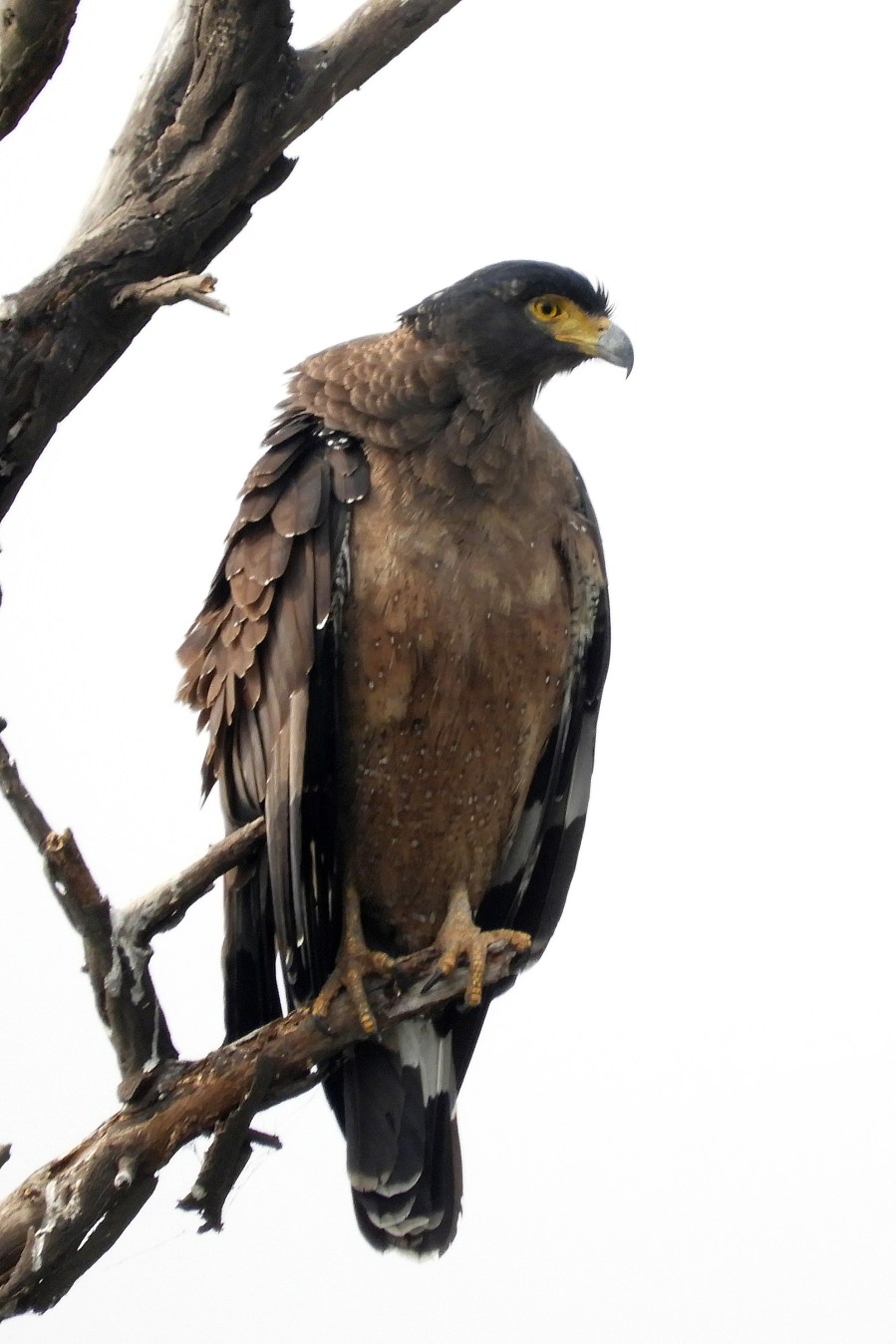
… whilst this is an adult.

We also saw Greater Spotted Eagle (seen here with two Black Drongos) and an Indian Spotted Eagle. Indian Spotted Eagle has been split from the more westerly Lesser Spotted Eagle and as my recollection of seeing it in 1986 is somewhat vague I was very pleased to catch up with it.
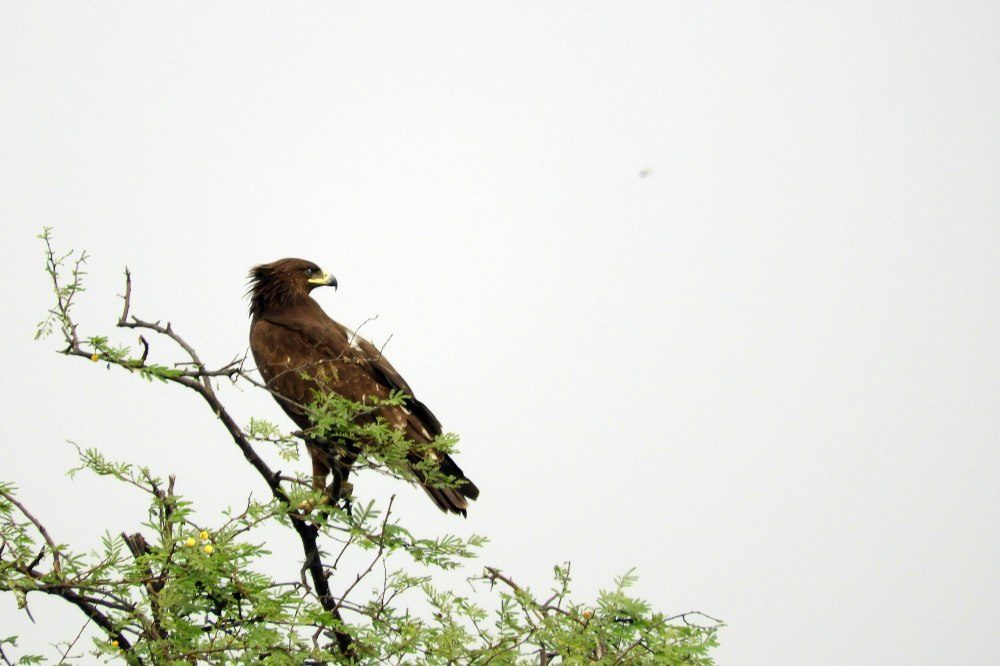
Greater Spotted Eagle can be identified in flight by the larger number of ‘fingers’ in the outer wing but is a bit trickier when perched, the shaggy nape and the gape extending up to but not beyond the centre of the eye are key features. All these large Palearctic eagles used to go by the scientific name of as Aquila clanga. Now for reasons I don’t understand it has been transferred to the new genus Clanga, so its now Clanga clanga! If anyone would ever reverse this decision they would be dropping a clanger!!
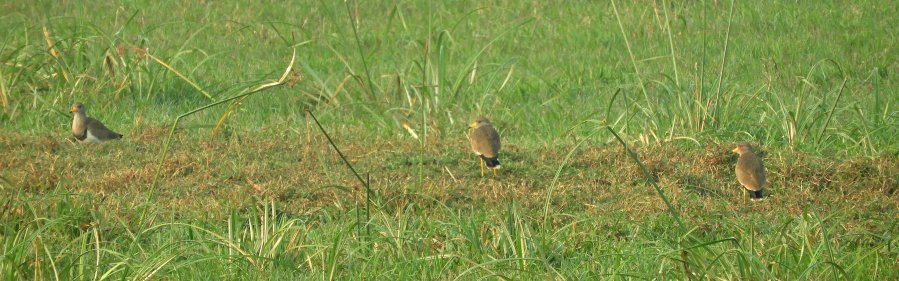
We were very pleased to come across a group of five Grey-headed Lapwing (three of which are pictured here), a species I’ve several times before in Asia but never as far west as this.

‘All the Birds of the World’ the single volume from Lynx Edicions which illustrates every bird in the world shows 24 species of Vanellus plover of which Grey-headed of course is one. One of the 24 is almost certainly extinct but I’m glad to say I’ve seen all but one of the others (Brown-chested, which I missed in Uganda).
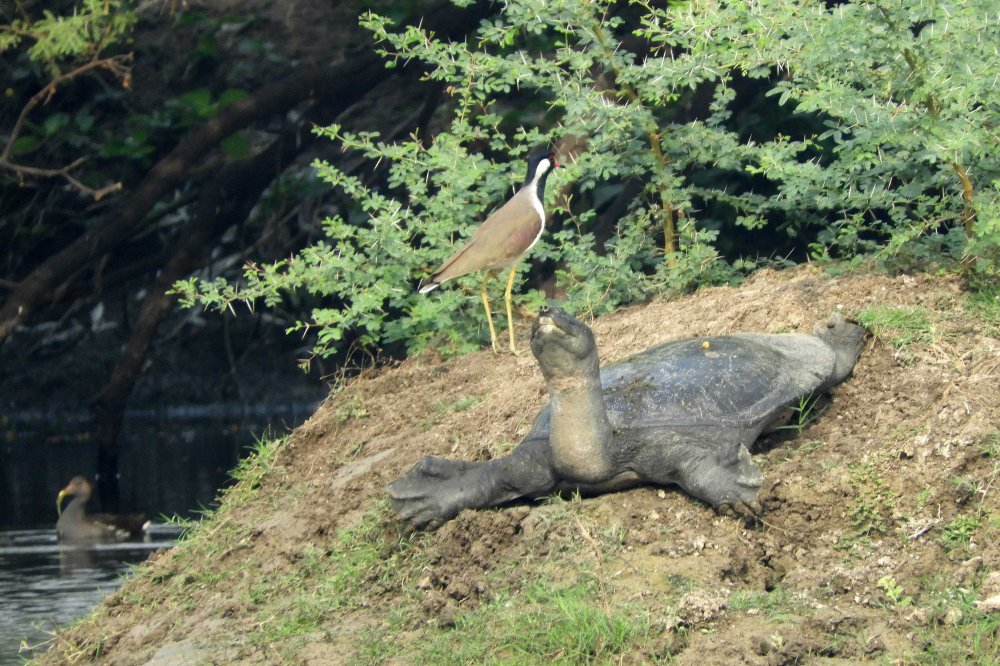
Another Vanellus plover, Red-wattled Lapwing in the background and a Common Moorhen to the left but the star of this photo is the impressively named Indian Narrow-headed Softshell Turtle.
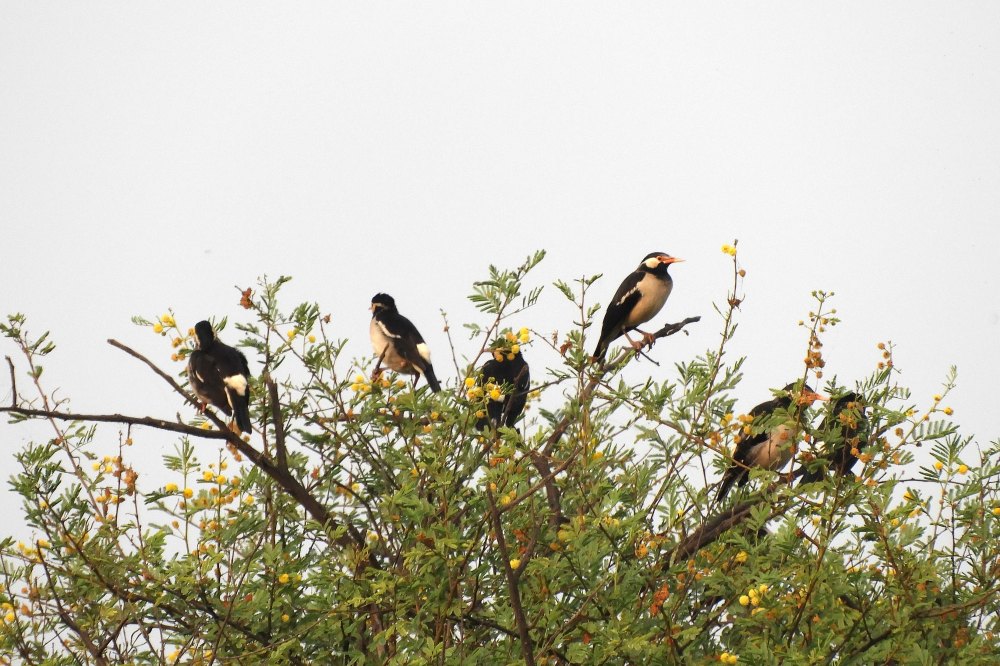
On our last morning we sort out some birds that skulked in the vegetation that fringed the jheels, these Pied Mynas were easy enough to see …
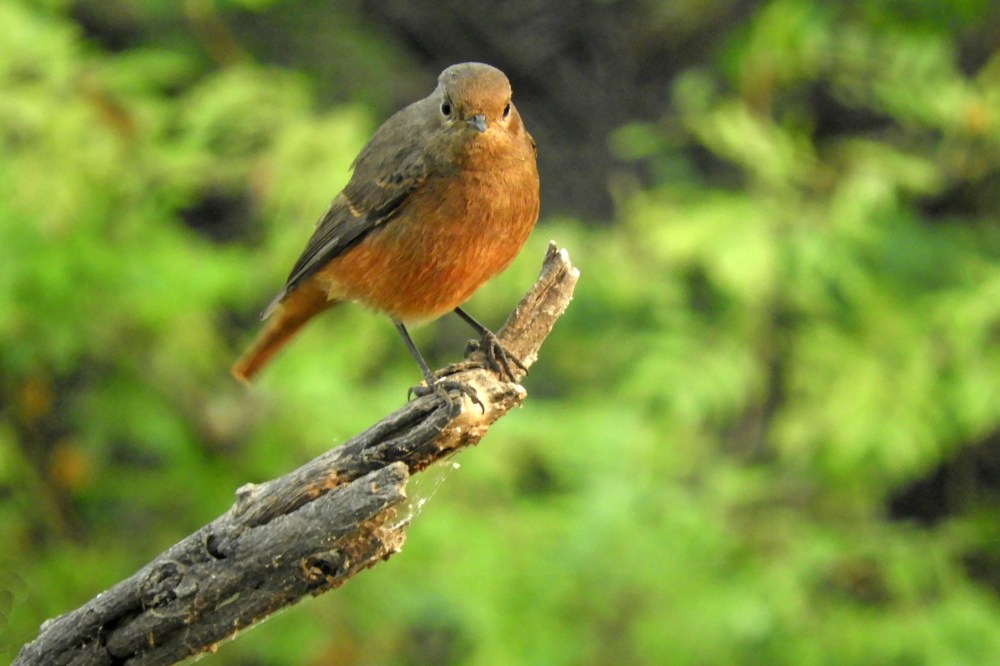
… as were Black Redstarts (here a female of one of the red-breasted Central Asia races).
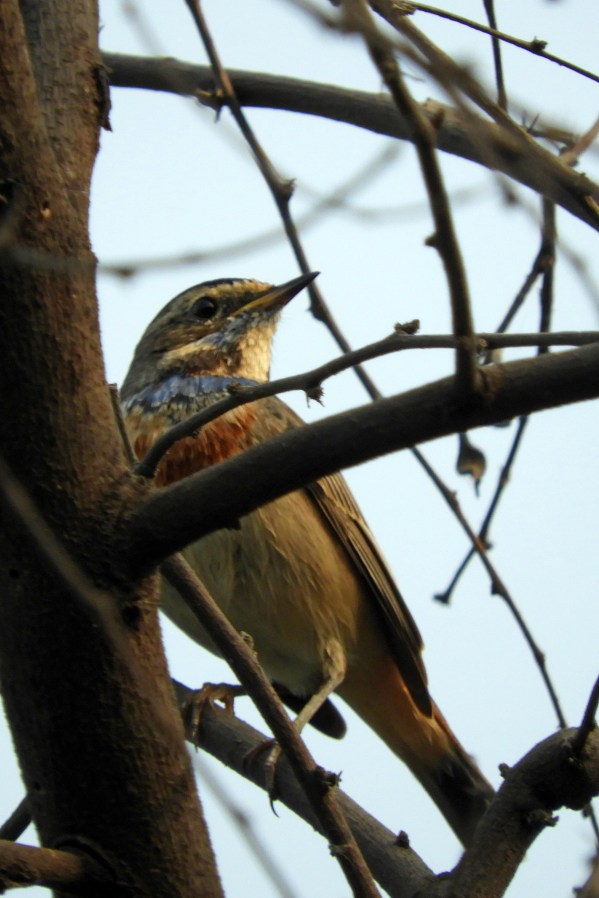
Wintering birds from Siberia included Bluethroat …
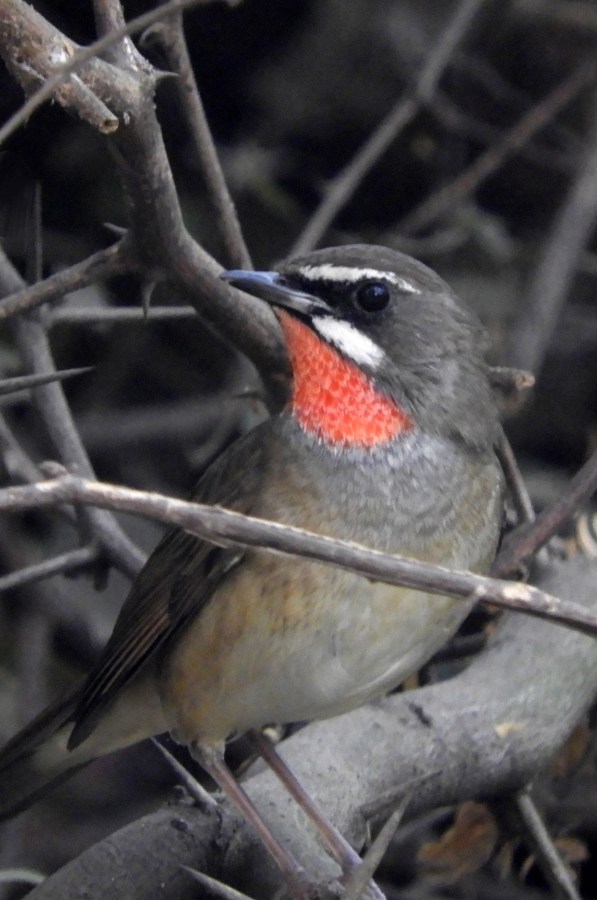
… but best of all was this superb Siberian Rubythroat that entertained us for some time, recalling seeing that one at Osmington Mills in Dorset in 1997, (a sighting so remarkable that some still claim it was an escape from captivity)

Unlike Tadoba, the previous national park we visited, Bharatpur doesn’t have any dangerous wildlife (hence all the tourists travelling around on bikes or rickshaws) but we did hear there was a Leopard in one (closed off) area. However we did see a few mammals such Rhesus Macaque …

… which scanned the tourists carefully for any sign of a free meal …

… several Golden Jackals were seen …

… a female Nilgai (with Purple Heron) …

… Indian Grey Mongoose …

… the inevitable Palm Squirrel …

… and Wild Boar.

I’m sure if we had spent more time at Bharatpur we could have seen more species in this wonderful park but we had to move on this time to the city of Jaipur. There was a site on route where the rare Indian Spotted Creeper, a life bird for me, could be found. Wild About Travel had arranged for our guide Gaj to accompany us and see if he could find the creeper. Unfortunately the creeper wasn’t at home but we did see a few other quality birds.
The next post will be about our visit to the historic city of Jaipur.
In November 2020 we went on a customised tour of northern India organised by Jo Thomas of Wild About Travel
This was Margaret’s first visit to India (although my sixth) and allowed us to combine visits to cultural sites with wildlife viewing. Earlier posts on this tour dealt with our visits to Tabora National Park and the Chambal River area.
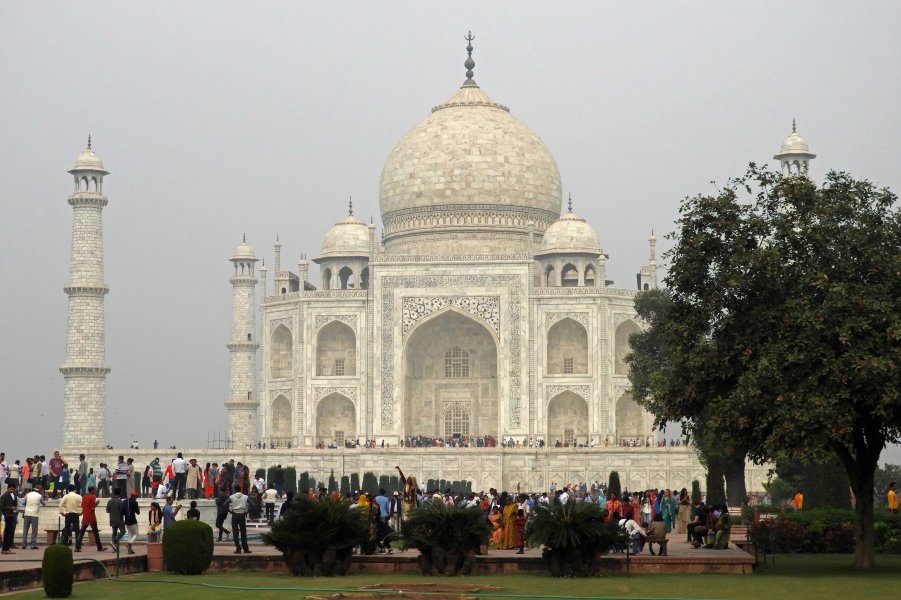
This is the third post on our trip to India in November 2019 and covers our visit to the Taj Mahal and the ancient city of Fatehpur Sikri in the city of Agra which we visited on route to our next overnight stop in the city of Bharatpur.
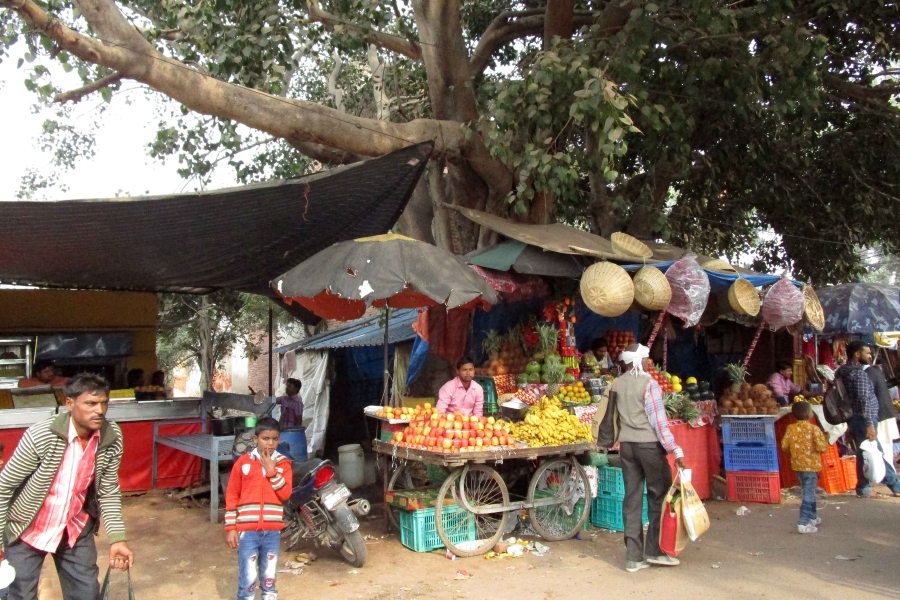
We left the Chambal River Lodge mid-morning and drove to Agra. Most of our earlier travels, from Nagpur to Tadoba and back, had been on main roads and the journey from Agra to Chambal was before dawn, so this was Margaret’s first real experience of the vibrancy and colour of everyday Indian rural life.

… to the omnipresent cows and water buffalos.
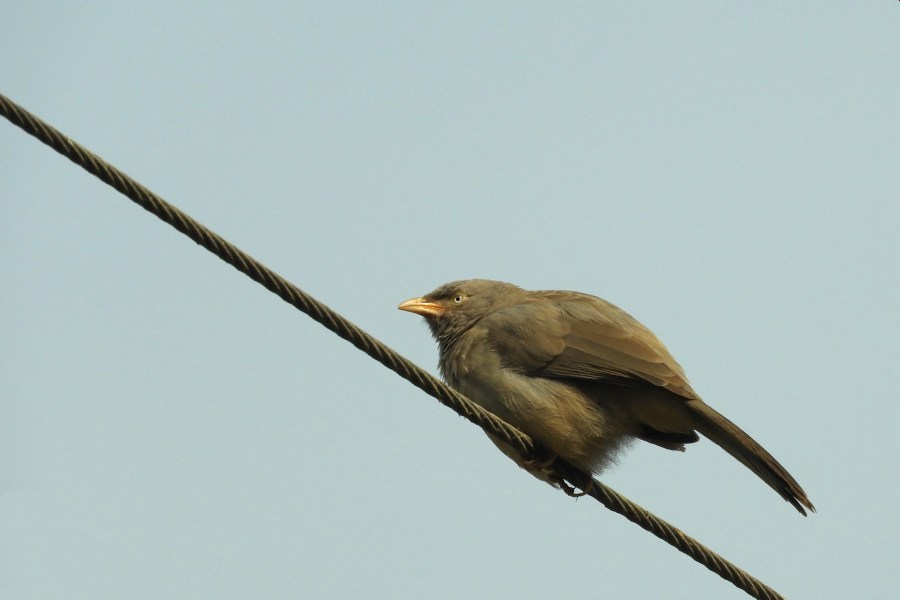
A few birds were seen on route such as the suitably common Common Babbler.
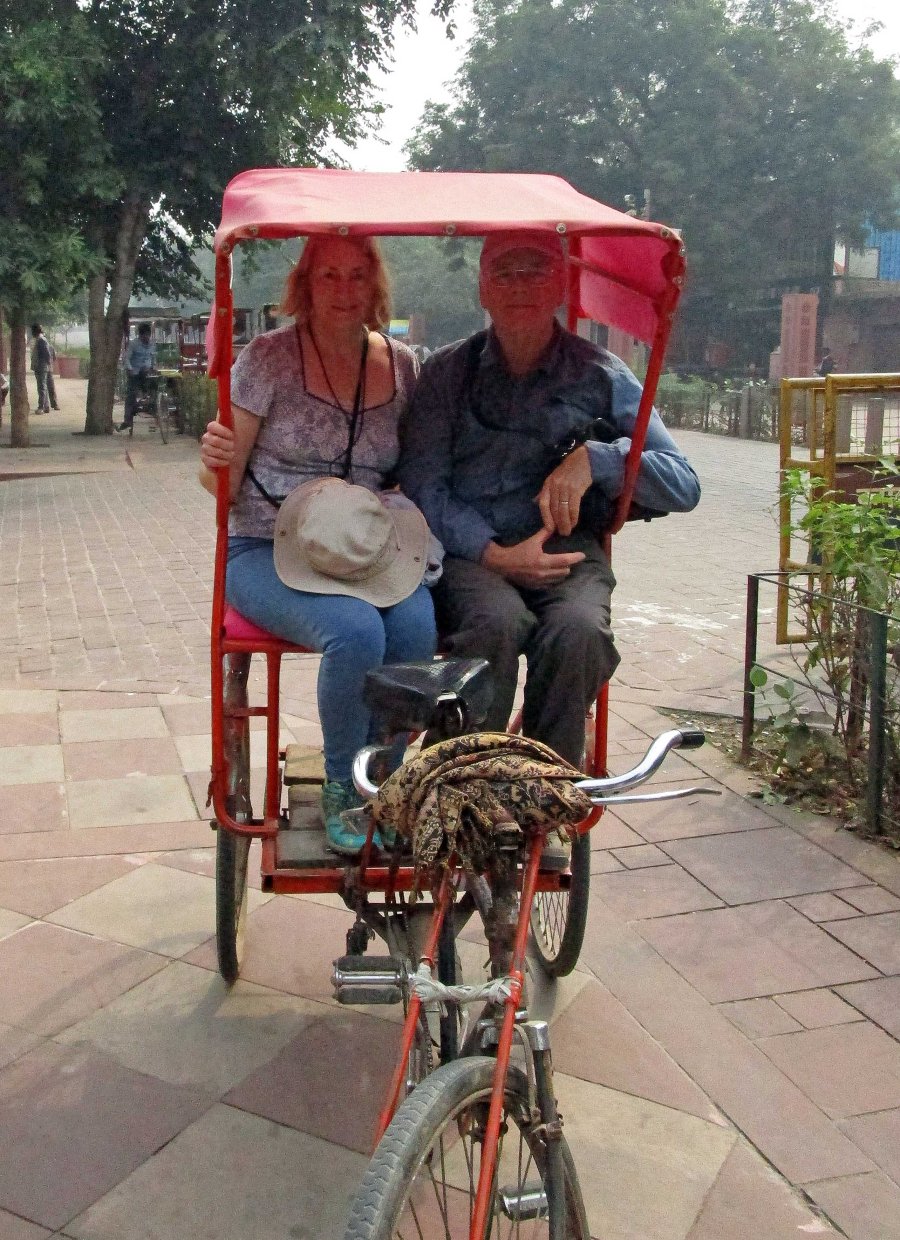
On arriving we arranged a local guide and took a bicycle rickshaw from the car park …
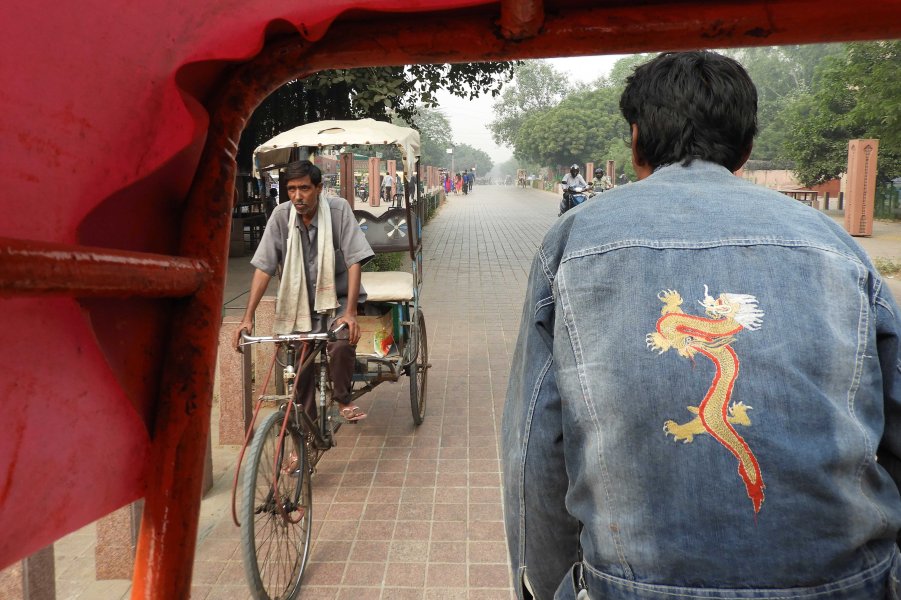
… travelling to the entrance to the Taj Mahal in style.
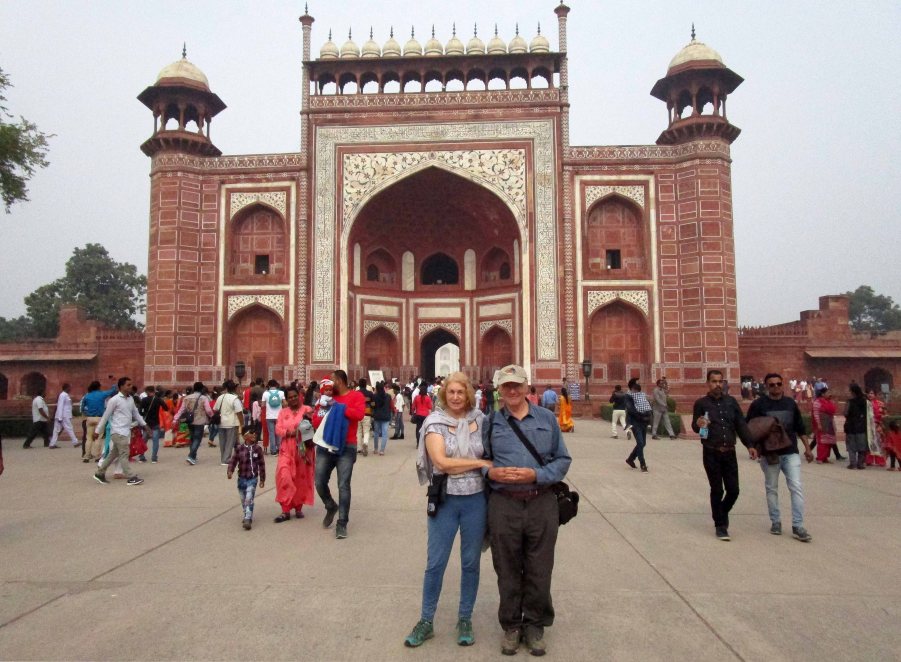
Our guide made sure we paused for all the clichéd photos.

To say the Taj Mahal was crowded would be an understatement.
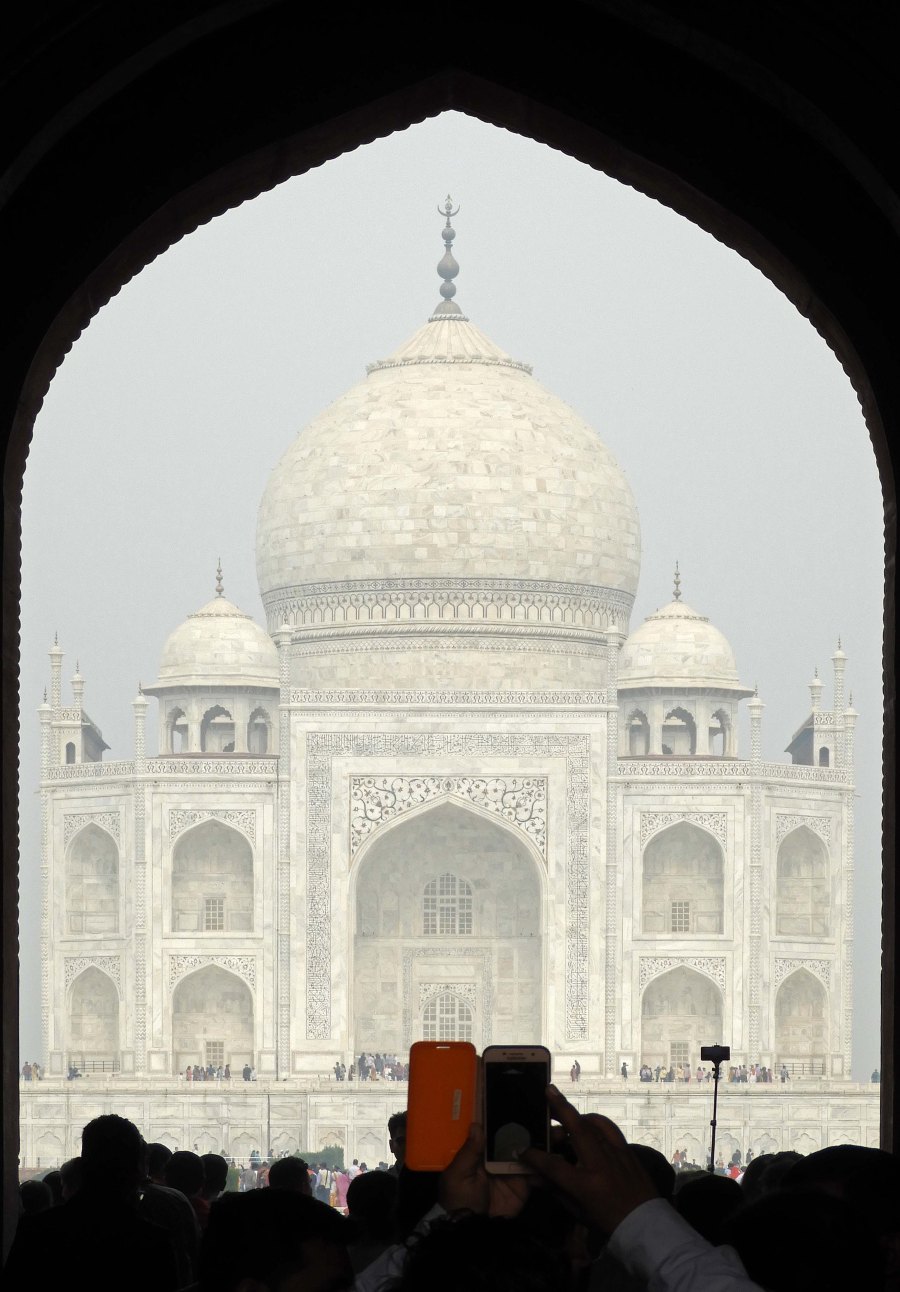
This is probably the best and most awe inspiring view of the Taj Mahal and as can be seen from all the phones and selfie sticks, everyone else felt the same.

From Wikipedia: The Taj Mahal is an ivory-white marble mausoleum on the southern bank of the river Yamuna in the Indian city of Agra. It was commissioned in 1632 by the Mughal emperor Shah Jahan (reigned from 1628 to 1658) to house the tomb of his favourite wife, Mumtaz Mahal; it also houses the tomb of Shah Jahan himself. The tomb is the centrepiece of a 17-hectare complex, which includes a mosque and a guest house, and is set in formal gardens bounded on three sides by a crenellated wall. Construction of the mausoleum was essentially completed in 1643, but work continued on other phases of the project for another 10 years. The Taj Mahal complex is believed to have been completed in its entirety in 1653 at a cost estimated at the time to be around 32 million rupees, which in 2020 would be approximately 70 billion rupees. The construction project employed some 20,000 artisans under the guidance of a board of architects led by the court architect to the emperor, Ustad Ahmad Lahauri. The Taj Mahal was designated as a UNESCO World Heritage Site in 1983 for being “the jewel of Muslim art in India and one of the universally admired masterpieces of the world’s heritage”. It is regarded by many as the best example of Mughal architecture and a symbol of India’s rich history. The Taj Mahal attracts 7–8 million visitors a year and in 2007, it was declared a winner of the New 7 Wonders of the World (2000–2007) initiative.
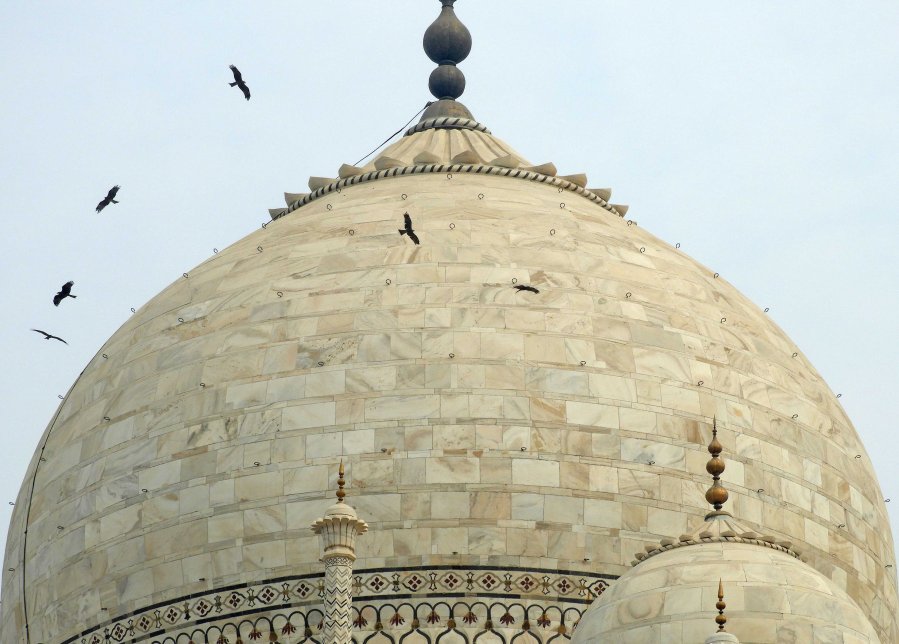
One bird that was absolutely abundant on my first visit to India in 1986 was Black Kite. I was surprised how few I saw on this trip, however there were quite a few flying around the dome of the Taj Mahal.

The race here is govinda, a more strongly marked race than those in Europe.

These black inlays in the white marble produce an optical illusion because if you gaze upwards the zig-zags become a straight line. I tried to capture this in a photo but the pillars ‘fell over backwards’ so badly that you will just have to imagine it!

The mausoleum itself is flanked on three sides by these red stone buildings, one of which is the entrance and exit …

… whilst the fourth side is flanked by the Yamuna river.

When I visited the Taj Mahal in 1986 this area was full of vultures, but the widespread use of the veterinary drug diclofenac (used to treat cattle which after death are eaten by vultures) has resulted in widespread poisoning and a reduction in numbers of over 99%. At least there were plenty of Great Cormorants and a few Painted Storks, Ruddy Shelducks and Grey Herons present.

We entered the mausoleum, but there was a policy of no photography inside …
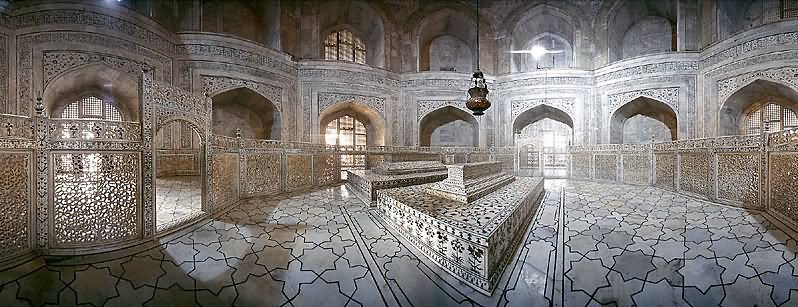
… the tomb of Shah Jahan’s wife Mumtaz Mahal lies centrally and so looks down the the central axis of the complex. Shah Jahan’s tomb which was placed here after his death in 1666 lies offset to one side. As I was unable to photograph the tomb I’ve copied this wide-angle shot from here

As we emerged from the mausoleum it was clear that the compound was rapidly filling up with tourists, it was time to get some lunch and move on.
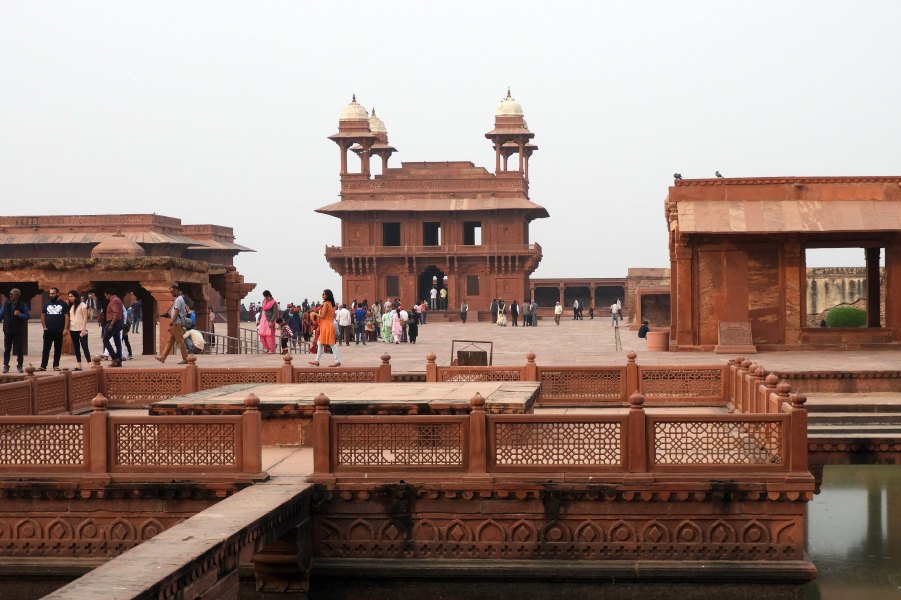
We continued on to the ancient city of Fatehpur Sikri.

From Wikipedia: Fatehpur Sikri is a city in the Agra District of Uttar Pradesh, India. The city itself was founded as the capital of Mughal Empire in 1571 by Emperor Akbar, serving this role from 1571 to 1585, when Akbar abandoned it due to a campaign in Punjab and was later completely abandoned in 1610. The name of the city is derived from the village called Sikri which occupied the spot before. An Archaeological Survey of India (ASI) excavation from 1999 to 2000 indicated that there was a habitation, temples and commercial centres here before Akbar built his capital. The region was settled by Sungas following their expansion. In 12th century, it was briefly controlled by Sikarwar Rajputs. The khanqah of Sheikh Salim existed earlier at this place. Akbar’s son Jahangir was born at the village of Sikri in 1569 and that year Akbar began construction of a religious compound to commemorate the Sheikh who had predicted the birth. After Jahangir’s second birthday, he began the construction of a walled city and imperial palace here. The city came to be known as Fatehpur Sikri, the “City of Victory”, after Akbar’s victorious Gujarat campaign in 1573. After occupying Agra in 1803, the English established an administrative centre here and it remained so until 1850. In 1815, the Marquess of Hastings ordered repair of monuments at Sikri.

Again from Wikipedia: The city was founded in 1571 and was named after the village of Sikri which occupied the spot before. The Buland Darwaza was built in honour of his successful campaign in Gujarat, when the city came to be known as Fatehpur Sikri – “The City of Victory”. It was abandoned by Akbar in 1585 when he went to fight a campaign in Punjab. It was later completely abandoned by 1610. The reason for its abandonment is usually given as the failure of the water supply, though Akbar’s loss of interest may also have been the reason since it was built solely on his whim.[14] Ralph Fitch described it as such, “Agra and Fatehpore Sikri are two very great cities, either of them much greater than London, and very populous. Between Agra and Fatehpore are 12 miles (Kos) and all the way is a market of victuals and other things, as full as though a man were still in a town, and so many people as if a man were in a market.
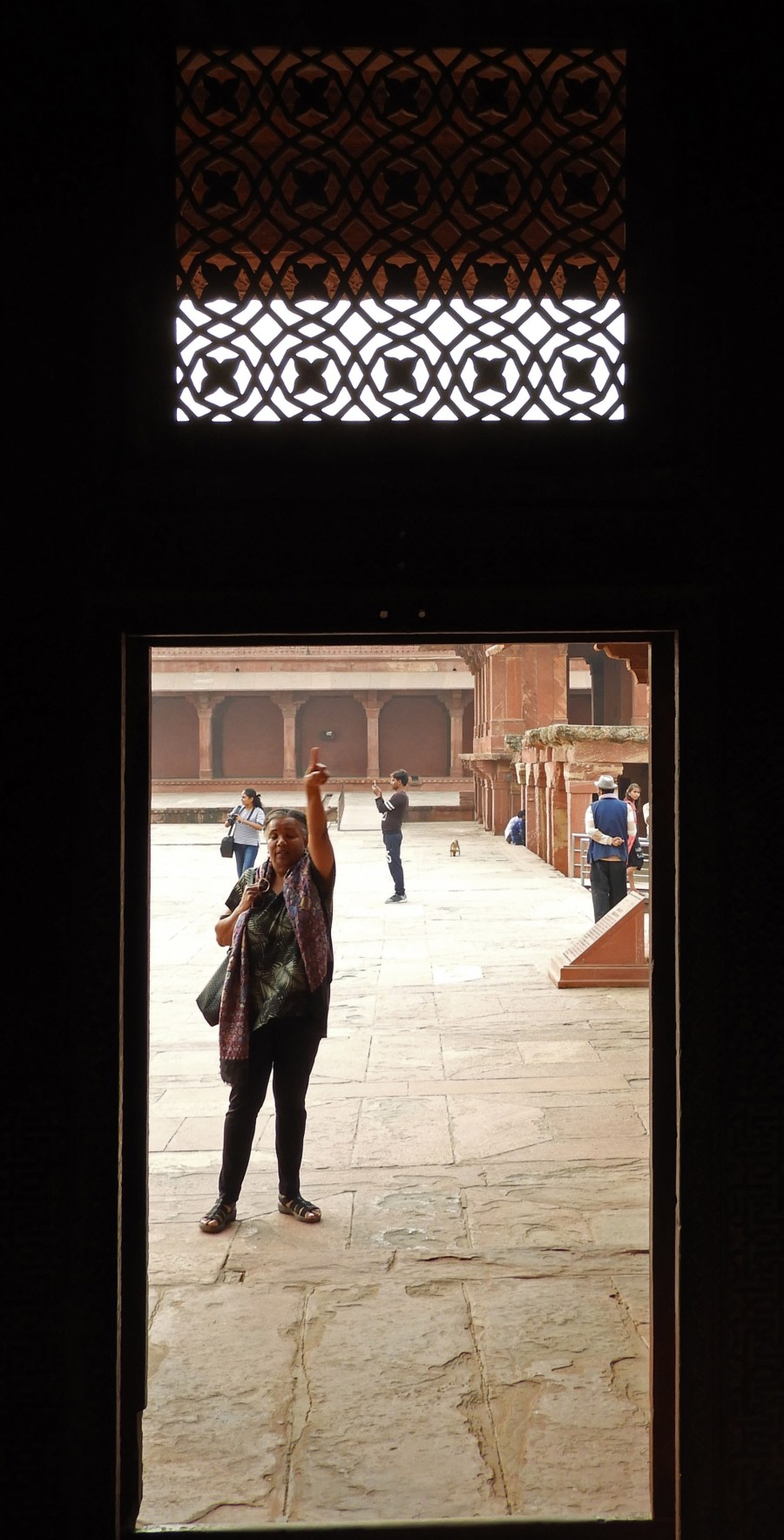
This lady looks impressed by the architecture!
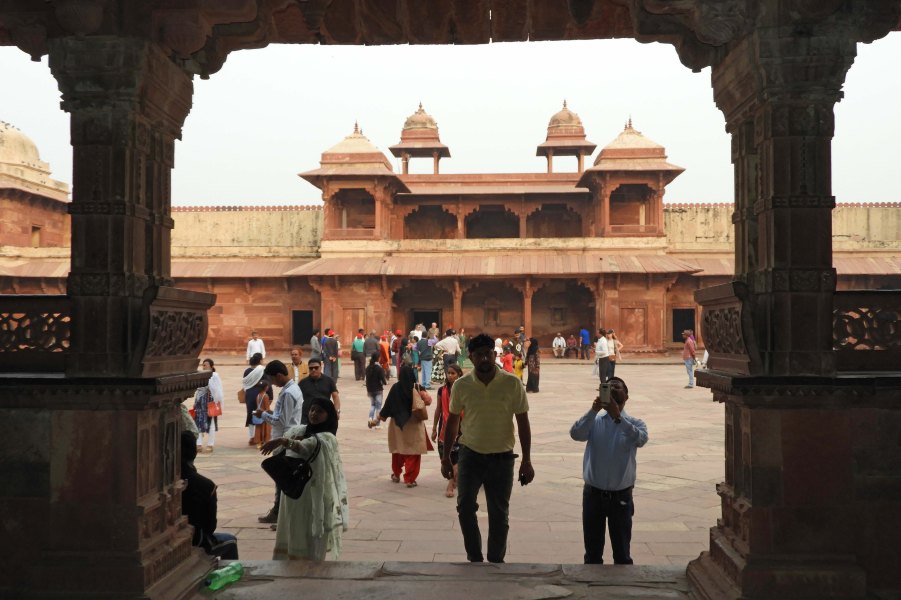
Of course we could only visit a small part of the city. More from Wikipedia: Fatehpur Sikri sits on rocky ridge, 3 kilometres in length and 1 km wide and palace city is surrounded by a 6 km wall on three sides with the fourth bordered by a lake. The city is generally organized around this 40 m high ridge, and falls roughly into the shape of a rhombus. The general layout of the ground structures, especially the “continuous and compact pattern of gardens and services and facilities” that characterized the city leads urban archaeologists to conclude that Fatehpur Sikri was built primarily to afford leisure and luxury to its famous residents. The dynastic architecture of Fatehpur Sikri was modelled on Timurid forms and styles. The city was built massively and preferably with red sandstone. Gujarati influences are also seen in its architectural vocabulary and décor of the palaces of Fatehpur Sikri. The city’s architecture reflects both the Hindu and Muslim form of domestic architecture popular in India at the time. The remarkable preservation of these original spaces allows modern archaeologists to reconstruct scenes of Mughal court life, and to better understand the hierarchy of the city’s royal and noble residents. It is accessed through gates along the 8.0 km long fort wall, namely, Delhi Gate, the Lal Gate, the Agra Gate and Birbal’s Gate, Chandanpal Gate, The Gwalior Gate, the Tehra Gate, the Chor Gate, and the Ajmeri Gate. The palace contains summer palace and winter palace for Queen Jodha.
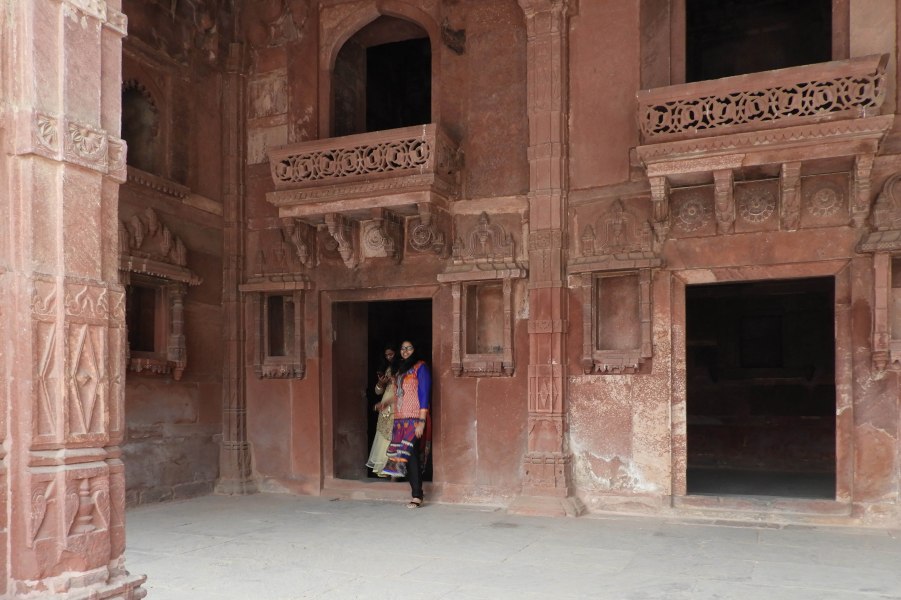
One thing that greatly surprised Margaret was that pretty young Indian ladies would ask if they could take a selfie with her, like she was some sort of celebrity. I caught these two in a more candid pose after they had done the selfie thing with my wife.
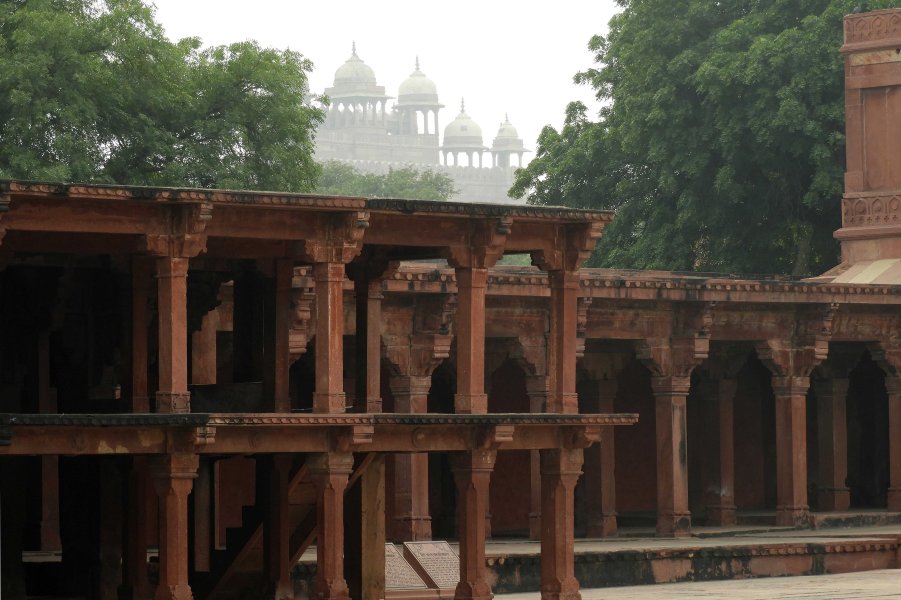
We appreciated that we had only visited of this ancient place but were pleased we had taken the time to do so. In spite of the constant haze and pollution that blights the lowlands of northern India in the winter we had captured some nice photos …

… however as always we concentrated on photographing what we came to see rather than photographing us!
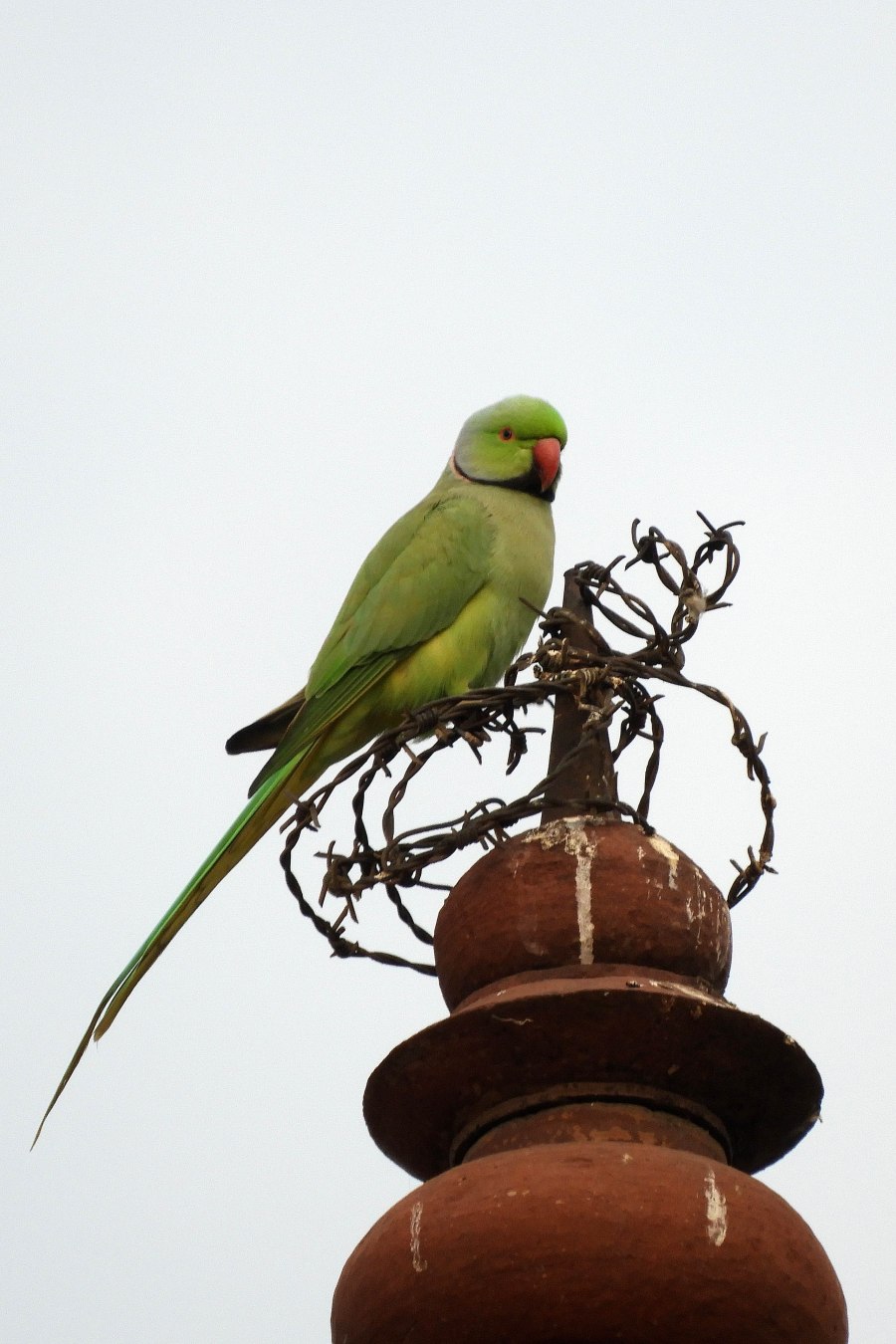
Rose-ringed Parakeets (or Ring-necked as they are often called in the UK) were a common sight …
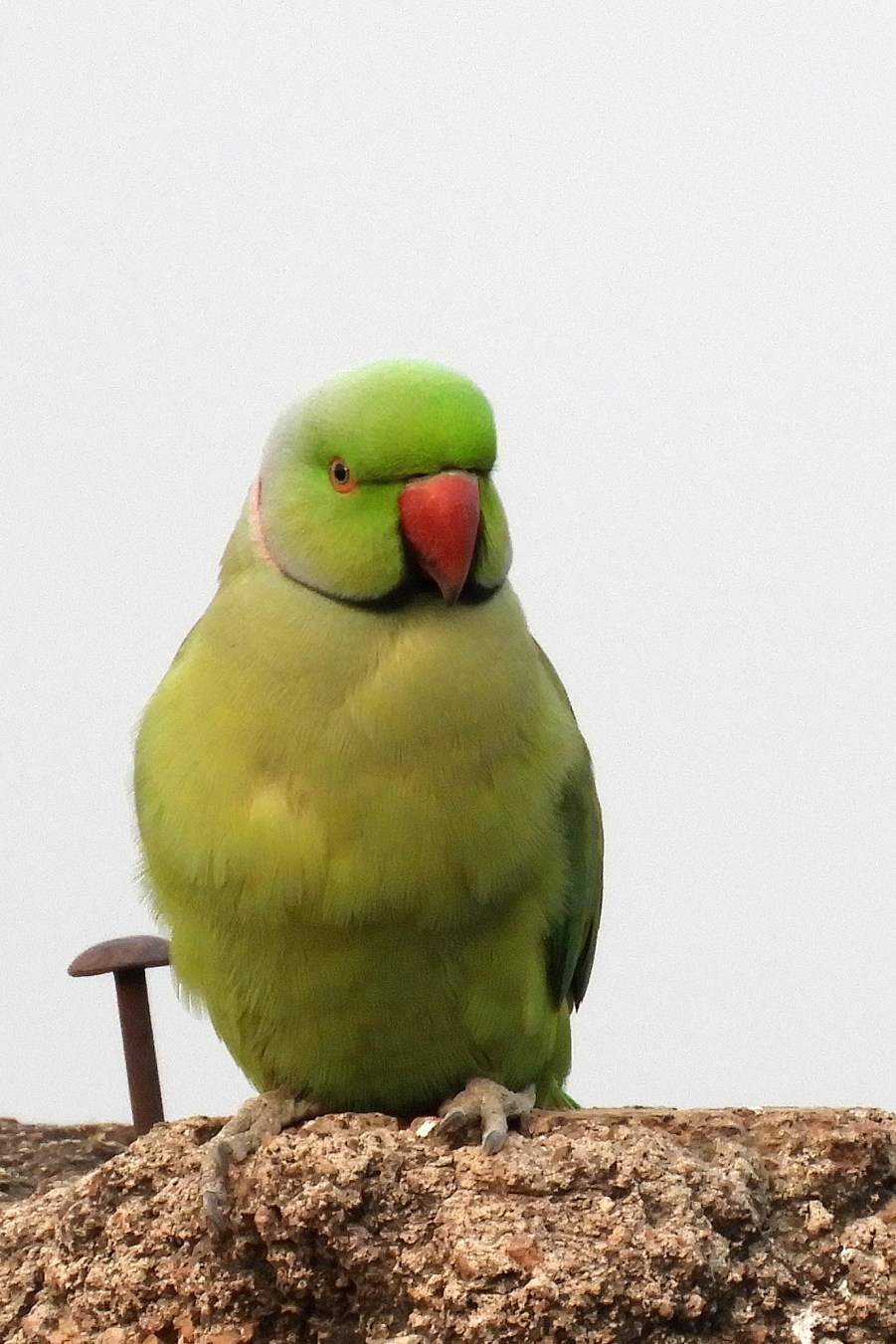
… native to India and parts of northern Africa this species has been introduced into many places, including the UK where they often become a pest, competing with native species for food and nest holes.

Northern Palm Squirrels were a common sight running along the ancient walls and roofs.

A few final views of Fatehpur Sikri …

… its lakes …

… and spires …
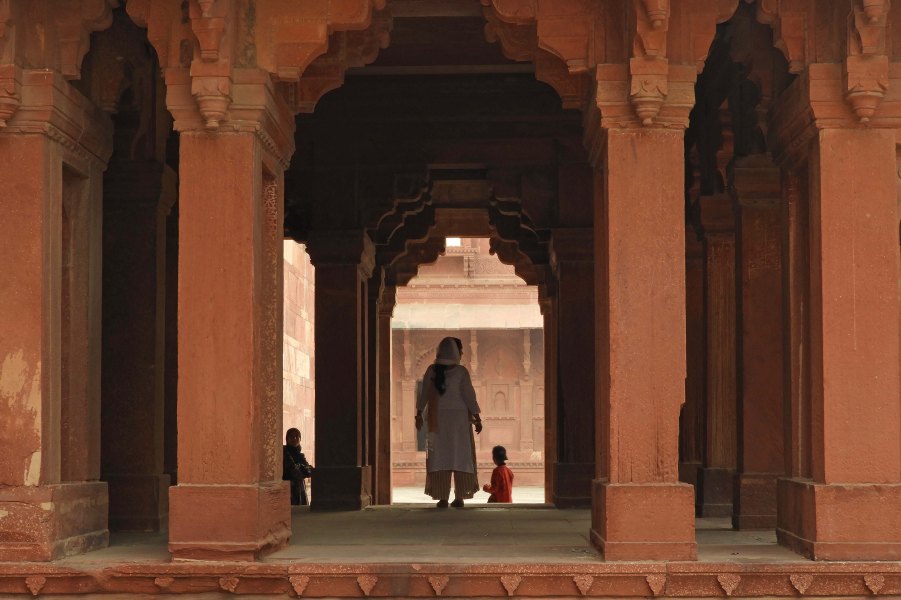
… before we departed to the city of Bharatpur and the wonderful wildlife reserve nearby.

On route we driven down a major highway, this gave Margaret her first chance to experience heavy Indian traffic. I don’t think she sat in the front seat again after that! Although Indians nominally drive on the left like we do in the UK, the rules of the road seem to be made up as they go along. Of course the traffic speed is much lower than the UK, with all the cows, sheep, bicycles and vehicles going the wrong way it couldn’t be otherwise. We loved the highly decorated Indian lorries, although not their kamikaze driving.
The next post will cover our visit to one of the finest wetland reserves in the world, Keolandeo National Park, known also universally by the name of the adjacent city Bharatpur.
This is the second post about our private trip to India in November 2019 which was organised by Jo Thomas of Wild About Travel
The previous post dealt with our time at Tadoba National Park and our overnight train journey from Nagpur to Agra. Arriving at Agra at 0500. We were met by our driver who took us to the Chambal River Lodge to the east of the city where we stayed for one night.

We arrived at dawn and after breakfast I decided to have a look around the grounds while it was still cool. Margaret, feeling very tired after our overnight train journey opted for a rest.
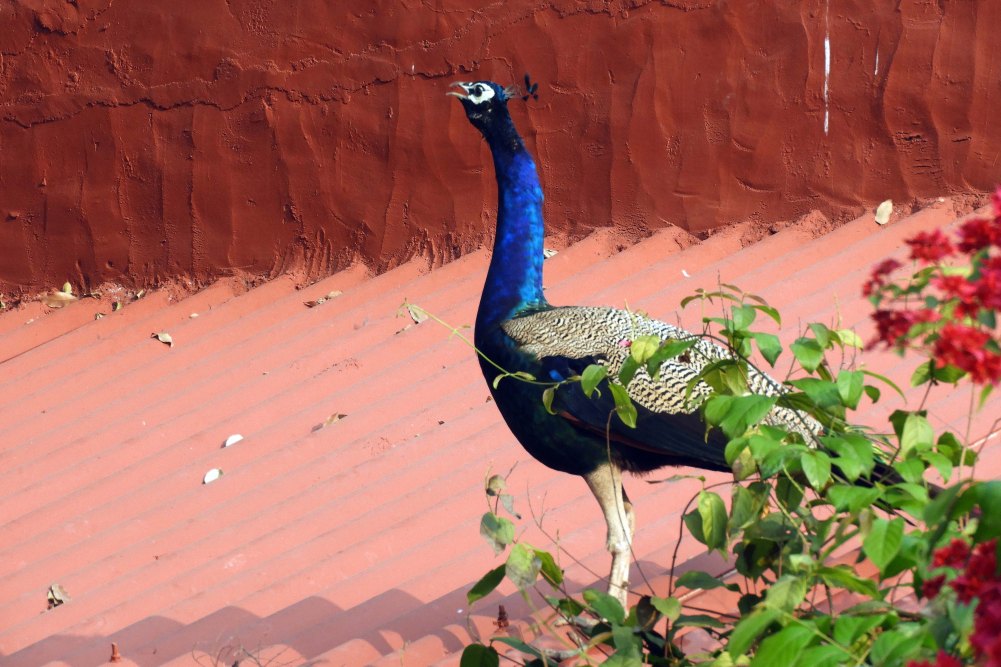
Indian Peacocks were ubiquitous and noisy …
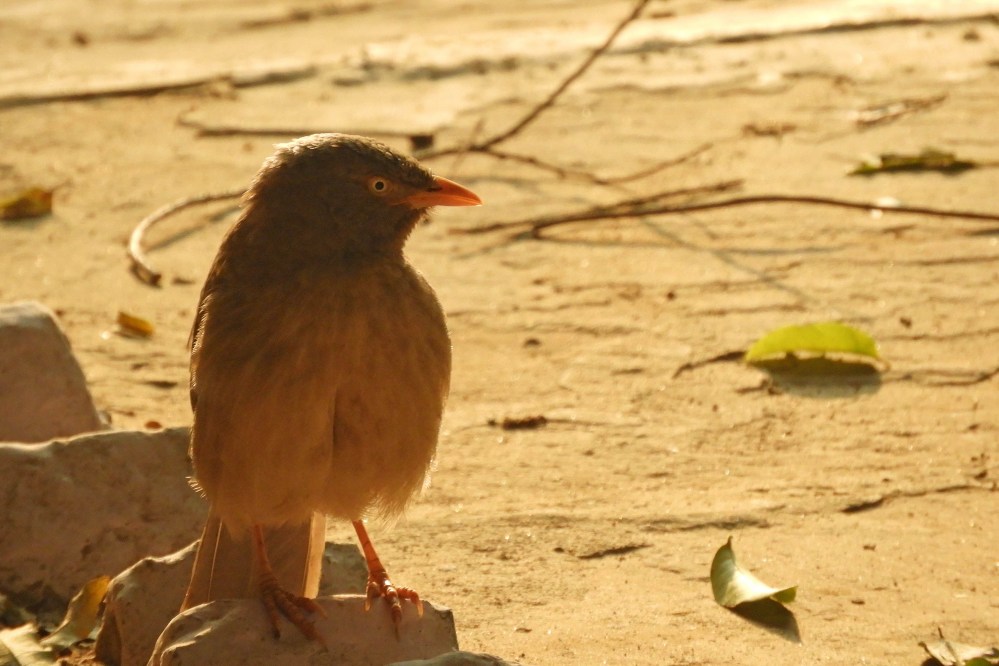
… and garrulous groups of Jungle Babblers fed in the ornamental hedges and open areas.
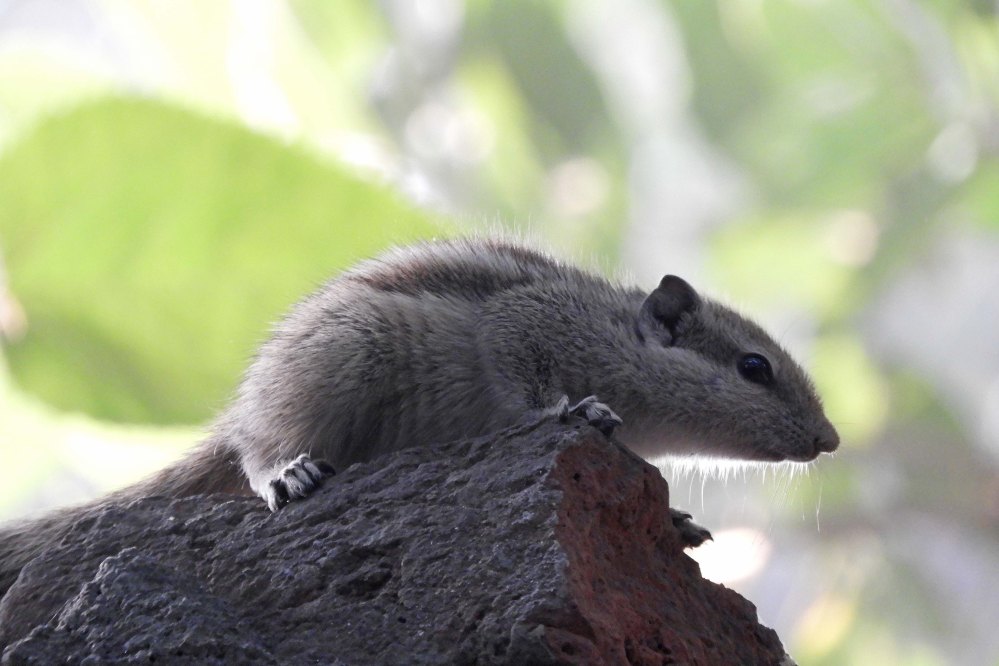
Northern Palm Squirrels were easy to find …
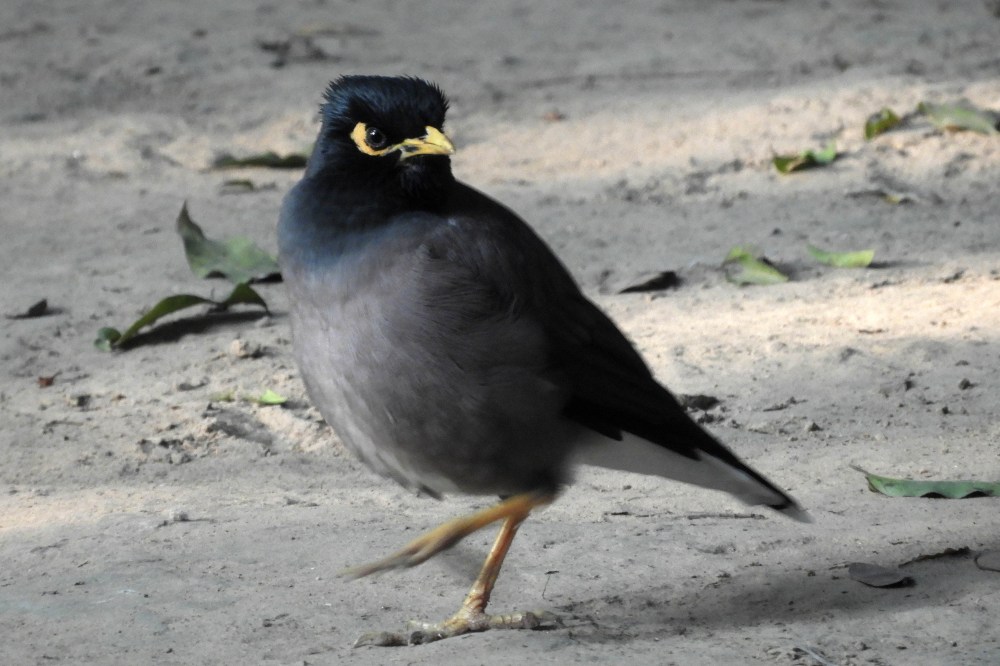
… and Common Mynas lived up to their name. This omnivorous and adaptable species has a wide range in southern Asia but regrettably has been introduced to places like Australia, New Zealand, parts of the USA, South Africa and many islands across the Indian and Pacific Oceans where it has done untold damage to native species.
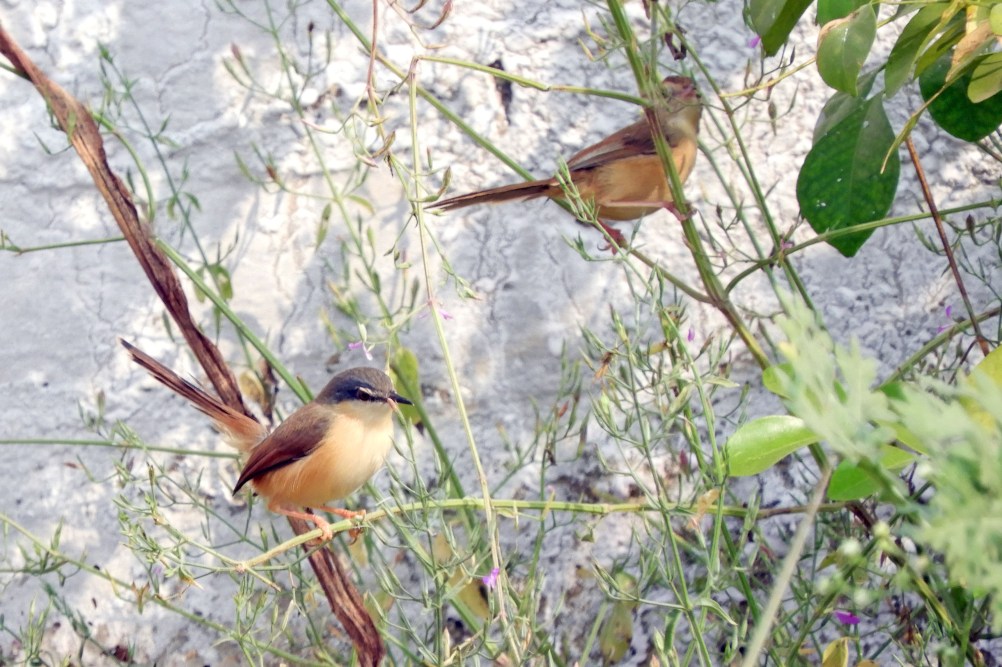
Also around the gardens were these Ashy Prinias …
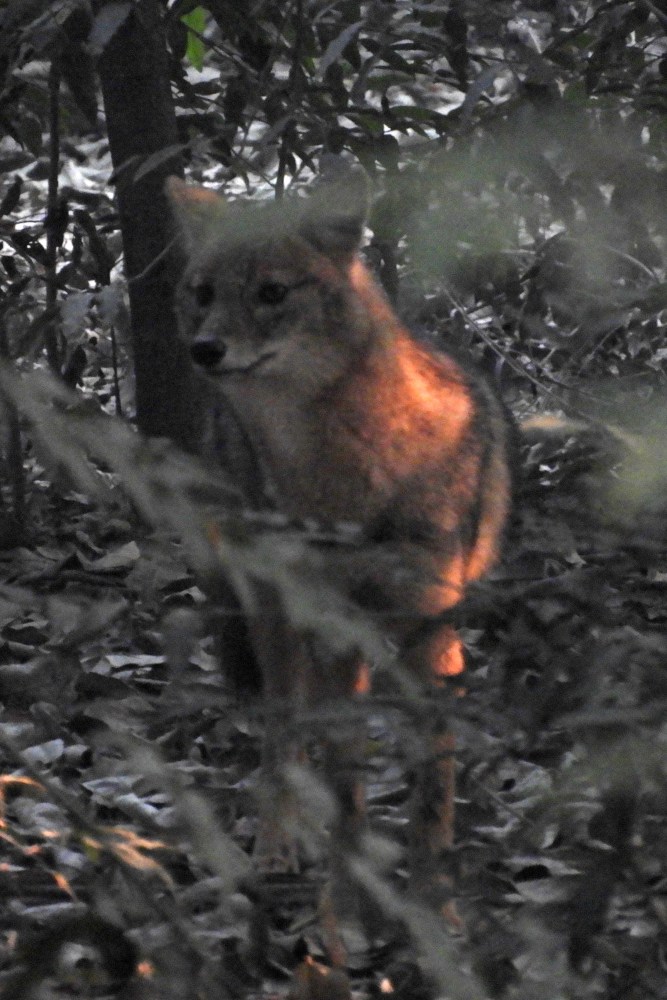
… and in deep cover I came across a Golden Jackal.
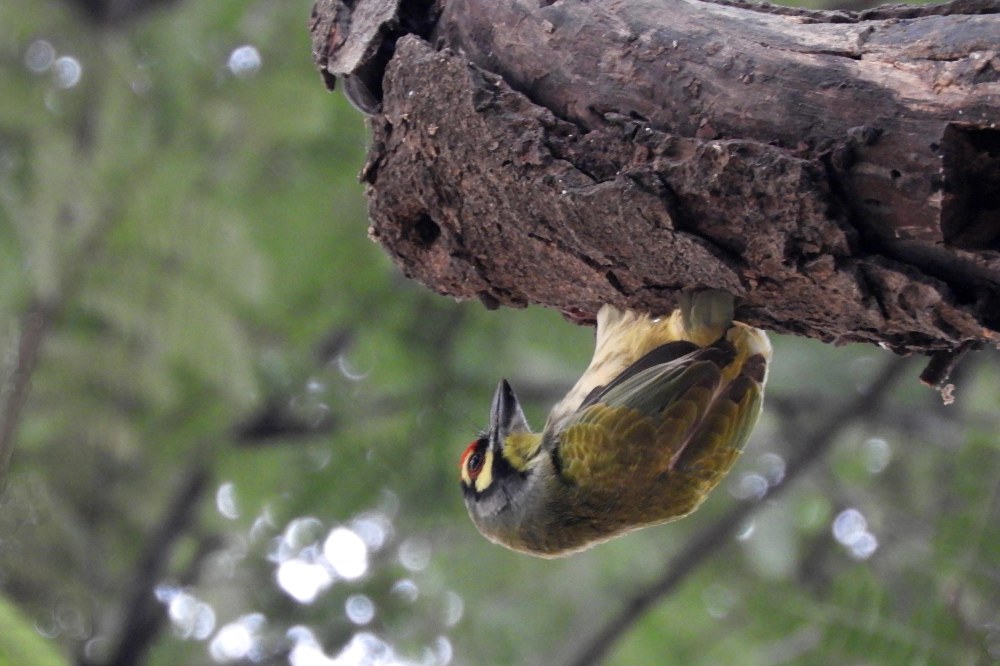
Although of course you see more when accompanied by a local guide, it was fun to spend that morning finding my own birds, which included Greenish Warbler, Pied Starling and this Coppersmith Barbet.
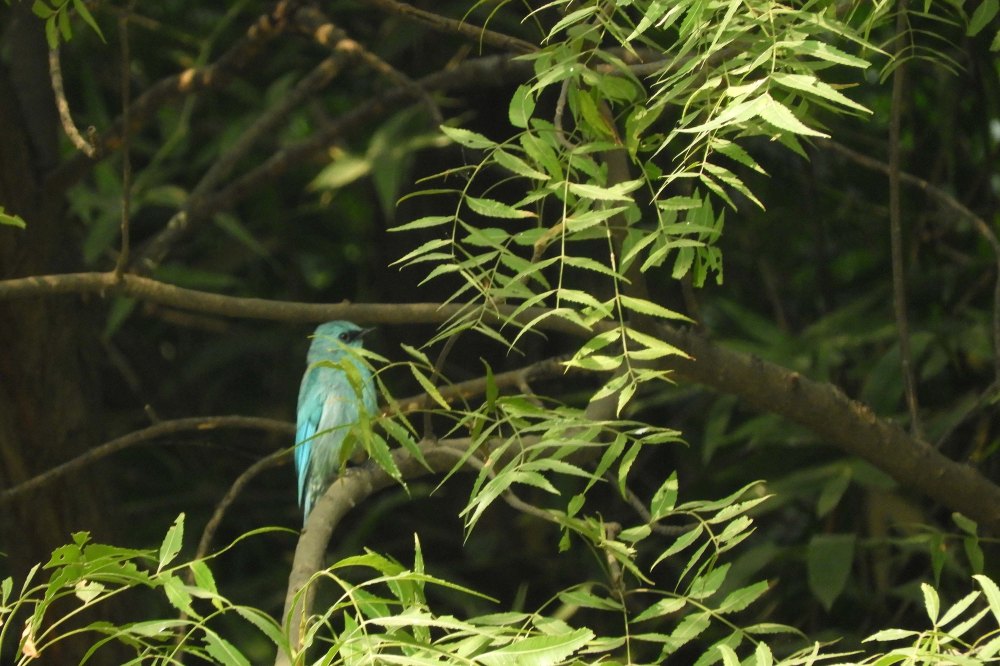
We spent the afternoon on the Chambal River, the reason for our visit with local guide Gajendra, photos of which are shown below. On the second morning he took us around the gardens again and also outside the lodge into the surrounding countryside. Here we came across a wider range of species including – Verditer Flycatcher …
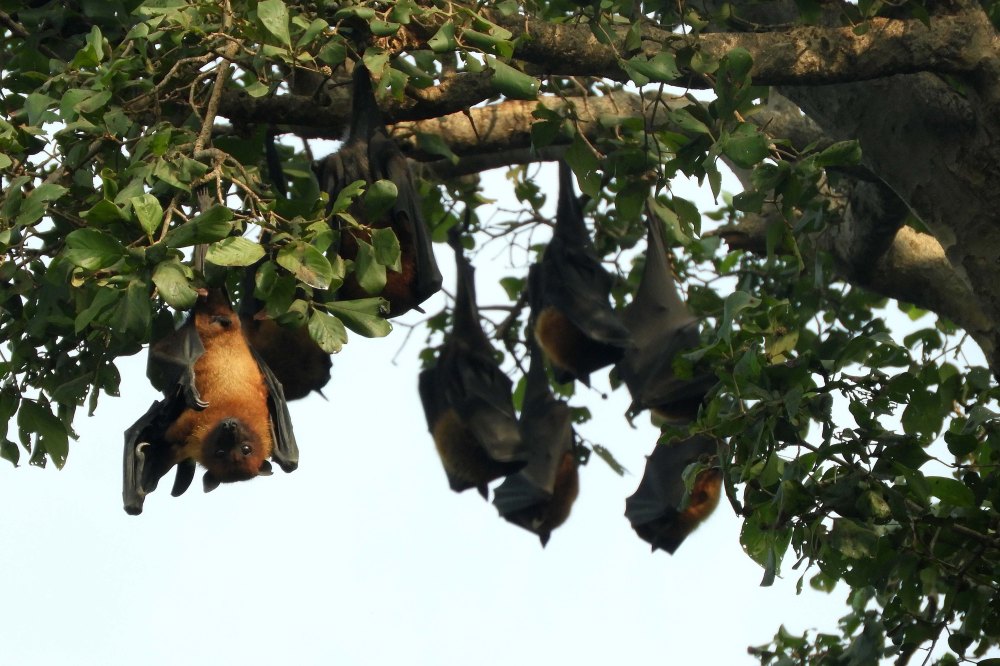
… a roost of Indian Flying Foxes (or Indian Fruit Bats) …
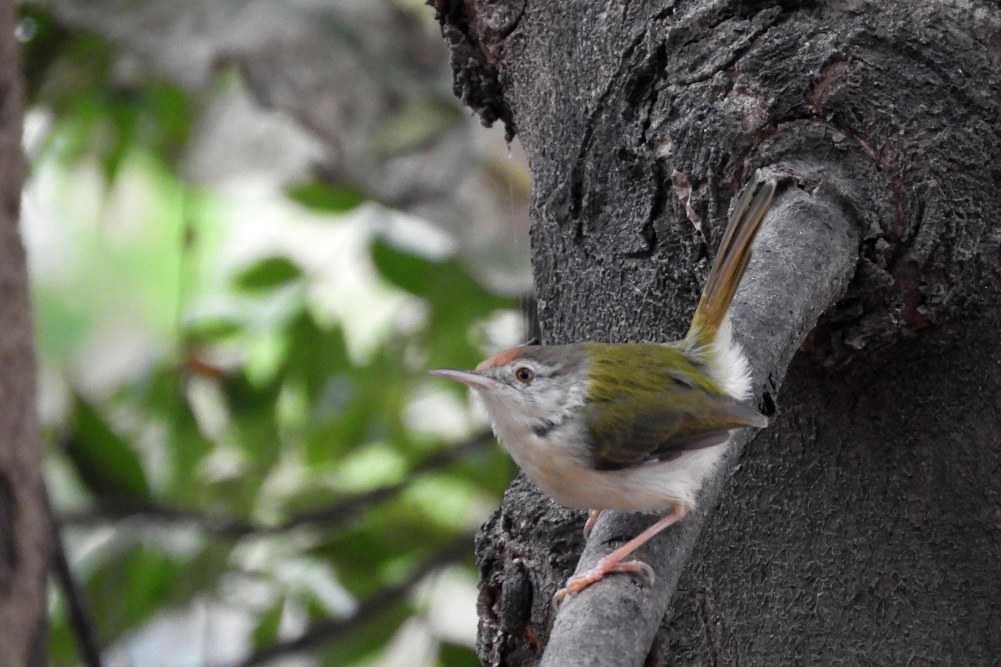
… Common Tailorbird, so called because it sews leaves together to make a nest …
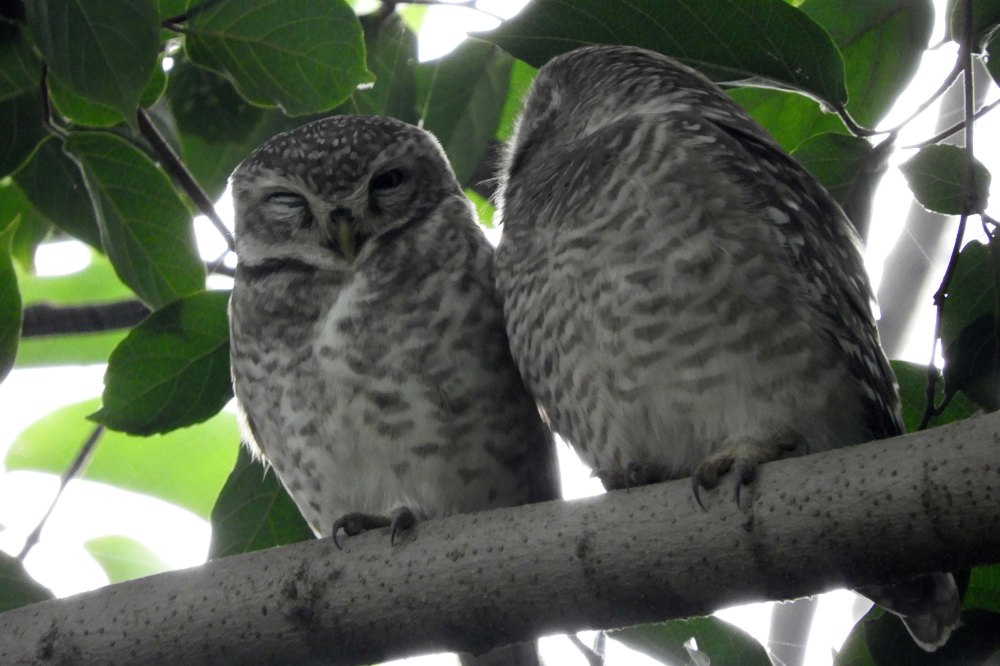
… roosting Spotted Owlets …
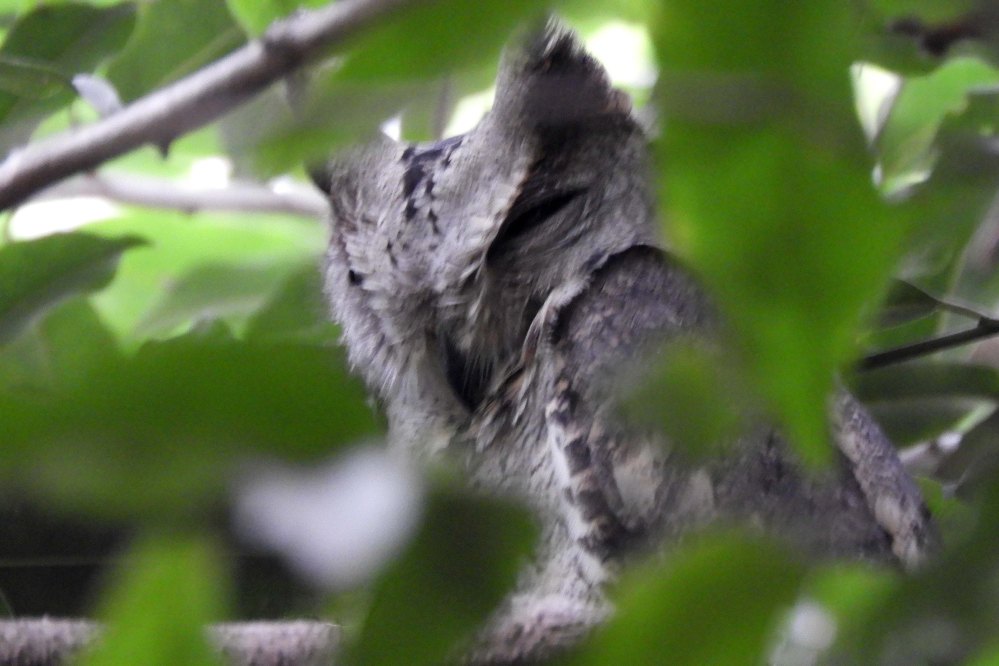
… and Indian Scops Owl.

More species awaited us outside the walled gardens …
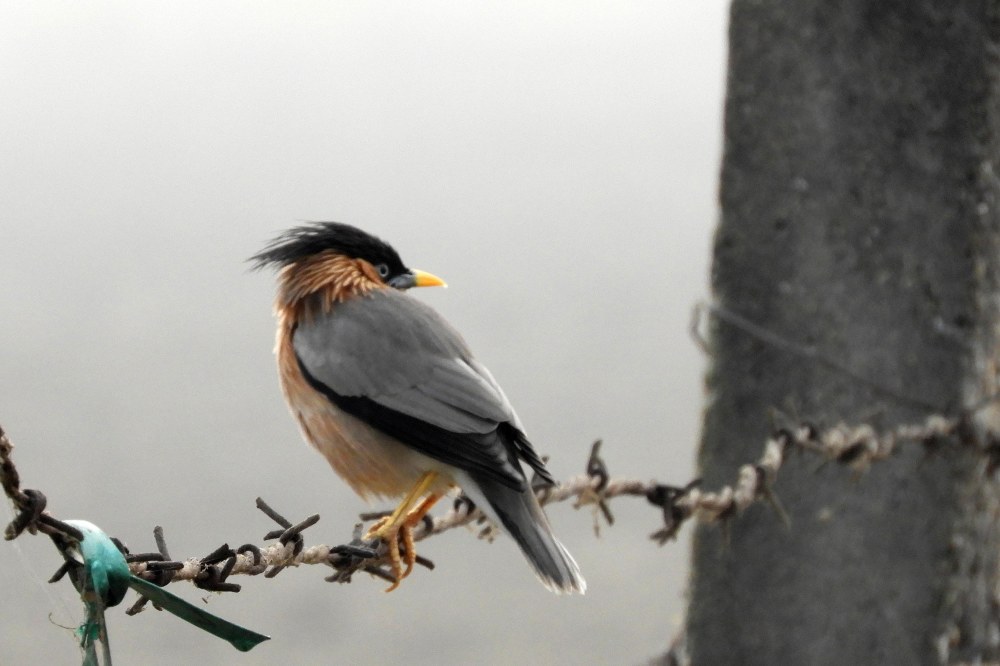
Here we saw a new range of open country species like Black-breasted and Baya Weavers, Red-headed Buntings from Central Asia and good numbers of Brahminy Mynas (pictured above).

Other species included Yellow-footed Green Pigeon, one of the easiest to see of the 30 species in the genus Treron which occur from Africa east to to Wallacea.

Also seen were Brown-headed Barbet …
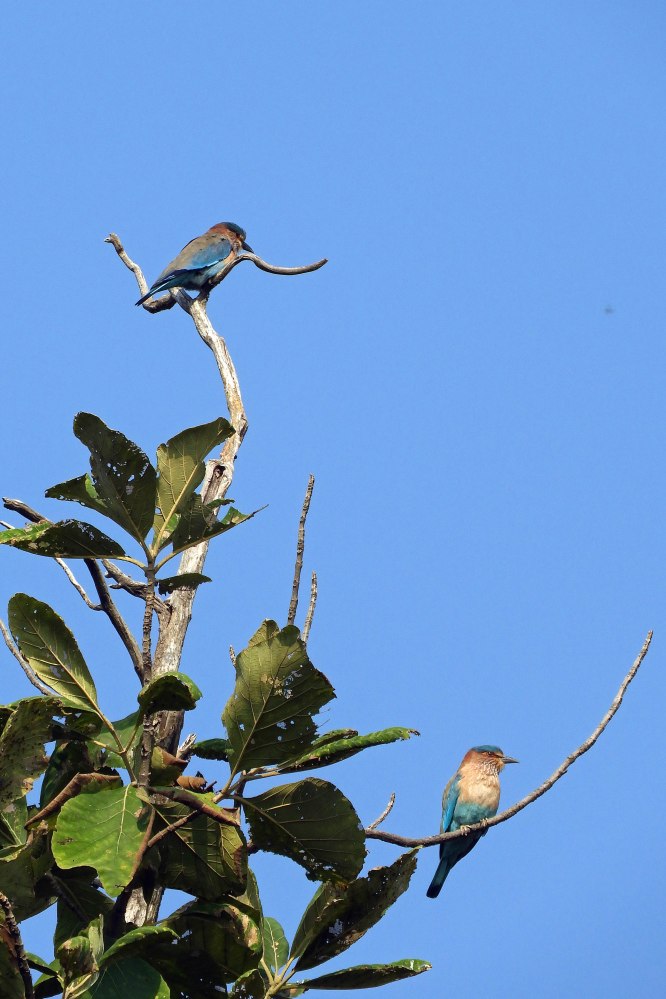
… Indian Rollers …

… and the distinctive Siberian race tristis of Common Chiffchaff which surely deserves specific status.

At Tadoba langurs had been the common monkey species, here Rhesus Macaques abounded.

Wet areas held White-breasted Waterhens …

… whilst Red-wattled Lapwings …

… and Greater Coucals (a species of cuckoo) could be found at the field edges.

In general I approve of most taxonomic splits, the insights provided by genetic and acoustic research has shown that there are more ‘good species’ than examination of museum specimens alone ever could. However there is one recent split that I feel uncomfortable with, the apparently arbitrary division of Cattle Egret into Eastern and Western. This non-breeding Eastern Cattle Egret looks the same as the Western ones we see in Europe. Colour of the plumage in breeding plumage is supposed to be the clincher but I have seen breeding Westerns in the Caribbean as orange-tinged as breeding Easterns are supposed to be. It is claimed that there is a difference in vocalisations but others have disputed this and said that the comparison has been made between non-homologous calls.

We spent the afternoon of the first day on the nearby Chambal River. A bridge is being built across the river …

… but until it is complete locals will have to depend on overcrowded ferries.

We set off in a boat like this, initially it was quite overcast but as the afternoon progressed the murk cleared. The Chambal is a tributary of the Yamuna River, which itself is a tributary of the Ganges.
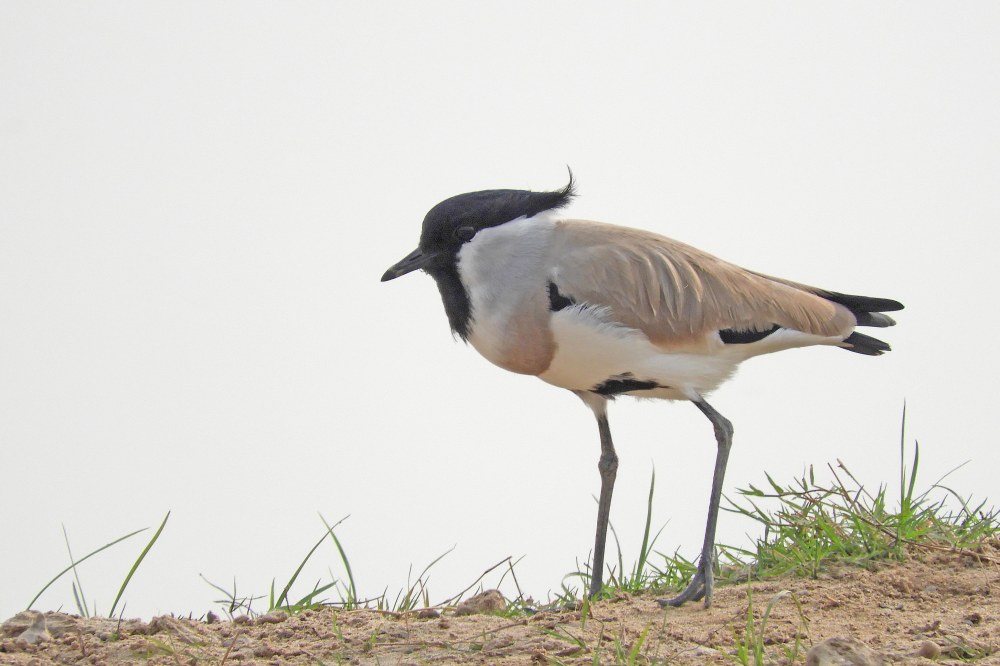
Among the many species we saw from the boat were River Lapwings …
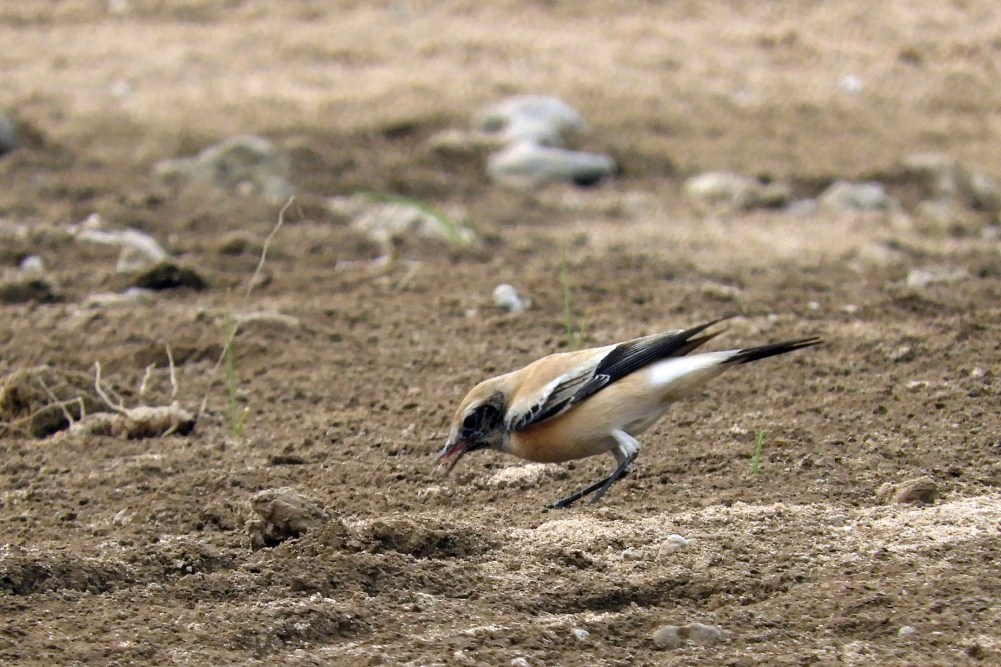
… wintering Desert Wheatear …
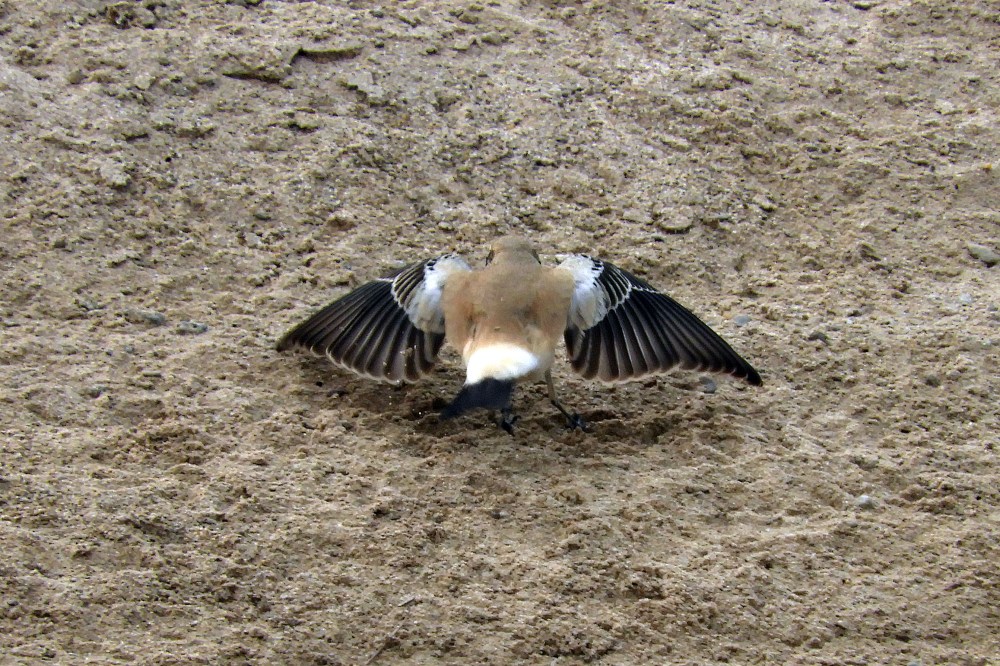
… here showing the diagnostic all black tail.

Ruddy Shelducks here for the wintering from their north Asian breeding grounds …

Joined by Mongolian/Tibetan Bar-headed Geese which fly over the high Himalayan peaks to reach their wintering grounds.
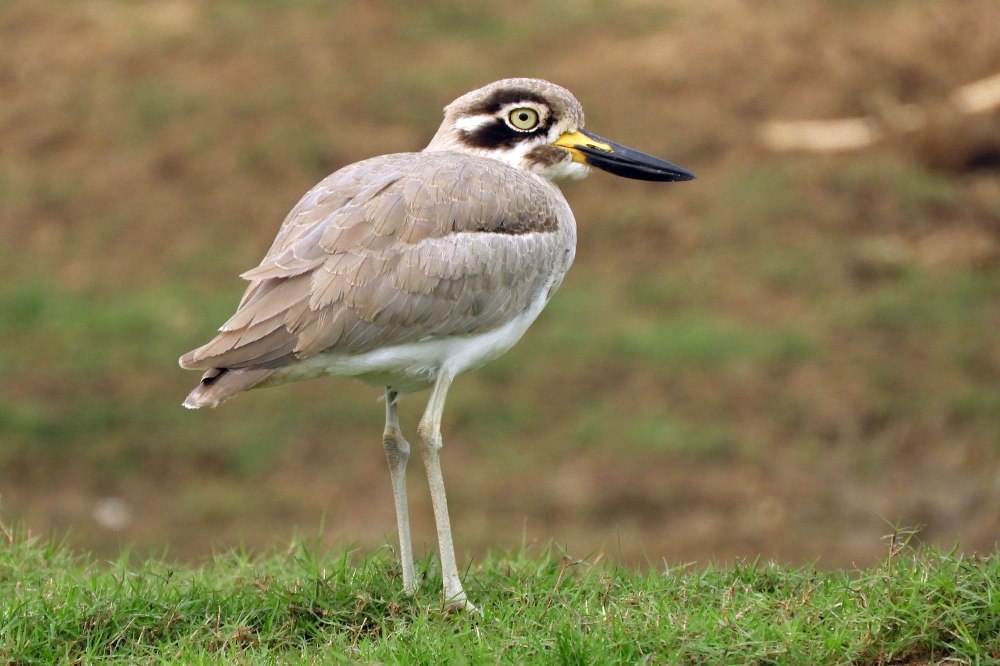
A couple of imposing Great Thick-knees, a species of stone-curlew, were seen on the bank …
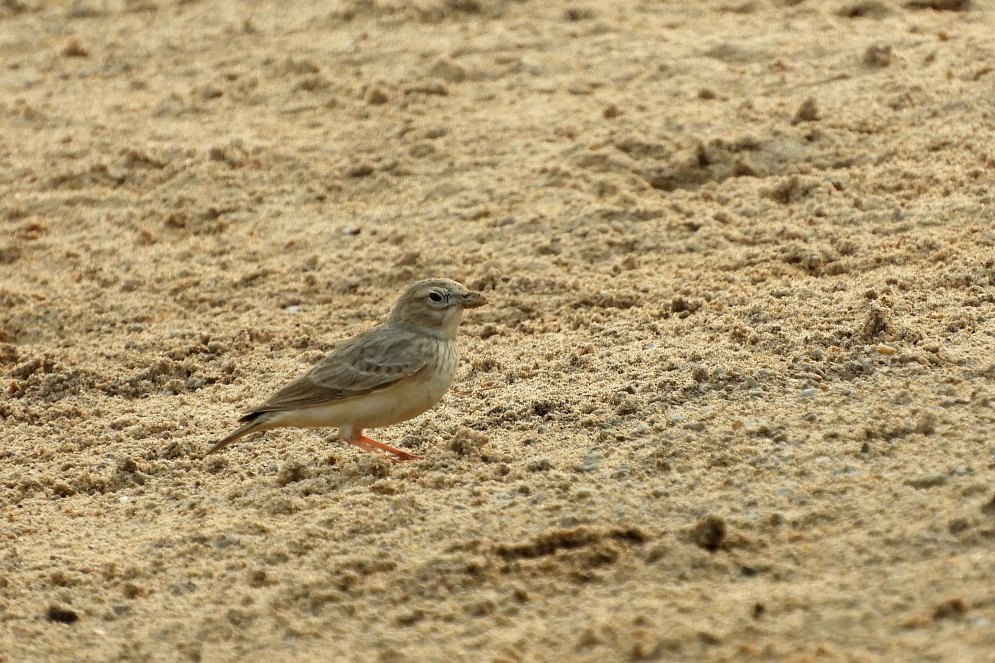
… as were Sand Lark, a species closely related to Lesser Short-toed Lark (which has recently been renamed Mediterranean ST Lark following the splitting off of Turkestan ST Lark). Note that some primary tips can be seen beyond the tertials, an important feature to distinguish members of this group from Greater ST Lark.
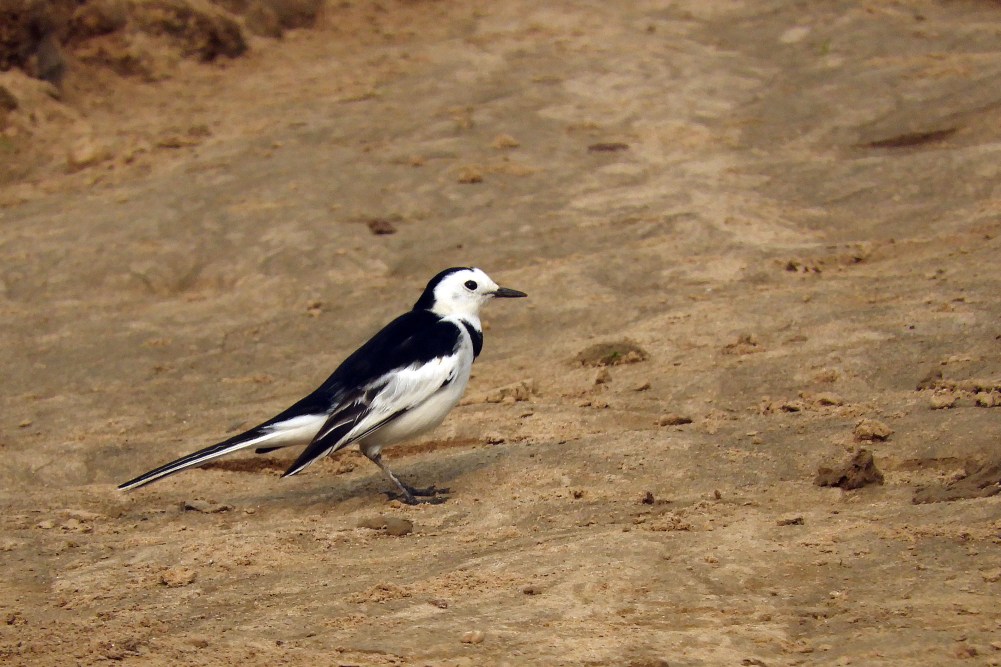
The black-and-white wagtails are a confusing group, White Wagtail, here of the race leucopsis which breeds in mainly in China, can be seen along with race personata from central Asia and possibly other Asian races as well. All these races are of the same species as our familiar yarrelli Pied Wagtails in Britain. Add to that the marked variation between 1st winters/adults and and males/females and the situation gets most complex.
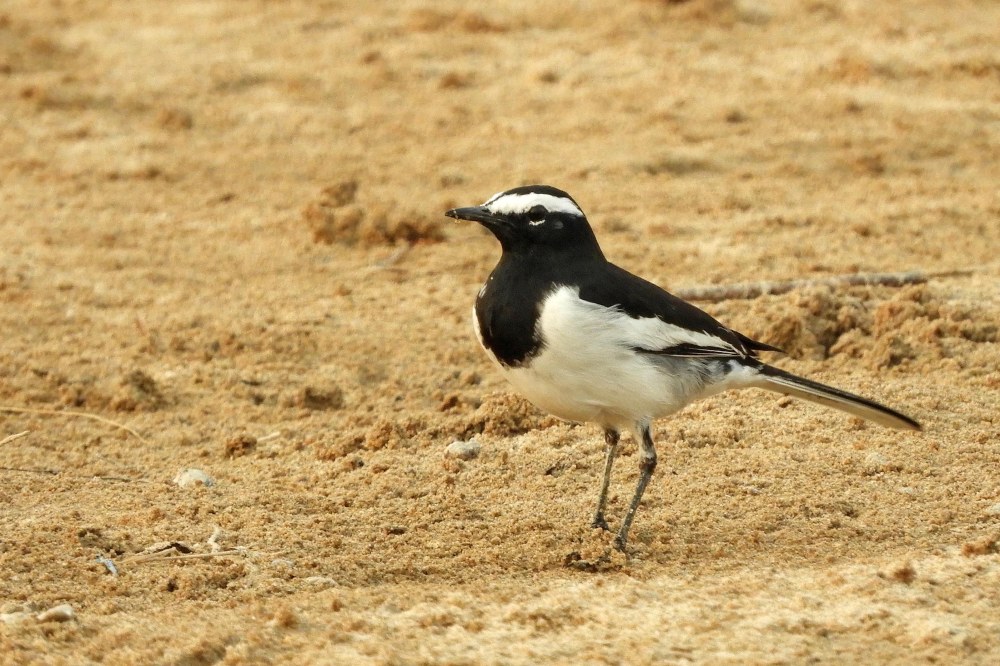
On the other hand the resident White-browed Wagtail are considered a separate species …
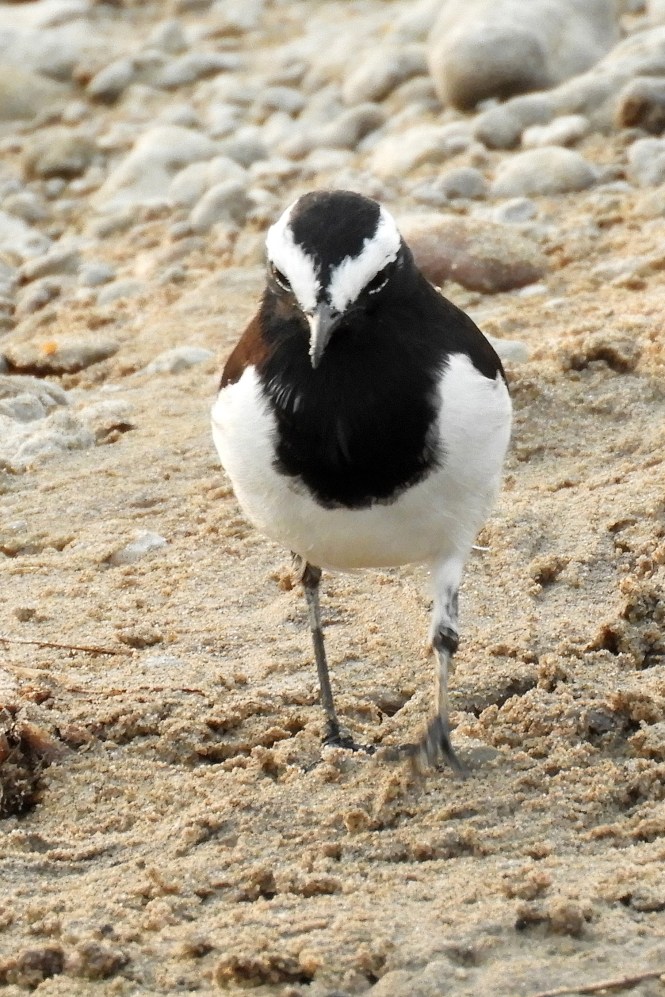
… and we had close up views of several along the river.

Non-avian highlights included this large and comparatively aggressive crocodilian – the Muggar …

… and the bizarre yet benign Gharial …
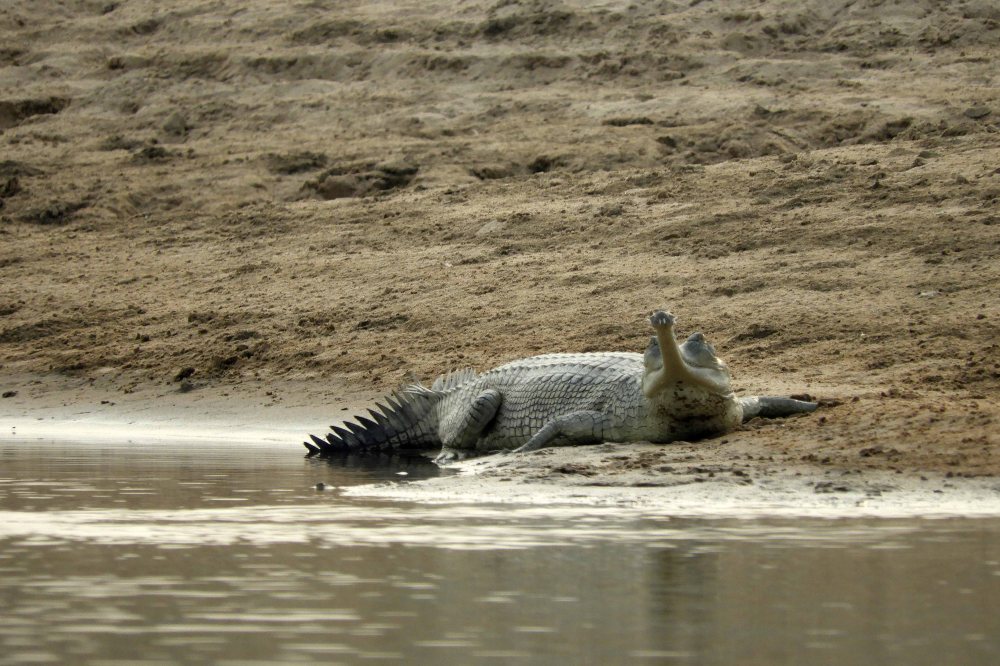
… this crocodilian is exclusively a fish eater and its long snout and 110 pairs of interlocking teeth are adaptions to enable this. Now occurring in only 2% of its historic range and is now considered critically endangered.

Another reptile we saw was the Indian Roofed Turtle.
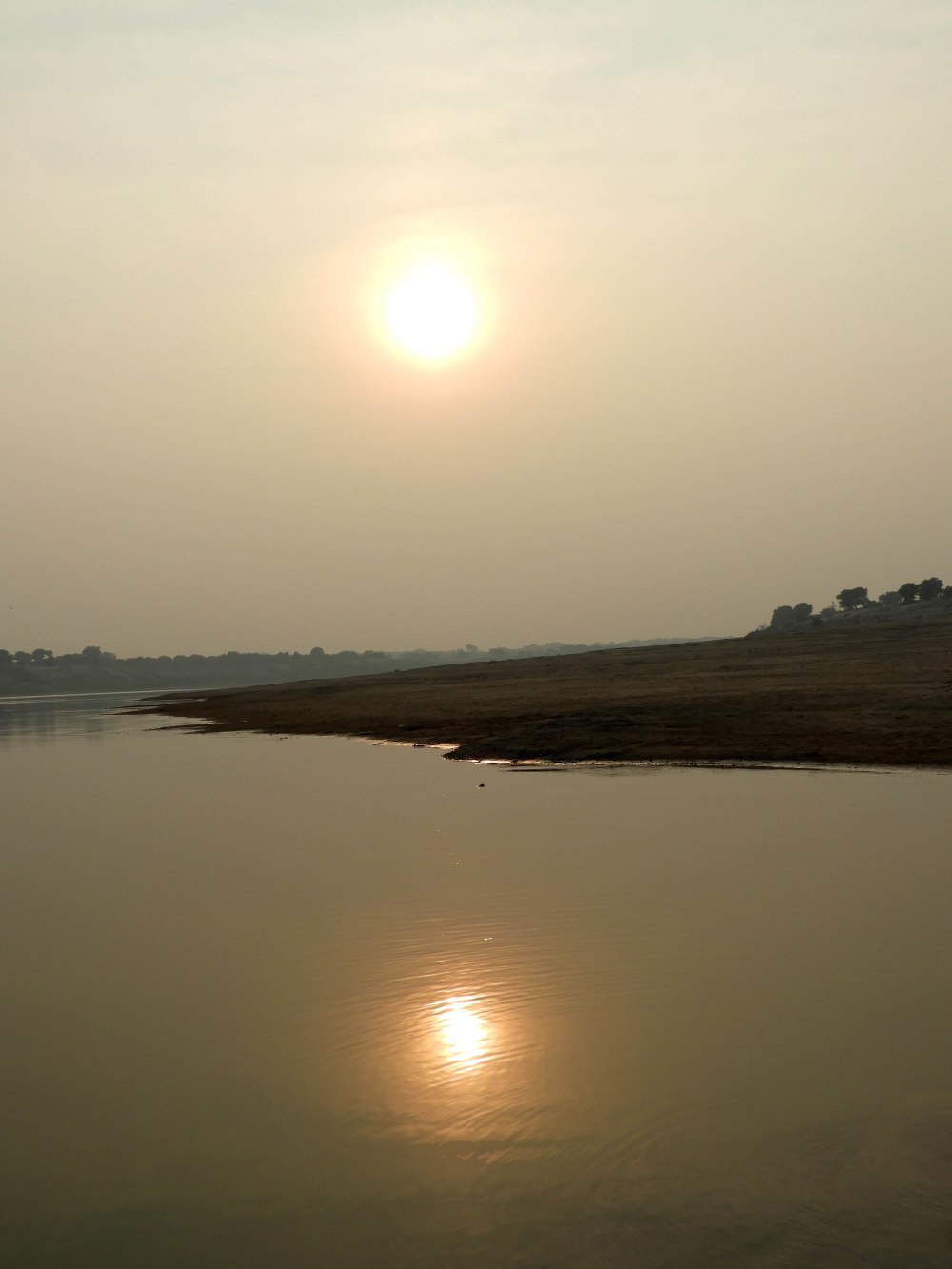
Asian ‘big river’ birds are in trouble, the enigmatic White-eyed River Martin of Thailand apparently went extinct as soon as it was discovered, Indian Skimmers and Black-bellied Terns are seldom seen and we didn’t encounter them on this trip. Pollution, mineral extraction and disturbance have taken their toll. Fortunately this section of the Chambal River is a reserve and lets hope it will protect these birds for future generations.
The next post will cover our visit to the tourist hotspots of the Taj Mahal and Fatehpur Sikri in Agra.
Although Margaret likes to travel she usually doesn’t want to join me on long and intensive birding trips where most of the time will be spent in dense forest. However we have enjoyed trips to Europe, the USA, South Africa and the Middle East where birding is mixed with sightseeing and other activities.
One area she was keen to visit was India. I have been on four dedicated birding tours of India plus have visited Bhutan and Sri Lanka so I’ve most of the birds, but there were still a few things I wanted to see. We needed some form of organised trip as I had absolutely no desire to drive myself, but both a standard tourist trip with no wildlife or a intensive birding trip with no sightseeing were out of the question. It was suggestedwe contact Jo Thomas of Wild About Travel who was able to organise an itinerary around what we wanted to see, with drivers, hotels, transfers etc all for a quite reasonable price. In particular she arranged us to visit Tadoba National Park in the state of Maharashtra which a park that I knew nothing about, yet proved to be highly successful and a beautiful place to visit.
This post is mainly about our visit to Tadoba National Park.
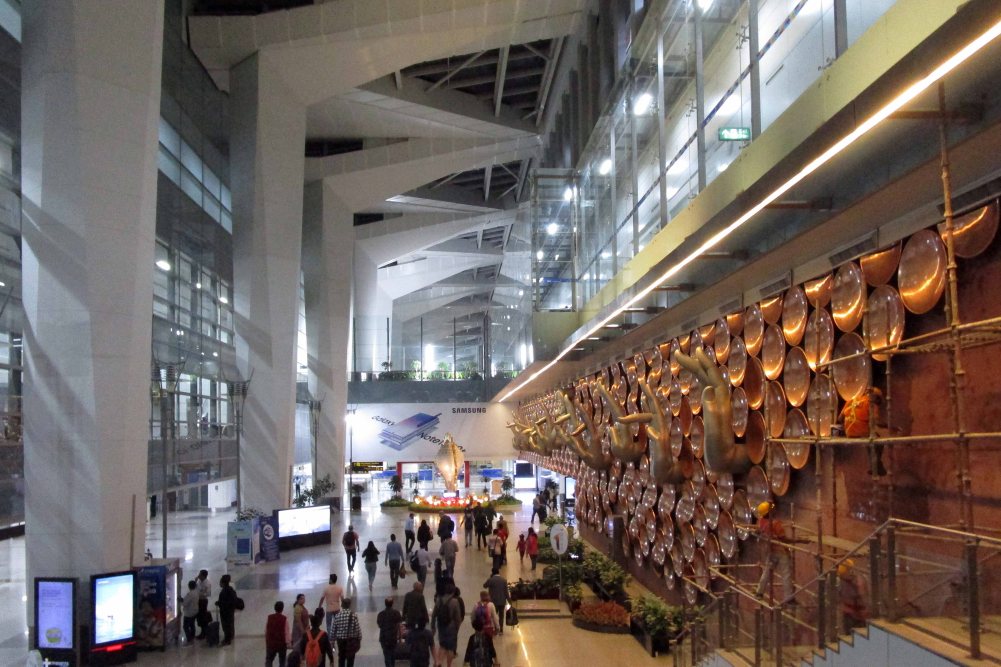
When I visited India for the first time in 1986 Delhi airport was a shabby affair, hot, crowded and inefficient – it lived up to the western stereotype of India. Now look at it, modern, air conditioned and efficient. We had decided not to burn the candles at both end on this trip so after the overnight flight we transferred to a nearby hotel where we rested for much of the day before being picked up and taken to the domestic terminal for an evening flight to Nagpur. Here we were driven to another hotel and the following morning were collected for the three-hour drive to Tadoba National Park.

Tadoba Nation park consists of 578 sq km of mainly teak forest, grassland and marshes in central Maharashtra. There are about four lodges around the periphery and we stayed at Jaharana Jungle Lodge. In the afternoon we made the first of four safaris in open backed jeeps. It was magical driving though the tall teak forest with peacocks and other birds scampering across the tracks.

Although there were plenty of birds to see in Tadoba, for safety reasons we were not allowed to leave the jeeps except at one or two designated areas. In reality mammals were the main focus here. The first mammal species to be seen was this Grey Mongoose.

Tadoba has recently acquired a large buffer zone around the park, significantly increasing its area. This consists of mainly open grassland and was very good for seeing ungulates, in particular the impressive Gaur.
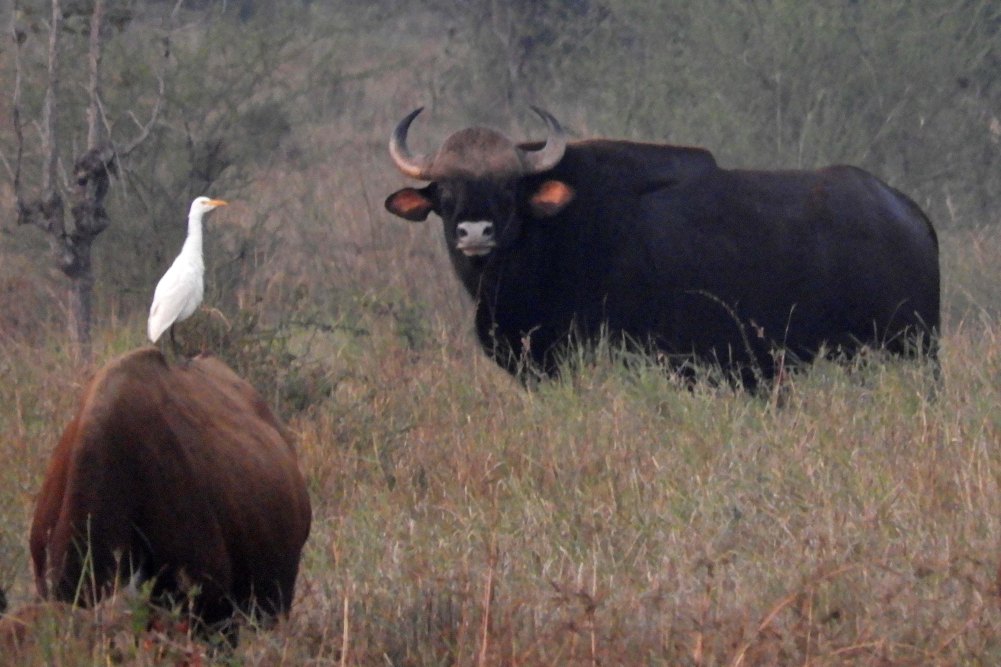
Zooming in you can see just how large and imposing a bull Gaur is, the head and body (excluding tail) measure around 3m and it can be over 2m tall at the shoulders. It is the largest wild bovid extant today. I have longed to see this species since childhood and in 2018 I finally succeeded. After quite some effort we saw a few cows and calves in dense forest in southern India. I was amazed how common and easy they were to see in Tadoba and how conspicuous the bulls were.

Another common inhabitant of the more open areas were Nilgai, mainly herds of hinds and calves.

Indeed some would run down the track ahead of the jeep before heading of into cover.
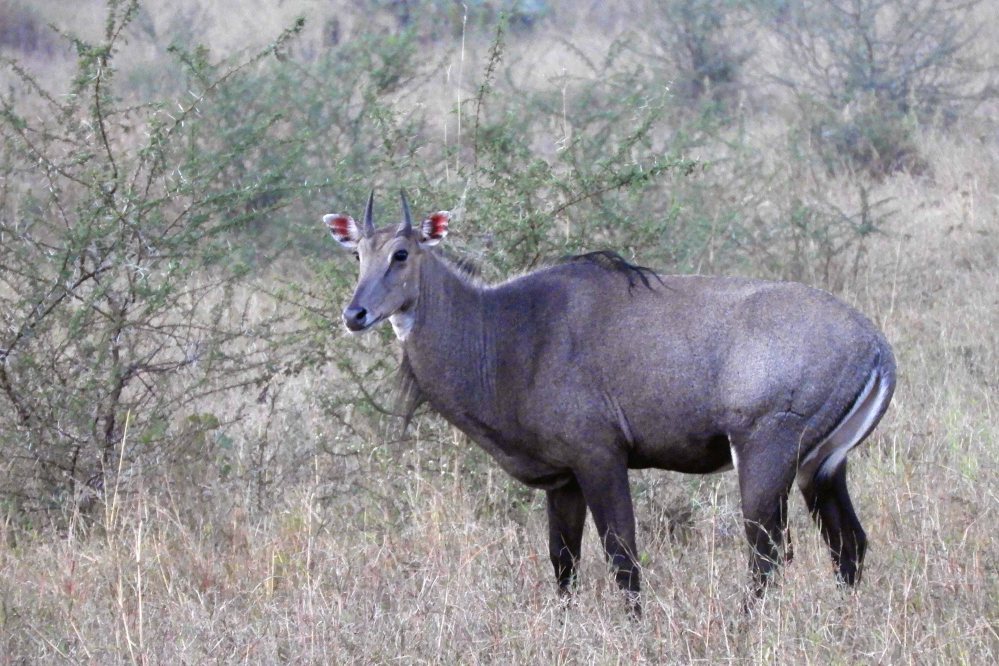
The male Nilgai is often known as the ‘Blue Bull’ but of course its an antelope not a bovid. After the two species of Eland in Africa its probably the largest of the antelopes.

Sambar were commoner in the wooded areas and hinds were regularly seen from the tracks, this species is similar in size or a bit larger than a Red Deer.
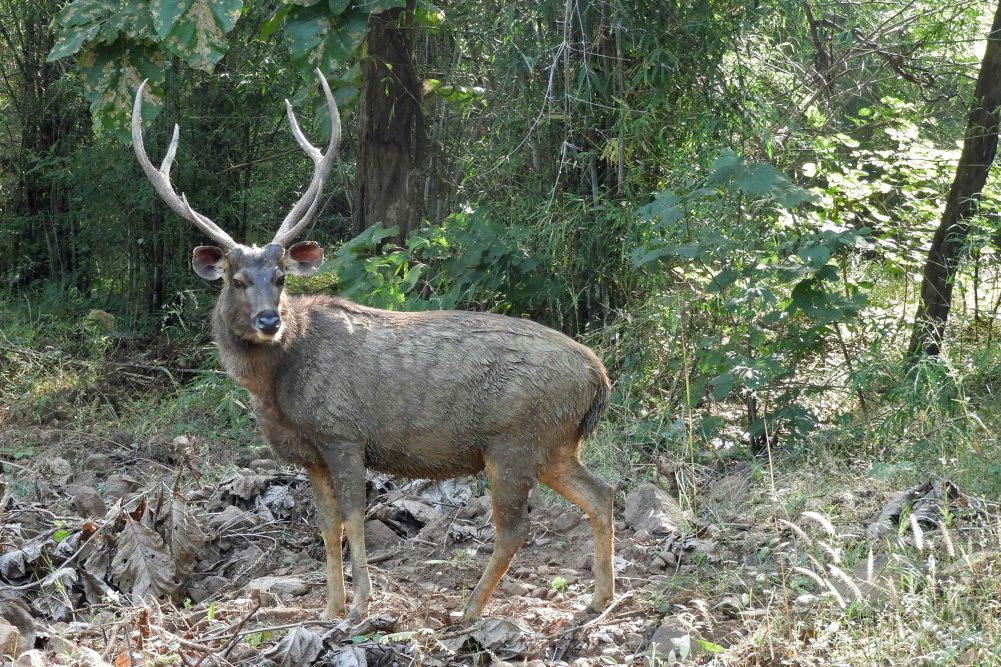
This impressive stag has just enjoyed a wallow in the mud.
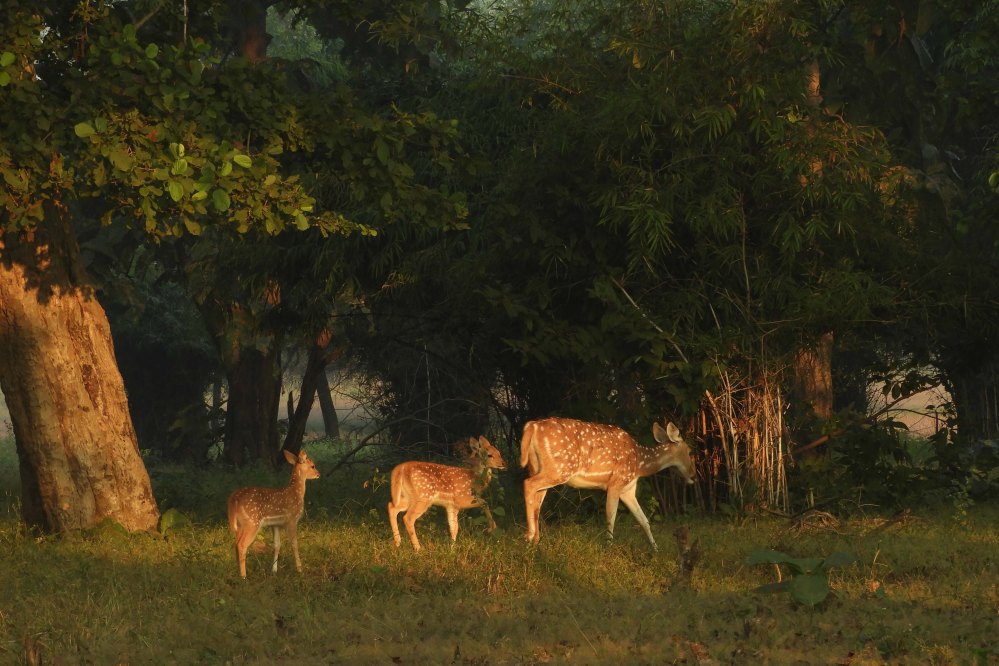
Chital, sometimes called Spotted Deer, were common in shaded glades where the forest met open areas of pasture. I suppose their spots camouflage them well in this sort of habitat.

It was lovely to see this Chital fawn suckling but it would have been a better photo if mum had turned her head towards us!
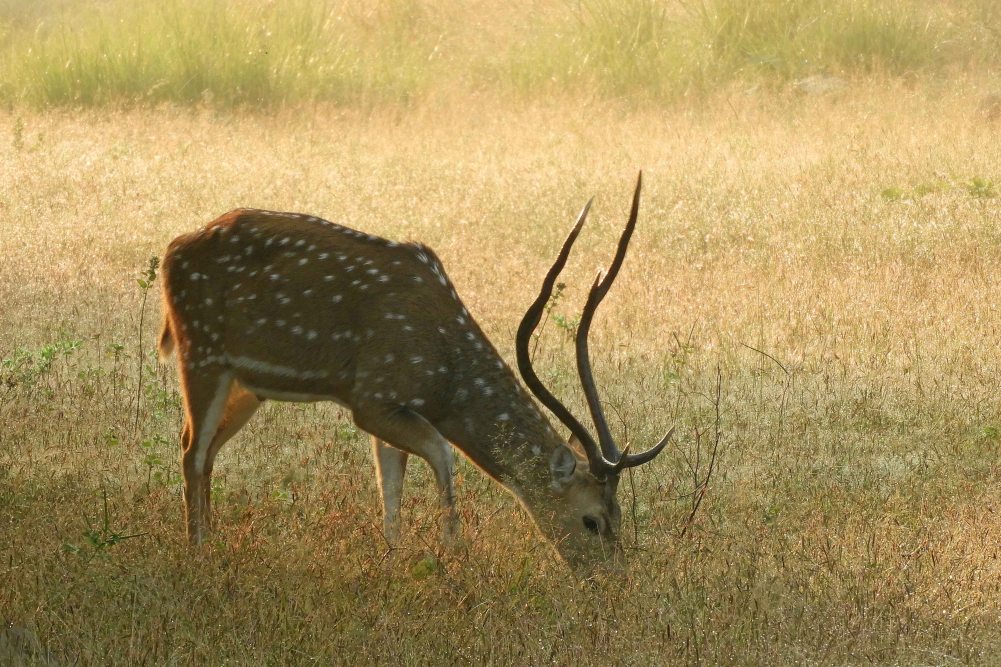
Unlike our similarly spotted Fallow Deer, Chital don’t have palmate antlers.

Langur Monkeys (more precisely Northern Plains Grey Langurs) were common.
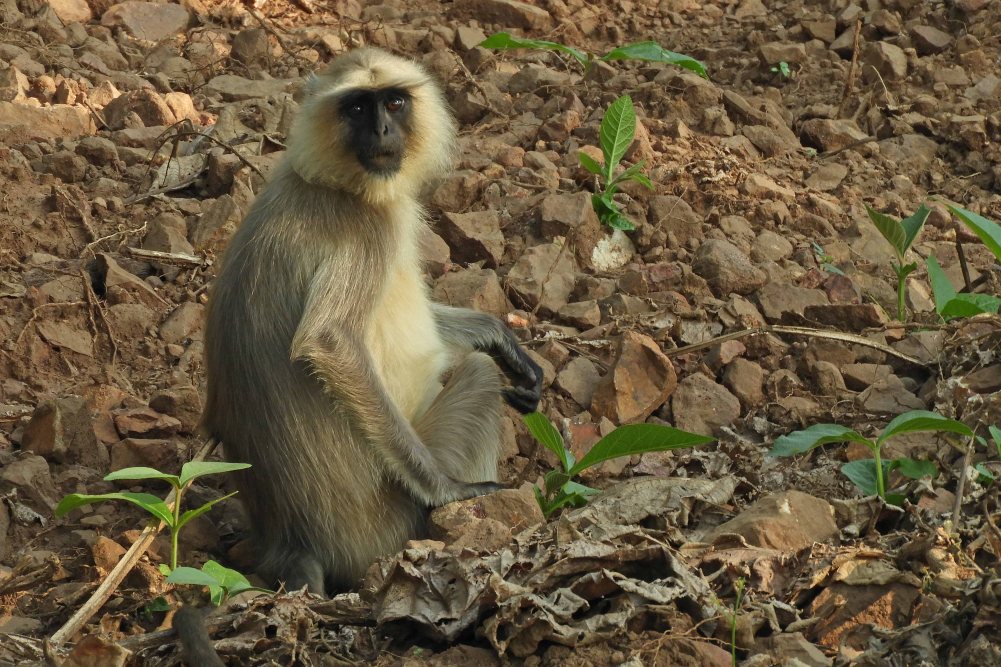
They seem to have a feeding association with the Chital (although there is another explanation for their co-habitation) which I will explain later.

As evening fell we made our way back and came across this huge bull Gaur by the road. Bear in mind I’m standing up on the back of the jeep. If I was at ground level it would be towering over me!
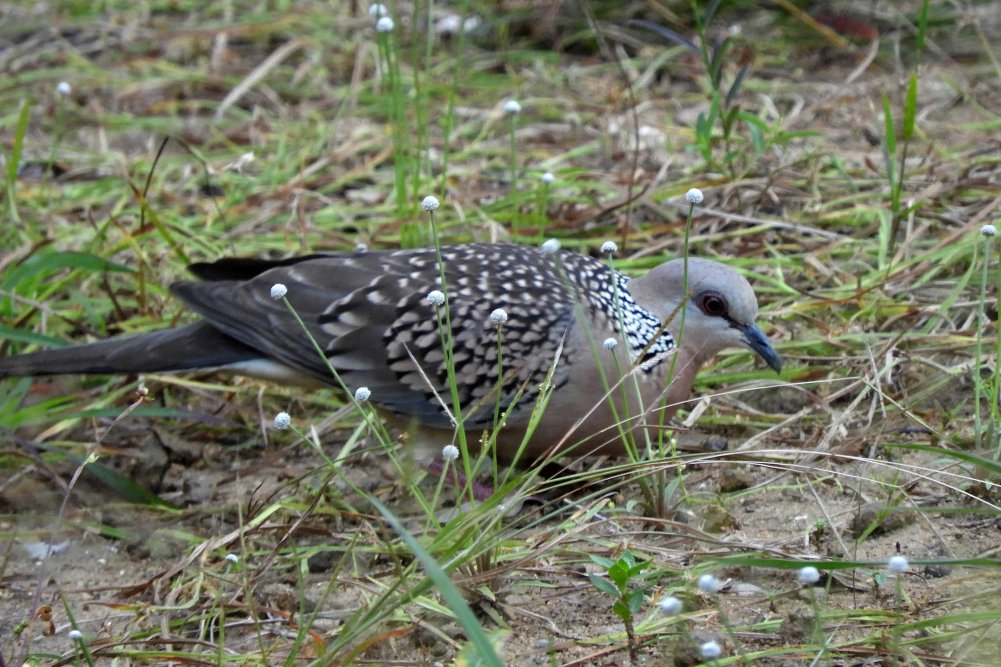
There were plenty of birds to see both around the lodge and on the game drives. Here is the ubiquitous Spotted Dove.

Peacocks are thought of as ornamental birds, commensal with mankind but in the forests of India they are truly wild. The mating season was over though and the males had dropped their spectacular tail feathers.

Red-wattled Lapwings were common throughout the trip.
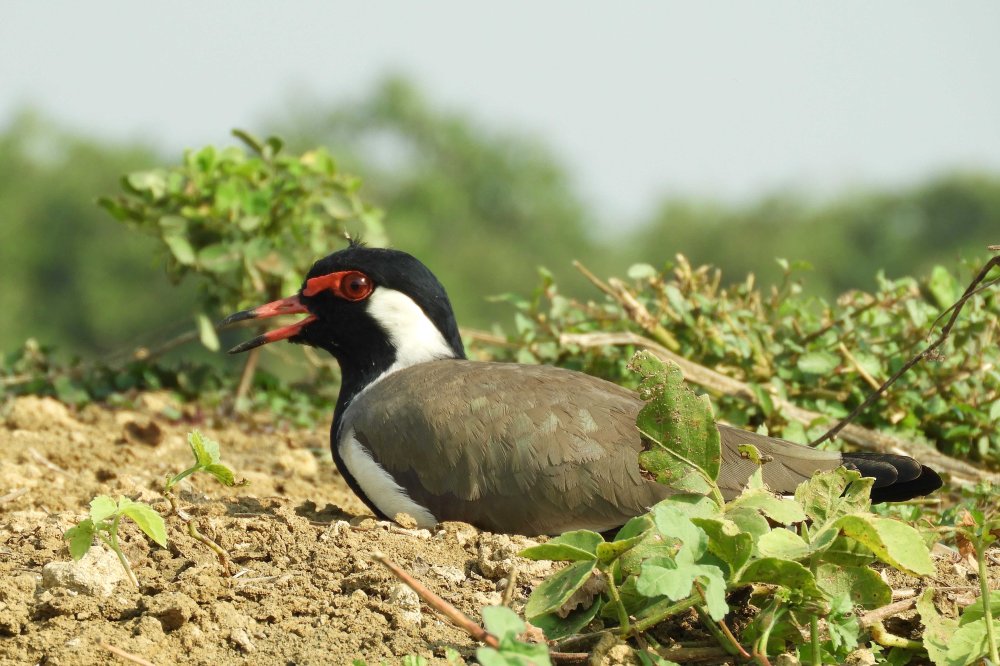
This one was nesting on a raised embankment so when we stopped briefly for a photo it was at eye level.

India , like much of the Oriental region, has some great woodpeckers including this Black-rumped Flameback.

There were a number of wintering pipits but this one seems to be the resident Paddyfield Pipit, rather than its slightly larger and migratory cousin Richard’s Pipit.

The area was also home to a male Pied Stonechat …

… and the eponymous White-eyed Buzzard.
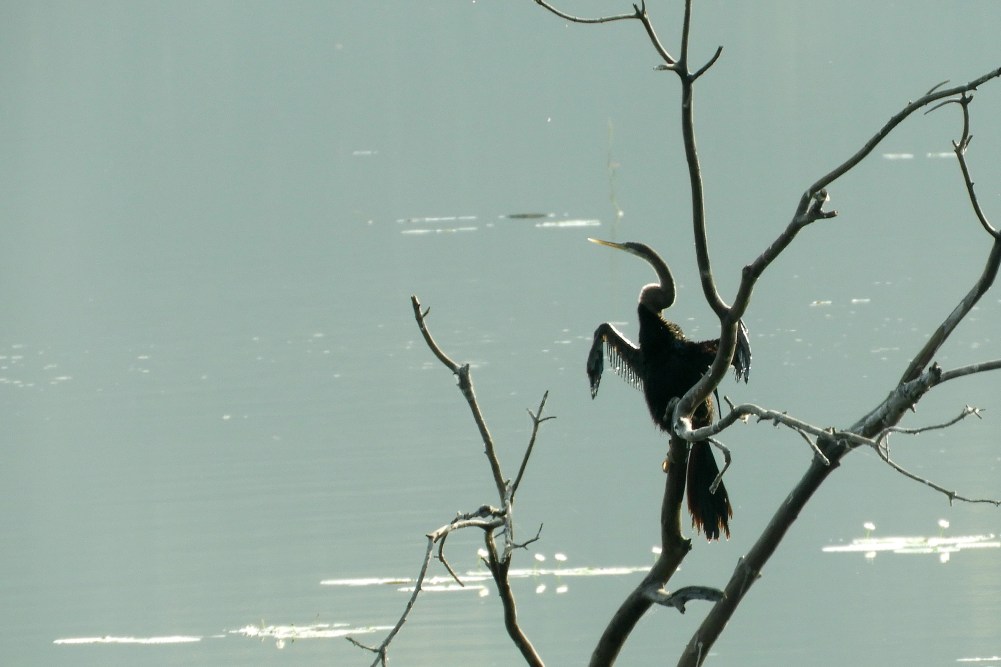
There were a few wetland areas but getting close enough for decent photos wasn’t easy as we were confined to the jeep but I quite like this shot of an Oriental Darter drying its wings. Darters and their cousins the cormorants don’t produce oil from their preen gland to waterproof their feathers. This means they lack buoyancy underwater and so can swim faster, deeper and for longer when hunting fish but the downside is that they must hang their wings out to dry when they surface.

Another bird that showed well along the same lake was Red-naped Ibis, a bird that I missed on visits to India up until 2018 when I finally caught up with them in Rajasthan.

Not such a great photo, as it was hiding in thick vegetation, but this was the only Lesser Adjutant (stork) of the trip.

Green Bee-eaters, here of the race orientalis, which is rightly given specific race by some authorities, was common in the park with hundreds seen.

Of course the animal most tourists want to see is the Tiger. The establishing of Tiger reserves all over India has probably saved the species from extinction, but it is still heavily targeted by poachers for the Oriental traditional medicine trade. Almost all tourists head off in the early morning, there are lovely views like this as the sun filters through the dust stirred up by the jeeps. Communication between vehicle by phone or radio is banned, presumably to avoid every one racing around after Tiger sightings, but these still happen. After a number of false alarms our lucky break came (twice) on the second afternoon.

The presence of a Tiger is often revealed by the bark of a Chital …
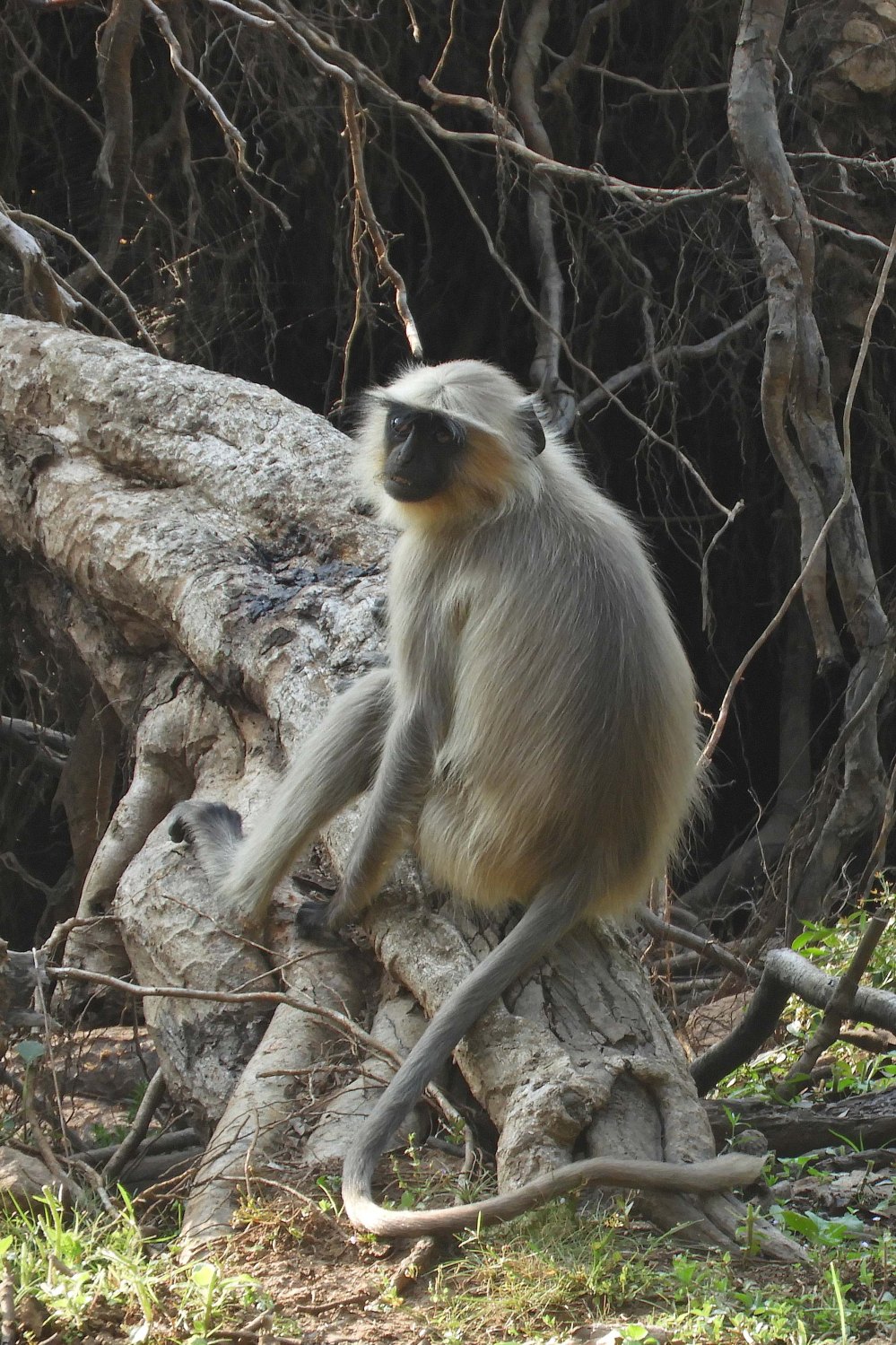
… or the chatter of Langurs, some of which which remain alert in the trees and so can see danger coming. The Chital, on the other hand, probably have a better sense of smell, this symbiosis seems to benefit all but the Tiger!

We had two sightings of Tiger that afternoon, this was the second and probably least successful of the two, hence the decision to keep the best for last. It was a well known male; magnificent, but for most of the time it was hidden deep in cover.
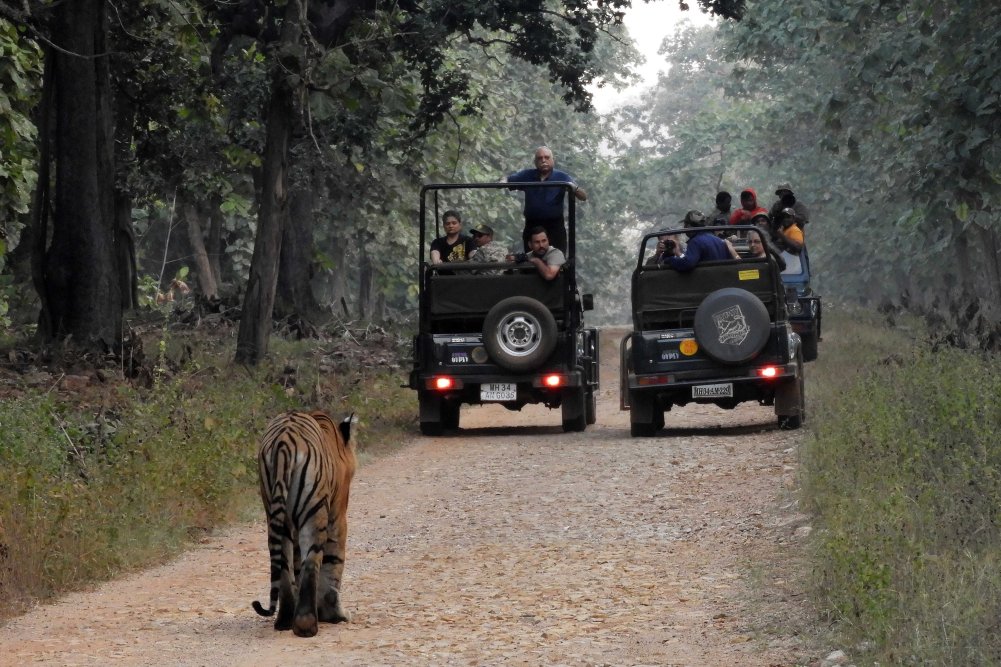
There were two other jeeps ahead of us and they reversed to give the Tiger some space when it decided to wander down the road. The light was already going and this wasn’t such a good encounter as the earlier one.

Earlier that afternoon we had taken a one-way side road that led up to a viewpoint over a lake when another jeep passed and said there was a Tiger not too far away. To my surprise the driver didn’t either continue and go the long way round or ignore the one-way regulation and turn about, instead he reversed for over a mile as fast as he could. By the time we reached the main road there were about four jeeps all in a convoy and all going backwards! We joined an assemblage of at least six other jeeps and stared into the dense roadside vegetation.

Although initially hidden it wasn’t long until this female walked out right into the open …

… ignoring the admiring hoards she sauntered past the jeeps a matter of feet away.

It goes without saying that if she had wanted to she could have leaped into any of the jeeps in one bound and attacked anyone of us. Given the fact that a birder I once knew was killed by a Tiger back in the 80s, this was not something to be dismissed lightly.
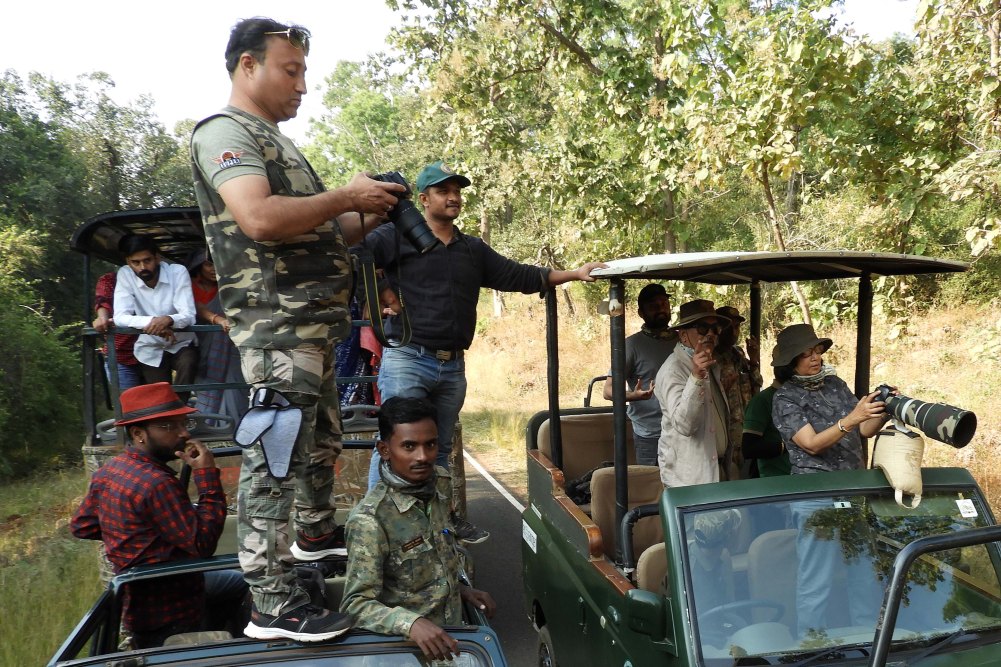
I don’t mean this to sound patronising so don’t take it that way, but in National Parks in Africa almost all the visitors are western tourists. You hardly ever see a local unless they are employed there. So I was delighted to see that out of the 40 or so tourists (in 15 vehicles by the time we left!) who were watching the Tiger we were the only Europeans. Only when people value the wildlife in their own country will true progress be made in conservation.

I think this lad had the wrong hat on!
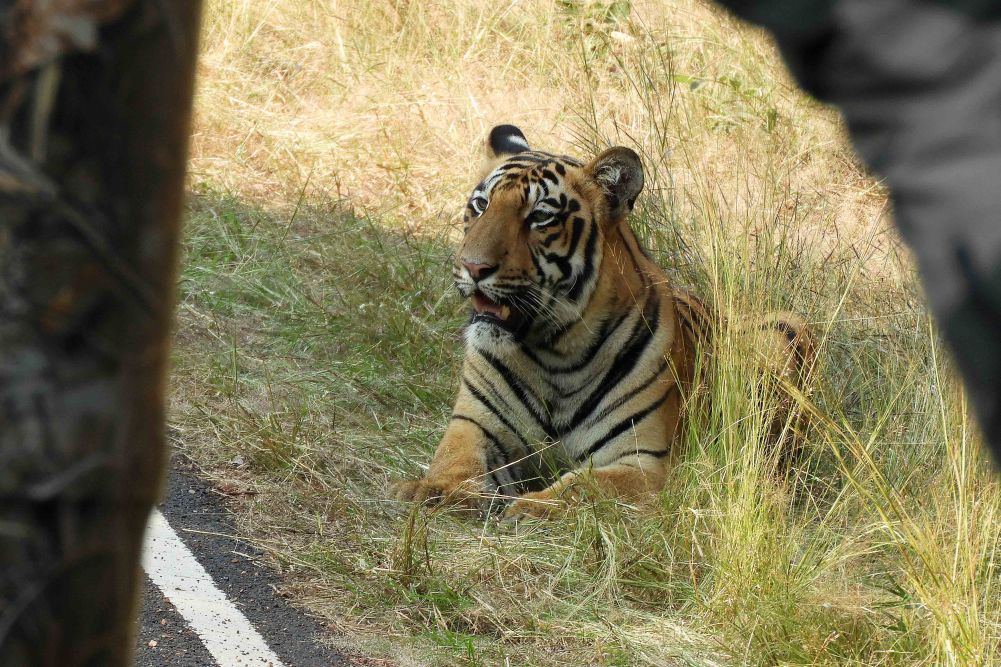
The Tiger (or should I say Tigress) sat down just feet from the jeeps. One guy decided to straddle two vehicles and I ended up trying photograph her through his legs.
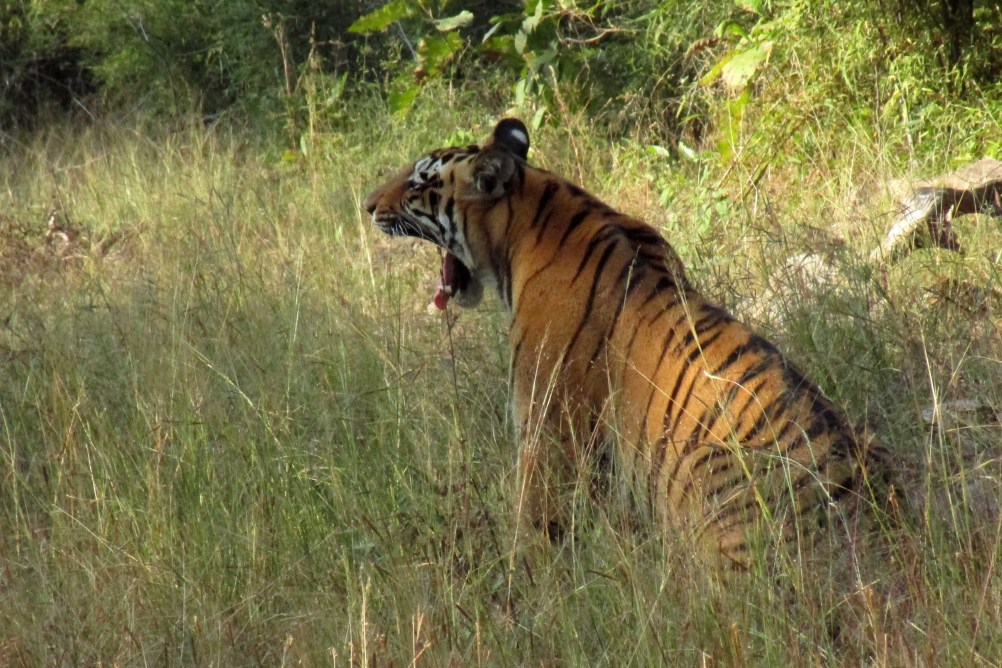
I make no apology for posting so may photos of the same animal. I had a poor view of a Tiger from our bus in Corbett NP in 1986 and one quickly crossed the road just in front of our Jeep in Kaziranga in Assam in 2001 but both were brief encounters. This Tiger just hung around giving fantastic views, one of my best wildlife encounters ever.

In due course she crossed the road behind us and lay down on this rock and was still there when we eventually left. As I said and illustrated earlier in this post, a couple of hours later that afternoon we had another encounter – this time with a male.

So with two Tigers under the belt we drove back to the lodge at dusk. But the day still had a surprise in store. A Sloth Bear walked out onto the track in front of us!

… and moments later was joined by a second. I had seen Tiger before but this species was new to me. ten years previously I hadn’t seen a single species of bear in the wild, then I saw Polar Bear in Spitsbergen in 2011, Black Bear in USA in 2014, Brown Bear in Kamchatka in 2016. Just three more to go! The only trouble was it was getting very late for photos and these were taken at quite low shutter speeds.

Back at the lodge we were intercepted on our way from the chalet to the dining room and directed towards the swimming pool. We were treated to a poolside dinner. Romantic, but when the waiter stood in front of the bright light you couldn’t see what you were eating.
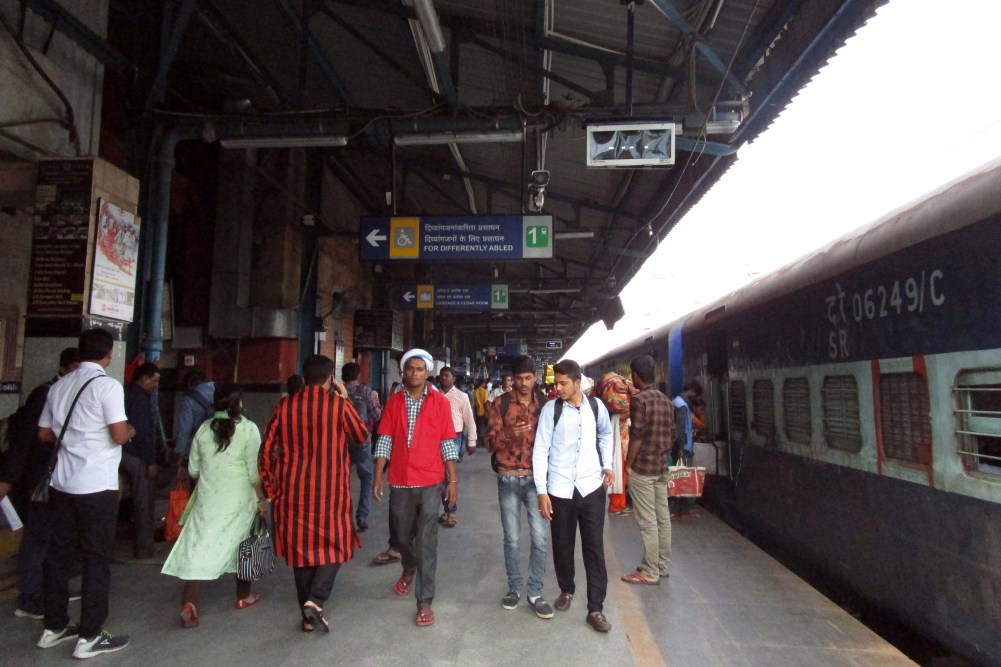
Our final morning at Tadoba brought us some new birds but no new mammals. Having said that I’ve now seen most of the ‘good’ mammals in lowland India. All those marvels that I read about in Rudyard Kipling’s Jungle Book as a child and have yearned to see ever since have been put to bed. We were picked up late morning and driven back to Nagpur, this time to the railway station. We got there quite early and had to hang around for a couple of hours, but we did add one more species to the mammal list whilst waiting – Brown Rat!
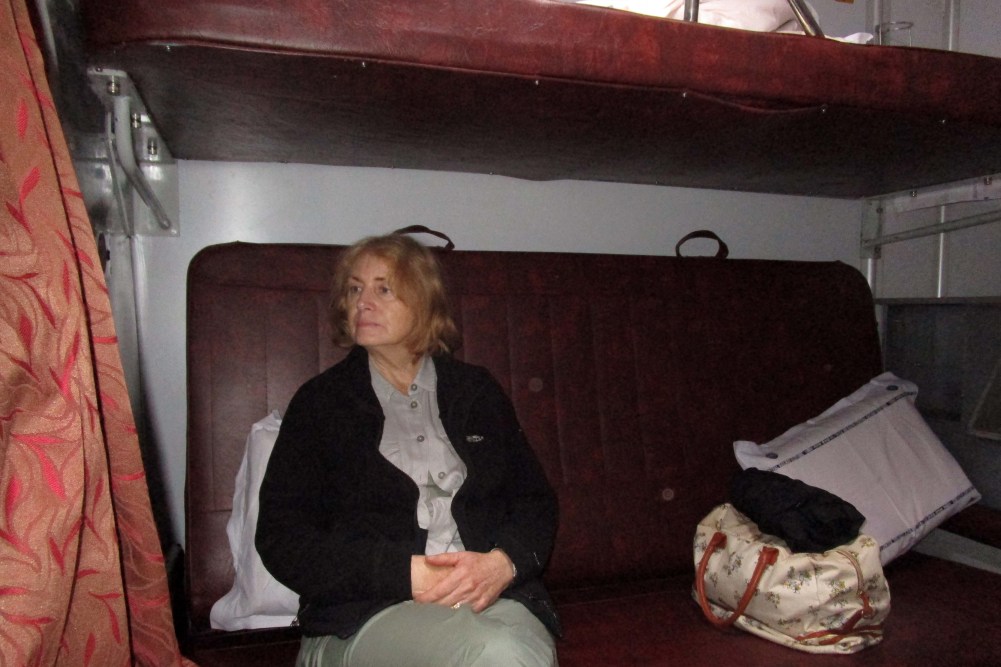
It had been arranged for us to take the overnight train to Agra, we shared a first class compartment with two locals. It was quite comfy but the movement of the train as it went over points and juddered to a stop at stations throughout the night meant we got little sleep. We were on the train for about 12 hours and arrived at Agra around 0500 where we were met by by our driver for the next section of the trip.
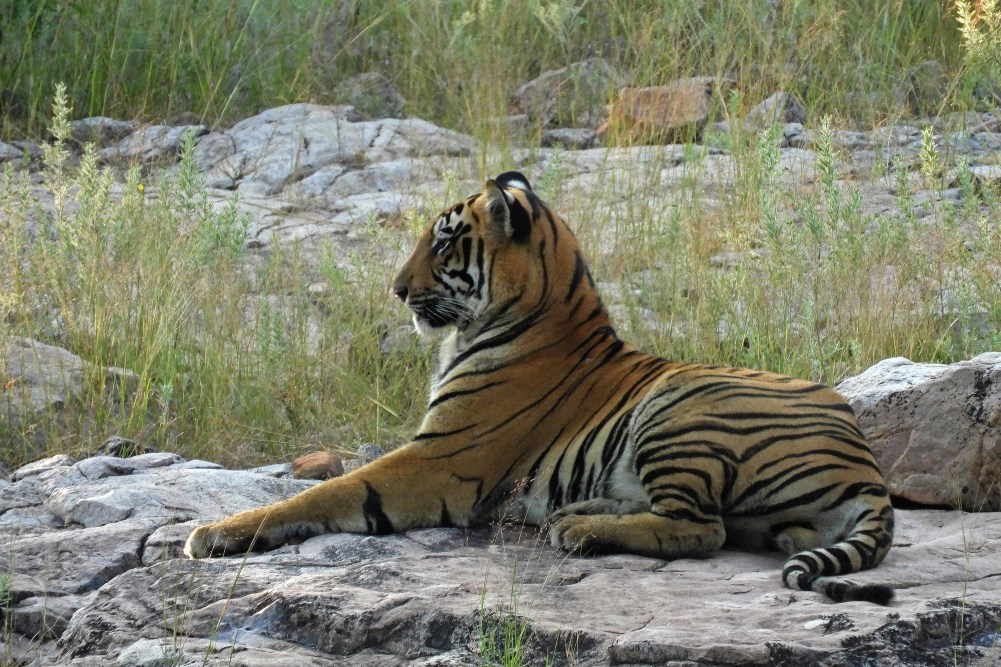
I don’t want to end this blog post with a photo of a railway compartment so here’s the star of the show (yet) again.
The next post will illustrate our time on the Chambal River and a visit to one of the most famous buildings in the world, the incomparable Taj Mahal.
This is the second post covering my trip to the South Moluccan islands of eastern Indonesia.
In the first post I explained that the Moluccas weren’t connected to mainland Asia in the Ice Ages whilst the Greater Sunda islands of Borneo, Sumatra, Java and Bali were, nor were they connected to Australia like New Guinea and the Aru Islands were. As a result there has been limited mixing of Asia and Australian birds and what mixing there has been was within the area known as Wallacea, shown within the dotted line below. For a map of Indonesia’s coast line during the height of the Ice Age see part one of my account of the trip to the South Moluccas.

As I outlined in the previous post, the group of Indonesian islands that were not connected to either Asia or Australasia during the Ice Ages are known as Wallacea in honour of Alfred Russell Wallace, the co-discovered (with Charles Darwin) of evolution via natural selection, who was the first to speculate on the unusual mix of Australasian and Asia species in this region.

In the first post I described my travels around Ambon, Buru and Yamdena in the Tanimbar Islands. In this post I cover our time on Kai, Haruku, Seram and Boano. Note this is a map of the political jurisdictions of Maluku Utara and Maluka and so includes the Aru Islands which do not form part of the biogeographical area of Wallacea and the deep blue background represents a political area and not the depth of the ocean..

The conclusion of the last post saw the group flying back from the Tanimbar islands to the regional hub of Ambon, before flying on to Kai Kecil in the Kai island group, something I described as being like flying from London to Exeter via Aberdeen. On arrival we commenced birding along the road from the airport which bordered a variety of woodland habitats.
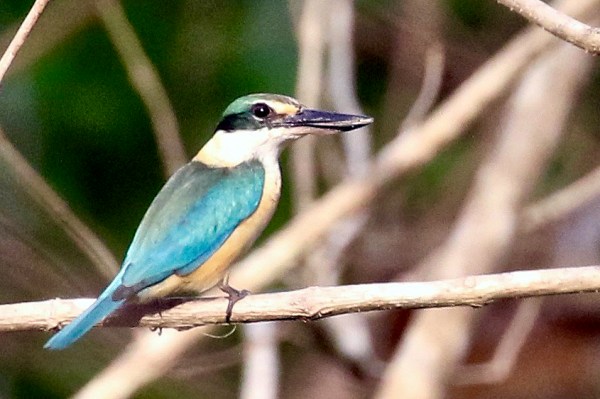
Birds seen varied from the widespread Sacred Kingfisher … (photo © Craig Robson/Birdquest).
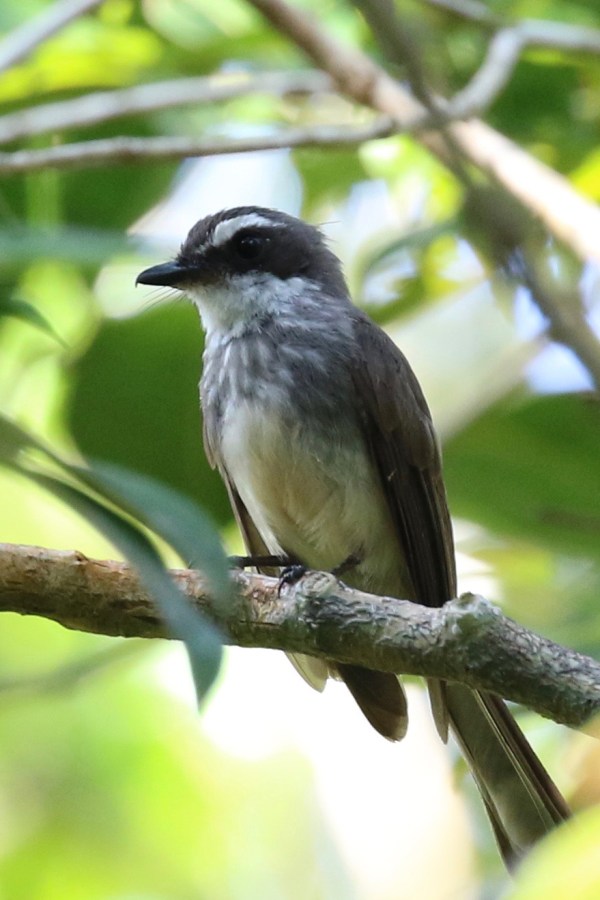
… to the island endemic ‘Kai Fantail’, currently considered a race of the widespread Northern Fantail but treated as a full species by Eaton et al in the Indonesian Field Guide. (photo © Craig Robson/Birdquest).

The Golden-bellied or Kai Kecil White-eye is endemic to this single island … (photo © Craig Robson/Birdquest).
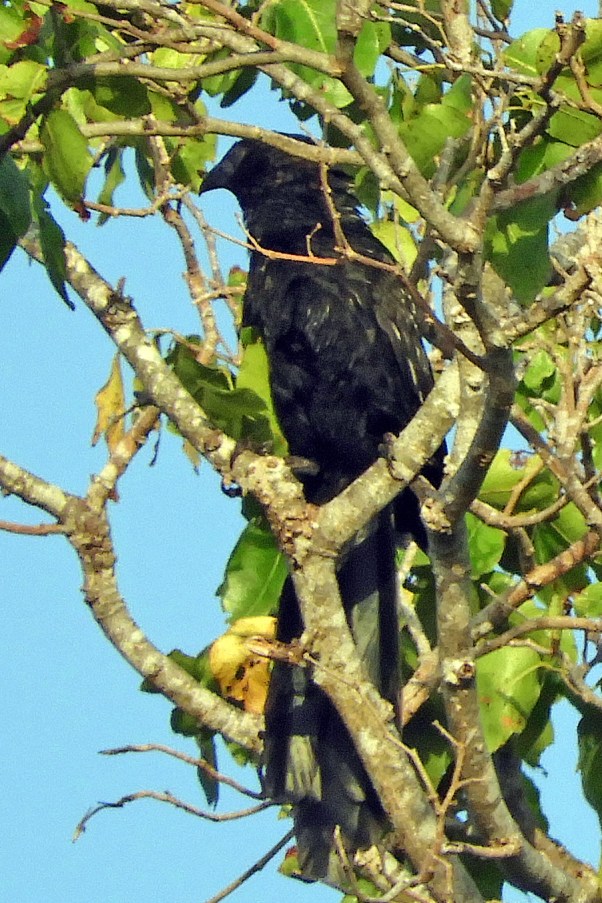
… to the Kai Coucal, a cuckoo once considered a dark form of the Australasian Pheasant Coucal but now considered a full species endemic to the Kai island group.

Perhaps the best bird on Kai Kecil was the beautiful endemic White-tailed Monarch (photo © Craig Robson/Birdquest).

Although Kai Kecil is the ‘capital’ of the Kai islands, neighbouring Kai Besar is larger although much less populated. On earlier trips groups had visited Kai Besar by small boat charter but due to the persistent strong winds we had to go by ferry instead.

The interior of the ferry was quite well appointed yet empty …

… but that was because the locals had all squeezed together on deck. The guy on the right is Caesar, our local agent and ‘Mr Fixit’, who ensured that this logistically complex trip ran smoothly.
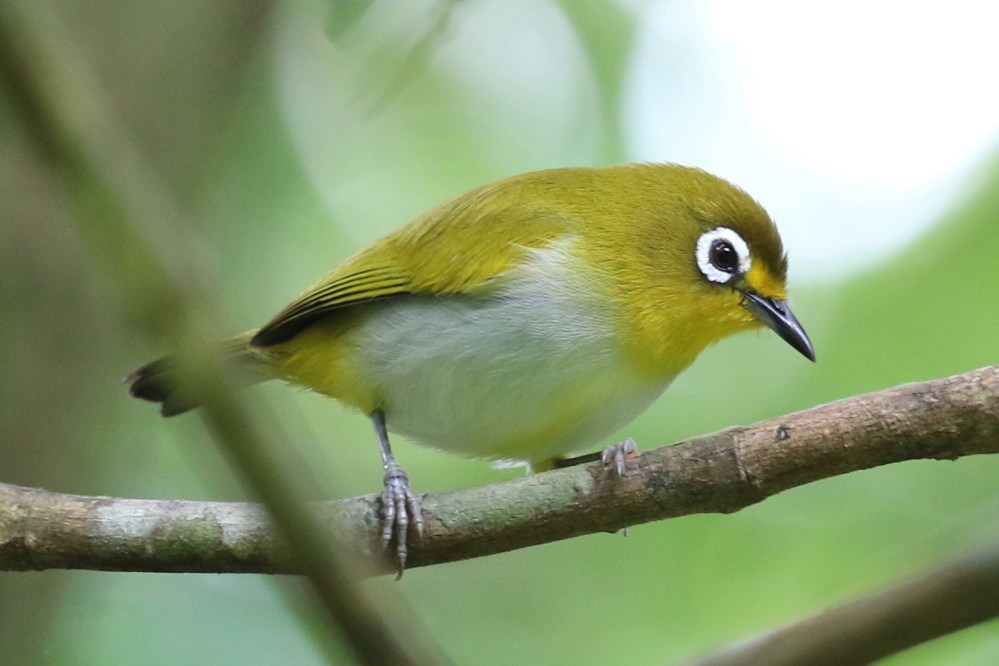
Our visit to Kai Besar was to see the single island endemic Pearl-bellied White-eye which we saw without difficulty … (photo © Craig Robson/Birdquest).

… however the James Eaton’s book ‘Birds of the Indonesian Archipelago’ treats the Kai Besar form of Island Leaf Warbler as a separate species so it made sense to try and see it if only for ‘insurance’. However it only occurs above 350m asl and as we only had a short amount of time before the return ferry, a tiring and rapid ascent up a narrow track was required.
Once there it was easily seen (photo © Craig Robson/Birdquest). As the Aru Islands are part of the Papuan/Australasia region then Kai Besar is the easternmost island of Wallacea. If Wallacea is treated as part of the Oriental faunal region (which it usually is) then this island is it’s easternmost point at 133 degrees east. However its not the easternmost point of Asia as the easternmost tip of Russia, Big Diomede Island in the Bering Straits is 169 degrees west nearly 60 degrees further east.
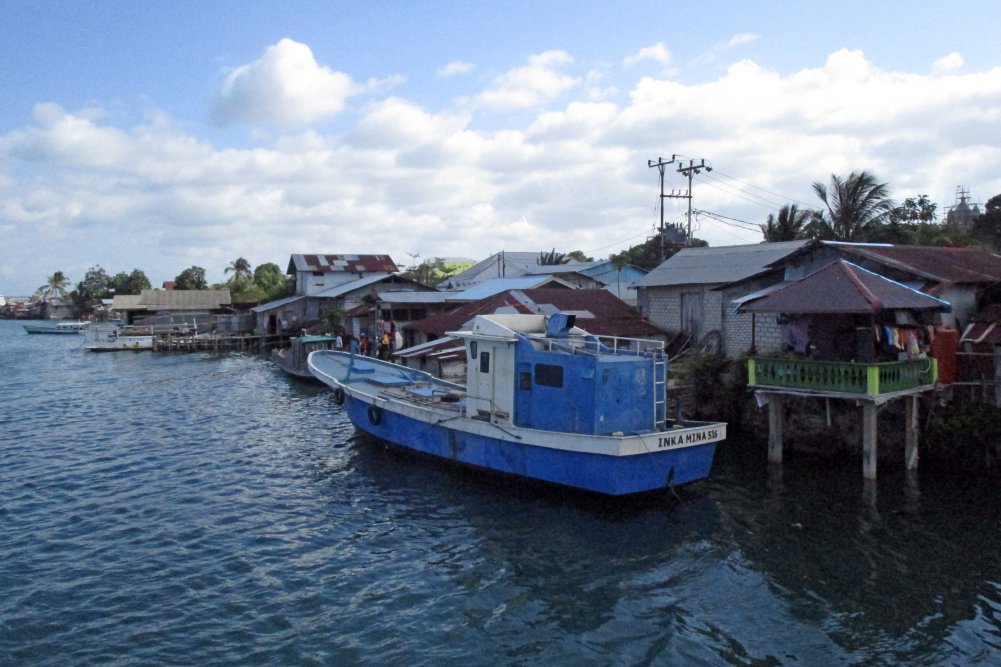
We got back in good time for the ferry trip back to Kai Kecil (this is taken from the ferry near the dock at Kai Kecil, this is not the ferry itself!)

The next day it was a return flight to Ambon. Apart from the journey home this was out last island hopping flight, the remaining islands were visited by boat.
Once on Ambon we didn’t drive straight to the hotel, instead we crossed the big bridge across the estuary and headed to the north side of the island …

… and continued on to a small village on the north-east coast.

Here, in the late afternoon, we took a small charter boat to the nearby island of Haruku.

We disembarked at a small village where we soon became the centre of attention for the local kids.

We walked along the shore to an open sandy area …

… and as it got dark the skittish Moluccan Scrubfowl emerged to dig holes in the ground into which they would lay their eggs. Scrubfowl, along with megapodes and brush turkeys belong to the Family Megapodiidae, birds that either construct mounds of rotting vegetation or dig holes in volcanically heated or otherwise warmed ground in order to incubate their eggs. The laying sites are maintained to optimise the incubation temperature but then the chicks are left to fledge alone and fend for themselves. As the chicks are at an advanced stage of development when they hatch and claw their way out of the nest hole (in some species can fly on hatching) the eggs are unusually large and so are often targeted by local people for food. Here at least they seem unmolested. This photo was taken on another Birdquest trip by leader Pete Morris on the island of Halmahera in the northern Moluccas and is used with permission. (photo © Pete Morris/Birdquest).

It was well after sunset as our little boat made its way back to Ambon, fortunately the pilot could navigate in the dark …

… but the tide was now low so we couldn’t disembark on the dock, instead had to balance on a narrow plank!

The next morning saw us take a commercial ferry (identical to that seen in the background of this photo) to the island of Seram. We passed multiple islands on route including Haruku where we were last night.
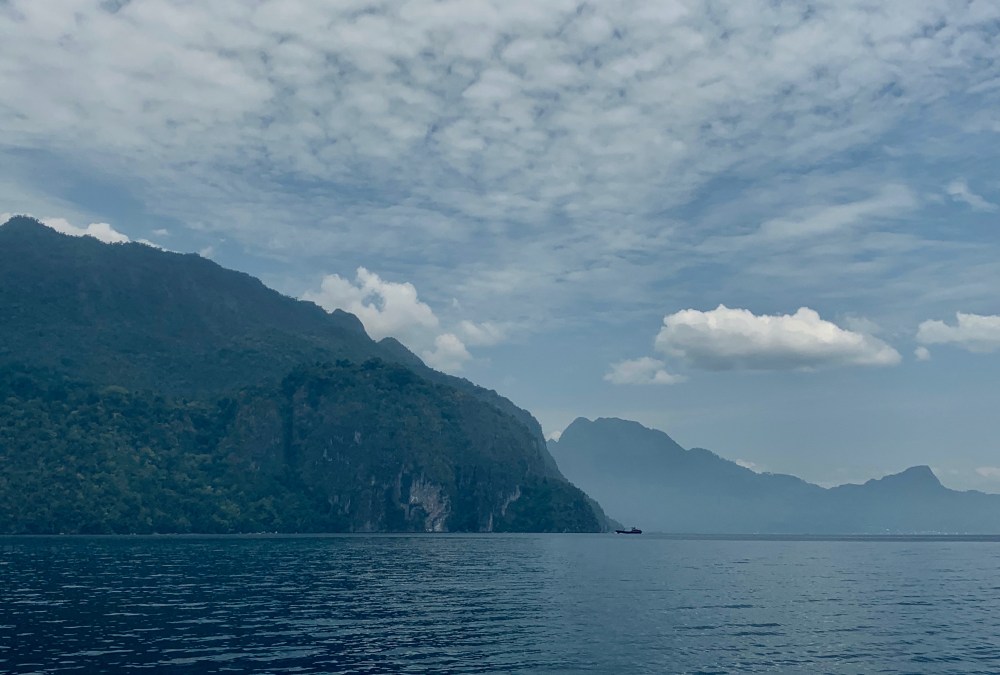
Seram was the largest island that we visited. The ferry terminal was on the south side and it took quite a while for us to travel over the mountainous spine of the island and then eastwards towards our base at on the north coast.
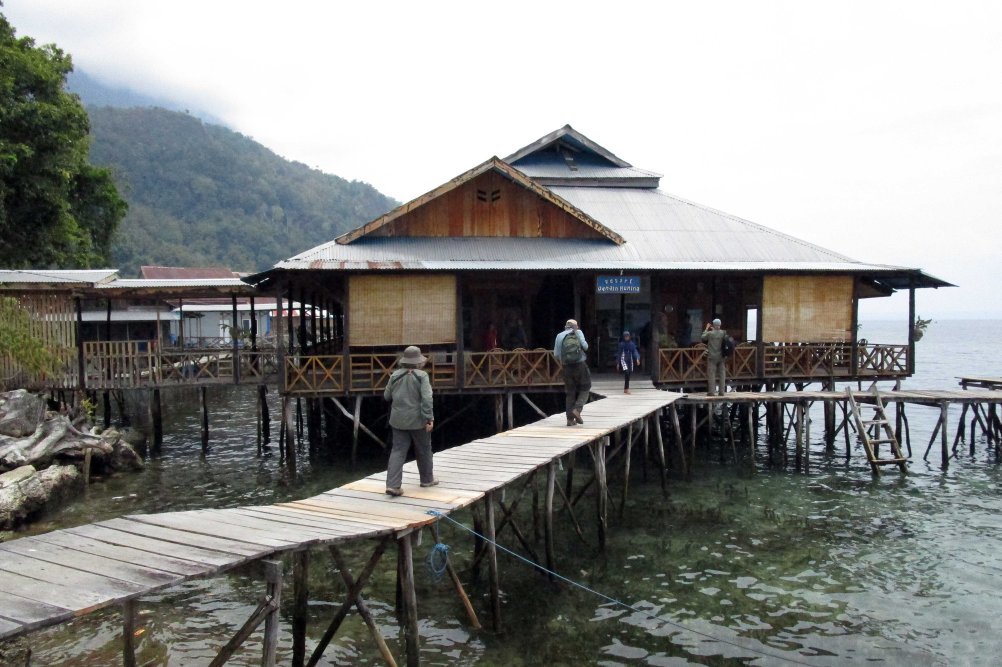
We arrived at Sawai in time for lunch at this fairly basic, yet charming lodge built on stilts over the sea.
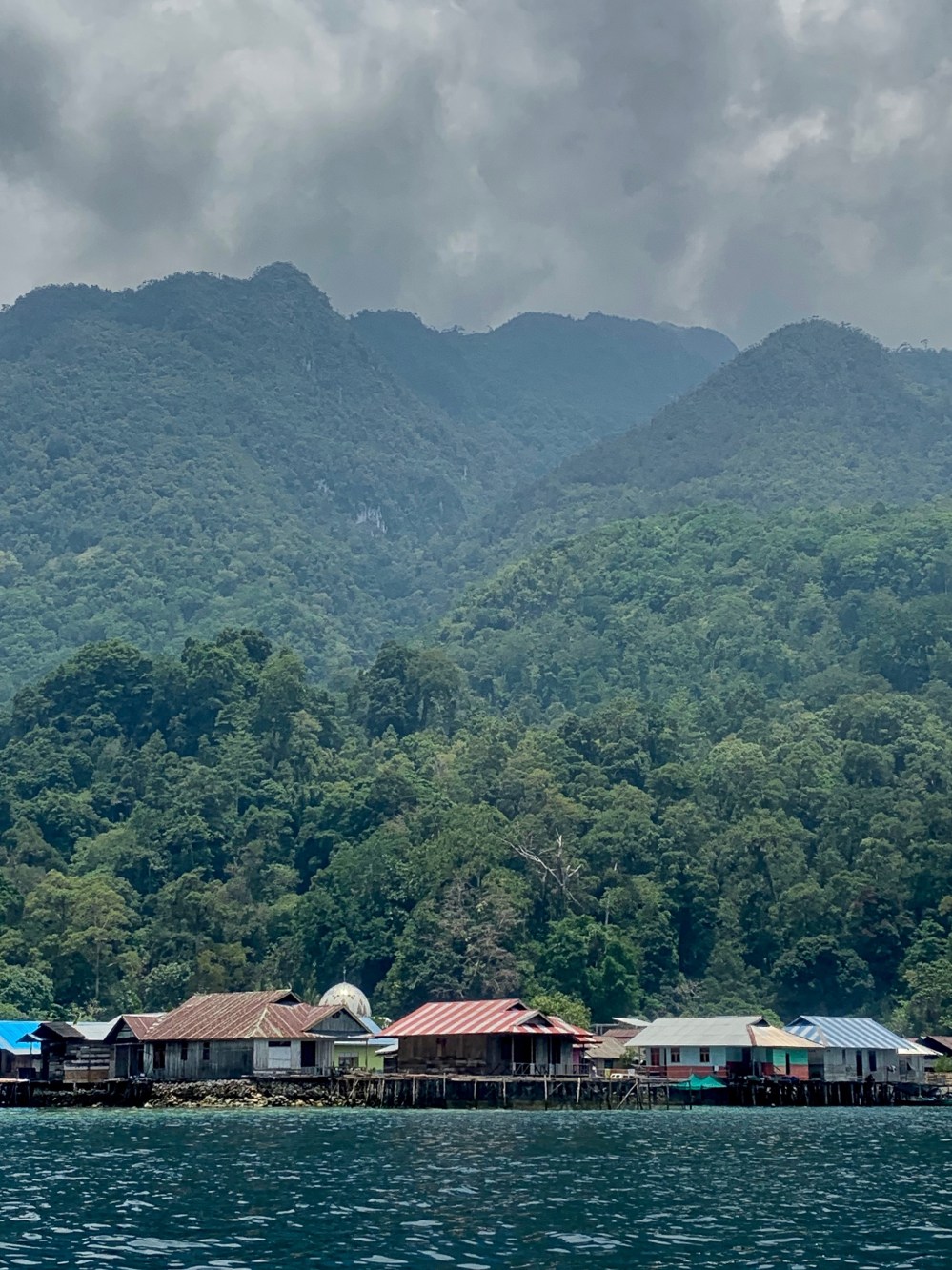
This part of Seram has some large areas untouched forest rising from sea level to the mountain tops. (photo © Craig Robson/Birdquest).
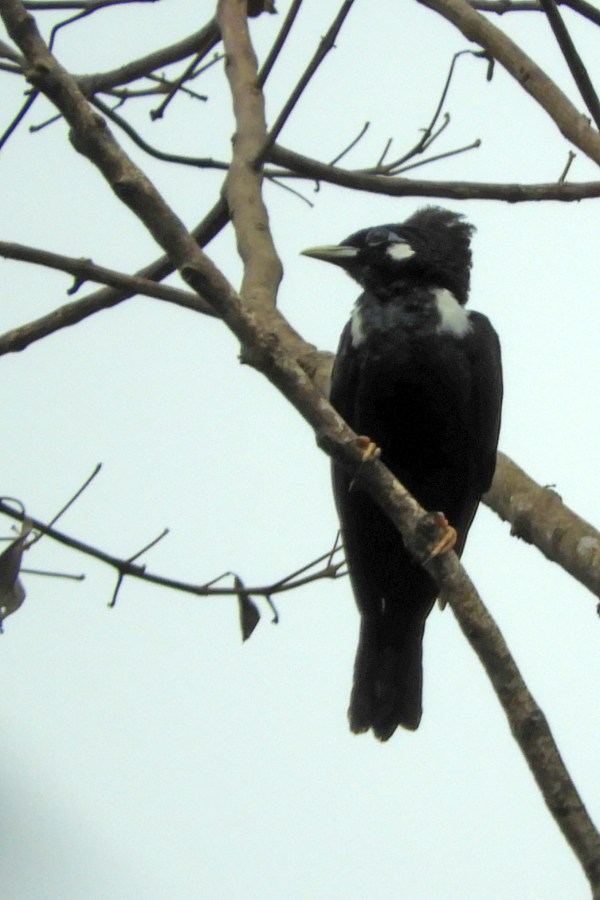
It was often overcast and light levels were low. As some of my photos are at a poor resolution or have been greatly enlarged I’m showing them at reduced a size. One of our targets was the bizarre Seram endemic Long-crested Myna.
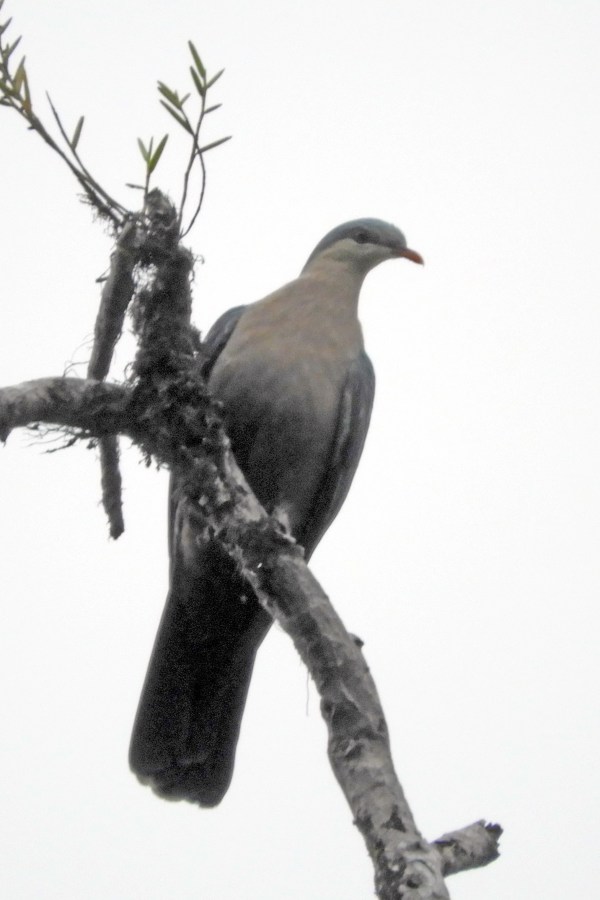
Another Seram endemic found along the mountain roads was Seram Mountain Pigeon.
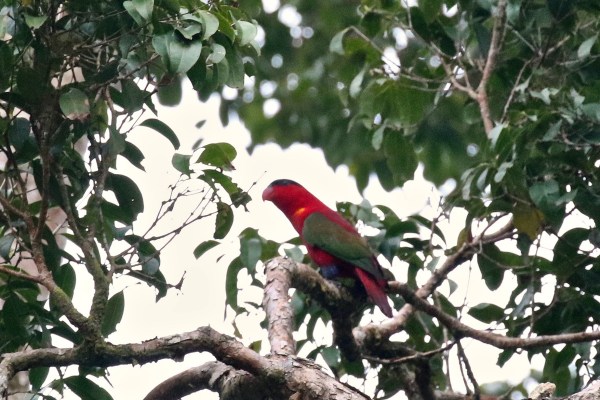
Parrots were well represented. The beautiful Purple-naped Lory used to occur on Ambon but is now presumed extinct there and so becomes a Seram endemic. (photo © Craig Robson/Birdquest).

However Coconut Lorikeet has a much wider distribution. ranging from the Moluccas to New Caledonia. The range was once much larger when it was lumped in with several other species in an enlarged ‘Rainbow Lorikeet’ whoose range extended all the way to Tasmania. (photo © Craig Robson/Birdquest).

As well as a great area for birds the road that run along the mountainous spine of the island was also a good place for butterflies such as this Eight-spot Diadem (photo © Craig Robson/Birdquest).

Other Seram endemics included Seram White-eye which by white-eye standards is quite striking … (photo © Craig Robson/Birdquest).

… Streak-breasted Fantail … (photo © Craig Robson/Birdquest).

… and Violet Crow, a recent and well-deserved split from Slender-billed Crow. (photo © Craig Robson/Birdquest).

A few owling sessions got us Moroccan Scops Owl (for a photo see last post) and Seram Boobook but unfortunately not the very elusive Moluccan Masked Owl.

Early one morning we took a couple of boats to a small offshore island called Pulau Lusaolate …

… our target was Olive Honeyeater, a small drab species that is known to like small islands. Unfortunately only one was seen and then just by the leader just as we were approaching as it was high-tailed off to the mainland. Apparently there are usually several on this tiny islet and we can only assume that they come to feed on particular flowers or fruit that weren’t available in September. In 2019 for reasons unknown, this trip was run two months earlier than usual. Differences were the unusually dry and windy conditions which caused problems in some areas and a lack of northern migrants that hadn’t yet arrived from Asia. Chief of these as far as I’m concerned was the lack of Gray’s Grasshopper Warblers, a species that breeds in Siberia that I’ve never seen anywhere and was one of my main targets of the trip. One was heard on Buru by Craig but I didn’t hear it and none were seen, They are apparently quite common in the Moluccas by November.
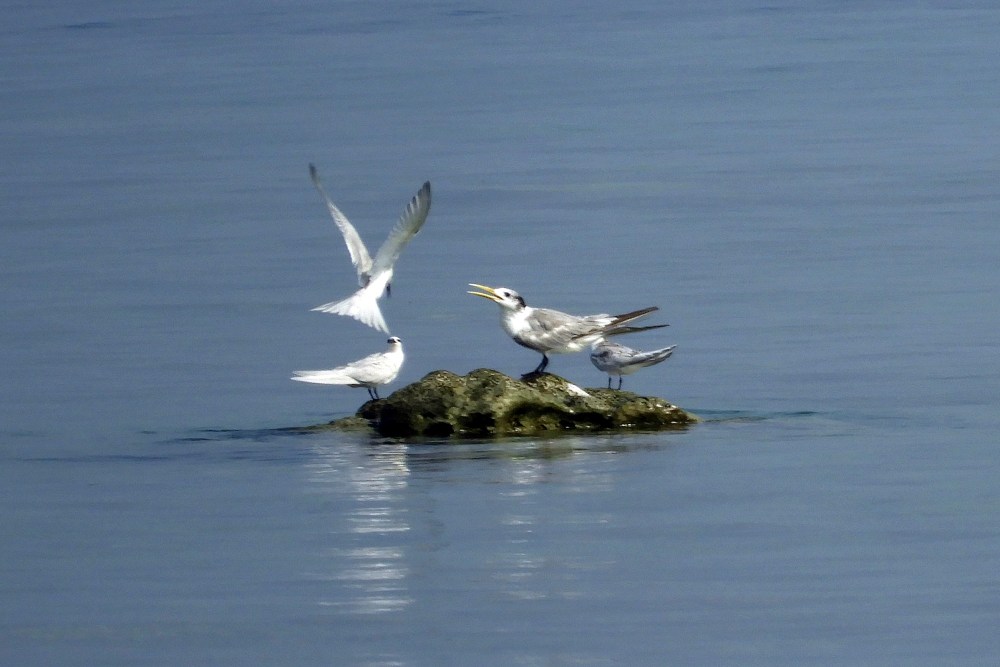
Around the islet was a series of exposed rocks which acted as roosting sites for Black-naped and Crested Terns. These are common and widespread species but in previous trip they have been joined by at least one individual of another species, the critically endangered Chinese Crested Tern, of which perhaps as few as 50 remain globally. Unfortunately this wasn’t the case this year. Whether this was because the individual involved had stopped coming here or whether, as was the case with the Gray’s Gropper and the Olive Honeyeater, we were too early in the autumn, I’ll never know. However I reassured myself that as I was booked to go to eastern China in May 2020 then I’d catch up with Chinese Crested Tern there, but I wasn’t allowing for the fact that a) due to Covid-19 the trip would be cancelled or that b) the Chinese Crested Terns had abandoned the traditional site visited on that tour. So I went from two very good chances of seeing the species to none at all.

As we explored the little island we had close views of Eastern Reef Egret …

… and in the clear shallows saw some bizarre starfish …

… and a poisonous sea snake, Yellow-lipped Sea Krait.
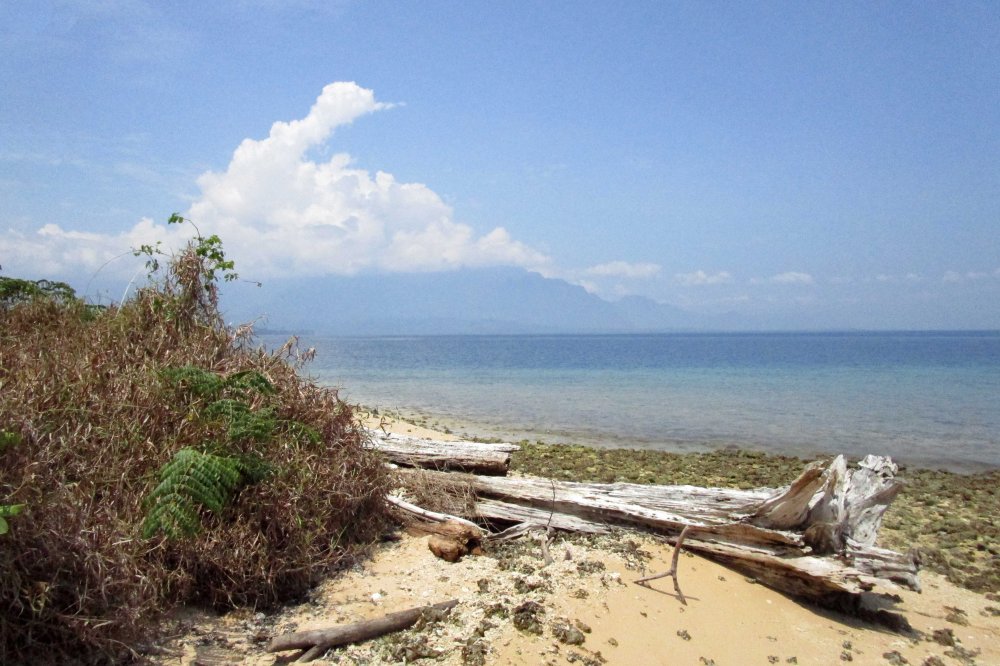
We had a look at the nearby mainland just in case we could locate the Olive Honeyeater that had been seen flying in that direction …
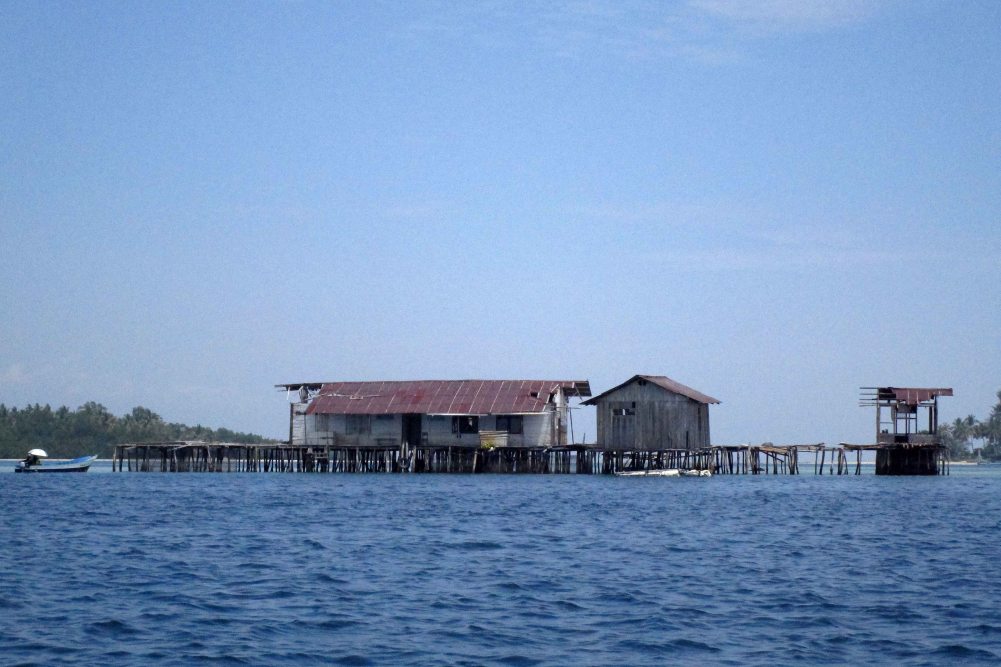
… before cruising around the bay past various fishing platforms in the hope we could locate a Chinese Crested Tern.
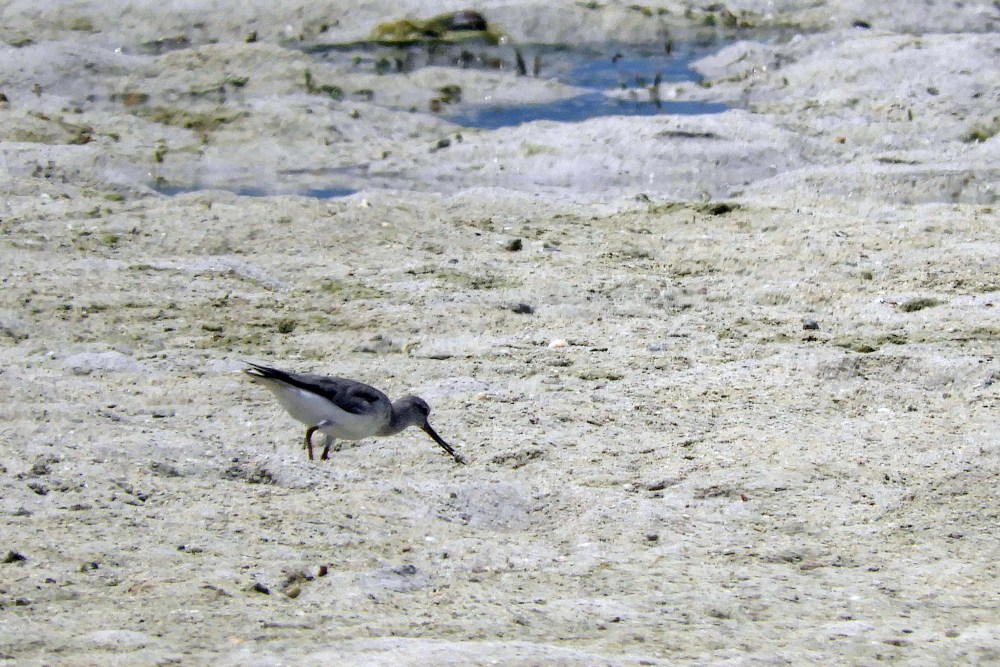
No luck with the tern but we did see a Terek Sandpiper, a Siberian breeding wader that is a rare vagrant to the UK (I’ve seen four in the UK but none since 1998) and has a wide wintering range in the Old World tropics.
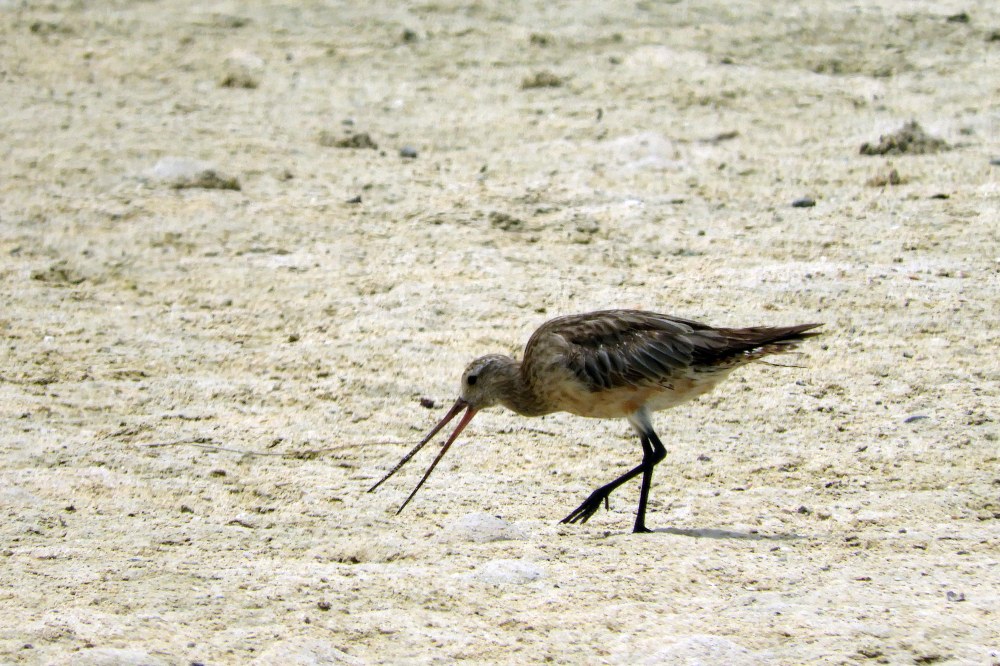
We also saw a number of Bar-tailed Godwits, this is a far more familiar species for me as a flock of 100+ winter in Poole Harbour and can be seen from the road at Sandbanks. Even so it was nice to see a few thousands of miles away in the Moluccas.

On our last morning at this site some of us did a very arduous ascent up a steep slope in the mountains. Our target was the almost unknown Seram Thrush. This species has recently been rediscovered in another part of the mountains but it took them three days of extremely difficult hiking to get there. News of another location just off the mountain highway was too good to pass by. We slogged up the slope (can you see John, one of the the other clients, just above me in the upper centre-left of the photo?) and eventually located one. It was in a deep and densely vegetated gully and although it called a few times it refused to budge. In fact the call was so high pitched that only a couple of the participants heard it, fortunately I was one of them.
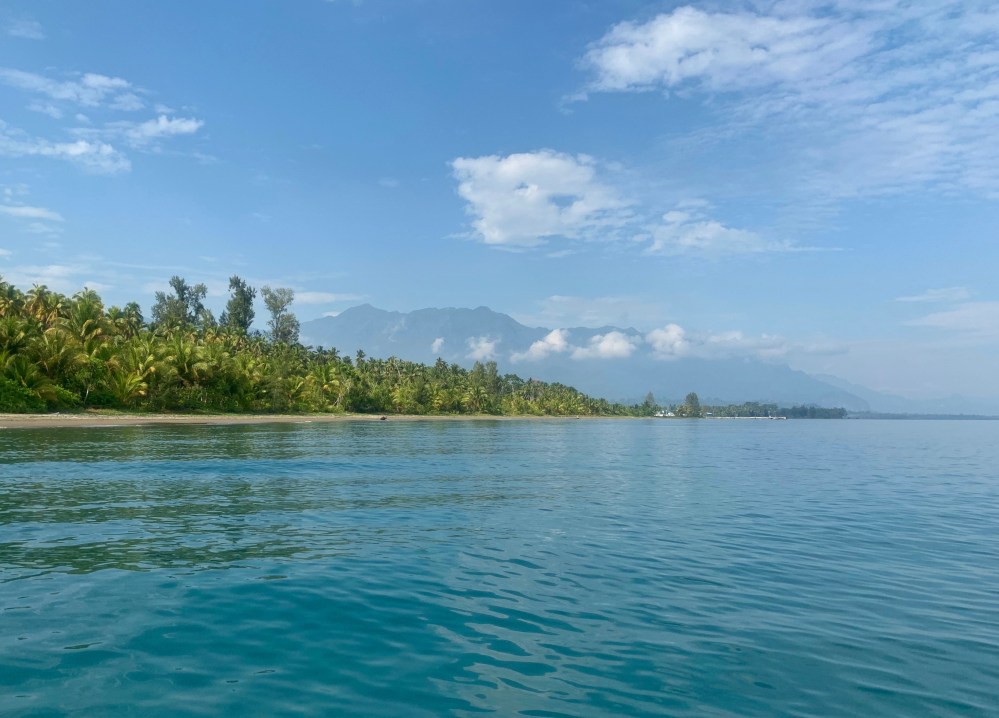
So it was back to Sawai for lunch, pack up and the long drive along the north coast of Seram to Piru in the north-west corner.

The following morning we left early in small boats for the island of Boano.
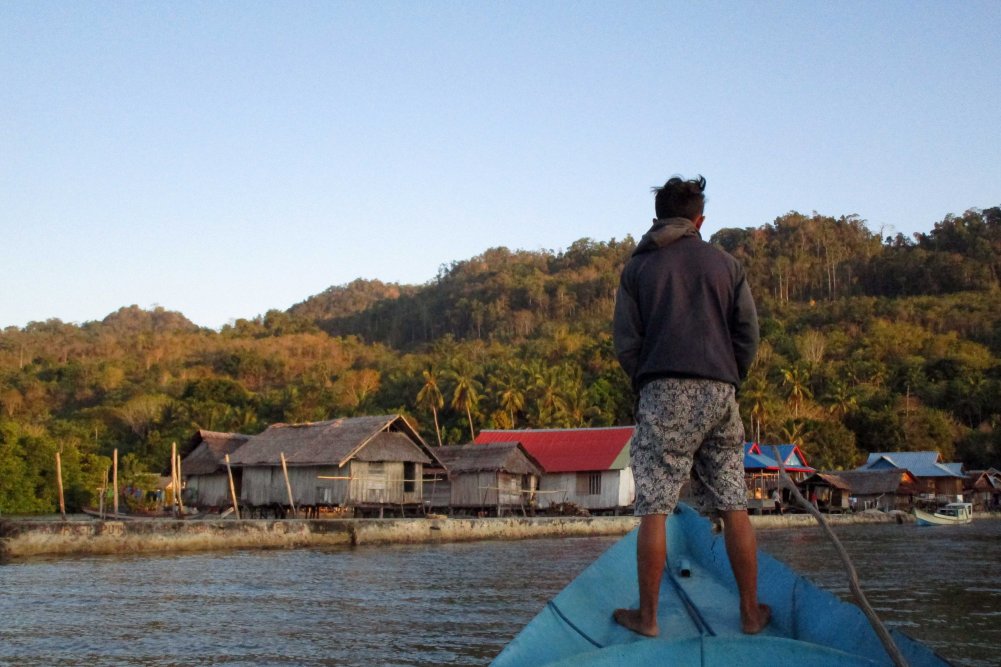
We saw a few shorebirds and terns on the crossing but little of note …

… after docking at a small village on stilts …
.

… we headed inland and after a bit of a climb found the endangered endemic Boano Monarch, our last new bird of the trip. (photo © Craig Robson/Birdquest).

Back at the little village we boarded our boats for the trip back to Piru.
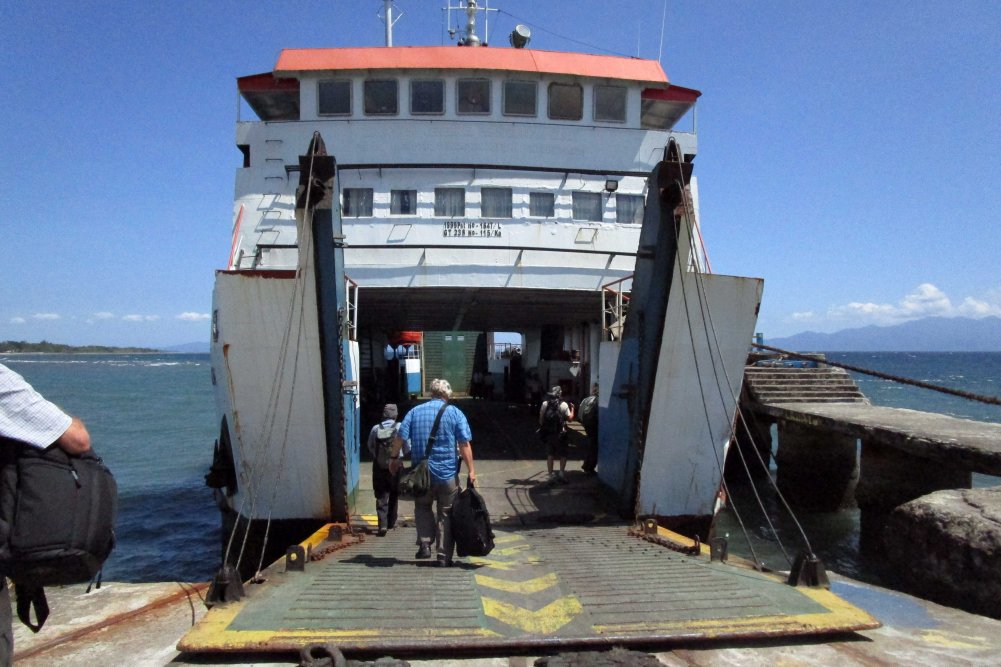
… then drove down the coast to catch the ferry from western Seram to northern Ambon and a transfer to Ambon City for a final night before departing home via Jakarta and Abu Dhabi the next day.

So its a goodbye from me, John, Norbert, Steve, Pete, Sally and Rainer. It had been a great trip with about 75 life birds for me. There had been a few disappointments, mainly because I hadn’t realised that the earlier departure would mean less migrants but it certainly is a beautiful and endemic rich part of the world and well worth visiting. (photo © Craig Robson/Birdquest).

I’ll conclude with this lovely phot from Craig of the sunset at Sawai in north Seram. (photo © Craig Robson/Birdquest).
Off all the countries in the world Indonesia is one of the most remarkable. Spread along the equator across almost 50 degrees of longitude with the western point of Banda Aceh on Sumatra level with eastern India and the eastern most point, the border with Papuan New Guinea is almost as far east as Tasmania, it consists of 17,500 islands varying from the huge islands of Sumatra, Borneo and New Guinea to uninhabited ‘desert islands’. It is the fourth most populated nation in the world with nearly 268 million inhabitants yet most people (in the UK at least) couldn’t point to it on a map.
From a biological point of view it is amazing, although the mega-fauna of the large western islands has largely disappeared due to habitat destruction, the bird life is incredible – although similarly threatened by habitat loss. Close to 1600 bird species have been discovered, beaten only by Brazil, Ecuador and Colombia and far in excess of any country that’s not in South America. Two factors can explain this; the multitude of islands had led to the evolution of myriads of variations on a theme, and perhaps more importantly and almost uniquely, Indonesia lies slap across the boundary of two faunal zone with a huge zone of integration between them.
Biologically Indonesia can be split into three zones, the Greater Sundas in the west with their typical Asia fauna, West Papua in the east with its Australasian fauna and between them Wallacea.

On the map above take particular note of the channels that separates 1) Borneo from Sulawesi, 2) Bali from Lombock and 3) Halmahera, Seram and Tanimbar from New Guinea and the Aru Islands. Now look at the next map below. – Map of Indonesia from see here
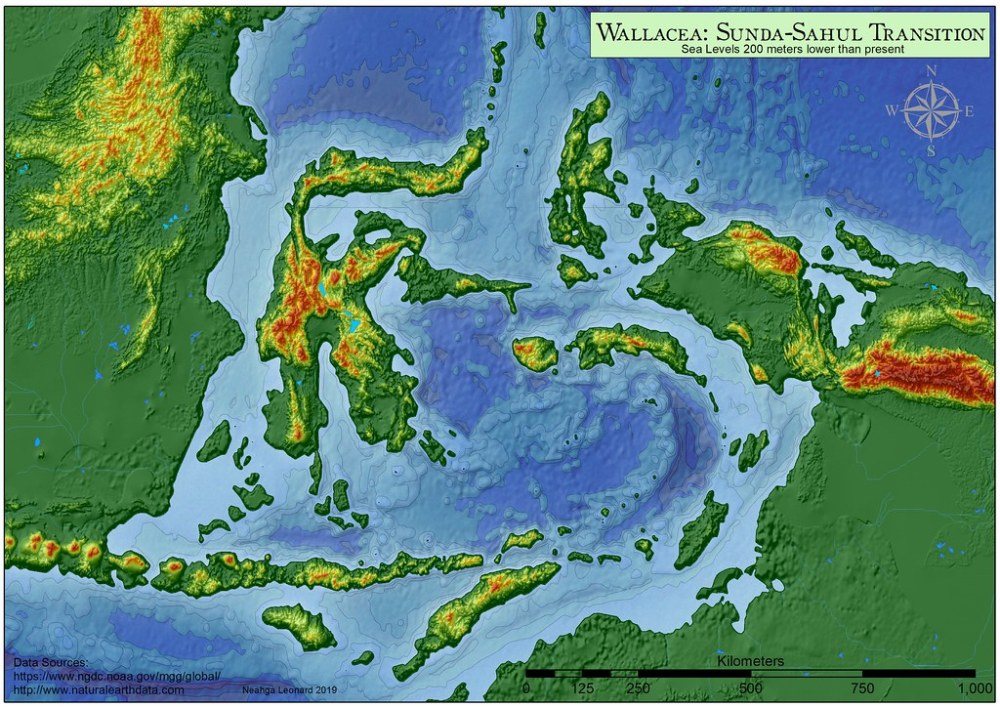
This map of what is now central Indonesia shows the situation at the height of the Ice Ages. So much sea water was locked up in the polar ice sheets that sea levels were considerably lower than now. Note Bali is connected to Java but the channel between Bali and Lombok still exits. New Guinea and the Aru Islands are connected to northern Australia but Halmahera and satellite islands, Buru, Seram, Kai and Tanimbar islands plus all the Lesser Sundas remain isolated. This huge area that was not connected to Asia or Australia/New Guinea is now known as Wallacea after Alfred Russell Wallace, the co-discoverer (with Charles Darwin) of evolution through natural selection and who was the first to realise that this region has a surprising mixture of Oriental and Australasian flora and flora. Map created by Neahga Leonard neahga@yahoo.com and taken from www.naturalearthdata.com
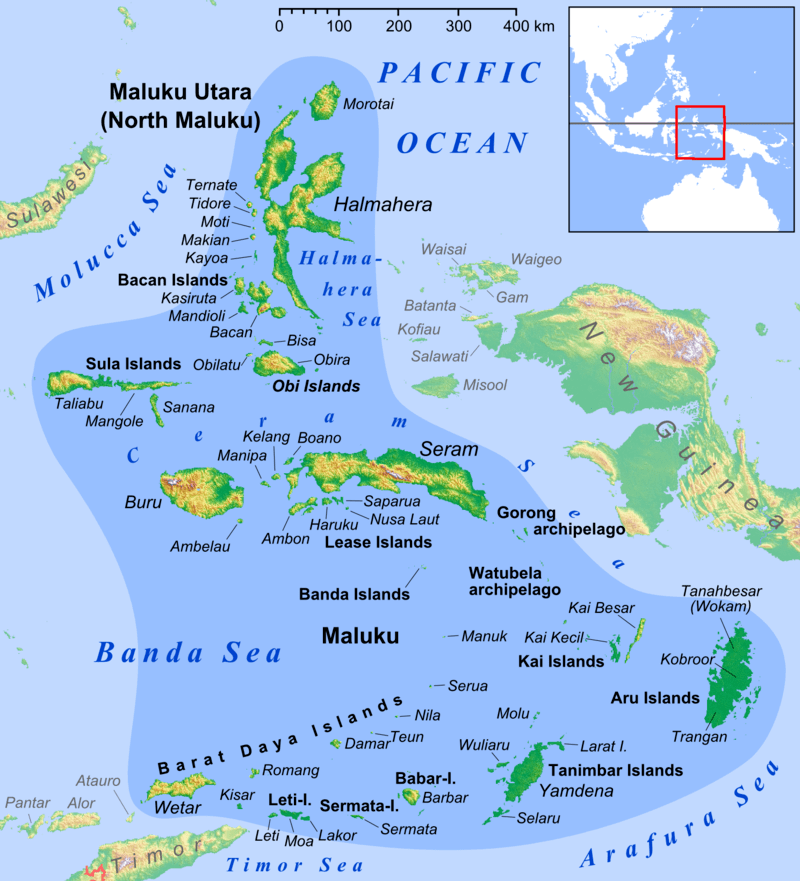
This map shows the Moluccas and is geopolitical rather than biogeographical. The dark blue encircles the administrative provinces of North Maluku and (south) Maluku. Note that the Aru islands are politically part of Maluku but bio-geographically part of Papua and were not visited on this tour. Photo from Wikipedia Commons.
This was my third visit to Wallacea. I had visited Halmahera and Sulawesi in 1995 and Timor and other islands in the Lesser Sundas in 2006. The tour started at Ambon, then visited Buru, back to Ambon, Yamdena in the Tanimbar Islands, then back to Ambon, Kai Kecil and Kai Besar, then back to Ambon, a short visit to Haruku (from Ambon), Seram, Boano before returning to Ambon for the flight home.
This post deals with the first half of the tour, Ambon, Buru and Yamdena.

I left home on the 4th September for the afternoon flight to Abu Dhabi. I left there in the early hours of the 5th and arrived at Jakarta on Java in mid afternoon. I stopped overnight at the conveniently situated airport hotel and then flew to Ambon where the tour started in the early afternoon of the 6th. I find it annoying when British news refers to almost any island in Indonesia as the ‘the remote Indonesian island of —‘. Ambon Island for example, although only 804 sq km in area has a population of half a million, most of which live in Ambon City, is the capital of Maluku Province and has an international airport. Hardly what I would call remote. Transport is largely by motorbike but that doesn’t prevent the traffic jams!
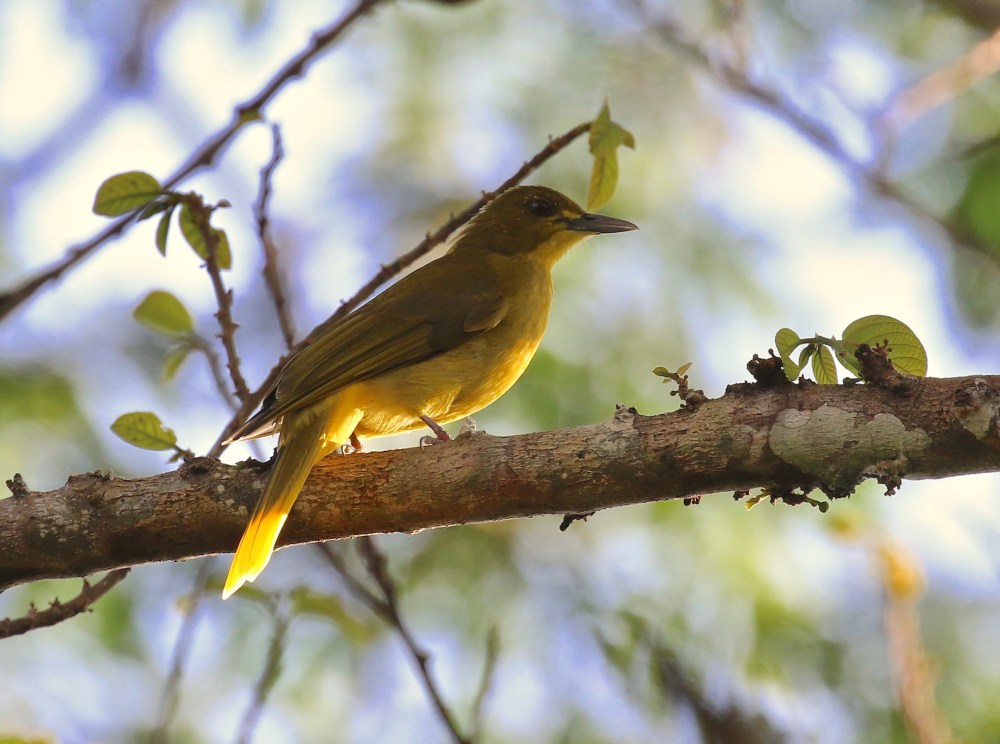
Our first birding was in an area known as Ewang Tulehu. Ambon was connected to Seram during the ice ages and so has few endemics. The only one currently recognised is the Ambon White-eye which we saw well, but we also saw the Ambon form of Seram Golden Bulbul (above) which is a potential split. Photo © Craig Robson/Birdquest.

We also had good views of Ashy Flowerpecker, a species that is shared with the island of Seram.

Early the next morning we flew west one of the many inter-island turboprop flights to the island of Buru.
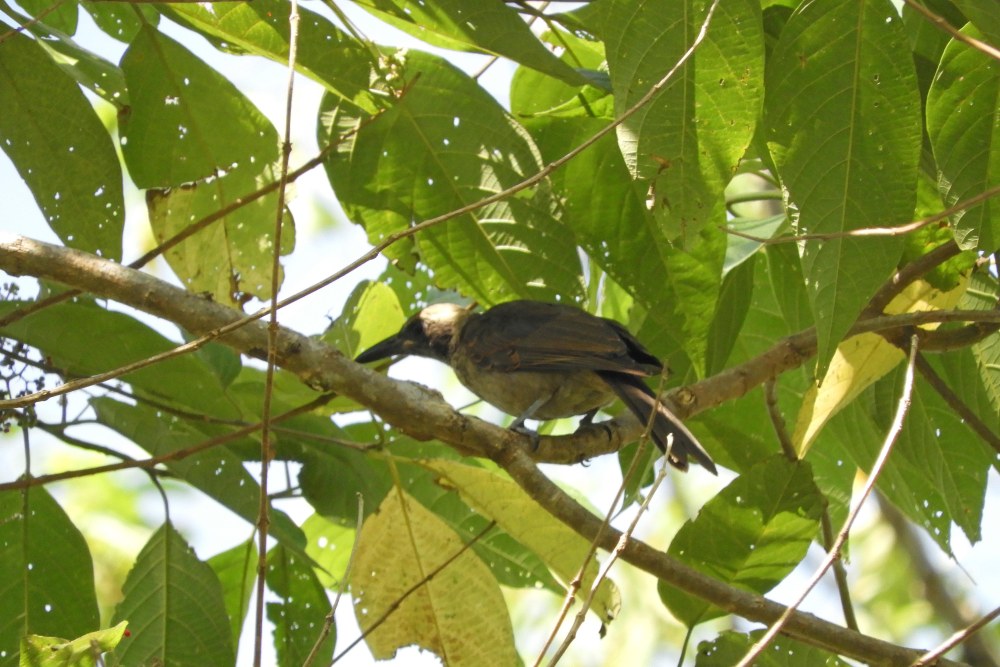
We arrived as early as 0730 so it was straight out birding. We saw a number of endemics such as this Buru Friarbird, or was it a Buru Oriole? In one of the strangest cases of mimicry in the world, almost every one of the larger Moluccan islands has a species of Friarbird (a large honeyeater) that is mimicked in both plumage and vocalisations by a totally unrelated species of Old World Oriole. The size and slightly downcurved bill makes me think this is the Friarbird but the definitive test is whether the dark area on the face is bare skin (friarbird) or feathered (oriole). Tour leader Craig Robson made the following comments in the trip report. ‘A recently published paper (Jonsson et al. 2016. The evolution of mimicry of friarbirds by orioles (Aves: Passeriformes) in Australo-Pacific archipelagos. Proc. R. Soc. B 283: 20160409. http://dx.doi.org/10.1098/rspb.2016.0409) has tested the hypothesis that regional brown orioles mimic friarbirds. Historical observations by Alfred Wallace and Jared Diamond of plumage similarities between co-occurring orioles and friarbirds led them to conclude that the former represent visual mimics of the latter. Here, the authors used molecular phylogenies and plumage reflectance measurements to test the mimicry hypothesis. The results show that friarbirds originated before brown orioles, and that the two groups did not co-speciate (although there is a plausible instance of co-speciation on Buru and Seram). Furthermore, the greater size disparity between model and mimic and a longer history of co-occurrence have resulted in a stronger plumage similarity (mimicry). This suggests that resemblance between orioles and friarbirds represents mimicry and that colonization of islands by brown orioles has been facilitated by their ability to mimic the aggressive friarbirds’.

We also two (rather poorly photographed) pigeons – Spectacled Imperial Pigeon …

… and the exquisite Claret-breasted Fruit Dove. One pigeon we didn’t connect with was Buru Green Pigeon, possibly because this tour wasn’t running at the usual time of year and they weren’t visiting their usual fruiting tree due to lack of fruit.
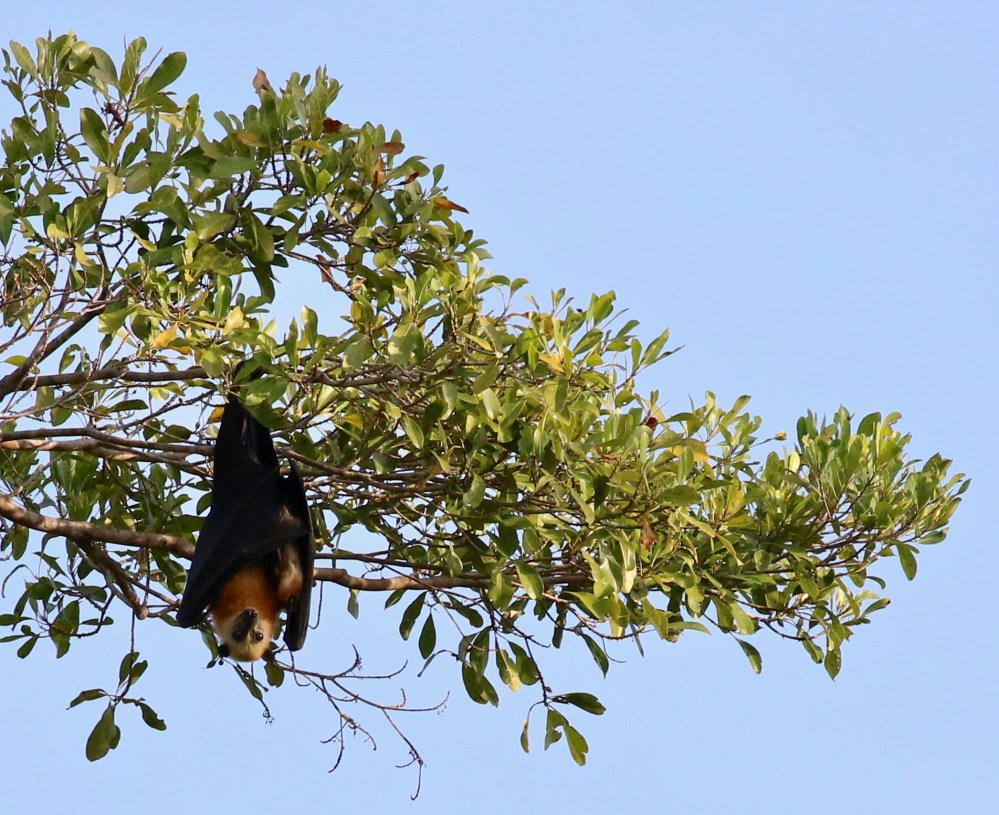
We did however see plenty of Black-bearded Flying Foxes. Mammals are scarce in Wallacea. We recorded three species of flying, two cetaceans, an introduced Brown Rat and a single species of cuscus, a marsupial that has somehow crossed the sea from New Guinea to colonise one of the Kai Islands. Western Indonesia has (or has had) the full suite of SE Asia mammals; leopards, tigers, elephants, rhinos, wild cattle etc whilst New Guinea has a large variety of marsupials. A single primate colonised Sulawesi but in general Wallacea is depauperate when it comes to mammals, in contract to the situation with the more mobile birdlife. Photo © Craig Robson/Birdquest.

Much of our birding was along this old logging road, but we did make some forays into the forest …

… which proved tricky for the shorter members of the group.

We reached our accommodation on the north shore just before lunchtime where we searched for seabirds until we went out again in the afternoon …

… and we were lucky enough to get close views of Indo-Pacific Bottle-nosed Dolphins just offshore.

There were great views at sunset but having been continuously on the go for several days we were glad we weren’t out owling that night …
… instead we were out at 0430 the following day and scored with Buru Boobook, Large-tailed Nightjar …

… and the diminutive Moluccan Scops Owl. Photo © Craig Robson/Birdquest.

We explored other parts of the island by 4×4 …
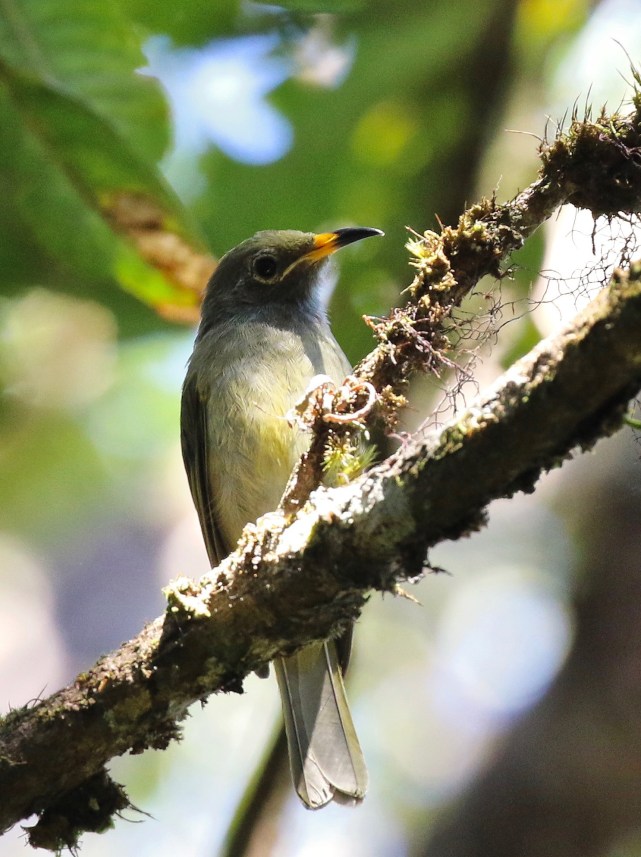
… seeing great birds like the endemic Buru Honeyeater (Photo © Craig Robson/Birdquest) …

… and Buru Racquet-tail (named after the unusual racquet-shaped tail feathers which can just be seen on the lower left). Photo © Craig Robson/Birdquest.
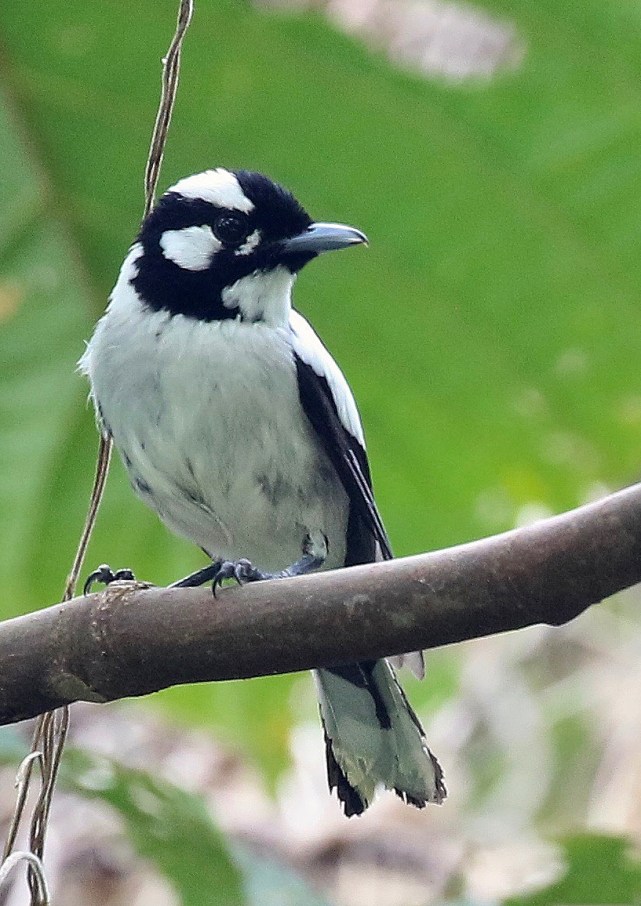
But one of the best was this gorgeous White-naped Monarch, one of many species in this mainly Australasian family. Photo © Craig Robson/Birdquest.

Some of us also undertook an arduous trek into the highlands. Our main target was the legendary Madanga, a bird that was once classified as a funny looking white-eye but genetic analysis has shown (crazy as it sounds) to be an aberrant pipit. However if a group of pipits had been blown to this (once) totally forested island they would have had to adapt to survive and what sort of bird survives well in forested environments in Wallacea, small rotund passerines like white-eyes or flowerpeckers! Nowadays of course pipits could find live a more typical lifestyle in the many deforested areas. Unfortunately we didn’t become the second ever tour group to see the Madanga (the first was the previous Birdquest group) but we did see …

… Cinnamon-chested Flycatcher (Photo © Craig Robson/Birdquest) …

… and a juvenile Moluccan Cuckoo being fed by Buru Leaf Warblers. Photo © Craig Robson/Birdquest.
We had done pretty well on Buru, no Madanga or Buru Green Pigeon, but most of the island endemics were UTB. It was time to return to Ambon. We had time to visit a freshwater lake which added a few quality waders, a Black Bittern …

… and the cobalt-eared form of Common Kingfisher to our lists. The rest of the day was spent in forest where a number of new birds (mainly ones we would see again later on Seram) were recorded.

We overnighted in Ambon City …
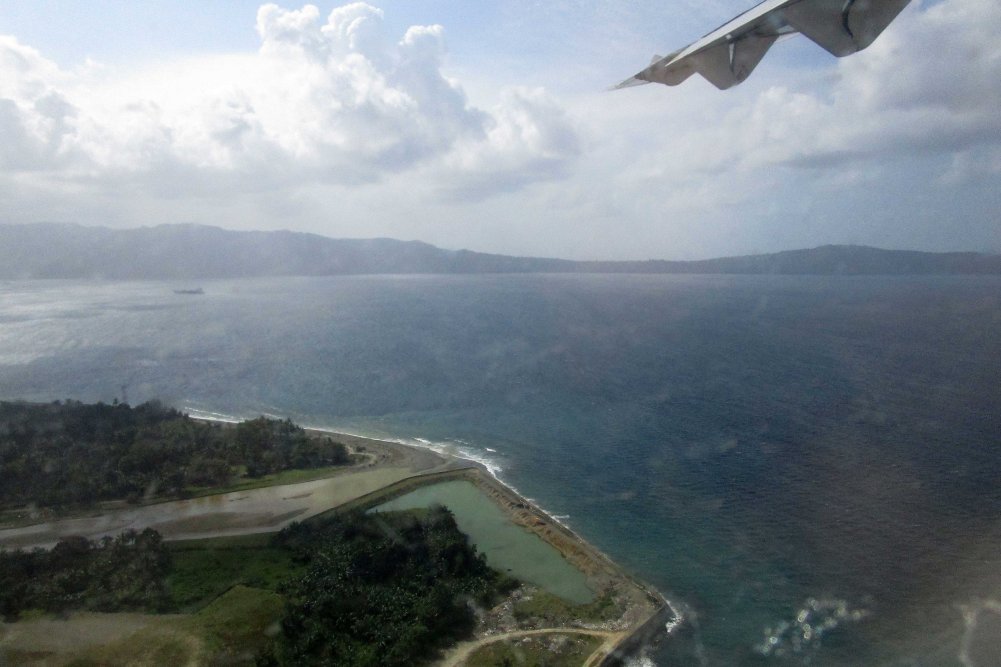
… and then flew the following morning to Yamdena in the Tanimbar Islands, the southernmost point of our trip and just 350 km north of the Australian mainland.
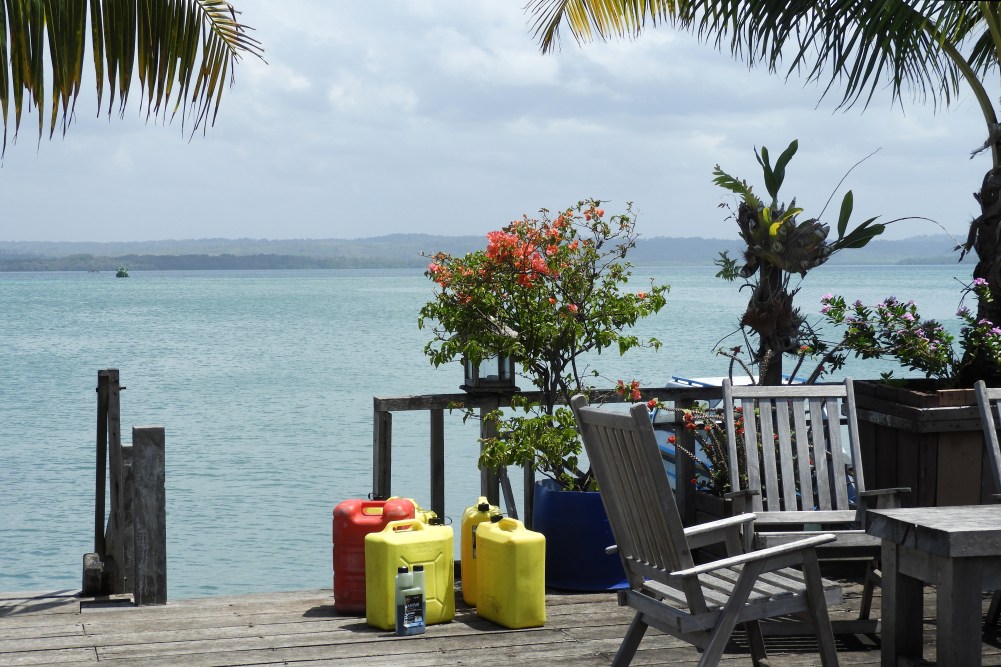
Our accommodation was built on a pier out into the harbour.
Our rooms weren’t ready on arrival and there wasn’t time to go anywhere before lunch so we just enjoyed the view and watched for seabirds.

There was a great view from our rooms …

… over the nearby waterside shacks and boats.
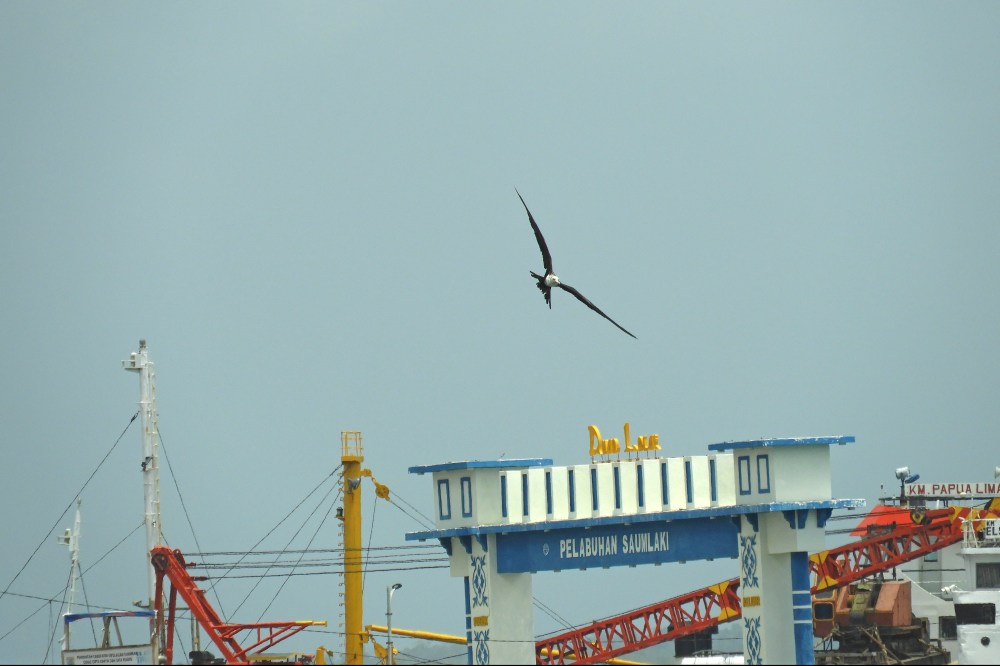
You could even see Lesser Frigatebirds from your bed.

Yamdena is much flatter than Buru (or Seram) and so is more prone to deforestation, either clear felling for agriculture …
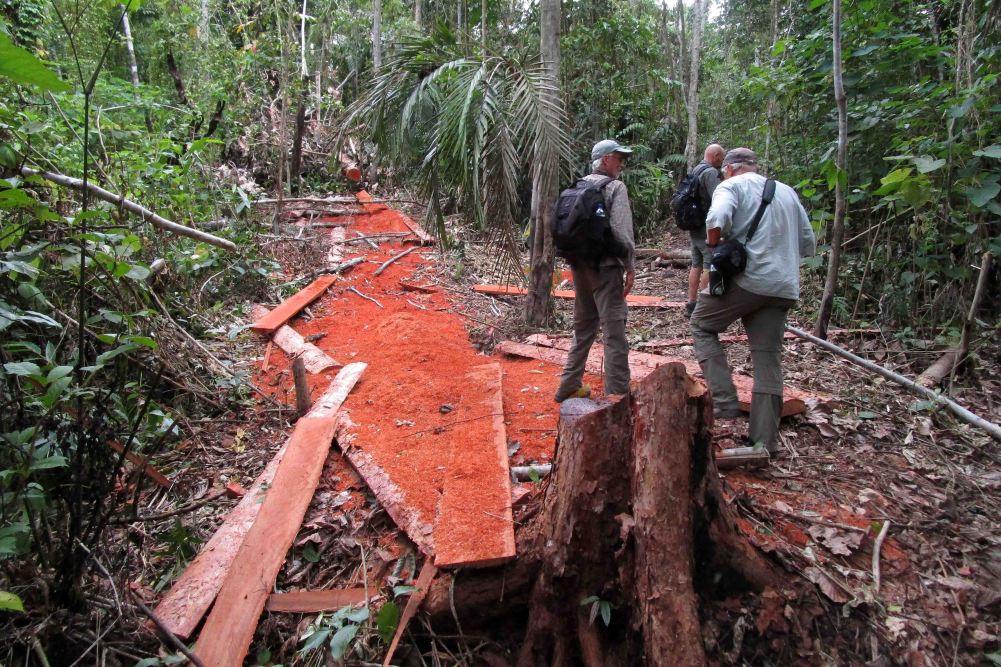
… or by stripping out the tallest trees in the forest.

Quite a bit of our time was spent finding our way through dense thickets …
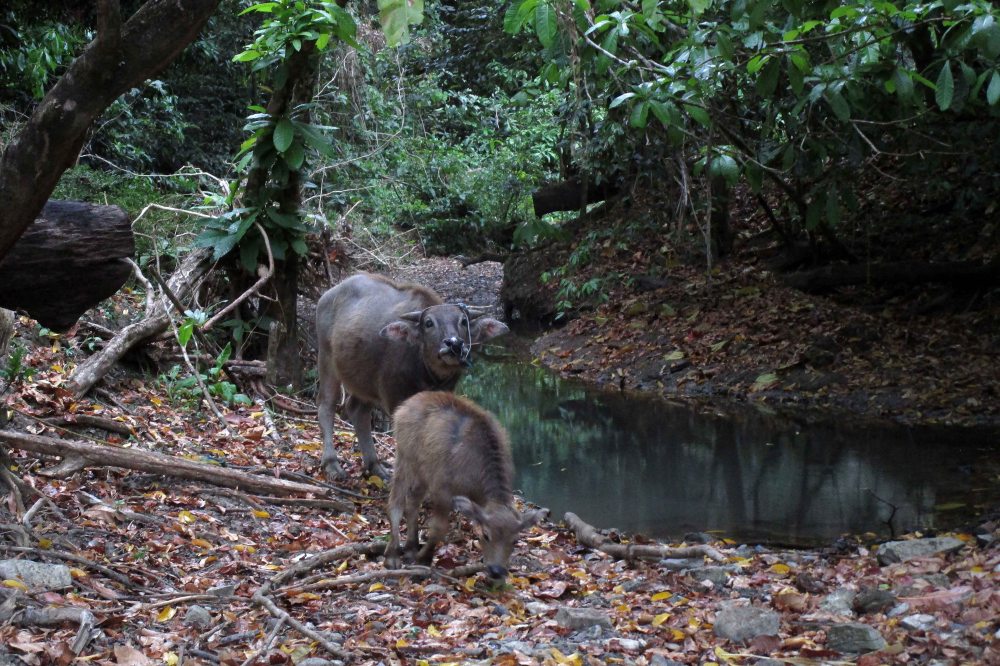
… and along watercourses. As I said before the Moluccas have little in the way of terrestrial mammals but domestic water buffalo wander these woodlands and can turn up unexpectedly.

We saw a number of exquisite orchids in the gloom of the forest …

… and the bizarre ant plants, epiphytes in the genus Mermecodia that have a symbiotic relationship with certain species of ants. The plants give the ants shelter and food, the plant benefs from the protection the ants provide and nutrients from the ant’s dead bodies and waste. The plant grows epiphytically high in a tree (the seed having been deposited there by a bird) and grows these bizarre convoluted chambers to house the ants. This plant has fallen from a tree and split open exposing the ant containing chambers.

There were many good birds on Yamdena including this endemic Golden Flyrobin (Photo © Craig Robson/Birdquest) …
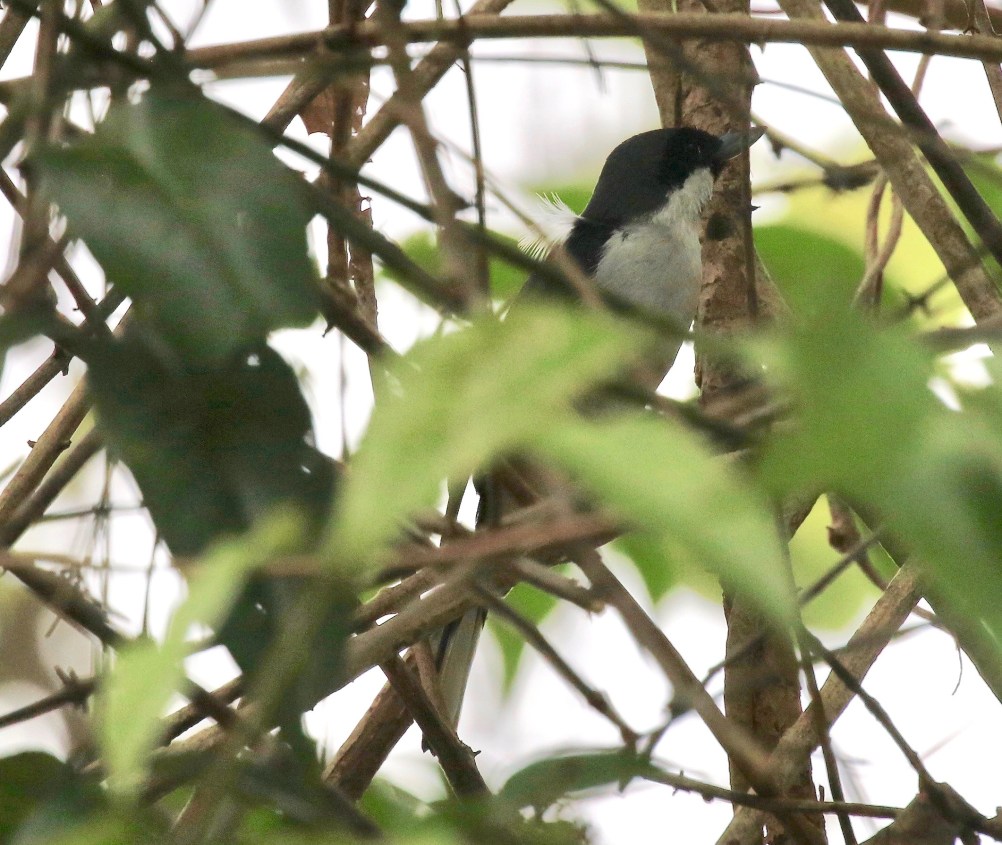
… and another endemic Black-bibbed Monarch. Photo © Craig Robson/Birdquest
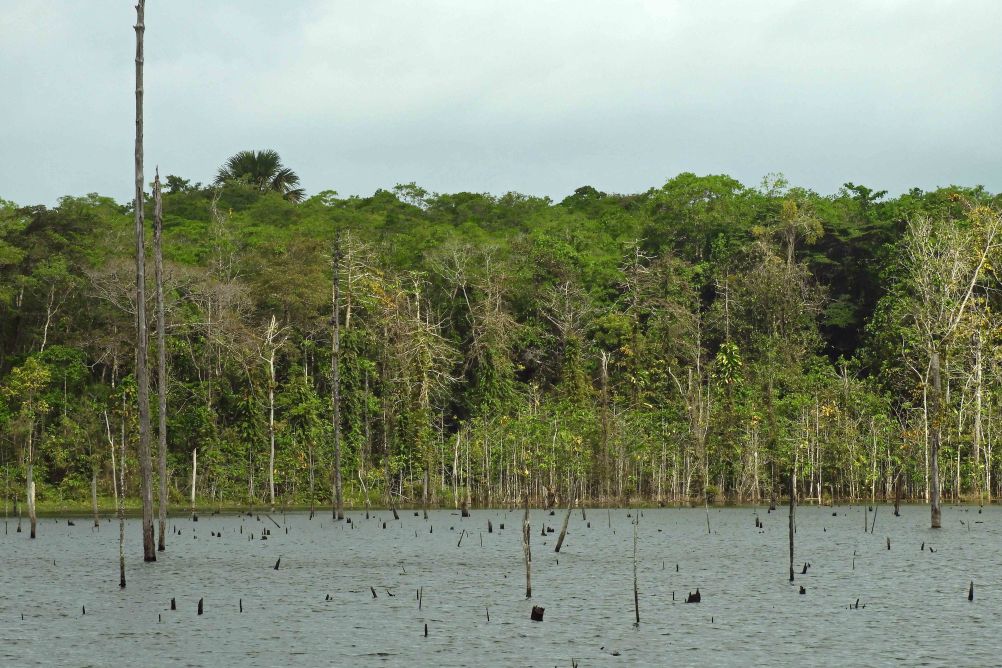
Near the airport was this wetland area where we saw a number of waterbirds, mainly of Australian descent.

Another indication of our proximity to Australia was the presence of several Tree Martins.

Elegant Imperial Pigeons which are found on other small islands in the Moluccas and on the Lesser Sundas.

More widespread is the aptly named Eclectus Parrots which occurs throughout New Guinea and as far as Cape York in Australia. The female surprisingly in the red one whilst the male is green.

With the Eclectus were a number of Tanimbar Corellas, a species of cockatoo, it is endemic to the Tanimbar islands, but a few have been introduced to the Kai Islands.

The local xanthogaster race of Rose-crowned Fruit Dove lacks the rose crown! Variation between different races of a wide variety of species in Wallacea is often greater than the variation between different species elsewhere. It is hard to know where to draw the line between species and subspecies, but modern techniques of voice analysis and genetics may provide the answer. James Eaton et al’s lovely book on the birds of Indonesia splits many more forms (but sadly not this one) than do the various World Checklists. So far when detailed studies have been performed he has been shown to be right. Trips to Wallacea will be source of armchair ticks for years to come.
A nocturnal expedition got us great views of the endemic Tanimbar Boobook but unfortunately no photos.
It was very dry with string winds which is quite unusual in these parts. It made it difficult to traverse the forest quietly. However there were some damp areas remaining and here we located one of the loveliest birds of the trip …
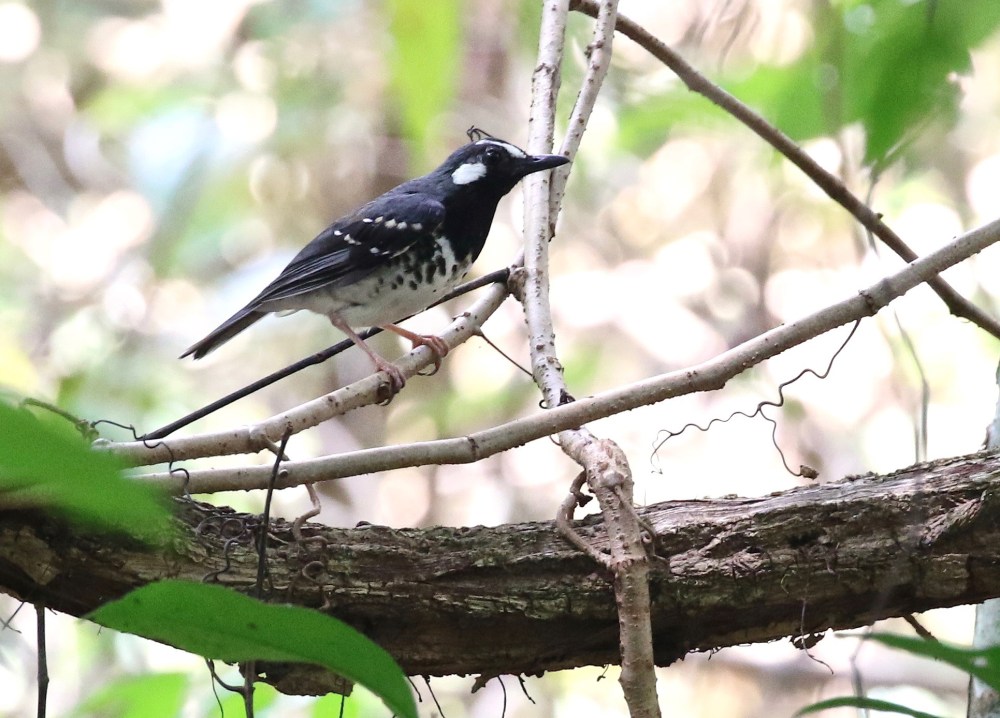
… the endemic Slaty-backed Thrush. Photo © Craig Robson/Birdquest.
But there was one bird that really eluded us. Its presence was obvious from the raised mounds in the forest that it constructs to incubate its eggs. I’m talking about the elusive and endemic Tanimbar Scrubfowl. We searched high and low, occasionally the person at the front next to the leader would get a glimpse, but I usually missed. Eventually one was located in a tree and I got a brief view as it shot away.

Photographer Mark Harper clearly got much better views but he was probably working alone. Tanimbar Scrubfowl photo by Mark Harper from Bird Forum Opus

Our next destination was the Kai Islands about 250 km away to the north-west. Unfortunately we had to fly the 600 km back to Ambon and a similar distance back again. A bit like flying from London to Exeter via Aberdeen.
The next post will cover the rest of the trip with photos from Kai Kecil and Kai Besar, Haruku, Seram, Boano and of course Ambon.
Before I continue to catch up with accounts of my foreign birding I thought I’d add a post about another area of interest of mine – mothing.
Many birders have developed an interest in butterflies and dragonflies and other interesting invertebrates that they might see whilst out birding, but in recent years the arrival of some very good field guides have opened up the world of moths to non-specialists.
There are about 70 species of butterfly in the UK (and you’d only get to see about 20-30 of these unless you made an effort to go and see the rarer/more localised species) but there are 750+ species of macro-moth and if you include all the micro-moths then the total rises at around 2,500!
I first starting to hear about mothing back in the late 90s. There were always people talking about and pouring over moth traps at Portland Bill Bird Observatory but it was the publication in 2003 of ‘The Field Guide to the Moths of Great Britain and Ireland’ by Waring and Townsend that really got birders interested, because for the first time moths were depicted as you would see them alive in the field and not dead and pinned to a board. Of course moths caught in a trap are released unharmed.
I got a moth trap at the end of 2003 and started mothing in my garden in 2004. Unfortunately soon afterwards my life went through some major changes and over the next few years it was hard to find time to keep the hobby going. Things improved markedly by the end of 2007 when Margaret moved in with me and settled life resumed, but I spent less and less time on mothing and by the time we were married in 2009 I had given up.
Fortunately I kept the old trap. In April of this year with Coronavirus lockdown in place, I couldn’t do any bird ringing outside the garden and birding was reduced to what could be seen on the short one-hour walks from home that were permitted under the guise of ‘exercise’.
To maintain some sort of sanity I dug out the old trap and was surprised to find that the mercury-vapour bulb still worked after all this time. Of course it was like starting from scratch I had forgotten all the moth names and during the intervening eleven years my metal acuity had diminished somewhat. But nevertheless I still greatly enjoyed sorting through a night’s catch, a few of the results of which are shown below.
As the autumn approached and lockdown eased, then I spent more time bird ringing and mothing has been relegated to the occasional day when I couldn’t go ringing for whatever reason. I’ll have to wait and see if I can manage to maintain mothing, birding, bird ringing and foreign travel when (or should I say if) Coronavirus restrictions are ever lifted.
You can start mothing but just looking for the species that fly by day or by tapping vegetation in the hopes of dislodging resting individuals, but most moth-ers (note the hyphen to distinguish them from mothers!) attract moths to light. This can be as simple as leaving the porch light on, but it’s best is to use a purpose designed trap with a mercury-vapour light (which shines in the UV as well as visible) or an actinic light. Such traps can be bought commercially but mine was built by a friend in Weymouth for a much reduced sum. The interior of the trap is usually filled with old egg boxes to give the trapped moths somewhere to rest.
The first picture was greatly under-exposed so you could see through the perspex lid but in practice it looks more like this. I usually run the trap between the conservatory door and the neighbour’s fence a) because its sheltered from any wind and b) to avoid shining the light directly into neighbour’s bedroom windows.
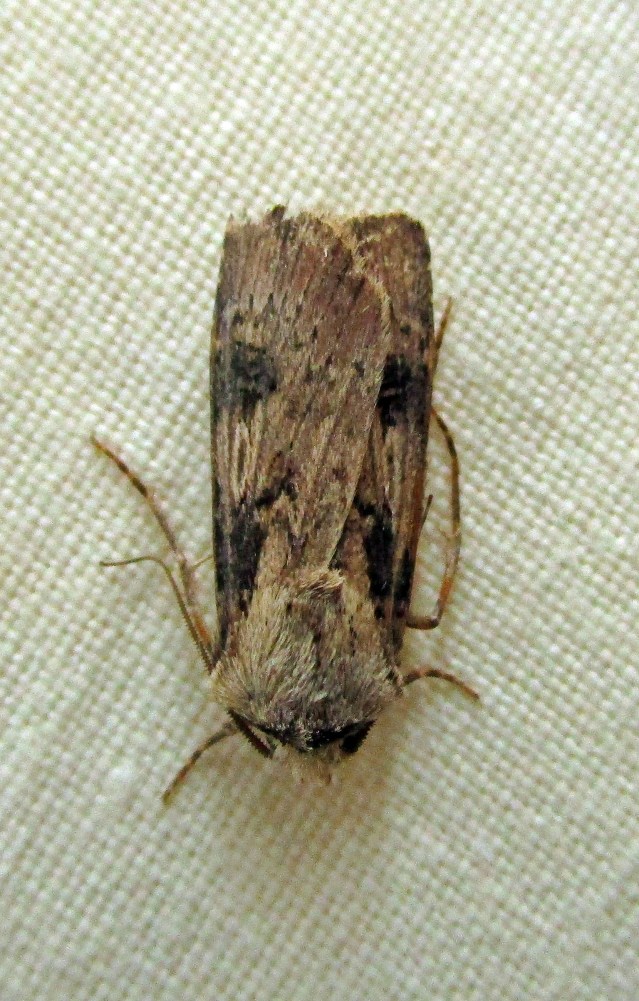
So the first thing you are going to say is that all moths are brown and boring. Well some like this Shuttle-shaped Dart, are brown, but few are boring. Also the vast majority of moths larvae don’t eat clothes, I think there are only two or three species that do.

So as well as a trap and some small plastic/glass pots to hold them in until you have identified and/or photographed them, you will need a guide. There are various versions of this guide but I find the Concise Guide to be the easiest to use when mothing, although I think I will buy the updated version of the full guide soon.
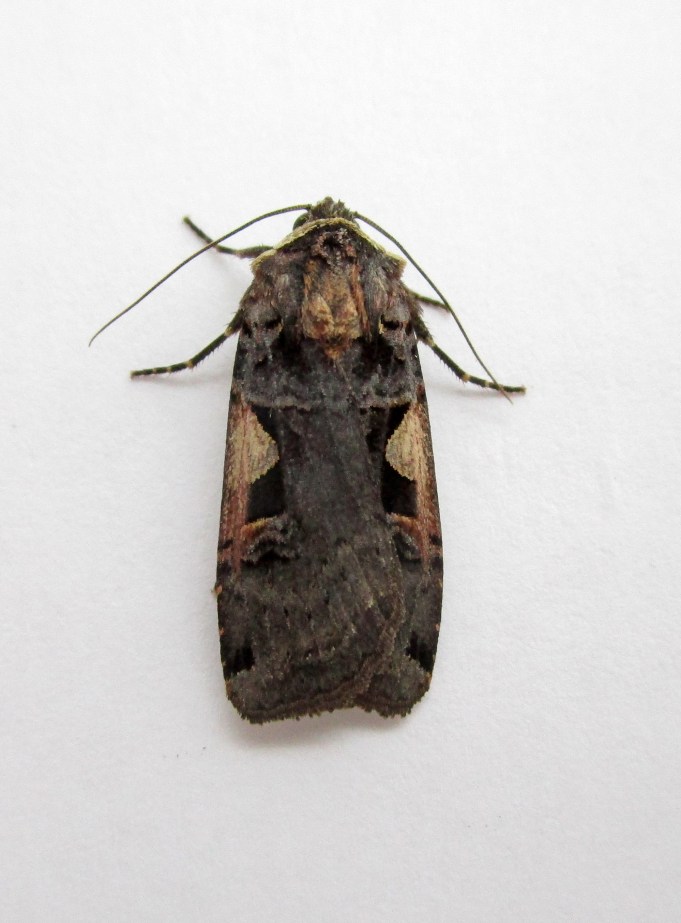
Moths can be photographed easily with any pocket camera or phone. The main problem is photographing them before they fly away, something I have yet to master! Moths have some wonderful names, some are purely descriptive like Large Yellow Underwing others are bizarre like The Uncertain, the Anomalous or Cousin German. There is both a Bright-lined Brown-eye and Brown-lined Bright-eye! This species is called Setaceous Hebrew Character. The Hebrew character bit I get, but apparently there is no known origin for the word ‘setaceous’

Although may of them do come in dull colours, the variety of shades, patterns and shapes is extraordinary. This is an Angle Shades.

Moths can vary greatly within the same species, some come in a variety of shades depending on their sex and/or location. This is a typical Broad-bordered Yellow Underwing (probably a male) …

… this is a female, but both sexes share the startling yellow-orange underwing which has probably evolved to startle predators. Photo by Bernard Dupont from Wikipedia Commons.
Like most wildlife moths can be habitat specific and moving just a short distance can result in a completely different series of species being trapped. I have a friend who lives a stone’s show from the wetlands of Lytchett Bay and gets a much higher variety in his garden than I do. Another friend from birding trips abroad lives in the Peterborough area and was surprised to find that I regularly catch this species, Bird’s Wing, albeit in very small numbers, as in decades of mothing he’s never had one in his garden.

Another moth that is brown but far from boring is The Drinker, so called because the caterpillar sips on drops of dew on grass stems. Initially I used a cork mat to photograph the moths as it resulted in a neutral background colour for the camera exposure without too many shadows but more recently I have gone for white sheet of paper as it is less distracting.
Of course moths are a major food resource for birds and many are consumed, so it makes sense that some pretty amazing camouflage will have evolved. None more so than this Buff-tip which has evolved a perfect imitation of a broken-off twig. Photo by Iain Leach from Butterfly Conservation
A similar deception seems to be at work in this moth known as The Spectacle …
… you have to see it head-on to see where it got its name.
Often its easy to identify a moth to a ‘group’ but harder to tie it down to a species. In this ‘group’ there are only two species both of which shown here. On the left is Lesser Swallow Prominent and on the right is Swallow Prominent.

Even brown and grey moths can be extraordinarily beautiful. This Buff Arches has an intricate pattern on the forewing …
… whilst the large triangular patches on the rear of the forewing (next to the abdomen on the the closed wing) glisten like polished flint or grey obsidian.

Moths vary considerably in size from a few mm to big critters like this Oak Eggar with a forewing length of 40mm. One of the largest is the Death’s Head Hawk Moth (see photos towards the end of this post) which has a forewing of up 60mm ie its wingspan would be a full 12cm or 5 inches.

In general butterflies have a club-shaped antenna whilst moths have a feathered antenna, especially in the male. Most butterflies rest with their wings closed whilst most moths rest with the wings open. An exception is this Canary-shouldered Thorn which usually rests in this position. Butterflies are very closely related to moths, in fact genetically the butterfly Families are embedded between the various moth Families.
As well as brown ones and yellow ones, moths come in delightful pastel shades like this Buff Ermine …

… or pearly white as in the Common White Wave.
A few moths are a rich shade of green like this Common Emerald …

… or the delightful Scarce Silver-lines, but most of the ’emeralds’ fade to an off-white in time.
Black-and-white moths such as this Knot Grass abound (and I find many difficult to separate) …

… but there was no confusion when I trapped this pretty little Rosy Footman.
I never caught this spectacular Swallow-tailed Moth in the trap but found it on the conservatory door one morning. I got one or two pics before it flew away.
This individual was photographed when some of us ran a portable moth trap at Lytchett Bay earlier in the summer but I have also caught the striking Black Arches in my garden.

Moths are very sensitive to climate change as it effects both their life-cycle and the timing and availability of their food plants. So species like this Jersey Tiger are moving in from the continent. I was very pleased to trap one in the garden although I had to get this photo from Wikipedia Commons (photographer wasn’t credited).

Some of the most spectacular of the moths are the hawkmoths. I’ve trapped four species in my garden this year, Poplar Hawkmoth …

… Elephant Hawkmoth, was probably the commonest. The other two are Privet and Lime HM.

There’s always a chance of catching something really rare when mothing, a species that has drifted over from Europe or even North Africa. That is exactly what I thought had happened when I found this strange looking moth which wasn’t in either of my field guides. I sent this photo to a local moth expert who told me it was an invasive species called Box-tree Moth which was accidentally introduced to the UK from the Far-East and is spreading rapidly. The caterpillars doing serious damage to ornamental hedges.
One group of moths, the pugs, is renowned for being very difficult to ID. However this one, Lime-speck Pug is the exception and is uniquely patterned. Pugs are the only moths in the ‘macro’ field guide that are shown at greater than life-size. Although obviously most ‘macros’ are larger than the ‘micros’ there is considerable overlap.

When I used to do mothing in the ‘naughties’ I used to ignore the micros but this year I though I’d buy the guide and give it a go.

I quite like a group of ‘micros’ known as plume moths. This one is Beautiful Plume Moth.
Many micros can only be identified by dissection, in some cases there are dozens of near-identical species in the same genus and nearly all only are known by their scientific names This one is Anania coronata. Unfortunately although I have picked up the scientific names of most British birds over the years I very much doubt that I will be able to repeat that with the micro-moths.

This micro for example cannot be identified to species without dissection and so I’ll have to find a way of recording it on my Wildlife Recorder program as Cnephasia sp.

Not a micro but a very usual macro. This moth belongs to a group called clearwings. They don’t come to light, they are diurnal and are wasp mimics. The only way to see these is to buy specially prepared clearwing pheromones to attract them in. This is exactly what my friend Nick did for this Yellow-legged Clearwing at Lytchett Bay. So I was introduced to the new experience of ‘moth twitching’ when I went round to his house (all of half a mile away) to see it. However some ‘moth twitchers’ will drive hundreds of miles to see a new moth which in most cases is sitting in a pot in someone’s fridge awaiting their arrival (the moth of course will be released when it gets dark).

Of course moths occur everywhere and I have come seen a number of species in locations other than my garden. If my interest grows I will make the effort to see species that I’m not going to see at home, such as this beautiful Magpie Moth.
Because I’ve been there so many (probably hundreds) of times for birding I’ve encountered a number of special moths at Portland Bird Observatory as they trap just about every night. Perhaps my favourite has been the enormous Death’s Head Hawkmoth, a moth that actually squeaks if touched.
This is a rare migrant/immigrant from the continent and I was very lucky to see one at the Observatory. The origin of the name is obvious with the striking skull-like marking on the thorax.
Of course I’ve travelled a lot for birding and, especially when staying at remote lodges, rather than city centre hotels, I’ve seen a lot of impressive moths. I’ve photographed a few and sent them to interested people when I get back to the UK, but little is known about moths in the tropics. many species haven’t even been scientifically described and those that have have only scientific (Latin) names.

Some like this fella that I photographed in Paraguay are truly enormous (compare it to the size of the bricks in the photo above) and undoubtedly have been named but there is little information available and on birding tours little time to even take in their beauty.
Mothing will undoubtedly remain a side-show in my desire (obsession?) to see the birds of the world but I’m glad that lockdown has forced me to revisit it as a hobby. I hope that I will continue to run my trap throughout the rest of this year and into the future and hopefully get to recognise (and remember) all the species that visit my garden.
IF ANY MOTH EXPERTS READ THIS POST AND FIND ANY GLARING ERRORS PLEASE E-MAIL ME OR LEAVE A COMMENT. BUT IF I’VE ID’d A MOTH INCORRECTLY PLEASE TELL ME WHY!
POST SCRIPT
Since I uploaded this post I caught, on 19th September, what was probably the best moth I’ve ever seen in my garden, if not the UK; the stunning Clifden Nonpareil. The Clifden part of the name refers to the estate of Cliveden in Berkshire where it was presumably first discovered in the UK and ‘nonpareil’ is French for ‘without equal’.
This mega (in both the literal and metaphorical sense) wasn’t found in the trap but resting on a fence post beside it.
An alternative name is the most descriptive ‘Blue-underwing’ but I prefer ‘nonpareil’.
Even the under surface of both the fore and wind wings is strikingly patterned.
It’s now October and the number and variety of moths is decreasing rapidly. However interesting species occur in late autumn and there are species lie December Moth that live up to their name so I won’t be packing the trap away anytime soon.
 gryllosblog